New Semester
Started
Get
50% OFF
Study Help!
--h --m --s
Claim Now
Question Answers
Textbooks
Find textbooks, questions and answers
Oops, something went wrong!
Change your search query and then try again
S
Books
FREE
Study Help
Expert Questions
Accounting
General Management
Mathematics
Finance
Organizational Behaviour
Law
Physics
Operating System
Management Leadership
Sociology
Programming
Marketing
Database
Computer Network
Economics
Textbooks Solutions
Accounting
Managerial Accounting
Management Leadership
Cost Accounting
Statistics
Business Law
Corporate Finance
Finance
Economics
Auditing
Tutors
Online Tutors
Find a Tutor
Hire a Tutor
Become a Tutor
AI Tutor
AI Study Planner
NEW
Sell Books
Search
Search
Sign In
Register
study help
physics
mechanics
Fundamentals of Physics 8th Extended edition Jearl Walker, Halliday Resnick - Solutions
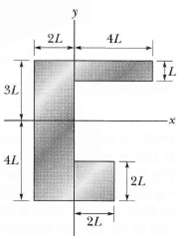
What are?(a) The x coordinate and(b) The y coordinate of the center of mass for the uniform plate shown in Figure if L =5.0cm?
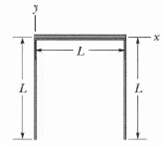
In Figure, three uniform thin rods, each of length L = 22cm, form an inverted U. The vertical rods each have a mass of 14g; the horizontal rod has a mass of 42g. What are?(a) The x coordinate and(b) The y coordinates of the system??s center ofmass?
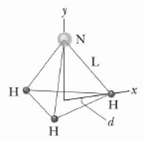
In the ammonia (NH3) molecule of Figure, three hydrogen (H) atoms form an equilateral triangle, with the center of the triangle at distance d = 9.40 x 10⁻¹¹ m from each hydrogen atom. The nitrogen (N) atom is at the apex of a pyramid, with the three hydrogen atoms forming the base. The
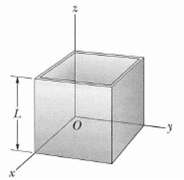
Figure shows a cubical box that has been constructed from uniform metal plate of negligible thickness. The box is open at the top and has edge length L = 40 cm. Find(a) The x coordinates,(b) The y coordinate, and(c) The z coordinates of the center of mass of thebox.
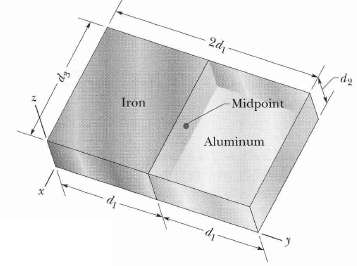
Figure shows a slab with dimensions d1 = 11.0 cm, d2 = 2.80 cm, and d3 = 13.0 cm. Half the slab consists of aluminum (density = 2.70 glcm3) and half consists of iron (density = 7.85 g/cm3).What are(a) The x coordinates,(b) The y coordinate, and(c) The e coordinates of the slab's center ofmass?
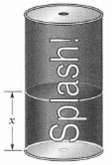
A uniform soda can of mass 0.140 kg is 12.0 cm tall and filled with 1.3l kg of soda (Figure).Then small holes are drilled in the top and bottom (with negligible loss of metal) to drain the soda. What is the height h of the com of the can and contents?(a) Initially and(b) After the can loses all the
A big olive (m = 0.50 kg) lies at the origin of an xy coordinate system, and a big Brazil nut (M = 1.5 kg) lies at the point (1.0, 2.0) m. At t = 0, a force Fo = (2.0i + 3.0j) N begins to act on the olive, and a force Fn = (– 3.0i - 2.0i) N begins to act on the nut. In unit-vector notation, what
Two skaters, one with mass 65 kg and the other with mass 40 kg, stand on an ice rink holding a pole of length 10 m and negligible mass. Starting from the ends of the pole, the skaters pull themselves along the pole until they meet. How far does the 40 kg skater move?
A stone is dropped at t - 0. A second stone, with twice the mass of the first, is dropped from the same point at t = 100ms. (a) How far below the release point is the center of mass of the two stones at t = 300 ms? (Neither stone has yet reached the ground.) (b) How fast is the center of mass of
A 1000 kg automobile is at rest at a traffic signal. At the instant the light turns green, the automobile starts to move with a constant acceleration of 4.0m/s2. At the same instant a 2000 kg truck, traveling at a constant speed of 8.0 m/s, overtakes and passes the automobile. (a) How far is the
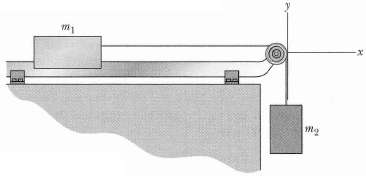
Figure shows an arrangement with an air track, in which a cart is connected by a cord to a hanging block. The cart has mass m1 = 0.600kg and its center is initially at xy coordinates (?? 0.500 m, 0m); the block has mass m2 = 0.400 kg, and its center is initially at xy coordinates (0, ?? 0.100 m).
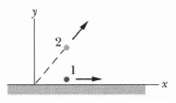
In Figure two particles are launched from the origin of the coordinate system at time t = 0. Particle 1 of mass m1 = 5.00g is shot directly along the x axis on a frictionless floor, with constant speed 10.0m/s. Particle 2 of mass m2 = 3.00g is shot with a velocity of magnitude 20.0m/s, at an upward
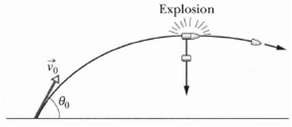
A shell is shot with an initial velocity vo of 20 m/s, at an angle of ?0 = 60o with the horizontal. At the top of the trajectory, the shell explodes into two fragments of equal mass (Figure). One fragment, whose speed immediately after the explosion is zero, falls vertically. How far from the gun
Ricardo, of mass 80 kg, and Carmelita, who is lighter, are enjoying Lake Merced at dusk in a 30 kg canoe. When the canoe is at rest in the placid water, they exchange seats, which are 3.0 m apart and symmetrically located with respect to the canoe's center. If the canoe moves 40 cm horizontally
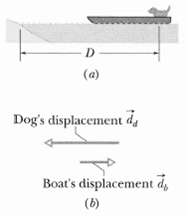
In Figure a, a 4.5 kg dog stands on an 18 kg flatboat at distance D = 6.1 m from the shore. It walks 2.4 m along the boat toward shore and then stops. Assuming no friction between the boat and the water, find how far the dog is then from the shore.
A 0.70 kg ball moving horizontally at 5.0 m/s strikes a vertical wall and rebounds with speed 2.0 m/s. What is the magnitude of the change in its linear momentum?
A 2100 kg truck traveling north at 41 km/h turns east and accelerates to 51 km/h. (a) What is the change in the truck's kinetic energy? What are the (b) Magnitude and(c) Direction of the change in its momentum?
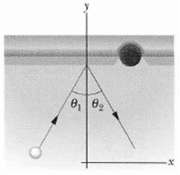
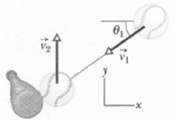
Figure gives an overhead view of the path taken by a 0.1-65 kg cue ball as it bounces from a rail of a pool table. The ball's initial speed is 2.00 m/s, and the angle ?1 is 30.0o. The bounce reverses the y component of the ball's velocity but does not alter the -r component.What are?(a) Angle ?2
A 0.30 kg softball has a velocity of 15 m/s at an angle of 35o below the horizontal just before making contact with the bat. What is the magnitude of the change in momentum of the ball while in contact with the bat if the ball leaves with a velocity of?(a) 20 m/s, vertically downward, and(b) 20
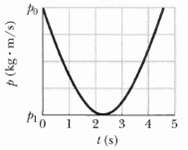
At time t = 0, a ball is struck at ground level and sent over level ground. Figure gives momentum p versus t during the flight (p0 = 6.0 kg ∙ m/s and p1 = 4.0 kg ∙ m/s). At what initial angle is the ball launched?
A force in the negative direction of an x axis is applied for 27 ms to a 0.40 kg ball initially moving at 14 m/s in the positive direction of the axis. The force varies in magnitude, and the impulse has magnitude 32.4 N ∙ s. What are the balls? (a) Speed and (b) Direction of travel just
In a common but dangerous prank, a chair is pulled away as a person is moving downward to sit on it, causing the victim to land hard on the floor. Suppose the victim falls by 0.50 m, the mass that moves downward is 70 kg, and the collision on the floor lasts 0.082 s. What are the magnitudes of
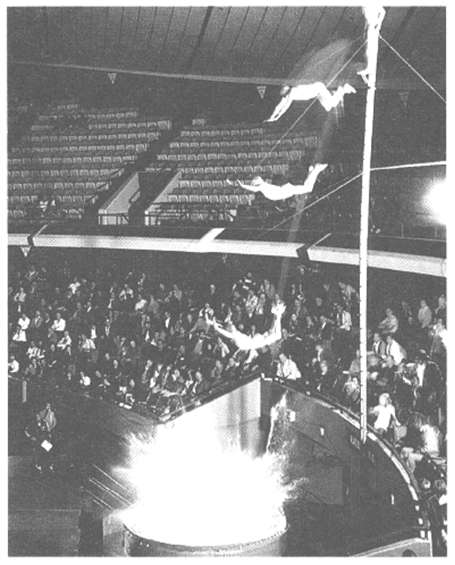
Until his seventies, Henri LaMothe (Figure) excited audiences by belly-flopping from a height of 12 m into 30 cm of water. Assuming that he stops just as he reaches the bottom of the water and estimating his mass, flnd the magnitude of the impulse on him from thewater.
In February 1955, a paratrooper fell 370 m from an airplane without being able to open his chute but happened to land in snow, suffering only minor injuries. Assume that his speed at impact was 56 m/s (terminal speed), that his mass (including gear) was 85 kg, and that the magnitude of the force on
A 1.2 kg ball drops vertically onto a floor, hitting with a speed of 25 m/s. It rebounds with an initial speed of 10 m/s. (a) What impulse acts on the ball during the contact? (b) If the ball is in contact with the floor for 0.020 s, what is the magnitude of the average force on the floor from the
In tae-kwon-do, a hand is slammed down onto a target at a speed of 13 m/s and comes to a stop during the 5.0 ms collision. Assume that during the impact the hand is independent of the arm and has a mass of 0.70 kg. What are the magnitudes of the (a) Impulse and (b) Average force on the hand from
Suppose a gangster sprays Superman's chest with 3 g bullets at the rate of 100bullets/min and the speed of each bullet is 500 m/s. Suppose too that the bullets rebound straight back with no change in speed. What is the magnitude of the average force on Superman's chest?
A 5.0kg toy car can move along an x axis; Figure gives Fx of the force acting on the car, which begins at rest at time t = 0. The scale on the Fx axis is set by Fxs, = 5.0 N. In unit-vector notation, what is P at (a) t = 4.0 s and (b) t = 7 .0 s, and (c) What is v at t = 9.0 s?
Figure shows a 0.300 kg baseball just before and just after it collides with a bat. Just before, the ball has velocity v1 of magnitude 12.0 m/s and angle ?1 = 35.0o. Just after, it is traveling directly upward with velocity v2 of magnitude 10.0 m/s. The duration of the collision is 2.00 ms, what
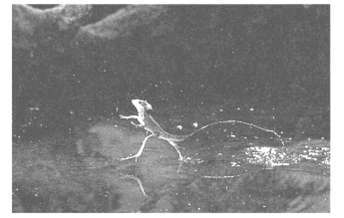
Basilisk lizards can run across the top of a water surface (Figure). With each step, a hzard first slaps its foot against the water and then pushes it down into the water rapidly enough to form an air cavity around the top of the foot. To avoid having to pull the foot back up against water drag in
Jumping up before the elevator hits after the cable snaps and the safety system fails, an elevator cab free-falls from a height of 36 m. During the collision at the bottom of the elevator shaft, a 90 kg passenger is stopped in 5.0 ms. (Assume that neither the passenger nor the cab reboundr.) What
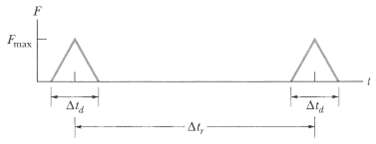
Two average forces. A steady stream of.0.250 kg snowballs is shot perpendicularly into a wall at a speed of 4.00 m/s. Each ball sticks to the wall. Figure gives the magnitude F of the force on the wall as a function of time t for two of the snowball impacts. Impacts occur with a repetition time
A soccer player kicks a soccer ball of mass 0.45kg that is initially at rest. The player’s foot is in contact with the ball for 3.0 x 10 – 3s, and the force of the kick is given F(t) = [(6.0 x 10⁶)t – (2.0 x 10⁹) t2]N for 0 < t < 3.0 x 10⁻³ s, where t is in seconds. Find the magnitudes of (a)
In the overhead view of Figure, a 300 g ball with a speed y of 6.0 m/s strikes a wall at an angle θ of 30o and then rebounds with the same speed and angle. It is in contact with the wall for 10ms. In unit-vector notation, what are? (a) The impulse on the ball from the wall and (b) The
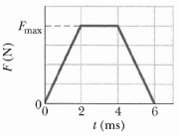
Figure shows an approximate plot of force magnitude F versus time t during the collision of a 58g super ball with a wall. The initial velocity of the ball is 34 m/s perpendicular to the wall; the ball rebounds directly back with approximately the same speed, also perpendicular to the wall. What is
A 0.25 kg puck is initially stationary on an ice surface with negligible friction. At time t = 0, a horizontal force begins to move the puck. The force is given by F = 02.0 – 3.00t2)i, with F in Newton’s and t in seconds, and it acts until its magnitude is zero. (a) What is the magnitude of the
A 91 kg man lying on a surface of negligible friction shoves a 68 g stone away from himself, giving it a speed of 4.0 m/s. What speed does the man acquire as a result?
A space vehicle is traveling at 4300 km/h relative to Earth when the exhausted rocket motor (mass 4m) is disengaged and sent backward with a speed of 82 km/h relative to the command module (mass m).What is the speed of the command module relative to Earth just after the separation?
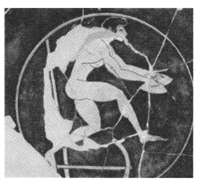
In the Olympiad of 708B.C, some athletes competing in the standing long jump used handheld weights called halters to lengthen their jumps (Figure). The weights were swung up in front just before liftoff and then swung down and thrown backward during the flight. Suppose a modern 78 kg long jumper
A 4.0 kg mess kit sliding on a frictionless surface explodes into two 2.0kg parts: 3.0 m/s, due north, and 5.0 m/s, 30o north of east. What is the original speed of the mess kit?
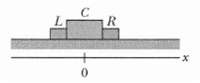
Figure shows a two-ended "rocket" that is initially stationary on a frictionless floor, with its center at the origin of an x axis. The rocket consists of a central block C (of mass M = 6.00 kg) and blocks L and R (each of mass m = 2.00 kg) on the left and right sides. Small explosions can shoot
An object, with mass m and speed v relative to an observer, explodes into two pieces, one three times as massive as the other; the explosion takes place in deep space. The less massive piece stops relative to the observer. How much kinetic energy is added to the system during the explosion, as
A vessel at rest at the origin of an xy coordinate system explodes into three pieces. Just after the explosion, one piece, of mass m, moves with velocity (-30 m/s)i and a second piece, also of mass ffi, moves with velocity (-30 m/s)i. The third piece has mass 3m.Just after the explosion, what are
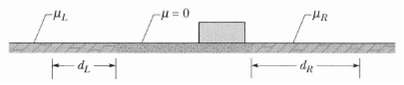
In Figure, a stationary block explodes into two pieces L and R that slide across a frictionless floor and then into regions with friction, where they stop. Piece L, with a mass of 2.0kg, encounters a coefficient of kinetic friction ?L = 0.40 and slides to a stop in distance dL = 0.15 m. Piece R
A 20.0 kg body is moving through space in the positive direction of an x axis with a speed of 200 m/s when, due to an internal explosion, it breaks into three parts. One part, with a mass of 10.0 kg, moves away from the point of explosion with a speed of 100 m/s in the positive y direction. A
Particle A and particle B arc held together with a compressed spring between them. When they are released, the spring pushes them apart, and they then fly off in opposite directions, free of the spring. The mass of A is 2.00 times the mass of B, and the energy stored in the spring was 60J.Assume
A bullet of mass 10 g strikes a ballistic pendulum of mass 2.0 kg. The center of mass of the pendulum rises a vertical distance of 12 cm, assuming that the bullet remains embedded in the pendulum, calculate the bullet's initial speed.
A 5.20 g bullet moving at 672 m/s strikes a700 g wooden block at rest on a frictionless surface. The bullet emerges, traveling in the same direction with its speed reduced to 428 m/s.(a) What is the resulting speed of the block? (b) What is the speed of the bullet-block center of mass?
In Anchorage, collisions of a vehicle with a moose are so common that they are referred to with the abbreviation MVC. Suppose a l000 kg car slides into a stationary 500 kg moose on a very slippery a road, with the moose being thrown through the windshield (a common MVC result). (a) What percent of
In the "before" part of Figure, car A (mass 1100 kg) is stopped at a traffic light when it is rear-ended by car B (mass 1400 kg). Both cars then slide with locked wheels until the frictional force from the slick road (with a low μK of 0.13) stops them, at distances dA = 8.2m and dB = 6.1m.
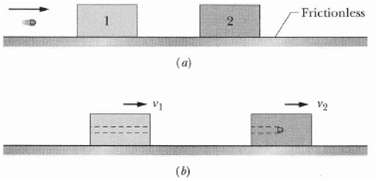
In Figure a, a 3.50 g bullet is fired horizontally at two blocks at rest on a frictionless table. The bullet passes through block 1 (mass 1.20 kg) and embeds itself in block 2 (mass 1.80 kg). The blocks end up with speeds v1 = 0.630 m/s and v1 = 1.40 m/s (Figure b). Neglecting the material removed
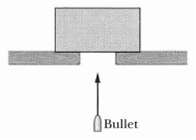
In Figure, a 10 g bullet moving directly upward at 1000 m/s strikes and passes through the center of mass of a 5.0 kg block initially at rest. The bullet emerges from the block moving directly upward at 400 m/s. To what maximum height does the block then rise above its initialposition?
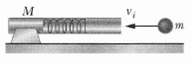
In Figure a ball of mass m = 60 g is shot with speed vi = 22 m/s into the barrel of a spring gun of mass M = 240 g initially at rest on a frictionless surface. The ball sticks in the barrel at the point of maximum compression of the spring. Assume that the increase in thermal energy due to friction
A completely inelastic collision occurs between two balls of wet putty that move directly toward each other along a vertical axis. Just before the collision, one ball, of mass 3.0 kg, is moving upward at 20 m/s and the other ball, of mass 2.0 kg, is moving downward at 12 m/s. How high do the
A 5.0kg block with a speed of 3.0m/s collides with a 10 kg block that has a speed of 2.0 m/s in the same direction. After the collision, the 10 kg block travels in the original direction with a speed of 2.5 m/s. (a) What is the velocity of the 5.0 kg block immediately after the collision? (b) BV
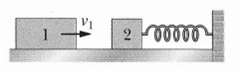
In Figure block 2 (mass 1.0 kg) is at rest on a frictionless surface and touching the end of an un-stretched spring of spring constant 200 N/m. The other end of the spring is fixed to a wall. Block 1 (mass 2.0 kg), traveling at speed v1 = 4.0 m/s, collides with block 2, and the two blocks stick
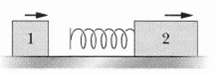
In Figure block 1, (mass 2.0 kg) is moving rightward at 10 m/s and block 2 (mass 5.0 kg) is moving rightward at 3.0 m/s. The surface is frictionless, and a spring with a spring constant of 1120 N/m is blocks collide, the compression the instant the blocks have the mum compressron.
Two titanium spheres approach each other head-on with the same speed and collide elastically. After the collision, one of the spheres whose mass is 300 g, remains at rest.(a) What is the mass of the other sphere?(b) What is the speed of the two-sphere center of mass if the initial speed of each
A cart with mass 340 g moving on a frictionless linear air track at an initial speed of l- .2m/s undergoes an elastic collision with an initially stationary cart of unknown mass. After the collision, the first cart continues in its original direction at 0.66 m/s.(a) What is the mass of the second
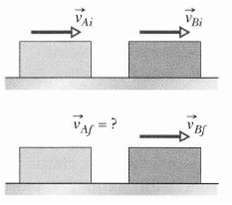
In Figure block A (mass 1.6 kg) slides into block B (mass 2.4 kg), along a frictionless surface. The directions of three velocities before (i) and after (f) the collision are indicated; the corresponding speeds are vAi = 5.5 m/s, vBi =2.5 m/s, and vBf = 4.9 m/s. What are the (a) Speed and (b)
A body of mass 2.0 kg makes an elastic collision with another body at rest and continues to move in the original direction but with one-fourth of its original speed.(a) What is the mass of the other body?(b) What is the speed of the two-body center of mass if the initial speed of the 2.0 kg body
Block 1, with mass m1 and speed 4.0 m/s, slides along an x axis on a frictionless floor and then undergoes a onedimensional elastic collision with stationary blo ck 2, with mass tnz: 0.40m1. The two blocks then slide into a region where the coefflcient of kinetic friction is 0.50; there they stop.
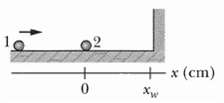
In Figure, particle 1 of mass m1 = 0.30 kg slides rightward along an x axis on a frictionless floor with a speed of 2.0m/s. When it reaches x = 0, it undergoes a one-dimensional classtic collision with stationary particle 2 of mass m2 = 0.40kg. When particle 2 then reaches a wall at xw = 70cm, it
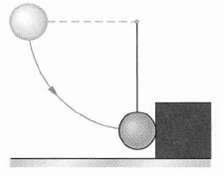
A steel ball of mass 0.500 kg is fastened to a cord that is 70.0 cm long and fixed at the far end. The ball is then released when the cord is horizontal (Figure). At the bottom of its path, the ball strikes a 2.50 kg steel block initially at rest on a frictionless surface. The collision is elastic.
Block 1 of mass ml slides along a frictionless floor and into a one-dimensional elastic collision with stationary block 2 of mass m2 = 3m1. Prior to the collision, the center of mass of the two-block system had a speed of 3.00 m/s, afterward what are the speeds of?(a) The center of mass and(b)
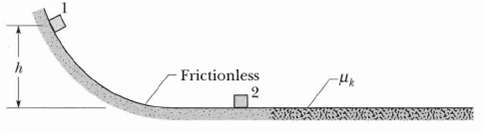
In Figure block 1 of mass m1 slides from rest along a frictionless ramp from height h = 2.50 m and then collides with stationary block 2, which has mass m2 = 00m1. After the collision, block 2 slides into a region where the coefficient of kinetic friction μk is 0.500 and comes to a stop in
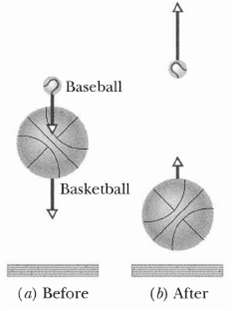
A small ball of mass m is aligned above a larger ball of mass M = 0.63 kg (with a slight separation, as with the baseball and basketball of Figure a), and the two are dropped simultaneously from a height of h = 1.8 m. (Assume the radius of each ball is negligible relative to h.) (a) If the larger
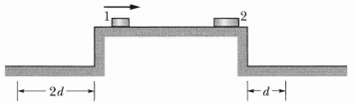
In Figure puck 1, of mass m1 = 0.20 kg is sent sliding across a frictionless lab bench, to undergo a one-dimensional elastic collision with stationary puck 2. Puck 2 then slides off the bench and lands a distance d from the base of the bench. Puck 1 rebounds from the collision and slides off the
A projectile proton with a speed of 500 m/s collides elastically with a target proton initially at rest. The two protons then move along perpendicular paths, with the projectile path at 60' from the original direction. After the collision, what are the speeds of(a) The target proton and(b) The
Two 2.0kg bodies, A and B, collide. The velocities before the collision are vA = (15i + 30i) m/s and vA = (-10i + 5.0j) m/s. After the collision, vA = (-5.0i + 20j)m/s what are?(a) The final velocity of B and(b) The change in the total kinetic energy (including sign)?
In Figure projectile particle I is an alpha particle and target particle 2 is an oxygen nucleus. The alpha particle is scattered at angle θl = 64.0o and the oxygen nucleus recoils with speed 1.20 x 10⁵ m/s and at angle θl = 51.0o. In atomic mass units, the mass of the alpha particle is 4.00 u and
Ball B, moving in the positive direction of an x axis at speed v, collides with stationary ball A at the origin. A and B have different masses, after the collision, B moves in the negative direction of the y axis at speed v/2.(a) In what direction does A move?(b) Show that the speed of A cannot be
After a completely inelastic collision, two objects of the same mass and same initial speed move away together at half their initial speed. Find the angle between the initial velocities of the objects.
Consider a rocket that is in deep space and at rest relative to an inertial reference frame. The rocket's engine is to be fired for a certain interval. What must be the rocket's mass ratio (ratio of initial to final mass) over that interval if the rocket's original speed relative to the inertial
A rocket that is in deep space and initially at rest relative to an inertial reference frame has a mass of 2.55 x 10⁵ kg, of which 1.81 x 10⁵ kg is fuel. The rocket engine is then fired for 250 s while fuel is consumed at the rate of 480 kg/s. The speed of the exhaust products relative to the
A 6090 kg space probe moving nose-first toward Jupiter at 105 m/s relative to the Sun fires its rocket engine, ejecting 80.0 kg of exhaust at a speed of 253 m/s relative to the space probe. What is the final velocity of the probe?
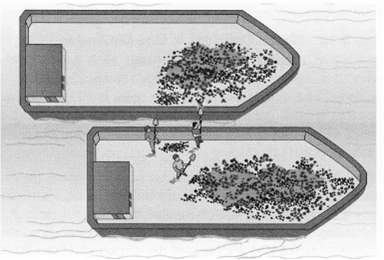
In Figure two long barges are moving in the same direction in still water, one with a speed of 10 km/h and the other with a speed of 20 km/h. While they are passing each other, coal is shoveled from the slower to the faster one at a rate of 1000 kg/min. How much additional force must be provided by
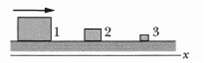
Speed amplifier. In Figure block 1 of mass m1 slides along an x axis on a frictionless floor with a speed of v1i: = 4.00 m/s. Then it undergoes a one-dimensional elastic collision with stationary block 2 of mass m2 = 0.500m1. Next, block 2 undergoes a one-dimensional elastic collision with
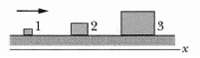
Speed amplifier. In Figure block 1 of mass m1 slides along an x axis on a frictionless floor at speed 4.00 m/s. Then it undergoes a one-dimensional elastic collision with stationary block 2 of mass m2 = 2.00m1 Next block 2 undergoes a one-dimensional elastic collision with stationary block 3 of
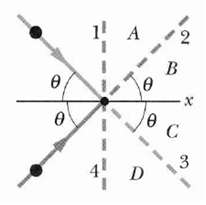
Figure shows an overhead view of two particles sliding at constant velocity over a frictionless surface. The particles have the same mass and the same initial speed v = 4.00 m/s, and they collide where their paths intersect. An x axis is arranged to bisect the angle between their incoming paths, so
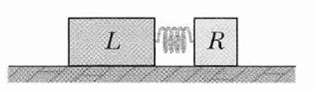
Relative" is an important word. In Figure block L of mass mL = 1.00 kg and block R of mass mR = 0.500 kg are held in place with a compressed spring between them. When the blocks are released, the spring sends them sliding across a frictionless floor. (The spring has negligible mass and falls to the
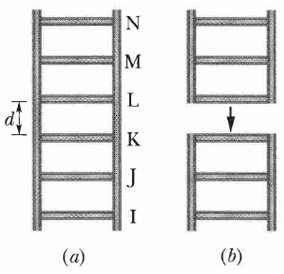
Pancake collapse of a tall building. In the section of a tall building shown in Figure a, the infrastructure of any given floor K must support the weight W of all higher floors. Normally the infrastructure is constructed with a safety factor s so that it can withstand an even greater downward force
A railroad car moves under a grain elevator at a constant speed of 3.20m/s. Grain drops into the car at the rate of 540 kg/min. What is the magnitude of the force needed to keep the car moving at constant speed if friction is negligible?
Tyrannosaurus rex may have known from experience not to run particularly fast because of the danger of tripping, in which case its short forearms would have been no help in cushioning the fall. Suppose a T. rex of mass m trips while walking, toppling over, with its center of mass falling freely a
A man (weighing 915 N) stands on a long railroad flat-car (weighing 2415 N) as it rolls at I8.2 m/s in the positive direction of an x axis, with negligible friction. Then the man runs along the flatcar in the negative x direction at 4.00 m/s relative to the flatcar. What is the resulting increase
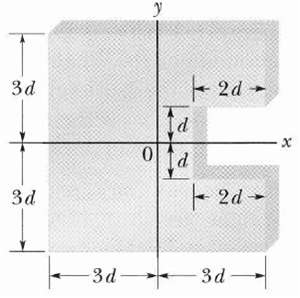
Figure shows a uniform square plate of edge length 6d = 6.0 m from which a square piece of edge length 2d has been removed. What are? (a) The x coordinate and (b) The y coordinates of the center of mass of the remaining piece?
The last stage of a rocket, which is traveling at a speed of 7600m/s, consists of two parts that are clamped together: a rocket case with a mass of 290.0 kg and a payload capsule with a mass of 150.0 kg. When the clamp is released, a compressed spring causes the two parts to separate with a
An object is tracked by a radar station and found to have a position vector given by r = (3500 – 160t)i +2700j + 300k, with r in meters and t in seconds, the radar station's x axis points east, its y axis north, and its z axis vertically up. If the object is a 250 kg meteorological missile, what
A pellet gun fires ten 2.0 g pellets per second with a speed of 500 m/s. The pellets are stopped by a rigid wall. What are?(a) The magnitude of the momentum of each pellet,(b) The kinetic energy of each pellet, and(c) The magnitude of the average force on the wall from the stream of pellets?(d) If
A body is traveling at2.0 m/s along the positive direction of an x axis; no net force acts on the body. An internal explosion separates the body into two parts, each of 4.0 kg, and increases the total kinetic energy by 16 J. The forward part continues to move in the original direction of motion.
A 1400 kg car moving at 5.3m/s is initially traveling north along the positive direction of a y axis. After completing a 90o right-hand turn rn 4.6 s, the inattentive operator drives into a tree, which stops the car in 350ms. In unit-vector notation, what is the impulse on the car?(a) Due to the
A spacecraft is separated into two parts by detonating the explosive bolts that hold them together. The masses of the parts are 1200 kg and 1800 kg; the magnitude of the impulse on each part from the bolts is 300 N ∙ s. With what relative speed do the two parts separate because of the detonation?
A ball having a mass of 1-50 g strikes a wall with a speed of 5.2m/s and rebounds with only 50% of its initial kinetic energy.(a) What is the speed of the ball immediately after rebounding?(b) What is the magnitude of the impulse on the wall from the ball?(c) If the ball is in contact with the wall
An old Chrysler with mass 2400 kg is moving along a straight stretch of road at 80 km/h. It is followed by a Ford with mass 1600 kg moving at 60 km/h. How fast is the center of mass of the two cars moving?
A railroad freight car of mass 3.18 x 10⁴ kg collides with a stationary caboose car. They couple together, and 27.0% of the initial kinetic energy is transferred to thermal energy, sound, vibrations, and so on. Find the mass of the caboose.
Two blocks of masses 1.0kg and 3.0 kg are connected by a spring and rest on a frictionless surface. They are given velocities toward each other such that the 1.0 kg block travels initially at 1.7m/s toward the center of mass, which remains at rest. What is the initial speed of the other block?
A 75 kg man is riding on a 39 kg cart traveling at a velocity of 2.3m/s. He jumps off with zero horizontal velocity relative to the ground. What is the resulting change in the cart's velocity, including sign?
A certain radioactive (parent) nucleus transforms to a different (daughter) nucleus by emitting an electron and a neutrino. The parent nucleus was at rest at the origin of an xy coordinate system. The electron moves away from the origin with linear momentum (–1.2 x 10⁻²² kg ∙ m/s) i; the
In the arrangement of Figure billiard ball 1 moving at a speed of 2.2 m/s undergoes a glancing collision with identical billiard ball 2 that is at rest. After the collision, ball 2 moves at speed 1.1 m/s, at an angle of θ2 = 60o. What are?(a) The magnitude and(b) The direction of the velocity of
A rocket is moving away from the solar system at a speed of 6.0 x 10³ m/s. It fires its engine, which ejects exhaust with a speed of 3.0 x 10³ m/s relative to the rocket. The mass of the rocket at this time is 4.0 x 10⁴ kg, and its acceleration is 2.0 m/s2.(a) What is the thrust of the engine?(b)
Showing 5000 - 5100
of 21795
First
44
45
46
47
48
49
50
51
52
53
54
55
56
57
58
Last
Step by Step Answers

 Get 50% OFF
Claim Now
Get 50% OFF
Claim Now