New Semester
Started
Get
50% OFF
Study Help!
--h --m --s
Claim Now
Question Answers
Textbooks
Find textbooks, questions and answers
Oops, something went wrong!
Change your search query and then try again
S
Books
FREE
Study Help
Expert Questions
Accounting
General Management
Mathematics
Finance
Organizational Behaviour
Law
Physics
Operating System
Management Leadership
Sociology
Programming
Marketing
Database
Computer Network
Economics
Textbooks Solutions
Accounting
Managerial Accounting
Management Leadership
Cost Accounting
Statistics
Business Law
Corporate Finance
Finance
Economics
Auditing
Tutors
Online Tutors
Find a Tutor
Hire a Tutor
Become a Tutor
AI Tutor
AI Study Planner
NEW
Sell Books
Search
Search
Sign In
Register
study help
business
exploring psychology
Exploring Psychology 10th Edition David G. Myers, C Nathan Dewall - Solutions
2-14 How do twin and adoption studies help us understand the effects and interactions of nature and nurture?
2-13 What are chromosomes, DNA, genes, and the human genome? How do behavior geneticists explain our individual differences?
• Match the following terms to the correct explanation 1. Epigenetics 2. Behavior genetics a. Study of the relative effects of our genes and our environ- ment on our behavior. b. Study of environmental factors that affect how our genes are expressed.
• When the mother’s egg and the father’s sperm unite, each contributes 23 ____________.
• Put the following cell structures in order from smallest to largest: nucleus, gene, chromosome
10. Damage to the brain’s right hemisphere is most likely to reduce a person’s ability toa. recite the alphabet rapidly.b. make inferences.c. understand verbal instructions.d. solve arithmetic problems.
9. Studies of people with split brains and brain scans of those with undivided brains indicate that the left hemisphere excels ina. processing language.c. making inferences.b. visual perceptions.d. neurogenesis.
8. An experimenter fl ashes the word HERON across the visual fi eld of a man whose corpus callosum has been severed. HER is transmitted to his right hemisphere and ON to his left hemisphere. When asked to indicate what he saw, the man says he saw ____________ but points to _____________ .
7. Plasticity is especially evident in the brains ofa. split-brain patients.c. young children.b. young adults.d. right-handed people.
6. The “uncommitted” areas that make up about threefourths of the cerebral cortex are called _____________ ______________.
5. What would it be like to talk on the phone if you didn’t have temporal lobe association areas? What would you hear? What would you understand?
3. Which of the following body regions has the greatest representation in the somatosensory cortex?a. Upper armc. Lipsb. Toesd. All regions are equally represented.
1. If a neurosurgeon stimulated your right motor cortex, you would most likelya. see light.c. feel a touch on the right arm.b. hear a sound.d. move your left leg.
• (1) If we flash a red light to the right hemisphere of a person with a split brain, and flash a green light to the left hemisphere, will each observe its own color? (2) Will the person be aware that the colors differ? (3) What will the person verbally report seeing?
• Why are association areas important?
• Our brain’s _____________cortex registers and processes body touch and movement sensations. The ____________cortex controls our voluntary movements.
7. The neural structure that most directly regulates eating, drinking, and body temperature is thea. endocrine system.c. hippocampus.b. hypothalamus.d. amygdala.
5. Two parts of the limbic system are the amygdala and thea. cerebral hemispheres.c. thalamus.b. hippocampus.d. pituitary.
3. The lower brain structure that governs arousal is thea. spinal cord.c. reticular formation.b. cerebellum.d. medulla.
2. The thalamus functions as aa. memory bank.c. breathing regulator.b. balance center.d. sensory control center.
1. The part of the brainstem that controls heartbeat and breathing is thea. cerebellum.c. cortex.b. medulla.d. thalamus.
2-8 What structures make up the brainstem, and what are the functions of the brainstem, thalamus, reticular formation, and cerebellum?
• Electrical stimulation of a cat’s amygdala provokes angry reactions. Which autonomic nervous system division is activated by such stimulation?
• In what brain region would damage be most likely to (1) disrupt your ability to skip rope?(2) disrupt your ability to hear and taste? (3) perhaps leave you in a coma? (4) cut off the very breath and heartbeat of life?
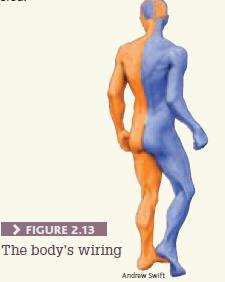
• Nerves from the left side of the brain are mostly linked to the _________ side of the body, and vice versa. > FIGURE 2.13 The body's wiring Andrew Swift
• Match the scanning technique with the correct description. Technique: 1. fMRI scan 2. PET scan 3. MRI scan Description: a. tracks radioactive glucose to reveal brain activity. b. tracks successive images of brain tissue to show brain function. c. uses magnetic fields and radio waves to show
10. The secrete(s)epinephrine and norepinephrine, helping to arouse the body during times of stress.
9. The most infl uential endocrine gland, known as the master gland, is thea. pituitary.c. thyroid.b. hypothalamus.d. pancreas.
8. The neurons of the spinal cord are part of the nervous system.
7. The sympathetic nervous system arouses us for action and the parasympathetic nervous system calms us down.Together, the two systems make up the nervous system.
6. The autonomic nervous system controls internal functions, such as heart rate and glandular activity.The word autonomic meansa. calming.c. self-regulating.b. voluntary.d. arousing.
5. Endorphins are released in the brain in response toa. morphine or heroin.b. pain or vigorous exercise.c. the all-or-none response.d. all of the above.
4. In a sending neuron, when an action potential reaches an axon terminal, the impulse triggers the release of chemical messengers called .
3. Regarding a neuron’s response to stimulation, the intensity of the stimulus determinesa. whether or not an impulse is generated.b. how fast an impulse is transmitted.c. how intense an impulse will be.d. whether reuptake will occur.
2. The tiny space between the axon of one neuron and the dendrite or cell body of another is called thea. axon terminal.c. synaptic gap.b. branching fi ber.d. threshold.
1. The neuron fi ber that passes messages through its branches to other neurons or to muscles and glands is the .
• How are the nervous and endocrine systems alike, and how do they differ
• What bodily changes does your ANS direct before and after you give an important speech?
• Match the type of neuron to its description 1. Motor neurons 2. Sensory neurons 3. Interneurons Description a. carry incoming messages from sensory receptors to the CNS. b. communicate within the CNS and process information between incoming and outgoing messages. c. carry outgoing messages from
Curare poisoning paralyzes its victims by blocking ACh receptors involved in muscle movements. Morphine mimics endorphin actions. Which is an agonist, and which is an antagonist?
• Serotonin, dopamine, and endorphins are all chemical messengers called .?
• What is reuptake? What two other things can happen to excess neurotransmitters after a neuron reacts?
• What happens in the synaptic gap?
• How does our nervous system allow us to experience the difference between a slap and a tap on the back?
• When a neuron fires an action potential, the information travels through the axon, the dendrites, and the cell body, but not in that order. Place these three structures in the correct order.
15. In defending their experimental research with animals, psychologists have noted thata. animal research is subject to codes of ethics that ensure the animals’ health, safety, and comfort.b. animal experimentation sometimes helps animals as well as humans.c. advancing the well-being of humans
14. The laboratory environment is designed toa. exactly re-create the events of everyday life.b. re-create psychological forces under controlled conditions.c. provide a safe place.d. minimize the use of animals and humans in psychological research.
13. A researcher wants to determine whether noise level affects workers’ blood pressure. In one group, she varies the level of noise in the environment and records participants’ blood pressure. In this experiment, the level of noise is the .
12. In a double-blind procedure,a. only the participants know whether they are in the control group or the experimental group.b. experimental and control group members will be carefully matched for age, sex, income, and education level.c. neither the participants nor the researchers know who is in
11. To test the effect of a new drug on depression, we randomly assign people to control and experimental groups.Those in the control group take a pill that contains no medication. This is a .
10. To explain behaviors and clarify cause and effect, psychologists use .
9. Here are some recently reported correlations, with interpretations drawn by journalists. Knowing just these correlations, can you come up with other possible explanations for each of these?a. Alcohol use is associated with violence. (One interpretation:Drinking triggers or unleashes aggressive
8. Knowing that two events are correlated providesa. a basis for prediction.b. an explanation of why the events are related.c. proof that as one increases, the other also increases.d. an indication that an underlying third factor is at work.
7. A study fi nds that the more childbirth training classes women attend, the less pain medication they require during childbirth. This fi nding can be stated as a(positive/negative) correlation.
6. You wish to survey a group of people who truly represent the country’s adult population. The best way to ensure this is to question a sample of the population, in which each member has an equal chance of inclusion.
5. Which of the following is NOT one of the descriptive methods psychologists use to observe and describe behavior?a. A case studyc. Correlational researchb. Naturalistic observationd. A phone survey
4. Theory-based predictions are called .
3. How can critical thinking help you evaluate claims in the media, even if you’re not a scientifi c expert on the issue?
2. As scientists, psychologistsa. do not disclose their methods, so as to avoid other scientists’ replicating their research.b. assume the truth of articles published in leading scientifi c journals.c. discount evidence that competes with established assumptions.d. are willing to ask questions
1-14 How can psychological principles help you learn and remember?
1-13 Why do psychologists study animals, and what ethical guidelines safeguard human and animal research participants?How do human values infl uence psychology?
1-12 Can laboratory experiments illuminate everyday life?
1-11 What are the characteristics of experimentation that make it possible to isolate cause and effect?
1-10 What are positive and negative correlations, and why do they enable prediction but not cause-effect explanation?
1-9 How do psychologists use case studies, naturalistic observations, and surveys to observe and describe behavior, and why is random sampling important?
1-8 How do theories advance psychological science?
What does the acronym SQ3R stand for?
• The ________ _______describes the enhanced memory that results from repeated retrieval (as in self-testing) rather than from simple rereading of new information
• How are animal and human research participants protected?
Why, when testing a new drug to control blood pressure, would we learn more about its effectiveness from giving it to half of the participants in a group of 1000 than to all 1000 participants?
• In the experiment on the effects of perceived ethnicity on availability of rental housing, what was the independent variable?The dependent variable?
• In two recent studies, sexual hook-ups positively correlated with college women’s experiencing depression; delaying sexual intimacy correlated with positive outcomes such as greater relationship satisfaction and stability (Fielder et al., 2014; Willoughby et al., 2014). Do these findings mean
• Indicate whether each association is a positive correlation or a negative correlation.1. The more children and youth used various media, the less happy they were with their lives (Rideout et al., 2010).2. The less sexual content teens saw on TV, the less likely they were to have sex (Collins et
• What is an unrepresentative sample, and how do researchers avoid it?
• Why is replication important?
• Why is replication important?
• What does a good theory do?
• Why, after friends start dating, do we often feel that we knew they were meant to be together?
8. A psychologist conducting basic research to expand psychology’s knowledge base would be most likely toa. design a computer screen with limited glare and assess the effect on computer operators’ eyes after a day’s work.b. treat older people who are overcome by depression.c. observe 3- and
7. A mental health professional with a medical degree who can prescribe medication is a .
6. A psychologist treating emotionally troubled adolescents at a local mental health agency is most likely to be a(n)a. research psychologist.b. psychiatrist.c. industrial-organizational psychologist.d. clinical psychologist.
5. “Nurture works on what nature endows.” Describe what this means, using your own words.
4. Nature is to nurture asa. personality is to intelligence.b. biology is to experience.c. intelligence is to biology.d. psychological traits are to behaviors.
3. In the early twentieth century, redefi ned psychology as “the science of observable behavior.”a. John B. Watsonc. William Jamesb. Abraham Maslowd. Sigmund Freud
2. William James would be considered a(n) .Wilhelm Wundt and Edward Titchener would be considered .a. functionalist; structuralistsb. structuralist; functionalistsc. evolutionary theorist; structuralistsd. functionalist; evolutionary theorists
1. In 1879, in psychology’s fi rst experiment, and his students measured the time lag between hearing a ball hit a platform and pressing a key.
1-6 What are psychology’s main subfi elds?
1-5 What are psychology’s levels of analysis and related perspectives?
1-4 How has our understanding of biology and experience, culture and gender, and human fl ourishing shaped contemporary psychology?
1-3 How did psychology continue to develop from the 1920s through today?
1-2 What were some important milestones in psychology’s early development?
1-1 How do the scientifi c attitude’s three main components relate to critical thinking?
Showing 1200 - 1300
of 1292
1
2
3
4
5
6
7
8
9
10
11
12
13
Step by Step Answers

 Get 50% OFF
Claim Now
Get 50% OFF
Claim Now