New Semester
Started
Get
50% OFF
Study Help!
--h --m --s
Claim Now
Question Answers
Textbooks
Find textbooks, questions and answers
Oops, something went wrong!
Change your search query and then try again
S
Books
FREE
Study Help
Expert Questions
Accounting
General Management
Mathematics
Finance
Organizational Behaviour
Law
Physics
Operating System
Management Leadership
Sociology
Programming
Marketing
Database
Computer Network
Economics
Textbooks Solutions
Accounting
Managerial Accounting
Management Leadership
Cost Accounting
Statistics
Business Law
Corporate Finance
Finance
Economics
Auditing
Tutors
Online Tutors
Find a Tutor
Hire a Tutor
Become a Tutor
AI Tutor
AI Study Planner
NEW
Sell Books
Search
Search
Sign In
Register
study help
business
exploring psychology
Exploring Psychology 10th Edition David G. Myers, C Nathan Dewall - Solutions
1.7-10 How do different reinforcement schedules affect behavior?
1.7-9 How do positive and negative reinforcement differ, and what are the basic types of reinforcers?
1.7-8 Who was Skinner, and how is operant behavior reinforced and shaped?
1.7-7 What is operant conditioning?
1.• Salivating in response to a tone paired with food is a(n) ____________ behavior; pressing a bar to obtain food is a(n) _____________ behavior.
1.• Ethan constantly misbehaves at preschool even though his teacher scolds him repeatedly.Why does Ethan’s misbehavior continue, and what can his teacher do to stop it?
1.• Fill in the blanks below with one of the following terms: positive reinforcement (PR), negative reinforcement (NR), positive punishment (PP), and negative punishment (NP). We have provided the first answer (PR) for you. Give It Take It Away 2. Type of Stimulus Desired (for example, a teen's
1.• People who send spam are reinforced by which schedule? Home bakers checking the oven to see if the cookies are done are on which schedule? Airline frequent-flyer programs that offer a free flight after a certain number of miles of travel are using which reinforcement schedule?
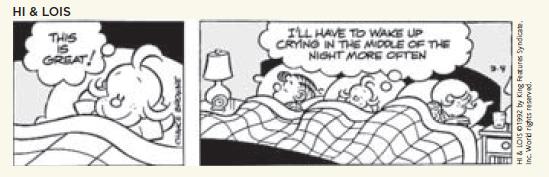
1.• How is operant conditioning at work in this cartoon? HI & LOIS THIS GREAT! I'LL HAVE TO WAKE UP CRYING IN THE MIDDLE OF THE NIGHT MORE OFTEN HI & LOIS 1992 by King Features Syndicate. Inc. World rights reserved.
1.• With classical conditioning, we learn associations between events we _________(do/do not) control. With operant conditioning, we learn associations between our behavior and_____________ (resulting/random) events.
1.6. “Sex sells!” is a common saying in advertising. Using classical conditioning terms, explain how sexual images in advertisements can condition your response to a product.
1.5. After Watson and Rayner classically conditioned Little Albert to fear a white rat, the child later showed fear in response to a rabbit, a dog, and a sealskin coat. This illustratesa. extinction.b. generalization.c. spontaneous recovery.d. discrimination between two stimuli.
1.4. Dogs have been taught to salivate to a circle but not to a square. This process is an example of ____________ .
1.3. In Pavlov’s experiments, the tone started as a neutral stimulus, and then became a(n) ______________ stimulus.
1.2. Two forms of associative learning are classical conditioning, in which the organism associates _______________ , and operant conditioning, in which the organism associates _____________.a. two or more responses; a response and consequenceb. two or more stimuli; two or more responsesc. two or
1.1. Learning is defi ned as “the process of acquiring through experience new and relatively enduring __________ or ____________.”
1.7-6 What have been some applications of Pavlov’s work to human health and well-being? How did Watson apply Pavlov’s principles to learned fears?
1.7-5 Why does Pavlov’s work remain so important?
1.7-4 In classical conditioning, what are the processes of acquisition, extinction, spontaneous recovery, generalization, and discrimination?
1.7-3 Who was Pavlov, and what are the basic components of classical conditioning?
1.7-2 What was behaviorism’s view of learning?
1.7-1 What is learning, and what are some basic forms of learning?
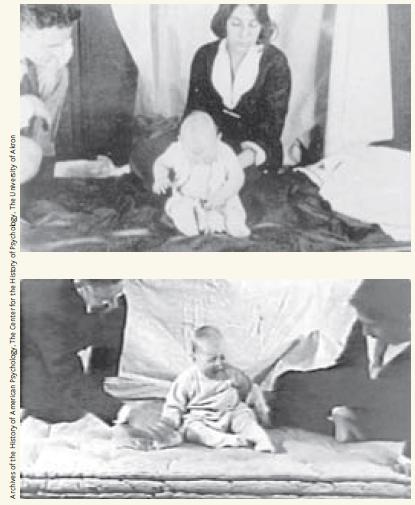
1.• In Watson and Rayner’s experiments, “Little Albert” learned to fear a white rat after repeatedly experiencing a loud noise as the rat was presented. In these experiments, what was the US? The UR? The NS? The CS? The CR? Archives of the History of American Psychology. The Center for the
1.• In slasher movies, sexually arousing images of women are sometimes paired with violence against women. Based on classical conditioning principles, what might be an effect of this pairing?
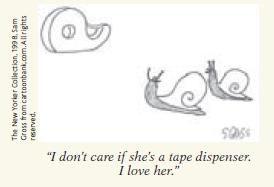
1.• What conditioning principle is influencing the snail’s affections? The New Yorker Collection, 1998. Sam Gross from cartoonbank.com.All rights reserved. "I don't care if she's a tape dispenser. I love her."
1.• The first step of classical conditioning, when an NS becomes a CS, is called _______________.When a US no longer follows the CS, and the CR becomes weakened, this is called ______________.
1.• An experimenter sounds a tone just before delivering an air puff to your blinking eye. After several repetitions, you blink to the tone alone. What is the NS? The US? The UR? The CS?The CR?
1.• Why are habits, such as having something sweet with that cup of coffee, so hard to break?
1.10. Which of the following ESP phenomena is supported by solid, replicable scientifi c evidence? a. Telepathy b. Clairvoyance C. Precognition d. None of these answers
1.9. A food’s aroma can greatly enhance its taste. This is an example of sensory adaptation. b. chemical sensation. C. kinesthesia. d. sensory interaction.
1.8. Why do you feel a little dizzy immediately after a rollercoaster ride?
1.6. We have specialized nerve receptors for detecting which fi ve tastes? How did this ability aid our ancestors?
1.5. How does the biopsychosocial approach explain our experience of pain? Provide examples.
1.4. The gate-control theory of pain proposes thata. special pain receptors send signals directly to the brain.b. pain is a property of the senses, not of the brain.c. small spinal cord nerve fi bers conduct most pain signals, but large-fi ber activity can close access to those pain signals.d. pain
1.6-24 What are the claims of ESP, and what have most research psychologists concluded after putting these claims to the test?
1.6-23 How does sensory interaction infl uence our perceptions, and what is embodied cognition?
1.6-22 How do we sense our body’s position and movement?
1.6-21 In what ways are our senses of taste and smell similar, and how do they differ?
1.6-20 What biological, psychological, and social-cultural infl uences affect our experience of pain? How do placebos, distraction, and hypnosis help control pain?
1.6-19 How do we sense touch?
1.6-18 How do we detect loudness, discriminate pitch, and locate sounds?
1.6-17 How does the ear transform sound energy into neural messages?
1.6-16 What are the characteristics of air pressure waves that we hear as sound?
1.• If an ESP event occurred under controlled conditions, what would be the next best step to confirm that ESP really exists?
1.• Where are kinesthetic receptors and vestibular sense receptors located?
1.• How does our system for sensing smell differ from our sensory systems for touch and taste?
1.• Which of the following has NOT been proven to reduce pain?a. Distractionb. Placebosc. Phantom limb sensationsd. Endorphins
1.Which theory of pitch perception would best explain a symphony audience’s enjoyment of a high-pitched piccolo? How about a low-pitched cello?
1.• The longer the sound waves are, the _____________ (lower/higher) their frequency is and the _____________ (lower/higher) their pitch.
1.• The amplitude of a sound wave determines our perception of _____________ (loudness/pitch).
1.14. Perceiving a tomato as consistently red, despite lighting shifts, is an example ofa. shape constancy.c. a binocular cue.b. perceptual constancy.d. continuity.
1.10. In listening to a concert, you attend to the solo instrument and perceive the orchestra as accompaniment.This illustrates the organizing principle ofa. fi gure-ground.c. grouping.b. shape constancy.d. depth perception.
1.9. Our tendencies to fi ll in the gaps and to perceive a pattern as continuous are two different examples of the organizing principle calleda. interposition.c. shape constancy.b. depth perception.d. grouping.
1.5. Two theories together account for color vision. The Young-Helmholtz trichromatic theory shows that the eye contains ___________, and the opponent- process theory accounts for the nervous system’s having ______________ .a. opposing retinal processes; three pairs of color receptorsb.
1.4. Cones are the eye’s receptor cells that are especially sensitive to __________ light and are responsible for our ______________ vision.a. bright; black-and-whitec. bright; colorb. dim; colord. dim; black-and-white
1.2. The amplitude of a light wave determines our perception ofa. brightness.c. meaning.b. color.d. distance.
1.6-15 What does research on restored vision, sensory restriction, and perceptual adaptation reveal about the effects of experience on perception?
1.6-14 How do perceptual constancies help us construct meaningful perceptions?
1.6-13 How do we use binocular and monocular cues to perceive the world in three dimensions?
1.6-12 How did the Gestalt psychologists understand perceptual organization, and how do fi gure-ground and grouping principles contribute to our perceptions?
1.6-11 How does the brain use parallel processing to construct visual perceptions?
1.6-10 Where are feature detectors located, and what do they do?
1.6-9 How do we perceive color in the world around us?
1.6-8 How do the rods and cones process information, and what is the path information travels from the eye to the brain?
1.6-7 What are the characteristics of the energy that we see as visible light? What structures in the eye help focus that energy?
1.• How do we normally perceive depth?
1.• What do we mean when we say that, in perception, the whole may exceed the sum of its parts?
1.• In terms of perception, a band’s lead singer would be considered ______________ (figure/ground), and the other musicians would be considered _____________ (figure/ground
1.• What are two key theories of color vision? Are they contradictory or complementary? Explain
1.Cats are able to open their ______________ much wider than we can, which allows more light into their eyes so they can see better at night.
1.• Some nocturnal animals, such as toads, mice, rats, and bats, have impressive night vision thanks to having many more ______________ (rods/cones) than ____________(rods/cones) in their retinas. These creatures probably have very poor _________________(color/black-and-white) vision.
1.6. Sensory adaptation helps us focus ona. visual stimuli.b. auditory stimuli.c. constant features of the environment.d. informative changes in the environment.
1.4. Another term for difference threshold is the _________________.
1.1. Sensation is to ______________ as perception is to _____________.a. absolute threshold; difference thresholdb. bottom-up processing; top-down processingc. interpretation; detectiond. grouping; priming 2. The process by which we organize and interpret sensory information is called ____________ .
1.6-6 How do our expectations, contexts, motivation, and emotions infl uence our perceptions?
1.6-5 What is the function of sensory adaptation?
1.6-4 Does subliminal sensation enable subliminal persuasion?
1.6-3 How do absolute thresholds and difference thresholds differ, and what effect, if any, do stimuli below the absolute threshold have on us?
1.6-2 What three steps are basic to all our sensory systems?
1.• Does perceptual set involve bottom-up or top-down processing? Why?
1.• Why is it that after wearing shoes for a while, you cease to notice them (until questions like this draw your attention back to them)?
1.• Using sound as your example, explain how these concepts differ: absolute threshold, subliminal stimulation, and difference threshold.
1.• What is the rough distinction between sensation and perception?
1.6. Which factors have researchers thus far found to be unrelated to the development of our sexual orientation?
1.5-13 What role do social factors play in our sexuality, and how do nature, nurture, and our own choices infl uence gender roles and sexuality?
1.5-12 What are the key criticisms of evolutionary explanations of human sexuality, and how do evolutionary psychologists respond?
1.5-11 How might an evolutionary psychologist explain malefemale differences in sexuality and mating preferences?
1.5-10 What has research taught us about sexual orientation?
1.5-9 What factors infl uence teenagers’ sexual behaviors and use of contraceptives?
1.5-8 How do external and imagined stimuli contribute to sexual arousal?
1.5-7 How can sexually transmitted infections be prevented?
1.5-6 What is the human sexual response cycle, and how do sexual dysfunctions and paraphilias differ?
1.5-5 How do hormones infl uence human sexual motivation?
1.• What are the three main criticisms of the evolutionary explanation of human sexuality?
1.• How do evolutionary psychologists explain sex differences in sexuality?
1.• Which THREE of the following five factors have researchers found to have an effect on sexual orientation?a. A domineering motherd. A distant or ineffectual fatherb. The size of certain cell clusters ine. For men, having multiple older the hypothalamus biological brothersc. Prenatal hormone
1.• Which THREE of the following five factors contribute to unplanned teen pregnancies?a. Alcohol used. Mass media modelsb. Higher intelligence levele. Increased communication about optionsc. Unprotected sex
1.• What factors influence our sexual motivation and behavior?
1.• The inability to complete the sexual response cycle may be considered a _________________ _____________. Exhibitionism would be considered a ______________ .
1.• The primary male sex hormone is ______________ . The primary female sex hormones are the _____________ .
Showing 800 - 900
of 1292
1
2
3
4
5
6
7
8
9
10
11
12
13
Step by Step Answers

 Get 50% OFF
Claim Now
Get 50% OFF
Claim Now