New Semester
Started
Get
50% OFF
Study Help!
--h --m --s
Claim Now
Question Answers
Textbooks
Find textbooks, questions and answers
Oops, something went wrong!
Change your search query and then try again
S
Books
FREE
Study Help
Expert Questions
Accounting
General Management
Mathematics
Finance
Organizational Behaviour
Law
Physics
Operating System
Management Leadership
Sociology
Programming
Marketing
Database
Computer Network
Economics
Textbooks Solutions
Accounting
Managerial Accounting
Management Leadership
Cost Accounting
Statistics
Business Law
Corporate Finance
Finance
Economics
Auditing
Tutors
Online Tutors
Find a Tutor
Hire a Tutor
Become a Tutor
AI Tutor
AI Study Planner
NEW
Sell Books
Search
Search
Sign In
Register
study help
business
exploring psychology
Exploring Psychology 10th Edition David G. Myers, C Nathan Dewall - Solutions
1.11-3 Why are some of us more prone than others to coronary heart disease?
1.11-2 How does stress make us more vulnerable to disease?
1.11-1 What events provoke stress responses, and how do we respond and adapt to stress?
1.• How does Type D personality differ from Type A?
1.• Which component of the Type A personality has been linked most closely to coronary heart disease?
1.• Which one of the following is an effective strategy for reducing angry feelings?a. Retaliate verbally or physicallyc. Express anger in action or fantasyb. Wait or “simmer down”d. Review the grievance silently
1.• What general effect does stress have on our overall health?
1.• The field of ___________ studies mind-body interactions, including the effects of psychological, neural, and endocrine functioning on the immune system and overall health
1.• The stress response system: When alerted to a negative, uncontrollable event, our ____________ nervous system arouses us. Heart rate and respiration _______________(increase/decrease). Blood is diverted from digestion to the skeletal ______________. The body releases sugar and fat. All this
1.1. When people are induced to assume fearful expressions, they often report feeling a little fear. This result is known as the ___________-___________ effect.
1.10-17 How do our facial expressions infl uence our feelings?
1.10-16 Do gestures and facial expressions mean the same thing in all cultures?
1.10-15 Do the genders differ in their ability to communicate nonverbally?
1.10-14 How do we communicate nonverbally?
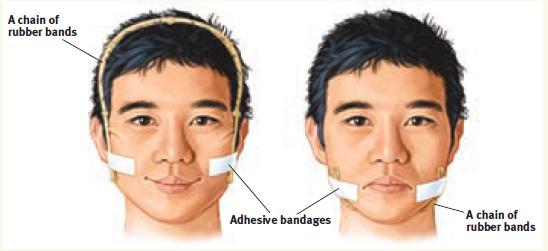
1.How to make people smile without telling them to smile Do as Kazuo Mori and Hideko Mori (2009) did with students in Japan: Attach rubber bands to the sides of the face with adhesive bandages, and then run them either over the head or under the chin. (1) Based on the facial feedback effect, how
1.• Are people more likely to differ culturally in their interpretations of facial expressions or of gestures?
1.• _____________ (Women/Men) report experiencing emotions more deeply, and they tend to be more adept at reading nonverbal behavior
1.4. What does a polygraph measure and why are its results questionable?
1.3. Zajonc and LeDoux maintain that some emotional reactions occur before we have had the chance to consciously label or interpret them. Lazarus noted the importance of how we appraise events. These psychologists differ in the emphasis they place on _____________ in emotional responses.a. physical
1.2. Assume that after spending an hour on a treadmill, you receive a letter saying that your scholarship request has been approved. The two-factor theory of emotion would predict that your physical arousal willa. weaken your happiness.b. intensify your happiness.c. transform your happiness into
1.1. The _____________ -____________ theory of emotion maintains that a physiological response happens BEFORE we know what we are feeling.
1.10-13 How effective are polygraphs in using body states to detect lies?
1.10-12 Do different emotions activate different physiological and brain-pattern responses?
1.10-11 What is the link between emotional arousal and the autonomic nervous system?
1.10-10 What are some of the basic emotions?
1.10-9 To experience emotions, must we consciously interpret and label them?
1.10-8 How do arousal, expressive behavior, and cognition interact in emotion?
1.• How do the two divisions of the autonomic nervous system affect our emotional responses?
1.• Emotion researchers have disagreed about whether emotional responses occur in the absence of cognitive processing. How would you characterize the approach of each of the following researchers: Zajonc, LeDoux, Lazarus, Schachter, and Singer?
1.• According to Schachter and Singer, two factors lead to our experience of an emotion:(1) physiological arousal and (2) ________________ appraisal.
1.• According to the Cannon-Bard theory, (a) our physiological response to a stimulus (for example, a pounding heart), and (b) the emotion we experience (for example, fear) occur _______________(simultaneously/sequentially). According to the James-Lange theory,(a) and (b) occur
1.7. Sanjay recently adopted the typical college diet, increasing his intake of processed fat and sugar. He knows he may gain weight, but he fi gures it’s no big deal because he can lose the extra weight in the future. How would you evaluate Sanjay’s plan?
1.6. Obese people fi nd it very diffi cult to lose weight permanently.This is due to several factors, including the fact thata. dieting triggers neophobia.b. the set point of obese people is lower than average.c. with dieting, metabolism increases.d. there is a genetic infl uence on body weight.
1.5. The rate at which your body expends energy while at rest is referred to as the _______________ _________________ rate.
1.4. The blood sugar _____________ provides the body with energy. When it is __________ (low/high), we feel hungry.
1.3. Which of the following is a genetically predisposed response to food?a. An aversion to eating cats and dogsb. An interest in novel foodsc. A preference for sweet and salty foodsd. An aversion to carbohydrates
1.2. According to the concept of ___________ ____________, our body maintains itself at a particular weight level.
1.1. Journalist Dorothy Dix once remarked, “Nobody wants to kiss when they are hungry.” How does Maslow’s hierarchy of needs support her statement?
1.10-7 What factors predispose some people to become and remain obese?
1.10-6 What cultural and situational factors infl uence hunger?
1.10-5 What physiological factors produce hunger?
1.• Why can two people of the same height, age, and activity level maintain the same weight, even if one of them eats much less than the other does?
1.• After an eight-hour hike without food, your long-awaited favorite dish is placed in front of you, and your mouth waters in anticipation. Why?
1.• Hunger occurs in response to____________ (low/high) blood glucose and ___________(low/high) levels of ghrelin.
1.8. What are some ways to manage our social networking time successfully?
1.7. Which of the following is NOT part of the evidence presented to support the view that humans are strongly motivated by a need to belong?a. Students who rated themselves as “very happy” also tended to have satisfying close relationships.b. Social exclusion—such as exile or solitary confi
1.6. According to Maslow’s hierarchy of needs, our most basic needs are physiological, including the need for food and water; just above these are __________ needs.a. safetyc. belongingnessb. self-esteemd. self-transcendence
1.5. With a challenging task, such as taking a diffi cult exam, performance is likely to peak when arousal isa. very high.c. very low.b. moderate.d. absent.
1.4. ______________ theory attempts to explain behaviors that do NOT reduce physiological needs.
1.3. Jan walks into a friend’s kitchen, smells cookies baking, and begins to feel very hungry. The smell of baking cookies is a(n) ______________ (incentive/drive).
1.2. An example of a physiological need is ______________.An example of a psychological drive is ____________.a. hunger; a “push” to fi nd foodb. a “push” to fi nd food; hungerc. curiosity; a “push” to reduce arousald. a “push” to reduce arousal; curiosity
1.1. Today’s evolutionary psychology shares an idea that was an underlying assumption of instinct theory. That idea is thata. physiological needs arouse psychological states.b. genes predispose species-typical behavior.c. physiological needs increase arousal.d. external needs energize and direct
1.10-4 What is achievement motivation?
1.10-3 How does social networking infl uence us?
1.10-2 What evidence points to our human affi liation need—our need to belong?
1.10-1 How do psychologists defi ne motivation? From what perspectives do they view motivated behavior?
1.• What have researchers found to be an even better predictor of school performance than intelligence test scores?
1.• Social networking tends to ___________ (strengthen/weaken) your relationships with people you already know,____________ (increase/decrease) your self-disclosure, and ________________(reveal/hide) your true personality.
1.How have students reacted in studies where they were made to feel rejected and unwanted? What helps explain these results?
1.• After hours of driving alone in an unfamiliar city, you finally see a diner. Although it looks deserted and a little creepy, you stop because you are really hungry and thirsty. How would Maslow’s hierarchy of needs explain your behavior?
1.• Performance peaks at lower levels of arousal for difficult tasks, and at higher levels for easy or well-learned tasks. (1) How might this phenomenon affect runners? (2) How might this phenomenon affect anxious test-takers facing a difficult exam? (3) How might the performance of anxious
1.4. ____________ _______________can lead to poor performance on tests by undermining test-takers’ belief that they can do well on the test.
1.3. The environmental infl uence that has the clearest, most profound effect on intellectual development isa. exposing normal infants to enrichment programs before age 1.b. growing up in an economically disadvantaged home or neighborhood.c. being raised in conditions of extreme deprivation.d.
1.2. To say that the heritability of intelligence is about 50 percent means that 50 percent ofa. an individual’s intelligence is due to genetic factors.b. the similarities between two groups of people are attributable to genes.c. the variation in intelligence within a group of people is
1.1. The strongest support for heredity’s infl uence on intelligence is the fi nding thata. identical twins, but not other siblings, have nearly identical intelligence test scores.b. the correlation between intelligence test scores of fraternal twins is not higher than that for other siblings.c.
1.9-26 Are intelligence tests inappropriately biased?
1.9-25 How and why do racial and ethnic groups differ in mental ability scores?
1.9-24 How and why do the genders differ in mental ability scores?
1.9-23 What does evidence reveal about environmental infl uences on intelligence?
1.9-22 What evidence points to a genetic infl uence on intelligence, and what is heritability?
1.• What psychological principle helps explain why women tend to perform more poorly when they believe their online chess opponent is male?
1.• What is the difference between a test that is biased culturally and a test that is biased in terms of its validity?
1.• The heritability of intelligence scores will be greater in a society marked by equal opportunity than in a society of peasants and aristocrats. Why?
1.• A check on your understanding of heritability: If environments become more equal, the heritability of intelligence willa. increase.b. decrease.c. be unchanged.
1.9. Which of the following is NOT a possible explanation for the fact that more intelligent people tend to live longer, healthier lives?a. Intelligence facilitates more education, better jobs, and a healthier environment.b. Intelligence encourages a more health-promoting lifestyle.c. Intelligent
1.8. Use the concepts of crystallized and fl uid intelligence to explain why writers tend to produce their most creative work later in life, and scientists may hit their peak much earlier.
1.7. The Stanford-Binet, the Wechsler Adult Intelligence Scale, and the Wechsler Intelligence Scale for Children yield consistent results—on retesting, for example. In other words, these tests have high _________________ .
1.6. The Wechsler Adult Intelligence Scale (WAIS) is best able to tell usa. what part of an individual’s intelligence is determined by genetic inheritance.b. whether the test-taker will succeed in a job.c. how the test-taker compares with other adults in vocabulary and arithmetic reasoning.d.
1.5. The IQ of a 6-year-old with a measured mental age of 9 would bea. 67.c. 86.b. 133.d. 150.
1.4. Emotionally intelligent people tend toa. seek immediate gratifi cation.b. understand their own emotions but not those of others.c. understand others’ emotions but not their own.d. succeed in their careers.
1.3. Sternberg’s three types of intelligence are __________________,_________________ , and ____________________.
1.2. The existence of savant syndrome seems to supporta. Sternberg’s distinction among three types of intelligence.b. criticism of multiple intelligence theories.c. Gardner’s theory of multiple intelligences.d. Thorndike’s view of social intelligence.
1.1. Charles Spearman suggested we have one _____________ _______________ underlying success across a variety of intellectual abilities.
1.9-21 What are the traits of those at the low and high intelligence extremes?
1.9-20 How stable are intelligence scores over the life span?
1.9-19 How does aging affect crystallized and fl uid intelligence?
1.9-18 What is a normal curve, and what does it mean to say that a test has been standardized and is reliable and valid?
1.9-17 When and why were intelligence tests created, and how do today’s tests differ from early intelligence tests?
1.9-16 What is an intelligence test, and what is the difference between achievement and aptitude tests?
1.9-15 What are the four components of emotional intelligence?
1.9-14 How do Gardner’s and Sternberg’s theories of multiple intelligences differ, and what criticisms have they faced?
1.9-13 How do psychologists defi ne intelligence, and what are the arguments for g?
1.• Why do psychologists NOT diagnose an intellectual disability based solely on a person’s intelligence test score?
1.• Researcher A is well funded to learn about how intelligence changes over the life span.Researcher B wants to study the intelligence of people who are now at various life stages.Which researcher should use the cross-sectional method, and which should use the longitudinal method?
1.• Correlation coefficients were used in this section. Here’s a quick review: Correlations do not indicate cause-effect, but they do tell us whether two things are associated in some way. A correlation of –1.0 represents perfect______________ (agreement/disagreement) between two sets of
1.• What are the three criteria that a psychological test must meet in order to be widely accepted? Explain.
1.• An employer with a pool of applicants for a single available position is interested in testing each applicant’s potential. To help her decide whom she should hire, she should use an _____________(achievement/aptitude) test. That same employer wishing to test the effectiveness of a new,
1.• What is the IQ of a 4-year-old with a mental age of 5?
1.• What did Binet hope to achieve by establishing a child’s mental age?
1.• How does the existence of savant syndrome support Gardner’s theory of multiple intelligences?
Showing 600 - 700
of 1292
1
2
3
4
5
6
7
8
9
10
11
12
13
Step by Step Answers

 Get 50% OFF
Claim Now
Get 50% OFF
Claim Now