New Semester
Started
Get
50% OFF
Study Help!
--h --m --s
Claim Now
Question Answers
Textbooks
Find textbooks, questions and answers
Oops, something went wrong!
Change your search query and then try again
S
Books
FREE
Study Help
Expert Questions
Accounting
General Management
Mathematics
Finance
Organizational Behaviour
Law
Physics
Operating System
Management Leadership
Sociology
Programming
Marketing
Database
Computer Network
Economics
Textbooks Solutions
Accounting
Managerial Accounting
Management Leadership
Cost Accounting
Statistics
Business Law
Corporate Finance
Finance
Economics
Auditing
Tutors
Online Tutors
Find a Tutor
Hire a Tutor
Become a Tutor
AI Tutor
AI Study Planner
NEW
Sell Books
Search
Search
Sign In
Register
study help
business
organizational behaviour understanding
Organizational Behaviour Understanding And Managing Life At Work 11th Edition Gary Johns, Alan M Saks - Solutions
Each group member should present their proactive personality, GSE, and CSE scores. Next, consider the extent to which each member has been involved in extracurricular and service activities and in personal accomplishments that involved making changes to their circumstances and how they have adapted
Based on what you know about learning theory, explain why the workers engaged in inappropriate behaviours during work hours and why they were not doing what they were supposed to be doing. Do you think it has anything to do with personality?
Want to learn about your general self-efficacy? Answer the eight questions below as frankly and honestly as possible, using the following response scale:1–Strongly disagree2–Disagree3–Neither agree nor disagree4–Agree5–Strongly agree_________1. I will be able to achieve most of the goals
When are a proactive personality, GSE, and CSE most likely to be beneficial? When are they least likely to be beneficial?
Use operant learning theory and social cognitive theory to explain what can be done to eliminate undesirable behaviours and increase desirable behaviours. What approach do you recommend and why?
To find out about your core self-evaluations, answer the 12 questions below as frankly and honestly as possible, using the following responsescale:1–Strongly disagree2–Disagree3–Neither agree nor disagree4–Agree5–Strongly agree________1. I am confident I get the success I deserve in
Do you think organizations should hire people based on whether they have a proactive personality and on their GSE and CSE scores? What are the implications of this?
What do you think of the way the school board responded to the Toronto Star investigation? Do you think it will eliminate the problems? Explain your answer.
Based on your proactive personality, GSE, and CSE scores, what have you learned about yourself and your behaviour in different situations?
Do you think that organizational learning practices can be used to change employee behaviours? Consider the potential of organizational behaviour modification, employee recognition programs, and training and development. What practices would you recommend and why?
Do you think it was a good idea to train all of the hotel’s employees? How effective was the training? Did the training result in a five-star standard of hotel service? Explain your answer.
What are the main problems at the Roaring Dragon Hotel? Use operant learning theory and social cognitive theory to explain why the hotel is having these problems. What role might personality play in the hotel’s problems?
How can your knowledge of your proactive personality, GSE, and CSE scores help you at school, work, and in your career? What can you do to become more proactive? What can you do to strengthen your GSE and CSE?
What behaviours need to be maintained or increased, and what behaviours should be reduced or eliminated? Be specific about the behaviours that need to be improved and those that need to be eliminated.
What advice would you give the Roaring Dragon Hotel on how to address the problems they are having? What do they need to do to achieve a five-star standard of quality? Explain your answer.
Answer the nine questions listed that follow. The questions refer to different types of overt and covert workplace age discrimination and attempt to assess the extent to which an individual has experienced age discrimination in the workplace. After you have answered the nine questions, follow the
Students should first compare their WADS scores to each other’s. What is the highest and lowest score in the group, and what is the group average? To what extent have group members experienced age discrimination in the workplace?
Discuss what it means to value diversity. Does TD Bank value diversity? Provide some examples to support your answer.
Each member of the group should indicate his or her age. Determine the median age of the group, and categorize those members above the median as being “older” and those below the median as being “younger.” Then calculate the average WADS score of the two age groups. Is there a difference in
What are some of the initiatives that TD Bank has implemented to increase diversity? What effect has this had on the bank and its employees?
Each group member should answer the following two questions using the following scale: 1 = strongly disagree, 2 = disagree, 3 = neither agree or disagree, 4 = agree, 5 = strongly agree.If you are not currently employed, answer these questions thinking about the last time you were employed): (1) In
When TD bank formed the LGBTA committee, only 94 employees were signed up for same-sex benefits, and there were no “out” executives at the bank. Why do you think so few employees were signed up for same-sex benefits and there were no “out” executives? Use the material in the chapter to
Given the results of the research on the WADS, which found relationships between WADS scores and the job satisfaction and turnover intentions of younger and older workers, what are the implications of age discrimination in the workplace for employers and employees?
Use the concepts and principles from operant learning theory and social cognitive theory to explain how the hotel can address its problems. What are some of the most important things it should do?
The response from stakeholders to TD’s LGBTA initiatives was mixed. Some stakeholders were indifferent, others were supportive, and some were anti-LGBTA. In addition, some clients and investors threatened to leave the bank. What role do perceptions and perceptual biases in person perception play
What can organizations do to prevent age discrimination in the workplace? What strategies do you recommend to reduce age discrimination and minimize its effects on employees?
Discuss the role of perceptions and attributions in the new hiring policy. Do perceptions and attributions have anything to do with the hiring policy?
Why were some employees hesitant to identify as LGBTA? Why were some managers resistant to the LGBTA initiatives and their responsibility, even after they received diversity training?
Discuss the role of stereotypes and bias in the new hiring policy. Do stereotypes and bias have anything to do with the hiring policy? Is it discrimination?
What are some of the mistakes that the bank made with its LGBTA initiatives? Do you think this had anything to do with perceptions and stereotypes? Explain your answer and consider the relevance of social identity theory.
Do you agree with the hospital’s new hiring policy? What are the implications of the policy for the hospital, its employees, and patients?
Why don’t all of the bank’s managers see LGBTA as a priority, and what can be done to change this? What can be done to better promote the LGBTA initiatives to employees?
What does this case teach us about perceptions, stereotypes, discrimination, and managing workforce diversity? What can other organizations learn about perceptions and managing workforce diversity from TD’s experience?
Compare your own scores on each work engagement dimension. Which dimension is highest and which is lowest? What does this say about your work or student engagement?
To find out about your work or student engagement, answer the 17 questions below as frankly and honestly as possible. Note that to answer the questions for work engagement, you should refer to your current or most recent job. Refer to the wording in parentheses if you are answering the questions as
Describe employee attitudes, behaviour, and performance at the following time periods: (a) 2003 to 2008; (b) After Giuntini’s cutbacks in 2009; (c) By the end of 2010. How, when, and why did employees’ attitudes, behaviour, and performance change?
Each group member should present their scores on each dimension of work or student engagement as well as their overall work engagement score. What is the range of group members’ scores on each dimension and overall work or student engagement? What dimensions do group members have high and low
To find out about how your organization scores on corporate social responsibility, answer the 35 questions below as frankly and honestly as possible. If you are not currently employed, answer the questions thinking about the last organization where you worked. Use the following response scale to
Using the goals of organizational behaviour, discuss the impact of Giuntini’s cutbacks on employees and the relationship between labour and management. In other words, predict and explain the effects of the cutbacks, and describe what you would do to manage them.
Try to understand why some group members have a low or high work or student engagement score. Each group member should try to explain what factors they think account for their low or high engagement score. If the group completed the scale for student engagement, you might discuss the courses you
Consider Leandro Giuntini’s performance in terms of managerial roles and activities. What roles and activities does he engage in, and how effective is he in performing them? What roles and activities does he need to do more or less of and why?
What effect do you think your level of student or work engagement has on your attitudes, behaviour, and performance? If you completed the scale for student engagement, consider your attitudes toward your program and your grades. If you completed the scale for work engagement, consider your job
Do you think Santiago’s plan to turn things around will be successful? What changes would you recommend for returning the company to profitability and why?
Based on your work or student engagement score, what have you learned about yourself as a student or an employee? What are the implications of this for your attitudes, grades, and performance?
Discuss the relevance of organizational behaviour for the issues and problems facing Ken Private Limited with respect to the Genesis Digitization Project. What topics in organizational behaviour help to explain the problems with the Genesis Digitization Project, and what topics are important for
How can knowledge of your work or student engagement help you as a student and as an employee? What can you do to become a more engaged student and employee? What are the potential consequences of being a more engaged student and employee?
Explain how the goals of organizational behaviour would have been helpful for the Genesis Digitization Project. Describe some of the things that Shekhar Sharma might have predicted, explained, and managed.
Group members should compare and contrast their scores on each dimension. On what dimensions does your organization score high and low on? Are there any patterns with respect to those dimensions that are particularly high or low within the group? On what dimensions do organizations seem to do best
Consider Shekhar Sharma’s role as project manager for the Genesis Digitization Project in terms of Mintzberg’s managerial roles and Luthans, Hodgetts, and Rosenkrantz’s managerial activities. What managerial roles and activities does he exhibit, and how effective is he in performing them?
Group members should compare their scores with one another. How does your organization compare to other group members’ organization on each dimension of CSR and the total CSR score?
To what extent are the contemporary management concerns described in Chapter 1 relevant for Ken Private and the Genesis Digitization Project? What should Ken Private be most concerned about, and what should they do to effectively manage the contemporary management concerns?
Group members should consider their pride towards their organization as well as their organizational identification, job satisfaction, and organizational commitment. Do some group members feel more strongly about these attitudes, and is there a connection between their attitudes and their
How can organizational behaviour help Saiyumn Savarker find a solution to steer the Genesis Digitization Project out of dangerous waters and to successfully complete the project? What should Savarker do to ensure Ken’s successful delivery of the project?
Based on your scores, what have you learned about your organization? What in particular does your organization have to focus on and do to improve their CSR? What are the implications of doing so?
How can knowledge of corporate social responsibility help you in your future search for employment and in your career?
How does Research Focus: Leader Over-Emergence and Gender Dynamics in Self-Managed Teams apply to the events in the case?
How is status relevant to the events at Metropole? Be sure to consider the impact of group diversity in your answer.
How cohesive is the software development team, and how does this affect the events in the case?
Each group member should present their score on the seven proactive socialization behaviours. What is the average group score on each proactive behaviour? What proactive behaviours were engaged in the most and least frequently by group members?
Explain how Jason’s anticipatory socialization might be contributing to his disappointment and job attitudes. How might this situation have been prevented?
What effect did your proactive behaviours have on your socialization? Do you think that the extent to which you engaged in each of the proactive behaviours had an effect on your learning, job attitudes, and behaviours?
Explain how unrealistic expectations and the psychological contract can help us understand Jason’s situation.
Based on your score on each proactive behaviour, what proactive behaviours do you need to engage in to a greater extent the next time you enter an organization and begin a new job? What are the implications of engaging in the proactive socialization behaviours more frequently?
Comment on the use of socialization tactics in Jason’s socialization. What tactics do you think were used and what effect did they have on Jason?
Do some people engage in proactive socialization behaviours more than others? To find out, refer to your score on the proactive personality scale from Chapter 2 . If you have not yet completed the scale, do so now and calculate your score. Once everybody in your group has their proactive
Given Jason’s current situation, is there anything the organization can do to prevent him from quitting? Is there anything that Jason can do to improve his situation? Is there anything the organization should do so that other new hires don’t have the same experience as Jason?
How can an understanding of proactive socialization help you in your future work experiences and career? What can organizations do to increase the likelihood that newcomers will engage in proactive socialization behaviours? What are the benefits for newcomers and organizations?
Describe the culture of the Walt Disney Company. What values, norms, and behaviours are associated with the culture? How does the culture influence the customer experience at its theme parks, and how has it contributed to its success?
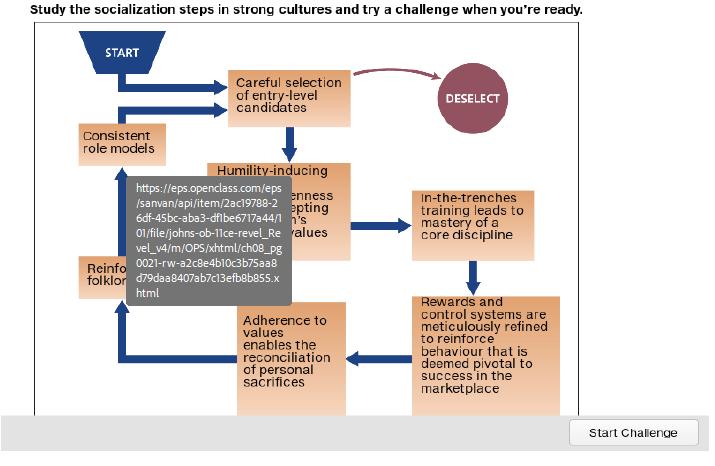
Discuss the process used to socialize new hires at Walt Disney Company. Refer to Exhibit 8.7 (Socialization Steps in Strong Cultures) to answer this question and provide specific examples of how each step is performed. To what extent does the Walt Disney Company follow each of the steps? What is
Discuss the “strong culture” concept with respect to the culture of the Walt Disney Company. What are some examples that demonstrate it has a strong culture? What are its assets and liabilities?
What factors have contributed to the foundation and continuation of the culture of Walt Disney Company?
Consider the role of fit at Walt Disney Company. What are the different types of fit and what types are especially important for Walt Disney Company? What does the company do to ensure that applicants are a good fit?
What are some of the ways that you can diagnose the culture of Walt Disney Company? Provide some specific examples and explain their purpose.
What can other organizations learn about socialization and culture from the Walt Disney Company?
Each group member should present their ELS score. What is the range of scores (highest and lowest) and the average score in your group? Overall, how ethical are group members’ supervisors?
To obtain your overall score, add up your responses to the 28 questions and divide by 28. Your total should be somewhere between 1 and 7. Higher scores indicate a more servant leader. You can also determine the score for the seven dimensions by adding your responses to the four items for each
Each group member should provide examples of what makes their supervisor an ethical or unethical leader. Be specific in describing supervisor behaviours that are ethical or unethical. Based on group members’ answers, what are some of the main differences between ethical and unethical leaders?
Each group member should provide examples of what makes their supervisor a servant leader. Be specific in describing servant behaviours in terms of your scores on the seven dimensions of the scale. Based on group members’ answers, what are some of the main things that distinguish servant leaders
Each group member should consider the impact that their supervisor has had on them, their co-workers, and the organization. Be specific in describing the effects that their ethical or unethical behaviour has had on people’s attitudes and behaviours as well as on the organization (e.g.,
Each group member should consider the impact that their supervisor has had on them, their co-workers, and the organization. Be specific in describing the effects that servant (or non-servant) leaders have had on people’s attitudes and behaviours as well as on the organization (e.g., reputation,
What does your supervisor need to do differently to be a more ethical leader?
What does your supervisor need to do to be a more servant leader? Be specific in terms of the scores on the seven dimensions.
If you are now or have been in a leadership position in the past, how ethical have you been? Take the ELS again, but this time thinking about yourself in a current or previous leadership role. How ethical are you (or were you)? What do you have to do to become a more ethical leader?
If you are now or have been in a leadership position in the past, to what extent have you been a servant leader? Take the Servant Leadership Scale again, but this time thinking about yourself in a current or previous leadership role. To what extent are you (or were you) a servant leader? What do
What do you think the manager is likely to do in this situation? What should she do and why?
Explain the relevance of ethical leadership in this situation. What will an ethical leader do and why? What will an unethical leader do?
Consider how the manager’s response to this situation can impact the ethical behaviour of her employees in the organization. What are some of the potential implications of her actions for employees and the organization?
Discuss the issues, problems, and challenges facing Corin Fiske and WEAA. To what extent are these issues, problems, and challenges the result of the station’s past and present leadership?
Evaluate Corin Fiske’s success as a leader in terms of the meaning of leadership and what it means to be an effective leader. Do you think she has been an effective leader? Provide some specific examples to support your answer.
Consider Corin Fiske’s leadership in terms of the different types of leadership behaviour (i.e., consideration, initiating structure, leader reward behaviour, and leader punishment behaviour). To what extent does she exhibit each of these behaviours, and how effective is she when she does? What
Use the situational theories of leadership (contingency theory and path–goal theory) to explain the leadership style and behaviour that is most likely to be effective given Corin Fiske’s situation. What is the difference between her current leadership style and behaviour and the style and
Discuss the merits of leader–member exchange (LMX) theory, transactional, and transformational leadership for the leadership situation facing Corin Fiske at WEAA. What type of leadership is necessary and why? What does each theory suggest that Corin Fiske should do to be a more effective leader?
Given the many challenges facing WEAA and Corin Fiske, what type of leadership is most important to improve the situation and the success of WEAA? Can Corin Fiske improve the situation by being a more effective leader, and if so, what type of leadership is required and why? Be sure to consider the
The advent of new forms of communication technology and associated social media have benefited organizations and their employees in many ways, but they have also led to an assortment of problems and conflicts. Several themes are apparent in the scenarios presented in this exercise. For one thing,
A representative of a Canadian mobile phone accessory company was finishing up negotiations with a Chinese manufacturer over the purchase of 10 000 accessory sets, when he mentioned one final detail: all product labelling should be in English and French. This news caused the Chinese Managing
The advent of new forms of communication technology and associated social media have benefited organizations and their employees in many ways, but they have also led to an assortment of problems and conflicts. Several themes are apparent in the scenarios presented in this exercise. For one thing,
A representative of a Canadian mobile phone accessory company was finishing up negotiations with a Chinese manufacturer over the purchase of 10 000 accessory sets, when he mentioned one final detail: all product labelling should be in English and French. This news caused the Chinese Managing
The advent of new forms of communication technology and associated social media have benefited organizations and their employees in many ways, but they have also led to an assortment of problems and conflicts. Several themes are apparent in the scenarios presented in this exercise. For one thing,
Discuss how the web and new media such as Facebook have (a) Aided (b) Complicated organizational communication. Be sure to consider the implications of sending a message when you do not know whom the receiver might be.Miranda Shaw was stymied. She had been on the verge of hiring a highly
The advent of new forms of communication technology and associated social media have benefited organizations and their employees in many ways, but they have also led to an assortment of problems and conflicts. Several themes are apparent in the scenarios presented in this exercise. For one thing,
Showing 1700 - 1800
of 1856
First
5
6
7
8
9
10
11
12
13
14
15
16
17
18
19
Step by Step Answers

 Get 50% OFF
Claim Now
Get 50% OFF
Claim Now