New Semester
Started
Get
50% OFF
Study Help!
--h --m --s
Claim Now
Question Answers
Textbooks
Find textbooks, questions and answers
Oops, something went wrong!
Change your search query and then try again
S
Books
FREE
Study Help
Expert Questions
Accounting
General Management
Mathematics
Finance
Organizational Behaviour
Law
Physics
Operating System
Management Leadership
Sociology
Programming
Marketing
Database
Computer Network
Economics
Textbooks Solutions
Accounting
Managerial Accounting
Management Leadership
Cost Accounting
Statistics
Business Law
Corporate Finance
Finance
Economics
Auditing
Tutors
Online Tutors
Find a Tutor
Hire a Tutor
Become a Tutor
AI Tutor
AI Study Planner
NEW
Sell Books
Search
Search
Sign In
Register
study help
business
organizational communication
Essentials Of Computer Organization And Architecture 4th Edition Linda Null, Julia Lobur - Solutions
66. Repeat question 65 to determine the following:a) The output string generated for the input: 00101101.b) In which state is the encoder after the sequence in part a is written?c) Which bit is in error in the string, 00 01 10 11 00 11 00? What is the probable value of the string?
65. Using the convolutional code and Viterbi algorithm described in this chapter, assuming that the encoder and decoder always start in State 0, determine the following:a) The output string generated for the input: 10010110.b) In which state is the encoder after the sequence in part a is read?c)
63. Construct two parity checkers using a Moore machine for one and a Mealy machine for the other.
62. Construct a Moore machine that counts modulo 5.
61. Construct Moore and Mealy machines that complement their input.
60. List the steps necessary to read a word from memory in the 4 × 3 memory circuit shown in Figure 3.32.
59. A Mux-Not flip-flop (MN flip-flop) behaves as follows: If M = 1, the flip-flop complements the current state. If M = 0, the next state of the flip-flop is equal to the value of N.a) Derive the characteristic table for the flip-flop.b) Show how a JK flip-flop can be converted to an MN flip-flop
58. A Null–Lobur flip-flop (NL flip-flop) behaves as follows: If N = 0, the flip-flop does not change state. If N = 1, the next state of the flip-flop is equal to the value of L.a) Derive the characteristic table for the NL flip-flop.b) Show how an SR flip-flop can be converted to an NL flip-flop
56. True or false: When a JK flip-flop is constructed from an SR flip-flop, S = JQ′ and R = KQ.
54. Complete the truth table for the following sequential circuit: XY N Full-Adder C D Q C Q' S Next State X XO Y Z S Q 0 0 0 0 0 1 0 1 0 0 1 1 1 0 0 1 0 1 1 1 0 1 1 1
53. Complete the truth table for the following sequential circuit: X D Q Q' A Next State A B X A B 0 0 0 0 0 1 J Q B 0 1 0 KQ' 0 1 1 1 0 0 1 0 1 1 1 0 1 1 1
52. Complete the truth table for the following sequential circuit: X D Next State A B X A B A 0 0 0 B 000 0 1 1 0 1 1 Q' Q' 1 0 0 1 0 1 1 1 0 1 1 1
51. Complete the truth table for the following sequential circuit: D Q Q' A Next State AO A B X A B 0 0 B 0 0 1 J Q 0 1 0 0 1 1 KQ' 1 0 0 1 0 1 1 1 0 1 1 1
50. Complete the truth table for the following sequential circuit: X Y J K Q' A Next State X Y A A B 0 0 0 DQ B 0 0 1 0 1 0 Q' 0 1 1 1 0 0 1 0 1 1 1 0 1 1 1
48. Tyrone Shoelaces has invested a huge amount of money into the stock market and doesn’t trust just anyone to give him buying and selling information. Before he will buy a certain stock, he must get input from three sources. His first source is Pain Webster, a famous stock broker. His second
47. Little Susie is trying to train her new puppy. She is trying to figure out when the puppy should get a dog biscuit as a reward. She has concluded the following:1. Give the puppy a biscuit if it sits and wiggles but does not bark.2. Give the puppy a biscuit if it barks and wiggles but does not
45. Simplify the function from exercise 44 and draw the logic circuit.
43. Assume you have the following truth tables for functions F1(w,x,y,z) and F2(w,x,y,z):a) Express F1 and F2 in sum-of-products form.b) Simplify each function.c) Draw one logic circuit to implement the above two functions. M X y Z F1 F2 0 0 0 0 0 0 0 0 0 1 1 1 0 0 1 0 0 0 0 0 1 1 1 1 0 1 0 0 0 0 0
42. Assume you have the following truth tables for functions F1(x,y,z) and F2(x,y,z):a) Express F1 and F2 in sum-of-products form.b) Simplify each function.c) Draw one logic circuit to implement the above two functions. X 0 y 0 NO 0 0 0 1 F F2 1 0 10 0 1 0 1 1 0 1 1 0 1 1 0 0 0 0 1 0 1 0 0 1 10 1 1
41. Draw circuits to implement the parity generator and parity checker shown in Tables 3.10 and 3.11, respectively.
40. How many control lines does a multiplexer have if it has 32 inputs?
39. How many inputs does a decoder have if it has 64 outputs?
38. Find the truth table that describes the following circuit: N X
37. Find the truth table that describes the following circuit: N y X DF
36. Find the truth table that describes the following circuit: Z F
35. Draw the combinational circuit that directly implements the Boolean expression: F(x,y,z) =(x(y XOR z)) + (xz)′
34. Draw the combinational circuit that directly implements the following Boolean expression:F(x,y,z) = x + xy + y′z
33. Draw the combinational circuit that directly implements the Boolean expression:F(x,y,z) = xyz + (y′ + z)
32. Design a circuit with three inputs x, y, and z representing the bits in a binary number, and three outputs (a,b, andc) also representing bits in a binary number. When the input is 0, 1, 6, or 7, the binary output will be the complement of the input. When the binary input is 2, 3, 4, or 5, the
31. Draw a full-adder using only NAND gates.
30. Draw a half-adder using only NAND gates.
29. Construct the XOR operator using only NAND gates.Hint: x XOR y = ((x′y)′(xy′)′)′
28. Construct the XOR operator using only AND, OR, and NOT gates.
27. Given the function, F(x,y,z) = y(x′z + xz′) + x(yz + yz′)a) List the truth table for F.b) Draw the logic diagram using the original Boolean expression.c) Simplify the expression using Boolean algebra and identities.d) List the truth table for your answer in part c.e) Draw the logic
26. Given the Boolean function, F(x,y,z) = x′y + xyz′a) Derive an algebraic expression for the complement of F. Express in sum-of-products form.b) Show that FF′ = 0.c) Show that F + F′ = 1.
25. Draw the truth table and rewrite the expression below as the complemented sum of two products:xy′ + x′y + xz + y′z
24. Which of the following Boolean expressions is not logically equivalent to all the rest?a) wx′ + wy′ + wzb) w + x′ + y′ + zc) w(x′ + y′ + z)d) wx′yz′ + wx′y′ + wy′z′ + wz
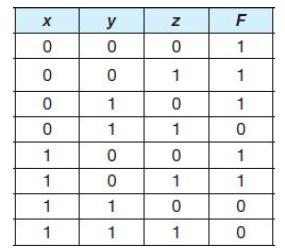
23. The truth table for a Boolean expression is shown below. Write the Boolean expression in sum-ofproducts form. x y Z F 0 0 0 1 0 0 1 1 0 1 0 1 0 1 1 0 1 0 0 1 1 0 1 1 1 1 0 0 1 1 1 0
22. The truth table for a Boolean expression is shown below. Write the Boolean expression in sum-ofproducts form. x y Z F 0 0 0 1 0 0 1 0 0 1 0 1 0 1 1 0 1 0 0 0 1 0 1 1 1 1 0 1 1 1 1 1
21. Using the basic identities of Boolean algebra, show that xy + x′z + yz = xy + x′z
20. Using the basic identities of Boolean algebra, show that x + x′y = x + y
19. Using the basic identities of Boolean algebra, show that x(x′ + y) = xy
18. Simplify the following functional expressions using Boolean algebra and its identities. List the identity used at each step.a) y(xz′ + x′z) + y′(xz′ +x′z)b) x(y′z + y) + x′(y + z′)′c) x[y′z + (y + z′)′](x′y + z)
17. Simplify the following functional expressions using Boolean algebra and its identities. List the identity used at each step.a) x(y + z)(x′ + z′)b) xy + xyz + xy′z + x′y′zc) xy′z + x(y + z′)′ + xy′z′
16. Simplify the following functional expressions using Boolean algebra and its identities. List the identity used at each step.a) z(w + x)′ + w′xz + wxyz′ + wx′yz′b) y′(x′z′ + xz) + z(x + y)′c) x(yz′ + x)(y′ + z)
15. Simplify the following functional expressions using Boolean algebra and its identities. List the identity used at each step.a) x(yz + y′z) + xy + x′y + xzb) xyz″ + (y + z)′ + x′yzc) z(xy′ + z)(x + y′)
14. Simplify the following functional expressions using Boolean algebra and its identities. List the identity used at each step.a) F(x,y,z) = y(x′ + (x + y)′)b) F(x,y,z) = x′yz + xzc) F(x,y,z) = (x′ + y + z′)′ + xy′z′ + yz + xyz
13. Use any method to prove the following either true or false.xz + x′y′ + y′z′ = xz + y′
12. Show that xz = (x + y)(x + y′)(x′ + z)a) Using truth tablesb) Using Boolean identities
11. Use only the first seven Boolean identities to prove the Absorption Laws.
10. Show that x = xy + xy′a) Using truth tablesb) Using Boolean identities
9. Is the following true or false? Prove your answer. (x XOR y)′ = xy + (x + y)′
8. Is the following distributive law valid or invalid? Prove your answer. x XOR (y + z) = (x XOR y)+ (x XOR z)
7. Prove DeMorgan’s Laws are valid.
6. Using DeMorgan’s Law, write an expression for the complement of F if F(x,y,z)= xz′(xy + xz) + xy′(wz + y).
5. Using DeMorgan’s Law, write an expression for the complement of F if F(w,x,y,z)= xz′(x′yz + x) + y(w′z + x′).
4. Using DeMorgan’s Law, write an expression for the complement of F if F(x,y,z)= (x′ + y)(x + z)(y′ + z)′.
3. Using DeMorgan’s Law, write an expression for the complement of F if F(x,y,z)= xy′(x + z).
2. Construct a truth table for the following:a) xyz + x(yz)′ + x′(y + z) + (xyz)′b) (x + y′)(x′ + z′)(y′ + z′)
1. Construct a truth table for the following:a) yz + z(xy)′b) x(y′ + z) + xyzc) (x + y)(x′ + y) (Hint: This is from Example 3.7.)
26. What does an algorithmic state machine offer that is not provided by either a Moore or a Mealy machine?
25. How is a Mealy machine different from a Moore machine?
24. Which flip-flop gives a true representation of computer memory?
23. Why are JK flip-flops often preferred to SR flip-flops?
22. How is a JK flip-flop related to an SR flip-flop?
21. In the context of digital circuits, what is feedback?
20. What do we mean when we say that a sequential circuit is edge triggered rather than level triggered?
19. What is the basic element of a sequential circuit?
18. How are sequential circuits different from combinational circuits?
17. What kind of circuit selects binary information from one of many input lines and directs it to a single output line?
15. What is the difference between a half-adder and a full-adder?
14. What are the necessary steps one must take when designing a logic circuit from a description of the problem?
13. What are the three methods we can use to express the logical behavior of Boolean functions?
12. Describe the operation of a ripple-carry adder. Why are ripple-carry adders not used in most computers today?
11. Describe the basic construction of a digital logic chip.
10. What are the two universal gates described in this chapter? Why are these universal gates important?
9. Name the four basic logic gates.
8. What is the difference between a gate and a circuit?
7. What is the relationship between transistors and gates?
5. What is the Boolean duality principle?
3. Which Boolean operation is referred to as a Boolean sum?
4. Write the 7-bit ASCII code for the character 4 using the following encoding:a) Non-return-to-zerob) Non-return-to-zero-invertc) Manchester coded) Frequency modulatione) Modified frequency modulationf) Run-length-limited(Assume 1 is “high” and 0 is “low.”)
3. Explain how run-length-limited encoding works.
2. Why is Manchester coding not a good choice for writing data to a magnetic disk?
1. Why is non-return-to-zero coding avoided as a method for writing data to a magnetic disk?
82. We have seen that floating-point arithmetic is neither associative nor distributive. Why do you think this is the case?
80. Using the CRC polynomial 1101, compute the CRC code word for the information word, 01011101. Check the division performed at the receiver.
76. Find the quotients and remainders for the following division problems modulo 2.a) 10011112 ÷ 11012b) 10111102 ÷ 11002c) 10011011102 ÷ 110012d) 1111010102 ÷ 100112
75. Find the quotients and remainders for the following division problems modulo 2.a) 110010012 ÷ 11012b) 10110002 ÷ 100112c) 111010112 ÷ 101112d) 1111100012 ÷ 10012
74. Find the quotients and remainders for the following division problems modulo 2.a) 11110102 ÷ 10112b) 10101012 ÷ 11002c) 11011010112 ÷ 101012d) 11111010112 ÷ 1011012
73. Find the quotients and remainders for the following division problems modulo 2.a) 10101112 ÷ 11012b) 10111112 ÷ 111012c) 10110011012 ÷ 101012d) 1110101112 ÷ 101112
72. When would you choose a CRC code over a Hamming code? A Hamming code over a CRC?
71. Name two ways in which Reed-Solomon coding differs from Hamming coding.
69. Repeat exercise 68 using the following code word:0 1 1 1 1 0 1 0 1 0 1
67. Suppose we want an error-correcting code that will allow all single-bit errors to be corrected for memory words of length 12.a) How many parity bits are necessary?b) Assuming we are using the Hamming algorithm presented in this chapter to design our errorcorrecting code, find the code word to
66. Suppose we want an error-correcting code that will allow all single-bit errors to be corrected for memory words of length 10.a) How many parity bits are necessary?b) Assuming we are using the Hamming algorithm presented in this chapter to design our errorcorrecting code, find the code word to
64. Compute the Hamming distance of the following code:0000000101111111 0000001010111111 0000010011011111 0000100011101111 0001000011110111 0010000011111011 0100000011111101 1000000011111110
63. Compute the Hamming distance of the following code:0011010010111100 0000011110001111 0010010110101101 0001011010011110
62. Are the error-correcting Hamming codes systematic? Explain.
61. Suppose we are given the following subset of code words, created for a 7-bit memory word with one parity bit: 11100110, 00001000, 10101011, and 11111110. Does this code use even or odd parity? Explain.
Showing 3200 - 3300
of 3825
First
25
26
27
28
29
30
31
32
33
34
35
36
37
38
39
Step by Step Answers

 Get 50% OFF
Claim Now
Get 50% OFF
Claim Now