New Semester
Started
Get
50% OFF
Study Help!
--h --m --s
Claim Now
Question Answers
Textbooks
Find textbooks, questions and answers
Oops, something went wrong!
Change your search query and then try again
S
Books
FREE
Study Help
Expert Questions
Accounting
General Management
Mathematics
Finance
Organizational Behaviour
Law
Physics
Operating System
Management Leadership
Sociology
Programming
Marketing
Database
Computer Network
Economics
Textbooks Solutions
Accounting
Managerial Accounting
Management Leadership
Cost Accounting
Statistics
Business Law
Corporate Finance
Finance
Economics
Auditing
Tutors
Online Tutors
Find a Tutor
Hire a Tutor
Become a Tutor
AI Tutor
AI Study Planner
NEW
Sell Books
Search
Search
Sign In
Register
study help
business
project management for small projects
Methods Of IT Project Management 3rd Edition Jeffrey L. Brewer; Kevin C. Dittman - Solutions
Research the risk management software applications available on the market and write a paper summarizing their features/capabilities. List some of the disadvantages of using these tools.
Search the Internet for examples of risk management plans and compare them to the one presented in this chapter.
Outsourcing portions of IT projects is an increasingly common practice. Research the risks inherent in projects for which all or some of the tasks are outsourced. Are there any additional issues related to projects whose tasks are outsourced to firms outside the United States? Explain.
Research articles written about IT projects that failed and discuss the risks that, if addressed, could have potentially changed the outcome.
List each of the ten knowledge areas defined in the Project Management Institute’s PMBOK. List and explain at least one risk per knowledge area that IT projects might experience.
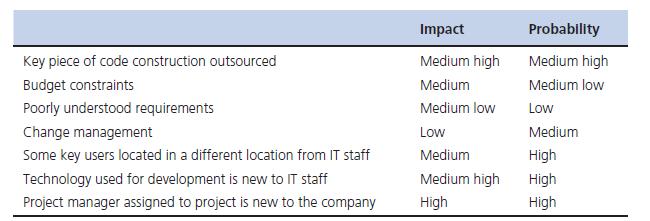
Create a probably/impact matrix based on the information below. Explain which of the risks needs to be further analyzed and/or watched closely during the project. Key piece of code construction outsourced Budget constraints Poorly understood requirements Change management Some key users located in
Following are four short case study scenarios that represent risk response category choices. Match each scenario with one of the four possible risk responses (accept, avoid, transfer, mitigate) and explain your answer.a. Two critical tasks in the project you are running deal with complex database
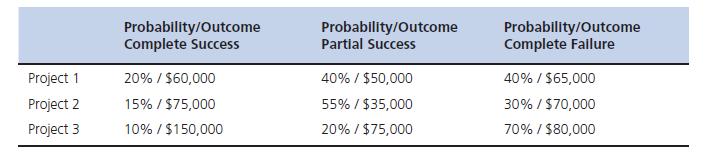
Change the probabilities in question 5 to the following and reevaluate your answers.Project 1 = 25, 30, 45 Project 2 = 20, 40, 40 Project 3 = 20, 35, 45
You have been asked to use decision tree analysis with EMV to assess the risk in selecting among three different projects, each with unique expenses, risks, and expected monetary outcomes, with estimates shown below:a. Draw a decision tree analysis chart with values from the table shown here,
Explain the difference between a fallback plan and a contingency plan. Create one of each for the R & S Amusements Services case study in this chapter, based on the risks identified in this chapter.Pick one of the risks and explain its impact to the project and your fallback and contingency plans.
Obtain a free copy of simulation software (see Appendix B for suggestions on where to find one) and conduct your own trials for the R & S Amusements Services project.
Explain the process of SWOT analysis and then conduct a SWOT analysis for the R & S Amusements Services case study, adding to information already addressed in this chapter.
Define and explain how Monte Carlo simulation is used to assess risks.
Define and explain how to assess risks with the decision tree analysis technique using EMV.
Describe the drawbacks to using qualitative risk analysis techniques.
Describe the process of building a probability and impact matrix and how the results are used to aid in risk management planning.
Describe the key differences between doing a qualitative risk assessment and doing a quantitative risk assessment.
List the contents and explain the function of the risk register.
Describe the steps of the Delphi technique.
Describe how a brainstorming session should be conducted to get the best results.
Explain how broad organizational categories are used to help identify risks.
Explain why it can be difficult to find and define all risks on a project.
List and explain the common risks that all IT projects share.
List each of the key pieces of information that make up a project risk management plan and briefly describe each piece.
Explain what is meant by crisis management and why many organizations continue to exist in this type of environment.
Explain why risk management should be done on every IT project but the amount of risk management varies by project.
Explain how risk management can allow an organization to be more aggressive and take on riskier projects.
List and explain the two main objectives of risk management.
What are the two major components of risk (based on the definition of risk the textbook uses)?
Explain why projects have risks.
Research a Quality Management System (QMS)and write a summary paper that defines what it is, who is using it, and its implications for project management. Also discuss any drawbacks or issues with a QMS.
Research Six Sigma and write a summary paper that defines what it is, who is using it, and its implications for project management. Also discuss any drawbacks or issues with Six Sigma.
Research the balanced scorecard and write a summary paper that defines what it is, who is using it, and its implications for project management.Also discuss any drawbacks or issues with the balanced scorecard.
Research the ISO 9000 standard and write a paper on the different certifications, how the certifications are awarded, and the implications for project management. Also discuss any drawbacks or issues with the standard.
Review one or more of the project failures mentioned early in this chapter and write a paper that explains in detail what happened and why quality was an issue.
Review work from any of the accomplished quality experts mentioned in this chapter and write a more detailed paper to summarize their contributions to the current quality movement. You could instead generate a paper that compares and contrasts the views of each noted author/researcher.
Research the OPM3 and write a paper that summarizes the steps, who is using the model, and its implications for project management. Also discuss any drawbacks or issues with the OPM3.
Research the CMMI and write a paper that summarizes the maturity steps, what organizations are using the model, and its implications for project management. Also discuss any drawbacks or issues with the CMMI.
Using the model of communications depicted in Figure 7-4, for an IT project, explain the issue of noise and its implications for a successful project.
Using Six Sigma, organizations strive to have 3.4 defects per 1 million opportunities. Explain what this means in terms of IT projects.
“Each of the standards ISO 9000, CMMI, and OPM3 prescribes a process to aid organizations in producing a quality product, but an organization can obtain certification at any level and still produce a bad product.” Explain whether you agree or disagree with this statement.
Explain why the quality movement is going away from inspection to prevention and the use of statistical process control measures. Also explain what impact this has on quality management plans.
Errors that are created during the early phase of a project, during requirements discovery, are much more expensive to fix the later in the project they are found. Explain why this is and explain its implications for project managers.
Discuss what is meant by the cost of quality or the cost of not producing a quality product.
Build a quality management plan for the other two R & S Amusements Services projects:customer contract management and collection management.
This chapter describes the viewpoint of many authors that quality should be included in the triple constraint. Explain why you believe quality should or should not be included in the triple constraint. Support your answer with examples.
What is the purpose of a stakeholder communication matrix? Describe its content
List and describe the sections of a communications management plan and the questions this plan must answer.
Define communications management.
What is a design of experiments?
What is a cost–benefit analysis?
List and describe the sections of the quality management plan.
List and explain each level contained in the OPM3.
What does CMMI stand for, and how is it used?
What is Six Sigma?
What is the Balanced Scorecard?
Define and list the key principles of TQM.
Define the different categories of the ISO 9000 standard.
Define what is meant by product maintainability.
Define what is meant by product reliability.
What does it mean for a product to be “fit for use”?
What does it mean to do rework?
What is the cost of nonconformance?
What is the cost of quality?
List and explain the eight quality management principles defined by the ISO.
Define quality management in your own words and stress the importance of satisfying both stated and implied stakeholder needs.
Research the agile techniques of planning poker and affinity grouping for user story estimating that are utilized by companies today.
Build a complete budget and write a scope statement for a project that would build a university computer lab, complete with hardware, software, and network connectivity. The project will be completed over the course of one summer. Be sure to include one-time costs and recurring costs.
Discuss a project you have worked on where cost was not an issue (unlimited budget) and time was the major factor. Was the project successful?
Build a WBS and schedule for a spring break trip to Florida. Identify all dependencies as either mandatory (internal or external) or discretionary(internal or external).
Research new developments and directions for the COCOMO II estimating technique.
Use the Internet to research the other two projects R & S is doing—customer relationship management and collections management—by looking at similar projects other companies have done.Build a high-level WBS and build a rough order of magnitude budget.
Research the techniques companies are using today for estimating duration and cost in their projects.
Using information from problem 11, management has gotten your assessment of when the project will be completed, assuming a linear path.Management is not happy with how long the project is going to take and wants suggestions on how to get it done sooner. What steps could you potentially take to
You have been tasked with selecting and deploying a new Enterprise Resource Planning(ERP) software application for your organization.Unfortunately, the project is already under way, and much of the initial planning has been completed. The initial WBS has been created in Excel because the original
Bob is a project manager for a small consulting company, Quickie Software Developers, Inc., and is preparing a bid for an outsourcing project for a large Fortune 200 company to develop a new web-based order entry software module. Quickie Software Developers is small and can’t afford to lose money
Use the schedule created in question 5 but adjust the durations using PERT calculation from the three-point estimates below and recalculate slack.Task A, Optimistic = 1, Normal = 2, Pessimistic = 5 Task B, Optimistic = 2, Normal = 4, Pessimistic = 8 Tack C, Optimistic = 3, Normal = 7, Pessimistic =
Create a spreadsheet similar to Table 6-1 and find the number of function points for the following application description:User inputs = Low complexity = 25, Medium complexity = 5, High complexity = 2 User outputs = Low complexity = 30, Medium complexity = 10, High complexity = 1 Files/structures =
What happens to the critical path in the network schedule created in question 5 if the duration of Task E changes to 11 days?
Using the diagram you created in question 5, calculate ES, EF, LS, and LF for each task and the amount of slack. (Refer to Figure 6-8 for an example.)List the tasks that appear on the critical path.
Create an activity on arrow diagram based on the following information:Task A, duration 2, no dependency Task B, duration 4, no dependency Task C, duration 7, no dependency Task D, duration 5, depends on Task A Task E, duration 3, depends on Task B and Task C Task F, duration 8, depends on Task C
Using the diagram you created in question 3, calculate ES, EF, LS, and LF for each task and the amount of slack. (Refer to Figure 6-8 for an example.)List the tasks that appear on the critical path.
Create an activity on arrow diagram based on the following information:Task A, duration 6, dependent on none Task B, duration 5, dependent on none Task C, duration 3, dependent on none Task D, duration 12, dependent on Task B and Task C Task E, duration 2, dependent on Task A Task F, duration 5,
Describe the advantages and disadvantages of the precedence diagram method and activity on arrow techniques for modeling task dependencies.
Explain the potential impact to project costs and schedules when assigning the following task relationships:mandatory (internal or external) or discretionary(internal or external).
Briefly describe the contents of the schedule management plan.
Explain timing and accuracy of the three levels of cost estimates: rough order of magnitude, budget, and definitive estimates.
Briefly describe and compare resource loading and resource leveling.
Describe the critical chain method and compare it to CPM.
Define and compare the schedule compression techniques crashing and fast tracking.
Can a project have multiple critical paths? Explain.
Explain the difference between slack and free slack.
Explain the CPM process for schedule development.
Explain the process followed when using the PERT approach to scheduling.
Describe the benefits associated with doing good project scheduling development.
Compare and contrast COCOMO and COCOMO II.
Define and explain each of the three project types described within COCOMO.
Compare and contrast the estimating techniques presented in the chapter, being sure to review advantages and disadvantages of each. You might want to create a table listing each technique and associated advantages and disadvantages.
Explain what is meant by this statement: “The function point analysis is only as accurate as the system requirements document.”
Briefly describe the task sizing methods lines of code and function points.
Showing 3100 - 3200
of 5917
First
25
26
27
28
29
30
31
32
33
34
35
36
37
38
39
Last
Step by Step Answers

 Get 50% OFF
Claim Now
Get 50% OFF
Claim Now