New Semester
Started
Get
50% OFF
Study Help!
--h --m --s
Claim Now
Question Answers
Textbooks
Find textbooks, questions and answers
Oops, something went wrong!
Change your search query and then try again
S
Books
FREE
Study Help
Expert Questions
Accounting
General Management
Mathematics
Finance
Organizational Behaviour
Law
Physics
Operating System
Management Leadership
Sociology
Programming
Marketing
Database
Computer Network
Economics
Textbooks Solutions
Accounting
Managerial Accounting
Management Leadership
Cost Accounting
Statistics
Business Law
Corporate Finance
Finance
Economics
Auditing
Tutors
Online Tutors
Find a Tutor
Hire a Tutor
Become a Tutor
AI Tutor
AI Study Planner
NEW
Sell Books
Search
Search
Sign In
Register
study help
engineering
engineering fluid mechanics
Munson Young And Okiishi's Fundamentals Of Fluid Mechanics 8th Edition Philip M. Gerhart, Andrew L. Gerhart, John I. Hochstein - Solutions
Blood flows at volume rate \(Q\) in a circular tube of radius \(R\). The blood cells concentrate and flow near the center of the tube, while the cell-free fluid (plasma) flows in the outer region. The center core of radius \(R_{c}\) has a viscosity \(\mu_{c}\), and the plasma has a viscosity
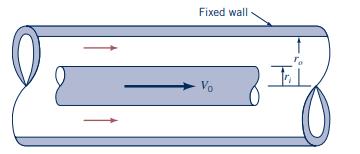
An incompressible Newtonian fluid flows steadily between two infinitely long, concentric cylinders as shown in Fig. P6.96. The outer cylinder is fixed, but the inner cylinder moves with a longitudinal velocity \(V_{0}\) as shown. The pressure gradient in the axial direction is \(-\Delta p / \ell\).
A viscous fluid is contained between two infinitely long, vertical, concentric cylinders. The outer cylinder has a radius \(r_{o}\) and rotates with an angular velocity \(\omega\). The inner cylinder is fixed and has a radius \(r_{i}\). Make use of the Navier-Stokes equations to obtain an exact
A double-pipe heat exchanger consists of two concentric tubes with one fluid flowing in the central tube and the other flowing in the annulus between the tubes. In a particular exchanger, cold \(\left(15^{\circ} \mathrm{C}\right)\) water flows at 300 liters \(/ \mathrm{min}\) through a \(10
A wire of diameter \(d\) is stretched along the centerline of a pipe of diameter \(D\). For a given pressure drop per unit length of pipe, by how much does the presence of the wire reduce the flowrate if (a) \(d / D=0.1 ;\) (b) \(d / D=0.01\) ?
Look through several professional society magazines such as Civil Engineering, Mechanical Engineering, or ASEE Prism. Count the advertisements for CFD software and calculate an "ad density" in advertisements per issue.
Consider the Navier-Stokes equations as written in Eq. 6.158. Write the physical meaning of each term in the equation; for example, "The term \(ho \mathbf{g}\) is the gravity force (or weight) per unit volume."Eq. 6.158 P(DV + V. vv) = -Vp+pg + VV
Find out what CFD software packages your college or university has. How many "seats" of each? How much does your institution spend annually on CFD software?
Obtain a photograph/image of a situation in which a fluid is flowing. Print this photo and draw in some lines to represent how you think some streamlines may look. Write a brief paragraph to describe the acceleration of a fluid particle as it flows along one of these streamlines.
The surface velocity of a river is measured at several locations \(x\) and can be reasonably represented by\[ V=V_{0}+\Delta V\left(1-e^{-a x}\right) \]where \(V_{0}, \Delta V\), and \(a\) are constants. Find the Lagrangian description of the velocity of a fluid particle flowing along the surface
The velocity field of a flow is given by \(\mathbf{V}=2 x^{2} t \hat{\mathbf{i}}+[4 y(t-1)\) \(\left.+2 x^{2} t\right] \hat{\mathbf{j}} \mathrm{m} / \mathrm{s}\), where \(x\) and \(y\) are in meters and \(t\) is in seconds. For fluid particles on the \(x\) axis, determine the speed and direction of
A two-dimensional velocity field is given by \(u=1+y\) and \(v=1\). Determine the equation of the streamline that passes through the origin. On a graph, plot this streamline.
Streamlines are given in Cartesian coordinates by the equation.\[ \psi=U\left(y-\frac{y}{x^{2}+y^{2}}\right) . \quad x^{2}+y^{2} \geq 1 \]Plot the streamlines for \(\psi=0, \pm 60.0625\), and describe the physical situation represented by this equation. The parameter \(U\) is an upstream uniform
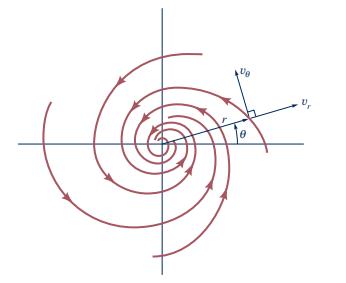
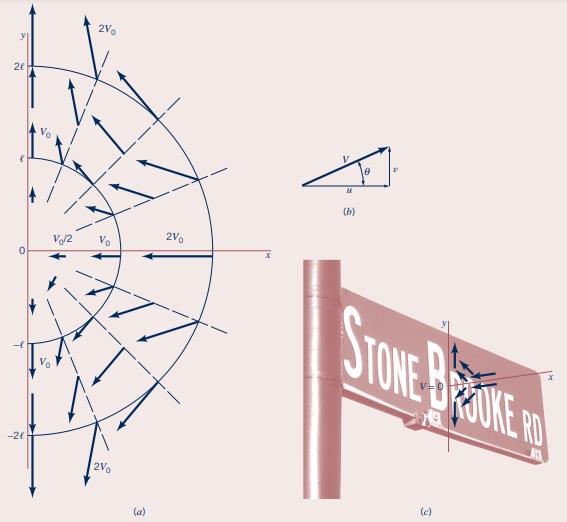
A flow can be visualized by plotting the velocity field as velocity vectors at representative locations in the flow as shown in Fig. E4.1. Consider the velocity field given in polar coordinates by \(v_{r}=-10 / r\), and \(v_{\theta}=10 / r\). This flow approximates a fluid swirling into a sink as
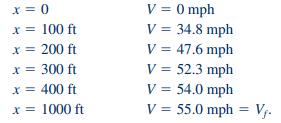
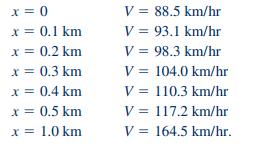
A car accelerates from rest to a final constant velocity \(V_{f}\) and a police officer records the following velocities at various locations \(x\) along the highway:Find a mathematical Eulerian expression for the velocity \(V\) traveled by the car as a function of the final velocity \(V_{f}\) of
The components of a velocity field are given by \(u=x+y\), \(v=x y^{3}+16\), and \(w=0\). Determine the location of any stagnation points \((\mathbf{V}=0)\) in the flow field.
A two-dimensional, unsteady velocity field is given by\[ u=5 x(1+t) \quad \text { and } \quad v=5 y(-1+t) \]where \(u\) is the \(x\)-velocity component and \(v\) the \(y\)-velocity component. Find \(x(t)\) and \(y(t)\) if \(x=x_{0}\) and \(y=y_{0}\) at \(t=0\). Do the velocity components
The velocity field of a flow is given by \(u=-V_{0} y /\left(x^{2}+\right.\) \(\left.y^{2}\right)^{1 / 2}\) and \(v=V_{0} x /\left(x^{2}+y^{2}\right)^{1 / 2}\), where \(V_{0}\) is a constant. Where in the flow field is the speed equal to \(V_{0}\) ? Determine the equation of the streamlines and
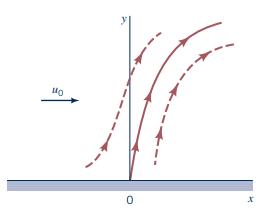
A velocity field is given by \(\mathbf{V}=x \hat{\mathbf{i}}+x(x-1)(y+1) \hat{\mathbf{j}}\), where \(u\) and \(v\) are in \(\mathrm{ft} / \mathrm{s}\) and \(x\) and \(y\) are in feet. Plot the streamline that passes through \(x=0\) and \(y=0\). Compare this streamline with the streakline through
From time \(t=0\) to \(t=5 \mathrm{hr}\) radioactive steam is released from a nuclear power plant accident located at \(x=-1\) mile and \(y=3\) miles. The following wind conditions are expected: \(\mathbf{V}=10 \hat{\mathbf{i}}-5 \hat{\mathbf{j}} \mathrm{mph}\) for \(0
The \(x\) and \(y\) components of a velocity field are given by \(u=x^{2} y\) and \(v=-x y^{2}\). Determine the equation for the streamlines of this flow and compare it with those in Example 4.2. Is the flow in this problem the same as that in Example 4.2? Explain.Example 4.2Consider the
In addition to the customary horizontal velocity components of the air in the atmosphere (the "wind"), there often are vertical air currents (thermals) caused by buoyant effects due to uneven heating of the air as indicated in Fig. P4.14. Assume that the velocity field in a certain region is
A test car is traveling along a level road at \(88 \mathrm{~km} / \mathrm{hr}\). In order to study the acceleration characteristics of a newly installed engine, the car accelerates at its maximum possible rate. The test crew records the following velocities at various locations along the level
For any steady flow the streamlines and streaklines are the same. For most unsteady flows this is not true. However, there are unsteady flows for which the streamlines and streaklines are the same. Describe a flow field for which this is true.
A tornado has the following velocity components in polar coordinates:\[ V_{r}=-\frac{C_{1}}{r} \quad \text { and } \quad V_{\theta}=-\frac{C_{2}}{r} \]Note that the air is spiraling inward. Find an equation for the streamlines. \(r\) and \(\theta\) are polar coordinates.
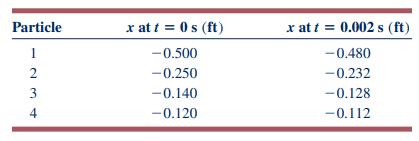
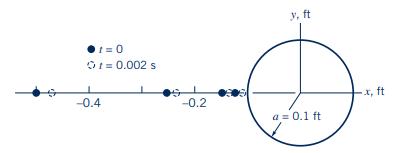
The Wide World of Fluids article titled "Follow those particles,". Two photographs of four particles in a flow past a sphere are superposed as shown in Fig. P4.18. The time interval between the photos is \(\Delta t=0.002 \mathrm{~s}\). The locations of the particles, as determined from the photos,
Air flows steadily through a circular, constant-diameter duct. The air is perfectly inviscid, so the velocity profile is flat across each flow area. However, the air density decreases as the air flows down the duct. Is this a one-, two-, or three-dimensional flow?
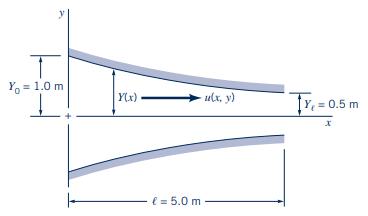
A constant-density fluid flows in the converging, twodimensional channel shown in Fig. P4.20. The width perpendicular to the paper is quite large compared to the channel height. The velocity in the \(z\) direction is zero. The channel half-height, \(Y\), and the fluid \(x\) velocity, \(u\), are
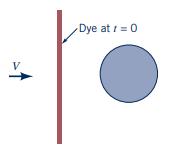
Pathlines and streaklines provide ways to visualize flows. Another technique would be to instantly inject a line of dye across streamlines and observe how this line moves as time increases. For example, consider the initially straight dye line injected in front of the circular cylinder shown in
Classify the following flows as one-, two-, or three-dimensional. Sketch a few streamlines for each.(a) Rainwater flow down a wide driveway(b) Flow in a straight horizontal pipe(c) Flow in a straight pipe inclined upward at a \(45^{\circ}\) angle(d) Flow in a long pipe that follows the ground in
The velocity components of \(u\) and \(v\) of a two-dimensional flow are given by\[ u=a x+\frac{b x}{x^{2} y^{2}} \quad \text { and } \quad v=a y+\frac{b y}{x^{2} y^{2}} \]where \(a\) and \(b\) are constants. Calculate the acceleration.
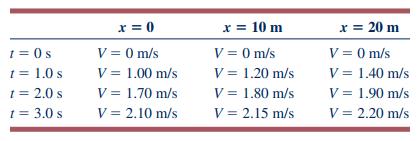
Air is delivered through a constant-diameter duct by a fan. The air is inviscid, so the fluid velocity profile is "flat" across each cross section. During the fan start-up, the following velocities were measured at the time \(t\) and axial positions \(x\) :Calculate the local acceleration, the
Water flows through a constant diameter pipe with a uniform velocity given by \(\mathbf{V}=(8 / t+5) \hat{\mathbf{j}} \mathrm{m} / \mathrm{s}\), where \(t\) is in seconds. Determine the acceleration at time \(t=1,2\), and \(10 \mathrm{~s}\).
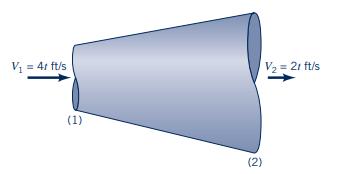
The velocity of air in the diverging pipe shown in Fig. P4.26 is given by \(V_{1}=4 t \mathrm{ft} / \mathrm{s}\) and \(V_{2}=2 t \mathrm{ft} / \mathrm{s}\), where \(t\) is in seconds. (a) Determine the local acceleration at points (1) and (2). (b) Is the average convective acceleration between
A certain flow field has the velocity vector\(\mathbf{V}=\frac{-2 x y z}{\left(x^{2}+y^{2}\right)^{2}} \mathbf{i}+\frac{\left(x^{2}-y^{2}\right) z}{\left(x^{2}+y^{2}\right)^{2}} \mathbf{j}+\frac{y}{x^{2}+y^{2}} \mathbf{k}\). Find the acceleration vector for this flow.
Determine the \(x\)-component of the acceleration, \(a_{x}\), along the centerline \((y=0)\) for the flow of Problem 4.20. Can you determine the acceleration vector at a location not on the centerline? Why or why not?Problem 4.20A constant-density fluid flows in the converging, twodimensional
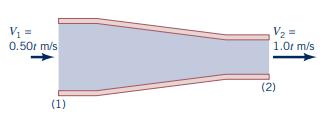
The velocity of the water in the pipe shown in Fig. P4.29 is given by \(V_{1}=0.50 t \mathrm{~m} / \mathrm{s}\) and \(V_{2}=1.0 t \mathrm{~m} / \mathrm{s}\), where \(t\) is in seconds. Determine the local acceleration at points (1) and (2). Is the average convective acceleration between these two
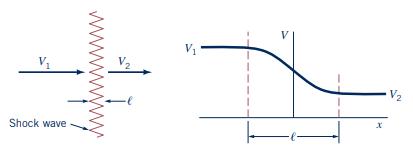
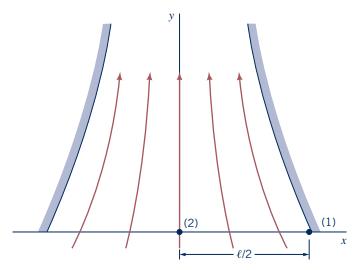
A shock wave is a very thin layer (thickness \(=\ell\) ) in a highspeed (supersonic) gas flow across which the flow properties (velocity, density, pressure, etc.) change from state (1) to state (2) as shown in Fig. P4.30. If \(V_{1}=1800 \mathrm{fps}, V_{2}=700 \mathrm{fps}\), and \(\ell=10^{-4}
Estimate the average acceleration of water as it travels through the nozzle on your garden hose. List all assumptions and show all calculations.
A stream of water from the faucet strikes the bottom of the sink. Estimate the maximum acceleration experienced by the water particles. List all assumptions and show calculations.
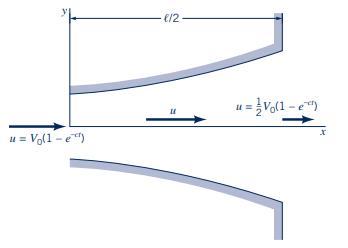
As a valve is opened, water flows through the diffuser shown in Fig. P4.33 at an increasing flowrate so that the velocity along the centerline is given by \(\mathbf{V}=\hat{u} \hat{\mathbf{i}}=V_{0}\left(1-e^{-c t}\right)(1-x / \ell) \hat{\mathbf{i}}\), where \(u_{0}, c\), and \(\ell\) are
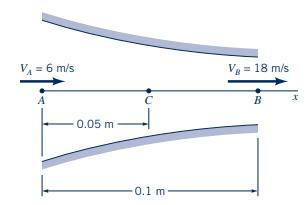
The fluid velocity along the \(x\) axis shown in Fig. P4.34 changes from \(6 \mathrm{~m} / \mathrm{s}\) at point \(A\) to \(18 \mathrm{~m} / \mathrm{s}\) at point \(B\). It is also known that the velocity is a linear function of distance along the streamline. Determine the acceleration at points
A fluid flows along the \(x\) axis with a velocity given by \(\mathbf{V}=(x / t) \hat{\mathbf{i}}\), where \(x\) is in feet and \(t\) in seconds. (a) Plot the speed for \(0 \leq x \leq 10 \mathrm{ft}\) and \(t=3 \mathrm{~s}\). (b) Plot the speed for \(x=7 \mathrm{ft}\) and \(2 \leq t \leq 4
A constant-density fluid flows through a converging section having an area \(A\) given by\[ A=\frac{A_{0}}{1+(x / \ell)} \]where \(A_{0}\) is the area at \(x=0\). Determine the velocity and acceleration of the fluid in Eulerian form and then the velocity and acceleration of a fluid particle in
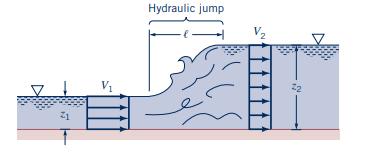
A hydraulic jump is a rather sudden change in depth of a liquid layer as it flows in an open channel as shown in Fig. P4.37 and Video V10.12. In a relatively short distance (thickness \(=\ell\) ) the liquid depth changes from \(z_{1}\) to \(z_{2}\), with a corresponding change in velocity from
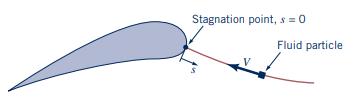
A fluid particle flowing along a stagnation streamline, as shown in Video V4.9 and Fig. P4.38, slows down as it approaches the stagnation point. Measurements of the dye flow in the video indicate that the location of a particle starting on the stagnation streamline a distance \(s=0.6 \mathrm{ft}\)
A nozzle is designed to accelerate the fluid from \(V_{1}\) to \(V_{2}\) in a linear fashion. That is, \(V=a x+b\), where \(a\) and \(b\) are constants. If the flow is constant with \(V_{1}=10 \mathrm{~m} / \mathrm{s}\) at \(x_{1}=0\) and \(V_{2}=25 \mathrm{~m} / \mathrm{s}\) at \(x_{2}=1
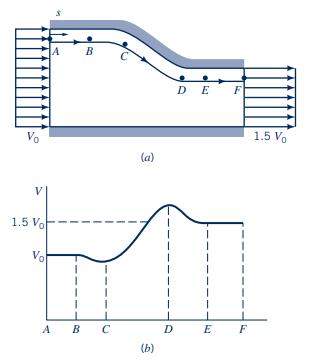
An incompressible fluid flows through the converging duct shown in Fig. P4.40a with velocity \(V_{0}\) at the entrance. Measurements indicate that the actual velocity of the fluid near the wall of the duct along streamline \(A-F\) is as shown in Fig. P4.40b. Sketch the component of acceleration
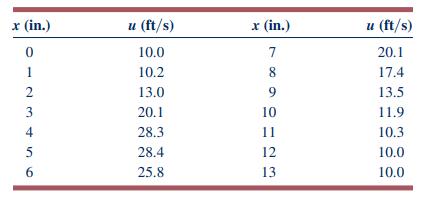
Air flows steadily through a variable area pipe with a velocity of \(\mathbf{V}=u(x) \hat{\mathbf{i}} \mathrm{ft} / \mathrm{s}\), where the approximate measured values of \(u(x)\) are given in the table. Plot the acceleration as a function of \(x\) for \(0 \leq x \leq 12\) in. Plot the acceleration
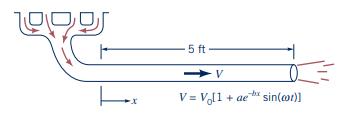
As is indicated in Fig. P4.42, the speed of exhaust in a car's exhaust pipe varies in time and distance because of the periodic nature of the engine's operation and the damping effect with distance from the engine. Assume that the speed is given by \(V=V_{0}\left[1+a e^{-b x} \sin (\omega
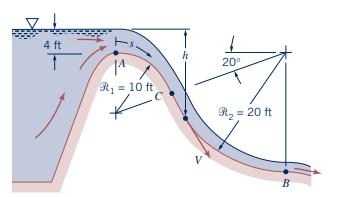
Water flows down the face of the dam shown in Fig. P4.43. The face of the dam consists of two circular arcs with radii of 10 and \(20 \mathrm{ft}\) as shown. If the speed of the water along streamline A-B is approximately \(V=(2 g h)^{1 / 2}\), where the distance \(h\) is as indicated, plot the
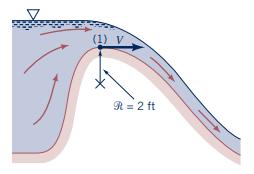
Water flows over the crest of a dam with speed \(V\) as shown in Fig. P4.44. Determine the speed if the magnitude of the normal acceleration at point (1) is to equal the acceleration of gravity, \(g\).Figure P4.44 (1) V R = 2 ft
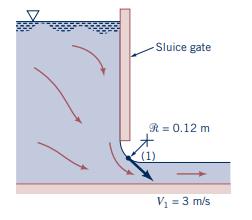
Water flows under the sluice gate shown in Fig. P4.45. If \(V_{1}=3 \mathrm{~m} / \mathrm{s}\), what is the normal acceleration at point (1)?Figure P4.45 Sluice gate R = 0.12 m (1) V = 3 m/s
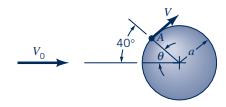
A fluid flows past a sphere with an upstream velocity of \(V_{0}=40 \mathrm{~m} / \mathrm{s}\) as shown in Fig. P4.46. From a more advanced theory it is found that the speed of the fluid along the front part of the sphere is \(V=\frac{3}{2} V_{0} \sin \theta\). Determine the streamwise and normal
Assume that the streamlines for the wingtip vortices from an airplane Fig. P4.15 can be approximated by circles of radius \(r\) and that the speed is \(V=K / r\), where \(K\) is a constant. Determine the streamline acceleration, \(a_{s}\), and the normal acceleration, \(a_{n}\), for this flow.Fig.
The velocity components for steady flow through the nozzle shown in Fig. P4.48 are \(u=-V_{0} x / \ell\) and \(v=V_{0}[1+(y / \ell)]\), where \(V_{0}\) and \(\ell\) are constants. Determine the ratio of the magnitude of the acceleration at point (1) to that at point (2).Figure P4.48 y (2) -1/2- (1)
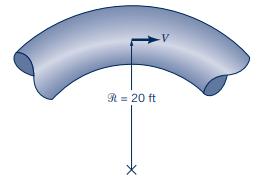
Water flows through the curved hose shown in Fig. P4.49 with an increasing speed of \(V=10 t \mathrm{ft} / \mathrm{s}\), where \(t\) is in seconds. For \(t=2 \mathrm{~s}\) determine(a) the component of acceleration along the streamline,(b) the component of acceleration normal to the streamline,(c)
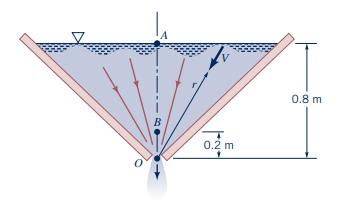
Water flows though the slit at the bottom of a two-dimensional water trough as shown in Fig. P4.50. Throughout most of the trough the flow is approximately radial (along rays from \(O\) ) with a velocity of \(V=c / r\), where \(r\) is the radial coordinate and \(c\) is a constant. If the velocity
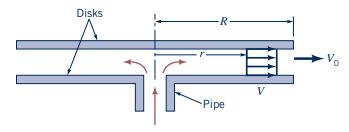
Air flows from a pipe into the region between two parallel circular disks as shown in Fig. P4.51. The fluid velocity in the gap between the disks is closely approximated by \(V=V_{0} R / r\), where \(R\) is the radius of the disk, \(r\) is the radial coordinate, and \(V_{0}\) is the fluid velocity
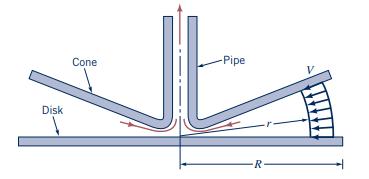
Air flows into a pipe from the region between a circular disk and a cone as shown in Fig. P4.52. The fluid velocity in the gap between the disk and the cone is closely approximated by \(V=V_{0} R^{2} / r^{2}\), where \(R\) is the radius of the disk, \(r\) is the radial coordinate, and \(V_{0}\) is
Fluid flows through a pipe with a velocity of \(2.0 \mathrm{ft} / \mathrm{s}\) and is being heated, so the fluid temperature \(T\) at axial position \(x\) increases at a steady rate of \(30.0^{\circ} \mathrm{F} / \mathrm{min}\). In addition, the fluid temperature is increasing in the axial
A gas flows along the \(x\) axis with a speed of \(V=5 x \mathrm{~m} / \mathrm{s}\) and a pressure of \(p=10 x^{2} \mathrm{~N} / \mathrm{m}^{2}\), where \(x\) is in meters.(a) Determine the time rate of change of pressure at the fixed location \(x=1\).(b) Determine the time rate of change of
Assume the temperature of the exhaust in an exhaust pipe can be approximated by \(T=T_{0}\left(1+a e^{-b x}\right)[1+c \cos (\omega t)]\), where \(T_{0}=100^{\circ} \mathrm{C}, a=3, b=0.03 \mathrm{~m}^{-1}, c=0.05\), and \(\omega=100 \mathrm{rad} / \mathrm{s}\). If the exhaust speed is a constant
A bicyclist leaves from her home at 9 A.M. and rides to a beach \(40 \mathrm{mi}\) away. Because of a breeze off the ocean, the temperature at the beach remains \(60^{\circ} \mathrm{F}\) throughout the day. At the cyclist's home the temperature increases linearly with time, going from \(60^{\circ}
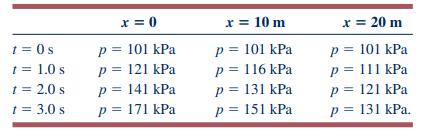
The following pressures for the air flow in Problem 4.24 were measured:Find the local rate of change of pressure \(\partial p / \partial t\) and the convective rate of change of pressure \(V \partial p / \partial x\) at \(t=2.0 \mathrm{~s}\) and \(x=10 \mathrm{~m}\).Problem 4.24Air is delivered
Obtain a photograph/image of a situation in which a fluid is flowing. Print this photo and draw a control volume through which the fluid flows. Write a brief paragraph that describes how the fluid flows into and out of this control volume.
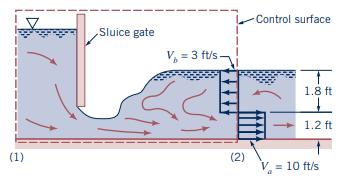
In the region just downstream of a sluice gate, the water may develop a reverse flow region as is indicated in Fig. P4.59 and Video V10.9. The velocity profile is assumed to consist of two uniform regions, one with velocity \(V_{a}=10 \mathrm{fps}\) and the other with \(V_{b}=3 \mathrm{fps}\).
At time \(t=0\) the valve on an initially empty (perfect vacuum, \(ho=0)\) tank is opened and air rushes in. If the tank has a volume of \(\forall_{0}\) and the density of air within the tank increases as \(ho=ho_{\infty}\left(1-e^{-b t}\right)\), where \(b\) is a constant, determine the time rate
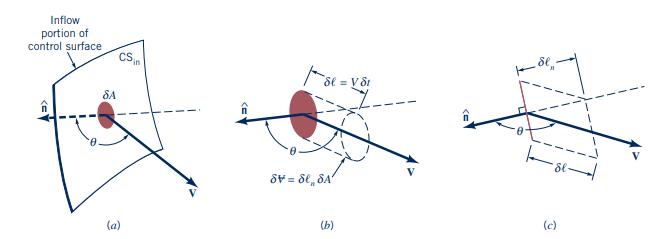
From calculus, one obtains the following formula (Leibnitz rule) for the time derivative of an integral that contains time in both the integrand and the limits of the integration:\[ \frac{d}{d t} \int_{x_{1}(t)}^{x_{2}(t)} f(x, t) d x=\int_{x_{1}}^{x_{2}} \frac{\partial f}{\partial t} d
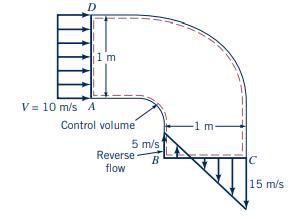
Air enters an elbow with a uniform speed of \(10 \mathrm{~m} / \mathrm{s}\) as shown in Fig. P4.62. At the exit of the elbow, the velocity profile is not uniform. In fact, there is a region of separation or reverse flow. The fixed control volume \(A B C D\) coincides with the system at time
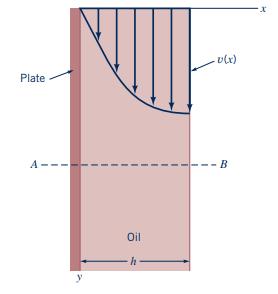
A layer of oil flows down a vertical plate as shown in Fig. P4.63 with a velocity of \(\mathbf{V}=\left(V_{0} / h^{2}\right)\left(2 h x-x^{2}\right) \hat{\mathbf{j}}\) where \(V_{0}\) and \(h\) are constants.(a) Show that the fluid sticks to the plate and that the shear stress at the edge of the
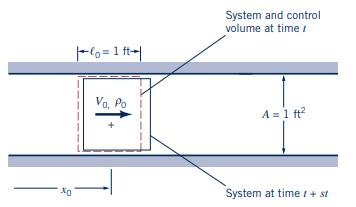
Figure P4.64 shows a fixed control volume. It has a volume \(V_{0}=1.0 \mathrm{ft}^{3}\), a flow area \(A=1.0 \mathrm{ft}^{2}\), and a length \(\ell_{0}=1.0 \mathrm{ft}\). Position \(x\) represents the center of the control volume where the fluid velocity \(V_{0}=1.0 \mathrm{ft} / \mathrm{s}\) and
Find \(D V / D t\) for the system in Problem 4.64.Problem 4.64Figure P4.64 shows a fixed control volume. It has a volume \(V_{0}=1.0 \mathrm{ft}^{3}\), a flow area \(A=1.0 \mathrm{ft}^{2}\), and a length \(\ell_{0}=1.0 \mathrm{ft}\). Position \(x\) represents the center of the control volume where
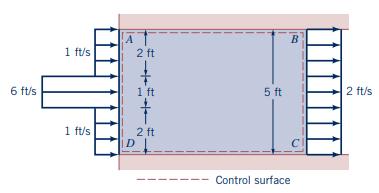
Water enters a 5 -ft-wide, 1 -ft-deep channel as shown in Fig. P4.66. Across the inlet the water velocity is \(6 \mathrm{ft} / \mathrm{s}\) in the center portion of the channel and \(1 \mathrm{ft} / \mathrm{s}\) in the remainder of it. Farther downstream the water flows at a uniform \(2 \mathrm{ft}
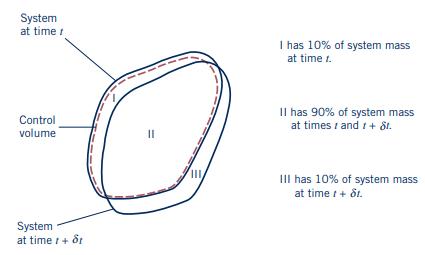
Figure P4.67 illustrates a system and fixed control volume at time \(t\) and the system at a short time \(\delta t\) later. The system temperature is \(T=100^{\circ} \mathrm{F}\) at time \(t\) and \(T=103^{\circ} \mathrm{F}\) at time \(t+\delta t\), where \(\delta t=0.1 \mathrm{~s}\). The system
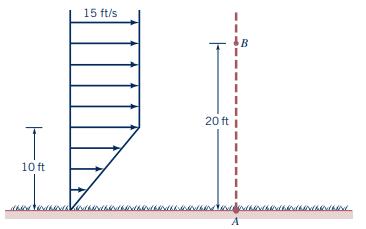
The wind blows across a field with an approximate velocity profile as shown in Fig. P4.68. Use Eq. 4.16 with the parameter \(b\) equal to the velocity to determine the momentum flowrate across the vertical surface \(A-B\), which is of unit depth into the paper.Figure P4.68 15 ft/s T 10 ft 20 ft A
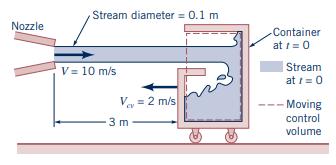
Water flows from a nozzle with a speed of \(V=10 \mathrm{~m} / \mathrm{s}\) and is collected in a container that moves toward the nozzle with a speed of \(V_{c v}=2 \mathrm{~m} / \mathrm{s}\) as shown in Fig. P4.69. The moving control surface consists of the inner surface of the container. The
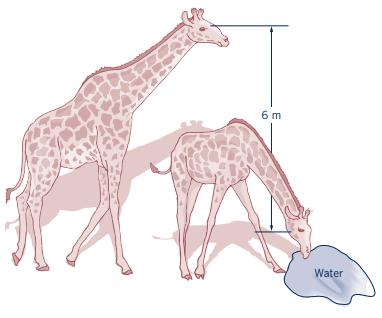
The Wide World of Fluids article titled "Giraffe's blood pressure,".(a) Determine the change in hydrostatic pressure in a giraffe's head as it lowers its head from eating leaves \(6 \mathrm{~m}\) above the ground to getting a drink of water at ground level as shown in Fig. P2.17. Assume the
What would be the barometric pressure reading, in \(\mathrm{mm} \mathrm{Hg}\), at an elevation of \(4 \mathrm{~km}\) in the U.S. standard atmosphere?
What pressure gradient along the streamline, \(d p / d s\), is required to accelerate water upward in a vertical pipe at a rate of \(30 \mathrm{ft} / \mathrm{s}^{2}\) ? What is the answer if the flow is downward?
The Bernoulli equation is valid for steady, inviscid, incompressible flows with constant acceleration of gravity. Consider flow on a planet where the acceleration of gravity varies with height so that \(g=g_{0}-c z\), where \(g_{0}\) and \(c\) are constants. Integrate \(" F=m a "\) along a
2013 Indianapolis 500 champion Tony Kanaan holds his hand out of his IndyCar while driving through still air with standard atmospheric conditions.(a) For safety, the pit lane speed limit is \(60 \mathrm{mph}\). At this speed, what is the maximum pressure on his hand?(b) Back on the race track, what
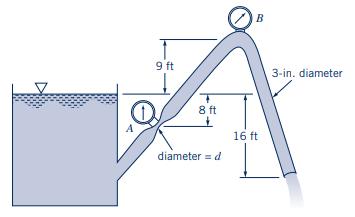
Water flows steadily from a large open tank and discharges into the atmosphere though a 3-in.-diameter pipe as shown in Fig. P3.89. Determine the diameter, \(d\), in the narrowed section of the pipe at \(A\) if the pressure gages at \(A\) and \(B\) indicate the same pressure.Figure P3.89 9 ft 8 ft
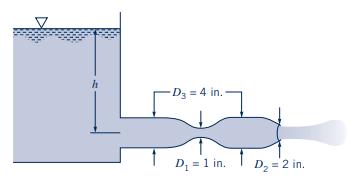
Water flows from a large tank as shown in Fig. P3.90. Atmospheric pressure is \(14.5 \mathrm{psia}\), and the vapor pressure is 1.60 psia. If viscous effects are neglected, at what height, \(h\), will cavitation begin? To avoid cavitation, should the value of \(D_{1}\) be increased or decreased? To
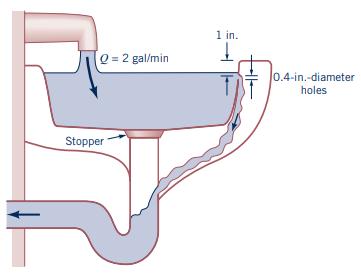
Water flows into the sink shown in Fig. P3.91 and Video V5.1 at a rate of \(2 \mathrm{gal} / \mathrm{min}\). If the drain is closed, the water will eventually flow through the overflow drain holes rather than over the edge of the sink. How many 0.4-in.-diameter drain holes are needed to ensure that
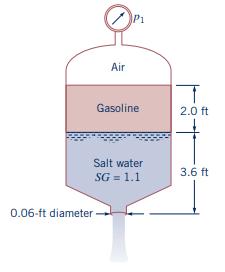
What pressure, \(p_{1}\), is needed to produce a flowrate of 0.09 \(\mathrm{ft}^{3} / \mathrm{s}\) from the tank shown in Fig. P3.92?Figure P3.92 Air P1 T Gasoline 2.0 ft Salt water SG = 1.1 0.06-ft diameter- 3.6 ft
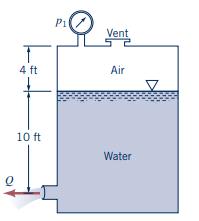
The vent on the tank shown in Fig. P3.93 is closed and the tank pressurized to increase the flowrate. What pressure, \(p_{1}\), is needed to produce twice the flowrate of that when the vent is open?Figure P3.93 T 4 ft Pi Vent Air 10 ft Water
A sump pump is submerged in \(60^{\circ} \mathrm{F}\) ordinary water that vaporizes at a pressure of \(0.256 \mathrm{psia}\). The pump inlet has an inside diameter of \(2.067 \mathrm{in}\). and is \(15 \mathrm{ft}\) below the water surface. Find the maximum possible flow rate before cavitation
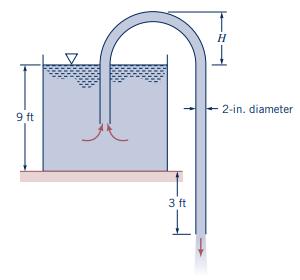
Water is siphoned from a large tank and discharges into the atmosphere through a 2-in.-diameter tube as shown in Fig. P3.95. The end of the tube is \(3 \mathrm{ft}\) below the tank bottom, and viscous effects are negligible.(a) Determine the volume flowrate from the tank.(b) Determine the maximum
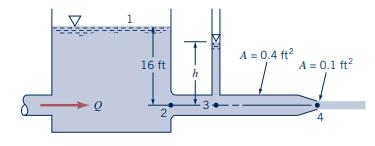
Water flows in the system shown in Fig. P3.96. Assume frictionless flow.(a) Calculate the rate \(Q\) at which water must be added at the inlet to maintain the 16-ft height.(b) Calculate the height \(h\) in feet of water in the static-pressure tube.Figure P3.96 A = 0.4 ft 16 ft A = 0.1 ft h 2 3
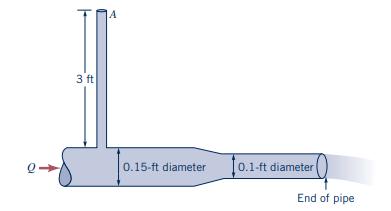
Water flows steadily from the pipe shown in Fig. P3.97 with negligible viscous effects. Determine the maximum flowrate if the water is not to flow from the open vertical tube at \(A\).Figure P3.97 3 ft A 0.15-ft diameter 0.1-ft diameter End of pipe
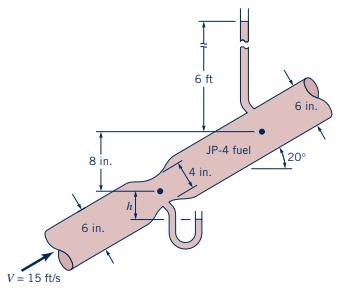
JP-4 fuel \((S G=0.77)\) flows through the Venturi meter shown in Fig. P3.98 with a velocity of \(15 \mathrm{ft} / \mathrm{s}\) in the 6 -in. pipe. If viscous effects are negligible, determine the elevation, \(h\), of the fuel in the open tube connected to the throat of the Venturi meter.Figure
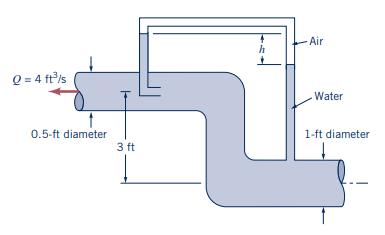
Water, considered an inviscid, incompressible fluid, flows steadily as shown in Fig. P3.99. Determine \(h\).Figure P3.99 Q = 4 ft/s h Air Water 0.5-ft diameter 1-ft diameter 3 ft
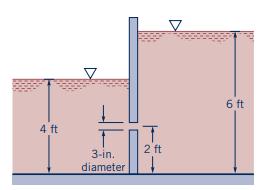
Determine the flowrate through the submerged orifice shown in Fig. P3.100 if the contraction coefficient is \(C_{c}=0.63\).Figure P3.100 4 ft 3-in. diameter 2 ft 6 ft
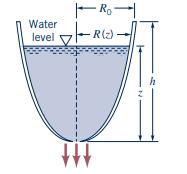
The water clock (clepsydra) shown in Fig. P3.101 is an ancient device for measuring time by the falling water level in a large glass container. The water slowly drains out through a small hole in the bottom. Determine the approximate shape \(R(z)\) of a container of circular cross section required
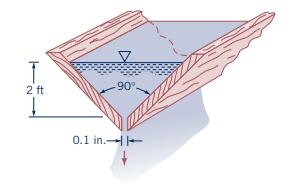
A long water trough of triangular cross section is formed from two planks as is shown in Fig. P3.102. A gap of 0.1 in. remains at the junction of the two planks. If the water depth initially was \(2 \mathrm{ft}\), how long a time does it take for the water depth to reduce to \(1 \mathrm{ft}\)
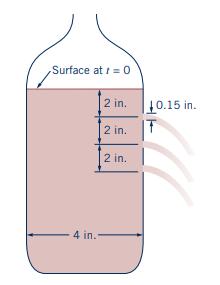
Pop (with the same properties as water) flows from a 4-in.-diameter pop container that contains three holes as shown in Fig. P3.103 (see Video 3.9). The diameter of each fluid stream is \(0.15 \mathrm{in}\)., and the distance between holes is \(2 \mathrm{in}\). If viscous effects are negligible and
A spherical tank of diameter \(D\) has a drain hole of diameter \(d\) at its bottom. A vent at the top of the tank maintains atmospheric pressure at the liquid surface within the tank. The flow is quasisteady and inviscid and the tank is full of water initially. Determine the water depth as a
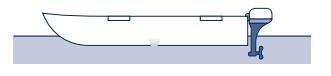
A small hole develops in the bottom of the stationary rowboat shown in Fig. P3.105. Estimate the amount of time it will take for the boat to sink. List all assumptions and show all calculations.Figure P3.105
When the drain plug is pulled, water flows from a hole in the bottom of a large, open cylindrical tank. Show that if viscous effects are negligible and if the flow is assumed to be quasisteady, then it takes 3.41 times longer to empty the entire tank than it does to empty the first half of the
Showing 800 - 900
of 2369
First
2
3
4
5
6
7
8
9
10
11
12
13
14
15
16
Last
Step by Step Answers

 Get 50% OFF
Claim Now
Get 50% OFF
Claim Now