New Semester
Started
Get
50% OFF
Study Help!
--h --m --s
Claim Now
Question Answers
Textbooks
Find textbooks, questions and answers
Oops, something went wrong!
Change your search query and then try again
S
Books
FREE
Study Help
Expert Questions
Accounting
General Management
Mathematics
Finance
Organizational Behaviour
Law
Physics
Operating System
Management Leadership
Sociology
Programming
Marketing
Database
Computer Network
Economics
Textbooks Solutions
Accounting
Managerial Accounting
Management Leadership
Cost Accounting
Statistics
Business Law
Corporate Finance
Finance
Economics
Auditing
Tutors
Online Tutors
Find a Tutor
Hire a Tutor
Become a Tutor
AI Tutor
AI Study Planner
NEW
Sell Books
Search
Search
Sign In
Register
study help
engineering
introduction mechanical engineering
Mechanical Vibrations Theory And Applications 1st Edition S. GRAHAM KELLY - Solutions
What is the relationship between a nondimensional natural frequency and the corresponding dimensional natural frequency for a torsional shaft.
A bar with a length of \(L\) and cross-sectional area \(A\) is made of a material with an elastic modulus \(E\) and mass density \(ho\) is fixed at \(x=0\) and has a rigid mass \(m\) attached at \(x=L\). It has a longitudinal mode shape \(X_{k}(x)\) which corresponds to a natural frequency
A bar with a length of \(L\) and cross-sectional area \(A\) is made of a material with an elastic modulus \(E\) and mass density \(ho\) is fixed at \(x=0\) and is attached to a spring with a stiffness of \(k\) at \(x=L\). The bar also has a longitudinal mode shape \(X_{k}(x)\) which corresponds to
The differential equation for the vibrations of a beam is\[ ho A \frac{\partial^{2} w}{\partial t^{2}}+E I \frac{\partial^{4} w}{\partial x^{4}}=f(x, t) \]Explain the physical meaning of each term in the equation.
The characteristic equation for a fixed-free beam is \(\cos \lambda^{1 / 4} \cosh \lambda^{1 / 4}=-1\). This is an example of a ______________ equation to solve for \(\lambda\).
What are the boundary conditions for the free vibrations of a fixed-free beam?
What are the boundary conditions for the free vibrations of a free-free beam?
What are the boundary conditions for the free vibrations of a beam that is fixed at \(x=0\) and has a rigid mass \(m\) attached at \(x=L\) ?
The characteristic equation for the fixed-pinned beam is the same as the characteristic equation for the pinned-free beam, yet their lowest natural frequency is different. How is this possible?
A bar with a length of \(L\) and cross-sectional area \(A\) is made of a material with an elastic modulus \(E\) and mass density \(ho\) and has a normalized longitudinal mode shape \(X_{k}(x)\) which corresponds to a natural frequency \(\omega_{k}\).(a) What is the potential energy of a system that
For Short Answer Problem 10.29 what is the value of \(R(w)\) ?Data From Short Problem 10.29:A bar with a length of \(L\) and cross-sectional area \(A\) is made of a material with an elastic modulus \(E\) and mass density \(ho\) and has a normalized longitudinal mode shape \(X_{k}(x)\) which
A beam with a length \(L\) cross-sectional area \(A\), and moment of inertia \(I\) is made of a material with an elastic modulus \(E\) and mass density \(ho\) and has a normalized transverse mode shape \(X_{k}(x)\) which corresponds to a natural frequency \(\omega_{k}\).(a) What is the potential
For Short Answer Problem 10.31 what is the value of \(R(w)\) ?Data From Short Problem 10.31:A beam with a length \(L\) cross-sectional area \(A\), and moment of inertia \(I\) is made of a material with an elastic modulus \(E\) and mass density \(ho\) and has a normalized transverse mode shape
What is the wave speed for torsional oscillations in a circular shaft made from steel? The shaft is of length \(60 \mathrm{~cm}\) and has a radius of \(3 \mathrm{~cm}\).
Calculate the wave speed of longitudinal waves in a \(3-\mathrm{m}\) long steel bar \(\left(E=210 \times 10^{9} \mathrm{~N} / \mathrm{m}^{2}, ho=7580 \mathrm{~kg} / \mathrm{m}^{3}\right)\) with a circular cross section of a \(20 \mathrm{~mm}\) radius.
Calculate the three lowest natural frequencies of a solid \(20-\mathrm{cm}\) radius steel shaft \(\left(G=80 \times 10^{9} \mathrm{~N} / \mathrm{m}^{2}, ho=7500 \mathrm{~kg} / \mathrm{m}^{3}\right)\) with a length of \(1.5 \mathrm{~m}\) that is fixed at one end and free at its other end.
The characteristic equation for a fourth-order continuous system is \(\cos \lambda=0\). What is the lowest natural frequency of the system?
What are the three lowest positive values of \(\lambda\) that satisfy the equation \(\tan \lambda=6 / \lambda\) ?
What are the three lowest positive values of \(\lambda\) that satisfy the equation \(\tan \lambda=4 \lambda\) ?
The nondimensional mode shape of a uniform bar is \(\sin 5 \pi \mathrm{x}\).(a) Determine the potential energy of this mode.(b) Determine the kinetic energy of this mode.(c) What is the nondimensional natural frequency that corresponds to this mode?
The nondimensional mode shape of a beam is \(\sqrt{2} \sin 3 \pi x\).(a) Determine the potential energy of this mode.(b) Determine the kinetic energy of this mode.(c) What is the nondimensional natural frequency that corresponds to this mode?
A circular bar with a length of \(80 \mathrm{~cm}\) and radius of \(3 \mathrm{~cm}\) is made of steel which has an elastic modulus \(200 \times 10^{9} \mathrm{~N} / \mathrm{m}^{2}\) and mass density \(7600 \mathrm{~kg} / \mathrm{m}^{3}\). The bar has a mode shape of \(X(x)=33.91 \cos 13.74
A carbon nanotube ( \(E=1 G P a, ho=2.3 \mathrm{~g} / \mathrm{cm}^{3}\) ) has a length of \(200 \mathrm{~nm}\) and radius of \(5 \mathrm{~nm}\). Using a fixed-free beam model for the nanotube, calculate its first four natural frequencies.
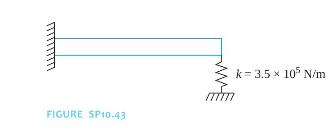
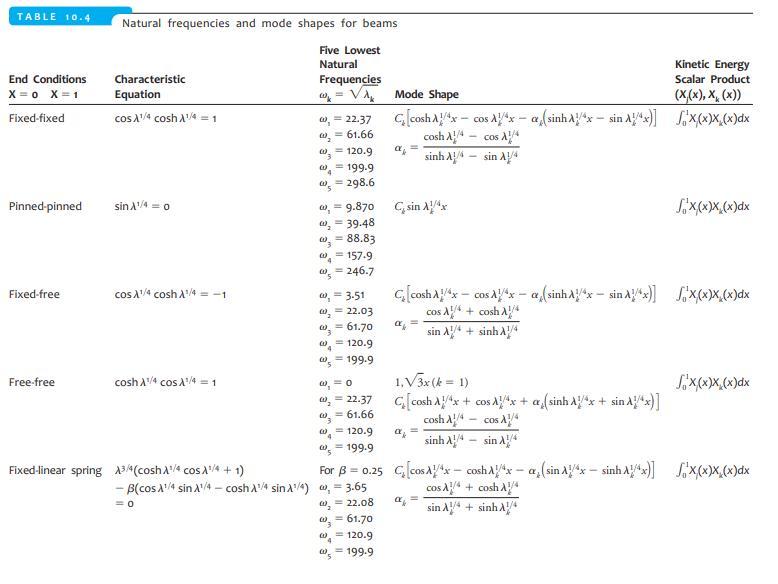
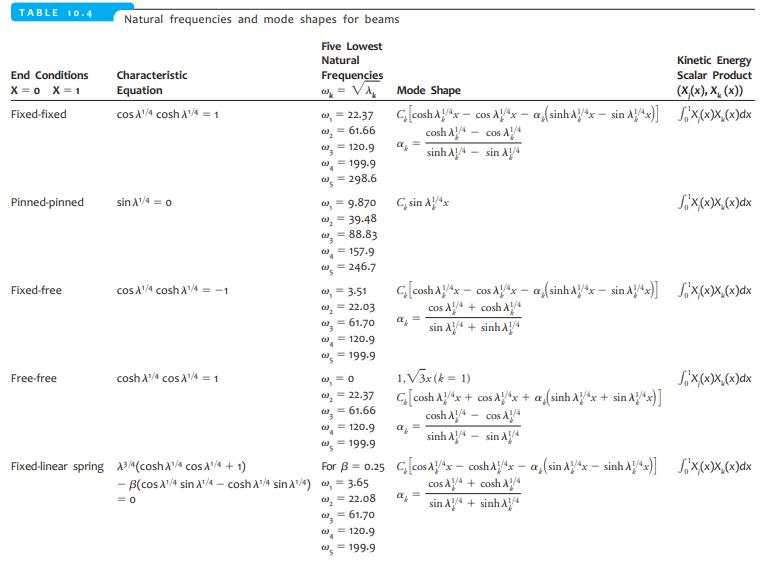
Each of the beams of Figures SP10.43 is made from a material of \(E=210 \times 10^{9} \mathrm{~N} / \mathrm{m}^{2}\) and \(ho=7580 \mathrm{~kg} / \mathrm{m}^{3}\) with A \(=1.2 \times 10^{-2} \mathrm{~m}^{2}, I=4.0 \times 10^{-5} \mathrm{~m}^{4}\), and \(L=1.4 \mathrm{~m}\). Use Table 10.4 to
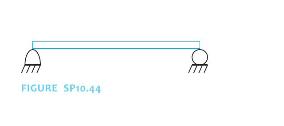
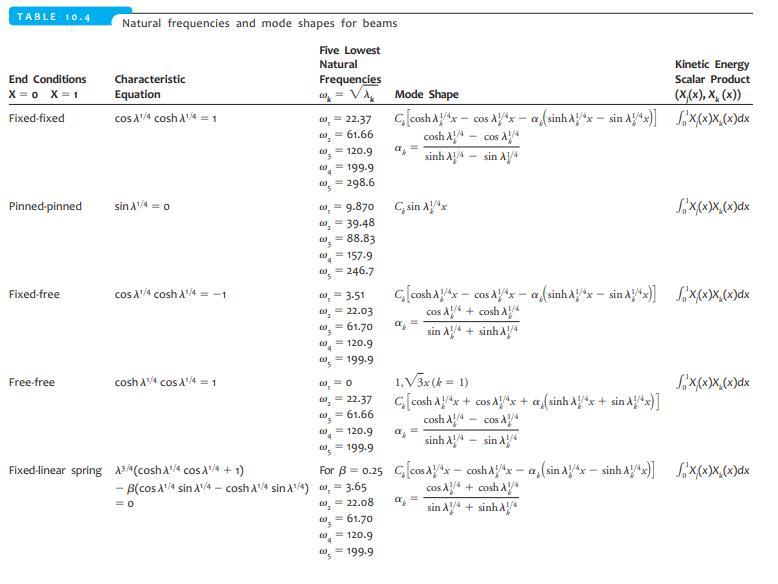
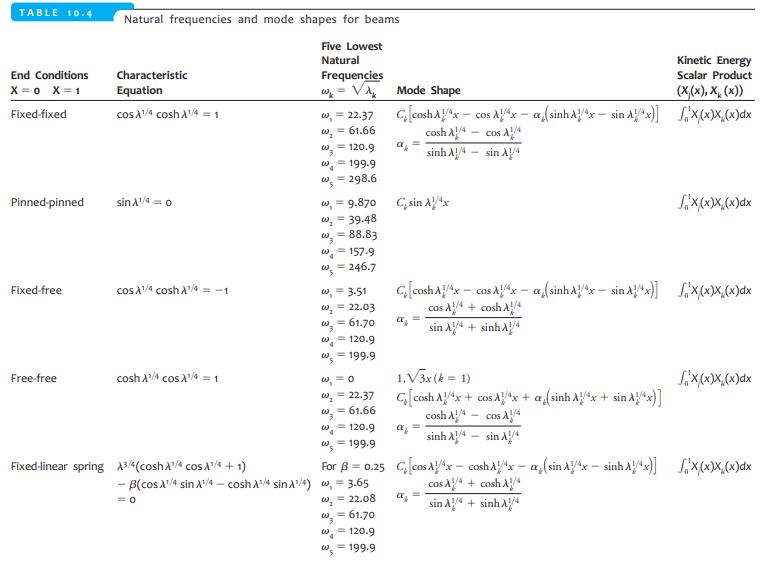
Each of the beams of Figures SP10.44 is made from a material of \(E=210 \times 10^{9} \mathrm{~N} / \mathrm{m}^{2}\) and \(ho=7580 \mathrm{~kg} / \mathrm{m}^{3}\) with A \(=1.2 \times 10^{-2} \mathrm{~m}^{2}, I=4.0 \times 10^{-5} \mathrm{~m}^{4}\), and \(L=1.4 \mathrm{~m}\). Use Table 10.4 to
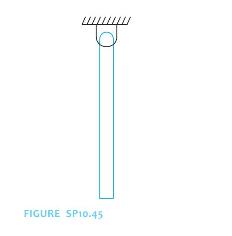
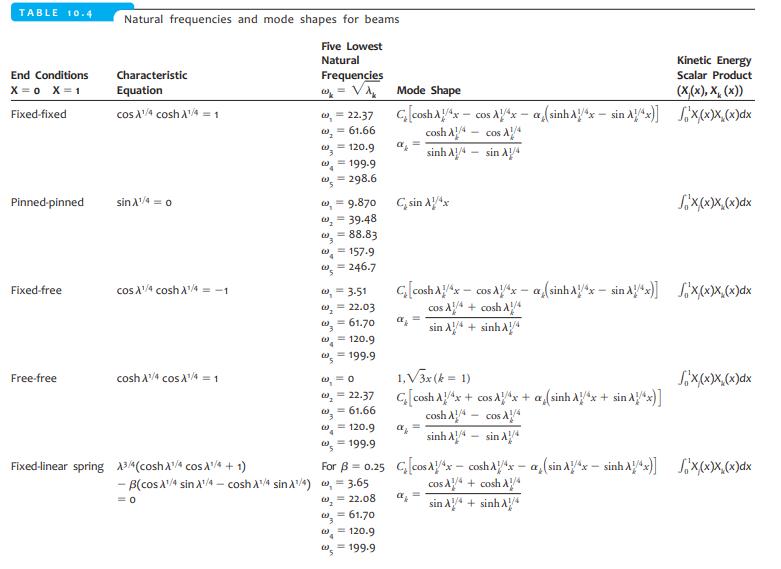
Each of the beams of Figures SP10.45 is made from a material of \(E=210 \times 10^{9} \mathrm{~N} / \mathrm{m}^{2}\) and \(ho=7580 \mathrm{~kg} / \mathrm{m}^{3}\) with A \(=1.2 \times 10^{-2} \mathrm{~m}^{2}, I=4.0 \times 10^{-5} \mathrm{~m}^{4}\), and \(L=1.4 \mathrm{~m}\). Use Table 10.4 to
Find all non-trivial solutions to the boundary value problem\[ \frac{d^{2} X}{d x^{2}}+\lambda X=0 \quad X^{\prime}(0)=0 \quad X^{\prime}(1)=0 \]
Find all non-trivial solutions to the boundary value problem\[ \frac{d^{4} X}{d x^{4}}-\lambda X=0 \quad X(0)=0 \quad X^{\prime \prime}(0)=0 \quad X(1)=0 \quad X^{\prime \prime}(1)=0 \]
Specify the SI units of the given quantity.(a) Wave speed of longitudinal vibrations in a bar, \(c\)(b) Flexural rigidity of a beam, \(E l\)(c) Natural frequency of sixth mode, \(\omega_{6}\)(d) Nondimensional natural frequency of first mode, \(\omega_{1}\)(e) Rayleigh's quotient, \(R(w)\)(f)
A \(5000 \mathrm{~N} \cdot \mathrm{m}\) torque is statically applied to the free end of a solid \(20-\mathrm{cm}\) radius steel shaft ( \(\left.G=80 \times 10^{9} \mathrm{~N} / \mathrm{m}^{2}, ho=7500 \mathrm{~kg} / \mathrm{m}^{3}\right)\) with a length of \(1.5 \mathrm{~m}\) that is fixed at one
A \(5000 \mathrm{~N} \cdot \mathrm{m}\) torque is statically applied to a the midspan of a solid \(20-\mathrm{cm}\) radius steel shaft \(\left(G=80 \times 10^{9} \mathrm{~N} / \mathrm{m}^{2}, ho=7500 \mathrm{~kg} / \mathrm{m}^{3}\right)\) with a length of \(1.5 \mathrm{~m}\) that is fixed at one
A steel shaft \(\left(ho=7850 \mathrm{~kg} / \mathrm{m}^{3}, G=85 \times 10^{9} \mathrm{~N} / \mathrm{m}^{2}\right)\) with a inner radius of \(30 \mathrm{~mm}\), outer radius of \(50 \mathrm{~mm}\), and length of \(1.0 \mathrm{~m}\) is fixed at both ends. Determine the three lowest natural
A \(10,000-\mathrm{N} \cdot \mathrm{m}\) torque is applied to the midspan of the shaft of Chapter Problem 10.3 and suddenly removed. Determine the time-dependent angular displacement of the midspan of the shaft.Data From Chapter Problem 10.3:A steel shaft \(\left(ho=7850 \mathrm{~kg} /
A motor of mass moment of inertia \(85 \mathrm{~kg} \cdot \mathrm{m}^{2}\) is attached to the end of the shaft of Chapter Problem 10.1. Determine the three lowest natural frequencies of the shaft and motor assembly. Compare the lowest natural frequency to that obtained by making a
Show the orthogonality of the two lowest mode shapes of the system in Chapter Problem 10.5.Data From Chapter Problem 10.5:A motor of mass moment of inertia \(85 \mathrm{~kg} \cdot \mathrm{m}^{2}\) is attached to the end of the shaft of Chapter Problem 10.1. Data From Chapter Problem 10.1:A \(5000
Operation of the motor attached to the shaft of Chapter Problem 10.5 produces a harmonic torque of amplitude \(2000 \mathrm{~N} \cdot \mathrm{m}\) at a frequency of \(110 \mathrm{~Hz}\). Determine the steady-state angular displacement of the end of the shaft.Data From Chapter Problem 10.5:A motor
A 20-cm-diameter, 2-m-long steel shaft ( \(ho=7600 \mathrm{~kg} / \mathrm{m}^{3}, G=80 \times 10^{9} \mathrm{~N} / \mathrm{m}^{2}\) ) has rotors of mass moment of inertia \(110 \mathrm{~kg} \cdot \mathrm{m}^{2}\) and \(65 \mathrm{~kg} \cdot \mathrm{m}^{2}\) attached to its ends. Determine the three
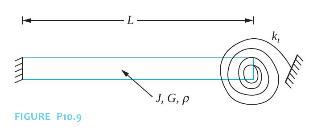
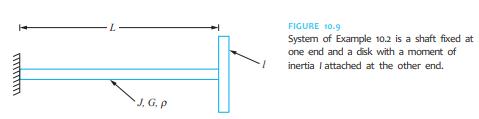
Determine an expression for the natural frequencies of the shaft of Figure P10.9. FIGURE P10.9 J, G, p
An oil well drilling tool is modeled as a bit attached to the end of a long shaft, unrestrained from rotation at its fixed end.(a) Determine the equation defining the natural frequencies of the drilling tool.(b) For a particular operation, the shaft ( \(ho=7500 \mathrm{~kg} / \mathrm{m}^{3}, G=80
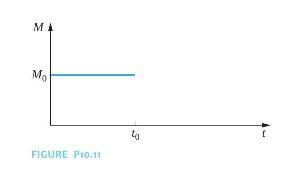
The shaft of Chapter Problem 10.1 is at rest in equilibrium when the time dependent moment of Figure P10.11 is applied to the end of the shaft. Determine the time-dependent form of the resulting torsional oscillations.Data From Chapter Problem 10.1:A \(5000 \mathrm{~N} \cdot \mathrm{m}\) torque is
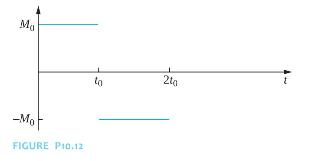
The shaft of Chapter Problem 10.1 is at rest in equilibrium when it is subject to the uniform time-dependent torque loading per unit length of Figure P10.12. Determine the time-dependent form of the resulting torsional oscillations. Ma -Mol FIGURE P10.12 to 2ta
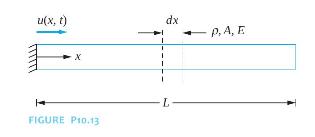
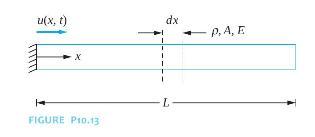
The elastic bar of Figure P10.13 is undergoing longitudinal vibrations. Let \(u(x, t)\) be the time-dependent displacement of a particle along the centroidal axis of the bar, initially a distance \(x\) from the left support.(a) Draw free-body diagrams showing the external and effective forces
Using the results of Chapter Problem 10.13, determine the natural frequencies of longitudinal vibrations of a bar fixed at one end and free at the other.Data From Chapter Problem 10.13:The elastic bar of Figure P10.13 is undergoing longitudinal vibrations. Let \(u(x, t)\) be the time-dependent
Show the orthogonality of mode shapes of longitudinal vibration of a bar fixed at one end and free at its other end.
A large industrial piston operates at \(1000 \mathrm{~Hz}\). The piston head has a mass of \(20 \mathrm{~kg}\). The shaft is made from steel \(\left(ho=7500 \mathrm{~kg} / \mathrm{m}^{3}, E=210 \times 10^{9} \mathrm{~N} / \mathrm{m}^{2}\right)\). For what shaft diameters will all natural
The free end of the piston of Chapter Problem 10.16 is subject to a force \(1000 \sin \omega t \mathrm{~N}\), where \(\omega=100 \mathrm{~Hz}\). If the diameter of the shaft is \(8 \mathrm{~cm}\), determine the steady-state response of the piston.Data From Chapter Problem 10.16:A large industrial
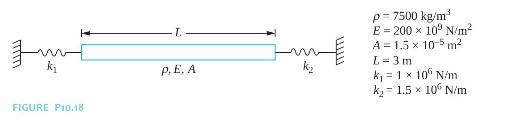
Determine the five lowest natural frequencies of the system of Figure P10.18. k FIGURE P10.18 L P.E, A p=7500 kg/m E 200 x 109 N/m A = 1.5 10-5 m L=3m k = 1 x 10 N/m k-1.5 10 N/m
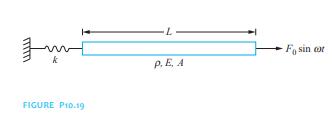
Determine the steady-state response of the system of Figure P10.19.\[ \begin{aligned} & ho=7500 \mathrm{~kg} / \mathrm{m}^{3} \\ & E=200 \times 10^{9} \mathrm{~N} / \mathrm{m}^{2} \\ & A=4.5 \times 10^{-5} \mathrm{~m}^{2} \\ & k=9 \times 10^{5} \mathrm{~N} / \mathrm{m} \\
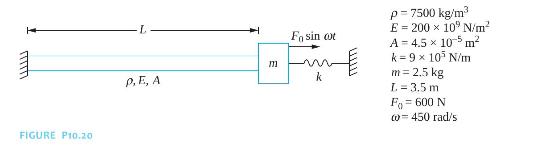
Determine the steady-state response of the system of Figure P10.20. FIGURE P10.20 p, E, A m Fo sin ot k p=7500 kg/m E 200 x 10 N/m A-4.5 105 m k = 9 10 N/m m = 2.5 kg L = 3.5 m = Fo 600 N w=450 rad/s
Draw frequency response curves for the response of the disk at the end of the shaft in Example 10.3. Plot the curves for \(\beta=0.5, \beta=2\), and \(\beta=20.0\).Example 10.3:The thin disk of Example 10.2 and Figure 10.9 is subject to a harmonic torque,\[T(t)=T_0 \sin \omega t\]Determine the
Determine the steady-state response of a circular shaft subject to a uniform torque per unit length \(T_{0} \sin \omega t\) applied over its entire length.
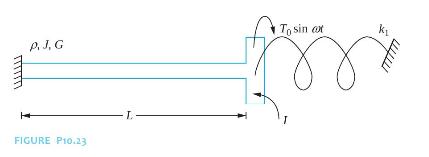
Determine the steady-state response of the system of Figure P10.23. p. J. G FIGURE P10.23 L To sin cot
Propeller blades totaling \(1200 \mathrm{~kg}\) with a total mass moment of inertia of \(155 \mathrm{~kg} \cdot \mathrm{m}^{2}\) are attached to a solid circular shaft ( \(ho=5000 \mathrm{~kg} / \mathrm{m}^{3}\), \(G=60 \times 10^{9} \mathrm{~N} / \mathrm{m}^{2}, E=140 \times 10^{9} \mathrm{~N} /
A pipe used to convey fluid is cantilevered from a wall. The steel pipe \(\left(ho=7500 \mathrm{~kg} / \mathrm{m}^{3}, G=80 \times 10^{9} \mathrm{~N} / \mathrm{m}^{2}, E=200 \times 10^{9} \mathrm{~N} / \mathrm{m}^{2}\right)\) has an inner radius of \(20 \mathrm{~cm}\), a thickness of \(1
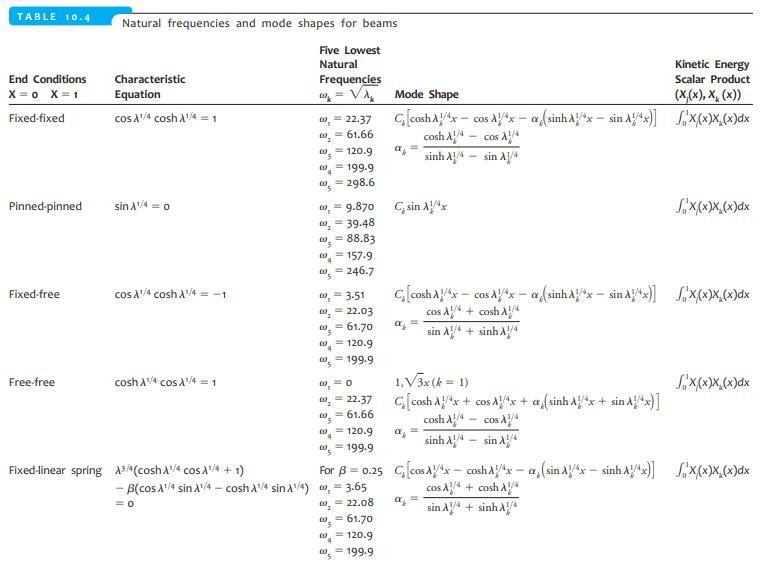
Verify the characteristic equation given in Table 10.4 for a pinned-free beam. TABLE 10.4 Natural frequencies and mode shapes for beams Characteristic Five Lowest Natural Frequencies Kinetic Energy Scalar Product (x,(x), X, (x)) cos A}x a (sinhA}x sin A}x)] /x(x)X,(x)dx - End Conditions X=0 X=1
Verify the characteristic equation given in Table 10.4 for a fixed-fixed beam. TABLE 10.4 Natural frequencies and mode shapes for beams Characteristic Five Lowest Natural Frequencies Kinetic Energy Scalar Product (x,(x), X, (x)) cos A}x a (sinhA}x sin A}x)] /x(x)X,(x)dx - End Conditions X=0 X=1
Verify the orthogonality of the eigenfunctions given in Table 10.4 for a pinnedfree beam. TABLE 10.4 Natural frequencies and mode shapes for beams Characteristic Five Lowest Natural Frequencies Kinetic Energy Scalar Product (x,(x), X, (x)) cos A}x a (sinhA}x sin A}x)] /x(x)X,(x)dx - End
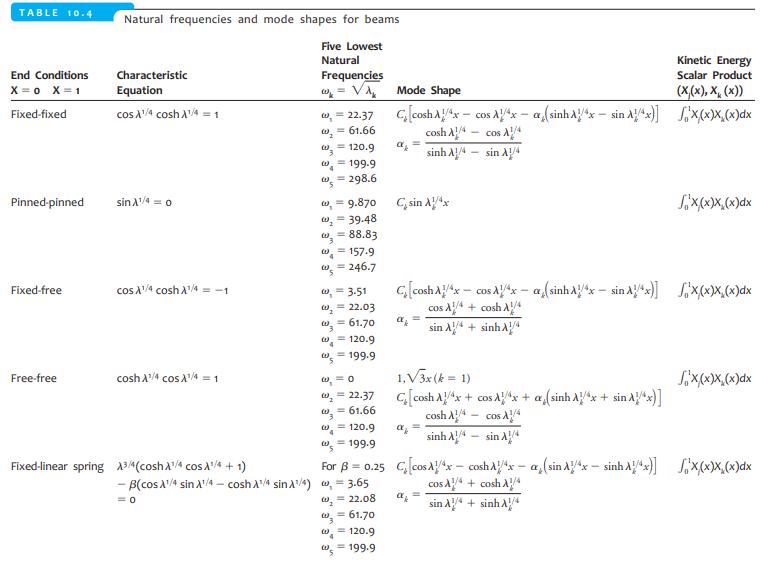
Verify the orthogonality of the eigenfunctions given in Table 10.4 for a fixed-attached mass beam. TABLE 10.4 Natural frequencies and mode shapes for beams Characteristic Five Lowest Natural Frequencies Kinetic Energy Scalar Product (x,(x), X, (x)) cos A}x a (sinhA}x sin A}x)] /x(x)X,(x)dx - End
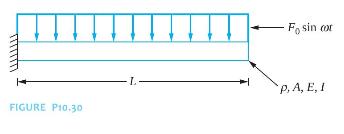
Determine the time-dependent displacement for the beam shown in Figures P10.30. + FIGURE P10.30 Fo sin cor P, A, E, I
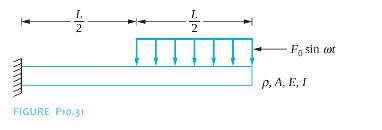
Determine the time-dependent displacement for the beam shown in Figures P10.31. FIGURE P10.31 T. 2 Fo sin cot P, A, E, I
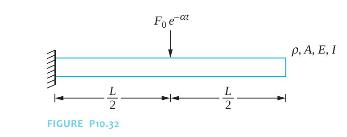
Determine the time-dependent displacement for the beam shown in Figures P10.32. Foe-at L L FIGURE P10.32 2 p. A, E, I
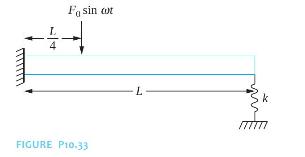
Determine the time-dependent displacement for the beam shown in Figures P10.33. Fo sin cot FIGURE P10.33 L
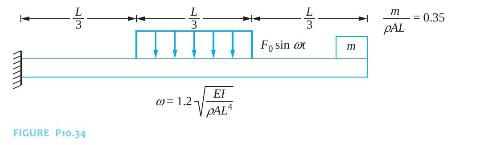
Determine the time-dependent displacement for the beam shown in Figures P10.34. FIGURE P10.34 EI = 12, 2DALA - Fosin ot 102 13 m 0.35 PAL
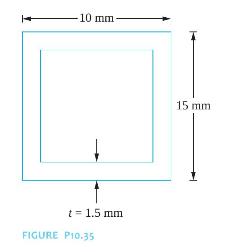
A root manipulator is \(60 \mathrm{~cm}\) long, made of steel \(\left(E=210 \times 10^{9} \mathrm{~N} / \mathrm{m}^{2}\right.\), \(ho=7500 \mathrm{~kg} / \mathrm{m}^{3}\) ) and has the cross section of Figure P10.35. One end of the manipulator is fixed and a 1-kg mass is attached to its opposite
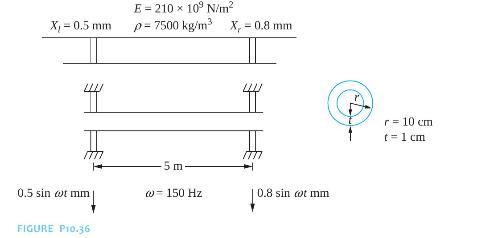
The steam pipe of Figure P10.36 is suspended from the ceiling in an industrial plant. A heavy machine with a rotating unbalance is placed on the floor above the machine causing vibrations of the ceiling. If the frequency of the oscillations is \(150 \mathrm{~Hz}\) and the amplitude of displacement
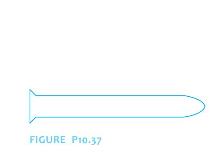
A simplified model of the rocket of Figure P10.37 is a free-free beam.(a) Calculate the five lowest natural frequencies for longitudinal vibration.(b) Calculate the five lowest natural frequencies for transverse vibration. FIGURE P10.37
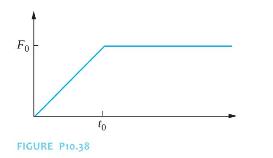
Longitudinal vibrations are initiated in the rocket of Figure P10.38 when thrust is developed. Determine the Laplace transform of the transient response \(\mathrm{U}(x, s)\) when the thrust of Figure P10.38 is developed. Do not invert the transform. Fo FIGURE P10.38 fo
Determine the response of a cantilever beam when the fixed support is subject to a displacement \(f(t)=A \sin \omega t\). Use the Laplace transform method and determine the transform \(W(x, s)\). Do not invert.
The tail rotor blades of a helicopter have a rotating unbalance of magnitude \(0.5 \mathrm{~kg} \cdot \mathrm{m}\) and operate at a speed of \(1200 \mathrm{rpm}\). Modeling the tail section as a cantilever beam of length \(3.5 \mathrm{~m}\) with \(E=31 \times 10^{6} \mathrm{~N} \cdot
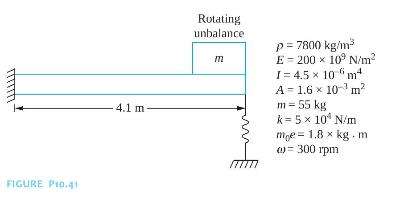
Determine the steady-state amplitude of the engine of Figure P10.41. FIGURE P10.41 4.1 m Rotating unbalance E p = 7800 kg/m E 200 x 109 N/m I= 4.5 x 10 m A 1.6 103 m m=55 kg k = 5 10 N/m moe 1.8 x kg m )=300 rpm
Show that the differential equation governing free vibration of a uniform beam subject to a constant axial load, \(P\), is\[ E I \frac{\partial^{4} w}{\partial x^{4}}-P \frac{\partial^{2} w}{\partial x^{2}}+ho A \frac{\partial w}{\partial t^{2}}=0 \]
Determine the frequency equation for a simply supported beam subject to an axial load.
Determine the frequency equation for a fixed-pinned beam subject to an axial load.
A fixed-fixed beam is made of a material with a coefficient of thermal expansion \(\alpha\). After installed, the temperature is decreased by \(\Delta T\). Determine the beam's frequency equation.
Show orthogonality of the mode shapes for a simply supported beam subject to an axial load.
Use Rayleigh's quotient to approximate the lowest natural frequency of a torsional shaft fixed at both ends.
Use Rayleigh's quotient to approximate the lowest natural frequency of a torsional shaft with a disk of mass moment of inertia \(I\) placed at its midspan. The shaft is fixed at both ends.
Use Rayleigh's quotient to approximate the lowest natural frequency of a fixedfree beam.
Use Rayleigh's quotient to approximate the lowest natural frequency of a simply supported beam with a mass \(m\) at its midspan. Use \(w(x)=\sin (\pi x / L)\) as the trial function.
Use the Rayleigh-Ritz method to approximate the two lowest natural frequencies of a fixed-free beam.
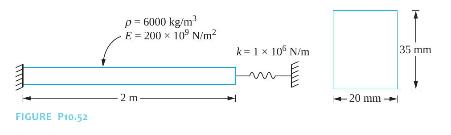
Use the Rayleigh-Ritz method to approximate the two lowest natural frequencies of the system of Figure P10.52. p=6000 kg/m E 200 x 10 N/m k = 1 10 N/m Im E FIGURE P10.52 2 m -20 mm 35 mm
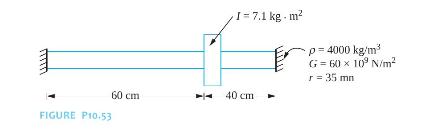
Use the Rayleigh-Ritz method to approximate the two lowest natural frequencies for the system of Figure P10.53. FIGURE P10.53 I-7.1 kg m p=4000 kg/m G = 60 109 N/m r = 35 mn 60 cm -40 cm
Use the Rayleigh-Ritz method to approximate the three lowest natural frequencies of a fixed-pinned beam. Use polynomial of order six or less as trial functions.
Use the Rayleigh-Ritz method to approximate the three lowest natural frequencies and their corresponding mode shapes of a fixed-free beam. Use polynomials of order six or less as trial functions.
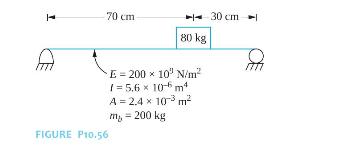
Use the Rayleigh-Ritz method to approximate the two lowest frequencies of transverse vibration of the system of Figure P10.56. 1 70 cm FIGURE P10.56 80 kg E 200 x 10" N/m 1 5.6 x 10⁶m4 A 2.4 x 10³ m my 200 kg 30 cm
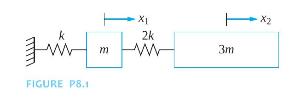
Calculate the natural frequencies and mode shapes for the system shown in Figures P8.1 by calculating the eigenvalues and eigenvectors of \(\mathbf{M}^{-1} \mathbf{K}\). Graphically illustrate the mode shapes. Identify any nodes. FIGURE P8.1 X 2k m w 3m X2
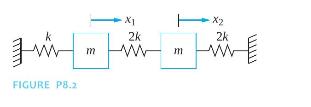
Calculate the natural frequencies and mode shapes for the system shown in Figures P8.2 by calculating the eigenvalues and eigenvectors of \(\mathbf{M}^{-1} \mathbf{K}\). Graphically illustrate the mode shapes. Identify any nodes. FIGURE P8.2 X1 2k m ww m X2 2k WE
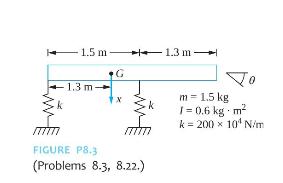
Calculate the natural frequencies and mode shapes for the system shown in Figures P8.3 by calculating the eigenvalues and eigenvectors of \(\mathbf{M}^{-1} \mathbf{K}\). Graphically illustrate the mode shapes. Identify any nodes. 1.5 m 1.3 m G 1.3 m x m = 1.5 kg 1=0.6 kg m .m k = 200 x 10 N/m
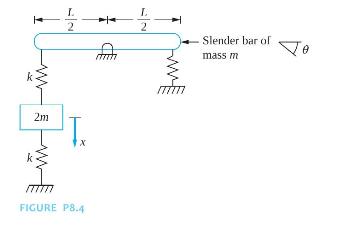
Calculate the natural frequencies and mode shapes for the system shown in Figures P8.4 by calculating the eigenvalues and eigenvectors of \(\mathbf{M}^{-1} \mathbf{K}\). Graphically illustrate the mode shapes. Identify any nodes. 2m L L 2 X FIGURE P8.4 2 Slender bar of mass m
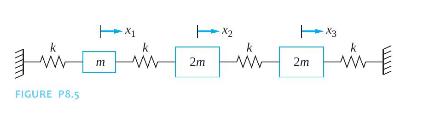
Calculate the natural frequencies and mode shapes for the system shown in Figures P8.5 by calculating the eigenvalues and eigenvectors of \(\mathbf{M}^{-1} \mathbf{K}\). Graphically illustrate the mode shapes. Identify any nodes. FIGURE P8.5 m X1 k www 2m k -X3 2m E
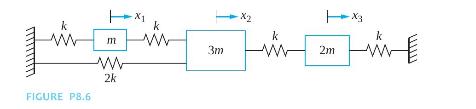
Calculate the natural frequencies and mode shapes for the system shown in Figures P8.6 by calculating the eigenvalues and eigenvectors of \(\mathbf{M}^{-1} \mathbf{K}\). Graphically illustrate the mode shapes. Identify any nodes. X2 k k m w k 3m w 2m w FIGURE P8.6 2k X3 k E
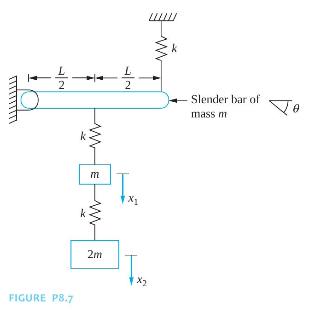
Calculate the natural frequencies and mode shapes for the system shown in Figures P8.7 by calculating the eigenvalues and eigenvectors of \(\mathbf{M}^{-1} \mathbf{K}\). Graphically illustrate the mode shapes. Identify any nodes. L Slender bar of mass m 12 12 E 2m FIGURE P8.7 X2
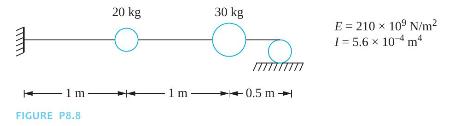
Two machines are placed on the massless fixed-pinned beam of Figure P8.8.Determine the natural frequencies for the system. 20 kg 30 kg -1m- 0.5 m FIGURE P8.8 E 210 x 109 N/m 1-5.6 104 m
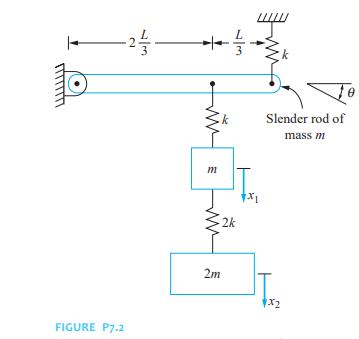
Determine the natural frequencies and mode shapes for the system of Figure P7.2 if \(k=3.4 \times 10^{5} \mathrm{~N} / \mathrm{m}, L=1.5 \mathrm{~m}\) and \(m=4.6 \mathrm{~kg}\). 13 -25- + www FIGURE P7.2 ww m k 2m 2k Te Slender rod of mass m 1x2
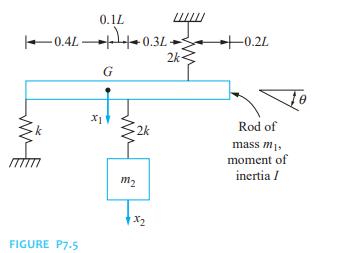
Determine the natural frequencies of the system of Figure P7.5 if \(k=2500 \mathrm{~N} / \mathrm{m}\), \(m_{1}=2.4 \mathrm{~kg}, m_{2}=1.6 \mathrm{~kg}, I=0.65 \mathrm{~kg} \cdot \mathrm{m}^{2}\), and \(L=1 \mathrm{~m}\). 0.1L 0.42 0.32 FIGURE P7.5 G m2 www 2k- 0.2L -2k Rod of Te mass m, moment of
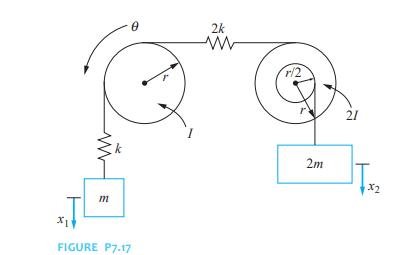
Determine the natural frequencies and mode shapes for the system of Figure P7.17 if \(k=10,000 \mathrm{~N} / \mathrm{m}, m=3 \mathrm{~kg}, I=0.6 \mathrm{~kg} \cdot \mathrm{m}^{2}\), and \(r=80 \mathrm{~cm}\). m FIGURE P7.17 2k w r/2 2m 21 x2
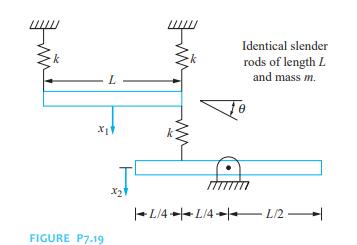
Determine the natural frequencies and mode shapes of the system of Figure P7.19 if \(k=12,000 \mathrm{~N} / \mathrm{m}\) and each bar is of mass \(12 \mathrm{~kg}\) and length \(4 \mathrm{~m}\). x1 FIGURE P7.19 L X2 Identical slender rods of length L and mass m. Te L/4 L/4 L/2
A \(400 \mathrm{~kg}\) machine is placed at the midspan of a 3-m-long, 200-kg simply supported beam. The beam is made of a material of elastic modulus \(200 \times 10^{9} \mathrm{~N} / \mathrm{m}^{2}\) and has a cross-sectional moment of inertia of \(1.4 \times 10^{-5} \mathrm{~m}^{4}\). Use a
A \(500 \mathrm{~kg}\) machine is placed at the end of a \(3.8-\mathrm{m}-\mathrm{long}, 190-\mathrm{kg}\) fixed-free beam. The beam is made of a material of elastic modulus \(200 \times 10^{9} \mathrm{~N} / \mathrm{m}^{2}\) and has a cross-sectional moment of inertia of \(1.4 \times 10^{-5}
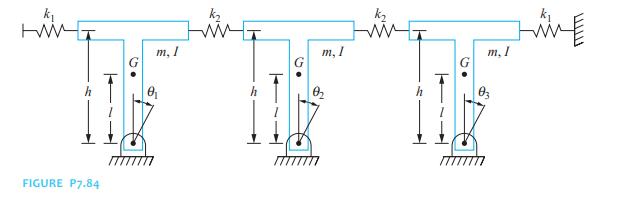
Determine the two lowest natural frequencies of the railroad bridge of Chapter Problem 7.84, if \(k_{1}=5.5 \times 10^{7} \mathrm{~N} / \mathrm{m}, k_{2}=1.2 \times 10^{7} \mathrm{~N} / \mathrm{m}, m=15,000 \mathrm{~kg}\), \(I=1.6 \times 10^{6} \mathrm{~kg} \cdot \mathrm{m}^{2}, l=6.7
Showing 600 - 700
of 4547
1
2
3
4
5
6
7
8
9
10
11
12
13
14
15
Last
Step by Step Answers

 Get 50% OFF
Claim Now
Get 50% OFF
Claim Now