New Semester
Started
Get
50% OFF
Study Help!
--h --m --s
Claim Now
Question Answers
Textbooks
Find textbooks, questions and answers
Oops, something went wrong!
Change your search query and then try again
S
Books
FREE
Study Help
Expert Questions
Accounting
General Management
Mathematics
Finance
Organizational Behaviour
Law
Physics
Operating System
Management Leadership
Sociology
Programming
Marketing
Database
Computer Network
Economics
Textbooks Solutions
Accounting
Managerial Accounting
Management Leadership
Cost Accounting
Statistics
Business Law
Corporate Finance
Finance
Economics
Auditing
Tutors
Online Tutors
Find a Tutor
Hire a Tutor
Become a Tutor
AI Tutor
AI Study Planner
NEW
Sell Books
Search
Search
Sign In
Register
study help
engineering
introduction mechanical engineering
Principles Of Mechanical Engineering 1st Edition Sadhu Singh - Solutions
If the lowest natural frequency of a system is zero, what is \(\operatorname{det} \mathbf{M}^{-1} \mathbf{K}\) ?
How many nodes located in the system should be expected for the third mode of a seven degree-of-freedom system?
The eigenvalues of \(\mathbf{M}^{-1} \mathbf{K}\) are 20, 50, and 100. What are the eigenvalues of AM?
The eigenvalues of \(\mathbf{M}^{-1} \mathbf{K}\) are 16,49, 100, and 225. What are the natural frequencies of the system?
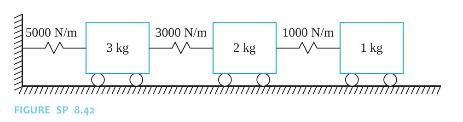
For the system of Figure SP8.42, calculate \((\mathbf{x}, \mathbf{y})_{K}\) for \(\mathbf{x}=\left[\begin{array}{lll}3 & 2 & -1\end{array}\right]^{T}\) and \(\mathbf{y}=\left[\begin{array}{lll}1 & -2 & 3\end{array}\right]^{T}\). 5000 N/m 3000 N/m 1000 N/m 3 kg 2 kg 1 kg FIGURE SP
For the system of Figure SP8.42, calculate Rayleigh's quotient for \(\mathbf{x}=\left[\begin{array}{lll}3 & 2 & -1\end{array}\right]^{T}\).
A mode shape vector of a two degree-of-freedom system is \(\left[\begin{array}{ll}1 & 2\end{array}\right]^{T}\). The mass matrix for the system is \(\boldsymbol{M}=\left[\begin{array}{ll}2 & 0 \\ 0 & 3\end{array}\right]\). Calculate the second mode-shape vector.
A mode-shape vector of a two degree-of-freedom system is \([12]^{T}\). Is this the modeshape vector for the first mode, which corresponds to the lowest natural frequency, or the higher mode? Why?
A mode-shape vector of a two degree-of-freedom system is \(\left[\begin{array}{ll}1 & 2\end{array}\right]^{T}\). The mass matrix for the system is \(\boldsymbol{M}=\left[\begin{array}{ll}2 & 0 \\ 0 & 3\end{array}\right]\). Normalize the mode-shape vector.
A normalized mode-shape vector for a two degree-of-freedom system is \(\left[\begin{array}{ll}0.1 & 0.3\end{array}\right]^{T}\). The stiffness matrix for the system is \(\boldsymbol{K}=\left[\begin{array}{cc}200 & -100 \\ -100 & 300\end{array}\right]\). Calculate the natural frequency corresponding
Can the vectors \(\left[\begin{array}{lll}1 & 2 & 2.5\end{array}\right]^{T}\) and \(\left[\begin{array}{lll}1 & 2 & -2\end{array}\right]^{T}\) be mode shape vectors of a system with a diagonal mass matrix with all three diagonal elements equal?
A three degree-of-freedom undamped system has natural frequencies of \(10 \mathrm{rad} / \mathrm{s}\), \(25 \mathrm{rad} / \mathrm{s}\), and \(50 \mathrm{rad} / \mathrm{s}\). What are the differential equations satisfied by the principal coordinates for the system for free vibration?
A three degree-of-freedom system with viscous damping that is proportional to the stiffness matrix has natural frequencies of \(10 \mathrm{rad} / \mathrm{s}, 25 \mathrm{rad} / \mathrm{s}\), and \(50 \mathrm{rad} / \mathrm{s}\). The modal damping ratio for the first mode is 0.1 .(a) What are the
A system has the differential equations\(\left[\begin{array}{lll}5 & 0 & 0 \\ 0 & 3 & 0 \\ 0 & 0 & 2\end{array}\right]\left[\begin{array}{c}\ddot{x}_{1} \\ \ddot{x}_{2} \\ \ddot{x}_{3}\end{array}\right]+\left[\begin{array}{ccc}3 & -1 & 0 \\ -1 & 4 & -3 \\ 0 & -3 &
Lagrange's equations are used to derive the differential equations for a three degree-of-freedom system resulting in\(\left[\begin{array}{lll}m_{11} & m_{12} & m_{13} \\ m_{21} & m_{22} & m_{23} \\ m_{31} & m_{32} & m_{33}\end{array}\right]\left[\begin{array}{c}\ddot{x}_{1} \\ \ddot{x}_{2} \\
In a single stage impulse turbine the blade angles are equal and the nozzle angle is \(20^{\circ}\). The velocity coefficient for the blade is 0.83. Find the mzximum blade efficiency possible. If the actual blade efficiency is \(90 \%\) of maximum blade efficiency, find the possible ratio of blade
The following data refer to a compound impulse turbine having two rows of moving blades and one row of fixed blades in between them.Nozzle angle \(=15^{\circ}\), Exit velocity of steam from the nozzle \(=450 \mathrm{~m} / \mathrm{s}\)Moving blades tip discharge angles \(=30^{\circ}\)Fixed blade
In a stage of impulse-reaction turbine, steam enters with a speed of \(250 \mathrm{~m} / \mathrm{s}\) at an angle of \(30^{\circ}\) in the direction of blade motion. The mean blade speed is \(150 \mathrm{~m} / \mathrm{s}\) when the rotor is running as \(3000 \mathrm{rpm}\). The blade height is \(10
At a stage of reaction turbine, the mean diameter of rotor is \(1.4 \mathrm{~m}\). the speed ratio is 0.7. Determine the blade inlet angle if the blade outlet angle is \(20^{\circ}\). The rotor speed is \(3000 \mathrm{rpm}\). Also find the diagram efficiency the percentage increase in it and rotor
In a \(50 \%\) reaction turbine stage running at \(50 \mathrm{rps}\), the exit angles are \(30^{\circ}\) and the inlet angles are \(50^{\circ}\). The mean diameter is \(1 \mathrm{~m}\). The steam flow rate is \(10^{4} \mathrm{~kg} / \mathrm{min}\) and the stage efficiency is \(85 \%\). Calculate
A single row impulse turbine develops \(130 \mathrm{~kW}\) at a blade speed of \(180 \mathrm{~m} / \mathrm{s}\) using \(2 \mathrm{~kg} / \mathrm{s}\) of steam. The steam leaves the nozzle at \(400 \mathrm{~m} / \mathrm{s}\). The friction coefficient for blades is 0.9 and steam leaves the blades
A simple impulse turbine has one ring of moving blades running at \(150 \mathrm{~m} / \mathrm{s}\). The absolute velocity of steam at exit from the stage is \(80 \mathrm{~m} / \mathrm{s}\) at an angle of \(75^{\circ}\) from the tangential direction. Blade speed coefficient is 0.85 and the rate of
In a single stage impulse turbine, nozzle angle is \(20^{\circ}\) and blade angles are equal. The velocity coefficient for blades is 0.85 . calculate the maximum blade efficiency possible. If the actual blade efficiency is \(92 \%\) of the maximum blade efficiency, find the possible ratio of blade
In a single stage steam turbine saturated steam at 10 bar is supplied through a convergent divergent steam nozzle of \(20^{\circ}\) angle. The mean blade speed is \(400 \mathrm{~m} / \mathrm{s}\). The steam pressure leaving the nozzle is \(1 \mathrm{bar}\). Find ( \(a\) ) the best blade angles if
The first stage of an impulse turbine is compounded for velocity and has two rows of moving blades and one ring of fixed blades. The nozzle angle is \(15^{\circ}\) and leaving angles of blades are respectively, first moving \(30^{\circ}\), fixed 20 , second moving \(30^{\circ}\). The velocity of
In a steam condenser, the partial pressure of steam and air are 0.060 bar and 0.007 bar respectively. The condenser pressure is(a) 0.067 bar(b) 0.060 bar(c) 0.053 bar(d) 0.007 bar
Cooling tower in a steam power plant is a device for(a) condensing steam into water(b) cooling the exhaust gases coming out the boiler(c) reducing the temperature of superheated steam(d) reducing the temperature of cooling water used in condenser.
The function of the surface condenser is to(a) lower the engine thermal efficiency(b) increase the engine thermal efficiency(c) increase the black pressure of the engine(d) cool the exhaust gases
In a jet condenser(a) steam and cooling water mix together(b) steam and cooling water do not mix together(c) steam passes through tubes and cooling water surrounds them(d) cooling water passes through tubes and steam surrounds them
A surface condenser is a(a) water tube device(b) steam tube device(c) steam and cooling water mix to give the condensate(d) all of the above
The air removal from the surface condenser leads to(a) fall in condenser pressure(b) rise in condenser pressure(c) no change in condenser pressure(d) rise in condenser temperature
Edward's air pump(a) removes only air from the condenser(b) removes air and vapour from the condenser(c) removes only uncondensed vapour from condenser(d) removes air along with vapour and condensed water from the condenser.
Vacuum efficiency of a condenser is defined as:(a) \(\frac{\text { Actual vacuum in condenser with air present }=p_{b}-p_{t}}{\text { Theoretical vacuum in condenser without air present }=p_{b}-p_{s}}\)(b) \(\frac{\text { Theoretical vacuum in condenser without air present }}{\text { Actual vacuum
Condenser efficiency is defined as :(a) \(\frac{t_{o w}-t_{i w}}{t_{s}-t_{i w}}\)(b) \(\frac{t_{s}-t_{i w}}{t_{o w}-t_{i w}}\)(c) \(\frac{t_{o w}-t_{i w}}{t_{s}}\)(d) \(\frac{t_{s}}{t_{o w}-t_{i w}}\)
The function of a condenser is to(a) condense steam(b) maintain pressure below atmospheric pressure(c) increase work output of prime mover(d) all of the above
Evaporative condenser has(a) steam in pipes(b) meter in pipes(c) steam mixed with meter in pipes(d) all of the above
Define a condenser.
What are the functions of a condenser ?
Name the various elements of a steam condensing plant.
What are the various types of steam condenser ?
Differentiate between jet and surface condensers.
What is an evaporative condenser ?
What are the requirements of a modern surface condenser ?
List the advantages and disadvantages of a jet condenser.
What are the advantages and disadvantages of surface condensers ?
State Dalton’s law of partial pressures.
How the mass of cooling water can be estimated in a surface condenser?
What are the sources of air infiltration in condenser ?
What are the effects of air infiltration in condensers ?
Define vacuum efficiency and condenser efficiency.
What is the role of cooling towers in surface condenser ?
Describe various types of cooling towers.
The vacuum in a condenser handling \(9000 \mathrm{~kg} / \mathrm{h}\) of steam is found to be \(72 \mathrm{~cm}\) of \(\mathrm{Hg}\) when Barometer reading is \(76 \mathrm{~cm}\) of \(\mathrm{Hg}\) and the temperature is \(25^{\circ} \mathrm{C}\). The air leakage amounts to \(2 \mathrm{~kg}\) for
A steam condenser has separate air and condensate pumps. The entry to air pump suction is screened. Steam enters the condenser at \(38^{\circ} \mathrm{C}\) and the condensate is removed at \(37^{\circ} \mathrm{C}\). The air removed has a temperature of \(36^{\circ} \mathrm{C}\). If the quantity of
A surface condenser deals with \(13625 \mathrm{~kg}\) of steam per hour at a pressure of \(0.09 \mathrm{bar}\). The steam enters 0.85 dry and the temperature at the condensate and air extraction pipes is \(36^{\circ} \mathrm{C}\). The air leakage amounts to \(7.26 \mathrm{~kg} /\) hour.
A surface condenser having an absolute pressure of 0.10 bar is supplied with cooling water at the rate of \(40 \mathrm{~kg}\) of steam condensed. The rise in the temperature of cooling water is \(14^{\circ} \mathrm{C}\). Find the dryness fraction of steam entering the condenser. The condensate
A steam turbine discharges \(5000 \mathrm{~kg} / \mathrm{h}\) of steam at \(40^{\circ} \mathrm{C}\) and 0.85 dry. The air leakage in the condenser is \(15 \mathrm{~kg} / \mathrm{h}\). The temperature at the suction of air pump is \(32^{\circ} \mathrm{C}\) and the temperature of condensate is
A steam turbine uses \(50,000 \mathrm{~kg} / \mathrm{h}\) of steam. The exhaust steam with dryness fraction 0.9 enters the condenser fitted with water extraction and air pumps. When the barometer reads \(76 \mathrm{~cm}\) of \(\mathrm{Hg}\), vacuum of air pump suction is \(72 \mathrm{~cm}\) of
The temperature in a surface condenser is \(40^{\circ} \mathrm{C}\) and the vacuum is \(69 \mathrm{~cm}\) of \(\mathrm{Hg}\) while the barometer reads \(75 \mathrm{~cm}\) of \(\mathrm{Hg}\). Determine the partial pressure of steam and air and the mass of air present per \(\mathrm{kg}\) of steam.
In a condenser, to check the leakage of air, the following procedure is adopted:After running the plant to reach the steady conditions, the steam supply to the condenser and also the air and condensate pumps are shut down, thus completely isolating the condenser. The temperature and vacuum readings
A surface condenser is required to deal with \(20,000 \mathrm{~kg}\) of steam per hour. The air leakage is estimated at \(0.3 \mathrm{~kg}\) per \(1000 \mathrm{~kg}\) of steam. The steam enters the condenser dry saturated of \(38^{\circ} \mathrm{C}\). The condensate is extracted at the lowest point
A surface condenser deals with \(13000 \mathrm{~kg} / \mathrm{h}\) of steam. The leakage air in the system amounts to \(1 \mathrm{~kg}\) per \(2700 \mathrm{~kg}\) of steam. The vacuum in the air pump suction is \(705 \mathrm{~mm}\) of mercury (barometer \(760 \mathrm{~mm}\) of \(\mathrm{Hg}\) ),
A gas turbine works on(a) Otto cycle(b) Rantine cycle(c) Brayton cycle(d) Stirling cycle
In a gas turbine cycle, the turbine output is \(600 \mathrm{~kJ} / \mathrm{kg}\), compressor work is \(400 \mathrm{~kJ} / \mathrm{kg}\) and heat supplied is \(1000 \mathrm{~kJ} / \mathrm{kg}\). The thermal efficiency of the cycle is:(a) \(80 \%\)(b) \(60 \%\)(c) \(40 \%\)(d) \(20 \%\)
The thermal efficiency of gas turbine as compared to diesel engine is(a) higher(b) lower(c) same(d) unpredictable.
For a gas turbine the pressure ratio may be in the range(a) 2 to 3(b) 3 to 5(c) 6 to 10(d) 12 to 16
With the increase in pressure ratio thermal efficiency of a simple gas turbine plant with fixed turbine inlet temperature(a) increases(b) decreases(c) first increases and then decreases(d) first decreases and then increases.
The thermal efficiency of closed cycle gas turbine is given by(a) \(1-\frac{1}{r_{p}^{\gamma-1}}\)(b) \(1-\frac{1}{r_{p}^{(\gamma-1) / \gamma}}\)(c) \(1-r_{p}\)(d) \(r_{p}-1\)
Give the fields of application of gas turbines.
What are the limitations of gas turbines ?
Compare gas turbines with I.C. engines.
How gas turbines are classified ?
Explain the working of constant pressure combustion gas turbine with(a) open cycle, and (b) closed cycle.
Explain the working of constant volume combustion gas turbine.
Compare open cycle and closed cycle gas turbines.
Define an expression for thermal efficiency of Brayton cycle.
In a gas turbine, air at a temperature of \(15^{\circ} \mathrm{C}\) and 1 bar pressure enters the compressor, where it is compressed to 5 bar. Air enters the turbine at a temperature of \(815^{\circ} \mathrm{C}\) and expands to original pressure of 1 bar. Calculate the ratio of turbine work to
A gas turbine works on Brayton cycle between \(27^{\circ} \mathrm{C}\) and \(827^{\circ} \mathrm{C}\). Determine the maximum not work per \(\mathrm{kg}\) and cycle efficiency. Take \(c_{p}=1.005 \mathrm{~kJ} / \mathrm{kg}\). K.
A gas turbine set takes in air at \(27^{\circ} \mathrm{C}\) and \(1 \mathrm{~atm}\). The pressure ratio is 4 and the maximum temperature is \(560^{\circ} \mathrm{C}\). The compressor and turbine efficiencies are 0.83 and 0.85 respectively. Determine the overall efficiency of the set.
The maximum and minimum temperature occurring in a closed cycle gas turbine plant are \(927^{\circ} \mathrm{C}\) and \(37^{\circ} \mathrm{C}\). The pressure at the outlet and the inlet of the compressor are \(5 \mathrm{bar}\) and 1 bar respectively per \(\mathrm{kg}\) of air flow in the cycle.
A screw jack is a _____ machine.
A centre lathe is a _____ machine.
Mechanical advantage is the ratio of _____ to _____.
Velocity ratio is the ratio of distance moved by _____ to distance moved by _____.
Efficiency is the ratio of _____ to _____.
The efficiency of an ideal machine is _____
The efficiency of a reversible machine is _____ 50 percent.
The efficiency of a self-locking machine is _____ 50 percent.
Maximum mechanical advantage is _____.
The velocity ratio of first system of pulleys is _____.
The velocity ratio of second system of pulley is _____.
The velocity ratio of third systemof pulleys is _____.
The efficiency of an ideal machine is 50%. True or False
The bicycle is a simple machine. True or False
The milling machine is a compound machine. True or False
Mechanical advantage is the ratio of effort applied to load lifted. True or False
Efficiency is the ratio of output to input. True or False
The efficiency of a reversible machine is less than 50%. True or False
The efficiency of self-locking machine is less than 50%. True or False
An irreversible machine is also called self-locking machine. True or False
Showing 1100 - 1200
of 4547
First
5
6
7
8
9
10
11
12
13
14
15
16
17
18
19
Last
Step by Step Answers

 Get 50% OFF
Claim Now
Get 50% OFF
Claim Now