New Semester
Started
Get
50% OFF
Study Help!
--h --m --s
Claim Now
Question Answers
Textbooks
Find textbooks, questions and answers
Oops, something went wrong!
Change your search query and then try again
S
Books
FREE
Study Help
Expert Questions
Accounting
General Management
Mathematics
Finance
Organizational Behaviour
Law
Physics
Operating System
Management Leadership
Sociology
Programming
Marketing
Database
Computer Network
Economics
Textbooks Solutions
Accounting
Managerial Accounting
Management Leadership
Cost Accounting
Statistics
Business Law
Corporate Finance
Finance
Economics
Auditing
Tutors
Online Tutors
Find a Tutor
Hire a Tutor
Become a Tutor
AI Tutor
AI Study Planner
NEW
Sell Books
Search
Search
Sign In
Register
study help
engineering
mechanical vibration analysis
Mechanical Vibrations 6th Edition Singiresu S Rao - Solutions
Find the initial and steady-state values of the impulse response of the underdamped system considered in Example 4.19 using both the time and Laplace domain solutions.Data From Example 4.19:-Equation 4.49:- Find the solution of Eq. (4.49) when the forcing function is a unit impulse at t = 0 and
Find the response of a critically damped single-degree-of-freedom system subjected to a step force with the equation of motion\[2 \ddot{x}+8 \dot{x}+8 x=5\]Assume the initial conditions as \(x_{0}=1\) and \(\dot{x}_{0}=2\).
Find the steady-state response of an underdamped single-degree-of-freedom system subjected to a ramp input \(F(t)=b t\) where \(b\) is the slope of the ramp.
Derive the expression for the total response of an underdamped single-degree-of-freedom system subjected to a forcing function \(F(t)\). Assume the initial conditions as \(x(t=0)=x_{0}\) and \(\dot{x}(t=0)=\dot{x}_{0}\).
For the damped second-order system with the transfer function given below, find the values of \(\zeta, \omega_{n}, t_{s}, t_{r}, t_{p}\), and percent overshoot:\[T(s)=\frac{X(s)}{F(s)}=\frac{121}{s^{2}+17.6 s+121}\]
For the damped second-order system with the transfer function given below, find the values of \(\zeta, \omega_{n}, t_{s}, t_{r}, t_{p}\), and percent overshoot:\[T(s)=\frac{X(s)}{F(s)}=\frac{3.24 \times 10^{6}}{s^{2}+2700 s+3.24 \times 10^{6}}\]
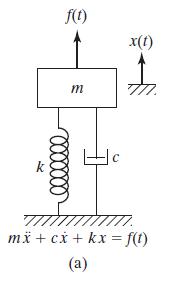
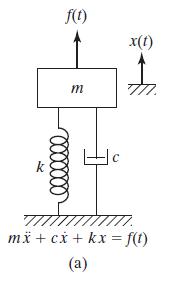
For the translational second-order system shown in Fig. 4.2(a) with \(m=6 \mathrm{~kg}, c=30 \mathrm{~N}-\mathrm{s} / \mathrm{m}\), and \(k=45 \mathrm{~N} / \mathrm{m}\), find the values of \(\zeta, \omega_{n}, t_{s}, t_{r}, t_{p}\), and percent overshoot for \(x(t)\). f(t) x(t) m mx + cx+kx = f(t)
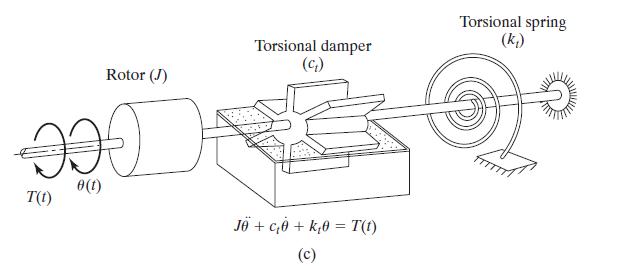
For the torsional second-order system shown in Fig. 4.2(c) with \(J=2 \mathrm{~kg}-\mathrm{m}^{2}, c_{t}=\) \(2 \mathrm{~N}-\mathrm{m}-\mathrm{s} / \mathrm{rad}\), and \(k_{t}=2 \mathrm{~N}-\mathrm{m} / \mathrm{rad}\), find the values of \(\zeta, \omega_{n}, t_{s}, t_{r}, t_{p}\), and percent
For the translational system shown in Fig. 4.2(a) with \(k=1\) and \(f(t)=\) unit step function, determine the values of \(m\) and \(c\) to achieve a \(40 \%\) overshoot and a settling time of \(5 \mathrm{~s}\).Figure 4.2(a):- f(t) x(t) m mx + cx+kx = f(t) (a)
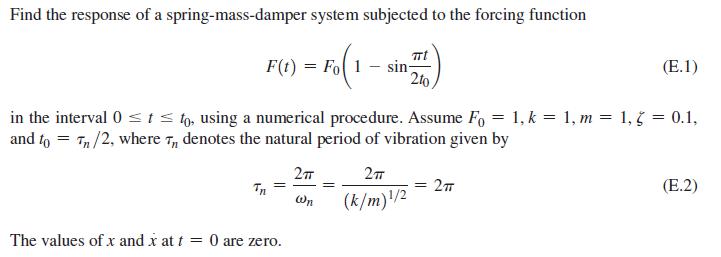
Find the response of a damped single-degree-of-freedom system with the equation of motion\[m \ddot{x}+c \dot{x}+k x=F(t)\]using Runge-Kutta method. Assume that \(m=5 \mathrm{~kg}, c=200 \mathrm{~N}-\mathrm{s} / \mathrm{m}, k=750 \mathrm{~N} / \mathrm{m}\), and\[F(t)= \begin{cases}\frac{F_{0}
Solve Problem 4.82 (using Runge-Kutta method) for the forcing function\[F(t)= \begin{cases}F_{0} \sin \frac{\pi t}{t_{1}} ; & 0 \leq t \leq t_{1} \\ 0 ; & t \geq t_{1}\end{cases}\]with \(F_{0}=2000 \mathrm{~N}\) and \(t_{1}=6 \mathrm{~s}\).Data From Problem 4.82:-Find the response of a damped
Solve Problem 4.82 (using Runge-Kutta method) for the forcing function\[F(t)= \begin{cases}\frac{F_{0} t}{t_{1}} ; & 0 \leq t \leq t_{1} \\ F_{0}\left(\frac{t_{2}-t}{t_{2}-t_{1}}\right) ; & t_{1} \leq t \leq t_{2} \\ 0 ; & t \geq t_{2}\end{cases}\]with \(F_{0}=2000 \mathrm{~N}, t_{1}=3
Derive the expressions for \(x_{j}\) and \(\dot{x}_{j}\) according to the linear interpolation function, considered in Section 4.9 for the undamped case. Using these expressions, find the solution of Example 4.31 by assuming the damping to be zero.
Find the response of a damped single-degree-of-freedom system with the equation of motion\[m \ddot{x}+c \dot{x}+k x=F(t)\]using the numerical method of Section 4.9. Assume that \(m=500 \mathrm{~kg}, c=200 \mathrm{~N}-\mathrm{s} / \mathrm{m}, k=\) \(750 \mathrm{~N} / \mathrm{m}\), and the values of
Find the response of a damped single-degree-of-freedom system with the equation of motion\[m \ddot{x}+c \dot{x}+k x=F(t)\]using the numerical method of Section 4.9. Assume that \(m=500 \mathrm{~kg}, c=200 \mathrm{~N}-\mathrm{s} / \mathrm{m}, k=\) \(750 \mathrm{~N} / \mathrm{m}\), and the values of
Find the response of a damped single-degree-of-freedom system with the equation of motion\[m \ddot{x}+c \dot{x}+k x=F(t)\]using the numerical method of Section 4.9. Assume that \(m=500 \mathrm{~kg}, c=200 \mathrm{~N}-\mathrm{s} / \mathrm{m}, k=\) \(750 \mathrm{~N} / \mathrm{m}\), and the values of
A machine is given an impact force by an impact hammer. If the machine can be modeled as a single-degree-of-freedom system with \(m=10 \mathrm{~kg}, k=4000 \mathrm{~N} / \mathrm{m}\), and \(c=40 \mathrm{~N}-\mathrm{s} / \mathrm{m}\), and the magnitude of the impact is \(F=100 \mathrm{~N}\)-s,
If the machine described in Problem 4.89 is given a double impact by the impact hammer, find the response of the machine. Assume the impact force, \(F(t)\), as \(F(t)=100 \delta(t)+50 \delta(t-0.5) \mathrm{N}\), where \(\delta(t)\) is the Dirac delta function. Also plot the response of the machine
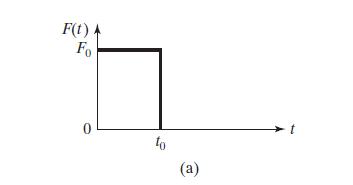
Using MATLAB, plot the response of a viscously damped spring-mass system subject to the rectangular pulse shown in Fig. 4.12 (a) with (a) \(t_{0}=0.1 \mathrm{~s}\) and (b) \(t_{0}=1.5 \mathrm{~s}\). Assume the following data: \(m=100 \mathrm{~kg}, k=1200 \mathrm{~N} / \mathrm{m}, c=50
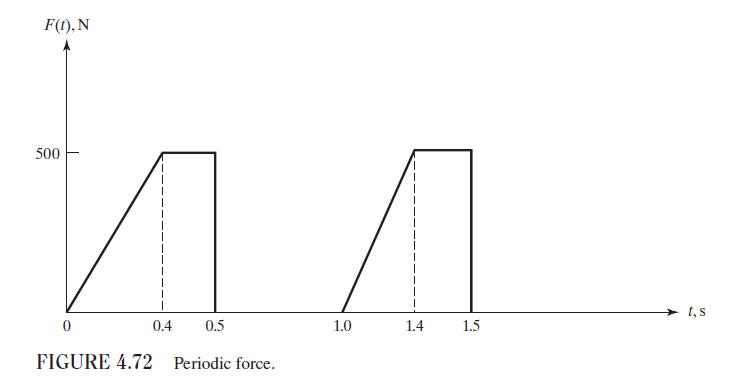
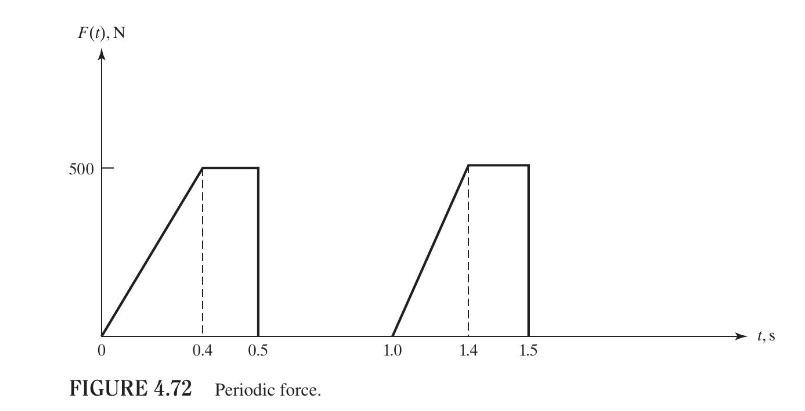
Using Program4.m, find the steady-state response of a viscously damped system with \(m=1 \mathrm{~kg}, k=400 \mathrm{~N} / \mathrm{m}\), and \(c=5 \mathrm{~N}-\mathrm{s} / \mathrm{m}\) subject to the periodic force shown in Fig. 4.72.Figure 4.72:- F(t), N 500 0 0.4 0.5 FIGURE 4.72 Periodic force.
Using Program5.m, find the response of a viscously damped system with \(m=100 \mathrm{~kg}\), \(k=10^{5} \mathrm{~N}\), and \(\zeta=0.1\) subject to the force \(F(t)=1000(1-\cos \pi t) \mathrm{N}\). F(t), N 500 0 0.4 0.5 FIGURE 4.72 Periodic force. t, s S 1.0 1.4 1.5
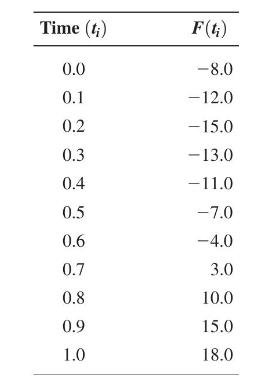
A damped single-degree-of-freedom system has a mass \(m=2\), a spring of stiffness \(k=50\), and a damper with \(c=2\). A forcing function \(F(t)\), whose magnitude is indicated in the table below, acts on the mass for \(1 \mathrm{~s}\). Find the response of the system by using the piecewise linear
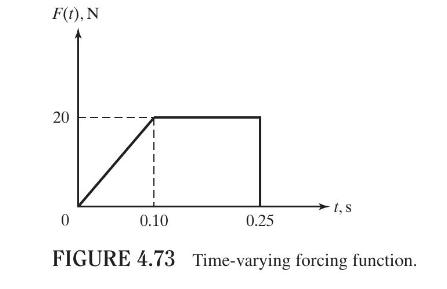
The equation of motion of an undamped system is given by \(2 \ddot{x}+1500 x=F(t)\), where the forcing function is defined by the curve shown in Fig. 4.73. Find the response of the system numerically for \(0 \leq t \leq 0.5\). Assume the initial conditions as \(x_{0}=\dot{x}_{0}=0\) and the step
Solve Problem 4.95 using MATLAB program ode23 if the system is viscously damped so that the equation of motion is\[2 \ddot{x}+10 \dot{x}+1500 x=F(t)\]Data From Problem 4.95:-The equation of motion of an undamped system is given by \(2 \ddot{x}+1500 x=F(t)\), where the forcing function is defined by
Write a MATLAB program for finding the steady-state response of a single-degree-of-freedom system subjected to an arbitrary force, by numerically evaluating the Duhamel integral. Using this program, solve Example 4.31.Data From Example 4.31:- Find the response of a spring-mass-damper system
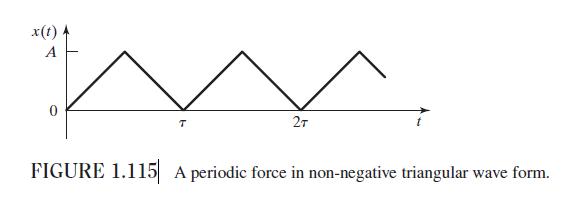
Find the relative displacement of the water tank shown in Fig. 4.43 (a) when its base is subjected to the earthquake acceleration record shown in Fig. 1.115 by assuming the ordinate represents acceleration in \(g\) 's. Use the program of Problem 4.97.Figure 1.115:-Data From Problem 4.97:-Write a
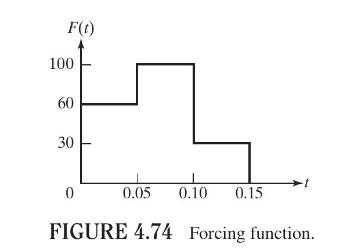
The differential equation of motion of an undamped system is given by \(2 \ddot{x}+150 x=F(t)\) with the initial conditions \(x_{0}=\dot{x}_{0}=0\). If \(F(t)\) is as shown in Fig. 4.74, find the response of the problem using the computer program of Problem 4.97.Figure 4.74:-Data From Problem
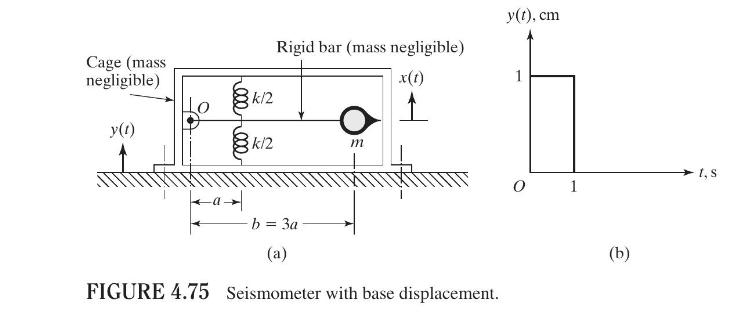
Design a seismometer of the type shown in Fig. 4.75 (a) (by specifying the values of \(a, m\), and \(k\) ) to measure earthquakes. The seismometer should have a natural frequency of \(10 \mathrm{~Hz}\), and the maximum relative displacement of the mass should be at least \(2 \mathrm{~cm}\) when its
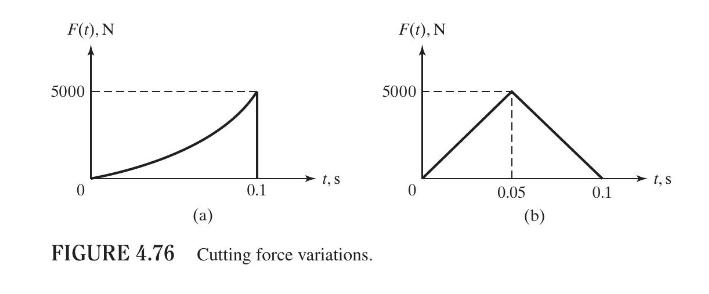
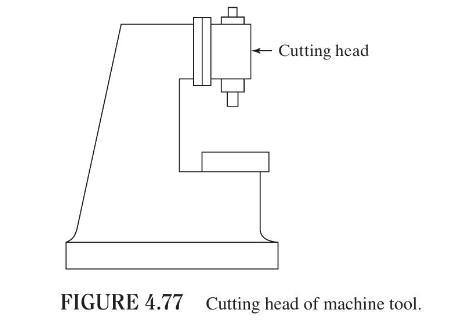
The cutting forces developed during two different machining operations are shown in Figs. 4.76 (a) and (b). The inaccuracies (in the vertical direction) in the surface finish in the two cases were observed to be \(0.1 \mathrm{~mm}\) and \(0.05 \mathrm{~mm}\), respectively. Find the equivalent mass
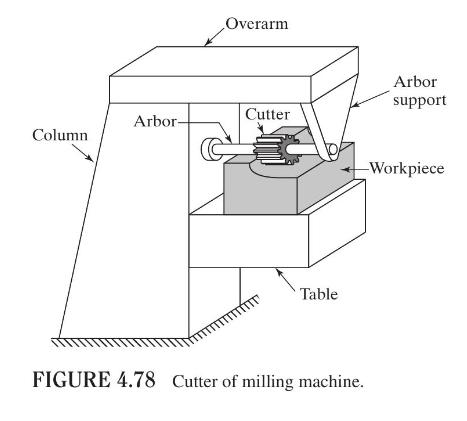
A milling cutter, mounted at the middle of an arbor, is used to remove metal from a workpiece (Fig. 4.78). A torque of \(500 \mathrm{~N}-\mathrm{m}\) is developed in the cutter under steady-state cutting conditions. One of the 16 teeth on the cutter breaks during the cutting operation. Determine
A weight of \(50 \mathrm{~N}\) is suspended from a spring of stiffness \(4000 \mathrm{~N} / \mathrm{m}\) and is subjected to a harmonic force of amplitude \(60 \mathrm{~N}\) and frequency \(6 \mathrm{~Hz}\). Find (a) the extension of the spring due to the suspended weight, (b) the static
A spring-mass system is subjected to a harmonic force whose frequency is close to the natural frequency of the system. If the forcing frequency is \(39.8 \mathrm{~Hz}\) and the natural frequency is \(40.0 \mathrm{~Hz}\), determine the period of beating.
Consider a spring-mass system, with \(k=4000 \mathrm{~N} / \mathrm{m}\) and \(m=10 \mathrm{~kg}\), subject to a harmonic force \(F(t)=400 \cos 10 t \mathrm{~N}\). Find and plot the total response of the system under the following initial conditions:a. \(x_{0}=0.1 \mathrm{~m}, \dot{x}_{0}=0\)b.
Consider a spring-mass system, with \(k=4000 \mathrm{~N} / \mathrm{m}\) and \(m=10 \mathrm{~kg}\), subject to a harmonic force \(F(t)=400 \cos 20 t \mathrm{~N}\). Find and plot the total response of the system under the following initial conditions:a. \(x_{0}=0.1 \mathrm{~m}, \dot{x}_{0}=0\)b.
Consider a spring-mass system, with \(k=4000 \mathrm{~N} / \mathrm{m}\) and \(m=10 \mathrm{~kg}\), subject to a harmonic force \(F(t)=400 \cos 20.1t \mathrm{~N}\). Find and plot the total response of the system under the following initial conditions:a. \(x_{0}=0.1 \mathrm{~m}, \dot{x}_{0}=0\)b.
Consider a spring-mass system, with \(k=4000 \mathrm{~N} / \mathrm{m}\) and \(m=10 \mathrm{~kg}\), subject to a harmonic force \(F(t)=400 \cos 30 t \mathrm{~N}\). Find and plot the total response of the system under the following initial conditions:a. \(x_{0}=0.1 \mathrm{~m}, \dot{x}_{0}=0\)b.
A spring-mass system consists of a mass weighing \(100 \mathrm{~N}\) and a spring with a stiffness of \(2000 \mathrm{~N} / \mathrm{m}\). The mass is subjected to resonance by a harmonic force \(F(t)=25 \cos \omega t \mathrm{~N}\). Find the amplitude of the forced motion at the end of (a)
A mass \(m\) is suspended from a spring of stiffness \(4000 \mathrm{~N} / \mathrm{m}\) and is subjected to a harmonic force having an amplitude of \(100 \mathrm{~N}\) and a frequency of \(5 \mathrm{~Hz}\). The amplitude of the forced motion of the mass is observed to be \(20 \mathrm{~mm}\). Find
A spring-mass system with \(m=10 \mathrm{~kg}\) and \(k=5000 \mathrm{~N} / \mathrm{m}\) is subjected to a harmonic force of amplitude \(250 \mathrm{~N}\) and frequency \(\omega\). If the maximum amplitude of the mass is observed to be \(100 \mathrm{~mm}\), find the value of \(\omega\).
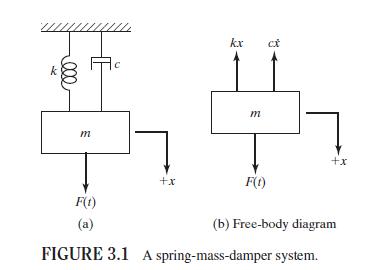
In Fig. 3.1(a), a periodic force \(F(t)=F_{0} \cos \omega t\) is applied at a point on the spring that is located at a distance of \(25 \%\) of its length from the fixed support. Assuming that \(c=0\), find the steady-state response of the mass \(m\). 000 m C kx m ct F(t) +x (a) F(t) +x (b)
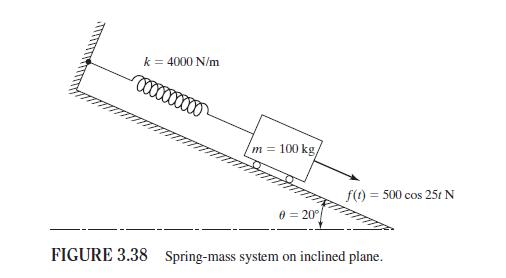
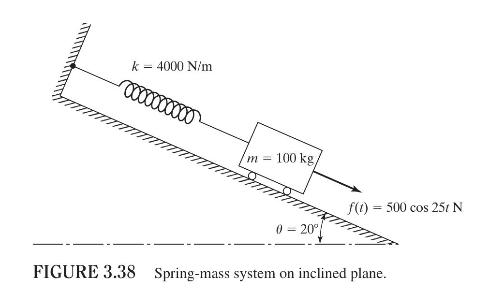
A spring-mass system, resting on an inclined plane, is subjected to a harmonic force as shown in Fig. 3.38. Find the response of the system by assuming zero initial conditions. k = 4000 N/m m= 100 kg 0 20/ f(t) = 500 cos 25t N FIGURE 3.38 Spring-mass system on inclined plane.
The natural frequency of vibration of a person is found to be \(5.2 \mathrm{~Hz}\) while standing on a horizontal floor. Assuming damping to be negligible, determine the following:a. If the mass of the person is \(70 \mathrm{~kg}\), determine the equivalent stiffness of his body in the vertical
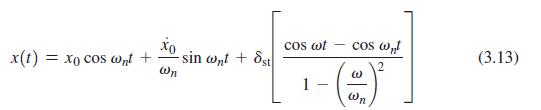
Plot the forced-vibration response of a spring-mass system given by Eq. (3.13) for the following sets of data:a. Set 1: \(\delta_{\mathrm{st}}=0.1, \omega=5, \omega_{n}=6, x_{0}=0.1, \quad \dot{x}_{0}=0.5\)b. Set 2: \(\delta_{\mathrm{st}}=0.1, \omega=6.1, \omega_{n}=6, x_{0}=0.1, \quad
A spring-mass system is set to vibrate from zero initial conditions under a harmonic force. The response is found to exhibit the phenomenon of beats with the period of beating equal to \(0.5 \mathrm{~s}\) and the period of oscillation equal to \(0.05 \mathrm{~s}\). Find the natural frequency of the
A spring-mass system, with \(m=100 \mathrm{~kg}\) and \(k=400 \mathrm{~N} / \mathrm{m}\), is subjected to a harmonic force \(f(t)=F_{0} \cos \omega t\) with \(F_{0}=10 \mathrm{~N}\). Find the response of the system when \(\omega\) is equal to (a) 2 \(\mathrm{rad} / \mathrm{s}\), (b) \(0.2
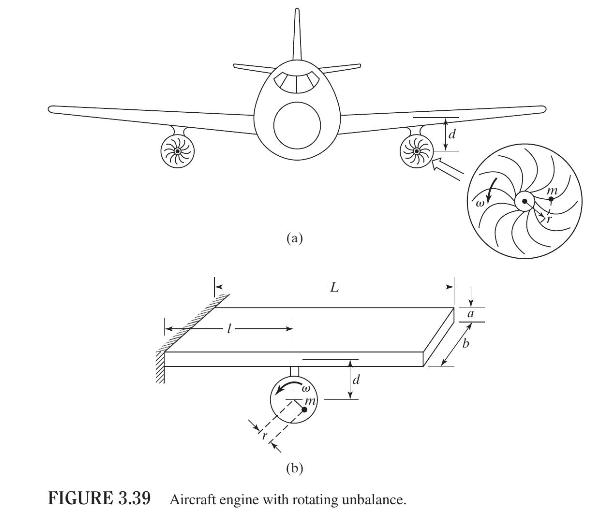
An aircraft engine has a rotating unbalanced mass \(m\) at radius \(r\). If the wing can be modeled as a cantilever beam of uniform cross section \(a \times b\), as shown in Fig. 3.39(b), determine the maximum deflection of the engine at a speed of \(N \mathrm{rpm}\). Assume damping and effect of
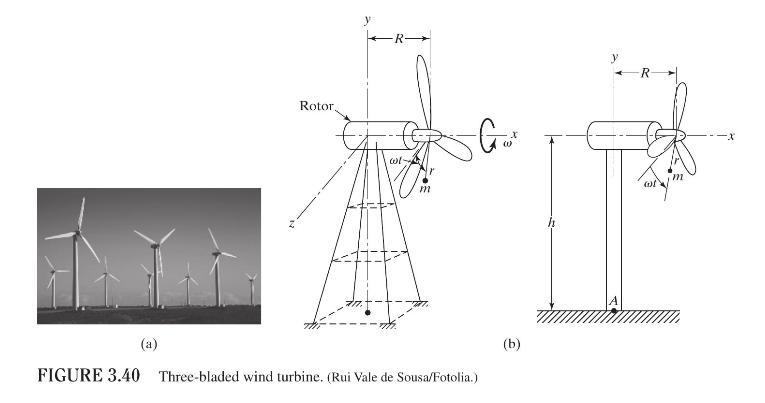
A three-bladed wind turbine (Fig. 3.40(a)) has a small unbalanced mass \(m\) located at a radius \(r\) in the plane of the blades. The blades are located from the central vertical \((y)\) axis at a distance \(R\) and rotate at an angular velocity of \(\omega\). If the supporting truss can be
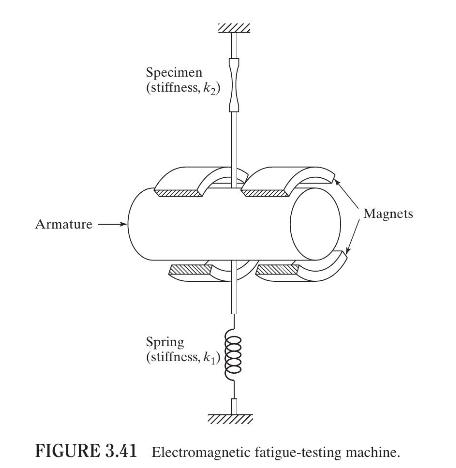
An electromagnetic fatigue-testing machine is shown in Fig. 3.41 in which an alternating force is applied to the specimen by passing an alternating current of frequency \(f\) through the armature. If the mass of the armature is \(20 \mathrm{~kg}\), the stiffness of the spring \(\left(k_{1}\right)\)
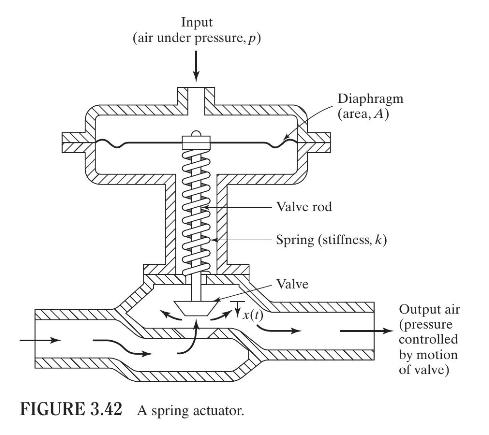
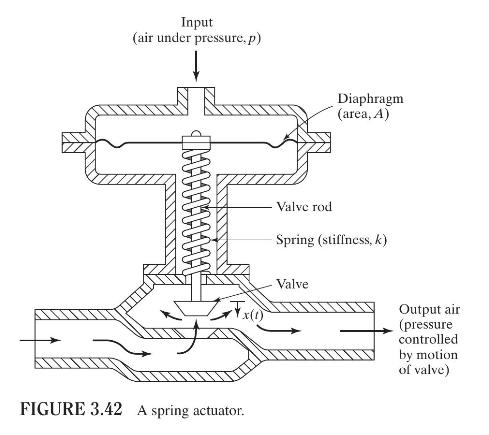
The spring actuator shown in Fig. 3.42 operates by using the air pressure from a pneumatic controller \((p)\) as input and providing an output displacement to a valve \((x)\) proportional to the input air pressure. The diaphragm, made of a fabric-base rubber, has an area \(A\) and deflects under
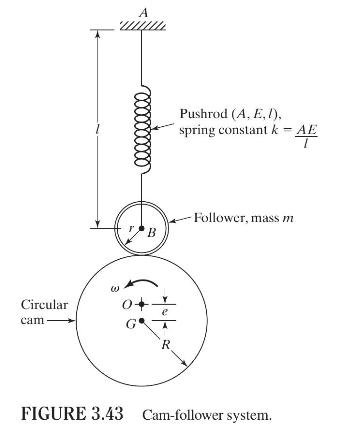
In the cam-follower system shown in Fig. 3.43, the rotation of the cam imparts a vertical motion to the follower. The pushrod, which acts as a spring, has been compressed by an amount \(x_{0}\) before assembly. Determine the following: (a) equation of motion of the follower, including the
Design a solid steel shaft supported in bearings which carries the rotor of a turbine at the middle. The rotor has a mass of \(250 \mathrm{~kg}\) and delivers a power of \(150 \mathrm{~kW}\) at \(3000 \mathrm{rpm}\). In order to keep the stress due to the unbalance in the rotor small, the critical
A hollow steel shaft of length \(2.6 \mathrm{~m}\), outer diameter \(110 \mathrm{~mm}\), and inner diameter \(95 \mathrm{~mm}\), carries the rotor of a turbine, of mass \(250 \mathrm{~kg}\), at the middle and is supported at the ends in bearings. The clearance between the rotor and the stator is
A steel cantilever beam, possessing a mass of \(0.04 \mathrm{~kg}\) at the free end, is used as a frequency meter. \({ }^{7}\) The beam has a length of \(0.3 \mathrm{~m}\), width of \(6 \mathrm{~mm}\), and thickness of \(1.8 \mathrm{~mm}\). The internal friction is equivalent to a damping ratio of
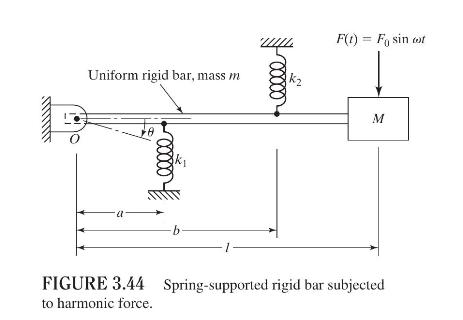
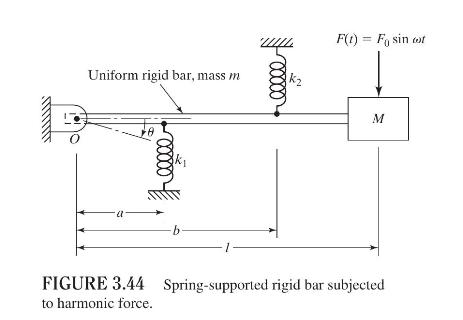
Derive the equation of motion and find the steady-state response of the system shown in Fig. 3.44 for rotational motion about the hinge \(O\) for the following data: \(k_{1}=k_{2}=5000 \mathrm{~N} / \mathrm{m}\), \(a=0.25 \mathrm{~m}, b=0.5 \mathrm{~m}, l=1 \mathrm{~m}, M=50 \mathrm{~kg}, m=10
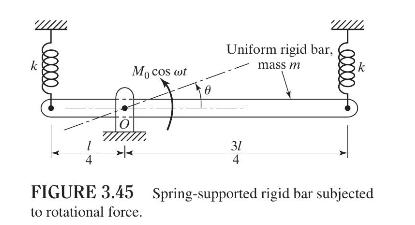
Derive the equation of motion and find the steady-state solution of the system shown in Fig. 3.45 for rotational motion about the hinge \(O\) for the following data: \(k=5000 \mathrm{~N} / \mathrm{m}\), \(l=1 \mathrm{~m}, m=10 \mathrm{~kg}, M_{0}=100 \mathrm{~N}-\mathrm{m}, \omega=1000
Consider a spring-mass-damper system with \(k=4000 \mathrm{~N} / \mathrm{m}, m=10 \mathrm{~kg}\), and \(c=40 \mathrm{~N}-\mathrm{s} / \mathrm{m}\). Find the steady-state and total responses of the system under the harmonic force \(F(t)=200 \cos 10 t \mathrm{~N}\) and the initial conditions
Consider a spring-mass-damper system with \(k=4000 \mathrm{~N} / \mathrm{m}, m=10 \mathrm{~kg}\), and \(c=40 \mathrm{~N}-\mathrm{s} / \mathrm{m}\). Find the steady-state and total responses of the system under the harmonic force \(F(t)=200 \cos 10 t \mathrm{~N}\) and the initial conditions
Consider a spring-mass-damper system with \(k=4000 \mathrm{~N} / \mathrm{m}, m=10 \mathrm{~kg}\), and \(c=40 \mathrm{~N}-\mathrm{s} / \mathrm{m}\). Find the steady-state and total responses of the system under the harmonic force \(F(t)=200 \cos 20 t \mathrm{~N}\) and the initial conditions
Consider a spring-mass-damper system with \(k=4000 \mathrm{~N} / \mathrm{m}, m=10 \mathrm{~kg}\), and \(c=40 \mathrm{~N}-\mathrm{s} / \mathrm{m}\). Find the steady-state and total responses of the system under the harmonic force \(F(t)=200 \cos 20 t \mathrm{~N}\) and the initial conditions
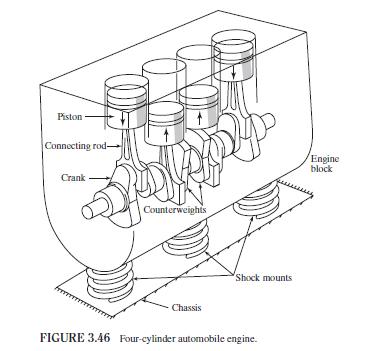
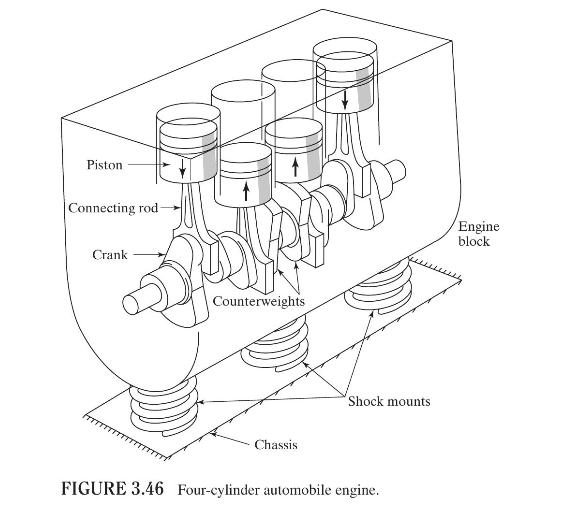
A four-cylinder automobile engine is to be supported on three shock mounts, as indicated in Fig. 3.46. The engine-block assembly has a mass of \(250 \mathrm{~kg}\). If the unbalanced force generated by the engine is given by \(1000 \sin 100 \pi t \mathrm{~N}\), design the three shock mounts (each
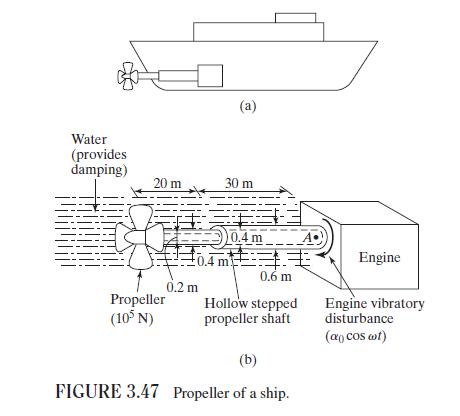
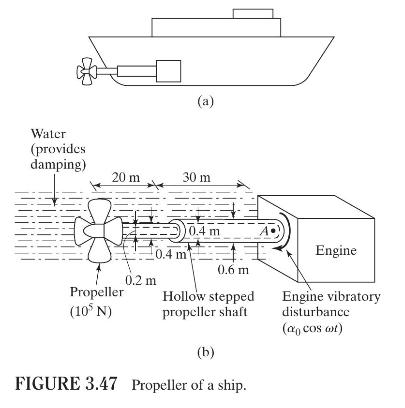
The propeller of a ship, of weight \(10^{5} \mathrm{~N}\) and polar mass moment of inertia \(10,000 \mathrm{~kg}-\mathrm{m}^{2}\), is connected to the engine through a hollow stepped steel propeller shaft, as shown in Fig. 3.47. Assuming that water provides a viscous damping ratio of 0.1, determine
Find the frequency ratio \(r=\omega / \omega_{n}\) at which the amplitude of a single-degree-of-freedom damped system attains the maximum value. Also find the value of the maximum amplitude.
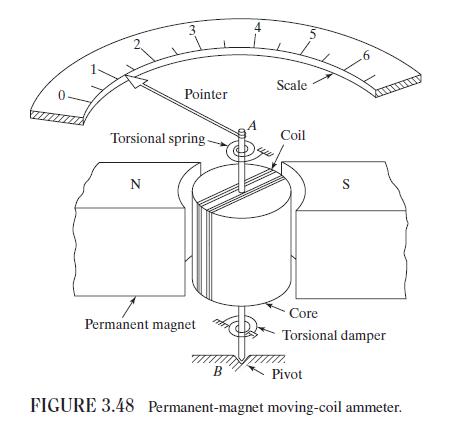
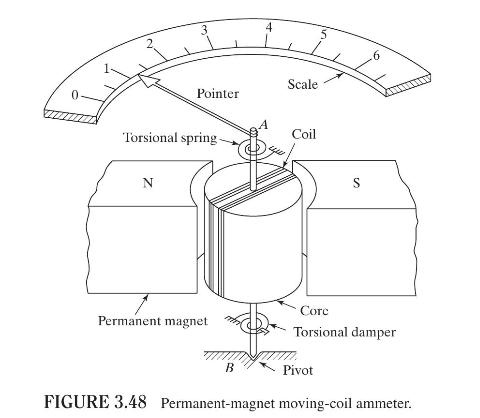
Figure 3.48 shows a permanent-magnet moving-coil ammeter. When current \((I)\) flows through the coil wound on the core, the core rotates by an angle proportional to the magnitude of the current that is indicated by the pointer on a scale. The core, with the coil, has a mass moment of inertia
A spring-mass-damper system is subjected to a harmonic force. The amplitude is found to be \(20 \mathrm{~mm}\) at resonance and \(10 \mathrm{~mm}\) at a frequency 0.75 times the resonant frequency. Find the damping ratio of the system.
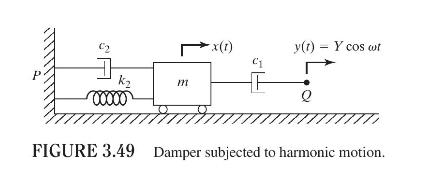
For the system shown in Fig. 3.49, \(x\) and \(y\) denote, respectively, the absolute displacements of the mass \(m\) and the end \(Q\) of the dashpot \(c_{1}\). (a) Derive the equation of motion of the mass \(m\), (b) find the steady-state displacement of the mass \(m\), and (c) find the force
The equation of motion of a spring-mass-damper system subjected to a harmonic force can be expressed aswhere \(f_{0}=\frac{F_{0}}{m}, \omega_{n}=\sqrt{\frac{k}{m}}\), and \(\zeta=c /\left(2 m \omega_{n}\right)\).i. Find the steady-state response of the system in the form \(x_{s}(t)=C_{1} \cos
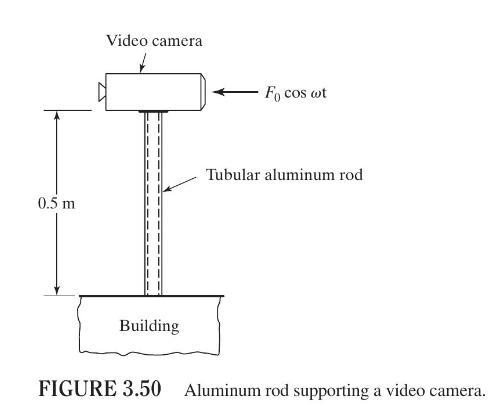
A video camera, of mass \(2.0 \mathrm{~kg}\), is mounted on the top of a bank building for surveillance. The video camera is fixed at one end of a tubular aluminum rod whose other end is fixed to the building as shown in Fig. 3.50. The wind-induced force acting on the video camera, \(f(t)\), is
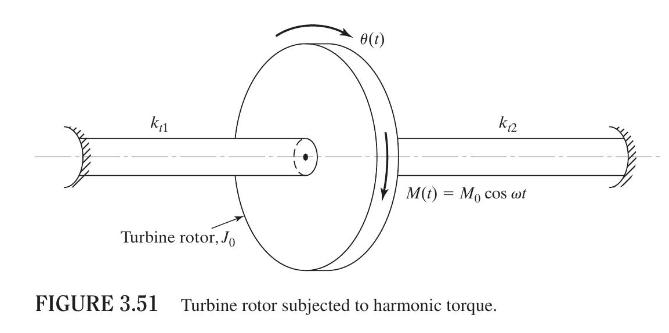
A turbine rotor is mounted on a stepped shaft that is fixed at both ends as shown in Fig. 3.51. The torsional stiffnesses of the two segments of the shaft are given by \(k_{t 1}=3000 \mathrm{~N}-\mathrm{m} / \mathrm{rad}\) and \(k_{t 2}=4000 \mathrm{~N}-\mathrm{m} / \mathrm{rad}\). The turbine
It is required to design an electromechanical system to achieve a natural frequency of \(1000 \mathrm{~Hz}\) and a Q factor of 1200. Determine the damping factor and the bandwidth of the system.
Show that, for small values of damping, the damping ratio \(\zeta\) can be expressed as\[\zeta=\frac{\omega_{2}-\omega_{1}}{\omega_{2}+\omega_{1}}\]where \(\omega_{1}\) and \(\omega_{2}\) are the frequencies corresponding to the half-power points.
A torsional system consists of a disc of mass moment of inertia \(J_{0}=10 \mathrm{~kg}-\mathrm{m}^{2}\), a torsional damper of damping constant \(c_{t}=300 \mathrm{~N}-\mathrm{m}-\mathrm{s} / \mathrm{rad}\), and a steel shaft of diameter \(4 \mathrm{~cm}\) and length \(1 \mathrm{~m}\) (fixed at
For a vibrating system, \(m=10 \mathrm{~kg}, k=2500 \mathrm{~N} / \mathrm{m}\), and \(c=45 \mathrm{~N}-\mathrm{s} / \mathrm{m}\). A harmonic force of amplitude \(180 \mathrm{~N}\) and frequency \(3.5 \mathrm{~Hz}\) acts on the mass. If the initial displacement and velocity of the mass are \(15
The peak amplitude of a single-degree-of-freedom system, under a harmonic excitation, is observed to be \(5 \mathrm{~mm}\). If the undamped natural frequency of the system is \(5 \mathrm{~Hz}\), and the static deflection of the mass under the maximum force is \(2.5 \mathrm{~mm}\), (a) estimate the
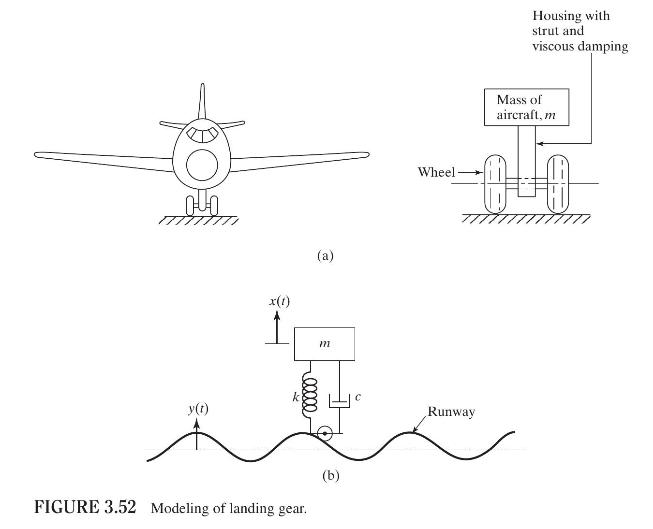
The landing gear of an airplane can be idealized as the spring-mass-damper system shown in Fig. 3.52 [3.16]. If the runway surface is described \(y(t)=y_{0} \cos \omega t\), determine the values of \(k\) and \(c\) that limit the amplitude of vibration of the airplane \((x)\) to \(0.1 \mathrm{~m}\).
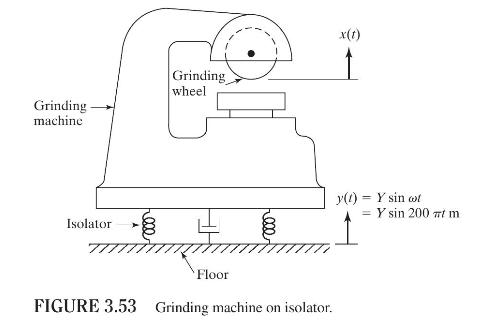
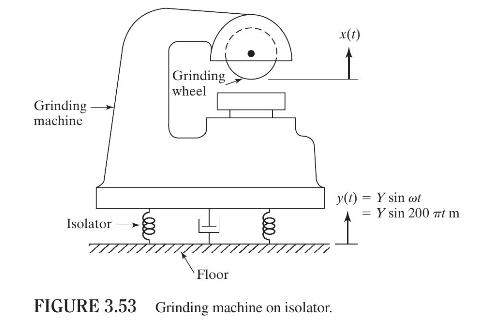
A precision grinding machine (Fig. 3.53) is supported on an isolator that has a stiffness of \(1 \mathrm{MN} / \mathrm{m}\) and a viscous damping constant of \(1 \mathrm{kN}-\mathrm{s} / \mathrm{m}\). The floor on which the machine is mounted is subjected to a harmonic disturbance due to the
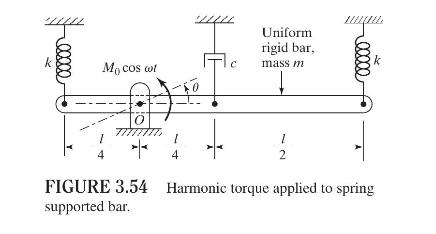
Derive the equation of motion and find the steady-state response of the system shown in Fig. 3.54 for rotational motion about the hinge \(O\) for the following data: \(k=5000 \mathrm{~N} / \mathrm{m}\), \(l=1 \mathrm{~m}, c=1000 \mathrm{~N}-\mathrm{s} / \mathrm{m}, m=10 \mathrm{~kg}, M_{0}=100
An air compressor of mass \(100 \mathrm{~kg}\) is mounted on an elastic foundation. It has been observed that, when a harmonic force of amplitude \(100 \mathrm{~N}\) is applied to the compressor, the maximum steady-state displacement of \(5 \mathrm{~mm}\) occurred at a frequency of \(300
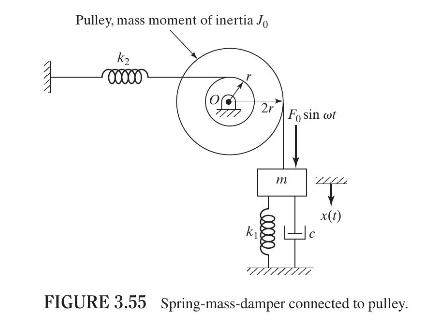
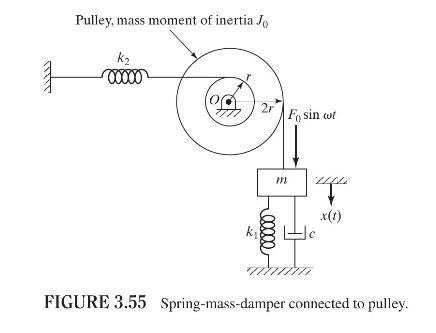
Find the steady-state response of the system shown in Fig. 3.55 for the following data: \(k_{1}=1000 \mathrm{~N} / \mathrm{m}, k_{2}=500 \mathrm{~N} / \mathrm{m}, c=500 \mathrm{~N}-\mathrm{s} / \mathrm{m}, m=10 \mathrm{~kg}, r=5 \mathrm{~cm}, J_{0}=1 \mathrm{~kg}-\mathrm{m}^{2}\), \(F_{0}=50
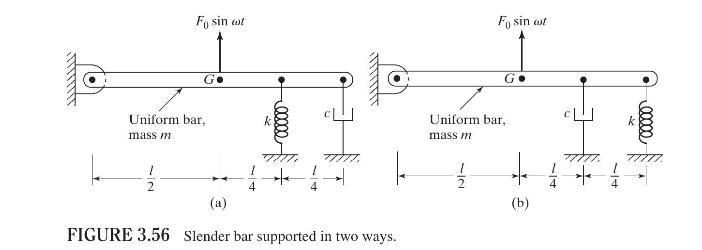
A uniform slender bar of mass \(m\) may be supported in one of two ways as shown in Fig. 3.56. Determine the arrangement that results in a reduced steady-state response of the bar under a harmonic force, \(F_{0} \sin \omega t\), applied at the middle of the bar, as shown in the figure. Pulley, mass
Determine the steady state response of the mass of a spring-mass-damper system subjected to a harmonic force, \(f(t)\), for the following data: \(m=1 \mathrm{~kg}, c=50 \mathrm{~N}-\mathrm{s} / \mathrm{m}\), \(k=50000 \mathrm{~N} / \mathrm{m}, f(t)=50 \cos 400 t \mathrm{~N}\).
By denoting the amplitudes of velocity and acceleration of the mass of a viscously damped system subjected to a harmonic force, as \(\dot{X}\) and \(\ddot{X}\), respectively, find expressions for the ratios \(\frac{\dot{X}}{F_{0} / \sqrt{k m}}\) and \(\frac{\ddot{X}}{F_{0} / m}\) in terms of \(r\)
Find the force transmitted to the base of a viscously damped system subjected to a harmonic force, in the steady state, by using the relation \(f_{T}=F_{0} \cos \omega t-m \ddot{x}\) instead of \(f_{T}=k x+c \dot{x}\) and the steady state response of the system given by Eq. (3.25).Equation 3.25:-
Derive the expression for the complex frequency response of an undamped torsional system.
A damped single-degree-of-freedom system, with parameters \(m=150 \mathrm{~kg}, k=25 \mathrm{kN} / \mathrm{m}\), and \(c=2000 \mathrm{~N}-\mathrm{s} / \mathrm{m}\), is subjected to the harmonic force \(f(t)=100 \cos 20 t \mathrm{~N}\). Find the amplitude and phase angle of the steady-state response
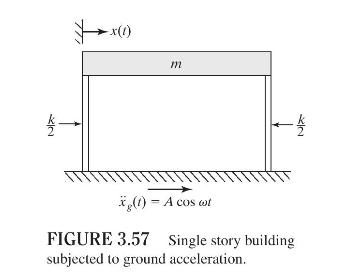
A single-story building frame is subjected to a harmonic ground acceleration, as shown in Fig. 3.57. Find the steady-state motion of the floor (mass \(m\) ).Figure 3.57:- 22 -x(t) m (!) - A cos cot 82 - FIGURE 3.57 Single story building subjected to ground acceleration.
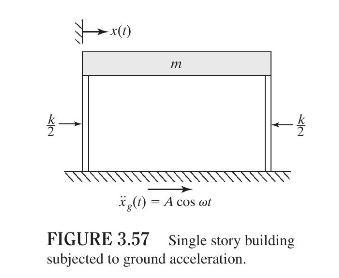
Find the horizontal displacement of the floor (mass \(m\) ) of the building frame shown in Fig. 3.57 when the ground acceleration is given by \(\ddot{x}_{g}=100 \sin \omega t \mathrm{~mm} / \mathrm{s}^{2}\). Assume \(m=2000 \mathrm{~kg}\), \(k=0.1 \mathrm{MN} / \mathrm{m}, \omega=25 \mathrm{rad} /
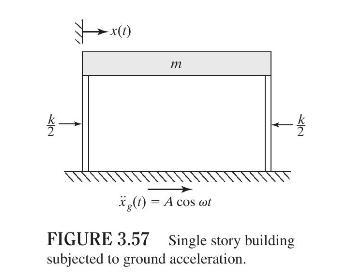
If the ground in Fig. 3.57, is subjected to a horizontal harmonic displacement with frequency \(\omega=200 \mathrm{rad} / \mathrm{s}\) and amplitude \(X_{g}=15 \mathrm{~mm}\), find the amplitude of vibration of the floor (mass m). Assume the mass of the floor as \(2000 \mathrm{~kg}\) and the
An automobile is modeled as a single-degree-of-freedom system vibrating in the vertical direction. It is driven along a road whose elevation varies sinusoidally. The distance from peak to trough is \(0.2 \mathrm{~m}\) and the distance along the road between the peaks is \(35 \mathrm{~m}\). If the
Derive Eq. (3.74). FT kY (1 1 + (25r) 2)2 + (25r)2. 1/2 (3.74)
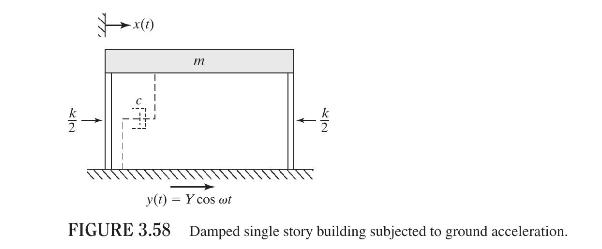
A single-story building frame is modeled by a rigid floor of mass \(m\) and columns of stiffness \(k\), as shown in Fig. 3.58. It is proposed that a damper shown in the figure is attached to absorb vibrations due to a horizontal ground motion \(y(t)=Y \cos \omega t\). Derive an expression for the
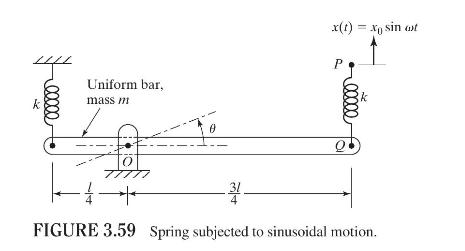
A uniform bar of mass \(m\) is pivoted at point \(O\) and supported at the ends by two springs, as shown in Fig. 3.59. End \(P\) of spring \(P Q\) is subjected to a sinusoidal displacement, \(x(t)=x_{0} \sin \omega t\). Find the steady-state angular displacement of the bar when \(l=1 \mathrm{~m}\),
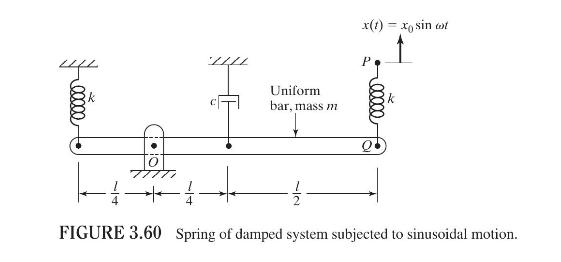
A uniform bar of mass \(m\) is pivoted at point \(O\) and supported at the ends by two springs, as shown in Fig. 3.60. End \(P\) of spring \(P Q\) is subjected to a sinusoidal displacement, \(x(t)=x_{0} \sin \omega t\). Find the steady-state angular displacement of the bar when \(l=1 \mathrm{~m}\),
Find the frequency ratio, \(r=r_{m}\), at which the displacement transmissibility given by Eq. (3.68) attains a maximum value.Equation 3.68:- = [ k + (cw) -(k - mw) + (cw). 1/2 = (1 1+ (2r) - r) + (2r). 27] 1/2 (3.68) XT
An automobile, of mass \(1500 \mathrm{~kg}\) when empty and \(2500 \mathrm{~kg}\) fully loaded, vibrates in a vertical direction while traveling at \(100 \mathrm{~km} / \mathrm{h}\) on a rough road having a sinusoidal waveform with an amplitude \(Y \mathrm{~m}\) and a period \(4 \mathrm{~m}\).
The base of a damped spring-mass system, with \(m=25 \mathrm{~kg}\) and \(k=2500 \mathrm{~N} / \mathrm{m}\), is subjected to a harmonic excitation \(y(t)=Y_{0} \cos \omega t\). The amplitude of the mass is found to be \(0.05 \mathrm{~m}\) when the base is excited at the natural frequency of the
Determine the steady state response of the mass of a spring-mass-damper system subjected to a harmonic base excitation, \(y(t)\), for the following data: \(m=1 \mathrm{~kg}, c=50 \mathrm{~N}-\mathrm{s} / \mathrm{m}\), \(k=50000 \mathrm{~N} / \mathrm{m}, y(t)=0.001 \cos 400 t \mathrm{~m}\).
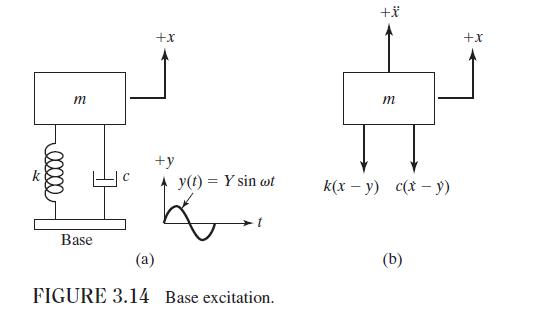
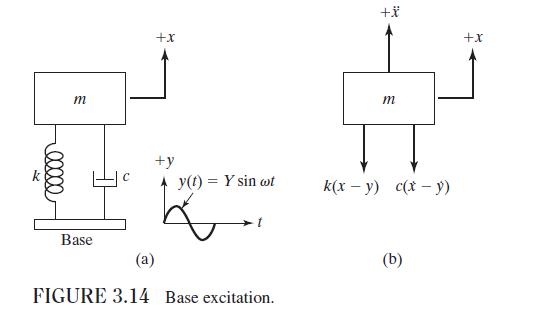
By denoting the amplitudes of velocity and acceleration of the mass of a viscously damped system subjected to a harmonic base motion, \(y(t)\), as shown in Fig. 3.14, as \(\dot{X}\) and \(\ddot{X}\), respectively, find expressions for the ratios \(\frac{\dot{X}}{\omega_{n} Y}\) and
By denoting the amplitudes of relative velocity and relative acceleration of the mass of a viscously damped system subjected to a harmonic base motion, \(y(t)\), as shown in Fig. 3.14, as \(\dot{Z}\) and \(\ddot{Z}\), respectively, find expressions for the ratios \(\frac{\dot{Z}}{\omega_{n} Y}\)
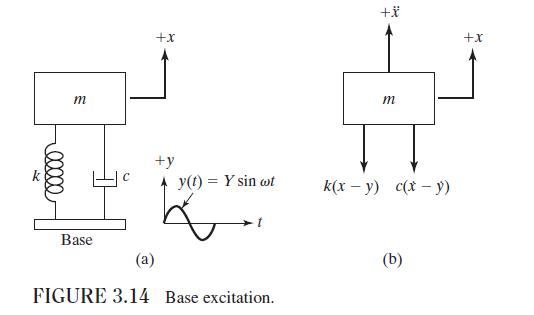
Determine the force transmitted to the base, in the steady state, in a damped single-degreeof-freedom system subjected to a harmonic base excitation, \(y(t)\) (Fig. 3.14). 00000 m +x +X +y m y(t) = Y sin wt k(xy) c(xy) Base (a) K FIGURE 3.14 Base excitation. (b) +x
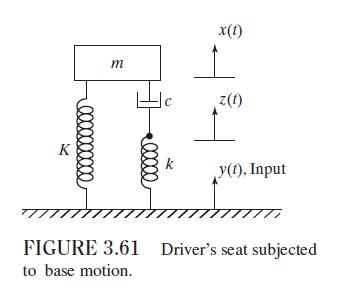
A cushion suspension, such as the driver's seat or a child seat in an automobile can be modeled as shown in Fig. 3.61. By assuming the support or base motion, \(y(t)\), as the input, derive the equations of motion for determining the responses \(x(t)\) and \(z(t)\). Combine the two equations of
Showing 1900 - 2000
of 2655
First
13
14
15
16
17
18
19
20
21
22
23
24
25
26
27
Step by Step Answers

 Get 50% OFF
Claim Now
Get 50% OFF
Claim Now