New Semester
Started
Get
50% OFF
Study Help!
--h --m --s
Claim Now
Question Answers
Textbooks
Find textbooks, questions and answers
Oops, something went wrong!
Change your search query and then try again
S
Books
FREE
Study Help
Expert Questions
Accounting
General Management
Mathematics
Finance
Organizational Behaviour
Law
Physics
Operating System
Management Leadership
Sociology
Programming
Marketing
Database
Computer Network
Economics
Textbooks Solutions
Accounting
Managerial Accounting
Management Leadership
Cost Accounting
Statistics
Business Law
Corporate Finance
Finance
Economics
Auditing
Tutors
Online Tutors
Find a Tutor
Hire a Tutor
Become a Tutor
AI Tutor
AI Study Planner
NEW
Sell Books
Search
Search
Sign In
Register
study help
engineering
mechanical vibration analysis
Mechanical Vibrations 6th Edition Singiresu S Rao - Solutions
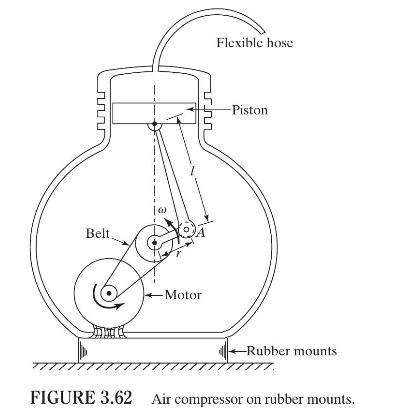
A single-cylinder air compressor of mass \(100 \mathrm{~kg}\) is mounted on rubber mounts, as shown in Fig. 3.62. The stiffness and damping constants of the rubber mounts are given by \(10^{6} \mathrm{~N} / \mathrm{m}\) and\(2000 \mathrm{~N}-\mathrm{s} / \mathrm{m}\), respectively. If the unbalance
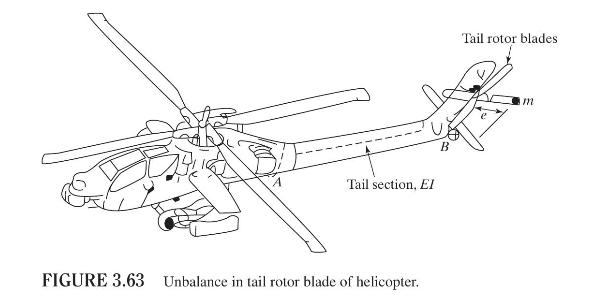
One of the tail rotor blades of a helicopter has an unbalanced mass of \(m=0.5 \mathrm{~kg}\) at a distance of \(e=0.15 \mathrm{~m}\) from the axis of rotation, as shown in Fig. 3.63. The tail section has a length of \(4 \mathrm{~m}\), a mass of \(240 \mathrm{~kg}\), a flexural stiffness ( \(E I\)
When an exhaust fan of mass \(380 \mathrm{~kg}\) is supported on springs with negligible damping, the resulting static deflection is found to be \(45 \mathrm{~mm}\). If the fan has a rotating unbalance of \(0.15 \mathrm{~kg}-\mathrm{m}\), find (a) the amplitude of vibration t \(1750 \mathrm{rpm}\),
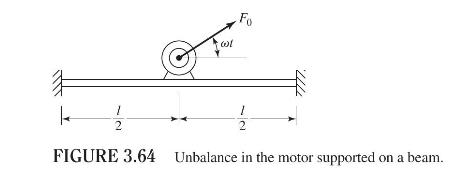
A fixed-fixed steel beam, of length \(5 \mathrm{~m}\), width \(0.5 \mathrm{~m}\), and thickness \(0.1 \mathrm{~m}\), carries an electric motor of mass \(75 \mathrm{~kg}\) and speed \(1200 \mathrm{rpm}\) at its mid-span, as shown in Fig. 3.64. A rotating force of magnitude \(F_{0}=5000 \mathrm{~N}\)
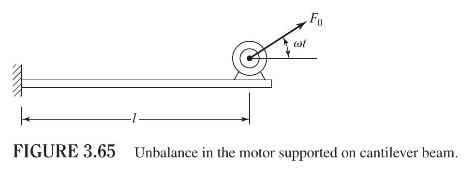
If the electric motor of Problem 3.74 is to be mounted at the free end of a steel cantilever beam of length \(5 \mathrm{~m}\) (Fig. 3.65), and the amplitude of vibration is to be limited to \(0.5 \mathrm{~cm}\), find the necessary cross-sectional dimensions of the beam. Include the weight of the
A centrifugal pump, weighing \(600 \mathrm{~N}\) and operating at \(1000 \mathrm{rpm}\), is mounted on six springs of stiffness \(6000 \mathrm{~N} / \mathrm{m}\) each. Find the maximum permissible unbalance in order to limit the steady-state deflection to \(5 \mathrm{~mm}\) peak-to-peak.
An air compressor, of mass \(500 \mathrm{~kg}\) and operating at \(1500 \mathrm{rpm}\), is to be mounted on a suitable isolator. A helical spring with a stiffness of \(7 \mathrm{MN} / \mathrm{m}\), another helical spring with a stiffness of \(2 \mathrm{MN} / \mathrm{m}\), and a shock absorber with
A variable-speed electric motor, having an unbalance, is mounted on an isolator. As the speed of the motor is increased from zero, the amplitudes of vibration of the motor are observed to be \(15 \mathrm{~mm}\) at resonance and \(4 \mathrm{~mm}\) beyond resonance. Find the damping ratio of the
An electric motor of mass \(300 \mathrm{~kg}\) and running at \(1800 \mathrm{rpm}\) is supported on four steel helical springs, each having eight active coils with a wire diameter of \(6 \mathrm{~mm}\) and a coil diameter of \(25 \mathrm{~mm}\). The rotor has a mass of \(45 \mathrm{~kg}\) with its
A small exhaust fan, rotating at \(1500 \mathrm{rpm}\), is mounted on a 6- \(\mathrm{mm}\) steel shaft. The rotor of the fan has a mass of \(15 \mathrm{~kg}\) and an eccentricity of \(0.25 \mathrm{~mm}\) from the axis of rotation. Find (a) the maximum force transmitted to the bearings, and (b) the
Derive Eq. (3.84) for the force transmitted to the foundation due to rotating unbalance. |F| = mew - (1 1 +45 12)2 + 452,2 (3.84)
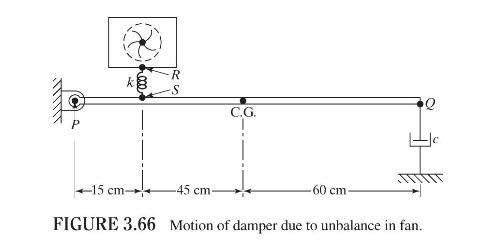
A rigid plate, of mass \(50 \mathrm{~kg}\), is hinged along an edge \((P)\) and is supported on a dashpot with \(c=177 \mathrm{~N}-\mathrm{s} / \mathrm{m}\) at the opposite edge \((Q)\), as shown in Fig. 3.66. A small fan of mass \(25 \mathrm{~kg}\) and rotating at \(750 \mathrm{rpm}\) is mounted
An electric motor is mounted at the end of a cantilever beam. The beam is observed to deflect by \(0.02 \mathrm{~m}\) when the motor runs at a speed of \(1500 \mathrm{rpm}\). By neglecting the mass and damping of the beam, determine the speed of the motor so that the dynamic amplification is less
An air compressor of mass \(50 \mathrm{~kg}\) is mounted on an elastic support and operates at a speed of \(1000 \mathrm{rpm}\). It has an unbalanced mass of \(2 \mathrm{~kg}\) at a radial distance (eccentricity) of \(0.1 \mathrm{~m}\) from the axis of rotation. If the damping factor of the elastic
A turbine rotor of mass \(200 \mathrm{~kg}\) has an unbalanced mass of \(15 \mathrm{~kg}\). It is supported on a foundation which has an equivalent stiffness of \(5000 \mathrm{~N} / \mathrm{m}\) and a damping ratio of \(\zeta=0.05\). If the rotor is found to vibrate with a deflection of \(0.1
A rotating machine of mass \(M=100 \mathrm{~kg}\) is supported on four elastic mounts, each having a stiffness of \(k=50,000 \mathrm{~N} / \mathrm{m}\) and damping constant of \(c=500 \mathrm{~N}-\mathrm{s} / \mathrm{m}\). The machine rotates at a speed of \(6000 \mathrm{rpm}\) and has an eccentric
Derive expressions for the ratios \(\frac{\dot{X}}{e \varepsilon \omega_{n}}\) and \(\frac{\ddot{X}}{e \varepsilon \omega_{n}^{2}}\) in terms of \(r\) and \(\zeta\) for an eccentrically excited damped single-degree-of-freedom system. Here \(\dot{X}\) and \(\ddot{X}\) denote the amplitudes of
Derive the expression for the force transmitted to the base or ground, in the steady state, in an eccentrically excited damped single-degree-of-freedom system.
Derive Eq. (3.99).Equation 3.99:- 2/w AW' = wFoX sin wt cos(wt -) dt = FOX sin (3.99)
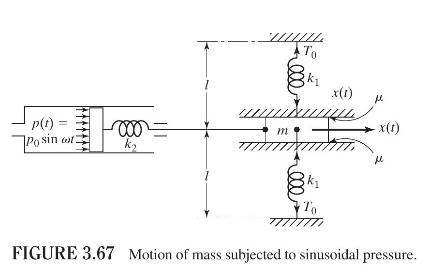
Derive the equation of motion of the mass \(m\) shown in Fig. 3.67 when the pressure in the cylinder fluctuates sinusoidally. The two springs with stiffness \(k_{1}\) are initially under a tension of \(T_{0}\), and the coefficient of friction between the mass and the contacting surfaces is \(\mu\).
The mass of a spring-mass system, with \(m=15 \mathrm{~kg}\) and \(k=25 \mathrm{kN} / \mathrm{m}\), vibrates on a horizontal surface under a harmonic force of magnitude \(200 \mathrm{~N}\) and frequency \(20 \mathrm{~Hz}\). Find the resulting amplitude of steady-state vibration. Assume the
A spring-mass system with \(m=25 \mathrm{~kg}\) and \(k=10 \mathrm{kN} / \mathrm{m}\) vibrates on a horizontal surface with coefficient of friction \(\mu=0.3\). Under a harmonic force of frequency \(8 \mathrm{~Hz}\), the steadystate vibration of the mass is found to be \(0.2 \mathrm{~m}\).
A spring-mass system is subjected to Coulomb damping. When a harmonic force of amplitude \(120 \mathrm{~N}\) and frequency \(2.5173268 \mathrm{~Hz}\) is applied, the system is found to oscillate with an amplitude of \(75 \mathrm{~mm}\). Determine the coefficient of dry friction if \(m=2
A load of \(5000 \mathrm{~N}\) resulted in a static displacement of \(0.05 \mathrm{~m}\) in a composite structure. A harmonic force of amplitude \(1000 \mathrm{~N}\) is found to cause a resonant amplitude of \(0.1 \mathrm{~m}\). Find (a) the hysteresis-damping constant of the structure, (b) the
The energy dissipated in hysteresis damping per cycle under harmonic excitation can be expressed in the general formwhere \(\gamma\) is an exponent \((\gamma=2\) was considered in Eq. (2.150)), and \(\beta\) is a coefficient of dimension (meter \()^{2-\gamma}\). A spring-mass system having \(k=60
When a spring-mass-damper system is subjected to a harmonic force \(F(t)=20 \cos 3 \pi t \mathrm{~N}\), the resulting displacement is given by \(x(t)=0.0125 \cos (3 \pi t-\pi / 3) \mathrm{m}\). Find the work done (a) during the first second, and (b) during the first 4 seconds.
Find the equivalent viscous-damping coefficient of a damper that offers a damping force of \(F_{d}=c(\dot{x})^{n}\), where \(c\) and \(n\) are constants and \(\dot{x}\) is the relative velocity across the damper. Also, find the amplitude of vibration.
Show that for a system with both viscous and Coulomb damping the approximate value of the steady-state amplitude is given by\[X^{2}\left[k^{2}\left(1-r^{2}\right)^{2}+c^{2} \omega^{2}\right]+X \frac{8 \mu N c \omega}{\pi}+\left(\frac{16 \mu^{2} N^{2}}{\pi^{2}}-F_{0}^{2}\right)=0\]
The equation of motion of a spring-mass-damper system is given by\[m \ddot{x} \pm \mu N+c \dot{x}^{3}+k x=F_{0} \cos \omega t\]Derive expressions for (a) the equivalent viscous-damping constant, (b) the steady-state amplitude, and (c) the amplitude ratio at resonance.
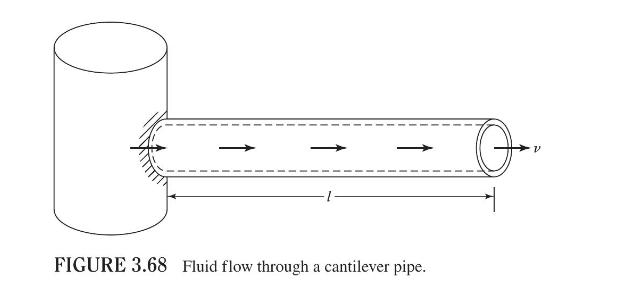
A fluid, with density \(ho\), flows through a cantilevered steel pipe of length \(l\) and cross-sectional area \(A\) (Fig. 3.68). Determine the velocity ( \(v\) ) of the fluid at which instability occurs. Assume that the total mass and the bending stiffness of the pipe are \(m\) and \(E I\),
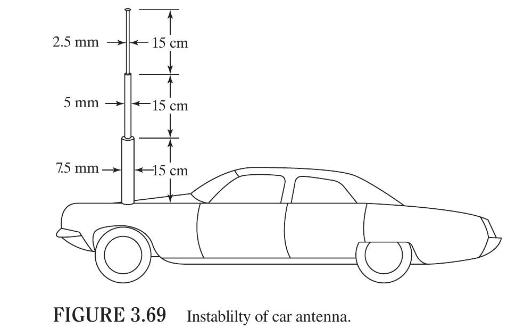
The first two natural frequencies of the telescoping car antenna shown in Fig. 3.69 are given by \(3.0 \mathrm{~Hz}\) and \(7.0 \mathrm{~Hz}\). Determine whether the vortex shedding around the antenna causes instability over the speed range \(90-130 \mathrm{~km} / \mathrm{h}\) of the automobile.
The signpost of a fast food restaurant consists of a hollow steel cylinder of height \(h\), inside diameter \(d\), and outside diameter \(D\), fixed to the ground and carries a concentrated mass \(M\) at the top. It can be modeled as a single-degree-of-freedom spring-mass-damper system with an
Consider the equation of motion of a single-degree-of-freedom system:\[m \ddot{x}+c \dot{x}+k x=F\]Derive the condition that leads to divergent oscillations in each of the following cases: (a) when the forcing function is proportional to the displacement, \(F(t)=F_{0} x(t)\); (b) when the forcing
Derive the transfer function of a viscously damped system subject to a harmonic base motion, with the equation of motion:\[m \ddot{x}+c(\dot{x}-\dot{y})+k(x-y)=0\]where \(y(t)=Y \sin \omega t\).
Derive the transfer function of a viscously damped system under rotating unbalance, with the equation of motion:\[M \ddot{x}+c \dot{x}+k x=m e \omega^{2} \sin \omega t\]
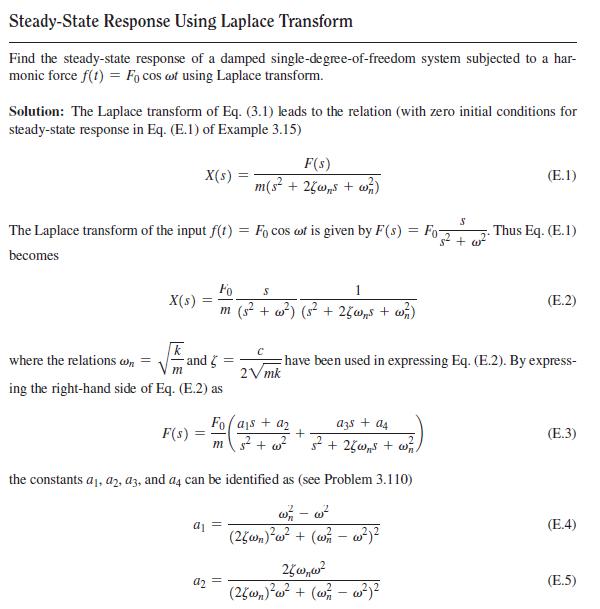
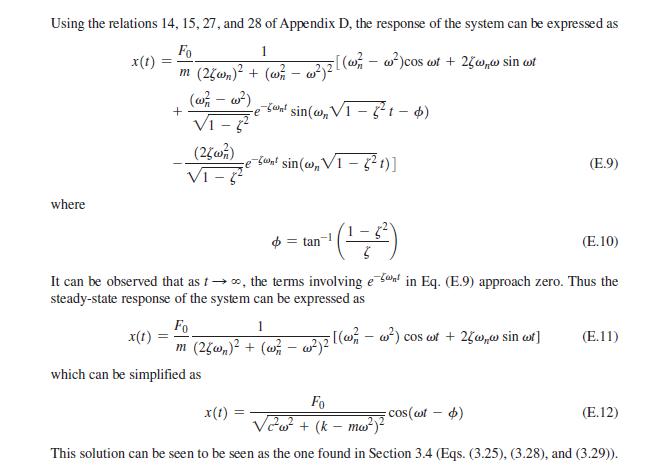
Find the steady-state response of a damped single-degree-of-freedom system subjected to a harmonic base motion, considered in Section 3.6, using Laplace transform.Data From Laplace Tranform:-Equation 3.25, 3.28 and 3.29:-Data From Example 3.15Figure 3.1:- Steady-State Response Using Laplace
Find the steady-state response of a damped single-degree-of-freedom system under rotating unbalance, considered in Section 3.7, using Laplace transform.Data From Laplace Tranform:-Equation 3.25, 3.28 and 3.29:-Data From Example 3.15Figure 3.1:- Steady-State Response Using Laplace Transform Find
Find the steady-state response of an undamped single-degree-of-freedom system subjected to a harmonic force, considered in Section 3.3, using Laplace transform.Data From Laplace Tranform:-Equation 3.25, 3.28 and 3.29:-Data From Example 3.15Figure 3.1:- Steady-State Response Using Laplace
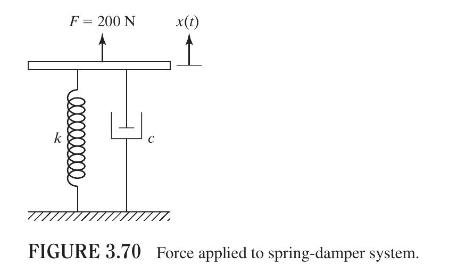
A spring and a viscous damper, connected to a massless rigid bar, are subjected to a harmonic force \(f(t)\) as shown in Fig. 3.70. Find the steady-state response of the system using Laplace transform.Data From Laplace Tranform:-Equation 3.25, 3.28 and 3.29:-Figure 3.70:-Data From Example
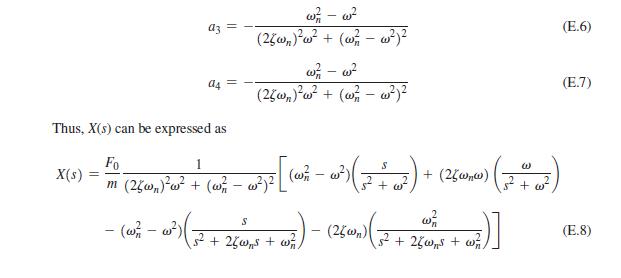
Derive Eqs. (E.4)-(E.7) in Example 3.17.Data From (E.4) - (E.7):-Data From Example 3.17:-Data From Example 3.15Figure 3.1:- F = 200 N K x(t) C FIGURE 3.70 Force applied to spring-damper system.
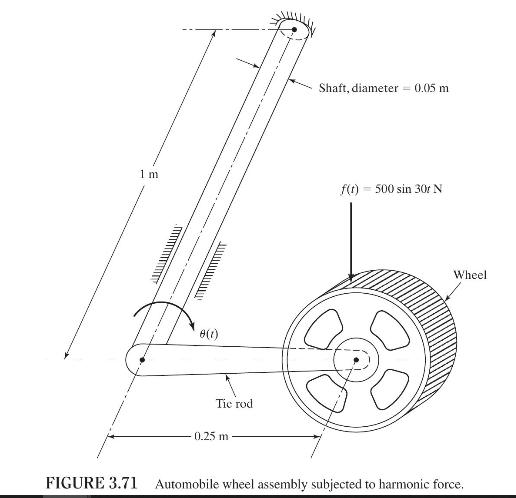
An experiment is conducted to find the dynamic response characteristics of an automobile wheel assembly system. For this, the wheel is connected to a shaft through a tie rod and is subjected to a harmonic force \(f(t)\) as shown in Fig. 3.71. The shaft offers a torsional stiffness of \(k_{t}\)
Generate the frequency transfer function from the general transfer function derived for a viscously damped system subject to a harmonic base motion considered in Problem 3.104 and identify the input, system, and output sinusoids.Data From Problem 3.104:-Derive the transfer function of a viscously
Generate the frequency transfer function from the general transfer function derived for a viscously damped system under rotating unbalance considered in Problem 3.105 and identify the input, system, and output sinusoids.Data From Problem 3.105:-Derive the transfer function of a viscously damped
Plot the forced response of an undamped spring-mass system under the following conditions: \(m=10 \mathrm{~kg}, \quad k=4000 \mathrm{~N} / \mathrm{m}, \quad F(t)=200 \cos 10 t \mathrm{~N}, \quad x_{0}=0.1 \mathrm{~m}\), \(\dot{x}_{0}=10 \mathrm{~m} / \mathrm{s}\).
Plot the forced response of a spring-mass system subject to Coulomb damping. Assume the following data: \(m=10 \mathrm{~kg}, k=4000 \mathrm{~N} / \mathrm{m}, F(t)=200 \sin 10 t \mathrm{~N}\), \(\mu=0.3, x_{0}=0.1 \mathrm{~m}, \dot{x}_{0}=10 \mathrm{~m} / \mathrm{s}\).
Plot the response of a viscously damped system under harmonic base excitation, \(y(t)\) \(=Y \sin \omega t \mathrm{~m}\), Assume the following data: \(m=100 \mathrm{~kg}, k=4 \times 10^{4} \mathrm{~N} / \mathrm{m}\), \(\zeta=0.25, Y=0.05 \mathrm{~m}, \omega=10 \mathrm{rad} / \mathrm{s}, x_{0}=1
Plot the steady-state response of a viscously damped system under the harmonic force \(F(t)=F_{0} \cos \omega t\). Assume the following data: \(m=10 \mathrm{~kg}, k=1000 \mathrm{~N} / \mathrm{m}\), \(\zeta=0.1, F_{0}=100 \mathrm{~N}, \omega=20 \mathrm{rad} / \mathrm{s}\).
Consider an automobile traveling over a rough road at a speed of \(v \mathrm{~km} / \mathrm{hr}\). The suspension system has a spring constant of \(40 \mathrm{kN} / \mathrm{m}\) and a damping ratio of \(\zeta=0.1\). The road surface varies sinusoidally with an amplitude of \(Y=0.05 \mathrm{~m}\)
Write a computer program for finding the total response of a spring-mass-viscous-damper system subjected to base excitation. Use this program to find the solution of a problem with \(m=2 \mathrm{~kg}, c=10 \mathrm{~N}-\mathrm{s} / \mathrm{m}, k=100 \mathrm{~N} / \mathrm{m}, y(t)=0.1 \sin 25 t
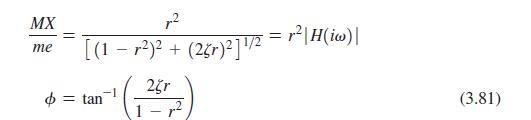
Plot the graphs of \(\frac{M X}{m e}\) versus \(r\) and \(\phi\) versus \(r\) for a damped system under rotating unbalance (Eq. (3.81)) for the damping ratios \(\zeta=0,0.2,0.4,0.6,0.8\), and 1.Equation 3.81:- MX me r [(1 r) + (23r)] 1/2 = $ = tan 25r 1-2 = r|H(iw)| (3.81)
Plot the graphs of \(\frac{X}{Y}\) versus \(r\) and \(\phi\) versus \(r\) for a damped system subjected to base excitation (Eqs. (3.68) and (3.69)) for the damping ratios \(\zeta=0,0.2,0.4,0.6,0.8\), and 1.Equation 3.68 and 3.69:- XT. = k + (cw) Y (k - mw) + (cw) 71/2 = 1 + (25r) (1- -r) + (25r)
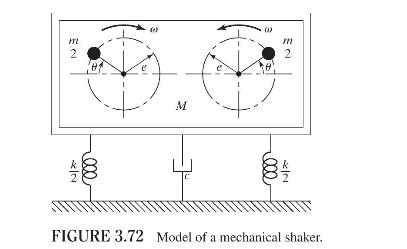
The arrangement shown in Fig. 3.72 consists of two eccentric masses rotating in opposite directions at the same speed \(\omega\). It is to be used as a mechanical shaker over the frequency range 20 to \(30 \mathrm{~Hz}\). Find the values of \(\omega,e, M, m, k\), and \(c\) to satisfy the following
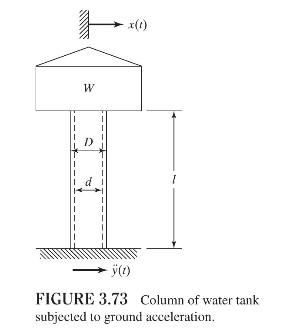
Design a minimum-weight, hollow circular steel column for the water tank shown in Fig. 3.73. The weight of the tank \((W)\) is \(500 \mathrm{kN}\) and the height is \(20 \mathrm{~m}\). The stress induced in the column should not exceed the yield strength of the material, which is \(200
An industrial press is mounted on a rubber pad to isolate it from its foundation. If the rubber pad is compressed \(5 \mathrm{~mm}\) by the self weight of the press, find the natural frequency of the system.
A spring-mass system has a natural period of \(0.21 \mathrm{~s}\). What will be the new period if the spring constant is (a) increased by \(50 \%\) and (b) decreased by \(50 \%\) ?
A spring-mass system has a natural frequency of \(10 \mathrm{~Hz}\). When the spring constant is reduced by \(800 \mathrm{~N} / \mathrm{m}\), the frequency is altered by \(45 \%\). Find the mass and spring constant of the original system.
A helical spring, when fixed at one end and loaded at the other, requires a force of \(100 \mathrm{~N}\) to produce an elongation of \(10 \mathrm{~mm}\). The ends of the spring are now rigidly fixed, one end vertically above the other, and a mass of \(10 \mathrm{~kg}\) is attached at the middle
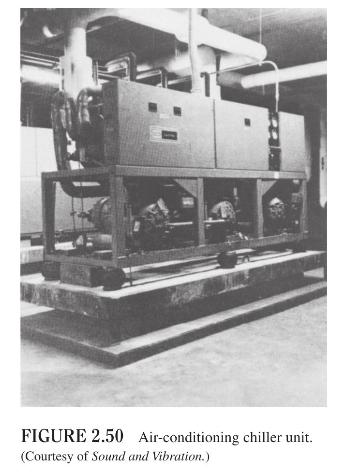
An air-conditioning chiller unit weighing \(10 \mathrm{kN}\) is to be supported by four air springs (Fig. 2.50). Design the air springs such that the natural frequency of vibration of the unit lies between \(5 \mathrm{rad} / \mathrm{s}\) and \(10 \mathrm{rad} / \mathrm{s}\). FIGURE 2.50
The maximum velocity attained by the mass of a simple harmonic oscillator is \(10 \mathrm{~cm} / \mathrm{s}\), and the period of oscillation is \(2 \mathrm{~s}\). If the mass is released with an initial displacement of \(2 \mathrm{~cm}\), find (a) the amplitude, (b) the initial velocity, (c) the
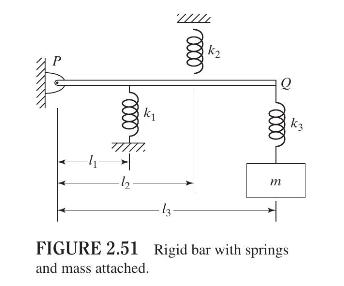
Three springs and a mass are attached to a rigid, weightless bar \(P Q\) as shown in Fig. 2.51. Find the natural frequency of vibration of the system. 0000 0000 k 12. 13 m + FIGURE 2.51 Rigid bar with springs and mass attached.
An automobile having a mass of \(2000 \mathrm{~kg}\) deflects its suspension springs \(0.02 \mathrm{~m}\) under static conditions. Determine the natural frequency of the automobile in the vertical direction by assuming damping to be negligible.
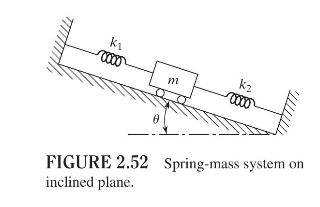
Find the natural frequency of vibration of a spring-mass system arranged on an inclined plane, as shown in Fig. 2.52. m 0000 FIGURE 2.52 Spring-mass system on inclined plane.
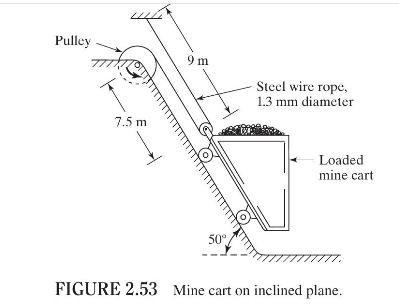
A loaded mine cart, with a mass of \(2000 \mathrm{~kg}\), is being lifted by a frictionless pulley and a wire rope, as shown in Fig. 2.53. Find the natural frequency of vibration of the cart in the given position. Pulley 7.5 m 9 m Steel wire rope, 1.3 mm diameter 50 Loaded mine cart FIGURE 2.53
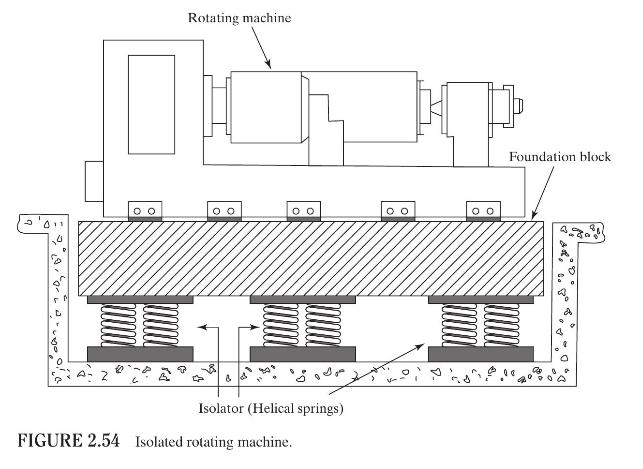
A rotating machine weighing \(1000 \mathrm{~N}\) (including the foundation block) is isolated by supporting it on six identical helical springs, as shown in Fig. 2.54. Design the springs so that the unit can be used in an environment in which the vibratory frequency ranges from 0 to \(5
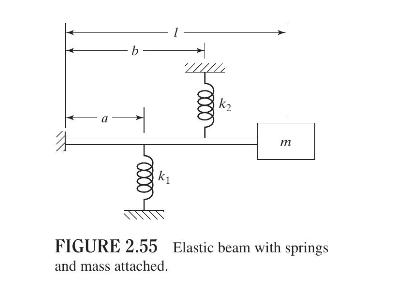
Find the natural frequency of the system shown in Fig. 2.55 with and without the springs \(k_{1}\) and \(k_{2}\) in the middle of the elastic beam. a b k 0000 0000 m FIGURE 2.55 Elastic beam with springs and mass attached.
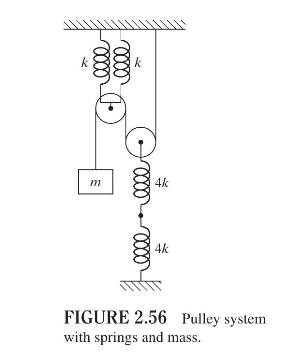
Find the natural frequency of the pulley system shown in Fig. 2.56 by neglecting the friction and the masses of the pulleys. 0000 m k 0000 4k 0000 4k FIGURE 2.56 Pulley system with springs and mass.
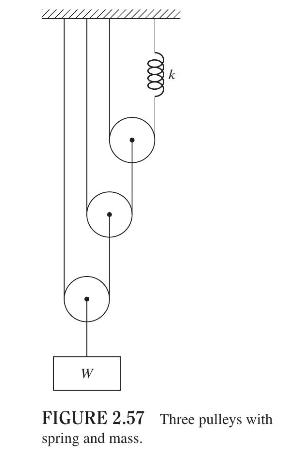
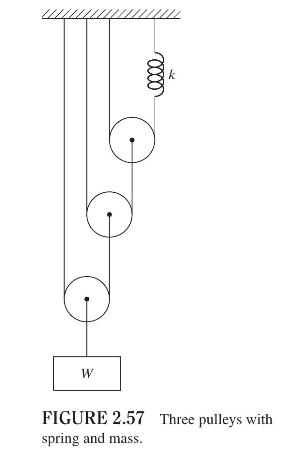
A weight \(W\) is supported by three frictionless and massless pulleys and a spring of stiffness \(k\), as shown in Fig. 2.57. Find the natural frequency of vibration of weight \(W\) for small oscillations. 0000 FIGURE 2.57 Three pulleys with spring and mass. W
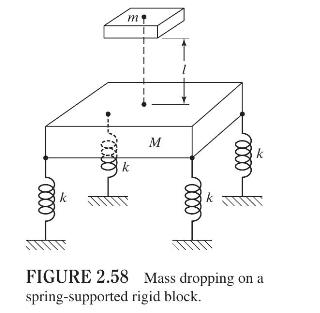
A rigid block of mass \(M\) is mounted on four elastic supports, as shown in Fig. 2.58. A mass \(m\) drops from a height \(l\) and adheres to the rigid block without rebounding. If the spring constant of each elastic support is \(k\), find the natural frequency of vibration of the system (a)
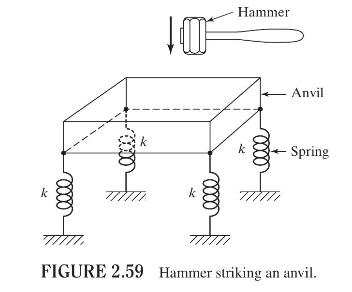
A sledgehammer strikes an anvil with a velocity of \(15 \mathrm{~m} / \mathrm{s}\) (Fig. 2.59). The hammer and the anvil have a mass of \(6 \mathrm{~kg}\) and \(50 \mathrm{~kg}\), respectively. The anvil is supported on four springs, each of stiffness \(k=17.5 \mathrm{kN} / \mathrm{m}\). Find the
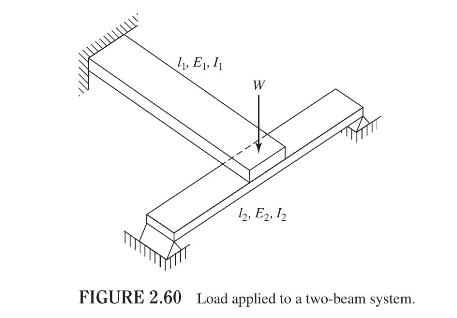
Derive the expression for the natural frequency of the system shown in Fig. 2.60. Note that the load \(W\) is applied at the tip of beam 1 and midpoint of beam 2. , E, I W 12, E2, 12 FIGURE 2.60 Load applied to a two-beam system.
A heavy machine weighing \(9810 \mathrm{~N}\) is being lowered vertically down by a winch at a uniform velocity of \(2 \mathrm{~m} / \mathrm{s}\). The steel cable supporting the machine has a diameter of \(0.01 \mathrm{~m}\). The winch is suddenly stopped when the steel cable's length is \(20
The natural frequency of a spring-mass system is found to be \(2 \mathrm{~Hz}\). When an additional mass of \(1 \mathrm{~kg}\) is added to the original mass \(m\), the natural frequency is reduced to \(1 \mathrm{~Hz}\). Find the spring constant \(k\) and the mass \(m\).
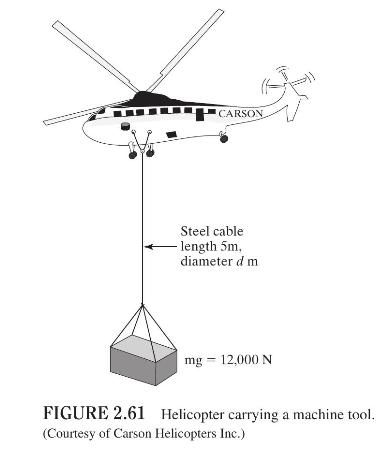
A heavy machine tool is transported by a helicopter. The crate containing the machine tool weighs \(12,000 \mathrm{~N}\) and is supported by a steel cable, of length \(5 \mathrm{~m}\) and diameter \(d \mathrm{~m}\), as shownin Fig. 2.61. If the natural time period of the crate is found to be \(0.1
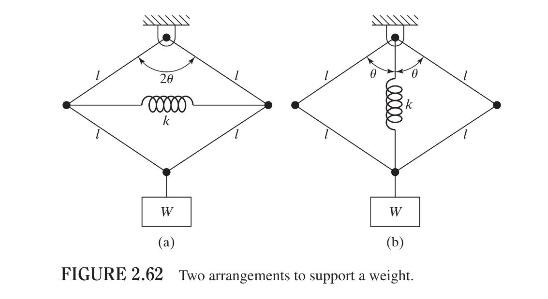
Four weightless rigid links and a spring are arranged to support a weight \(W\) in two different ways, as shown in Fig. 2.62. Determine the natural frequencies of vibration of the two arrangements. W k 28 W 00000 (a) (b) FIGURE 2.62 Two arrangements to support a weight.
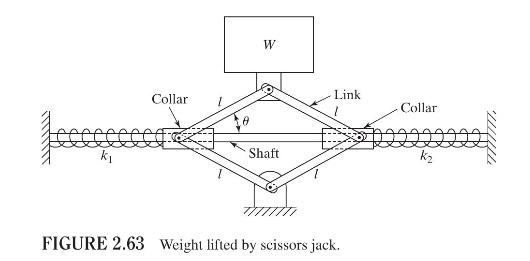
A scissors jack is used to lift a load \(W\). The links of the jack are rigid and the collars can slide freely on the shaft against the springs of stiffnesses \(k_{1}\) and \(k_{2}\) (see Fig. 2.63). Find the natural frequency of vibration of the weight in the vertical direction. Collar W Shaft
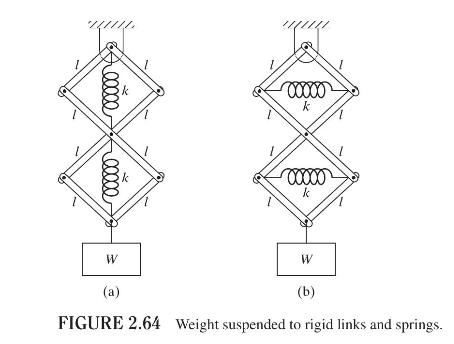
A weight is suspended using six rigid links and two springs in two different ways, as shown in Fig. 2.64. Find the natural frequencies of vibration of the two arrangements. 00000 W (a) 00000 k 00000 k W (b) FIGURE 2.64 Weight suspended to rigid links and springs.
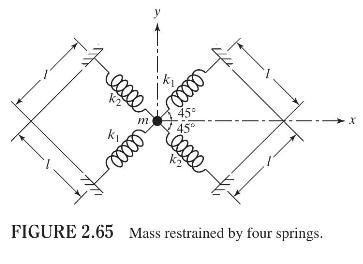
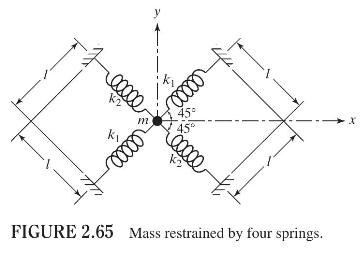
Figure 2.65 shows a small mass \(m\) restrained by four linearly elastic springs, each of which has an unstretched length \(l\), and an angle of orientation of \(45^{\circ}\) with respect to the \(x\)-axis. Determine the equation of motion for small displacements of the mass in the \(x\) direction.
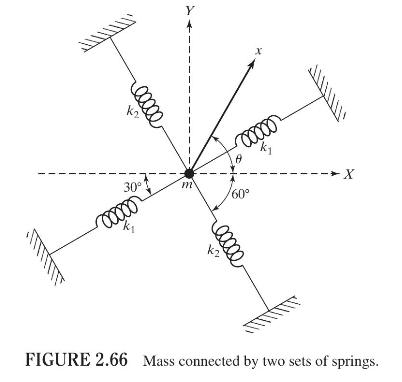
A mass \(m\) is supported by two sets of springs oriented at \(30^{\circ}\) and \(120^{\circ}\) with respect to the \(X\)-axis, as shown in Fig. 2.66. A third pair of springs, each with a stiffness of \(k_{3}\), is to be designed so as to make the system have a constant natural frequency while
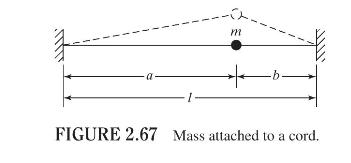
A mass \(m\) is attached to a cord that is under a tension \(T\), as shown in Fig. 2.67. Assuming that \(T\) remains unchanged when the mass is displaced normal to the cord, (a) write the differential equation of motion for small transverse vibrations and (b) find the natural frequency of
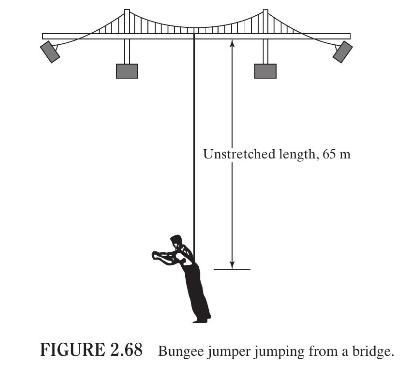
A bungee jumper, of mass \(70 \mathrm{~kg}\), ties one end of an elastic rope of length \(65 \mathrm{~m}\) and stiffness \(1.75 \mathrm{kN} / \mathrm{m}\) to a bridge and the other end to himself and jumps from the bridge (Fig. 2.68). Assuming the bridge to be rigid, determine the vibratory motion
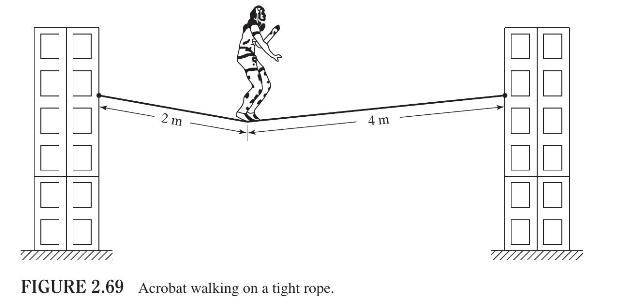
An acrobat, of mass \(50 \mathrm{~kg}\), walks on a tightrope, as shown in Fig. 2.69. If the natural frequency of vibration in the given position, in vertical direction, is \(10 \mathrm{rad} / \mathrm{s}\), find the tension in the rope. 2 m 4 m FIGURE 2.69 Acrobat walking on a tight rope.
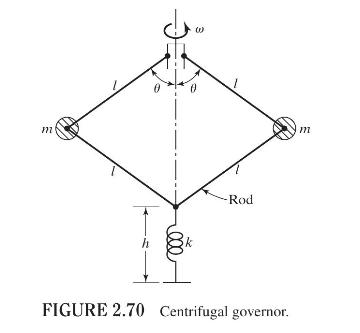
The schematic diagram of a centrifugal governor is shown in Fig. 2.70. The length of each rod is \(l\), the mass of each ball is \(m\), and the free length of the spring is \(h\). If the shaft speed is \(\omega\), determine the equilibrium position and the frequency for small oscillations about
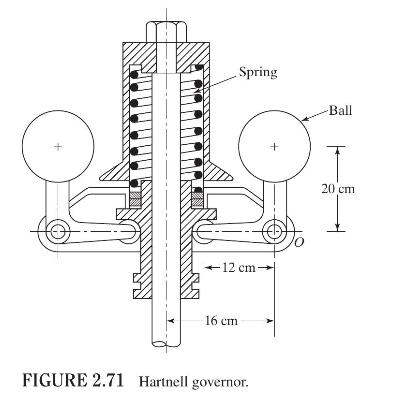
In the Hartnell governor shown in Fig. 2.71, the stiffness of the spring is \(10^{4} \mathrm{~N} / \mathrm{m}\) and the weight of each ball is \(25 \mathrm{~N}\). The length of the ball arm is \(20 \mathrm{~cm}\), and that of the sleeve arm is \(12 \mathrm{~cm}\). The distance between the axis of
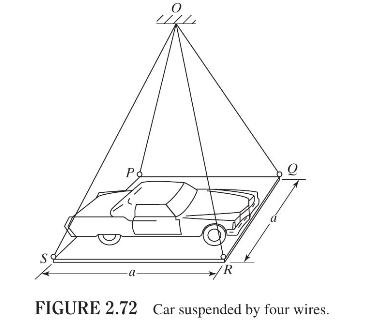
A square platform \(P Q R S\) and a car that it is supporting have a combined mass of \(M\). The platform is suspended by four elastic wires from a fixed point \(O\), as indicated in Fig. 2.72. The vertical distance between the point of suspension \(O\) and the horizontal equilibrium position of
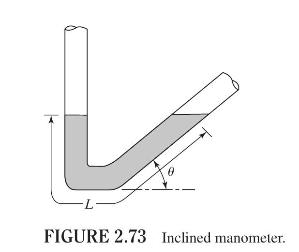
The inclined manometer, shown in Fig. 2.73, is used to measure pressure. If the total length of mercury in the tube is \(L\), find an expression for the natural frequency of oscillation of the mercury. FIGURE 2.73 Inclined manometer.
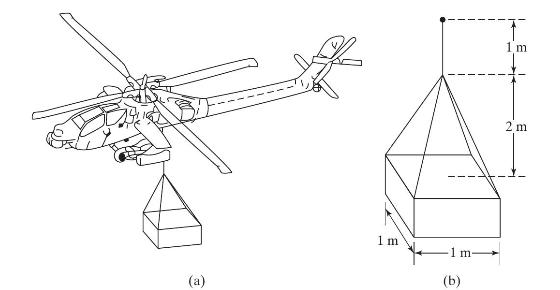
The crate, of mass \(250 \mathrm{~kg}\), hanging from a helicopter (shown in Fig. 2.74(a)) can be modeled as shown in Fig. 2.74(b). The rotor blades of the helicopter rotate at \(300 \mathrm{rpm}\). Find the diameter of the steel cables so that the natural frequency of vibration of the crate is at
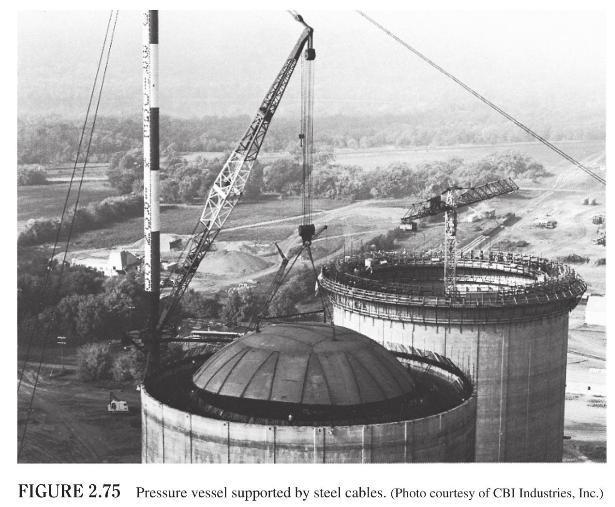
A pressure-vessel head is supported by a set of steel cables of length \(2 \mathrm{~m}\) as shown in Fig. 2.75. The time period of axial vibration (in vertical direction) is found to vary from \(5 \mathrm{~s}\) to \(4.0825 \mathrm{~s}\) when an additional mass of \(5000 \mathrm{~kg}\) is added to
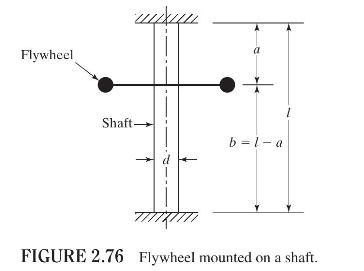
A flywheel is mounted on a vertical shaft, as shown in Fig. 2.76. The shaft has a diameter \(d\) and length \(l\) and is fixed at both ends. The flywheel has a weight of \(W\) and a radius of gyration of \(r\). Find the natural frequency of the longitudinal, the transverse, and the torsional
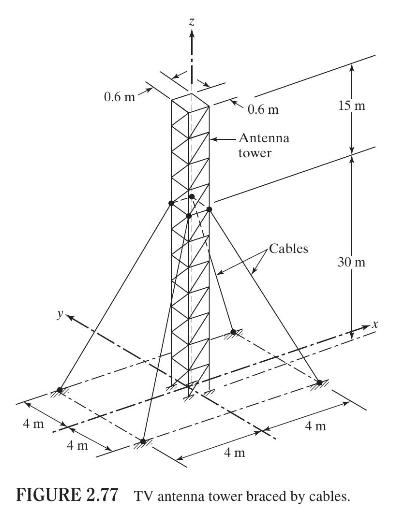
A TV antenna tower is braced by four cables, as shown in Fig. 2.77. Each cable is under tension and is made of steel with a cross-sectional area of \(322 \mathrm{~mm}^{2}\). The antenna tower can be modeled as a steel beam of square section of side \(25 \mathrm{~mm}\) for estimating its mass and
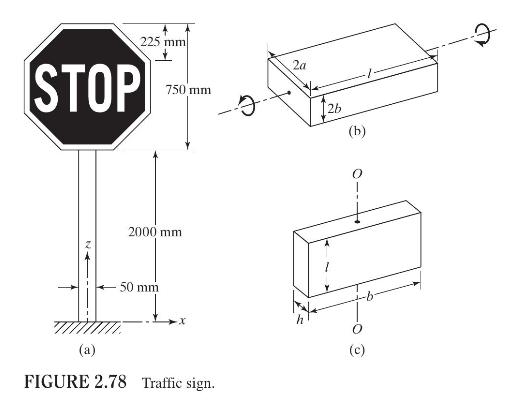
Figure 2.78 (a) shows a steel traffic sign, of thickness \(3 \mathrm{~mm}\) fixed to a steel post. The post is \(2 \mathrm{~m}\) high with a cross section \(50 \mathrm{~mm} \times 6 \mathrm{~mm}\), and it can undergo torsional vibration (about the \(z\)-axis) or bending vibration (either in the \(z
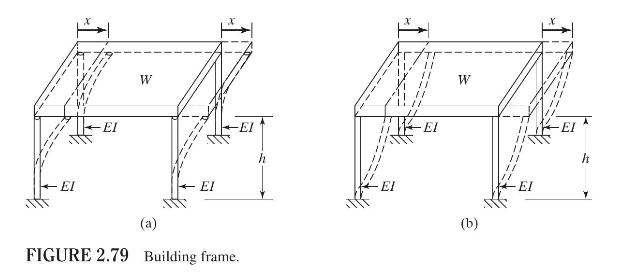
A building frame is modeled by four identical steel columns, each of weight \(w\), and a rigid floor of weight \(W\), as shown in Fig. 2.79. The columns are fixed at the ground and have a bending rigidity of \(E I\) each. Determine the natural frequency of horizontal vibration of the building frame
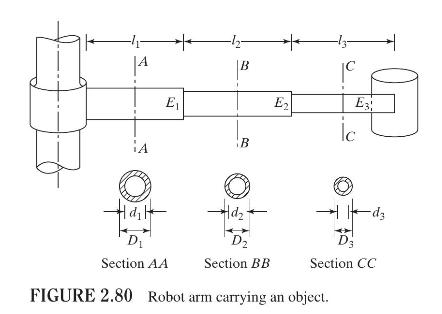
A pick-and-place robot arm, shown in Fig. 2.80, carries an object of mass \(5 \mathrm{~kg}\). Find the natural frequency of the robot arm in the axial direction for the following data: \(l_{1}=0.3 \mathrm{~m}, l_{2}=0.25 \mathrm{~m}\), \(l_{3}=0.2 \mathrm{~m} ; \quad E_{1}=E_{2}=E_{3}=69
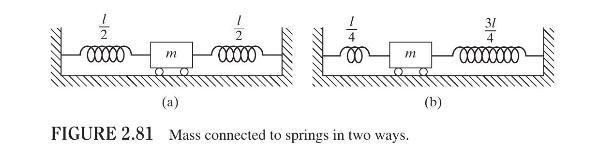
A helical spring of stiffness \(k\) is cut into two halves and a mass \(m\) is connected to the two halves as shown in Fig. 2.81(a). The natural time period of this system is found to be \(0.5 \mathrm{~s}\). If an identical spring is cut so that one part is one-fourth and the other part
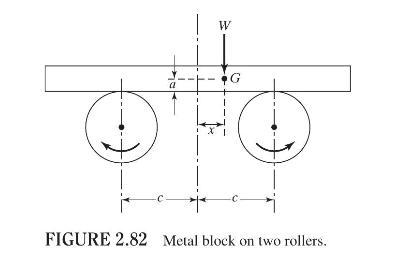
Figure 2.82 shows a metal block supported on two identical cylindrical rollers rotating in opposite directions at the same angular speed. When the center of gravity of the block is initially displaced by a distance \(x\), the block will be set into simple harmonic motion. Ifthe frequency of motion
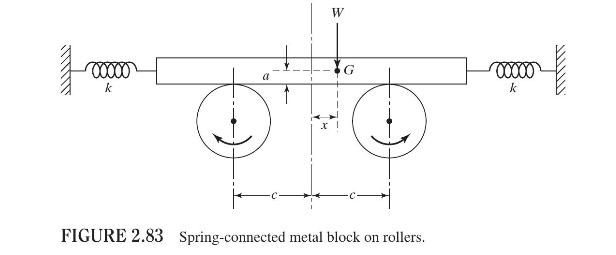
If two identical springs of stiffness \(k\) each are attached to the metal block of Problem 2.41 as shown in Fig. 2.83, determine the coefficient of friction between the block and the rollers.Data From Problem 2.41:-Figure 2.82 shows a metal block supported on two identical cylindrical rollers
An electromagnet of mass \(1500 \mathrm{~kg}\) is at rest while holding an automobile of mass \(900 \mathrm{~kg}\) in a junkyard. The electric current is turned off, and the automobile is dropped. Assuming that the crane and the supporting cable have an equivalent spring constant of \(1.75 \times
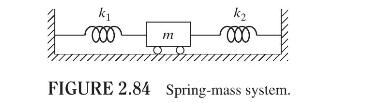
Derive the equation of motion of the system shown in Fig. 2.84, using the following methods: (a) Newton's second law of motion, (b) D'Alembert's principle, (c) principle of virtual work, and (d) principle of conservation of energy. k k2 000 m 000 FIGURE 2.84 Spring-mass system.
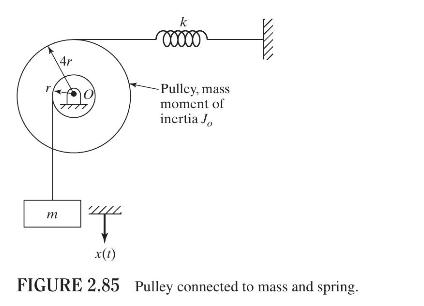
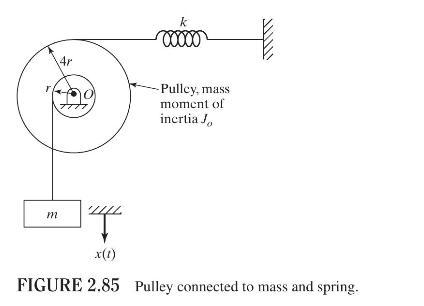
Draw the free-body diagram and derive the equation of motion using Newton's second law of motion for each of the systems shown in Figs. 2.85. 4r k 00000 -Pulley, mass moment of incrtia Jo m 1444 x(t) FIGURE 2.85 Pulley connected to mass and spring.
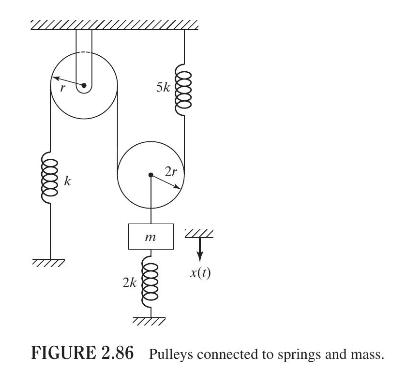
Draw the free-body diagram and derive the equation of motion using Newton's second law of motion for each of the systems shown in Figs. 2.86. 5k ellee 2r m 44 x(t) 2k FIGURE 2.86 Pulleys connected to springs and mass.
Derive the equation of motion using the principle of conservation of energy for each of the systems shown in Figs. 2.85. 4r k 00000 -Pulley, mass moment of incrtia Jo m 1444 x(t) FIGURE 2.85 Pulley connected to mass and spring.
Showing 2000 - 2100
of 2655
First
13
14
15
16
17
18
19
20
21
22
23
24
25
26
27
Step by Step Answers

 Get 50% OFF
Claim Now
Get 50% OFF
Claim Now