New Semester
Started
Get
50% OFF
Study Help!
--h --m --s
Claim Now
Question Answers
Textbooks
Find textbooks, questions and answers
Oops, something went wrong!
Change your search query and then try again
S
Books
FREE
Study Help
Expert Questions
Accounting
General Management
Mathematics
Finance
Organizational Behaviour
Law
Physics
Operating System
Management Leadership
Sociology
Programming
Marketing
Database
Computer Network
Economics
Textbooks Solutions
Accounting
Managerial Accounting
Management Leadership
Cost Accounting
Statistics
Business Law
Corporate Finance
Finance
Economics
Auditing
Tutors
Online Tutors
Find a Tutor
Hire a Tutor
Become a Tutor
AI Tutor
AI Study Planner
NEW
Sell Books
Search
Search
Sign In
Register
study help
engineering
mechanical vibration analysis
Mechanical Vibrations 6th Edition Singiresu S Rao - Solutions
Fill in the Blank.An impulse can be measured by finding the change in ___________ of the system.
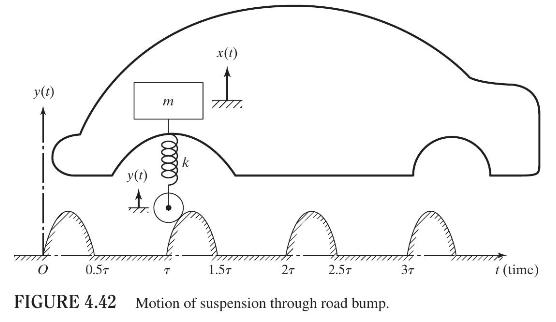
The suspension system of a car traveling on a bumpy road has a stiffness of \(k=5 \times 10^{6} \mathrm{~N} / \mathrm{m}\) and the effective mass of the car on the suspension is \(m=750 \mathrm{~kg}\). The road bumps can be considered to be periodic half-sine waves as indicated in Fig. 4.42.
How many resonant conditions are there when the external force is not harmonic?
In Laplace domain, \(\lim _{s \rightarrow 0}[s X(s)]\) gives the:a. initial valueb. transient valuec. steady-state value
True or False.The Runge-Kutta method can be used to solve to numerically solve differential equations of any order.
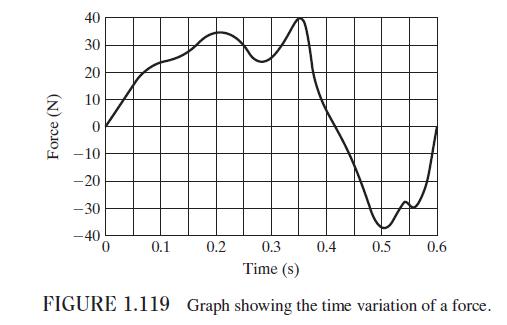
Find the response of a damped system with \(m=1 \mathrm{~kg}, k=15 \mathrm{kN} / \mathrm{m}\), and \(\zeta=0.1\) under the action of a periodic forcing function, as shown in Fig. 1.119.Figure 1.119:- Force (N) 40 30 20 10 -10 -20 -30 -40 0 0.1 0.2 0.3 0.4 0.5 0.6 Time (s) FIGURE 1.119 Graph
Fill in the Blank.The Duhamel integral is based on the ___________ response function of the system.
How do you compute the frequency of the first harmonic of a periodic force?
\(F(t)=\alpha\) t corresponds to:a. an impulseb. step forcec. ramp force
True or False.The Laplace transform of 1 is \(\frac{1}{s}\).
Fill in the Blank.The Duhamel integral can be used to find the response of ___________ single-degree-of-freedom systems under arbitrary excitations.
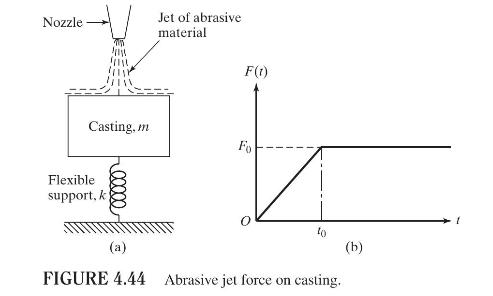
Sandblasting is a process in which an abrasive material, entrained in a jet, is directed onto the surface of a casting to clean its surface. In a particular setup for sandblasting, the casting of mass \(m\) is placed on a flexible support of stiffness \(k\) as shown in Fig. 4.44(a). If the force
\(f(t)=\delta(t-\tau)\) corresponds to a force applied ata. \(t-\tau=0\)b. \(t-\tau0\)
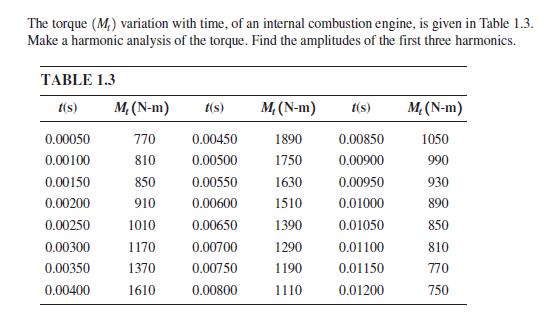
Find the response of a viscously damped system under the periodic force whose values are given in Problem 1.116. Assume that \(M_{t}\) denotes the value of the force in newtons at time \(t_{i}\) seconds. Use \(m=0.5 \mathrm{~kg}, k=8000 \mathrm{~N} / \mathrm{m}\), and \(\zeta=0.06\).Data From
What is the relation between the frequencies of higher harmonics and frequency of the first harmonic for a periodic excitation?
Fill in the Blank.The velocity response spectrum, determined from the acceleration spectrum, is known as the ___________ spectrum.
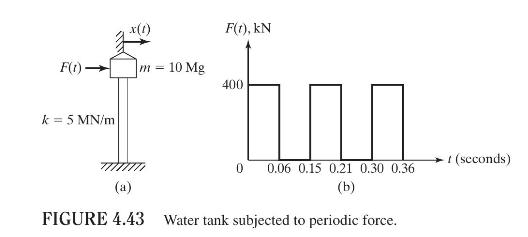
Find the displacement of the water tank shown in Fig. 4.43(a) under the periodic force shown in Fig. 4.43(b) by treating it as an undamped single-degree-of-freedom system. Use the numerical procedure described in Section 4.3. x(t) F(t), kN F(1) m = 10 Mg 400 k 5 MN/m (a) (seconds) 0 0.06 0.15 0.21
What is the difference between transient and steady-state responses?
In a perfect elastic collision of two masses \(m_{1}\) and \(m_{2}\), the quantity conserved is:a. energyb. momentumc. velocity
Fill in the Blank.Any periodic forcing function can be expanded in ___________ series.
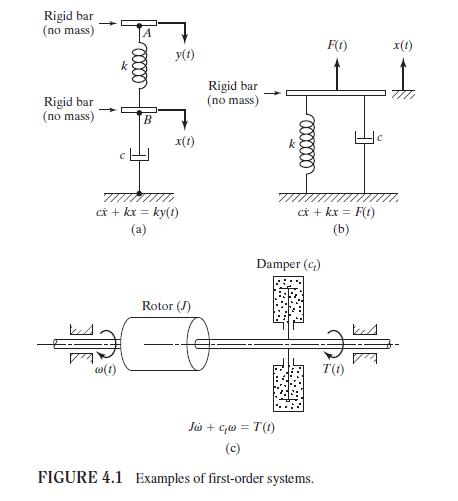
What is a first-order system?
The step response of an overdamped system exhibitsa. no oscillationsb. oscillationsc. overshoot
Fill in the Blank.In Laplace domain, \(\lim _{s \rightarrow 0}[s X(s)]\) gives ___________ value of the response.
Find the displacement of a damped single-degree-of-freedom system under the forcing function \(F(t)=F_{0} e^{-\alpha t}\), where \(\alpha\) is a constant.
What is an impulse?
The method used to express \(\frac{3 s+4}{(s+1)(s+2)}\) as \(\frac{C_{1}}{s+1}+\frac{C_{2}}{s+2}\) is called:a. separationb. partial fractionsc. decomposition
Fill in the Blank.A change in momentum of a system gives the ___________ .
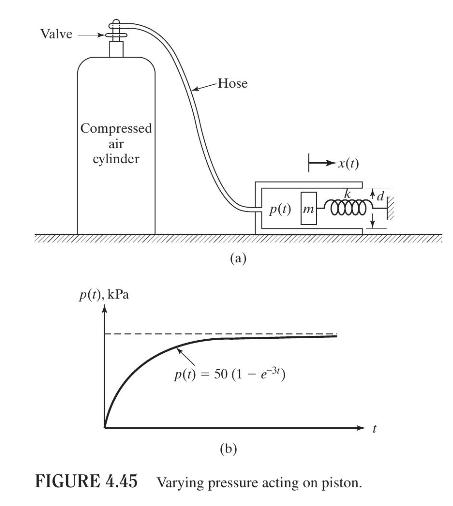
A compressed air cylinder is connected to the spring-mass system shown in Fig. 4.45(a). Due to a small leak in the valve, the pressure on the piston, \(p(t)\), builds up as indicated in Fig. 4.45(b). Find the response of the piston for the following data: \(m=10 \mathrm{~kg}, k=1000 \mathrm{~N} /
What are the properties of the Dirac delta function \(\delta(t)\) ?
Most numerical methods of solving differential equations assume that the order of the equation is:a. oneb. twoc. arbitrary
Fill in the Blank.Total response of a system is composed of transient and ___________ values.
Find the transient response of an undamped spring-mass system for \(t>\pi / \omega\) when the mass is subjected to a force 4.19. Find the transient response of an undamped spring-mass system for \(t>\pi / \omega\) when the mass is subjected to a force\[F(t)= \begin{cases}\frac{F_{0}}{2}(1-\cos
a. Inverse Laplace transform of \(\bar{x}(s)\)b. Generalized impedance functionc. Unit impulse response functiond. Laplace transforme. Convolution integralf. Admittance function\(x(t)=\frac{1}{m \omega_{d}} e^{-\zeta \omega_{n} t} \sin \omega_{d} t\)
Fill in the Blank.The Laplace transform of \(x(t)\) is denoted as ___________
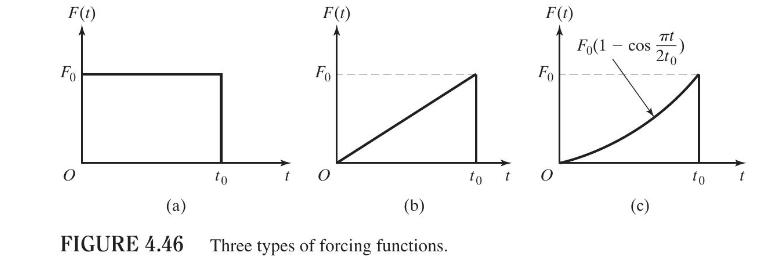
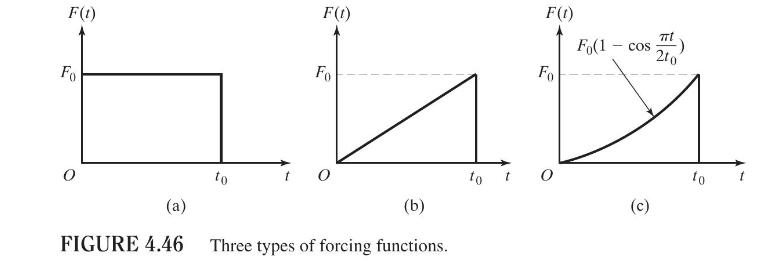
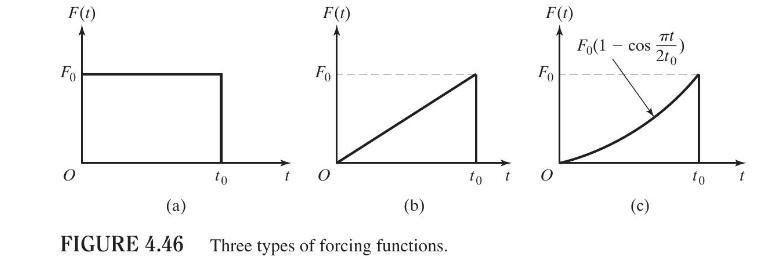
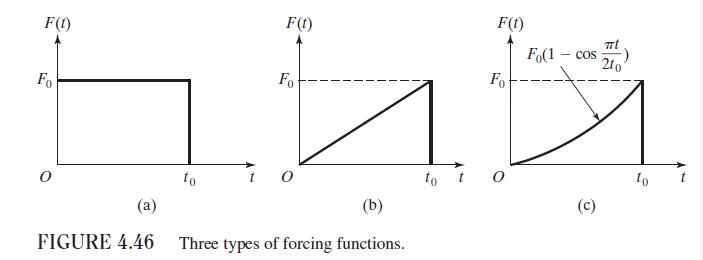
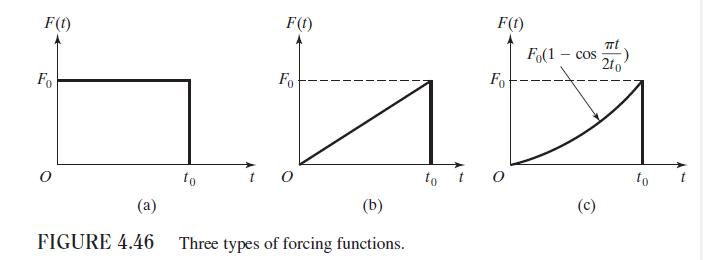
Use the Dahamel integral method to derive expressions for the response of an undamped system subjected to the forcing functions shown in Figs. 4.46(a). F(t) F(t) F(t) Fo(1 COS 210 Fo Fo Fo to 0 to 0 (a) (b) (c) FIGURE 4.46 Three types of forcing functions. to
a. Inverse Laplace transform of \(\bar{x}(s)\)b. Generalized impedance functionc. Unit impulse response functiond. Laplace transforme. Convolution integralf. Admittance function\(x(t)=\int_{0}^{t} F(\tau) g(t-\tau) d \tau\)
Fill in the Blank.\(f(t)\) denotes the inverse Laplace transform of ___________ .
Use the Dahamel integral method to derive expressions for the response of an undamped system subjected to the forcing functions shown in Figs. 4.46(b). F(t) F(t) F(t) Fo(1 COS 210 Fo Fo Fo to 0 to 0 (a) (b) (c) FIGURE 4.46 Three types of forcing functions. to
a. Inverse Laplace transform of \(\bar{x}(s)\)b. Generalized impedance functionc. Unit impulse response functiond. Laplace transforme. Convolution integralf. Admittance function\(x(t)=\mathscr{L}^{-1} Y(s) F(s)\)
Fill in the Blank.The equation of motion \(m \ddot{x}+c \dot{x}+k x=f \overline{(t) \text { corresponds to }}\) ____________ order system.
Use the Dahamel integral method to derive expressions for the response of an undamped system subjected to the forcing functions shown in Figs. 4.46(c). F(t) F(t) F(t) Fo(1 COS 210 Fo Fo Fo to 0 to 0 (a) (b) (c) FIGURE 4.46 Three types of forcing functions. to
a. Inverse Laplace transform of \(\bar{x}(s)\)b. Generalized impedance functionc. Unit impulse response functiond. Laplace transforme. Convolution integralf. Admittance function\(\bar{Y}(s)=\frac{1}{m s^{2}+c s+k}\)
Fill in the Blank.The Laplace transform of \(\delta(t)\) is ___________.
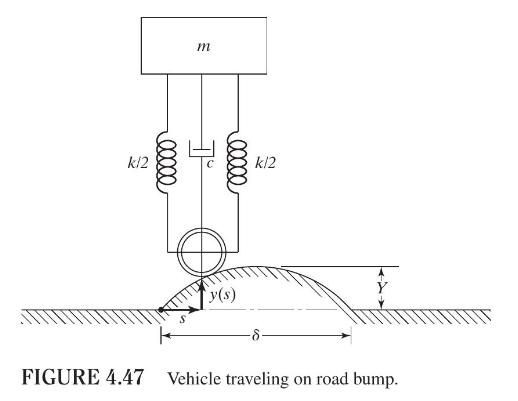
Figure 4.47 shows a one degree of freedom model of a motor vehicle traveling in the horizontal direction. Find the relative displacement of the vehicle as it travels over a road bump of the form \(y(s)=Y \sin \pi s / \delta\). k/2 m elle I 00000 k/2 y(s) -8 FIGURE 4.47 Vehicle traveling on road
a. Inverse Laplace transform of \(\bar{x}(s)\)b. Generalized impedance functionc. Unit impulse response functiond. Laplace transforme. Convolution integralf. Admittance function\(\bar{z}(s)=m s^{2}+c s+k\)
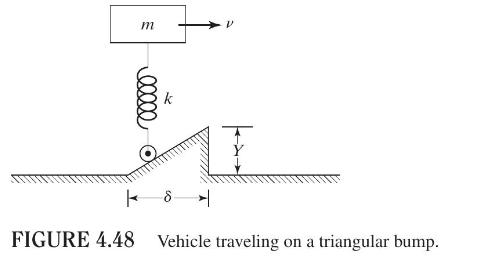
A vehicle traveling at a constant speed \(v\) in the horizontal direction encounters a triangular road bump, as shown in Fig. 4.48. Treating the vehicle as an undamped spring-mass system, determine the response of the vehicle in the vertical direction. www m FIGURE 4.48 Vehicle traveling on a
a. Inverse Laplace transform of \(\bar{x}(s)\)b. Generalized impedance functionc. Unit impulse response functiond. Laplace transforme. Convolution integralf. Admittance function\(\bar{x}(s)=\int_{0}^{\infty} e^{-s t} x(t) d t\)
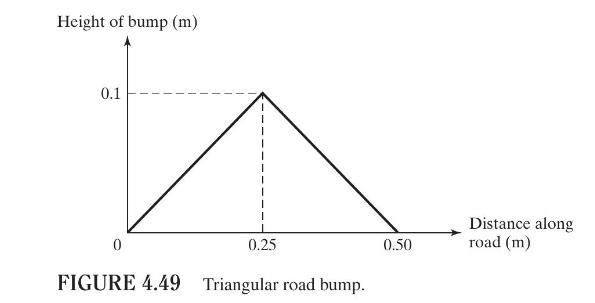
An automobile, having a mass of \(1000 \mathrm{~kg}\), runs over a road bump of the shape shown in Fig. 4.49. The speed of the automobile is \(50 \mathrm{~km} / \mathrm{h}\). If the undamped natural period of vibration in the vertical direction is \(1.0 \mathrm{~s}\), find the response of the
Maximum peak valuea. Peak timeb. Rise timec. Maximum overshootd. Settling timee. Decay time
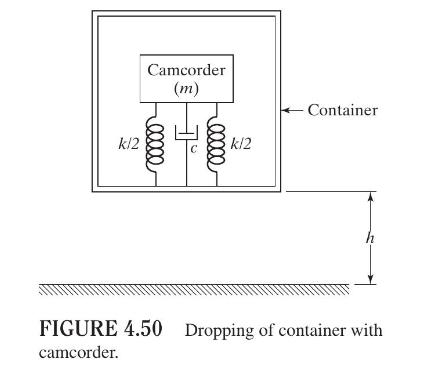
A camcorder of mass \(m\) is packed in a container using a flexible packing material. The stiffness and damping constant of the packing material are given by \(k\) and \(c\), respectively, and the mass of the container is negligible. If the container is dropped accidentally from a height of \(h\)
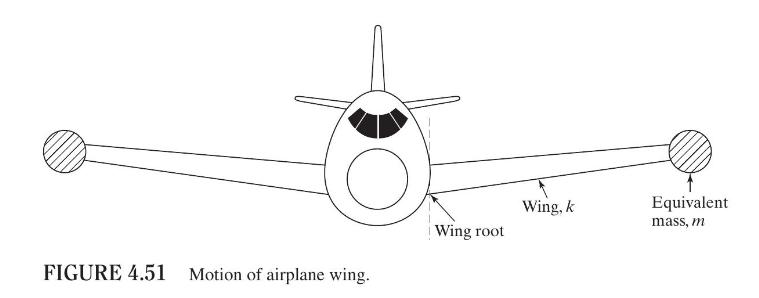
An airplane, taxiing on a runway, encounters a bump. As a result, the root of the wing is subjected to a displacement that can be expressed as\[y(t)= \begin{cases}Y\left(t^{2} / t_{0}^{2}\right), & 0 \leq t \leq t_{0} \\ 0, & t>t_{0}\end{cases}\]Find the response of the mass located at
Time to attain the maximum valuea. Peak timeb. Rise timec. Maximum overshootd. Settling timee. Decay time
Time to reach within \(\pm 2 \%\) of steady-state valuea. Peak timeb. Rise timec. Maximum overshootd. Settling timee. Decay time
Derive Eq. (E.1) of Example 4.12.Equation (E.1):-Data From Example 4.12:-Figure 4.13(a) and (b):- x(t) = y(t) (E.1)
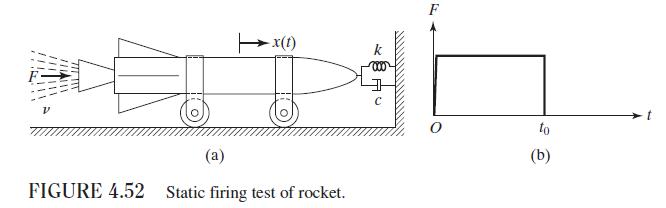
In a static firing test, a rocket is anchored to a rigid wall by a spring-damper system, as shown in Fig. 4.52(a). The thrust acting on the rocket reaches its maximum value \(F\) in a negligibly short time and remains constant until the burnout time \(t_{0}\), as indicated in Fig. 4.52(b). The
Time to reach \(50 \%\) of the steady-state valuea. Peak timeb. Rise timec. Maximum overshootd. Settling timee. Decay time
Time to increase from \(10 \%\) to \(90 \%\) of steady-state valuea. Peak timeb. Rise timec. Maximum overshootd. Settling timee. Decay time
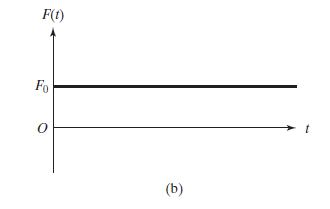
Show that the response to a unit step function \(h(t)\left(F_{0}=1\right.\) in Fig. 4.10(b)) is related to the impulse response function \(g(t)\), Eq. (4.25), as follows:\[g(t)=\frac{d h(t)}{d t}\]Figure 4.10(b):-Equation 4.25:- F(t) Fo (b) t
Show that the convolution integral, Eq. (4.31), can also be expressed in terms of the response to a unit step function \(h(t)\) as\[x(t)=F(0) h(t)+\int_{0}^{t} \frac{d F(\tau)}{d \tau} h(t-\tau) d \tau\]Equation 4.31:- F(T)e (-) sin wd (t - T) dr (4.31) x(t) == mwd F(T
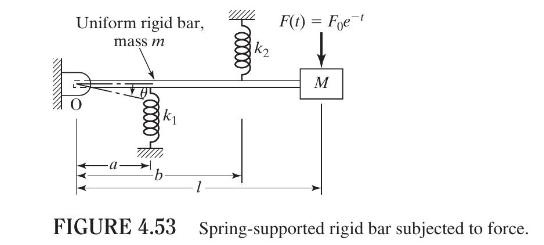
Find the response of the rigid bar shown in Fig. 4.53 using convolution integral for the following data: \(k_{1}=k_{2}=5000 \mathrm{~N} / \mathrm{m}, a=0.25 \mathrm{~m}, b=0.5 \mathrm{~m}, l=1.0 \mathrm{~m}, M=50 \mathrm{~kg}\), \(m=10 \mathrm{~kg}, F_{0}=500 \mathrm{~N}\). Uniform rigid bar, mass
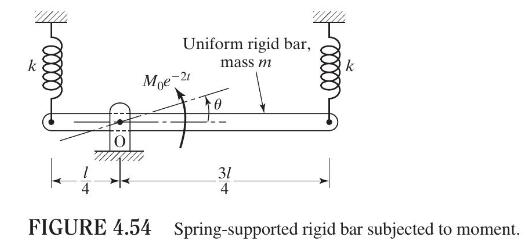
Find the response of the rigid bar shown in Fig. 4.54 using convolution integral for the following data: \(k=5000 \mathrm{~N} / \mathrm{m}, l=1 \mathrm{~m}, m=10 \mathrm{~kg}, M_{0}=100 \mathrm{~N}-\mathrm{m}\). k 00000 Moe Uniform rigid bar, mass m 31 4 FIGURE 4.54 Spring-supported rigid bar
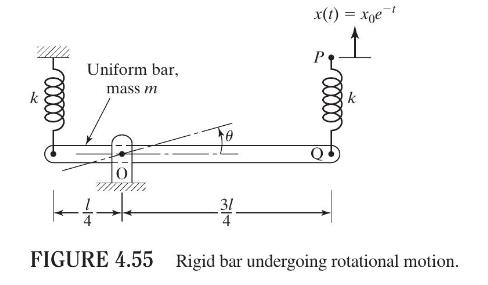
Find the response of the rigid bar shown in Fig. 4.55 using convolution integral when the end \(P\) of the spring \(P Q\) is subjected to the displacement, \(x(t)=x_{0} e^{-t}\). Data: \(k=5000 \mathrm{~N} / \mathrm{m}\), \(l=1 \mathrm{~m}, m=10 \mathrm{~kg}, x_{0}=1 \mathrm{~cm}\). k Uniform bar,
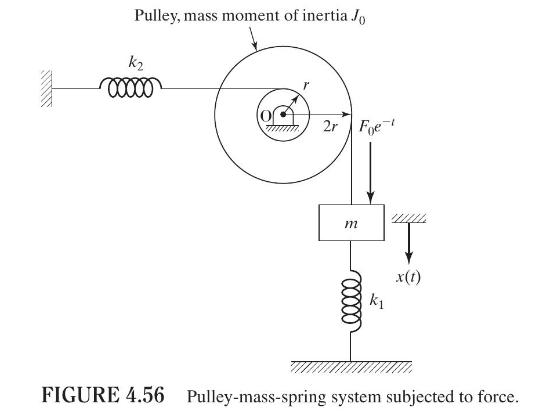
Find the response of the mass shown in Fig. 4.56 under the force \(F(t)=F_{0} e^{-t}\) using convolution integral. Data: \(k_{1}=1000 \mathrm{~N} / \mathrm{m}, k_{2}=500 \mathrm{~N} / \mathrm{m}, r=5 \mathrm{~cm}, m=10 \mathrm{~kg}, J_{0}=1 \mathrm{~kg}-\mathrm{m}^{2}\), \(F_{0}=50 \mathrm{~N}\).
Find the impulse response functions of a viscously damped spring-mass system for the following cases:a. Undamped \((c=0)\)c. Critically damped \(\left(c=c_{c}\right)\)b. Underdamped \(\left(cc_{c}\right)\)
Find the response of a single-degree-of-freedom system under an impulse \(F\) for the following data: \(m=2 \mathrm{~kg}, c=4 \mathrm{~N}-\mathrm{s} / \mathrm{m}, k=32 \mathrm{~N} / \mathrm{m}, F=4 \delta(t), x_{0}=0.01 \mathrm{~m}, \dot{x}_{0}=1 \mathrm{~m} / \mathrm{s}\).
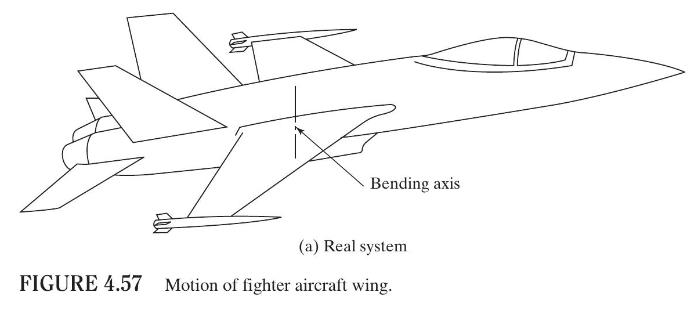
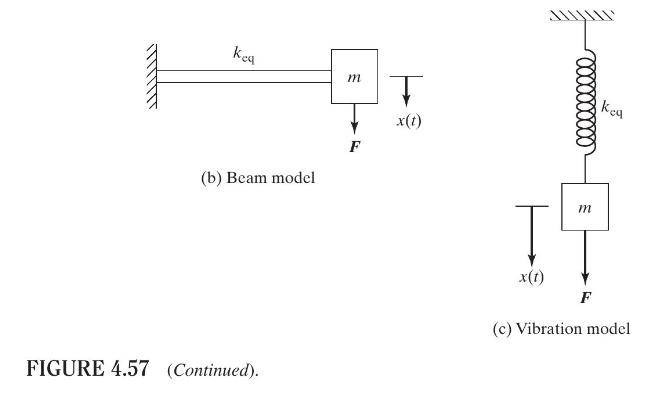
The wing of a fighter aircraft, carrying a missile at its tip, as shown in Fig. 4.57, can be approximated as an equivalent cantilever beam with \(E I=15 \times 10^{9} \mathrm{~N}-\mathrm{m}^{2}\) about the vertical axis and length \(l=10 \mathrm{~m}\). If the equivalent mass of the wing, including
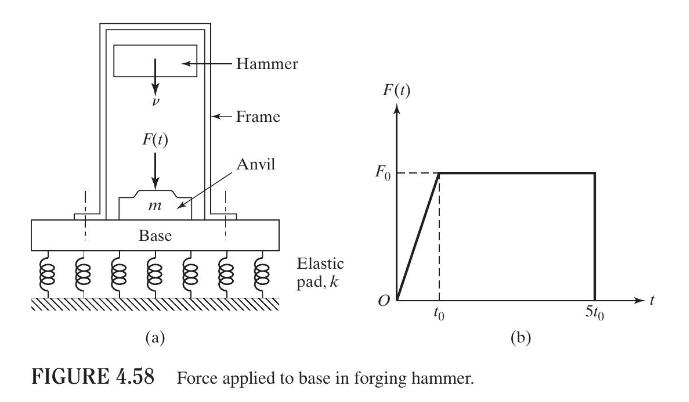
The frame, anvil, and base of the forging hammer shown in Fig. 4.58 (a) have a total mass of \(m\). The support elastic pad has a stiffness of \(k\). If the force applied by the hammer is given by Fig. 4.58(b), find the response of the anvil. 000 Hammer F(t) Anvil Fo F(t) Frame 000 m Base heee 000
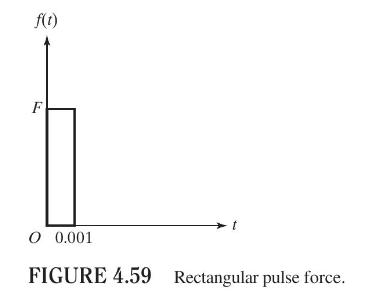
The input to the valve of an internal combustion engine is a force of \(F=15,000 \mathrm{~N}\) applied over a period of \(0.001 \mathrm{~s}\) by a cam as shown in Fig. 4.59. The valve has a mass of \(15 \mathrm{~kg}\), stiffness of \(10,000 \mathrm{~N} / \mathrm{m}\), and damping constant of \(20
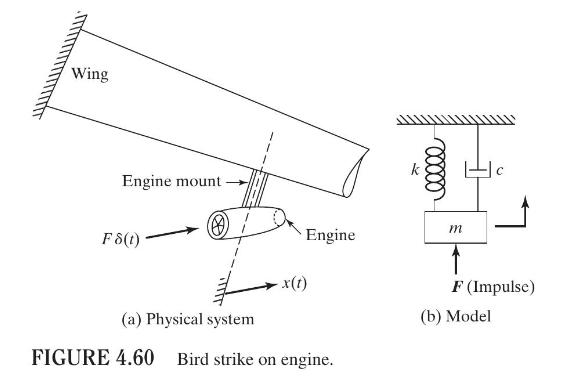
A bird strike on the engine of an airplane can be considered as an impulse (Fig. 4.60(a)). If the stiffness and damping coefficient of the engine mount are given by \(k=50,000 \mathrm{~N} / \mathrm{m}\) and \(c=1000 \mathrm{~N}-\mathrm{s} / \mathrm{m}\), and the engine mass is \(m=500
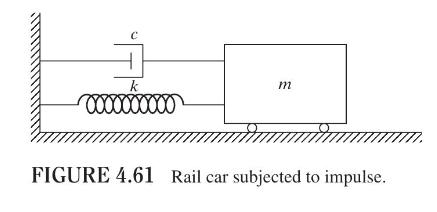
The rail car, shown in Fig. 4.61, is initially at rest and is set into motion by an impulse \(5 \delta(t)\).(a) Determine the motion of the car, \(x(t)\).(b) If it is desired to stop the car by applying another impulse, determine the impulse that needs to be applied to the car. C k 0000000000 m
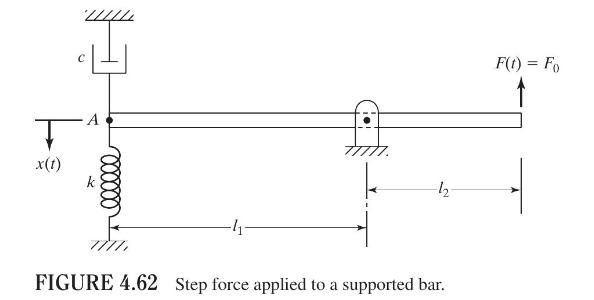
A spring-damper system is connected to a massless rigid lever as shown in Fig. 4.62. If a step force of magnitude \(F_{0}\) is applied at time \(t=0\), determine the displacement, \(x(t)\), of point \(A\) of the lever. TA x(t) 000000 -12 FIGURE 4.62 Step force applied to a supported bar. F(t) = Fo
A space experimental package of mass \(m\) is supported on an elastic suspension of stiffness \(k\) in the space shuttle. During launching, the space shuttle (base of the elastically supported package) experiences an acceleration of \(\ddot{y}(t)=\alpha t\), where \(\alpha\) is a constant. Find the
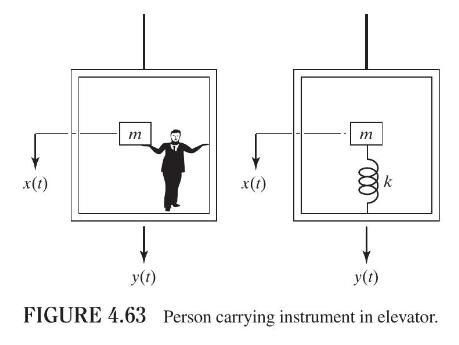
A person, carrying a precision instrument of mass \(m\), rides in the elevator of a building in a standing position (Fig. 4.63). The elevator, while moving with velocity \(v_{0}\) at time \(t=0\), decelerates to zero velocity (stops) in time \(\tau\), so that the variation of its velocity can be
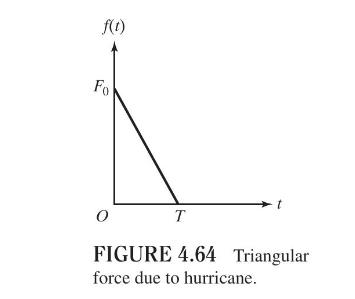
The water tank shown in Fig. 4.43(a) is subjected to a sudden hurricane force which varies with time as shown in Fig. 4.64. Assuming zero initial conditions, determine the displacement response, \(x(t)\), of the water tank. f(t) Fo T FIGURE 4.64 Triangular force due to hurricane.
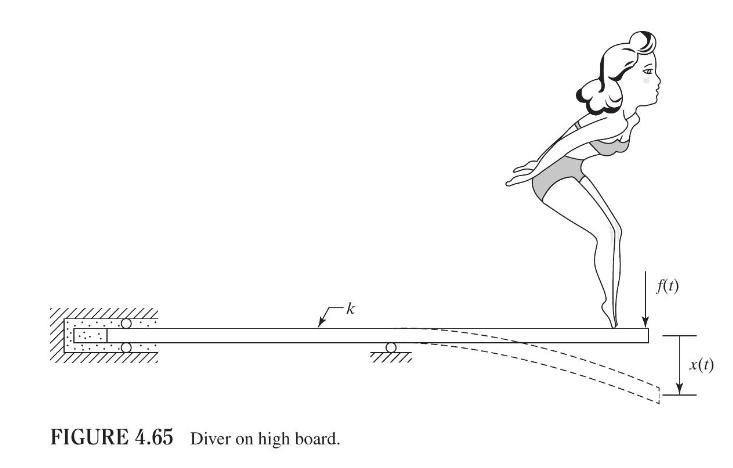
Figure 4.65 shows a diver on a high board. The friction at the fixing point of the diving board can be assumed to correspond to a viscous damping constant of \(c\) and stiffness of the diving board can be assumed to be \(k\). The diver's mass can be treated as a point mass \(m\) (weight, \(m g)\).
Derive the response spectrum of an undamped system for the rectangular pulse shown in Fig. 4.46(a). Plot \(\left(x / \delta_{\mathrm{st}}\right)_{\max }\) with respect to \(\left(t_{0} / \tau_{n}\right)\). F(t) F(1) F(t) Fo(1 COS 210 Fo Fo Fo to t 0 (b) () (a) to FIGURE 4.46 Three types of forcing
Find the displacement response spectrum of an undamped system for the pulse shown in Fig. 4.46(c). F(t) F(1) F(t) Fo(1 COS 210 Fo Fo Fo to t 0 (b) () (a) to FIGURE 4.46 Three types of forcing functions. to
The base of an undamped spring-mass system is subjected to an acceleration excitation given by \(a_{0}\left[1-\sin \left(\pi t / 2 t_{0}\right)\right]\). Find the relative displacement of the mass \(z\).
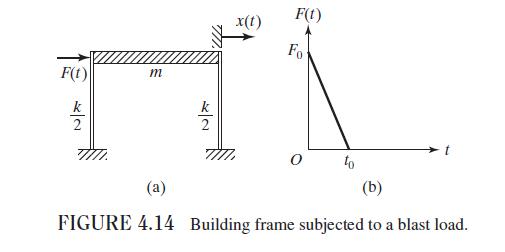
Find the response spectrum of the system considered in Example 4.13. Plot \(\left(k x / F_{0}\right)_{\max }\) versus \(\omega_{n} t_{0}\) in the range \(0 \leq \omega_{n} t_{0} \leq 15\).Data From Example 4.13:- A building frame is modeled as an undamped single-degree-of-freedom system (Fig.
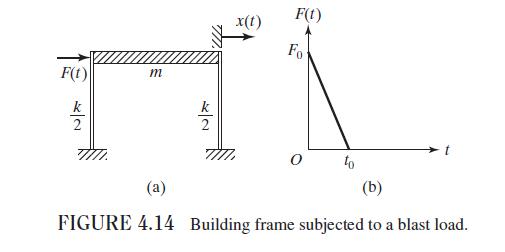
A building frame is subjected to a blast load, and the idealization of the frame and the load are shown in Fig. 4.14. If \(m=5000 \mathrm{~kg}, F_{0}=4 \mathrm{MN}\), and \(t_{0}=0.4 \mathrm{~s}\), find the minimum stiffness required if the displacement is to be limited to \(10 \mathrm{~mm}\). F(t)
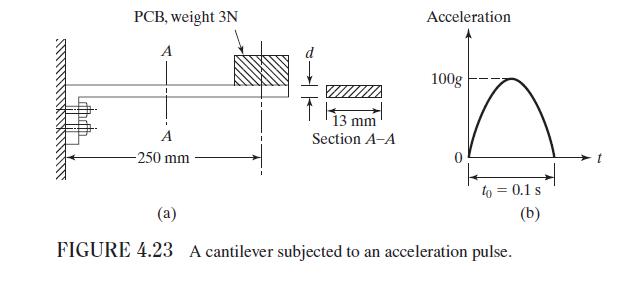
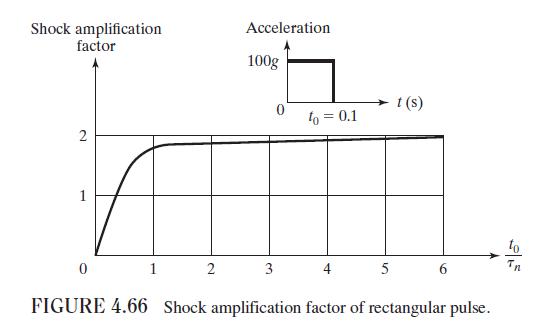
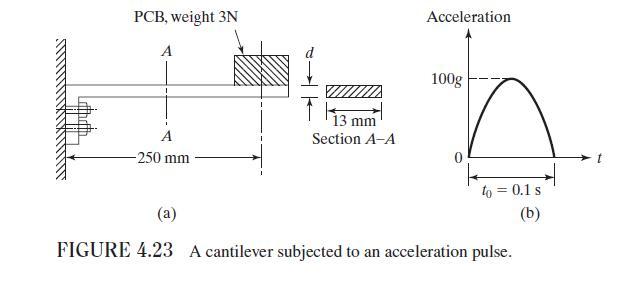
Consider the printed circuit board (PCB) mounted on a cantilevered aluminum bracket shown in Fig. 4.23(a). Design the bracket to withstand an acceleration level of \(100 g\) under the rectangular pulse shown in Fig. 4.66. Assume the specific weight, Young's modulus, and permissible stress of
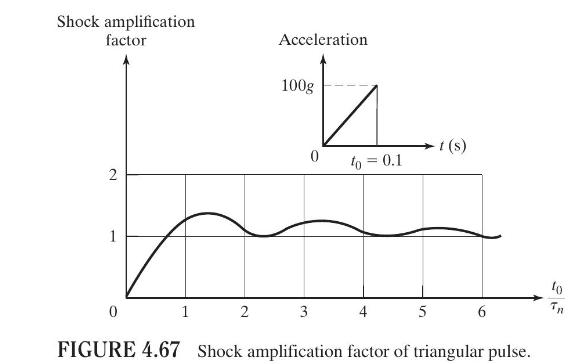
Consider the printed circuit board (PCB) mounted on a cantilevered aluminum bracket shown in Fig. 4.23(a). Design the bracket to withstand an acceleration level of \(100 \mathrm{~g}\) under the triangular pulse shown in Fig. 4.67. Assume the material properties as given in Problem 4.53.Data From
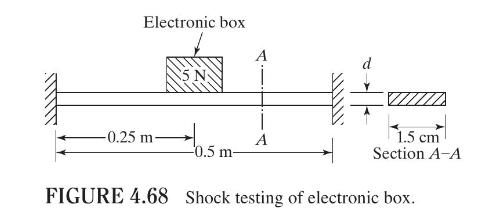
An electronic box, weighing \(5 \mathrm{~N}\), is to be shock-tested using a \(100 \mathrm{~g}\) half-sine pulse with a 0.1-s time base for a qualification test. The box is mounted at the middle of a fixed-fixed beam as shown in Fig. 4.68. The beam, along with the box, is placed in a container and
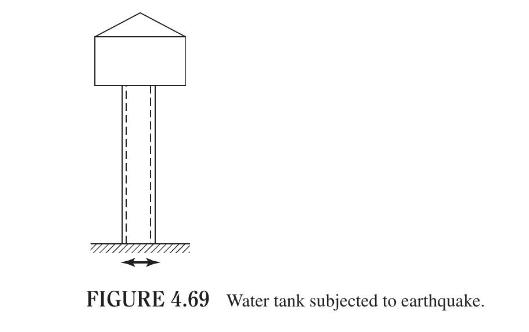
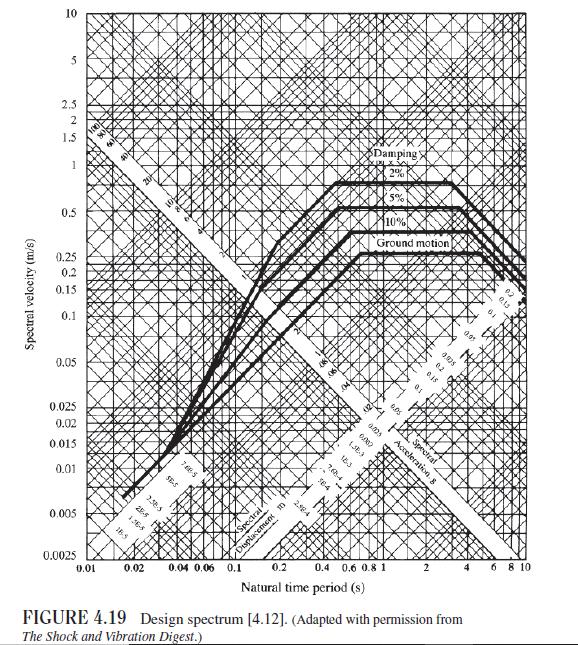
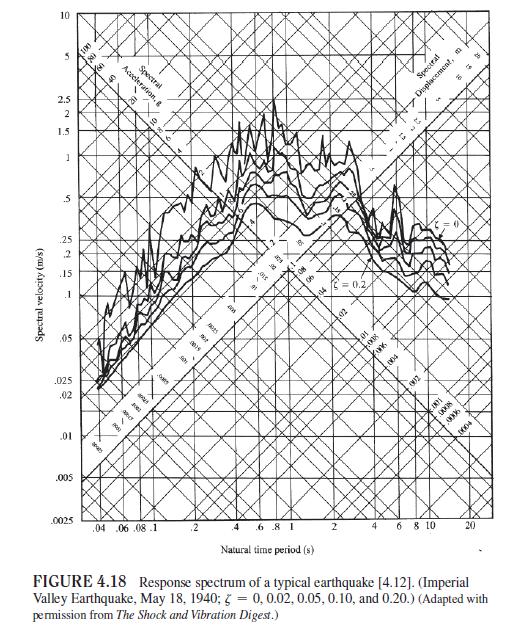
The water tank shown in Fig. 4.69 is subjected to an earthquake whose response spectrum is indicated in Fig. 4.18. The mass of the tank with water is \(60,000 \mathrm{~kg}\). Design a uniform steelFigure 4.18:-hollow circular column of height \(16 \mathrm{~m}\) so that the maximum bending stress
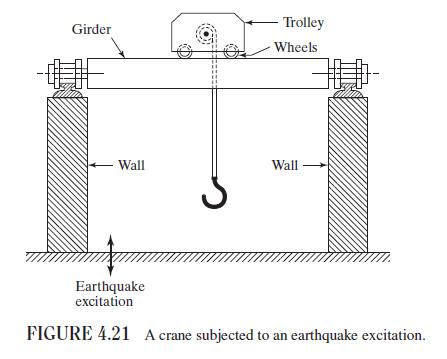
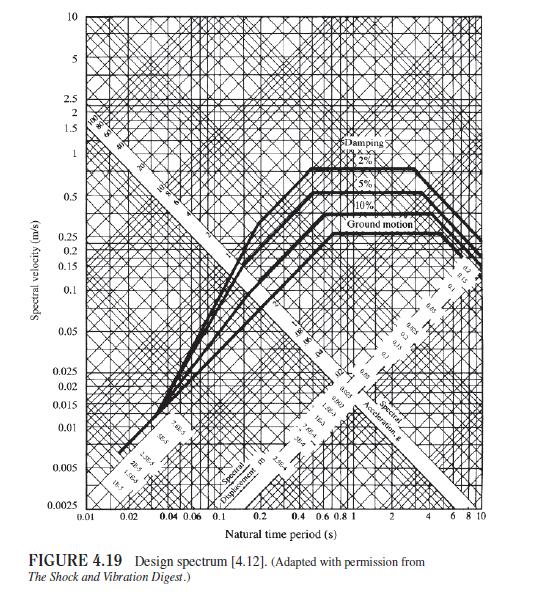
Consider the overhead traveling crane shown in Fig. 4.21. Assuming the mass of the trolley as \(2500 \mathrm{~kg}\) and the overall damping ratio as \(2 \%\), determine the overall stiffness of the system necessary in order to avoid derailment of the trolley under a vertical earthquake excitation
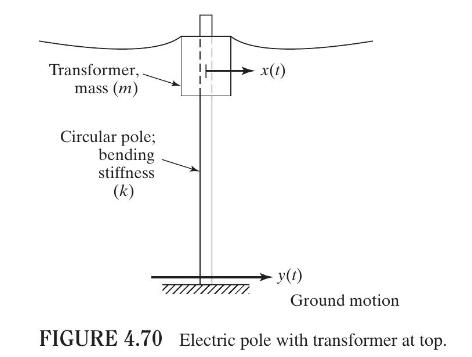
An electric pole of circular cross section, with a bending stiffness \(k=5000 \mathrm{~N} / \mathrm{m}\) and a damping ratio \(\zeta=0.05\), carries a transformer of mass \(m=250 \mathrm{~kg}\) as shown in Fig. 4.70. It is subjected to an earthquake that is characterized by a response spectrum
Find the steady-state response of an undamped single-degree-of-freedom system subjected to the force \(F(t)=F_{0} e^{i \omega t}\) by using the method of Laplace transformation.
Find the response of a damped spring-mass system subjected to a step function of magnitude \(F_{0}\) by using the method of Laplace transformation.
Find the response of an undamped system subjected to a square pulse \(F(t)=F_{0}\) for \(0 \leq t \leq t_{0}\) and 0 for \(t>t_{0}\) by using the Laplace transformation method. Assume the initial conditions as zero.
Derive the expression for the Laplace transform of the response of a damped single-degreeof-freedom system subjected to the following types of forcing functions:a. \(f(t)=A \sin \omega t\)b. \(f(t)=A \cos \omega t\)c. \(f(t)=A e^{-\omega t}\)d. \(f(t)=A \delta\left(t-t_{0}\right)\)
Derive an expression for the impulse response function of a critically damped single-degree-of-freedom system.
Find the response of a system with the following equation of motion:\[2 \ddot{x}+8 \dot{x}+16 x=5 \delta(t)\]using the initial conditions \(x(t=0)=x_{0}=0.05 \mathrm{~m}\) and \(\dot{x}(t=0)=\dot{x}_{0}=0\). Plot the response of the system.
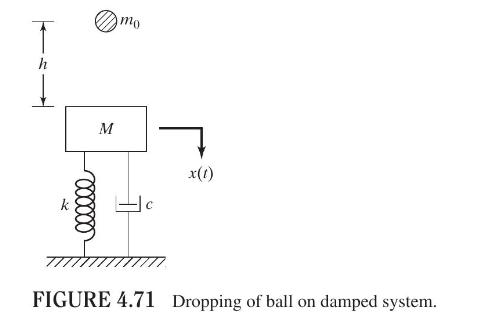
A bronze ball of mass \(m_{0}\) is dropped on the mass of a single-degree-of-freedom system from a height \(h\) as shown in Fig. 4.71. If the ball is caught after its first bounce, determine the resulting displacement response of the mass \(M\). Assume that the collision is perfectly elastic and
Consider the equation of motion of a first-order system:\[0.5 \dot{x}+4 x=f(t)\]where the forcing function \(f(t)\) is periodic. If the Fourier series representation of \(f(t)\) is given by\[f(t)=4 \sin 2 t+2 \sin 4 t+\sin 6 t+0.5 \sin 8 t+\ldots\]a. what is the bandwidth of the system?b. find the
Find the step response of a system with the stated equation of motion:a. \(2 \ddot{x}+10 \dot{x}+12.5 x=10 u_{s}(t)\)b. \(2 \ddot{x}+10 \dot{x}+8 x=10 u_{s}(t)\)c. \(2 \ddot{x}+10 \dot{x}+18 x=10 u_{s}(t)\)
Find the response of a spring-damper (first-order) system shown in Fig. 4.1(a) with the equation of motion\[c \dot{x}+k x=\bar{F}(t)\]where the forcing function \(F(t)\) is a unit step function. Also determine the initial and steadystate values of the response from the time and Laplace domain
Derive the Laplace transform of the ramp function \(F(t)=b t, t \geq 0\), starting from the definition of Laplace transform.
Find the inverse Laplace transform of\[F(S)=\frac{-s+3}{(s+1)(s+2)}\]
Find the inverse Laplace transform of\[F(S)=\frac{3 s+8}{(s+2)^{2}(s+5)}\]
Determine the initial and steady-state values of the ramp response of a first-order system considered in Example 4.20 from the time and Laplace domain solutions.Data From Example 4.20:-Equation 4.49:- Find the solution of Eq. (4.49) when the applied force is a ramp function.
Showing 1800 - 1900
of 2655
First
12
13
14
15
16
17
18
19
20
21
22
23
24
25
26
Last
Step by Step Answers

 Get 50% OFF
Claim Now
Get 50% OFF
Claim Now