New Semester
Started
Get
50% OFF
Study Help!
--h --m --s
Claim Now
Question Answers
Textbooks
Find textbooks, questions and answers
Oops, something went wrong!
Change your search query and then try again
S
Books
FREE
Study Help
Expert Questions
Accounting
General Management
Mathematics
Finance
Organizational Behaviour
Law
Physics
Operating System
Management Leadership
Sociology
Programming
Marketing
Database
Computer Network
Economics
Textbooks Solutions
Accounting
Managerial Accounting
Management Leadership
Cost Accounting
Statistics
Business Law
Corporate Finance
Finance
Economics
Auditing
Tutors
Online Tutors
Find a Tutor
Hire a Tutor
Become a Tutor
AI Tutor
AI Study Planner
NEW
Sell Books
Search
Search
Sign In
Register
study help
engineering
mechanical vibration analysis
Mechanical Vibrations 6th Edition Singiresu S Rao - Solutions
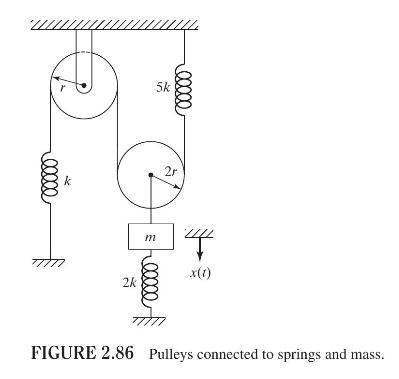
Derive the equation of motion using the principle of conservation of energy for each of the systems shown in Figs. 2.86. 5k ellee 2r m 44 x(1) 2k FIGURE 2.86 Pulleys connected to springs and mass.
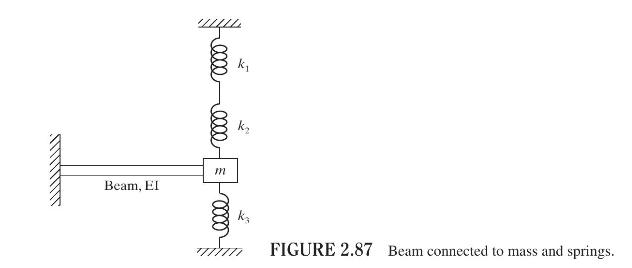
Determine the equivalent spring constant and the natural frequency of vibration of the system shown in Fig. 2.87. Beam, EI m 0000 0000 k k k FIGURE 2.87 Beam connected to mass and springs.
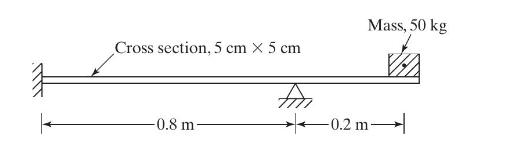
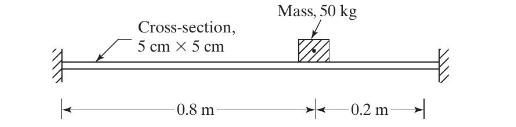
Find the natural frequency of vibration in bending of the system shown in Figs. 2.88(a) by modeling the system as a single-degree-of-freedom system. Assume that the mass is \(50 \mathrm{~kg}\) and the beam has a square cross section of \(5 \mathrm{~cm} \times 5 \mathrm{~cm}\), and is made of steel
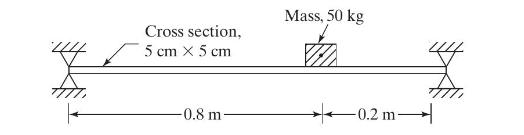
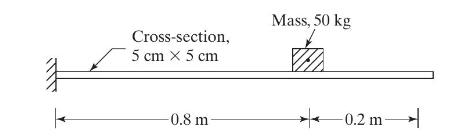
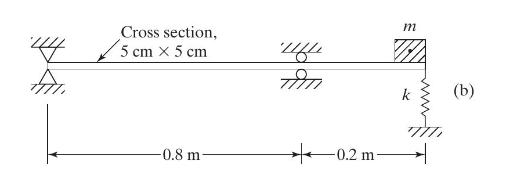
Find the natural frequency of vibration in bending of the system shown in Figs. 2.88(b) by modeling the system as a single-degree-of-freedom system. Assume that the mass is \(50 \mathrm{~kg}\) and the beam has a square cross section of \(5 \mathrm{~cm} \times 5 \mathrm{~cm}\), and is made of steel
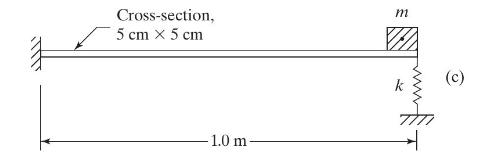
Find the natural frequency of vibration in bending of the system shown in Figs. 2.88 (c) by modeling the system as a single-degree-of-freedom system. Assume that the mass is \(50 \mathrm{~kg}\) and the beam has a square cross section of \(5 \mathrm{~cm} \times 5 \mathrm{~cm}\), and is made of steel
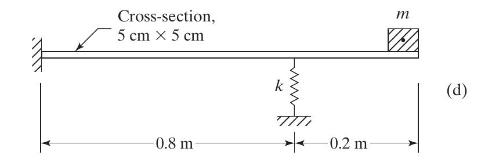
Find the natural frequency of vibration in bending of the system shown in Figs. 2.88(d) by modeling the system as a single-degree-of-freedom system. Assume that the mass is \(50 \mathrm{~kg}\) and the beam has a square cross section of \(5 \mathrm{~cm} \times 5 \mathrm{~cm}\), and is made of steel
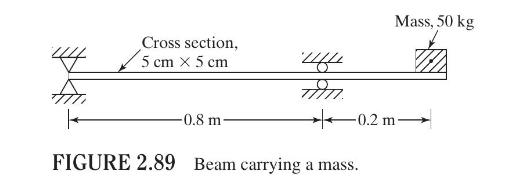
A steel beam of length \(1 \mathrm{~m}\) carries a mass of \(50 \mathrm{~kg}\) at its free end, as shown in Fig. 2.89. Find the natural frequency of transverse vibration of the system by modeling it as a single-degreeof-freedom system. Cross section, 44 AT 5 cm x 5 cm -0.8 m 44641 . FIGURE 2.89
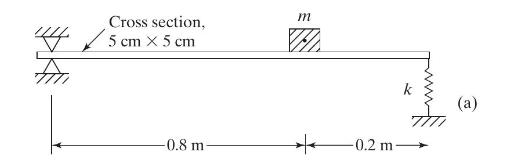
Determine the natural frequency of vibration, in bending, of the system shown in Figs. 2.90(a) by modeling the system as a single-degree-of-freedom system. Assume that the mass is \(m=50 \mathrm{~kg}\), spring stiffness is \(k=10,000\) and the beam has a square cross section of \(5 \mathrm{~cm}
Determine the natural frequency of vibration, in bending, of the system shown in Figs. 2.90(b) by modeling the system as a single-degree-of-freedom system. Assume that the mass is \(m=50 \mathrm{~kg}\), spring stiffness is \(k=10,000\) and the beam has a square cross section of \(5 \mathrm{~cm}
Determine the natural frequency of vibration, in bending, of the system shown in Figs. 2.90(c) by modeling the system as a single-degree-of-freedom system. Assume that the mass is \(m=50 \mathrm{~kg}\), spring stiffness is \(k=10,000\) and the beam has a square cross section of \(5 \mathrm{~cm}
Determine the natural frequency of vibration, in bending, of the system shown in Figs. 2.90(d) by modeling the system as a single-degree-of-freedom system. Assume that the mass is \(m=50 \mathrm{~kg}\), spring stiffness is \(k=10,000\) and the beam has a square cross section of \(5 \mathrm{~cm}
An undamped single-degree-of-freedom system consists of a mass \(5 \mathrm{~kg}\) and a spring of stiffness \(2000 \mathrm{~N} / \mathrm{m}\). Find the response of the system using Eq. (2.21) when the mass is subjected to the following initial conditions:a. \(x_{0}=20 \mathrm{~mm}, \dot{x}_{0}=200
An undamped single-degree-of-freedom system consists of a mass \(10 \mathrm{~kg}\) and a spring of stiffness \(1000 \mathrm{~N} / \mathrm{m}\). Determine the response of the system using Eq. (2.21) when the mass is subjected to the following initial conditions:a. \(x_{0}=10 \mathrm{~mm},
Describe how the phase angle \(\phi_{0}\) in Eq. (2.23) is to be computed for different combinations of positive and negative values of the initial displacement \(\left(x_{0}\right)\) and the initial velocity \(\left(\dot{x}_{0}\right)\).Equation 2.23:- x(t) == Ao sin (wt0) (2.23)
Find the response of the system described in Problem 2.59 using Eq. (2.23).Data From Problem 2.59:-An undamped single-degree-of-freedom system consists of a mass \(5 \mathrm{~kg}\) and a spring of stiffness \(2000 \mathrm{~N} / \mathrm{m}\). Find the response of the system using Eq. (2.21) when the
Find the response of the system described in Problem 2.60 using Eq. (2.23).Data From Problem 2.60:-An undamped single-degree-of-freedom system consists of a mass \(10 \mathrm{~kg}\) and a spring of stiffness \(1000 \mathrm{~N} / \mathrm{m}\). Determine the response of the system using Eq. (2.21)
Find the response of the system described in Example 2.1 using Eq. (2.23).Data From Example 2.1:-Equation 2.23:- An undamped single-degree-of-freedom system has a mass of 1 kg and a stiffness of 2500 N/m. Find the magnitude and the phase of the response of the system when the initial displacement
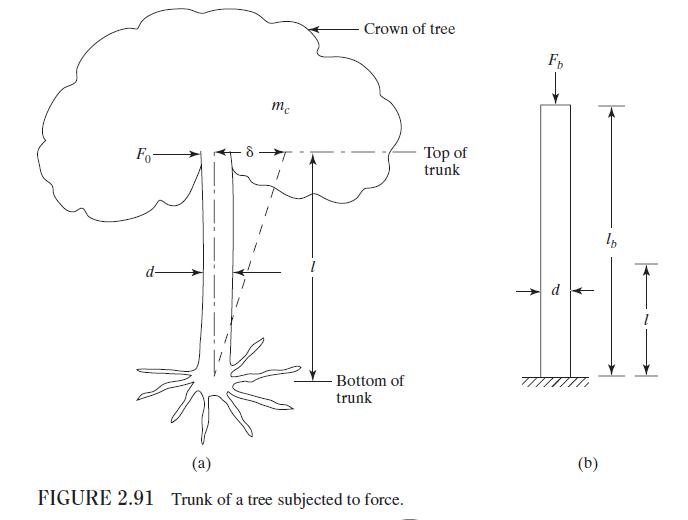
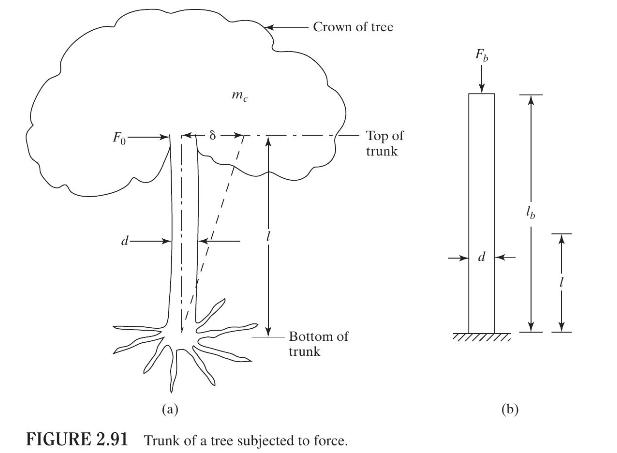
The trunk of the tree shown in Fig. 2.91 can be assumed to be a uniform cylinder of diameter \(d=0.25 \mathrm{~m}\) with a density of \(ho=800 \mathrm{~kg} / \mathrm{m}^{3}\) and Young's modulus of \(E=1.2 \mathrm{GPa}\), and the crown of the tree has a mass of \(m_{c}=100 \mathrm{~kg}\).a. If the
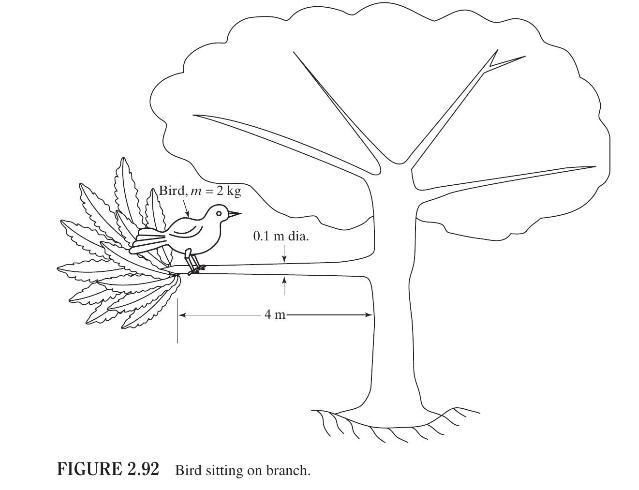
A bird of mass \(2 \mathrm{~kg}\) sits at the end of a horizontal branch of a tree as shown in Fig. 2.92. The branch has a length of \(4 \mathrm{~m}\) from the trunk of the tree with a diameter of \(0.1 \mathrm{~m}\). If the density of the branch is \(700 \mathrm{~kg} / \mathrm{m}^{3}\) and the
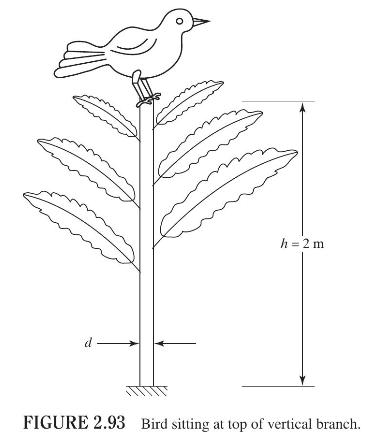
A bird of mass \(m=2 \mathrm{~kg}\) sits at the top of a slender vertical branch of a tree as shown in Fig. 2.93. The height of the branch from the trunk of the tree is \(2 \mathrm{~m}\) and the diameter of the branch is \(d \mathrm{~m}\). The density of the branch is \(700 \mathrm{~kg} /
Determine the displacement, velocity, and acceleration of the mass of a spring-mass system with \(k=500 \mathrm{~N} / \mathrm{m}, m=2 \mathrm{~kg}, x_{0}=0.1 \mathrm{~m}\), and \(\dot{x}_{0}=5 \mathrm{~m} / \mathrm{s}\).
Determine the displacement \((x)\), velocity \((\dot{x})\), and acceleration \((\ddot{x})\) of a spring-mass system with \(\omega_{n}=10 \mathrm{rad} / \mathrm{s}\) for the initial conditions \(x_{0}=0.05 \mathrm{~m}\) and \(\dot{x}_{0}=1 \mathrm{~m} / \mathrm{s}\). Plot \(x(t), \dot{x}(t)\), and
The free-vibration response of a spring-mass system is observed to have a frequency of 2 \(\mathrm{rad} / \mathrm{s}\), an amplitude of \(10 \mathrm{~mm}\), and a phase shift of \(1 \mathrm{rad}\) from \(t=0\). Determine the initial conditions that caused the free vibration. Assume the damping
An automobile is found to have a natural frequency of \(20 \mathrm{rad} / \mathrm{s}\) without passengers and 17.32 \(\mathrm{rad} / \mathrm{s}\) with passengers of mass \(500 \mathrm{~kg}\). Find the mass and stiffness of the automobile by treating it as a single-degree-of-freedom system.
A spring-mass system with mass \(2 \mathrm{~kg}\) and stiffness \(3200 \mathrm{~N} / \mathrm{m}\) has an initial displacement of \(x_{0}=0\). What is the maximum initial velocity that can be given to the mass without the amplitude of free vibration exceeding a value of \(0.1 \mathrm{~m}\) ?
A helical spring, made of music wire of diameter \(d\), has a mean coil diameter \((D)\) of \(14 \mathrm{~mm}\) and \(N\) active coils (turns). It is found to have a frequency of vibration (f) of \(193 \mathrm{~Hz}\) and a spring rate \(k\) of \(4.6 \mathrm{~N} / \mathrm{mm}\). Determine the wire
Solve Problem 2.73 if the material of the helical spring is changed from music wire to aluminum with \(G=26 \mathrm{GPa}\) and \(ho=2690 \mathrm{~kg} / \mathrm{m}^{3}\).Data From Problem 2.73:-A helical spring, made of music wire of diameter \(d\), has a mean coil diameter \((D)\) of \(14
A steel cantilever beam is used to carry a machine at its free end. To save weight, it is proposed to replace the steel beam by an aluminum beam of identical dimensions. Find the expected change in the natural frequency of the beam-machine system.
An oil drum of diameter \(1 \mathrm{~m}\) and a mass of \(500 \mathrm{~kg}\) floats in a bath of salt water of density \(ho_{w}=1050 \mathrm{~kg} / \mathrm{m}^{3}\). Considering small displacements of the drum in the vertical direction \((x)\), determine the natural frequency of vibration of the
The equation of motion of a spring-mass system is given by (units: SI system)\[500 \ddot{x}+1000\left(\frac{x}{0.025}\right)^{3}=0\]a. Determine the static equilibrium position of the system.b. Derive the linearized equation of motion for small displacements \((x)\) about the static equilibrium
A deceleration of \(10 \mathrm{~m} / \mathrm{s}^{2}\) is caused when brakes are applied to a vehicle traveling at a speed of \(100 \mathrm{~km} / \mathrm{hour}\). Determine the time taken and the distance traveled before the vehicle comes to a complete stop.
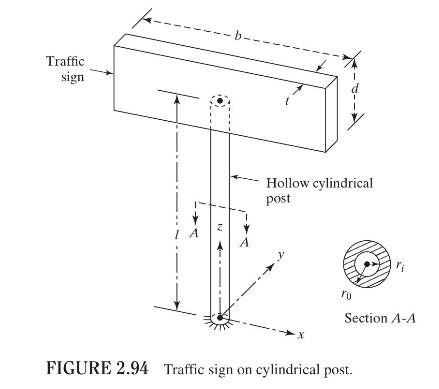
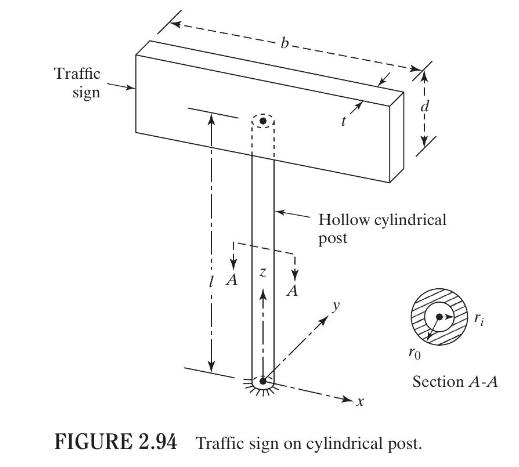
A steel hollow cylindrical post is welded to a steel rectangular traffic sign as shown in Fig. 2.94 with the following data:Dimensions: \(l=2 \mathrm{~m}, r_{0}=0.050 \mathrm{~m}, r_{i}=0.045 \mathrm{~m}, b=0.75 \mathrm{~m}, d=0.40 \mathrm{~m}, t=0.005 \mathrm{~m}\); material properties: \(ho\)
Solve Problem 2.79 by changing the material from steel to bronze for both the post and the sign. Material properties of bronze: \(ho\) (specific weight) \(=80.1 \mathrm{kN} / \mathrm{m}^{3}, E=111.0 \mathrm{GPa}\), \(G=41.4 \mathrm{GPa}\).Data From Problem 2.79:-A steel hollow cylindrical post is
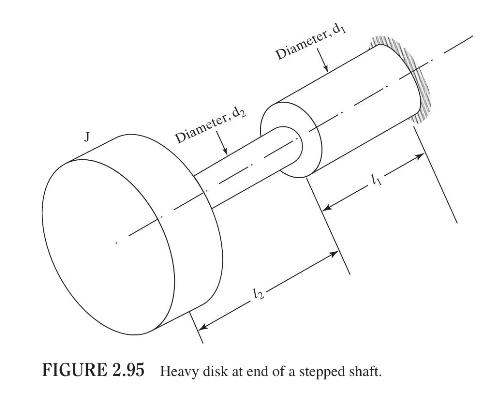
A heavy disk of mass moment of inertia \(J\) is attached at the free end of a stepped circular shaft as shown in Fig. 2.95. By modeling the system as a single-degree-of-freedom torsional system, determine the natural frequency of torsional vibration. Diameter, d 12 FIGURE 2.95 Heavy disk at end of
A simple pendulum of length \(1 \mathrm{~m}\) with a bob of mass \(1 \mathrm{~kg}\) is placed on Mars and was given an initial angular displacement of \(5^{\circ}\). If the acceleration due to gravity on Mars, \(\mathrm{g}_{\text {Mars }}\), is \(0.376 \mathrm{~g}_{\text {Earth }}\), determine the
A simple pendulum of length \(1 \mathrm{~m}\) with a bob of mass \(1 \mathrm{~kg}\) is placed on Moon and was given an initial angular displacement of \(5^{\circ}\). If the acceleration due to gravity on Moon, \(\mathrm{g}_{\text {Moon }}\), is \(1.6263 \mathrm{~m} / \mathrm{s}^{2}\), determine the
A simple pendulum is set into oscillation from its rest position by giving it an angular velocity of \(1 \mathrm{rad} / \mathrm{s}\). It is found to oscillate with an amplitude of \(0.5 \mathrm{rad}\). Find the natural frequency and length of the pendulum.
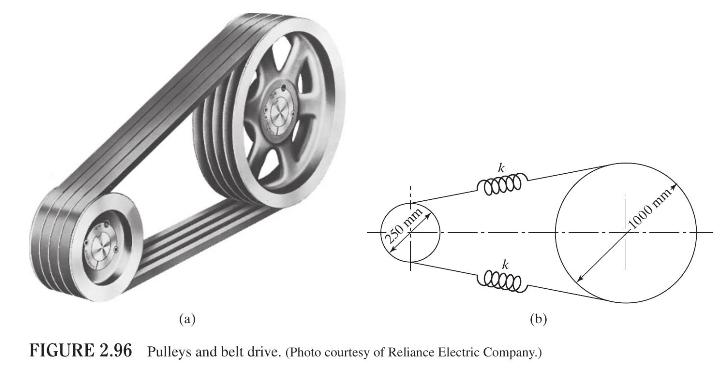
A pulley \(250 \mathrm{~mm}\) in diameter drives a second pulley \(1000 \mathrm{~mm}\) in diameter by means of a belt. The moment of inertia of the driven pulley is \(0.2 \mathrm{~kg}-\mathrm{m}^{2}\). The belt connecting these pulleys is represented by two springs, each of stiffness \(k\). For
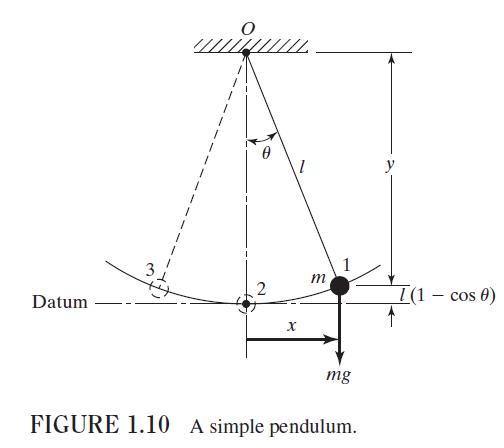
Derive an expression for the natural frequency of the simple pendulum shown in Fig. 1.10. Determine the period of oscillation of a simple pendulum having a mass \(m=5 \mathrm{~kg}\) and a length \(l=0.5 \mathrm{~m}\).Figure 1.10:- (a) 250 mm k 00000 FIGURE 2.96 Pulleys and belt drive. (Photo
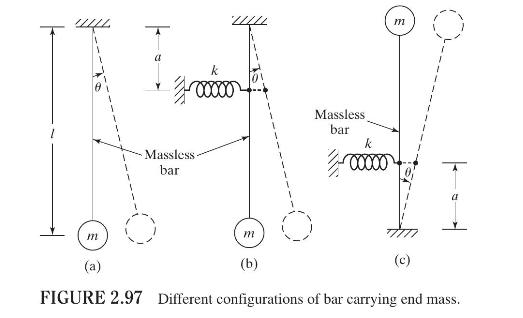
A mass \(m\) is attached at the end of a bar of negligible mass and is made to vibrate in three different configurations, as indicated in Fig. 2.97. Find the configuration corresponding to the highest natural frequency. m a Massless. bar Massless bar k 00000 m m (a). FIGURE 2.97 Different
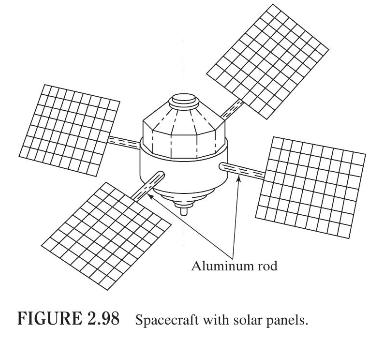
Figure 2.98 shows a spacecraft with four solar panels. Each panel has the dimensions \(1.5 \mathrm{~m} \times 1 \mathrm{~m} \times 0.025 \mathrm{~m}\) with a density of \(2690 \mathrm{~kg} / \mathrm{m}^{3}\) and is connected to the body of the spacecraft by aluminum rods of length \(0.3
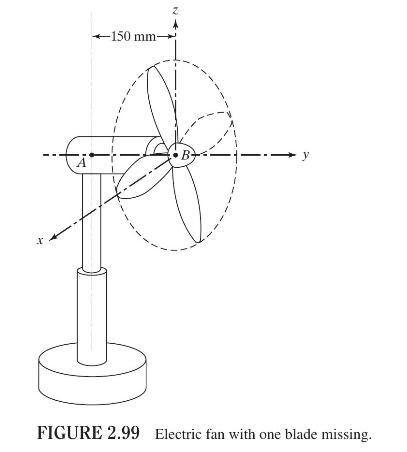
One of the blades of an electric fan is removed. The steel shaft \(A B\), on which the blades are mounted, is equivalent to a uniform shaft of diameter \(25 \mathrm{~mm}\) and length \(150 \mathrm{~mm}\). Each blade can be modeled as a uniform slender rod of mass \(1 \mathrm{~kg}\) and length \(300
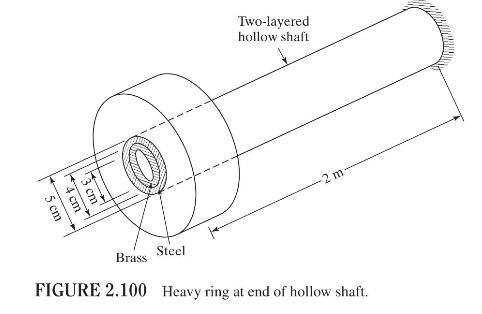
A heavy ring of mass moment of inertia \(1.0 \mathrm{~kg}-\mathrm{m}^{2}\) is attached at the end of a two-layered hollow shaft of length \(2 \mathrm{~m}\) (Fig. 2.100). If the two layers of the shaft are made of steel and brass, determine the natural time period of torsional vibration of the heavy
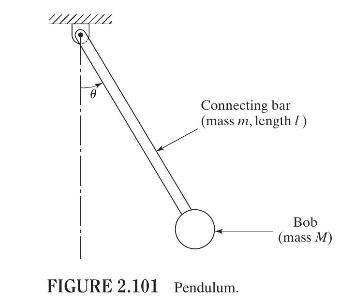
Find the natural frequency of the pendulum shown in Fig. 2.101 when the mass of the connecting bar is not negligible compared to the mass of the pendulum bob. Connecting bar (mass m, length /). FIGURE 2.101 Pendulum. Bob (mass M)
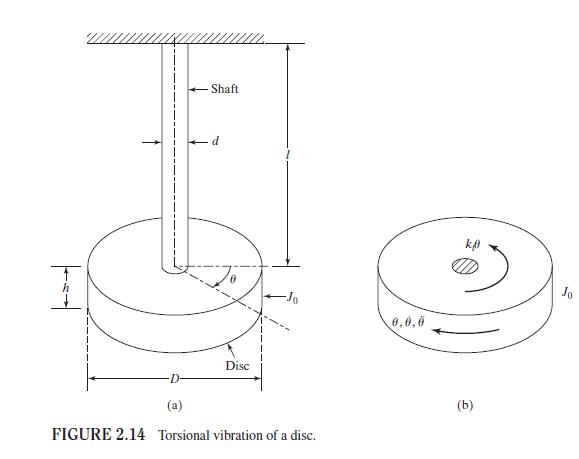
A steel shaft of \(0.05 \mathrm{~m}\) diameter and \(2 \mathrm{~m}\) length is fixed at one end and carries at the other end a steel disc of \(1 \mathrm{~m}\) diameter and \(0.1 \mathrm{~m}\) thickness, as shown in Fig. 2.14. Find the system's natural frequency of torsional vibration. - Shaft d
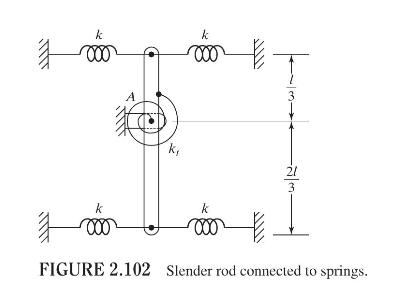
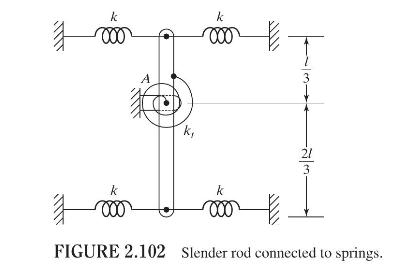
A uniform slender rod of mass \(m\) and length \(l\) is hinged at point \(A\) and is attached to four linear springs and one torsional spring, as shown in Fig. 2.102. Find the natural frequency of the system if \(k=2000 \mathrm{~N} / \mathrm{m}, k_{t}=1000 \mathrm{~N}-\mathrm{m} / \mathrm{rad},
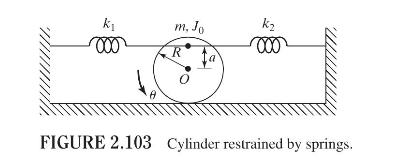
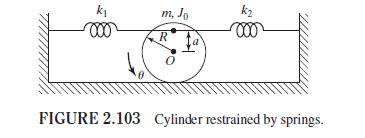
A cylinder of mass \(m\) and mass moment of inertia \(J_{0}\) is free to roll without slipping but is restrained by two springs of stiffnesses \(k_{1}\) and \(k_{2}\), as shown in Fig. 2.103. Find its natural frequency of vibration. Also find the value of \(a\) that maximizes the natural frequency
If the pendulum of Problem 2.86 is placed in a rocket moving vertically with an acceleration of \(5 \mathrm{~m} / \mathrm{s}^{2}\), what will be its period of oscillation?Data From Problem 2.86:-Derive an expression for the natural frequency of the simple pendulum shown in Fig. 1.10. Determine the
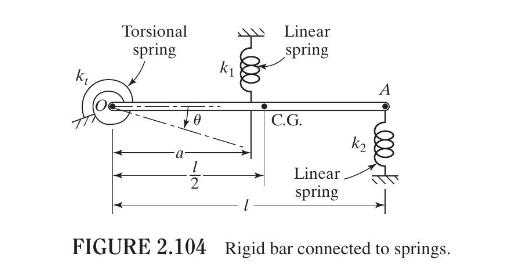
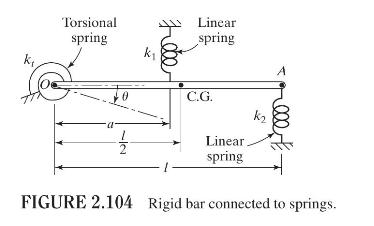
Find the equation of motion of the uniform rigid bar \(O A\) of length \(l\) and mass \(m\) shown in Fig. 2.104. Also find its natural frequency. k Fell Torsional spring k1 12 Linear spring C.G. A k Linear spring FIGURE 2.104 Rigid bar connected to springs.
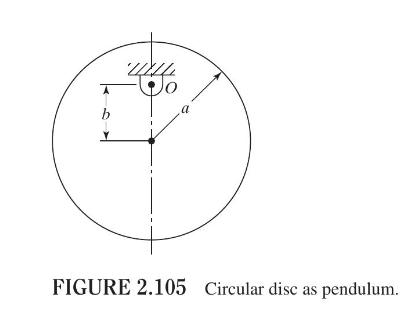
A uniform circular disc is pivoted at point \(O\), as shown in Fig. 2.105. Find the natural frequency of the system. Also find the maximum frequency of the system by varying the value of \(b\). b FIGURE 2.105 Circular disc as pendulum.
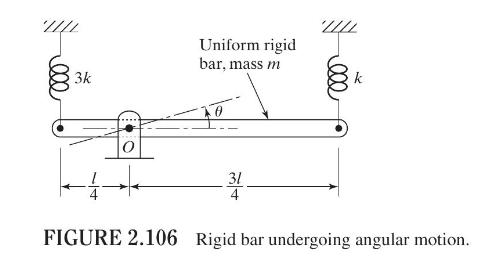
Derive the equation of motion of the system shown in Fig. 2.106, using the following methods: (a) Newton's second law of motion, (b) D'Alembert's principle, and (c) principle of virtual work. Uniform rigid bar, mass m 3k k 31 4 FIGURE 2.106 Rigid bar undergoing angular motion.
Find the natural frequency of the traffic sign system described in Problem 2.79 in torsional vibration about the \(z\)-axis by considering the masses of both the post and the sign.The spring stiffness of the post in torsional vibration about the \(z\)-axis is given by \(k_{t}=\frac{\pi G}{2
Solve Problem 2.99 by changing the material from steel to bronze for both the post and the sign. Material properties of bronze: \(ho\) (specific weight) \(=80.1 \mathrm{kN} / \mathrm{m}^{3}, E=111.0 \mathrm{GPa}\), \(G=41.4 \mathrm{GPa}\).Data From Problem 2.99:-Find the natural frequency of the
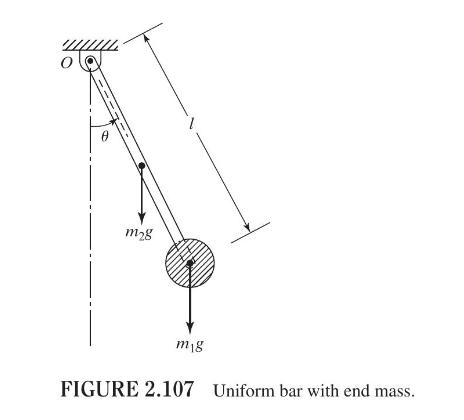
A mass \(m_{1}\) is attached at one end of a uniform bar of mass \(m_{2}\) whose other end is pivoted at point \(O\) as shown in Fig. 2.107. Determine the natural frequency of vibration of the resulting pendulum for small angular displacements. mg mig FIGURE 2.107 Uniform bar with end mass.
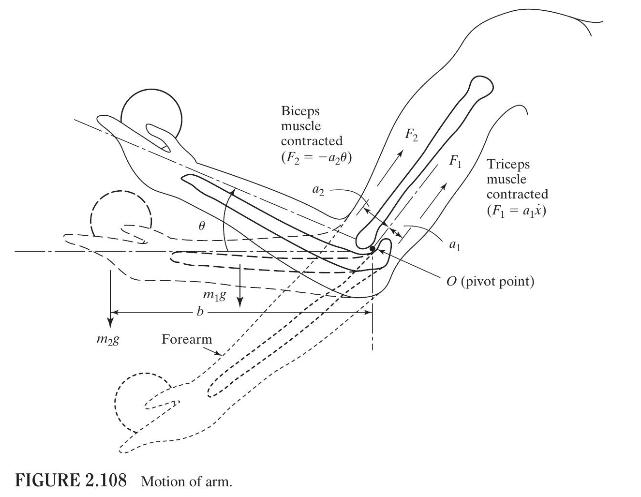
The angular motion of the forearm of a human hand carrying a mass \(m_{0}\) is shown in Fig. 2.108. During motion, the forearm can be considered to rotate about the joint (pivot point) \(O\) with muscle forces modeled in the form of a force by triceps \(\left(c_{1} \dot{x}\right)\) and a force in
Find the free-vibration response and the time constant, where applicable, of systems governed by the following equations of motion:a. \(100 \dot{u}+20 u=0, \quad u(0)=u(t=0)=10\)b. \(100 \dot{u}+20 u=10, \quad u(0)=u(t=0)=10\)c. \(100 \dot{v}-20 u=0, \quad u(0)=u(t=0)=10\)d. \(500 \dot{\omega}+50
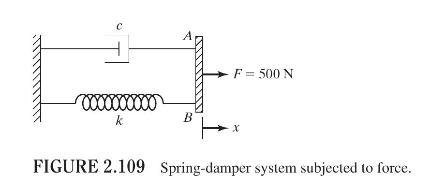
A viscous damper, with damping constant \(c\), and a spring, with spring stiffness \(k\), are connected to a massless bar \(A B\) as shown in Fig. 2.109. The bar \(A B\) is displaced by a distance of\(x=0.1 \mathrm{~m}\) when a constant force \(F=500 \mathrm{~N}\) is applied. The applied force
The equation of motion of a rocket, of mass \(m\), traveling vertically under a thrust \(F\) and air resistance or drag \(D\) is given by\[m \dot{u}=F-D-m g\]If \(m=1000 \mathrm{~kg}, F=50,000 \mathrm{~N}, D=2000 \mathrm{v}\), and \(g=9.81 \mathrm{~m} / \mathrm{s}^{2}\), find the time variation of
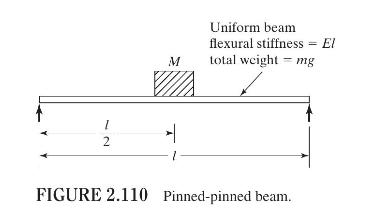
Determine the effect of self weight on the natural frequency of vibration of the pinned-pinned beam shown in Fig. 2.110. 1 2 M + Uniform beam flexural stiffness = El total weight-mg FIGURE 2.110 Pinned-pinned beam.
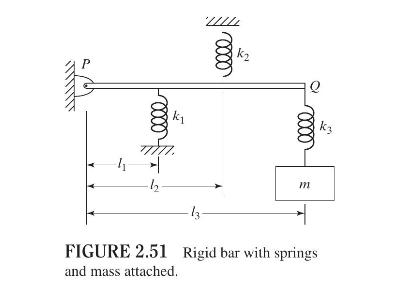
Use Rayleigh's method to solve Problem 2.7.Data From Problem 2.7:-Three springs and a mass are attached to a rigid, weightless bar \(P Q\) as shown in Fig. 2.51. Find the natural frequency of vibration of the system. 0000 0000 k1 12 k 0000 k3 m FIGURE 2.51 Rigid bar with springs and mass attached.
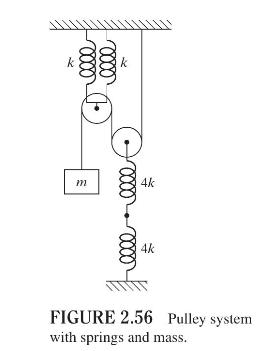
Use Rayleigh's method to solve Problem 2.13.Data From Problem 2.13:-Find the natural frequency of the pulley system shown in Fig. 2.56 by neglecting the friction and the masses of the pulleys. 0000 m k 0000 4k 0000 4k FIGURE 2.56 Pulley system with springs and mass.
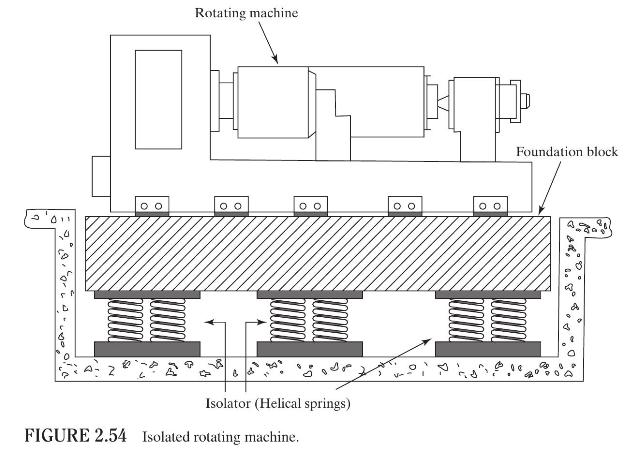
Find the natural frequency of the system shown in Fig. 2.54.Figure 2.54:- Rotating machine B Isolator (Helical springs) FIGURE 2.54 Isolated rotating machine. Foundation block
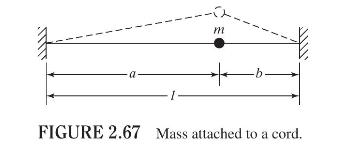
Use Rayleigh's method to solve Problem 2.26.Data From Problem 2.26:-A mass \(m\) is attached to a cord that is under a tension \(T\), as shown in Fig. 2.67. Assuming that \(T\) remains unchanged when the mass is displaced normal to the cord, (a) write the differential equation of motion for small
Use Rayleigh's method to solve Problem 2.93.Data From Problem 2.93:-A uniform slender rod of mass \(m\) and length \(l\) is hinged at point \(A\) and is attached to four linear springs and one torsional spring, as shown in Fig. 2.102. Find the natural frequency of the system if \(k=2000 \mathrm{~N}
Use Rayleigh's method to solve Problem 2.96.Data From Problem 2.96:-Find the equation of motion of the uniform rigid bar \(O A\) of length \(l\) and mass \(m\) shown in Fig. 2.104. Also find its natural frequency. Torsional spring k Linear spring C.G. 12 Linear. spring FIGURE 2.104 Rigid bar
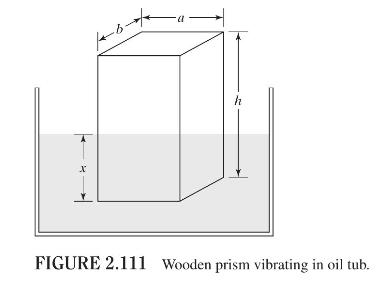
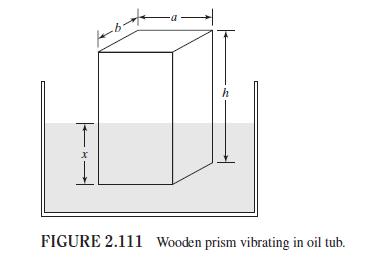
A wooden rectangular prism of density \(ho_{w}\), height \(h\), and cross section \(a \times b\) is initially depressed in an oil tub and made to vibrate freely in the vertical direction (see Fig. 2.111). Use Rayleigh's method to find the natural frequency of vibration of the prism. Assume the
Use the energy method to find the natural frequency of the system shown in Fig. 2.103.Figure 2.103:- k m, Jo k 000 R FIGURE 2.103 Cylinder restrained by springs.
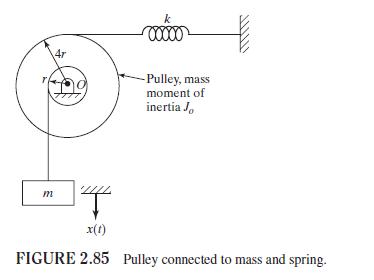
Use the energy method to find the natural frequency of vibration of the system shown in Fig. 2.85.Figure 2.85:- 4r 00000 -Pulley, mass moment of inertia Jo m T x(t) FIGURE 2.85 Pulley connected to mass and spring.
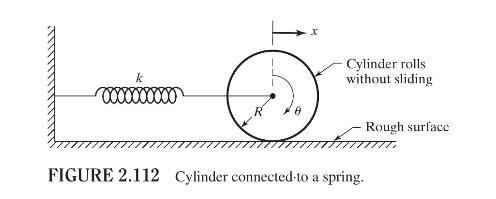
A cylinder of mass \(m\) and mass moment of inertia \(J\) is connected to a spring of stiffness \(k\) and rolls on a rough surface as shown in Fig. 2.112. If the translational and angular displacements of the cylinder are \(x\) and \(\theta\) from its equilibrium position, determine the
Consider the differential equation of motion for the free vibration of a damped single-degreeof-freedom system given byShow that Eq. (E.1) remains the same irrespective of the units used by considering the following data and systems of units:a. SI units: \(m=2 \mathrm{~kg}, c=800
A damped single-degree-of-freedom system has \(m=5 \mathrm{~kg}, c=500 \mathrm{~N}-\mathrm{s} / \mathrm{m}\), and \(k=5000 \mathrm{~N} / \mathrm{m}\). Determine the undamped and damped natural frequencies of vibration and the damping ratio of the system.
A damped single-degree-of-freedom system has \(m=5 \mathrm{~kg}, c=500 \mathrm{~N}-\mathrm{s} / \mathrm{m}\), and \(k=50,000 \mathrm{~N} / \mathrm{m}\). Determine the undamped and damped natural frequencies of vibration and the damping ratio of the system.
A damped single-degree-of-freedom system has \(m=5 \mathrm{~kg}, c=1000 \mathrm{~N}-\mathrm{s} / \mathrm{m}\), and \(k=50,000 \mathrm{~N} / \mathrm{m}\). Determine the undamped and damped natural frequencies of vibration and the damping ratio of the system.
Find the variation of the displacement with time, \(x(t)\), of a damped single-degree-of-freedom system with \(\zeta=0.1\) for the following initial conditions:a. \(x(t=0)=x_{0}=0.2 \mathrm{~m}, \dot{x}_{0}=0\)b. \(x(t=0)=x_{0}=-0.2 \mathrm{~m}, \dot{x}_{0}=0\)c. \(x_{0}=0, \dot{x}_{0}=0.2
Find the variation of the displacement with time, \(x(t)\), of a damped single-degree-of-freedom system with \(\zeta=1.0\) for the following initial conditions:a. \(x(t=0)=x_{0}=0.2 \mathrm{~m}, \dot{x}_{0}=0\)b. \(x(t=0)=x_{0}=-0.2 \mathrm{~m}, \dot{x}_{0}=0\)c. \(\dot{x}_{0}=0.2 \mathrm{~m} /
Find the variation of the displacement with time, \(x(t)\), of a damped single-degree-of-freedom system with \(\zeta=2.0\) for the following initial conditions:a. \(x(t=0)=x_{0}=0.2 \mathrm{~m}, \dot{x}_{0}=0\)b. \(x(t=0)=x_{0}=-0.2 \mathrm{~m}, \dot{x}_{0}=0\)c. \(\dot{x}_{0}=0.2 \mathrm{~m} /
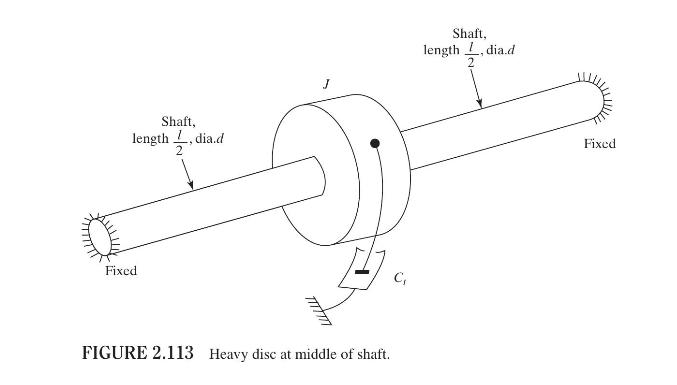
A heavy disk of mass moment of inertia \(J\) is attached at the middle of a circular shaft of length \(l\) and diameter \(d\) as shown in Fig. 2.113. By modeling the system as a single-degreeof-freedom torsional system, determine the natural frequency of torsional vibration. Fixed Shaft, length,
A simple pendulum is found to vibrate at a frequency of \(0.5 \mathrm{~Hz}\) in a vacuum and \(0.45 \mathrm{~Hz}\) in a viscous fluid medium. Find the damping constant, assuming the mass of the bob of the pendulum as \(1 \mathrm{~kg}\).
The ratio of successive amplitudes of a viscously damped single-degree-of-freedom system is found to be 18:1. Determine the ratio of successive amplitudes if the amount of damping is (a) doubled, and (b) halved.
Assuming that the phase angle is zero, show that the response \(x(t)\) of an underdamped singledegree-of-freedom system reaches a maximum value when\[\sin \omega_{d} t=\sqrt{1-\zeta^{2}}\]and a minimum value when\[\sin \omega_{d} t=-\sqrt{1-\zeta^{2}}\]Also show that the equations of the curves
Derive an expression for the time at which the response of a critically damped system will attain its maximum value. Also find the expression for the maximum response.
A shock absorber is to be designed to limit its overshoot to \(15 \%\) of its initial displacement when released. Find the damping ratio \(\zeta_{0}\) required. What will be the overshoot if \(\zeta\) is made equal to (a) \(\frac{3}{4} \zeta_{0}\), and (b) \(\frac{5}{4} \zeta_{0}\) ?
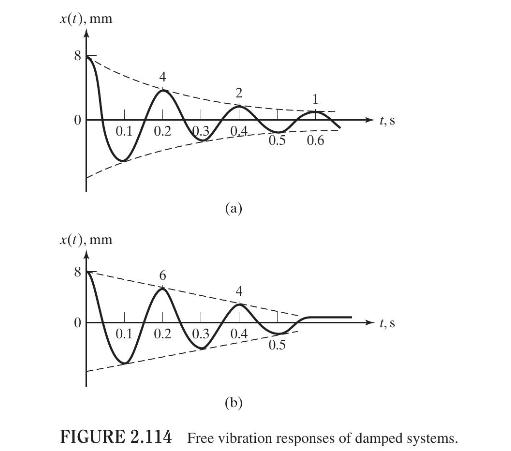
The free-vibration responses of an electric motor of weight \(500 \mathrm{~N}\) mounted on different types of foundations are shown in Figs. 2.114(a) and (b). Identify the following in each case: (i) the nature of damping provided by the foundation, (ii) the spring constant and damping coefficient
For a spring-mass-damper system, \(m=50 \mathrm{~kg}\) and \(k=5000 \mathrm{~N} / \mathrm{m}\). Find the following: (a) critical damping constant \(c_{c}\), (b) damped natural frequency when \(c=c_{c} / 2\), and (c) logarithmic decrement.
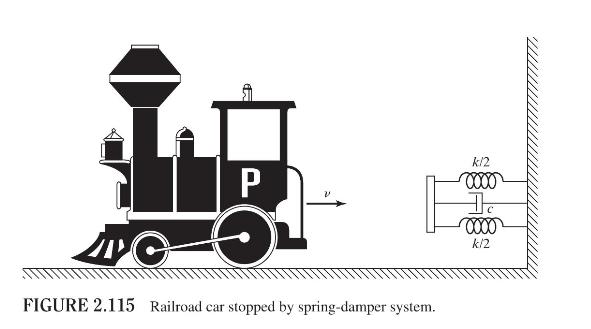
A railroad car of mass \(2000 \mathrm{~kg}\) traveling at a velocity \(v=10 \mathrm{~m} / \mathrm{s}\) is stopped at the end of the tracks by a spring-damper system, as shown in Fig. 2.115. If the stiffness of the spring is \(k=80 \mathrm{~N} / \mathrm{mm}\) and the damping constant is \(c=20
A torsional pendulum has a natural frequency of \(200 \mathrm{cycles} / \mathrm{min}\) when vibrating in a vacuum. The mass moment of inertia of the disc is \(0.2 \mathrm{~kg}-\mathrm{m}^{2}\). It is then immersed in oil and its natural frequency is found to be 180 cycles/min. Determine the damping
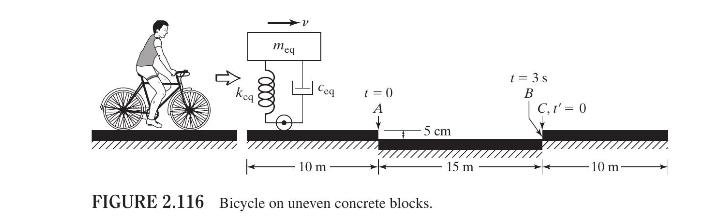
A boy riding a bicycle can be modeled as a spring-mass-damper system with an equivalent weight, stiffness, and damping constant of \(800 \mathrm{~N}, 50,000 \mathrm{~N} / \mathrm{m}\), and \(1000 \mathrm{~N}-\mathrm{s} / \mathrm{m}\), respectively. The differential setting of the concrete blocks on
A wooden rectangular prism of mass \(10 \mathrm{~kg}\), height \(1 \mathrm{~m}\), and cross section \(30 \mathrm{~cm} \times 60 \mathrm{~cm}\) floats and remains vertical in a tub of oil. The frictional resistance of the oil can be assumed to be equivalent to a viscous damping coefficient
A body vibrating with viscous damping makes five complete oscillations per second, and in 50 cycles its amplitude diminishes to \(10 \%\). Determine the logarithmic decrement and the damping ratio. In what proportion will the period of vibration be decreased if damping is removed?
The maximum permissible recoil distance of a gun is specified as \(0.5 \mathrm{~m}\). If the initial recoil velocity is to be between \(8 \mathrm{~m} / \mathrm{s}\) and \(10 \mathrm{~m} / \mathrm{s}\), find the mass of the gun and the spring stiffness of the recoil mechanism. Assume that a
A viscously damped system has a stiffness of \(5000 \mathrm{~N} / \mathrm{m}\), critical damping constant of \(0.2 \mathrm{~N}\)-s/ \(\mathrm{mm}\), and a logarithmic decrement of 2.0. If the system is given an initial velocity of \(1 \mathrm{~m} / \mathrm{s}\), determine the maximum displacement
Explain why an overdamped system never passes through the static equilibrium position when it is given (a) an initial displacement only and (b) an initial velocity only.
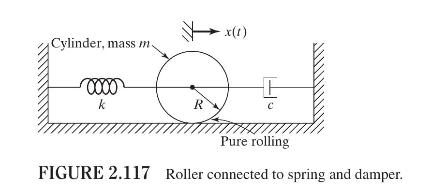
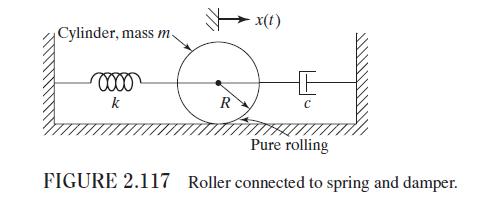
Derive the equation of motion and find the natural frequency of vibration of each of the systems shown in Figs. 2.117 Cylinder, mass m 0000 x(t) k R Pure rolling FIGURE 2.117 Roller connected to spring and damper.
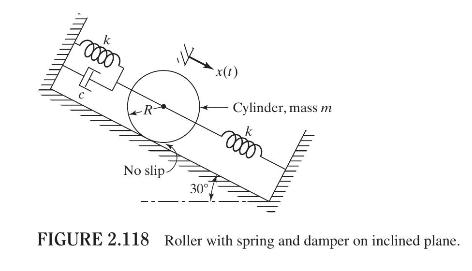
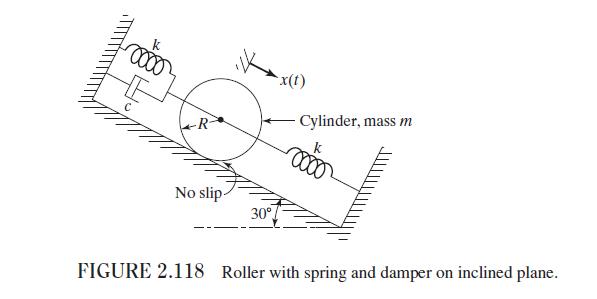
Derive the equation of motion and find the natural frequency of vibration of each of the systems shown in Figs. 2.118. k 0000 E C R x(t) No slip- 301 Cylinder, mass m FIGURE 2.118 Roller with spring and damper on inclined plane.
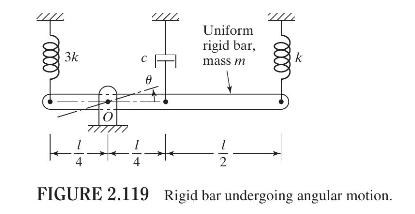
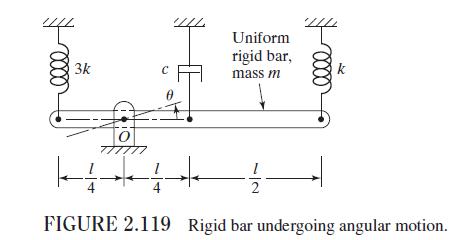
Derive the equation of motion and find the natural frequency of vibration of each of the systems shown in Figs. 2.119. 3k Uniform rigid bar, mass m 4 FIGURE 2.119 Rigid bar undergoing angular motion.
Using the principle of virtual work, derive the equation of motion for each of the systems shown in Figs. 2.117. Cylinder, mass m. 0000 k R x(t) Pure rolling FIGURE 2.117 Roller connected to spring and damper.
Using the principle of virtual work, derive the equation of motion for each of the systems shown in Figs. 2.118. x(t) R Cylinder, mass m No slip- 30 FIGURE 2.118 Roller with spring and damper on inclined plane.
Using the principle of virtual work, derive the equation of motion for each of the systems shown in Figs. 2.119. 3k C Uniform rigid bar, mass m 12 FIGURE 2.119 Rigid bar undergoing angular motion.
A wooden rectangular prism of cross section \(40 \mathrm{~cm} \times 60 \mathrm{~cm}\), height \(120 \mathrm{~cm}\), and mass \(40 \mathrm{~kg}\) floats in a fluid as shown in Fig. 2.111. When disturbed, it is observed to vibrate freely with a natural period of \(0.5 \mathrm{~s}\). Determine the
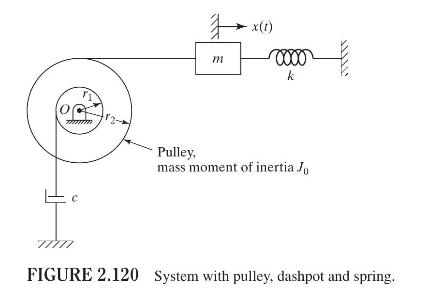
The system shown in Fig. 2.120 has a natural frequency of \(5 \mathrm{~Hz}\) for the following data: \(m=10 \mathrm{~kg}, J_{0}=5 \mathrm{~kg}-\mathrm{m}^{2}, r_{1}=10 \mathrm{~cm}, r_{2}=25 \mathrm{~cm}\). When the system is disturbed by giving it an initial displacement, the amplitude of free
Showing 2100 - 2200
of 2655
First
13
14
15
16
17
18
19
20
21
22
23
24
25
26
27
Step by Step Answers

 Get 50% OFF
Claim Now
Get 50% OFF
Claim Now