New Semester
Started
Get
50% OFF
Study Help!
--h --m --s
Claim Now
Question Answers
Textbooks
Find textbooks, questions and answers
Oops, something went wrong!
Change your search query and then try again
S
Books
FREE
Study Help
Expert Questions
Accounting
General Management
Mathematics
Finance
Organizational Behaviour
Law
Physics
Operating System
Management Leadership
Sociology
Programming
Marketing
Database
Computer Network
Economics
Textbooks Solutions
Accounting
Managerial Accounting
Management Leadership
Cost Accounting
Statistics
Business Law
Corporate Finance
Finance
Economics
Auditing
Tutors
Online Tutors
Find a Tutor
Hire a Tutor
Become a Tutor
AI Tutor
AI Study Planner
NEW
Sell Books
Search
Search
Sign In
Register
study help
mathematics
calculus early transcendentals 9th
Calculus Early Transcendentals 9th Edition James Stewart, Daniel K. Clegg, Saleem Watson, Lothar Redlin - Solutions
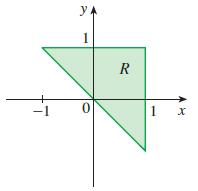
A region R is shown. Decide whether to use polar coordinates or rectangular coordinates and write ∫∫R f(x, y) dA as an iterated integral, where f is an arbitrary continuous function on R. yA 1 R -1 1
Determine whether the statement is true or false. If it is true, explain why. If it is false, explain why or give an example that disproves the statement. + y? dy dx = V+ y? dx dy
Evaluate the integral ∫∫∫E (xy + z2) dV, whereE = {(x, y, z)| 0 ≤ x ≤ 2, 0 ≤ y ≤ 1, 0 ≤ z ≤ 36}using three different orders of integration.
(a) How do you define ∫∫D f(x, y) dA if D is a bounded region that is not a rectangle?(b) What is a type I region? How do you evaluate ∫∫D f(x, y) dA if D is a type I region?(c) What is a type II region? How do you evaluate ∫∫D f(x, y) dA if D is a type II region?(d) What properties do
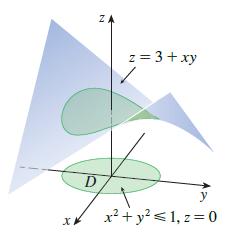
Find the area of the indicated part of the surface (above the region D). ZA z = 3+ xy y x? + y?
Find the image of the set S under the given transformation. S = {(u, v) | 0 < u < 1,0 < v < 2}; %3D x = u + v, y = -v
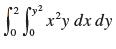
Evaluate the iterated integral. x²y dx dy Jo .2 Vo
Plot the point whose spherical coordinates are given. Then find the rectangular coordinates of the point.(a) (5, π/2, π/3)(b) (6, 0, 5π/6)
If R = [0, 4] × [−1, 2], use a Riemann sum with m = 2, n = 3 to estimate the value of ∫∫R (1 − xy2) dA. Take the sample points to be(a) The lower right corners(b) The upper left corners of the rectangles.
Plot the point whose cylindrical coordinates are given. Then find the rectangular coordinates of the point.(a) (5, π/2, 2)(b) (6, –π/4, –3)
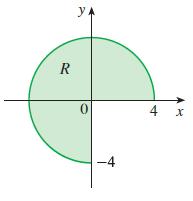
A region R is shown. Decide whether to use polar coordinates or rectangular coordinates and write ∫∫R f(x, y) dA as an iterated integral, where f is an arbitrary continuous function on R. yA R 4 -4
Determine whether the statement is true or false. If it is true, explain why. If it is false, explain why or give an example that disproves the statement. r6 2 L* sin(x – y) dx dy = Lx* sin(x – y) dy dx Jo Jo
Suppose f is a continuous function defined on a rectangle R = [a, b] × [c, d].(a) Write an expression for a double Riemann sum of f. If f(x, y) ≥ 0, what does the sum represent?(b) Write the definition of ∫∫ R f(x, y) dA as a limit.(c) What is the geometric interpretation of ∫∫ R f(x, y)
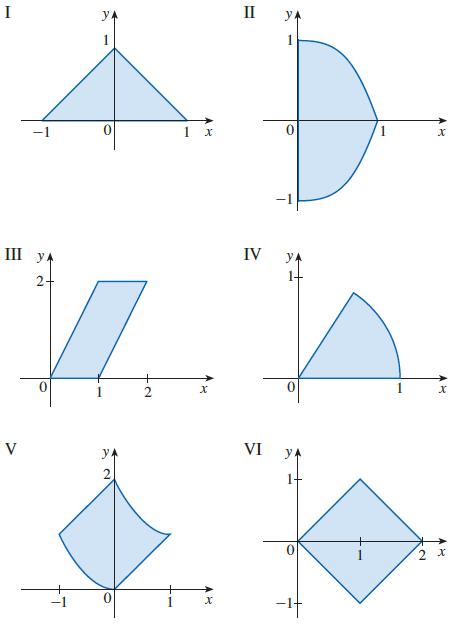
Match the given transformation with the image (labeled I–VI)1 of the set S = {(u, v) |0 ≤ u ≤ 1, 0 ≤ v ≤ 1} under the transformation. Give reasons for your choices.(a) x = u + v, y = u − v(b) x = u − v, y = uv(c) x = u cos v, y = u sin v(d) x = u − v, y = u + v2(e) x = u + v, y =
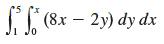
Evaluate the iterated integral. (8x – 2y) dy dx
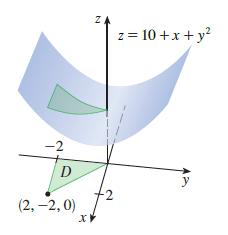
Find the area of the indicated part of the surface (above the region D). z = 10 +x+ y? -2 D y 2 (2, –2, 0)
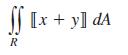
If v xb denotes the greatest integer in x, evaluate the integralwhere R = {(x, y) | 1 ≤ x ≤ 3, 2 ≤ y ≤ 5}. | [x + y] dA
Electric charge is distributed over the rectangle 0 ≤ x ≤ 5, 2 ≤ y ≤ 5 so that the charge density at (x, y) is σ(x, y) = 2x + 4y (measured in coulombs per square meter). Find the total charge on the rectangle.
Plot the point whose spherical coordinates are given. Then find the rectangular coordinates of the point.(a) (2, 3π/4, π/2)(b) (4, −π/3, π/4)
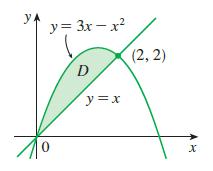
(a) Express the double integral ∫∫D f(x, y) dA as an iterated integral for the given function f and region D.(b) Evaluate the iterated integral.f(x, y) = 2y yA y= 3x - x? (2, 2) D y=x
(a) Show that(b) Show thatUse this equation to evaluate the triple integral correct to two decimal places. SI- 1 dx dy dz = Jo Jo 1- xyz
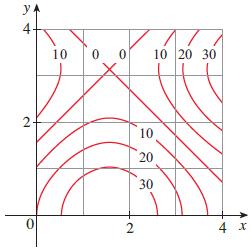
A contour map is shown for a function f on the square R = [0, 4] × [0, 4].(a) Use the Midpoint Rule with m = n = 2 to estimate the value of ∫∫R f(x, y) dA.(b) Estimate the average value of f . y4 4 10 10 20 30 10 20 30 4 x 2. 2.
Find the area of the surface.The part of the paraboloid z = 1 – x2 – y2 that lies above the plane z = –2.
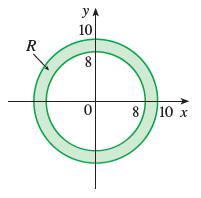
A region R is shown. Decide whether to use polar coordinates or rectangular coordinates and write ∫∫R f(x, y) dA as an iterated integral, where f is an arbitrary continuous function on R. 10 R 8 10 x
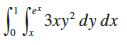
Calculate the iterated integral. 3xy dy dx Jo Jx
Determine whether the statement is true or false. If it is true, explain why. If it is false, explain why or give an example that disproves the statement. (x+Jy) sin(x²y²)dx dy < 9
Evaluate the iterated integral. /2 (2x (x+z cos(x – 2y + z) dy dz dx
Find the area of the surface.The part of the surface 2y + 4z – x2 = 5 that lies above the triangle with vertices (0, 0), (2, 0), and (2, 4).
Find the image of the set S under the given transformation.S is the disk given by u2 + v2 ≤ 1; x = au, y = bv
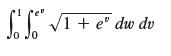
Evaluate the iterated integral. C VI + e" dw dv Jo Jo
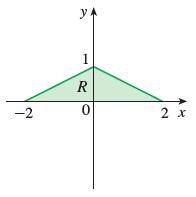
A region R is shown. Decide whether to use polar coordinates or rectangular coordinates and write ∫∫R f(x, y) dA as an iterated integral, where f is an arbitrary continuous function on R. yA 1 -2 2 x
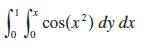
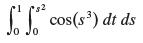
Calculate the iterated integral. C cos(x*) dy dx
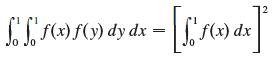
Determine whether the statement is true or false. If it is true, explain why. If it is false, explain why or give an example that disproves the statement.If f is continuous on [0, 1], then 72 L (x) F(9) dy dx - f(x) dx ||
Find the area of the surface.The part of the plane 3x + 2y + z = 6 that lies in the first octant.
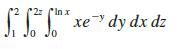
Evaluate the iterated integral. 2: (In x xe dy dx dz
Evaluate the iterated integral. cos(s') dt ds
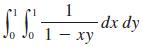
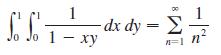
The double integralis an improper integral and could be defined as the limit of double integrals over the rectangle [0, t] × [0, t] as t → 1–. But if we expand the integrand as a geometric series, we can express the integral as the sum of an infinite series. Show that 1 dx dy 1- xy Vo Jo ху
Sketch the region in the plane consisting of points whose polar coordinates satisfy the given conditions.r ≥ 2, 0 ≤ θ ≤ π
Sketch the curve and find the area that it encloses.r = 4 cos θ
Sketch the region in the plane consisting of points whose polar coordinates satisfy the given conditions.3 < r < 5, 2π/3 ≤ θ ≤ 4π/3
Find an equation of the tangent to the curve at the given point by two methods:(a) Without eliminating the parameter(b) By first eliminating the parameter. x= sin t, y = cos?t; G)
Sketch the curve and find the area that it encloses.r = 3 − 2 sin θ
Sketch the region in the plane consisting of points whose polar coordinates satisfy the given conditions.2 ≤ r < 4, 3π/4 ≤ θ ≤ 7π/4
Find an equation of the tangent to the curve at the given point by two methods:(a) Without eliminating the parameter(b) By first eliminating the parameter. х — Vi+ 4, у— 1/(( + 4); (2,4) %3|
Sketch the region in the plane consisting of points whose polar coordinates satisfy the given conditions.r ≥ 0, π ≤ θ ≤ 5π/2
Find an equation of the tangent to the curve at the given point. Then graph the curve and the tangent.x = t2 − t, y = t2 + t + 1; (0, 3)
Find the distance between the points with polar coordinates (4, 4π/3) and (6, 5π/3).
Find a formula for the distance between the points with polar coordinates (r1, θ1) and (r2, θ2).
Identify the curve by finding a Cartesian equation for the curve.r2 = 5
Graph the curve and find the area that it encloses.r = 1 + 5 sin 6θ
Identify the curve by finding a Cartesian equation for the curve.r = 4 sec θ
Identify the curve by finding a Cartesian equation for the curve.r = 5 cos θ
Identify the curve by finding a Cartesian equation for the curve.θ = π/3
Identify the curve by finding a Cartesian equation for the curve.r2cos 2θ = 1
Find a polar equation for the curve represented by the given Cartesian equation.x2 + y2 = 7
Find the area of the region that lies inside the first curve and outside the second curve.r = 4 sin θ, r = 2
Find a polar equation for the curve represented by the given Cartesian equation.y = √3 x
Find a polar equation for the curve represented by the given Cartesian equation.y = −2x2
Find a polar equation for the curve represented by the given Cartesian equation.x2 + y2 = 4y
Find a polar equation for the curve represented by the given Cartesian equation.x2 − y2 = 4
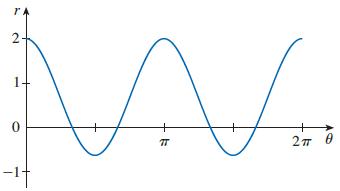
The figure shows a graph of r as a function of θ in Cartesian coordinates. Use it to sketch the corresponding polar curve. 2. 14 -1-
Find the area of the region that lies inside both curves.r = sin 2θ, r = cos 2θ
(a) Find the slope of the tangent to the asteroid x = a cos3θ, y = a sin3θ in terms of θ.(b) At what points is the tangent horizontal or vertical?(c) At what points does the tangent have slope 1 or −1?
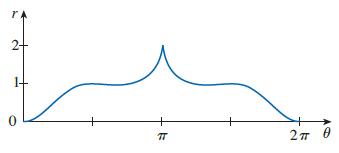
The figure shows a graph of r as a function of θ in Cartesian coordinates. Use it to sketch the corresponding polar curve. 2- IT 27 0
Find the area of the region that lies inside both curves.r2 = 2 sin 2θ, r = 1
Sketch the curve with the given polar equation by first sketching the graph of r as a function of θ in Cartesian coordinates.r = −2 sin θ
Find the area of the region that lies inside both curves.r = a sin θ, r = b cos θ, a > 0, b > 0
Sketch the curve with the given polar equation by first sketching the graph of r as a function of θ in Cartesian coordinates.r = 1 − cos θ
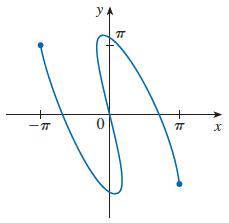
Graph the curve x = y − 2 sin πy.
Find the area inside the larger loop and outside the smaller loop of the limaçonr = 1/2 + cos θ.
Sketch the curve with the given polar equation by first sketching the graph of r as a function of θ in Cartesian coordinates.r = 2(1 + cos θ)
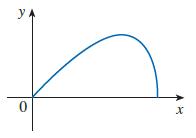
Find the area enclosed by the given parametric curve and the x-axis.x = sin t, y = sin t cos t, 0 ≤ t ≤ π/2
Sketch the curve with the given polar equation by first sketching the graph of r as a function of θ in Cartesian coordinates.r = 1 + 2 cos θ
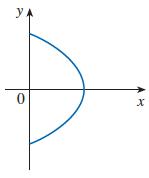
Find the area enclosed by the given parametric curve and the y-axis.x = sin2t, y = cos t yA
Sketch the curve with the given polar equation by first sketching the graph of r as a function of θ in Cartesian coordinates.r = θ, θ ≥ 0
Sketch the curve with the given polar equation by first sketching the graph of r as a function of θ in Cartesian coordinates.r = θ2, −2π ≤ θ ≤ 2π
Sketch the curve with the given polar equation by first sketching the graph of r as a function of θ in Cartesian coordinates.r = 3 cos 3θ
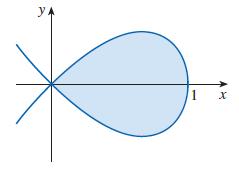
Find the area of the region enclosed by the loop of the curvex = 1 − t2, y = t − t3 yA 1
Find all points of intersection of the given curves.r = cos θ, r = sin 2θ
Sketch the curve with the given polar equation by first sketching the graph of r as a function of θ in Cartesian coordinates.r = −sin 5θ
Find all points of intersection of the given curves.r2 = 2 cos 2θ, r = 1
Sketch the curve with the given polar equation by first sketching the graph of r as a function of θ in Cartesian coordinates.r = 2 cos 4θ
Find all points of intersection of the given curves.r2 = sin 2θ, r2 = cos 2θ
Sketch the curve with the given polar equation by first sketching the graph of r as a function of θ in Cartesian coordinates.r = 2 sin 6θ
Sketch the curve with the given polar equation by first sketching the graph of r as a function of θ in Cartesian coordinates.r = 1 + 3 cosθ
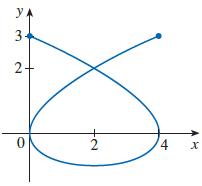
Set up an integral that represents the length of the part of the parametric curve shown in the graph. Then use a calculator (or computer) to find the length correct to four decimal places.x = 3t2 − t3, y = t2 − 2t yA 4 3. 2.
Sketch the curve with the given polar equation by first sketching the graph of r as a function of θ in Cartesian coordinates.r = 1 + 5 sinθ
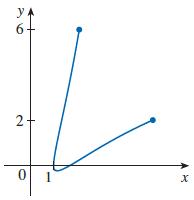
Set up an integral that represents the length of the part of the parametric curve shown in the graph. Then use a calculator (or computer) to find the length correct to four decimal places.x = t + e−t, y = t2 + t 0 1 2.
Sketch the curve with the given polar equation by first sketching the graph of r as a function of θ in Cartesian coordinates.r2 = 9 sin 2θ
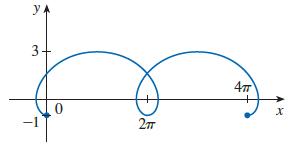
Set up an integral that represents the length of the part of the parametric curve shown in the graph. Then use a calculator (or computer) to find the length correct to four decimal places.x = t − 2 sin t, y = 1 − 2 cos t, 0 ≤ t ≤ 4π y 3+ 47 -1 27
Sketch the curve with the given polar equation by first sketching the graph of r as a function of θ in Cartesian coordinates.r2 = cos 4θ
Set up an integral that represents the length of the part of the parametric curve shown in the graph. Then use a calculator (or computer) to find the length correct to four decimal places.x = t cos t, y = t − 5 sin t yA
Sketch the curve with the given polar equation by first sketching the graph of r as a function of θ in Cartesian coordinates.r = 2 + sin 3θ
Sketch the curve with the given polar equation by first sketching the graph of r as a function of θ in Cartesian coordinates.r2θ = 1
Find the exact length of the curve.x = et − t, y = 4et/2, 0 ≤ t ≤ 2
Find the exact length of the curve.x = t sin t, y = t cos t, 0 ≤ t ≤ 1
Find the exact length of the polar curve.r = 2 cos θ, 0 ≤ θ ≤ π
Find the exact length of the curve.x = 3 cos t − cos 3t, y = 3 sin t − sin 3t, 0 ≤ t ≤ π
Find the exact length of the polar curve.r = eθ/2, 0 ≤ θ ≤ π/2
Find the exact length of the polar curve.r = θ2, 0 ≤ θ ≤ 2π
Showing 2400 - 2500
of 4932
First
18
19
20
21
22
23
24
25
26
27
28
29
30
31
32
Last
Step by Step Answers

 Get 50% OFF
Claim Now
Get 50% OFF
Claim Now