New Semester
Started
Get
50% OFF
Study Help!
--h --m --s
Claim Now
Question Answers
Textbooks
Find textbooks, questions and answers
Oops, something went wrong!
Change your search query and then try again
S
Books
FREE
Study Help
Expert Questions
Accounting
General Management
Mathematics
Finance
Organizational Behaviour
Law
Physics
Operating System
Management Leadership
Sociology
Programming
Marketing
Database
Computer Network
Economics
Textbooks Solutions
Accounting
Managerial Accounting
Management Leadership
Cost Accounting
Statistics
Business Law
Corporate Finance
Finance
Economics
Auditing
Tutors
Online Tutors
Find a Tutor
Hire a Tutor
Become a Tutor
AI Tutor
AI Study Planner
NEW
Sell Books
Search
Search
Sign In
Register
study help
mathematics
calculus early transcendentals 9th
Calculus Early Transcendentals 9th Edition James Stewart, Daniel K. Clegg, Saleem Watson, Lothar Redlin - Solutions
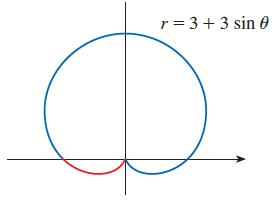
Find the exact length of the portion of the curve shown in blue. r= 3+ 3 sin 0
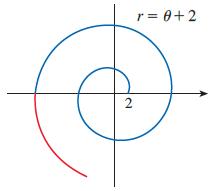
Find the exact length of the portion of the curve shown in blue. r = 0+2 2
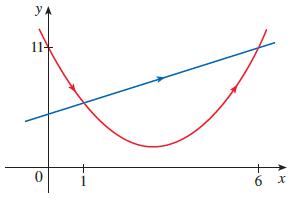
Suppose that the position of each of two particles is given by parametric equations. A collision point is a point where the particles are at the same place at the same time. If the particles pass through the same point but at different times, then the paths intersect but the particles don’t
Find the exact length of the curve. Use a graph to determine the parameter interval.r = cos4(θ/4)
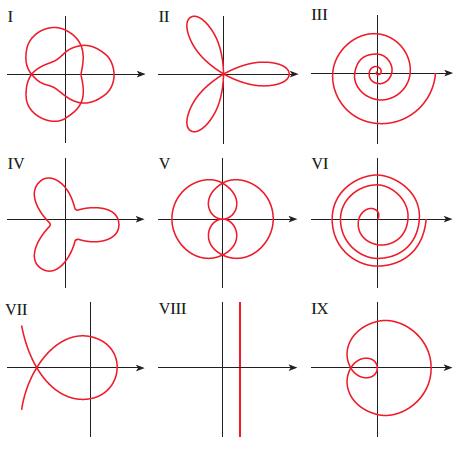
Match the polar equations with the graphs labeled I–IX. Give reasons for your choices.(a) r = cos 3θ(b) r = ln θ, 1 ≤ θ ≤ 6π(c) r = cos(θ/2)(d) r = cos(θ/3)(e) r = sec(θ/3)(f) r = secθ(g) r = θ2, 0 ≤ θ ≤ 8π(h) r = 2 + cos 3θ(i) r = 2 + cos(3θ/2) II III IV VI VII VIII IX
Find the exact length of the curve. Use a graph to determine the parameter interval.r = cos2(θ/2)
The parametric equations give the position (in meters) of a moving particle at time t (in seconds). Find the speed of the particle at the indicated time or point.x = 2t − 3, y = 2t2 − 3t + 6; t = 5
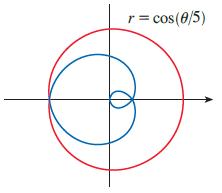
Set up, but do not evaluate, an integral to find the length of the portion of the curve shown in blue. r = cos(0/5)
If a projectile is fired from the origin with an initial velocity of ν0 meters per second at an angle α above the horizontal and air resistance is assumed to be negligible, then its position after t seconds is given by the parametric equationswhere t is the acceleration due to gravity (9.8
The parametric equations give the position (in meters) of a moving particle at time t (in seconds). Find the speed of the particle at the indicated time or point. - 2+ Sco). y--2+7 in() TT TT y = -2 + 7 sin -t); t=3 3
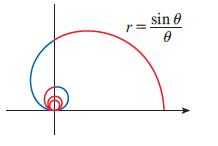
Set up, but do not evaluate, an integral to find the length of the portion of the curve shown in blue. sin 0 r =
The parametric equations give the position (in meters) of a moving particle at time t (in seconds). Find the speed of the particle at the indicated time or point.x = et, y = tet; (e, e)
Use a calculator or computer to find the length of the curve correct to four decimal places. If necessary, graph the curve to determine the parameter interval.One loop of the curve r = cos 2θ
Graph the polar curve. Choose a parameter interval that produces the entire curve. r= 1- 0.8 sin²0 (hippopede)
Graph the polar curve. Choose a parameter interval that produces the entire curve.r = esinθ − 2 cos(4θ) (butterfly curve)
A projectile is fired from the point (0, 0) with an initial velocity of ν0 m/s at an angle α above the horizontal. If we assume that air resistance is negligible, then the position (in meters) of the projectile after t seconds is given by the parametric equationswhere g = 9.8 m/s2 is the
Use a calculator or computer to find the length of the curve correct to four decimal places. If necessary, graph the curve to determine the parameter interval.r = sin(6 sin θ)
Graph the polar curve. Choose a parameter interval that produces the entire curve.r = |tanθ|| cotθ | (valentine curve)
Use a calculator or computer to find the length of the curve correct to four decimal places. If necessary, graph the curve to determine the parameter interval.r = sin(θ/4)
Graph the polar curve. Choose a parameter interval that produces the entire curve.r = 1 + cos999θ (Pac-Man curve)
Find the slope of the tangent line to the given polar curve at the point specified by the value of θ.r = 2 cos θ, θ = π/3
Graph the polar curve. Choose a parameter interval that produces the entire curve.r = 2 + cos(9θ/4)
Find the slope of the tangent line to the given polar curve at the point specified by the value of θ.r = 2 + sin 3θ, θ = π/4
Find the slope of the tangent line to the given polar curve at the point specified by the value of θ.r = sin θ + 2 cos θ, θ = π/2
Find the slope of the tangent line to the given polar curve at the point specified by the value of θ.r = cos 2θ, θ = π/4
Find the slope of the tangent line to the given polar curve at the point specified by the value of θ.r = 1 + 2 cos θ, θ = π/3
Find the points on the given curve where the tangent line is horizontal or vertical.r = sin θ
Find the exact area of the surface obtained by rotating the given curve about the x-axis.x = 2t2 + 1/t, y = 8√t, 1 ≤ t ≤ 3
Find the exact area of the surface obtained by rotating the given curve about the x-axis.x = a cos3θ, y = a sin3θ, 0 ≤ θ ≤ π/2
(a) Find a formula for the area of the surface generated by rotating the polar curve r = f(θ), a ≤ θ ≤ b (where f' is continuous and 0 ≤ a < b ≤ π), about the line θ = π/2.(b) Find the surface area generated by rotating the lemniscate r2 = cos 2θ about the line θ = π/2.
(a) Show that the points on all four of the given parametric curves satisfy the same Cartesian equation.(i) x = t2, y = t(ii) x = t, y = √t(iii) x = cos2t, y = cos t(iv) x = 32t, y = 3t(b) Sketch the graph of each curve in part (a) and explain how the curves differ from one another.
The parametric equations give the position (in meters) of a moving particle at time t (in seconds). Find the speed of the particle at the indicated time or point.x = t2 + 1, y = t4 + 2t2 + 1; (2, 4)
Use a calculator or computer to find the length of the curve correct to four decimal places. If necessary, graph the curve to determine the parameter interval.r = tan θ, π/6 ≤ θ ≤ π/3
Find the average value of the function on the given interval.h(x) = cos4x sin x, [0, π]
A solid is generated by rotating about the x-axis the region under the curve y = f(x), where f is a positive function and x ≥ 0. The volume generated by the part of the curve from x = 0 to x = b is b2 for all b > 0. Find the function f.
How much work is done when a weight lifter lifts 200 kg from 1.5 m to 2.0 m above the ground?
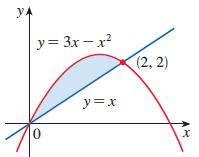
(a) Set up an integral for the area of the shaded region.(b) Evaluate the integral to find the area. yA y= 3x – x? (2, 2) y=x
Find the average value of the function on the given interval.f(x) = 3x2 + 8x, [–1, 2]
Determine whether the statement is true or false. If it is true, explain why. If it is false, explain why or give an example that disproves the statement.The area between the curves y = f(x) and y = g(x) for a ≤ x ≤ b is A = ∫ba [f (x) – g(x)] dx.
Find the area of the region bounded by the given curves.y = x2, y = 8x – x2
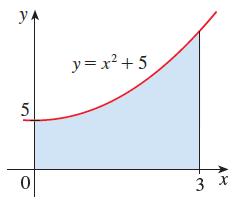
A solid is obtained by revolving the shaded region about the specified line.(a) Sketch the solid and a typical disk or washer.(b) Set up an integral for the volume of the solid.(c) Evaluate the integral to find the volume of the solid.About the x-axis yA y= x² + 5 3 x
Compute the work done in hoisting an 1100-lb grand piano from the ground up to the third floor, 35 feet above the ground.
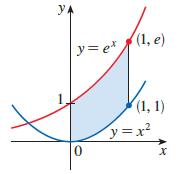
(a) Set up an integral for the area of the shaded region.(b) Evaluate the integral to find the area. yA (1, e) y= e, (1, 1) y =x?
Find the average value of the function on the given interval.f(x) = √x, (0, 4)
Determine whether the statement is true or false. If it is true, explain why. If it is false, explain why or give an example that disproves the statement.A cube is a solid of revolution.
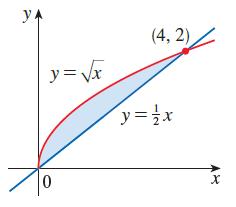
A solid is obtained by revolving the shaded region about the specified line.(a) Sketch the solid and a typical disk or washer.(b) Set up an integral for the volume of the solid.(c) Evaluate the integral to find the volume of the solid.About the x-axis y (4, 2) y: y=¿x
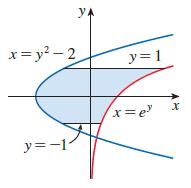
(a) Set up an integral for the area of the shaded region.(b) Evaluate the integral to find the area. yA x= y? - 2 y=1 x=e y= ー1
Find the average value of the function on the given interval.g(x) = 3 cos x, [–π/2, π/2]
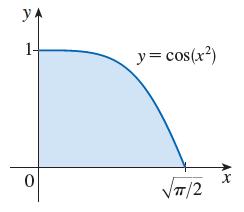
A solid is obtained by rotating the shaded region about the specified line.(a) Set up an integral using the method of cylindrical shells for the volume of the solid.(b) Evaluate the integral to find the volume of the solid.About the y-axis y 1- y= cos(x?) 7/2
Determine whether the statement is true or false. If it is true, explain why. If it is false, explain why or give an example that disproves the statement.If the region bounded by the curves y = √x and y = x is revolved about the x-axis, then the volume of the resulting solid is V = ∫10 π(√x
Find the area of the region bounded by the given curves.y = 1 – 2x2, y = |x|
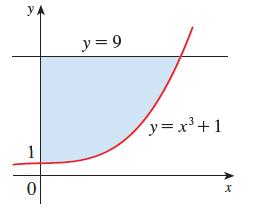
A solid is obtained by revolving the shaded region about the specified line.(a) Sketch the solid and a typical disk or washer.(b) Set up an integral for the volume of the solid.(c) Evaluate the integral to find the volume of the solid.About the y-axis yA y = 9 y=x³+1 1
A variable force of 4√x newtons moves a particle along a straight path when it is x meters from the origin. Calculate the work done in moving the particle from x = 4 to x = 16.
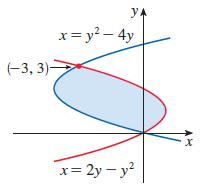
(a) Set up an integral for the area of the shaded region.(b) Evaluate the integral to find the area. yA x= y? – 4y (-3, 3)- x= 2y – y?
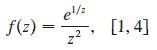
Find the average value of the function on the given interval. f(z) = [1,4]
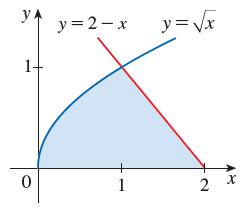
A solid is obtained by rotating the shaded region about the specified line.(a) Set up an integral using the method of cylindrical shells for the volume of the solid.(b) Evaluate the integral to find the volume of the solid.About the x-axis y. y = 2- x y= Vx 1+ 1 2
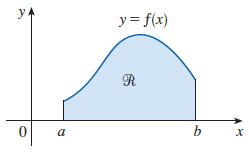
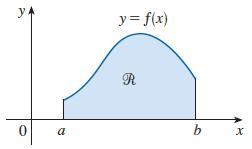
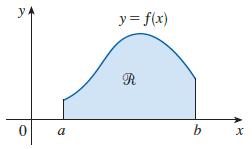
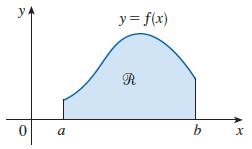
Determine whether the statement is true or false. If it is true, explain why. If it is false, explain why or give an example that disproves the statement.Let R be the region shown.If R is revolved about the y-axis, then the volume of the resulting solid is V = ∫ba 2πx f(x) dx. y. y = f(x) R a b
Find the area of the region bounded by the given curves.x + y = 0, x = y2 + 3y
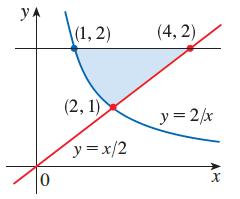
A solid is obtained by revolving the shaded region about the specified line.(a) Sketch the solid and a typical disk or washer.(b) Set up an integral for the volume of the solid.(c) Evaluate the integral to find the volume of the solid.About the y-axis yA (1, 2) (4, 2) (2, 1) y= 2/x y=x/2
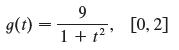
Find the average value of the function on the given interval. 9. 9(t)- 1+ 12' [0, 2]
Set up, but do not evaluate, an integral for the volume of the solid obtained by rotating the region bounded by the given curves about the specified line.y = ln x, y = 0, x = 2; about the y-axis
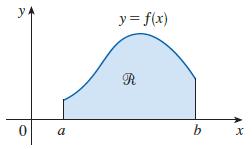
Determine whether the statement is true or false. If it is true, explain why. If it is false, explain why or give an example that disproves the statement.Let R be the region shown.If R is revolved about the x-axis, then the volume of the resulting solid is V = ∫ba π[f (x)]2 dx. y y= f(x) a b
Set up, but do not evaluate, an integral for the volume of the solid obtained by rotating the region bounded by the given curves about the specified line.y = ln x, y = 0, x = 3; about the x-axis
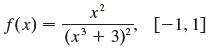
Find the average value of the function on the given interval. x? f(x) = [-1, 1] (x³ + 3)
Set up, but do not evaluate, an integral for the volume of the solid obtained by rotating the region bounded by the given curves about the specified line.y = x3, y = 8, x = 0; about the x-axis
Determine whether the statement is true or false. If it is true, explain why. If it is false, explain why or give an example that disproves the statement.Let R be the region shown.If R is revolved about the x-axis, then vertical cross-sections perpendicular to the x-axis of the resulting solid are
Set up, but do not evaluate, an integral for the volume of the solid obtained by rotating the region bounded by the given curves about the specified line.x = √5 – y, y = 0, x = 0; about the y-axis
Set up, but do not evaluate, an integral representing the area of the region enclosed by the given curves.y = 2x, y = 3x, x = 1
Set up, but do not evaluate, an integral for the volume of the solid obtained by rotating the region bounded by the given curves about the specified line.y = sin–1x, y = π/2, x = 0; about y = 3
Determine whether the statement is true or false. If it is true, explain why. If it is false, explain why or give an example that disproves the statement.Let R be the region shown.If R is revolved about the y-axis, then horizontal cross sections of the resulting solid are cylindrical shells. y y=
Set up, but do not evaluate, an integral for the volume of the solid obtained by rotating the region bounded by the given curves about the specified line.8y = x2, y = √x ; about the y-axis
Set up, but do not evaluate, an integral representing the area of the region enclosed by the given curves.y = ln x, y = ln(x2), x = 2
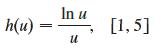
Find the average value of the function on the given interval. h(u) = In n u [1,5]
Set up, but do not evaluate, an integral for the volume of the solid obtained by rotating the region bounded by the given curves about the specified line.y = 4x – x2, y = x; about x = 7
Determine whether the statement is true or false. If it is true, explain why. If it is false, explain why or give an example that disproves the statement.Let R be the region shown.The volume of the solid obtained by revolving R about the line x = –2 is the same as the volume of the solid obtained
Set up, but do not evaluate, an integral for the volume of the solid obtained by rotating the region bounded by the given curves about the specified line.y = (x – 2)2, y = x + 10; about the x-axis
Set up, but do not evaluate, an integral representing the area of the region enclosed by the given curves.y = 2 – x, y = 2x – x2
(a) Find the average value of f on the given interval.(b) Find c in the given interval such that favg = f(c).(c) Sketch the graph of f and a rectangle whose base is the given interval and whose area is the same as the area under the graph of f.f(t) = 1/t2, [1, 3]
Determine whether the statement is true or false. If it is true, explain why. If it is false, explain why or give an example that disproves the statement.Let R be the region shown.If R is the base of a solid S and cross-sections of S perpendicular to the x-axis are squares, then the volume of S is
Set up, but do not evaluate, an integral for the volume of the solid obtained by rotating the region bounded by the given curves about the specified line.y = sin x, y = 0, 0 ≤ x ≤ π; about y = –2
Set up, but do not evaluate, an integral representing the area of the region enclosed by the given curves.x = y4, x = 2 – y2
(a) Find the average value of f on the given interval.(b) Find c in the given interval such that favg = f(c).(c) Sketch the graph of f and a rectangle whose base is the given interval and whose area is the same as the area under the graph of f.g(x) = (x + 1)3, [0, 2]
Use the method of cylindrical shells to find the volume generated by rotating the region bounded by the given curves about the y-axis.y = x3, y = 0, x = 1, x = 2
Determine whether the statement is true or false. If it is true, explain why. If it is false, explain why or give an example that disproves the statement.A cable hangs vertically from a winch located at the top of a tall building. The work required for the winch to pull up the top half of the cable
Set up, but do not evaluate, an integral for the volume of the solid obtained by rotating the region bounded by the given curves about the specified line.y = √x, y = 0, x = 4; about x = 6
Use the method of cylindrical shells to find the volume generated by rotating the region bounded by the given curves about the y-axis.y = 1/x, y = 0, x = 1, x = 4
Determine whether the statement is true or false. If it is true, explain why. If it is false, explain why or give an example that disproves the statement.If ∫52 f(x) dx = 12, then the average value of f on [2, 5] is 4.
Find the volume of the solid obtained by rotating the region bounded by the given curves about the specified line. Sketch the region, the solid, and a typical disk or washer.y = x + 1, y = 0, x = 0, x = 2; about the x-axis
Use the method of cylindrical shells to find the volume generated by rotating the region bounded by the given curves about the y-axis.y = e–x2, y = 0, x = 0, x = 1
Find the volume of the solid obtained by rotating the region bounded by the given curves about the specified line. Sketch the region, the solid, and a typical disk or washer.y = 1/x, y = 0, x = 1, x = 4; about the x-axis
Find the volume of the solid obtained by rotating the region bounded by the given curves about the specified line. Sketch the region, the solid, and a typical disk or washer.y = √x – 1, y = 0, x = 5; about the x-axis
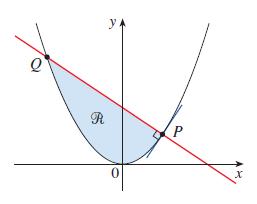
Let P(a, a2), a > 0, be any point on the part of the parabola y = x2 in the first quadrant, and let R be the region bounded by the parabola and the normal line through P. (See the figure.) Show that the area of R is smallest when a = 1/2 . y A (P
Sketch the region enclosed by the given curves. Decide whether to integrate with respect to x or y. Draw a typical approximating rectangle and label its height and width. Then find the area of the region.y = cos x, y = ex, x = π/2
Use the method of cylindrical shells to find the volume generated by rotating the region bounded by the given curves about the y-axis.y = 4x – x2, y = x
Find the volume of the solid obtained by rotating the region bounded by the given curves about the specified line. Sketch the region, the solid, and a typical disk or washer.y = ex, y = 0, x = –1, x = 1; about the x-axis
Show how to approximate the required work by a Riemann sum. Then express the work as an integral and evaluate it. A cable that weighs 2 lb/ft is used to lift 800 lb of coal up a mine shaft 500 ft deep. Find the work done.
Sketch the region enclosed by the given curves. Decide whether to integrate with respect to x or y. Draw a typical approximating rectangle and label its height and width. Then find the area of the region.y = (x – 2)2, y = x
Use the method of cylindrical shells to find the volume of the solid obtained by rotating the region bounded by the given curves about the x axis.xy = 1, x = 0, y = 1, y = 3
The region bounded by the given curves is rotated about the specified axis. Find the volume of the solid using(a) x as the variable of integration(b) y as the variable of integration.y = x3, y = 3x2; about x = –1
Show how to approximate the required work by a Riemann sum. Then express the work as an integral and evaluate it. A chain lying on the ground is 10 m long and its mass is 80 kg. How much work is required to raise one end of the chain to a height of 6 m?
Showing 2500 - 2600
of 4932
First
19
20
21
22
23
24
25
26
27
28
29
30
31
32
33
Last
Step by Step Answers

 Get 50% OFF
Claim Now
Get 50% OFF
Claim Now