New Semester
Started
Get
50% OFF
Study Help!
--h --m --s
Claim Now
Question Answers
Textbooks
Find textbooks, questions and answers
Oops, something went wrong!
Change your search query and then try again
S
Books
FREE
Study Help
Expert Questions
Accounting
General Management
Mathematics
Finance
Organizational Behaviour
Law
Physics
Operating System
Management Leadership
Sociology
Programming
Marketing
Database
Computer Network
Economics
Textbooks Solutions
Accounting
Managerial Accounting
Management Leadership
Cost Accounting
Statistics
Business Law
Corporate Finance
Finance
Economics
Auditing
Tutors
Online Tutors
Find a Tutor
Hire a Tutor
Become a Tutor
AI Tutor
AI Study Planner
NEW
Sell Books
Search
Search
Sign In
Register
study help
mathematics
calculus early transcendentals 9th
Calculus Early Transcendentals 9th Edition James Stewart, Daniel K. Clegg, Saleem Watson, Lothar Redlin - Solutions
The given curve is rotated about the y-axis. Set up, but do not evaluate, an integral for the area of the resulting surface by integrating(a) With respect to x(b) With respect to y.x = e2y, 0 ≤ y ≤ 2
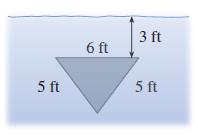
A vertical plate is submerged (or partially submerged) in water and has the indicated shape. Explain how to approximate the hydrostatic force against one side of the plate by a Riemann sum. Then express the force as an integral and evaluate it. 3 ft 6 ft 5 ft 5 ft
Set up, but do not evaluate, an integral for the length of the curve.y2 = ln x, –1 ≤ y ≤ 1
Find the length of the curve yーF-Ia 1
Find the exact area of the surface obtained by rotating the curve about the x-axis.y = x3, 0 ≤ x ≤ 2
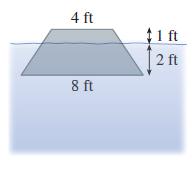
A vertical plate is submerged (or partially submerged) in water and has the indicated shape. Explain how to approximate the hydrostatic force against one side of the plate by a Riemann sum. Then express the force as an integral and evaluate it. 4 ft 1 ft 2 ft 8 ft
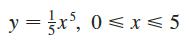
Find the exact length of the curve. y =r2, 0
Find the exact length of the curve.y = (x + 4)3/2, 0 ≤ x ≤ 4
Find the exact area of the surface obtained by rotating the curve about the x-axis.y2 = x + 1, 0 ≤ x ≤ 3
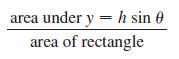
In a famous 18th-century problem, known as Buffon’s needle problem, a needle of length h is dropped onto a flat surface (for example, a table) on which parallel lines L units apart, L ≥ h, have been drawn. The problem is to determine the probability that the needle will come to rest
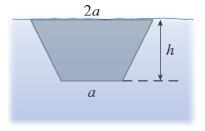
A vertical plate is submerged (or partially submerged) in water and has the indicated shape. Explain how to approximate the hydrostatic force against one side of the plate by a Riemann sum. Then express the force as an integral and evaluate it. 2а a
Find the exact length of the curve. y = }(1 + x*)/2, 0
In a purely competitive market, the price of a good is naturally driven to the value where the quantity demanded by consumers matches the quantity made by producers, and the market is said to be in equilibrium. These values are the coordinates of the point of intersection of the supply and demand
Find the exact length of the curve.36y2 = (x2 – 4)3, 2 ≤ x ≤ 3, y ≥ 0
The time between infection and the display of symptoms for streptococcal sore throat is a random variable whose probability density function can be approximated by f(t) = 1/15,676 t2e–0.05t if 0 ≤ t ≤ 150 and f(t) = 0 otherwise (t measured in hours).(a) What is the probability that an
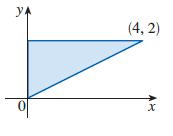
Find the centroid of the region shown. yA (4, 2)
The sum of consumer surplus and producer surplus is called the total surplus; it is one measure economists use as an indicator of the economic health of a society. Total surplus is maximized when the market for a good is in equilibrium.(a) The demand function for an electronics company’s car
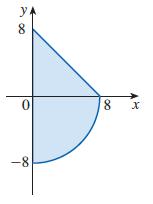
Find the centroid of the region shown. yA 8 8 -8
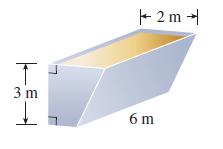
A trough with a trapezoidal cross-section, as shown in the figure, contains vegetable oil with density 925 kg/m3.(a) Find the hydrostatic force on one end of the trough if it is completely full of oil.(b) Compute the force on one end if the trough is filled to a depth of 1.2 m. - 2 m - 6 m
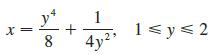
Find the exact length of the curve. y* 1 1< y< 2 4y2" 8 +
Find the exact length of the curve.y = 1/2 ln(sin 2x), π/8 ≤ x ≤ π/6
Find the exact area of the surface obtained by rotating the curve about the x-axis.x = 1 + 2y2, 1 ≤ y ≤ 2
Find the exact length of the curve.y = ln(cos xd, 0 ≤ x ≤ π/3
If income is continuously collected at a rate of f(t) dollars per year and will be invested at a constant interest rate r (compounded continuously) for a period of T years, then the future value of the income is given by ∫T0 f(t) er(T – t) dt. Compute the future value after 6 years for income
Find the exact length of the curve.y = ln(sec x), 0 ≤ x ≤ π/4
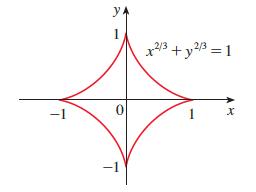
The given curve is rotated about the y-axis. Find the area of the resulting surface.x2/3 + y2/3 = 1, 0 ≤ y ≤ 1
Set up an integral for the area of the surface obtained by rotating the given curve about the specified axis. Then evaluate your integral numerically, correct to four decimal places.y = e–x2, –1 ≤ x ≤ 1; x-axis
Set up an integral for the area of the surface obtained by rotating the given curve about the specified axis. Then evaluate your integral numerically, correct to four decimal places.xy = y2 – 1, 1 ≤ y ≤ 3; x-axis
Set up an integral for the area of the surface obtained by rotating the given curve about the specified axis. Then evaluate your integral numerically, correct to four decimal places.x = y + y3, 0 ≤ y ≤ 1; y-axis
Find the exact length of the curve.y = ln(1 – x2), 0 ≤ x ≤ 1/2
Set up an integral for the area of the surface obtained by rotating the given curve about the specified axis. Then evaluate your integral numerically, correct to four decimal places.y = x + sin x, 0 ≤ x ≤ 2π/3; y-axis
The masses mi are located at the points Pi. Find the moments Mx and My and the center of mass of the system.m1 = 4, m2 = 3, m3 = 6, m4 = 3;P1(6, 1), P2(3, –1), P3(–2, 2), P4(–2, –5)
Find the exact length of the curve.y = 1 – e–x, 0 ≤ x ≤ 2
Set up an integral for the area of the surface obtained by rotating the given curve about the specified axis. Then evaluate your integral numerically, correct to four decimal places.ln y = x – y2, 1 ≤ y ≤ 4; x-axis
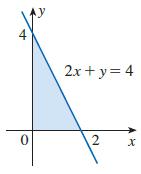
Visually estimate the location of the centroid of the region shown. Then find the exact coordinates of the centroid. 4 2x + y= 4 2.
Set up an integral for the area of the surface obtained by rotating the given curve about the specified axis. Then evaluate your integral numerically, correct to four decimal places.x = cos2y, 0 ≤ y ≤ π/2; y-axis
Find the length of the arc of the curve from point P to point Q.x2 = (y – 4)3, P(1, 5), Q(8, 8)
Find the exact area of the surface obtained by rotating the given curve about the x-axis.y = 1/x, 1 ≤ x ≤ 2
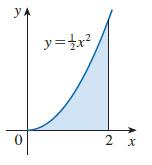
Visually estimate the location of the centroid of the region shown. Then find the exact coordinates of the centroid. yA 2 х
Graph the curve and visually estimate its length. Then compute the length, correct to four decimal places.y = x2 + x3, 1 ≤ x ≤ 2
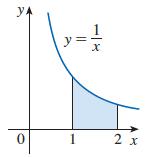
Visually estimate the location of the centroid of the region shown. Then find the exact coordinates of the centroid. yA y 1 2 х
Graph the curve and visually estimate its length. Then compute the length, correct to four decimal places.y = x + cos x, 0 ≤ x ≤ π/2
Use a computer to find the exact area of the surface obtained by rotating the given curve about the y-axis. If your software has trouble evaluating the integral, express the surface area as an integral in the other variable.y = x3, 0 ≤ y ≤ 1
Use a computer to find the exact area of the surface obtained by rotating the given curve about the y-axis. If your software has trouble evaluating the integral, express the surface area as an integral in the other variable.y = ln(x + 1), 0 ≤ x ≤ 1
Find the centroid of the region bounded by the given curves.y = 2 – x2, y = x
Graph the curve and visually estimate its length. Then compute the length, correct to four decimal places.y = x tan x, 0 ≤ x ≤ 1
Use Simpson’s Rule with n = 10 to approximate the area of the surface obtained by rotating the given curve about the x-axis. Compare your answer with the value of the integral produced by a calculator or computer. y = 3x', 0
Find the arc length function for the curvewith starting point (0, 1). y = sin-x + V1 – x2 x²
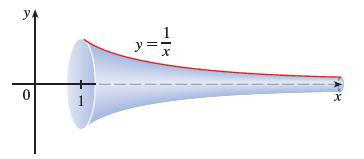
The surface formed by rotating the curve y = 1/x, x ≥ 1 , about the x-axis is known as Gabriel’s horn. Show that the surface area is infinite 1
Find the centroid of the region bounded by the given curves.x + y = 2, x = y2
Use Simpson’s Rule with n = 10 to estimate the arc length of the curve. Compare your answer with the value of the integral produced by a calculator or computer.y = x sin x, 0 ≤ x ≤ 2π
Use Simpson’s Rule with n = 10 to estimate the arc length of the curve. Compare your answer with the value of the integral produced by a calculator or computer.y = e–x2, 0 ≤ x ≤ 2
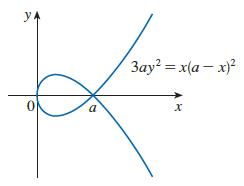
(a) If a > 0, find the area of the surface generated by rotating the loop of the curve 3ay2 = x(a – x)2 about the x-axis.(b) Find the surface area if the loop is rotated about the y-axis. y A 3ay = x(a – x)? a
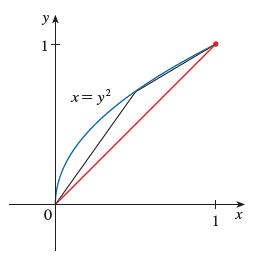
(a) Graph the curve(b) Compute the lengths of approximating polygonal paths with n = 1, 2, and 4 segments. (Divide the interval into equal subintervals.) Illustrate by sketching the curve and these paths (as in Figure 6).(c) Set up an integral for the length of the curve.(d) Compute the length of
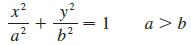
(a) The ellipseis rotated about the x-axis to form a surface called an ellipsoid, or prolate spheroid. Find the surface area of this ellipsoid.(b) If the ellipse in part (a) is rotated about its minor axis (the y-axis), the resulting ellipsoid is called an oblate spheroid. Find the surface area of
Repeat Exercise 35 for the curvey = x + sin x 0 ≤ x ≤ 2πData From Exercise 35:(a) Graph the curve(b) Compute the lengths of approximating polygonal paths with n = 1, 2, and 4 segments. (Divide the interval into equal subintervals.) Illustrate by sketching the curve and these paths
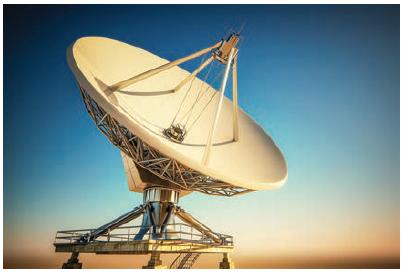
A group of engineers are building a parabolic satellite dish whose shape will be formed by rotating the curve y = ax2 about the y-axis. If the dish is to have a 10-ft diameter and a maximum depth of 2 ft, find the value of u and the surface area of the dish.
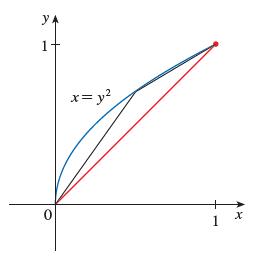
Use either a computer or a table of integrals to find the exact length of the arc of the curve y = ex that lies between the points (0, 1) and (2, e2).
Find the length of the astroid x2/3 + y2/3 = 1. y 1 x3 + y = 1 2/3 -1
(a) If the curve y = f(x), a ≤ x ≤ b, is rotated about the horizontal line y = c, where f(x) ≤ c, find a formula for the area of the resulting surface.(b) Set up an integral to find the area of the surface generated by rotating the curve y = √x, 0 ≤ x ≤ 4, about the line y = 4. Then
Set up an integral for the area of the surface obtained by rotating the curve y = x3, 1 ≤ x ≤ 2, about the given line. Then evaluate the integral numerically, correct to two decimal places.(a) x = –1(b) x = 4(c) y = 1/2(d) y = 10
(a) Find the arc length function for the curve y = ln(sin x), 0 < x < π, with starting point (π/2, 0).(b) Graph both the curve and its arc length function on the same screen. Why is the arc length function negative when x is less than π/2?
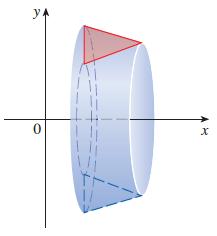
A zone of a sphere is the portion of the sphere that lies between two parallel planes.Show that the surface area of a zone of a sphere is S = 2πRh, where R is the radius of the sphere and h is the distance between the planes.
A zone of a sphere is the portion of the sphere that lies between two parallel planes.Show that the surface area of a zone of a cylinder with radius R and height h is the same as the surface area of the zone of a sphere in Exercise 42.Data From Exercise 42:Show that the surface area of a zone of a
If x is the x-coordinate of the centroid of the region that lies under the graph of a continuous function f, where a ≤ x ≤ b, show that L(cr + d)f(x) dx = (cã + d) [" f(x) dx
The arc length function for a curve y = f(x), where f is an increasing function, is(a) If f has y-intercept 2, find an equation for f.(b) What point on the graph of f is 3 units along the curve from the y intercept? State your answer rounded to 3 decimal places. s(x) = 5 /3t + 5 dt.
Use the Theorem of Pappus to find the volume of the given solid.The solid obtained by rotating the triangle with vertices (2, 3), (2, 5), and (5, 4) about the x-axis yA
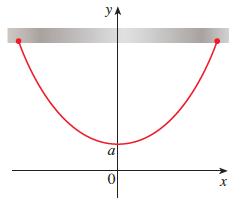
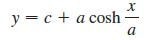
Catenary Curves A chain (or cable) of uniform density that is suspended between two points, as shown in the figure, hangs in the shape of a curve called a catenary with equation y = a cosh(x/a).(a) Find the arc length of the catenary y = a cosh(x/a) on the interval [c, d].(b) Show that on any
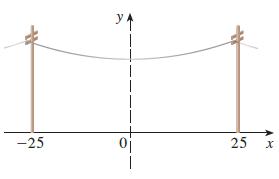
Catenary Curves A chain (or cable) of uniform density that is suspended between two points, as shown in the figure, hangs in the shape of a curve called a catenary with equation y = a cosh(x/a).The figure shows a telephone wire hanging between two poles at x = –25 and x = 25. The wire hangs in
Catenary Curves A chain (or cable) of uniform density that is suspended between two points, as shown in the figure, hangs in the shape of a curve called a catenary with equation y = a cosh(x/a).The British physicist and architect Robert Hooke (1635–1703) was the first to observe that the ideal
For the function f(x) = 1/4 ex + e–x, prove that the arc length on any interval has the same value as the area under the curve.
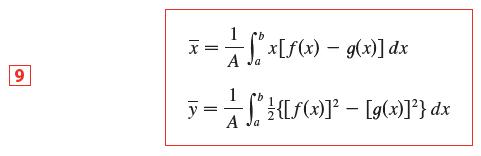
Prove Formulas 9. 1 x = A *[sx) – g(x)] dx Ja 9. 1 y | A Ja
Find the length of the curve y - f VP – I dt 1
Determine whether the differential equation is linear. If it is linear, then write it in the form of Equation 1.12y' + x√y = x2
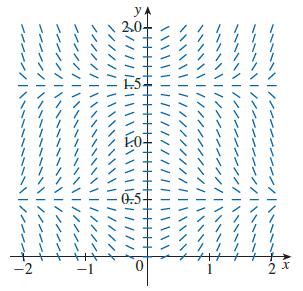
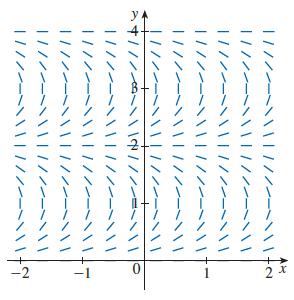
A direction field for the differential equation y' = x cos πy is shown.(a) Sketch the graphs of the solutions that satisfy the given initial conditions.(i) y(0) = 0(ii) y(0) = 0.5(iii) y(0) = 1(iv) y(0) = 1.6(b) Find all the equilibrium solutions. ~ \|/レンーンーーー//|\ /
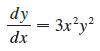
Solve the differential equation. dy - 3x²y? dx
Determine whether the statement is true or false. If it is true, explain why. If it is false, explain why or give an example that disproves the statement.All solutions of the differential equation y' = –1 – y4 are decreasing functions.
Determine whether the differential equation is linear. If it is linear, then write it in the form of Equation 1.12y' – x = y tan x
Write a differential equation that models the given situation. In each case the stated rate of change is with respect to time t.The rate of change of the velocity v of a falling body is constant.
A direction field for the differential equation y' = tan(1/2πy) is shown.(a) Sketch the graphs of the solutions that satisfy the given initial conditions.(i) y(0) = 1(ii) y(0) = 0.2(iii) y(0) = 2(iv) y(1) = 3(b) Find all the equilibrium solutions. AK 1///レー\\\|///--\\N 1///レー\\\|///-ー~
Solve the differential equation. dy y* dx
Determine whether the statement is true or false. If it is true, explain why. If it is false, explain why or give an example that disproves the statement.The function f(x) = (ln x)/x is a solution of the differential equation x2y' + xy = 1.
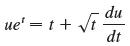
Determine whether the differential equation is linear. If it is linear, then write it in the form of Equation 1.12 du ue' =t+ Jt dt
Write a differential equation that models the given situation. In each case the stated rate of change is with respect to time t.For a car with maximum velocity M, the rate of change of the velocity v of the car is proportional to the difference between M and v.
What is a direction field for the differential equation y' = F(x, y)?
Solve the differential equation. dy dx
Determine whether the statement is true or false. If it is true, explain why. If it is false, explain why or give an example that disproves the statement.The function y = 3e2x – 1 is a solution of the initial-value problem y' – 2y = 1, y(0) = 2.
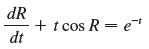
Determine whether the differential equation is linear. If it is linear, then write it in the form of Equation 1.12 dR + t cos R = e dt
Write a differential equation that models the given situation. In each case the stated rate of change is with respect to time t.When an infectious disease is introduced into a city of fixed population N, the rate of change of the number y of infected individuals is proportional to the product of
Lynx eat snowshoe hares and snowshoe hares eat woody plants like willows. Suppose that, in the absence of hares, the willow population will grow exponentially and the lynx population will decay exponentially. In the absence of lynx and willow, the hare population will decay exponentially. If L(t),
Solve the differential equation.xy' = y + 3
Determine whether the statement is true or false. If it is true, explain why. If it is false, explain why or give an example that disproves the statement.The equation y' = x + y is separable.
Solve the differential equation.y' + y = 1
Write a differential equation that models the given situation. In each case the stated rate of change is with respect to time t.When an advertising campaign for a new product is introduced into a city of fixed population N, the rate of change of the number y of individuals who have heard about the
Solve the differential equation.xyy' = x2 + 1
Determine whether the statement is true or false. If it is true, explain why. If it is false, explain why or give an example that disproves the statement.The equation y' = 3y – 2x + 6xy – 1 is separable.
Solve the differential equation.y' = xe−sin x − y cos x
Solve the differential equation.y' – y = ex
Determine whether the given function is a solution of the differential equation.y = sin x – cos x; y' + y = 2 sin x
What is a first-order linear differential equation? How do you solve it?
Showing 2800 - 2900
of 4932
First
22
23
24
25
26
27
28
29
30
31
32
33
34
35
36
Last
Step by Step Answers

 Get 50% OFF
Claim Now
Get 50% OFF
Claim Now