New Semester
Started
Get
50% OFF
Study Help!
--h --m --s
Claim Now
Question Answers
Textbooks
Find textbooks, questions and answers
Oops, something went wrong!
Change your search query and then try again
S
Books
FREE
Study Help
Expert Questions
Accounting
General Management
Mathematics
Finance
Organizational Behaviour
Law
Physics
Operating System
Management Leadership
Sociology
Programming
Marketing
Database
Computer Network
Economics
Textbooks Solutions
Accounting
Managerial Accounting
Management Leadership
Cost Accounting
Statistics
Business Law
Corporate Finance
Finance
Economics
Auditing
Tutors
Online Tutors
Find a Tutor
Hire a Tutor
Become a Tutor
AI Tutor
AI Study Planner
NEW
Sell Books
Search
Search
Sign In
Register
study help
mathematics
calculus early transcendentals 9th
Calculus Early Transcendentals 9th Edition James Stewart, Daniel K. Clegg, Saleem Watson, Lothar Redlin - Solutions
Solve the differential equation e−yy' + cos x = 0 and graph several members of the family of solutions. How does the solution curve change as the constant C varies?
Solve the initial-value problem y' = (sin x)/sin y, y(0) = π/2, and graph the (implicitly defined) solution.
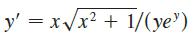
Solve the differential equationand graph several members of the family of (implicitly defined) solutions. How does the solution curve change as the constant C varies? y' = x/x? + 1/(ye")
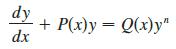
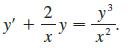
A Bernoulli differential equation (named after James Bernoulli) is of the formSolve the differential equation dy + P(x)y = Q(x)y" dx
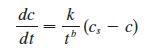
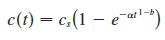
Differential equations have been used extensively in the study of drug dissolution for patients given oral medications. One such equation is the Weibull equation for the concentration c(t) of the drug:where k and cs are positive constants and 0 < b < 1. Verify thatis a solution of the Weibull
Find a function f such that f(3) = 2 and (t + 1)f'(t) + [f(1)] + 1 0 t +1
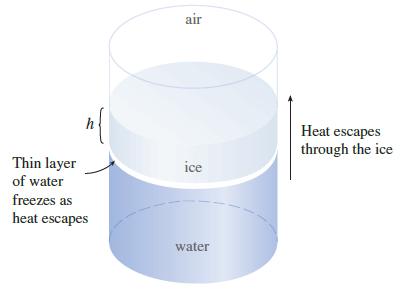
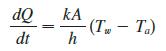
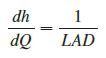
Many factors influence the formation and growth of sea ice. In this exercise we develop a simplified model that describes how the thickness of sea ice is affected over time by the temperatures of the air and ocean water. As a good model simplifies reality enough to permit mathematical calculations
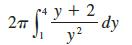
Each integral represents the volume of a solid. Describe the solid. y+2 dy y? 27
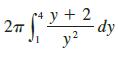
Each integral represents the volume of a solid. Describe the solid. 27 ("Y+ 2 dy 4 y? 2
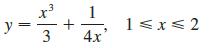
Find the exact length of the curve. .3 y = 1
Find the exact length of the curve. x= e' + te", 0 < y
Find the exact length of the curve. x=Vy (y - 3), 1< y
Find the exact length of the curve. y = 3 + cosh 2x, 0
Find the exact length of the curve. y = x? - In x, 1
Find the exact length of the curve. y = Vx - x? + sin-(Vx)
The masses mi are located at the points Pi. Find the moments Mx and My and the center of mass of the system.m1 = 5, m2 = 8, m3 = 7;P1(3, 1), P2(0, 4), P3(–5, –2)
Find the exact area of the surface obtained by rotating the given curve about the x-axis. y = Vx? + 1, 0
Use the method of cylindrical shells to find the volume generated by rotating the region bounded by the given curves about the specified axis.x = 2y2, y ≥ 0, x = 2; about y = 2
Sketch the region enclosed by the given curves and find its area.y = x4 – 3x2, y – x2
The kinetic energy KE of an object of mass m moving with velocity v is defined as KE = 1/2 mv2. If a force f(x) acts on the object, moving it along the x-axis from x1 to x2, the Work-Energy Theorem states that the net work done is equal to the change in kinetic energy: 1/2 mv22 – 1/2 mv21, where
Use the method of cylindrical shells to find the volume generated by rotating the region bounded by the given curves about the specified axis.x = 2y2, x = y2 + 1; about y = –2
The kinetic energy KE of an object of mass m moving with velocity v is defined as KE = 1/2 mv2. If a force f(x) acts on the object, moving it along the x-axis from x1 to x2, the Work-Energy Theorem states that the net work done is equal to the change in kinetic energy: 1/2 mv22 – 1/2 mv21, where
(a) Set up an integral for the volume of the solid obtained by rotating the region bounded by the given curve about the specified axis.(b) Use a calculator or computer to evaluate the integral correct to five decimal places.y = tan x, y = 0, x = π/4; about x = π/2
The kinetic energy KE of an object of mass m moving with velocity v is defined as KE = 1/2 mv2. If a force f(x) acts on the object, moving it along the x-axis from x1 to x2, the Work-Energy Theorem states that the net work done is equal to the change in kinetic energy: 1/2 mv22 – 1/2 mv21, where
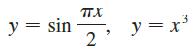
Sketch the region enclosed by the given curves and find its area. y = sin y = x' 2
(a) Set up an integral for the volume of the solid obtained by rotating the region bounded by the given curve about the specified axis.(b) Use a calculator or computer to evaluate the integral correct to five decimal places. y = cos x, y = cos*x, /2 x /2; about x =
(a) Set up an integral for the volume of the solid obtained by rotating the region bounded by the given curve about the specified axis.(b) Use a calculator or computer to evaluate the integral correct to five decimal places. y = x, y = 2x/(1+x); about x = - 1
Sketch the region enclosed by the given curves and find its area. y = 1/x, y = x, y = x, x >0
(a) Set up an integral for the volume of the solid obtained by rotating the region bounded by the given curve about the specified axis.(b) Use a calculator or computer to evaluate the integral correct to five decimal places.x = √sin y, 0 ≤ y ≤ π, x = 0; about y = 4
(a) Set up an integral for the volume of the solid obtained by rotating the region bounded by the given curve about the specified axis.(b) Use a calculator or computer to evaluate the integral correct to five decimal places.x2 – y2 = 7, x = 4; about y = 5
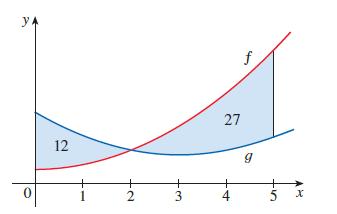
The graphs of two functions are shown with the areas of the regions between the curves indicated.(a) What is the total area between the curves for 0 ≤ x ≤ 5?(b) What is the value of ∫50 [f(x) – g(x)] dx ? y. f 27 12 3 4 2.
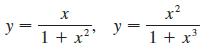
Sketch the region enclosed by the given curves and find its area. x? y = 1 + x*" y = 1 + x
Each integral represents the volume of a solid. Describe the solid. | 2nx dx Jo
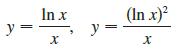
Sketch the region enclosed by the given curves and find its area. In x y = (In x)? y =
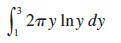
Each integral represents the volume of a solid. Describe the solid. 2m y Iny dy
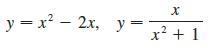
Use a graph to estimate the x-coordinates of the points of intersection of the given curves. Then use this information and a calculator or computer to estimate the volume of the solid obtained by rotating about the y-axis the region enclosed by these curves. y = x? - 2x, y = х? + 1
Use a graph to estimate the x-coordinates of the points of intersection of the given curves. Then use this information and a calculator or computer to estimate the volume of the solid obtained by rotating about the y-axis the region enclosed by these curves.y = esin x, y = x2 – 4x + 5
Use a computer algebra system to find the exact volume of the solid obtained by rotating the region bounded by the given curves about the specified line.y = sin2x, y = sin4x, 0 ≤ x ≤ π; about x = π/2
Use a computer algebra system to find the exact volume of the solid obtained by rotating the region bounded by the given curves about the specified line.y = x3 sin x, y = 0, 0 ≤ x ≤ π; about x = –1
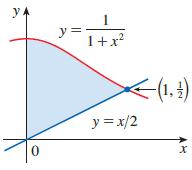
A solid is obtained by rotating the shaded region about the specified line.(a) Set up an integral using any method to find the volume of the solid.(b) Evaluate the integral to find the volume of the solid.About the y-axis 1 y= 1+x? (1.) y = x/2
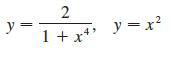
Graph the region between the curves and compute the area correct to five decimal places. y = 1 +x* y = x?
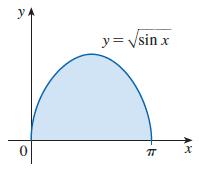
A solid is obtained by rotating the shaded region about the specified line.(a) Set up an integral using any method to find the volume of the solid.(b) Evaluate the integral to find the volume of the solid.About the x-axis у. y= Vsin x
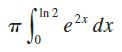
Each integral represents the volume of a solid of revolution. Describe the solid. In 2 e2* dx TT
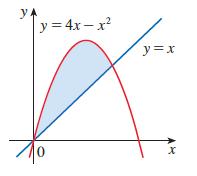
A solid is obtained by rotating the shaded region about the specified line.(a) Set up an integral using any method to find the volume of the solid.(b) Evaluate the integral to find the volume of the solid.About the y-axis yA y = 4x–x y=x
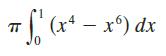
Each integral represents the volume of a solid of revolution. Describe the solid. (r* - x) dx
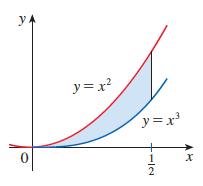
A solid is obtained by rotating the shaded region about the specified line.(a) Set up an integral using any method to find the volume of the solid.(b) Evaluate the integral to find the volume of the solid.About the line x = –2 y. y = x? y=x³
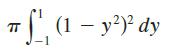
Each integral represents the volume of a solid of revolution. Describe the solid. L, (1 - y²Y° dy TT
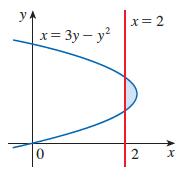
A solid is obtained by rotating the shaded region about the specified line.(a) Set up an integral using any method to find the volume of the solid.(b) Evaluate the integral to find the volume of the solid.About the line y = 3 x= 2 x= 3y – y? 2.
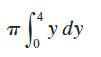
Each integral represents the volume of a solid of revolution. Describe the solid. ydy
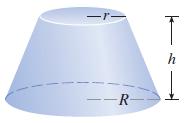
Find the volume of the described solid S.A frustum of a right circular cone with height h, lower base radius R, and top radius r ードー h --R
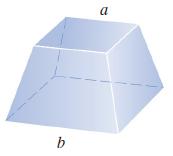
Find the volume of the described solid S.A frustum of a pyramid with square base of side b, square top of side a, and height hWhat happens if a = b? What happens if a = 0? a b
Find the volume of the described solid S.A tetrahedron with three mutually perpendicular faces and three mutually perpendicular edges with lengths 3 cm, 4 cm, and 5 cm
Find the number b such that the line y = b divides the region bounded by the curves y = x2 and y = 4 into two regions with equal area.
Find the volume of the described solid S.The base of S is an elliptical region with boundary curve 9x2 + 4y2 = 36. Cross-sections perpendicular to the x-axis are isosceles right triangles with hypotenuse in the base.
Find the volume of the described solid S.The base of S is the triangular region with vertices (0, 0), (1, 0), and (0, 1). Cross-sections perpendicular to the y-axis are equilateral triangles.
Find the volume of the described solid S.The base of S is the same base as in Exercise 68, but cross sections perpendicular to the x-axis are squares.Data From Exercise 68:The base of S is the triangular region with vertices (0, 0), (1, 0), and (0, 1). Cross-sections perpendicular to the y-axis are
Find the volume of the described solid S.The base of S is the region enclosed by the parabola y = 1 – x2 and the x axis. Cross-sections perpendicular to the y-axis are squares.
Find the volume of the described solid S.The base of S is the same base as in Exercise 70, but cross sections perpendicular to the x-axis are isosceles triangles with height equal to the base.Data From Exercise 70:The base of S is the region enclosed by the parabola y = 1 – x2 and the x axis.
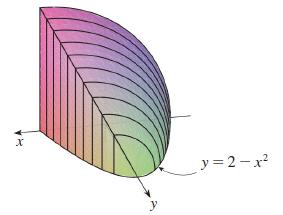
Find the volume of the described solid S.The base of S is the region enclosed by y = 2 – x2 and the x-axis. Cross sections perpendicular to the y-axis are quarter-circles. y= 2- x?
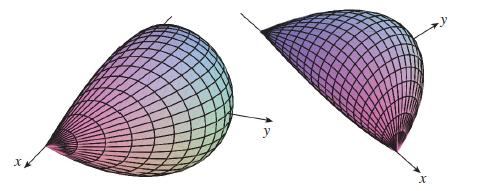
Find the volume of the described solid S.The solid S is bounded by circles that are perpendicular to the x-axis, intersect the x-axis, and have centers on the parabola y = 1/2(1 – x2), –1 ≤ x ≤ 1.
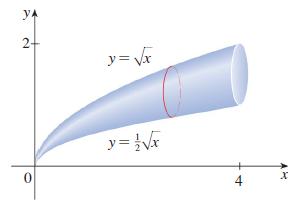
Find the volume of the described solid S.Cross-sections of the solid S in planes perpendicular to the x-axis are circles with diameters extending from the curve y = 1/2√x to the curve y = √x for 0 ≤ x ≤ 4. yA 2- y= Vx y= V 4
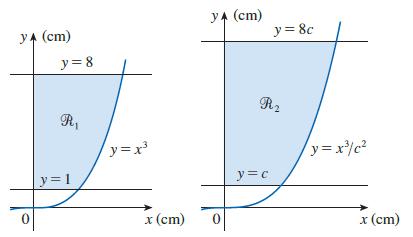
A dilation of the plane with scaling factor c is a transformation that maps the point (x, y) to the point (cx, cy). Applying a dilation to a region in the plane produces a geometrically similar shape. A manufacturer wants to produce a 5-liter (5000 cm3) terra-cotta pot whose shape is geometrically
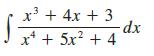
Evaluate the integral. x³ + 4x + 3 x* + 5x? + 4
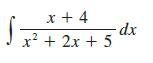
Evaluate the integral. x + 4 x? + 2x + 5
Evaluate the indefinite integral. Illustrate, and check that your answer is reasonable, by graphing both the function and its antiderivative (take C − 0).∫ x3√1 + x2 dx
Find the length of the curve.y = 4(x – 1)3/2, 1 ≤ x ≤ 4
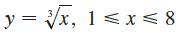
The given curve is rotated about the x-axis. Set up, but do not evaluate, an integral for the area of the resulting surface by integrating(a) With respect to x(b) With respect to y. y = Vx, 1
Find the area of the regionS = {(x, y) | x ≥ 0, y ≤ 1, x2 + y2 ≤ 4y}.
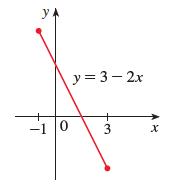
Use the arc length formula (3) to find the length of the curve y = 3 – 2x, –1 ≤ x ≤ 3. Check your answer by noting that the curve is a line segment and calculating its length by the distance formula. y = 3 – 2x -1 3
(a) How is the length of a curve defined?(b) Write an expression for the length of a smooth curve given by y = f (x), a ≤ x ≤ b.(c) What if x is given as a function of y ?
Determine whether the statement is true or false. If it is true, explain why. If it is false, explain why or give an example that disproves the statement.The arc lengths of the curves y = f(x) and y = f(x) + c for a ≤ x ≤ b are equal.
Find the length of the curve.y = 2 ln(sin 1/2 x), π/3 ≤ x ≤ π
The given curve is rotated about the x-axis. Set up, but do not evaluate, an integral for the area of the resulting surface by integrating(a) With respect to x(b) With respect to y.x2 = ey, 1 ≤ x ≤ e
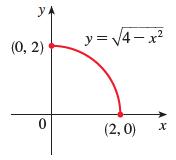
Use the arc length formula to find the length of the curve y = √4 – x2, 0 ≤ x ≤ 2. Check your answer by noting that the curve is part of a circle. yA y = V4-x? .2 (0, 2) (2, 0)
Determine whether the statement is true or false. If it is true, explain why. If it is false, explain why or give an example that disproves the statement.If the curve y = f(x), a ≤ x ≤ b, lies above the x-axis and if c > 0, then the areas of the surfaces obtained by revolving y = f(x) and y
Find the length of the curve.12x = 4y3 + 3y–1, 1 ≤ y ≤ 3
The given curve is rotated about the x-axis. Set up, but do not evaluate, an integral for the area of the resulting surface by integrating(a) With respect to x(b) With respect to y.x = ln(2y + 1), 0 ≤ y ≤ 1
Set up, but do not evaluate, an integral for the length of the curve.y = x3, 0 ≤ x ≤ 2
Let f(x) = 30x2(1 – x)2 for 0 ≤ x ≤ 1 and f(x) = 0 for all other values of x.(a) Verify that f is a probability density function.(b) Find P(X ≤ 1/3).
Determine whether the statement is true or false. If it is true, explain why. If it is false, explain why or give an example that disproves the statement.If f(x) ≤ g(x) for a ≤ x ≤ b, then the arc length of the curve y = f(x) for a ≤ x ≤ b is less than or equal to the arc length of the
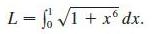
Determine whether the statement is true or false. If it is true, explain why. If it is false, explain why or give an example that disproves the statement.The length of the curve y = x3, 0 ≤ x ≤ 1, is L = f V1 + x° dx.
The given curve is rotated about the x-axis. Set up, but do not evaluate, an integral for the area of the resulting surface by integrating(a) With respect to x(b) With respect to y.y = tan–1 x, 0 ≤ x ≤ 1
Set up, but do not evaluate, an integral for the length of the curve.y = ex, 1 ≤ x ≤ 3
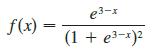
The density functionis an example of a logistic distribution.(a) Verify that f is a probability density function.(b) Find P(3 ≤ X ≤ 4).(c) Graph f. What does the mean appear to be? What about the median? e3-x f(x) = (1 + e3-x)2
Determine whether the statement is true or false. If it is true, explain why. If it is false, explain why or give an example that disproves the statement.If f is continuous, f(0) = 0, and f(3) = 4, then the arc length of the curve y = f(x) for 0 ≤ x ≤ 3 is at least 5.
The given curve is rotated about the y-axis. Set up, but do not evaluate, an integral for the area of the resulting surface by integrating(a) With respect to x(b) With respect to y.xy = 4, 1 ≤ x ≤ 8
The demand function for a manufacturer’s microwave oven is p(x) = 870e–0.03x, where x is measured in thousands. Calculate the consumer surplus when the sales level for the ovens is 45,000.
Set up, but do not evaluate, an integral for the length of the curve.y = x – ln x, 1 ≤ x ≤ 4
Let f(x) = c/(1 + x2).(a) For what value of c is f a probability density function?(b) For that value of c, find P(–1 < X < 1).
The given curve is rotated about the y-axis. Set up, but do not evaluate, an integral for the area of the resulting surface by integrating(a) With respect to x(b) With respect to y.y = (x + 1)4, 0 ≤ x ≤ 2
Set up, but do not evaluate, an integral for the length of the curve.x = y2 + y, 0 ≤ y ≤ 3
Let f(x) = k(3x – x2) if 0 ≤ x ≤ 3 and f(x) = 0 if x < 0 or x > 3.(a) For what value of k is f a probability density function?(b) For that value of k, find P(X > 1).(c) Find the mean.
Determine whether the statement is true or false. If it is true, explain why. If it is false, explain why or give an example that disproves the statement.Hydrostatic pressure on a dam depends only on the water level at the dam and not on the size of the reservoir created by the dam.
Use Simpson’s Rule with n = 10 to estimate the length of the sine curve y = sin x, 0 ≤ x ≤ π. Round your answer to four decimal places.
The given curve is rotated about the y-axis. Set up, but do not evaluate, an integral for the area of the resulting surface by integrating(a) With respect to x(b) With respect to y.y = 1 + sin x, 0 ≤ x ≤ π/2
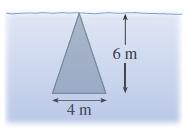
A vertical plate is submerged (or partially submerged) in water and has the indicated shape. Explain how to approximate the hydrostatic force against one side of the plate by a Riemann sum. Then express the force as an integral and evaluate it. 6 m 4 m
A concert-promoting company has been selling an average of 210 T shirts at performances for $18 each. The company estimates that for each dollar that the price is lowered, an additional 30 shirts will be sold. Find the demand function for the shirts and calculate the consumer surplus if the shirts
Set up, but do not evaluate, an integral for the length of the curve.x = sin y, 0 ≤ y ≤ π/2
(a) What is cardiac output?(b) Explain how the cardiac output can be measured by the dye dilution method.
(a) Set up, but do not evaluate, an integral for the area of the surface obtained by rotating the sine curve in Exercise 7 about the x-axis.(b) Evaluate your integral correct to four decimal places.Data From Exercise 7:Use Simpson’s Rule with n = 10 to estimate the length of the sine curve y =
Showing 2700 - 2800
of 4932
First
21
22
23
24
25
26
27
28
29
30
31
32
33
34
35
Last
Step by Step Answers

 Get 50% OFF
Claim Now
Get 50% OFF
Claim Now