New Semester
Started
Get
50% OFF
Study Help!
--h --m --s
Claim Now
Question Answers
Textbooks
Find textbooks, questions and answers
Oops, something went wrong!
Change your search query and then try again
S
Books
FREE
Study Help
Expert Questions
Accounting
General Management
Mathematics
Finance
Organizational Behaviour
Law
Physics
Operating System
Management Leadership
Sociology
Programming
Marketing
Database
Computer Network
Economics
Textbooks Solutions
Accounting
Managerial Accounting
Management Leadership
Cost Accounting
Statistics
Business Law
Corporate Finance
Finance
Economics
Auditing
Tutors
Online Tutors
Find a Tutor
Hire a Tutor
Become a Tutor
AI Tutor
AI Study Planner
NEW
Sell Books
Search
Search
Sign In
Register
study help
mathematics
calculus early transcendentals 9th
Calculus Early Transcendentals 9th Edition James Stewart, Daniel K. Clegg, Saleem Watson, Lothar Redlin - Solutions
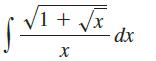
Make a substitution to express the integrand as a rational function and then evaluate the integral. /1 + x X - dx
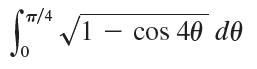
Evaluate the integral. (/4 1 - cos 40 de
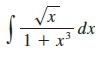
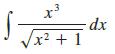
Evaluate the integral. ax .3 1 + x
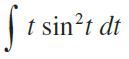
Evaluate the integral. Si t sint dt
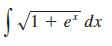
Evaluate the integral. SVī+ e* dx
Evaluate the integral or show that it is divergent. In x dx
Evaluate the indefinite integral. Illustrate, and check that your answer is reasonable, by graphing both the function and its antiderivative (take C − 0).∫ x2 sin 2x dx
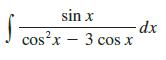
Make a substitution to express the integrand as a rational function and then evaluate the integral. sin x dx cos?x – 3 cos x
Evaluate the integral.∫ x sec x tan x dx
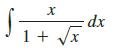
Evaluate the integral. dx 1+ Vx
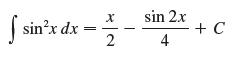
(a) Use the reduction formula to show that(b) Use part (a) and the reduction formula to evaluate ∫ sin4x dx. S sin 2x + C 4 sin?x dx
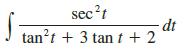
Make a substitution to express the integrand as a rational function and then evaluate the integral. sec?t dt tan?t + 3 tan t + 2
Evaluate the integral.∫ x tan2x dx
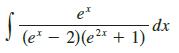
Make a substitution to express the integrand as a rational function and then evaluate the integral. et dx J (e - 2)(e2 + 1)
Evaluate the integral.∫ x sin3x dx
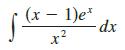
Evaluate the integral. (x – 1)e* dx x?
(a) If g(x) = (sin2x)/x2, use a calculator or computer to make a table of approximate values of ∫t1 g(x) dx for t = 2, 5, 10, 100, 1000, and 10,000. Does it appear that ∫∞1 g(x) dx is convergent?(b) Use the Comparison Theorem with f(x) = 1/x2 to show that ∫∞1 g(x) dx is convergent.(c)
Make a substitution to express the integrand as a rational function and then evaluate the integral. dx 1 + e*
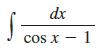
Evaluate the integral. dx cos x 1 -
Evaluate the integral.∫ x3(x – 1)–4 dx
Prove that, for even powers of sine, T/2 sin2"x dx 1:3. 5. ..*. (2n – 1) T 2.4. 6. .. · 2n 2
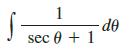
Evaluate the integral. 1 sec e + 1
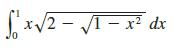
Evaluate the integral. xv2 - I x
Evaluate the indefinite integral. Illustrate, and check that your answer is reasonable, by graphing both the integrand and its antiderivative (taking C = 0).∫ x sin2(x2) dx
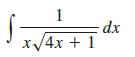
Evaluate the integral. 1 x/4x + 1
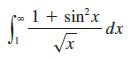
Use the Comparison Theorem to determine whether the integral is convergent or divergent. 1+ sin?x
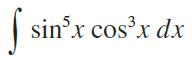
Evaluate the indefinite integral. Illustrate, and check that your answer is reasonable, by graphing both the integrand and its antiderivative (taking C = 0). I sinx cosx dx
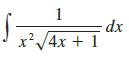
Evaluate the integral. 1 dx x'/4x + 1
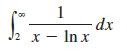
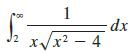
Use the Comparison Theorem to determine whether the integral is convergent or divergent. 1 dx J2 x - In x
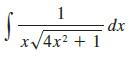
Evaluate the integral. 1 dx x/4x² + 1
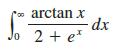
Use the Comparison Theorem to determine whether the integral is convergent or divergent. p- arctan x Jo 2 + e*
Evaluate the integral or show that it is divergent. tan -x dx .2 8
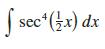
Evaluate the indefinite integral. Illustrate, and check that your answer is reasonable, by graphing both the integrand and its antiderivative (taking C = 0). S sec (x) dx
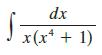
Evaluate the integral. dx x(x* + 1)
Use Exercise 57 to find ∫ (ln x)3 dx.Data From Exercise 57:Use integration by parts to prove the reduction formula. S In x)" dx = x(In x)" – n (In x)- dx %3D
Evaluate the integral.∫ x2 sinh mx dx
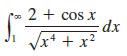
Use the Comparison Theorem to determine whether the integral is convergent or divergent. 2 + cos x Vx* + x?
Use Exercise 58 to find ∫ x4ex dx.Data From Exercise 58:Use integration by parts to prove the reduction formula. 'e*dx %3|
Evaluate the indefinite integral. Illustrate, and check that your answer is reasonable, by graphing both the function and its antiderivative (take C = 0). .3 Vx? + 1
Evaluate the integral.∫ (x + sin x)2 dx
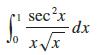
Use the Comparison Theorem to determine whether the integral is convergent or divergent. sec?x =dx
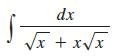
Evaluate the integral. dx x + xVx
Find the area of the region bounded by the given curves.y = x2e–x, y = xe–x
Evaluate the integral. dx Vx + xx
The integral ∫∞a f(x) dx is improper because the interval [a, ∞) is infinite. If f has an infinite discontinuity at a, then the integral is improper for a second reason. In this case we evaluate the integral by expressing it as a sum of improper integrals of Type 2 and Type 1 as
Use a graph to find approximate x-coordinates of the points of intersection of the given curves. Then find (approximately) the area of the region bounded by the curves. y = arcsin(x), y= 2 - x?
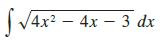
Use the Table of Integrals on Reference Pages 6–10 to evaluate the integral. |V4x? – 4x – 3 dx
Find the area of the region bounded by the given curves.y = sin2 x, y = sin3 x, 0 ≤ x ≤ π
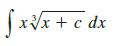
Evaluate the integral. xVx + c dx
The integral ∫∞a f(x) dx is improper because the interval [a, ∞) is infinite. If f has an infinite discontinuity at a, then the integral is improper for a second reason. In this case we evaluate the integral by expressing it as a sum of improper integrals of Type 2 and Type 1 as
Use a graph to find approximate x-coordinates of the points of intersection of the given curves. Then find (approximately) the area of the region bounded by the curves.y = x ln(x + 1), y = 3x – x2
Use the Table of Integrals on Reference Pages 6–10 to evaluate the integral.∫ csc5t dt
Find the area of the region bounded by the given curves.y = tan x, y = tan2 x, 0 ≤ x ≤ π/4
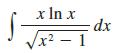
Evaluate the integral. x In x dx Vx? – 1
The integral ∫∞a f(x) dx is improper because the interval [a, ∞) is infinite. If f has an infinite discontinuity at a, then the integral is improper for a second reason. In this case we evaluate the integral by expressing it as a sum of improper integrals of Type 2 and Type 1 as
Use the method of cylindrical shells to find the volume generated by rotating the region bounded by the curves about the given axis.y = cos(πx/2), y = 0, 0 ≤ x ≤ 1; about the y-axis
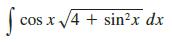
Use the Table of Integrals on Reference Pages 6–10 to evaluate the integral. cos x V4 + sin?x dx
Evaluate the integral. dx x* - 16
The integral ∫∞a f(x) dx is improper because the interval [a, ∞) is infinite. If f has an infinite discontinuity at a, then the integral is improper for a second reason. In this case we evaluate the integral by expressing it as a sum of improper integrals of Type 2 and Type 1 as
Use the method of cylindrical shells to find the volume generated by rotating the region bounded by the curves about the given axis.y = ex, y = e–x, x = 1; about the y-axis
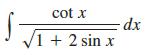
Use the Table of Integrals on Reference Pages 6–10 to evaluate the integral. cot x =dx V1 + 2 sin x
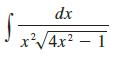
Evaluate the integral. dx x'V4x? – 1 .2
Use the method of cylindrical shells to find the volume generated by rotating the region bounded by the curves about the given axis.y = e–x, y = 0, x = –1, x = 0; about x = 1
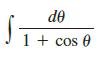
Evaluate the integral. de 1 + cos 0
Use the method of cylindrical shells to find the volume generated by rotating the region bounded by the curves about the given axis.y = ex, x = 0, y = 3; about the x-axis
Evaluate the integral. de 1 + cos?e
Use(a) The Trapezoidal Rule(b) The Midpoint Rule(c) Simpson’s Rule with n = 10 to approximate the given integral. Round your answers to six decimal places. 1 ах 12 In x
Is it possible to find a number n such that ∫∞0 xn dx is convergent?
Evaluate the integral. eva dx
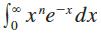
(a) Evaluate the integral(b) Guess the value ofwhen n is an arbitrary positive integer.(c) Prove your guess using mathematical induction. S x"e*dx for n = 0, 1, 2, and 3.
Find the volume obtained by rotating the region bounded by the curves about the given axis.y = sec x, y = cos x, 0 ≤ x ≤ π/3; about y = −1
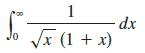
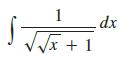
Evaluate the integral. 1 dx Vx + 1
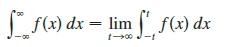
The Cauchy principal value of the integraldefined byShow thatdiverges but the Cauchy principal value of this integral is 0. f(x) dx -00
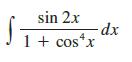
Evaluate the integral. sin 2x 1+ cos*x
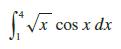
Use(a) The Trapezoidal Rule(b) The Midpoint Rule(c) Simpson’s Rule with n = 10 to approximate the given integral. Round your answers to six decimal places. SVi cos. cos x dx
(a) Use a computer algebra system to find the partial fraction decomposition of the function(b) Use part (a) to find ∫ f(x) dx and graph f and its indefinite integral on the same screen.(c) Use the graph of f to discover the main features of the graph of ∫ f (x) dx. 12x – 7x - 13x2 + 8 100x -
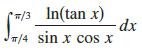
Evaluate the integral. =/3 In(tan x) -dx T/4 sin x cos x
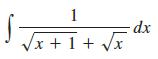
Evaluate the integral. 1 dx Vx +1 + Vx
If f(0) = g(0) = 0 and f" and g" are continuous, show that ()g"(x) dx = f(a)g'(a) – f'(a)g(a) + [f"(x)g(x) dx
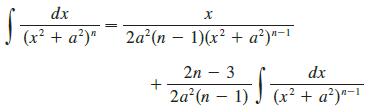
(a) Use integration by parts to show that, for any positive integer n,(b) Use part (a) to evaluate dx (x² + a²)" 2a (n – 1)(x + a?)"- 2n – 3 dx 2a (n – 1) J (x? + a?)"-1
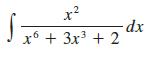
Evaluate the integral. x? x° + 3x3 + 2
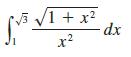
Evaluate the integral. V1 + x? dx x? Len
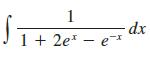
Evaluate the integral. 1 1 + 2e* - e*
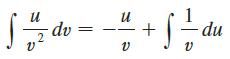
(a) Recall that the formula for integration by parts is obtained from the Product Rule. Use similar reasoning to obtain the following integration formula from the Quotient Rule.(b) Use the formula in part (a) to evaluate и dv 2 + du
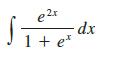
Evaluate the integral. e2x ax 1+ e*
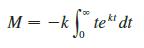
As we saw a radioactive substance decays exponentially: The mass at time t is m(t) = m(0)ekt, where ms0d is the initial mass and k is a negative constant. The mean life M of an atom in the substance isFor the radioactive carbon isotope, 14C, used in radiocarbon dating, the value of k is
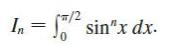
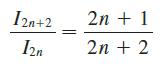
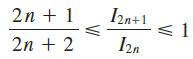
The Wallis Product Formula for π Let(a) Show that I2n+2 ≤ I2n+1 ≤ I2n.(b) Use Exercise 56 to show that(c) Use parts (a) and (b) to show thatand deduce that(d) Use part (c) and Exercises 55 and 56 to show thatThis formula is usually written as an infinite product:and is called the Wallis
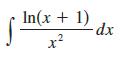
Evaluate the integral. In(x + 1) dx x?
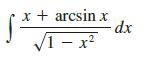
Evaluate the integral. x + arcsin x V1 - x2
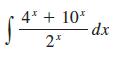
Evaluate the integral. 4* + 10* dx 2*
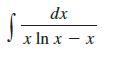
Evaluate the integral. dx x In x - x
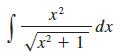
Evaluate the integral. x? dx x² +1
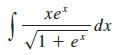
Evaluate the integral. xe* -dx V1 + e*
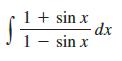
Evaluate the integral. 1 + sin x 1- sin x
Evaluate the integral.∫ x sin2x cos x dx
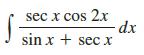
Evaluate the integral. sec x cos 2x -dx sin x + sec x
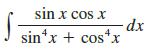
Evaluate the integral. sin x cos x J sin*x + cos*x
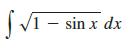
Evaluate the integral. SVi - sin x dx
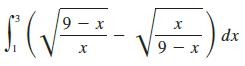
Evaluate the integral. 9- x V dx 9 - x
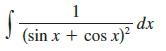
Evaluate the integral. 1 dx (sin x + cos x)
Showing 3100 - 3200
of 4932
First
25
26
27
28
29
30
31
32
33
34
35
36
37
38
39
Last
Step by Step Answers

 Get 50% OFF
Claim Now
Get 50% OFF
Claim Now