New Semester
Started
Get
50% OFF
Study Help!
--h --m --s
Claim Now
Question Answers
Textbooks
Find textbooks, questions and answers
Oops, something went wrong!
Change your search query and then try again
S
Books
FREE
Study Help
Expert Questions
Accounting
General Management
Mathematics
Finance
Organizational Behaviour
Law
Physics
Operating System
Management Leadership
Sociology
Programming
Marketing
Database
Computer Network
Economics
Textbooks Solutions
Accounting
Managerial Accounting
Management Leadership
Cost Accounting
Statistics
Business Law
Corporate Finance
Finance
Economics
Auditing
Tutors
Online Tutors
Find a Tutor
Hire a Tutor
Become a Tutor
AI Tutor
AI Study Planner
NEW
Sell Books
Search
Search
Sign In
Register
study help
mathematics
calculus early transcendentals 9th
Calculus Early Transcendentals 9th Edition James Stewart, Daniel K. Clegg, Saleem Watson, Lothar Redlin - Solutions
Sketch the region enclosed by the given curves. Decide whether to integrate with respect to x or y. Draw a typical approximating rectangle and label its height and width. Then find the area of the region.y = x2 = 4x, y = 2x
Use the method of cylindrical shells to find the volume of the solid obtained by rotating the region bounded by the given curves about the x axis.y = √x, x = 0, y = 2
Find the volume of the solid obtained by rotating the region bounded by the given curves about the specified line. Sketch the region, the solid, and a typical disk or washer.2x = y2, x = 0, y = 4; about the y-axis
Show how to approximate the required work by a Riemann sum. Then express the work as an integral and evaluate it. A 10-ft chain weighs 25 lb and hangs from a ceiling. Find the work done in lifting the lower end of the chain to the ceiling so that it is level with the upper end.
Sketch the region enclosed by the given curves. Decide whether to integrate with respect to x or y. Draw a typical approximating rectangle and label its height and width. Then find the area of the region.x = 1 – y2, x = y2 – 1
Use the method of cylindrical shells to find the volume of the solid obtained by rotating the region bounded by the given curves about the x-axis.y = x3/2, y = 8, x = 0
Find the volume of the solid obtained by rotating the region bounded by the given curves about the specified line. Sketch the region, the solid, and a typical disk or washer.y = x2, y = 2x; about the y-axis
Show how to approximate the required work by a Riemann sum. Then express the work as an integral and evaluate it. A 0.4-kg model rocket is loaded with 0.75 kg of rocket fuel. After launch, the rocket rises at a constant rate of 4 m ys but the rocket fuel is dissipated at a rate of 0.15 kg ys. Find
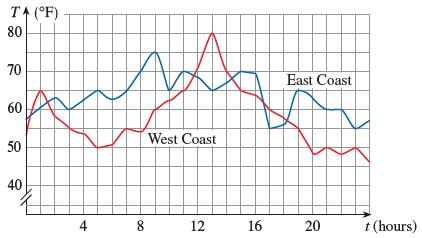
The figure shows graphs of the temperatures for a city on the East Coast and a city on the West Coast during a 24-hour period starting at midnight. Which city had the highest temperature that day? Find the average temperature during this time period for each city using the Midpoint Rule with n =
Use the method of cylindrical shells to find the volume of the solid obtained by rotating the region bounded by the given curves about the x axis.x = –3y2 + 12y – 9, x = 0
Find the volume of the solid obtained by rotating the region bounded by the given curves about the specified line. Sketch the region, the solid, and a typical disk or washer.y = 6 – x2, y = 2; about the x-axis
Use the method of cylindrical shells to find the volume of the solid obtained by rotating the region bounded by the given curves about the x-axis.x = 1 + (y – 2)2, x = 2
Find the volume of the solid obtained by rotating the region bounded by the given curves about the specified line. Sketch the region, the solid, and a typical disk or washer.y = x3, y = √x ; about the x-axis
Show how to approximate the required work by a Riemann sum. Then express the work as an integral and evaluate it. A circular swimming pool has a diameter of 24 ft, the sides are 5 ft high, and the depth of the water is 4 ft. How much work is required to pump all of the water out over the side?
Use the method of cylindrical shells to find the volume of the solid obtained by rotating the region bounded by the given curves about the x-axis.x + y = 4, x = y2 – 4y + 4
Find the volume of the solid obtained by rotating the region bounded by the given curves about the specified line. Sketch the region, the solid, and a typical disk or washer.x = 2 – y2, x = y4; about the y-axis
The region bounded by the given curves is rotated about the specified axis. Find the volume of the resulting solid using(a) x as the variable of integration(b) y as the variable of integration.y = x2, y = 8√x ; about the y-axis
Show how to approximate the required work by a Riemann sum. Then express the work as an integral and evaluate it. A spherical water tank, 24 ft in diameter, sits atop a 60-ft-tall tower. The tank is filled by a hose attached to the bottom of the sphere. If a 1.5-horsepower pump is used to deliver
(a) A cup of coffee has temperature 95°C and takes 30 minutes to cool to 61°C in a room with temperature 20°C. Use Newton’s Law of Cooling to show that the temperature of the coffee after t minutes isT(t) = 20 + 75e–ktwhere k ≈ 0.02.(b) What is the average temperature of the coffee during
The region bounded by the given curves is rotated about the specified axis. Find the volume of the resulting solid using(a) x as the variable of integration(b) y as the variable of integration.y = x3, y = 4x2; about the x-axis
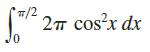
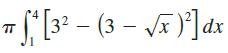
Each integral represents the volume of a solid. Describe the solid. 7/2 2т сos?x dx
Find the volume of the solid obtained by rotating the region bounded by the given curves about the specified line. Sketch the region, the solid, and a typical disk or washer.y = x3, y = 1, x = 2; about y = –3
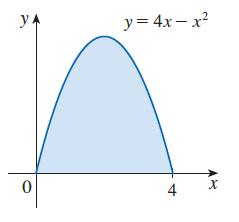
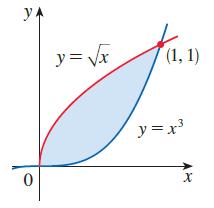
A solid is obtained by rotating the shaded region about the specified axis.(a) Sketch the solid and a typical approximating cylindrical shell.(b) Use the method of cylindrical shells to set up an integral for the volume of the solid.(c) Evaluate the integral to find the volume.About x = –2 yA y=
Sketch the region enclosed by the given curves and find its area.y = x3, y = x
A solid is obtained by rotating the shaded region about the specified axis.(a) Sketch the solid and a typical approximating cylindrical shell.(b) Use the method of cylindrical shells to set up an integral for the volume of the solid.(c) Evaluate the integral to find the volume.About y = –1 y y=
Each integral represents the volume of a solid. Describe the solid. 2т (6 — у)(4у —у?) dy
Use the method of cylindrical shells to find the volume generated by rotating the region bounded by the given curves about the specified axis.y = x3, y = 8, x = 0; about x = 3
Use the method of cylindrical shells to find the volume generated by rotating the region bounded by the given curves about the specified axis.y = 4 – 2x, y = 0, x = 0; about x = –1
Let favg [a, b] denote the average value of f on the interval [a, b].Show that if f is continuous, then lim,-a+ favg [a, t] = f(a).
Use the method of cylindrical shells to find the volume generated by rotating the region bounded by the given curves about the specified axis.y = 4x – x2, y = 3; about x = 1
Use the method of cylindrical shells to find the volume generated by rotating the region bounded by the given curves about the specified axis.y = √x, x = 2y ; about x = 5
Sketch the region enclosed by the given curves and find its area.y = x4, y = 2 – |x|
(a) Set up an integral for the volume of the solid obtained by rotating the region bounded by the given curve about the specified axis.(b) Use a calculator or computer to evaluate the integral correct to five decimal places.y = xe–x, y = 0, x = 2; about the y-axis
Each integral represents the volume of a solid of revolution. Describe the solid. 32 3 dx TT
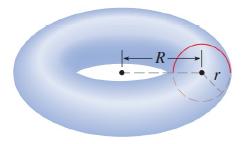
Use cylindrical shells to find the volume of the solid.The solid torus of Exercise 6.2.75Data From Exercise 6.2.75:Set up an integral for the volume of a solid torus (the donut-shaped solid shown in the figure) with radii r and R.By interpreting the integral as an area, find the volume of the
Use cylindrical shells to find the volume of the solid.A right circular cone with height h and base radius r
A hole of radius r is bored through the middle of a cylinder of radius R > r at right angles to the axis of the cylinder. Set up, but do not evaluate, an integral for the volume that is cut out.
If a demand curve is modeled by p = 6 – (x/3500), find the consumer surplus when the selling price is $2.80.
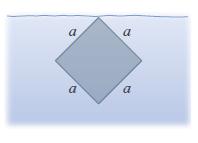
A vertical plate is submerged (or partially submerged) in water and has the indicated shape. Explain how to approximate the hydrostatic force against one side of the plate by a Riemann sum. Then express the force as an integral and evaluate it. a a a a
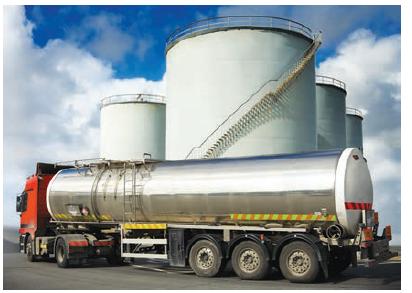
A tanker truck transports gasoline in a horizontal cylindrical tank with diameter 8 ft and length 40 ft. If the tank is full of gasoline with density 47 lb/ft3, compute the force exerted on one end of the tank.
Find the length of the arc of the curve from point P to point Q. - x, P(-1,). Q(1, 4) y =
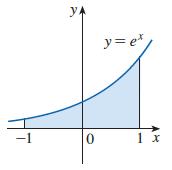
Visually estimate the location of the centroid of the region shown. Then find the exact coordinates of the centroid. yA y= e* -1 1 х
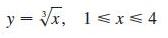
Graph the curve and visually estimate its length. Then compute the length, correct to four decimal places. y = Vx, 1
Graph the curve and visually estimate its length. Then compute the length, correct to four decimal places.y = xe–x, 1 ≤ x ≤ 2
Use Simpson’s Rule with n = 10 to approximate the area of the surface obtained by rotating the given curve about the x-axis. Compare your answer with the value of the integral produced by a calculator or computer.y = x ln x, 1 ≤ x ≤ 2
Graph the curve and visually estimate its length. Then compute the length, correct to four decimal places.y = ln(x2 + 4), –2 ≤ x ≤ 2
The Second Theorem of Pappus is in the same spirit as Pappus’s Theorem discussed in this section, but for surface area rather than volume: let C be a curve that lies entirely on one side of a line l in the plane. If C is rotated about l, then the area of the resulting surface is the product of
Write a differential equation that models the given situation. In each case the stated rate of change is with respect to time t.The rate of change of the radius r of a tree trunk is inversely proportional to the radius.
Determine whether the given function is a solution of the differential equation.y = tan x; y' – y2 = 1
Use the direction field labeled III (above) to sketch the graphs of the solutions that satisfy the given initial conditions.(a) y(0) = 1(b) y(0) = 2.5(c) y(0) = 3.5
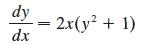
Solve the differential equation. dy 2x(y? + 1) dx
Determine whether the statement is true or false. If it is true, explain why. If it is false, explain why or give an example that disproves the statement.The solution curve of the differential equation(2x – y) y' = x + 2ythat passes through the point (3, 1) has slope 1 at that point.
Solve the differential equation.x2y' − y = 2x3e−1/x
Solve the differential equation.xy' + y = √x
Determine whether the given function is a solution of the differential equation.y = √x; xy' – y = 0
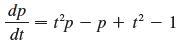
Solve the differential equation. dp - гр — р+ ? - 1 + t? - P dt
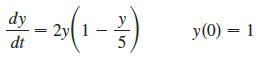
Determine whether the statement is true or false. If it is true, explain why. If it is false, explain why or give an example that disproves the statement.If y is the solution of the initial-value problemthen limt→∞ y = 5. dy 2y 1 (1-) y y(0) = 1 dt 5
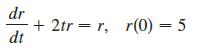
Solve the initial-value problem. dr + 2tr = r, r(0) = 5 dt
Solve the differential equation.2xy' + y = 2√x
Determine whether the given function is a solution of the differential equation. y = V1 - x; yy' - x= 0
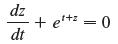
Solve the differential equation. dz + el+: = 0 dt
Solve the initial-value problem.(1 + cos x)y' = (1 + e−y) sin x, y(0) = 0
Solve the differential equation.xy' – 2y = x2, x > 0
Determine whether the given function is a solution of the differential equation.y = x3; x2y" – 6y = 0
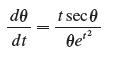
Solve the differential equation. t sece Oe de dt
Solve the initial-value problem.xy' − y = x ln x, y(1) = 2
Solve the differential equation.y' – 3x2y = x2
Determine whether the given function is a solution of the differential equation.y = ln x; xy" – y' = 0
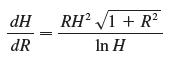
Solve the differential equation. RH V1 + R? HP In H dR
Solve the initial-value problem y' = 3x2ey, y(0) = 1, and graph the solution.
Show that the given function is a solution of the initial-value problem. dy y = -t cos t - 1; = y + t'sin t, y(7) = 0 dt || %3D
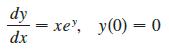
Find the solution of the differential equation that satisfies the given initial condition. dy - хе', у(0) — 0 dx y(0) = 0
Show that the given function is a solution of the initial-value problem. dy y = 5e2* + x; - 2y = 1 - 2x, y(0) = 5 dx
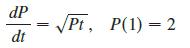
Find the solution of the differential equation that satisfies the given initial condition. dP Pt, P(1) = 2 dt
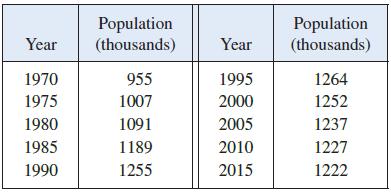
The table gives the midyear population P of Trinidad and Tobago, in thousands, from 1970 to 2015.(a) Make a scatter plot of these data. Choose t − 0 to correspond to the year 1970.(b) From the scatter plot, it appears that a logistic model might be appropriate if we first shift the data points
Solve the differential equation.y' + y cos x = x
(a) For what values of r does the function y = erx satisfy the differential equation 2y" + y' – y = 0 ?(b) If r1 and r2 are the values of r that you found in part (a), show that every member of the family of functions y = aer1x + ber2x is also a solution.
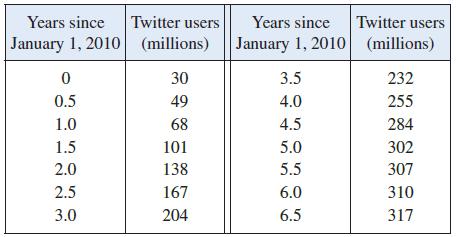
The table gives the number of active Twitter users worldwide, semiannually from 2010 to 2016.Use a calculator or computer to fit both an exponential function and a logistic function to these data. Graph the data points and both functions, and comment on the accuracy of the models. Years since
Solve the differential equation.y' + 2xy = x3 ex2
(a) For what values of k does the function y = cos kt satisfy the differential equation 4y" = –25y ?(b) For those values of k, verify that every member of the family of functions y = A sin kt + B cos kt is also a solution.
Find the solution of the differential equation that satisfies the given initial condition.x2y' = k sec y, y(1) = π/6
Solve the initial-value problem.xy' + y = 3x2, y(1) = 4
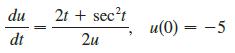
Find the solution of the differential equation that satisfies the given initial condition. du 2t + sec?t u(0) = -5 dt 2u
Let c be a positive number. A differential equation of the formwhere k is a positive constant, is called a doomsday equation because the exponent in the expression ky1+c is larger than the exponent 1 for natural growth.(a) Determine the solution that satisfies the initial condition y(0) = y0(b)
Solve the initial-value problem.xy' – 2y = 2x, y(2) = 0
Solve the initial-value problem.x2y' + 2xy = ln x, y(1) = 2
Solve the initial-value problem. dy + 3r'y = cos t, y(7) = 0 dt
Solve the initial-value problem. du t = 1? + 3u, t> 0, u(2) = 4 = dt
Use Euler’s method with step size 0.5 to compute the approximate y values y1, y2, y3, and y4 of the solution of the initial-value problem y' = y – 2x, y(1) = 0.
Solve the initial-value problem.xy' + y = x ln x, y(1) = 0
Use Euler’s method with step size 0.2 to estimate y(1), where y(x) is the solution of the initial-value problem y' = x2 y – 1/2y2, y(0) = 1.
Find the function f such that f'(x) = x f(x) − x and f(0) = 2.
Solve the initial-value problem.xy' = y + x2 sin x, y(π) = 0
Use Euler’s method with step size 0.1 to estimate y(0.5), where y(x) is the solution of the initial-value problem y' = y + xy, y(0) = 1.
Solve the initial-value problem. dy + 3x(у — 1) — 0, у(0) - 2 dx (x² + 1)-
Solve the differential equation xy' = y + xey/x by making the change of variable v = y/x.
Brett weighs 85 kg and is on a diet of 2200 calories per day, of which 1200 are used automatically by basal metabolism. He spends about 15 cal/kg/day times his weight doing exercise. If 1 kg of fat contains 10,000 cal and we assume that the storage of calories in the form of fat is 100% efficient,
Solve the differential equation and graph several members of the family of solutions. How does the solution curve change as C varies?xy' + 2y = ex
Solve the differential equation and graph several members of the family of solutions. How does the solution curve change as C varies?xy' = x2 + 2y
(a) Use Euler’s method with step size 0.01 to calculate y(2), where y is the solution of the initial-value problem y' = x3 – y3 y(0) = 1(b) Compare your answer to part (a) to the value of y(2) that appears on a computer-drawn solution curve.
Showing 2600 - 2700
of 4932
First
20
21
22
23
24
25
26
27
28
29
30
31
32
33
34
Last
Step by Step Answers

 Get 50% OFF
Claim Now
Get 50% OFF
Claim Now