New Semester
Started
Get
50% OFF
Study Help!
--h --m --s
Claim Now
Question Answers
Textbooks
Find textbooks, questions and answers
Oops, something went wrong!
Change your search query and then try again
S
Books
FREE
Study Help
Expert Questions
Accounting
General Management
Mathematics
Finance
Organizational Behaviour
Law
Physics
Operating System
Management Leadership
Sociology
Programming
Marketing
Database
Computer Network
Economics
Textbooks Solutions
Accounting
Managerial Accounting
Management Leadership
Cost Accounting
Statistics
Business Law
Corporate Finance
Finance
Economics
Auditing
Tutors
Online Tutors
Find a Tutor
Hire a Tutor
Become a Tutor
AI Tutor
AI Study Planner
NEW
Sell Books
Search
Search
Sign In
Register
study help
mathematics
first course differential equations
A First Course in Differential Equations with Modeling Applications 11th edition Dennis G. Zill - Solutions
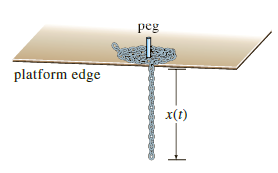
Falling Chain A portion of a uniform chain of length 8€‘ft is loosely coiled around a peg at the edge of a high horizontal platform, and the remaining portion of the chain hangs at rest over the edge of the platform. See the following. Suppose that the length of the overhanging chain is 3
True or False: Every separable first-order equation dy/dx = g(x)h(y) is exact.
Differential equations are sometimes solved by having a clever idea. Here is a little exercise in cleverness: Although the differential equation {x – √(x2 + y2)} dx + y dy = 0 is not exact, show how the rearrangement (x dx + y dy)/√(x2 + y2) = dx and the observation ½ d(x2 + y2) = x dx + y
Discuss how the functions M(x, y) and N(x, y) can be found so that each differential equation is exact. Carry out your ideas.(a) M(x, y) dx + (xexy + 2xy + 1/x) dy = 0(b) {x-1/2y1/2 + x/(x2 + y)} dx + N(x, y) dy = 0
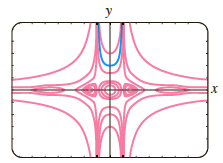
Discuss why we can conclude that the interval of definition of the explicit solution of the IVP (the blue curve in the following figure) is (21, 1). y
Consider the concept of an integrating factor. Are the two equations M dx + N dy = 0 and μM dx + μN dy = 0 necessarily equivalent in the sense that a solution of one is also a solution of the other? Discuss.
(a) Show that a one-parameter family of solutions of the equation(4xy + 3x2) dx + (2y + 2x2) dy = 0 is x3 + 2x2y + y2 = c.(b) Show that the initial conditions y(0) = -2 and y(1) = 1 determine the same implicit solution.(c) Find explicit solutions y1(x) and y2(x) of the differential equation in part
Solve the given initial-value problem by finding, as in Example 4, an appropriate integrating factor.(x2 + y2 - 5) dx = (y + xy) dy, y(0) = 1
Solve the given initial-value problem by finding, as in Example 4, an appropriate integrating factor.x dx + (x2y + 4y) dy = 0, y(4) = 0
Solve the given differential equation by finding, as in Example 4, an appropriate integrating factor.(y2 + xy3) dx + (5y2 - xy + y3 sin y) dy = 0
Solve the given differential equation by finding, as in Example 4, an appropriate integrating factor.(10 - 6y + e-3x) dx - 2 dy = 0
Solve the given differential equation by finding, as in Example 4, an appropriate integrating factor.cos x dx + (1 + 2/y) sin x dy = 0
Solve the given differential equation by finding, as in Example 4, an appropriate integrating factor.6xy dx + (4y + 9x2) dy = 0
Solve the given differential equation by finding, as in Example 4, an appropriate integrating factor.y(x + y + 1) dx + (x + 2y) dy = 0
Solve the given differential equation by finding, as in Example 4, an appropriate integrating factor.(2y2 + 3x) dx + 2xy dy = 0
Verify that the given differential equation is not exact. Multiply the given differential equation by the indicated integrating factor μ(x, y) and verify that the new equation is exact. Solve.(x2 + 2xy - y2) dx + (y2 + 2xy - x2) dy = 0; μ(x, y) = (x + y)-2
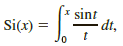
(a) Use a CAS to graph the solution curve of the initial-value problem in Problem 47 on the interval [0, ˆž).(b) Use a CAS to nd the value of the absolute maximum of the solution y(x) on the interval.Data from problem 47The sine integral function is defined aswhere the integrand
Find the value of k so that the given differential equation is exact.(6xy3 + cos y) dx + (2kx2y2 - x sin y) dy = 0
Verify that the given differential equation is not exact. Multiply the given differential equation by the indicated integrating factor μ(x, y) and verify that the new equation is exact. Solve.(-xy sin x + 2y cos x) dx + 2x cos x dy = 0; μ(x, y) = xy
Find the value of k so that the given differential equation is exact.(y3 + kxy4 - 2x) dx + (3xy2 + 20x2y3) dy = 0
Solve the given initial-value problem.{(1/1 + y2)} + cos x - 2xy) dy/dx = y(y + sin x), y(0) = 1
Solve the given initial-value problem.(y2 cos x - 3x2y - 2x) dx + (2y sin x - x3 + ln y) dy = 0, y(0) = e
Solve the given initial-value problem.(3y2 - t2/y5) – dy/dt + t/2y4 = 0, y(1) = 1
Solve the given initial-value problem.(4y + 2t - 5) dt + (6y + 4t - 1) dy = 0, y(-1) = 2
Solve the given initial-value problem.(ex + y) dx + (2 + x + yey) dy = 0, y(0) = 1
Solve the given initial-value problem.(x + y)2 dx + (2xy + x2 - 1) dy = 0, y(1) = 1
Determine whether the given differential equation is exact. If it is exact, solve it.{1/t + 1/t2 – y/(t2 + y2)} dt + {yey + t/(t2 + y2)} dy = 0
Determine whether the given differential equation is exact. If it is exact, solve it.(4t3y - 15t2 - y) dt + (t4 + 3y2 -t) dy = 0
Determine whether the given differential equation is exact. If it is exact, solve it.(2y sin x cos x - y + 2y2exy2) dx = (x - sin2 x - 4xyexy2 ) dy
Determine whether the given differential equation is exact. If it is exact, solve it.(tan x - sin x sin y) dx + cos x cos y dy = 0
Determine whether the given differential equation is exact. If it is exact, solve it.(5y - 2x)y9 - 2y = 0
Determine whether the given differential equation is exact. If it is exact, solve it.(x2y3 – 1/1 + 9x2) dx/dy + x3y2 = 0
Determine whether the given differential equation is exact. If it is exact, solve it.(1 – 3/y + x) dy/dx + y = 3/x - 1
Determine whether the given differential equation is exact. If it is exact, solve it.x dy/dx = 2xex - y + 6x2
Determine whether the given differential equation is exact. If it is exact, solve it.(3x2y + ey) dx + (x3 + xey - 2y) dy = 0
Determine whether the given differential equation is exact. If it is exact, solve it.(y ln y – e-xy) dx + (1/y + x ln y) dy = 0
Determine whether the given differential equation is exact. If it is exact, solve it.(x3 + y3) dx + 3xy2 dy = 0
Determine whether the given differential equation is exact. If it is exact, solve it.(x - y3 + y2 sin x) dx = (3xy2 + 2y cos x) dy
Determine whether the given differential equation is exact. If it is exact, solve it.(1 + ln x + y/x)dx = (1 - ln x) dy
Determine whether the given differential equation is exact. If it is exact, solve it.(x2 - y2) dx + (x2 - 2xy) dy = 0
Determine whether the given differential equation is exact. If it is exact, solve it.(2y – 1/x + cos 3x)dy/dx + y/x2 – 4x3 + 3y sin 3x = 0
Determine whether the given differential equation is exact. If it is exact, solve it.(2xy2 - 3) dx + (2x2y + 4) dy = 0
Determine whether the given differential equation is exact. If it is exact, solve it.(sin y - y sin x) dx + (cos x - x cos y - y) dy = 0
Determine whether the given differential equation is exact. If it is exact, solve it.(5x + 4y) dx + (4x - 8y3) dy = 0
Determine whether the given differential equation is exact. If it is exact, solve it.(2x + y) dx - (x + 6y) dy = 0
Determine whether the given differential equation is exact. If it is exact, solve it.(2x - 1) dx + (3y + 7) dy = 0
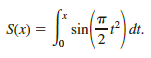
(a) Use a CAS to graph the solution curve of the initial-value problem in Problem 48 on the interval (-ˆž, ˆž).(b) It is known that Fresnel sine integral S(x) †’ 1/2 as x †’ ˆž and S(x) †’ -1/2 as x †’ -ˆž. What does
(a) Use a CAS to graph the solution curve of the initial-value problem in Problem 44 on the interval (-∞, ∞).(b) Use tables or a CAS to value the value y(2).Data from problem 44Proceed as in Example 7 and express the solution of the given initial-value problem in terms of erfc(x).dy/dx - 2xy =
Heart Pacemaker A heart pacemaker consists of a switch, a battery of constant voltage E0, a capacitor with constant capacitance C, and the heart as a resistor with constant resistance R. When the switch is closed, the capacitor charges; when the switch is open, the capacitor discharges, sending an
The following system of differential equations is encountered in the study of the decay of a special type of radioactive series of elements:dx/dt = λ1xdy/dt = λ1x – λ2y,where λ1 and λ2 are constants. Discuss how to solve this system subject to x(0) = x0, y(0) = y0. Carry out your ideas.
Suppose P(x) is continuous on some interval I and α is a number in I. What can be said about the solution of the initial-value problem y' + P(x)y = 0, y(a) = 0?
In determining the integrating factor (3), we did not use a constant of integration in the evaluation of ∫P(x) dx. Explain why using ∫P(x) dx + c1 has no effect on the solution of (2).
(a) Construct a linear first-order differential equation of the form xy' + 3y = g(x) for which y = x3 1 c/x3 is its general solution. Give an interval I of definition of this solution.(b) Give an initial condition y(x0) = y0 for the DE found in part (a) so that the solution of the IVP is y = x3
Use a graphing utility to graph the continuous function y(x).dy/dx + 2xy = f (x), y(0) = 2, where
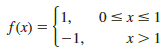
Use a graphing utility to graph the continuous function y(x).dy/dx + y = f (x), y(0) = 1, where 1, f(x) = -1,
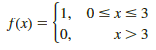
Use a graphing utility to graph the continuous function y(x).dy/dx + 2y = f (x), y(0) = 0, where |1, 0sx
Solve the given initial-value problem. Give the largest interval I over which the solution is defined.y' + (tan x)y = cos2x, y(0) = -1
Solve the given initial-value problem. Give the largest interval I over which the solution is defined.y' - (sin x)y = 2 sin x, y(π/2) = 1
Solve the given initial-value problem. Give the largest interval I over which the solution is defined.x(x + 1) dy/dx + xy = 1, y(e) = 1
Solve the given initial-value problem. Give the largest interval I over which the solution is defined.(x + 1) dy/dx + y = ln x, y(1) = 10
Solve the given initial-value problem. Give the largest interval I over which the solution is defined.y' + 4xy = x3ex2, y(0) = -1
Solve the given initial-value problem. Give the largest interval I over which the solution is defined.x dy/dx + y = 4x + 1, y(1) = 8
Solve the given initial-value problem. Give the largest interval I over which the solution is defined.dT/dt = k(T - Tm), T(0) = T0, k, Tm, T0 constants
Solve the given initial-value problem. Give the largest interval I over which the solution is defined.L di/dt + Ri = E, i(0) = i0, L, R, E, i0 constants
Solve the given initial-value problem. Give the largest interval I over which the solution is defined.y dx/dy - x = 2y2, y(1) = 5
Solve the given initial-value problem. Give the largest interval I over which the solution is defined.y dx/dy - x = 2y2, y(1) = 5
Solve the given initial-value problem. Give the largest interval I over which the solution is defined.xy' + y = ex, y(1) = 2
Solve the given initial-value problem. Give the largest interval I over which the solution is defined.dy/dx = 2x - 3y, y(0) = 1/3
Solve the given initial-value problem. Give the largest interval I over which the solution is defined.dy/dx = x + 5y, y(0) = 3
Find the general solution of the given differential equation. Give the largest interval I over which the general solution is defined. Determine whether there are any transient terms in the general solution.(x2 - 1) dy/dx + 2y = (x + 1)2
Find the general solution of the given differential equation. Give the largest interval I over which the general solution is defined. Determine whether there are any transient terms in the general solution.x dy/dx + (3x + 1)y = e-3x
Find the general solution of the given differential equation. Give the largest interval I over which the general solution is defined. Determine whether there are any transient terms in the general solution.dP/dt + 2tP = P + 4t - 2
Find the general solution of the given differential equation. Give the largest interval I over which the general solution is defined. Determine whether there are any transient terms in the general solution.dr/dθ + r sec θ = cos θ
Find the general solution of the given differential equation. Give the largest interval I over which the general solution is defined. Determine whether there are any transient terms in the general solution.(x + 2)2 dy/dx = 5 - 8y - 4xy
Find the general solution of the given differential equation. Give the largest interval I over which the general solution is defined. Determine whether there are any transient terms in the general solution.(x + 1) dy/dx + (x + 2)y = 2xe-x
Find the general solution of the given differential equation. Give the largest interval I over which the general solution is defined. Determine whether there are any transient terms in the general solution.cos2x sin x dy/dx + (cos3x)y = 1
Find the general solution of the given differential equation. Give the largest interval I over which the general solution is defined. Determine whether there are any transient terms in the general solution.cos x dy/dx + (sin x)y = 1
Find the general solution of the given differential equation. Give the largest interval I over which the general solution is defined. Determine whether there are any transient terms in the general solution.y dx - 4(x + y6) dy = 0
Find the general solution of the given differential equation. Give the largest interval I over which the general solution is defined. Determine whether there are any transient terms in the general solution.xy' + (1 + x)y = e-x sin 2x
Find the general solution of the given differential equation. Give the largest interval I over which the general solution is defined. Determine whether there are any transient terms in the general solution.x2y' + x(x + 2)y = ex
Find the general solution of the given differential equation. Give the largest interval I over which the general solution is defined. Determine whether there are any transient terms in the general solution.(1 + x) dy/dx - xy = x + x2
Find the general solution of the given differential equation. Give the largest interval I over which the general solution is defined. Determine whether there are any transient terms in the general solution.x dy/dx + 4y = x3 - x
Find the general solution of the given differential equation. Give the largest interval I over which the general solution is defined. Determine whether there are any transient terms in the general solution.x dy/dx + 2y = 3
Find the general solution of the given differential equation. Give the largest interval I over which the general solution is defined. Determine whether there are any transient terms in the general solution.x dy/dx – y = x2 sin x
Find the general solution of the given differential equation. Give the largest interval I over which the general solution is defined. Determine whether there are any transient terms in the general solution.y' = 2y + x2 + 5
Find the general solution of the given differential equation. Give the largest interval I over which the general solution is defined. Determine whether there are any transient terms in the general solution.x2y' + xy = 1
Find the general solution of the given differential equation. Give the largest interval I over which the general solution is defined. Determine whether there are any transient terms in the general solution.y' + 2xy = x3
Find the general solution of the given differential equation. Give the largest interval I over which the general solution is defined. Determine whether there are any transient terms in the general solution.y' + 3x2y = x2
Find the general solution of the given differential equation. Give the largest interval I over which the general solution is defined. Determine whether there are any transient terms in the general solution.3dy/dx + 12y = 4
Find the general solution of the given differential equation. Give the largest interval I over which the general solution is defined. Determine whether there are any transient terms in the general solution.dy/dx + y = e3x
Find the general solution of the given differential equation. Give the largest interval I over which the general solution is defined. Determine whether there are any transient terms in the general solution.dy/dx + 2y = 0
Find the general solution of the given differential equation. Give the largest interval I over which the general solution is defined. Determine whether there are any transient terms in the general solution.dy/dx = 5y
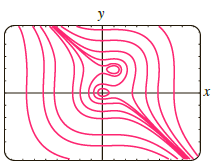
(a) Use a CAS and the concept of level curves to plot representative graphs of members of the family of solutions of the differential equationdy/dx = x(1 - x)/y(-2 + y).Experiment with different numbers of level curves as well as various rectangular regions in the xy-plane until your result
(a) Find an implicit solution of the IVP(2y + 2)dy - (4x3 + 6x)dx = 0, y(0) = -3.(b) Use part (a) to nd an explicit solution y = -(x) of the IVP.(c) Consider your answer to part (b) as a function only. Use a graphing utility or a CAS to graph this function, and then use the graph to estimate its
(a) Use a CAS and the concept of level curves to plot representative graphs of members of the family of solutions of the differential equationdy/dx = - (8x + 5) / (3y – 11). Experiment with different numbers of level curves as well as various rectangular regions dened by a ≤ x ≤ b, c ≤ y
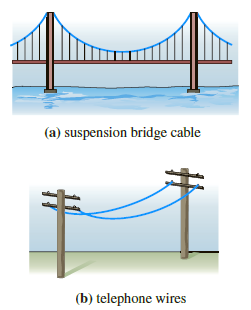
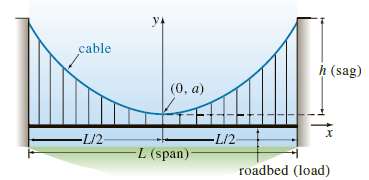
In (16) of Section 1.3 we saw that a mathematical model for the shape of a exible cable strung between two vertical supports isdy/dx = W/T1 €¦€¦€¦€¦€¦.. (11)where W denotes the portion of the total vertical load between the points P1 and
(a) The differential equation in Problem 27 is equivalent to the normal formDy/dx = √(1 - y2) / (1 - x2) in the square region in the xy-plane dened by |x| < 1 < |y| , 1. But the quantity under the radical is nonnegative also in the regions dened by |x| > 1 > |y| . 1. Sketch
Find a function whose square plus the square of its derivative is 1.
(a) Solve the two initial-value problems:Dy/dx = y, y(0) = 1anddy/dx = y + y/x ln x, y(e) = 1.(b) Show that there are more than 1.65 million digits in the y-coordinate of the point of intersection of the two solution curves in part (a).
We saw that every autonomous rstorder differential equation dy/dx = f (y) is separable. Does this fact help in the solution of the initial-value problemDy/dx = √(1+ y2) sin2 y, y(0) = ½ ?Discuss. Sketch, by hand, a plausible solution curve of the problem.
Showing 2300 - 2400
of 2513
First
12
13
14
15
16
17
18
19
20
21
22
23
24
25
26
Step by Step Answers

 Get 50% OFF
Claim Now
Get 50% OFF
Claim Now