New Semester
Started
Get
50% OFF
Study Help!
--h --m --s
Claim Now
Question Answers
Textbooks
Find textbooks, questions and answers
Oops, something went wrong!
Change your search query and then try again
S
Books
FREE
Study Help
Expert Questions
Accounting
General Management
Mathematics
Finance
Organizational Behaviour
Law
Physics
Operating System
Management Leadership
Sociology
Programming
Marketing
Database
Computer Network
Economics
Textbooks Solutions
Accounting
Managerial Accounting
Management Leadership
Cost Accounting
Statistics
Business Law
Corporate Finance
Finance
Economics
Auditing
Tutors
Online Tutors
Find a Tutor
Hire a Tutor
Become a Tutor
AI Tutor
AI Study Planner
NEW
Sell Books
Search
Search
Sign In
Register
study help
mathematics
first course differential equations
Differential Equations And Linear Algebra 4th Edition C. Edwards, David Penney, David Calvis - Solutions
A computer with a printer is required for Problems 17 through 24. In these initial value problems, use the improved Euler method with step sizes h = 0.1, 0.02, 0.004, and 0.0008 to approximate to five decimal places the values of the solution at ten equally spaced points of the given interval.
A computer with a printer is required for Problems 17 through 24. In these initial value problems, use the Runge–Kutta method with step sizes h = 0.2, 0.1, 0.05, and 0.025 to approximate to six decimal places the values of the solution at five equally spaced points of the given interval. Print
A computer with a printer is required for Problems 17 through 24. In these initial value problems, use the improved Euler method with step sizes h = 0.1, 0.02, 0.004, and 0.0008 to approximate to five decimal places the values of the solution at ten equally spaced points of the given interval.
A computer with a printer is required for Problems 17 through 24. In these initial value problems, use Euler’s method with step sizes h = 0.1, 0.02, 0.004, and 0.0008 to approximate to four decimal places the values of the solution at ten equally spaced points of the given interval. Print the
In each of Problems 23-30, a second-order differential equation and its general solution y(x) are given. Determine the constants A and B so as to find a solution of the differential equation that satisfies the given initial conditions involving y (0) and y' (0).y" + 2y' - 15y = 0, y(x) = Ae3x +
In Problems 11–22, use elementary row operations to transform each augmented coefficient matrix to echelon form. Then solve the system by back substitution.4x1 - 2x2 - 3x3 + x4 = 32x1 - 2x2 - 5x3 = -104x1 + x2 + 2x3 + x4 = 173x1
In Problems 11–22, use elementary row operations to transform each augmented coefficient matrix to echelon form. Then solve the system by back substitution.x1 + x2 + x3 = 62x1 - 2x2 - 5x3 = -133x1
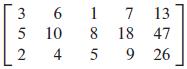
Find the reduced echelon form of each of the matrices given in Problems 1–20. 3 6 5 10 4 352 1 7 8 18 5 9 13 47 26
In Problems 11–22, use elementary row operations to transform each augmented coefficient matrix to echelon form. Then solve the system by back substitution.2x1 + 4x2 - x3 - 2x4 + 2x5 = 6x1 + 3x2 + 2x3 - 7x4 + 3x5 = 95x1 + 8x2 - 7x3 + 6x4 + x5 = 4
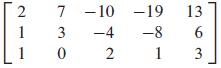
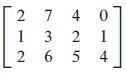
Find the reduced echelon form of each of the matrices given in Problems 1–20. 2 1 3 -4 0 2 L 1 7-10-19 13 6 13 -8
In Problems 11–22, use elementary row operations to transform each augmented coefficient matrix to echelon form. Then solve the system by back substitution.3x1 + x2 + x3 + 6x4 = 14x1 - 2x2 + 5x3 - 5x4 = -74x1 + x2 + 2x3 + 7x4 = 17
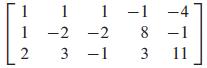
Find the reduced echelon form of each of the matrices given in Problems 1–20. 1 11 1 -2 -2 3-1 -1 -4 8-1 11 3
The linear systems in Problems 1–10 are in echelon form. Solve each by back substitution.x1 + x2 + 2x3 = 5 x2 + 3x3 = 6 x3 = 2
A computer with a printer is required for Problems 17 through 24. In these initial value problems, use the improved Euler method with step sizes h = 0.1, 0.02, 0.004, and 0.0008 to approximate to five decimal places the values of the solution at ten equally spaced points of the given interval.
A computer with a printer is required for Problems 17 through 24. In these initial value problems, use the Runge–Kutta method with step sizes h = 0.2, 0.1, 0.05, and 0.025 to approximate to six decimal places the values of the solution at five equally spaced points of the given interval. Print
A computer with a printer is required for Problems 17 through 24. In these initial value problems, use the improved Euler method with step sizes h = 0.1, 0.02, 0.004, and 0.0008 to approximate to five decimal places the values of the solution at ten equally spaced points of the given interval.
A computer with a printer is required for Problems 17 through 24. In these initial value problems, use Euler’s method with step sizes h = 0.1, 0.02, 0.004, and 0.0008 to approximate to four decimal places the values of the solution at ten equally spaced points of the given interval. Print the
A computer with a printer is required for Problems 17 through 24. In these initial value problems, use the Runge–Kutta method with step sizes h = 0.2, 0.1, 0.05, and 0.025 to approximate to six decimal places the values of the solution at five equally spaced points of the given interval. Print
A computer with a printer is required for Problems 17 through 24. In these initial value problems, use Euler’s method with step sizes h = 0.1, 0.02, 0.004, and 0.0008 to approximate to four decimal places the values of the solution at ten equally spaced points of the given interval. Print the
A computer with a printer is required for Problems 17 through 24. In these initial value problems, use the Runge–Kutta method with step sizes h = 0.2, 0.1, 0.05, and 0.025 to approximate to six decimal places the values of the solution at five equally spaced points of the given interval. Print
Find the reduced echelon form of each of the matrices given in Problems 1–20. 3 نیا
Find the reduced echelon form of each of the matrices given in Problems 1–20. 3] 3 7 25
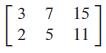
Find the reduced echelon form of each of the matrices given in Problems 1–20. 3 7 5 2 15 11
The linear systems in Problems 1–10 are in echelon form. Solve each by back substitution.2x1 - 5x2 + x3 = 2 3x2 - 2x3 = 9 x3 = -3
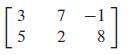
Find the reduced echelon form of each of the matrices given in Problems 1–20. 3 7 5 2 -1 8
The linear systems in Problems 1–10 are in echelon form. Solve each by back substitution.x1 - 3x2 + 4x3 = 7 x2 - 5x3 = 2
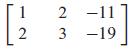
Find the reduced echelon form of each of the matrices given in Problems 1–20. 2 -11 2 3 -19
The linear systems in Problems 1–10 are in echelon form. Solve each by back substitution.x1 - 5x2 + 2x3 = 10 x2 - 7x3 = 5
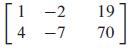
Find the reduced echelon form of each of the matrices given in Problems 1–20. จาก 4 -7
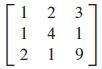
Find the reduced echelon form of each of the matrices given in Problems 1–20. L 12 2 1 3 1 4 219
The linear systems in Problems 1–10 are in echelon form. Solve each by back substitution.x1 + x2 - 2x3 + x4 = 9 X2 - X3 + 2x4 = 1 X3 - 3x4 = 5
The linear systems in Problems 1–10 are in echelon form. Solve each by back substitution.x1 - 2x2 + 5x3 - 3x4 = 7 x2 - 3x3 + 2x4 = 3 X4 = -4
The linear systems in Problems 1–10 are in echelon form. Solve each by back substitution.x1 + 2x2 + 4x3 - 5x4 = 17 x2 - 2x3 + 7x4 = 7
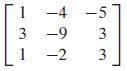
Find the reduced echelon form of each of the matrices given in Problems 1–20. 1 -4 3 -9 1-2 -5 3 3 نیا نیا
The linear systems in Problems 1–10 are in echelon form. Solve each by back substitution.x1 - 10x2 + 3x3 - 13x4 = 5 x3 + 3x4 = 10
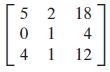
Find the reduced echelon form of each of the matrices given in Problems 1–20. 5 2 01 L 4 1 18 4 12
The linear systems in Problems 1–10 are in echelon form. Solve each by back substitution.2x1 + x2 + x3 + x4 = 6 3x2 - X3 - 2x4 = 2 3x3 + 4x4 = 9
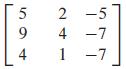
Find the reduced echelon form of each of the matrices given in Problems 1–20. -7 577 24 1 594
The linear systems in Problems 1–10 are in echelon form. Solve each by back substitution.x1 - 5x2 + 2x3 - 7x4 + 11x5 = 0 x2 - 13x3 + 3x4 - 7x5 = 0 X4 - 5x5 = 0
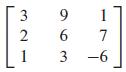
Find the reduced echelon form of each of the matrices given in Problems 1–20. 32 1 9 1 6 7 3-6
In Problems 11–22, use elementary row operations to transform each augmented coefficient matrix to echelon form. Then solve the system by back substitution.2x1 + 8x2 + 3x3 = 2x1 + 3x2 + 2x3 = 52x1 + 7x2 + 4x3 = 8
In Problems 11–22, use elementary row operations to transform each augmented coefficient matrix to echelon form. Then solve the system by back substitution.3x1 + x2 - 3x3 = 62x1 + 7x2 + x3 = -92x1 + 5x2 = -5
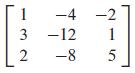
Find the reduced echelon form of each of the matrices given in Problems 1–20. 1 32 12 -4-2 1 5 -12 -8
Find the reduced echelon form of each of the matrices given in Problems 1–20. c 1 26 Ժ Ա + Ո 4
In Problems 11–22, use elementary row operations to transform each augmented coefficient matrix to echelon form. Then solve the system by back substitution.x1 + 3x2 + 3x3 = 132x1 + 5x2 + 4x3 = 232x1 + 7x2 + 8x3 = 29
In Problems 11–22, use elementary row operations to transform each augmented coefficient matrix to echelon form. Then solve the system by back substitution.3x1 - 6x2 - 2x3 = 12x1 - 4x2 + x3 = 17x1 - 2x2 - 2x3 = -9
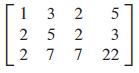
Find the reduced echelon form of each of the matrices given in Problems 1–20. 122 357 227 53 7 7 22
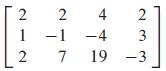
Find the reduced echelon form of each of the matrices given in Problems 1–20. 2 2 1 -1 2 7 4 -4 19 2 23 -3
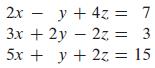
In Problems 11–22, use elementary row operations to transform each augmented coefficient matrix to echelon form. Then solve the system by back substitution.2x1 + 5x2 + 12x3 = 63x1 + x2 + 5x3 = 125x1 + 8x2 + 21x3 = 17
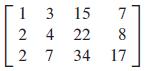
Find the reduced echelon form of each of the matrices given in Problems 1–20. 1 3 15 2 4 22 2 7 34 7 7x 8 17
In Problems 11–22, use elementary row operations to transform each augmented coefficient matrix to echelon form. Then solve the system by back substitution.x1 - 4x2 - 3x3 - 3x4 = 42x1 - 6x2 -5x3 - 5x4 = 53x1 - x2 - 4x3 - 5x4 = -7
In each of Problems 1–22, use the method of elimination to determine whether the given linear system is consistent or inconsistent. For each consistent system, find the solution if it is unique; otherwise, describe the infinite solution set in terms of an arbitrary parameter t (as in Examples 5
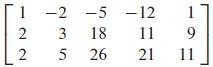
Find the reduced echelon form of each of the matrices given in Problems 1–20. 1 2 L 2 -2 -5 3 18 5 5 26 -12 11 21 1 9 11
This problem outlines a proof that two linear systems LS1 and LS2 are equivalent (that is, have the same solution set) if their augmented coefficient matrices A1 and A2 are row equivalent.(a) If a single elementary row operation transforms A1 to A2, show directly—considering separately the
Show that the two matrices in (1) are both row equivalent to the 3 x 3 identity matrix (and hence, by Theorem 1, to each other). THEOREM 1 Unique Reduced Echelon Form Every matrix is row equivalent to one and only one reduced echelon matrix.
A system of the forma1x + b1y = 0a2x + b2y = 0,in which the constants on the right-hand side are all zero, is said to be homogeneous. Explain by geometric reasoning why such a system has either a unique solution or infinitely many solutions. In the former case, what is the unique solution?
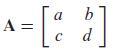
Show that the 2 x 2 matrixis row equivalent to the 2 x 2 identity matrix provided that ad - bc ≠ 0. A = [a b d
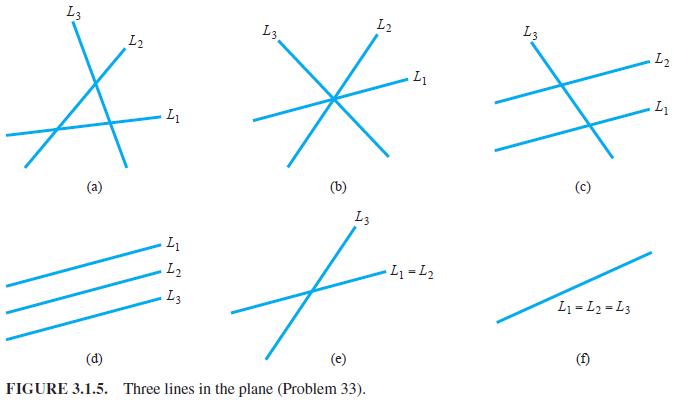
The linear systema1x + b1y = c1a2x + b2y = c2a3x + b3y = c3of three equations in two unknowns represents three lines L1, L2, and L3 in the xy-plane. Figure 3.1.5 shows six possible configurations of these three lines. In each case describe the solution set of the system.
List all possible reduced row-echelon forms of a 3 x 3 matrix, using asterisks to indicate elements that may be either zero or nonzero.
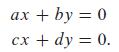
Consider the homogeneous system(a) If x = x0 and y = y0 is a solution and k is a real number, then show that x = kx0 and y = ky0 is also a solution.(b) If x = x1, y = y1 and x = x2, y = y2 are both solutions, then show that x = x1 + x2, y = y1 + y2 is a solution. ax + by = 0 cx + dy = 0.
Consider the linear systema1x + b1y + c1z = d1a2x + b2y + c2z = d2a3x + b3y + c3z = d3of three equations in three unknowns to represent three planes P1, P2, and P3 in xyz-space. Describe the solution set of the system in each of the following cases.(a) The three planes are parallel and distinct.(b)
Let E be an echelon matrix that is row equivalent to the matrix A. Show that E has the same number of nonzero rows as does the reduced echelon form E* of A. Thus the number of nonzero rows in an echelon form of A is an “invariant” of the matrix A. Suggestion: Consider reducing E to E*.
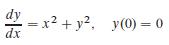
Apply Euler’s method with successively smaller step sizes on the interval [0,2] to verify empirically that the solution of the initial value problemhas a vertical asymptote near x = 2.003147. (Contrast this with Example 2, in which y(0) = 1.) dy dx = x² + y². y(0) = 0
The general solution of the equationis y(x) = tan(C + sin x) With the initial condition y(0) = 0 the solution y(x) = tan(sin x) is well behaved. But with y(0) = 1 the solution y(x) = tan (1/4π sin x) has a vertical asymptote at x = sin-1 (π/4) ≈ 0.90334. Use Euler’s method to verify this fact
A computer with a printer is required for Problems 17 through 24. In these initial value problems, use Euler’s method with step sizes h = 0.1, 0.02, 0.004, and 0.0008 to approximate to four decimal places the values of the solution at ten equally spaced points of the given interval. Print the
Use the improved Euler method with a computer system to find the desired solution values in Problems 27 and 28. Start with step size h = 0.1, and then use successively smaller step sizes until successive approximate solution values at x = 2 agree rounded off to four decimal places. y' = x + y²,
Use Euler’s method with a computer system to find the desired solution values in Problems 27 and 28. Start with step size h = 0.1, and then use successively smaller step sizes until successive approximate solution values at x = 2 agree rounded off to two decimal places.y' = x2 + y2 - 1, y(0) = 0;
A computer with a printer is required for Problems 17 through 24. In these initial value problems, use the improved Euler method with step sizes h = 0.1, 0.02, 0.004, and 0.0008 to approximate to five decimal places the values of the solution at ten equally spaced points of the given interval.
Use the improved Euler method with a computer system to find the desired solution values in Problems 27 and 28. Start with step size h = 0.1, and then use successively smaller step sizes until successive approximate solution values at x = 2 agree rounded off to four decimal places. y' = x² + y²1,
Use the Runge–Kutta method with a computer system to find the desired solution values in Problems 27 and 28. Start with step size h = 1, and then use successively smaller step sizes until successive approximate solution values at x = 2 agree rounded off to five decimal places. y = x² + y²-1,
Consider the initial value problem(a) Solve this problem for the exact solutionwhich has an infinite discontinuity at x = 0.(b) Apply Euler’s method with step size h = 0.15 to approximate this solution on the interval -1 ≦ x ≦ 0.5. Note that, from these data alone, you might not suspect any
Use the Runge–Kutta method with a computer system to find the desired solution values in Problems 27 and 28. Start with step size h = 1, and then use successively smaller step sizes until successive approximate solution values at x = 2 agree rounded off to five decimal places. y' = x + y²₁
Use Euler’s method with a computer system to find the desired solution values in Problems 27 and 28. Start with step size h = 0.1, and then use successively smaller step sizes until successive approximate solution values at x = 2 agree rounded off to two decimal places.y' = x + 1/2y2, y(-2) = 0;
Find general solutions of the differential equations in Problems 1 through 30. Primes denote derivatives with respect to x.x3 + 3y - xy' = 0
Find general solutions of the differential equations in Problems 1 through 30. Primes denote derivatives with respect to x throughout.(x + y) y' = x - y
Find general solutions of the differential equations in Problems 1 through 30. Primes denote derivatives with respect to x.xy2 + 3y2 - x2y' = 0
Find general solutions of the differential equations in Problems 1 through 30. Primes denote derivatives with respect to x throughout.2xy y' = x2 + 2y2
Find general solutions of the differential equations in Problems 1 through 30. Primes denote derivatives with respect to x.xy + y2 - x2y' = 0
Find general solutions of the differential equations in Problems 1 through 30. Primes denote derivatives with respect to x throughout.xy' = y + 2√xy
Find general solutions of the differential equations in Problems 1 through 30. Primes denote derivatives with respect to x.2xy3 + ex + (3x2y2 + sin y) y' = 0
Find general solutions of the differential equations in Problems 1 through 30. Primes denote derivatives with respect to x throughout.(x - y) y' = x + y
Find general solutions of the differential equations in Problems 1 through 30. Primes denote derivatives with respect to x.3y + x4y' = 2xy
Find general solutions of the differential equations in Problems 1 through 30. Primes denote derivatives with respect to x throughout.x(x + y) y' = y(x - y)
Find general solutions of the differential equations in Problems 1 through 30. Primes denote derivatives with respect to x.2xy2 + x2y' = y2
Find general solutions of the differential equations in Problems 1 through 30. Primes denote derivatives with respect to x throughout.(x + 2y) y' = y
Find general solutions of the differential equations in Problems 1 through 30. Primes denote derivatives with respect to x.2x2y + x3y' = 1
Find general solutions of the differential equations in Problems 1 through 30. Primes denote derivatives with respect to x throughout.xy2y' = x3 + y3
Find general solutions of the differential equations in Problems 1 through 30. Primes denote derivatives with respect to x.xy' + 2y = 6x2 √y
Find general solutions of the differential equations in Problems 1 through 30. Primes denote derivatives with respect to x throughout. xy' = y + √√x² + y²
Find general solutions of the differential equations in Problems 1 through 30. Primes denote derivatives with respect to x.2xy + x2y' = y2
Find general solutions of the differential equations in Problems 1 through 30. Primes denote derivatives with respect to x throughout.x2y' = xy + x2 ey/x
Find general solutions of the differential equations in Problems 1 through 30. Primes denote derivatives with respect to x throughout. xyy = y2 + xv4x2+y2
Find general solutions of the differential equations in Problems 1 through 30. Primes denote derivatives with respect to x throughout. yy' + x = √√√√x² + y² x2
Find general solutions of the differential equations in Problems 1 through 30. Primes denote derivatives with respect to x throughout.x2y' = xy + y2
Find general solutions of the differential equations in Problems 1 through 30. Primes denote derivatives with respect to x.y' = 1 + x2 + y2 + x2y2
Find general solutions of the differential equations in Problems 1 through 30. Primes denote derivatives with respect to x throughout.xyy' = x2 + 3y2
Find general solutions of the differential equations in Problems 1 through 30. Primes denote derivatives with respect to x throughout. y' = = √√√x+y+I
Find general solutions of the differential equations in Problems 1 through 30. Primes denote derivatives with respect to x.x2y' = xy + 3y2
Find general solutions of the differential equations in Problems 1 through 30. Primes denote derivatives with respect to x throughout.(x2 - y2)y' = 2xy
Find general solutions of the differential equations in Problems 1 through 30. Primes denote derivatives with respect to x.6xy3 + 2y4 + (9x2y2 + 8xy3)y' = 0
Showing 1500 - 1600
of 2513
First
9
10
11
12
13
14
15
16
17
18
19
20
21
22
23
Last
Step by Step Answers

 Get 50% OFF
Claim Now
Get 50% OFF
Claim Now