New Semester
Started
Get
50% OFF
Study Help!
--h --m --s
Claim Now
Question Answers
Textbooks
Find textbooks, questions and answers
Oops, something went wrong!
Change your search query and then try again
S
Books
FREE
Study Help
Expert Questions
Accounting
General Management
Mathematics
Finance
Organizational Behaviour
Law
Physics
Operating System
Management Leadership
Sociology
Programming
Marketing
Database
Computer Network
Economics
Textbooks Solutions
Accounting
Managerial Accounting
Management Leadership
Cost Accounting
Statistics
Business Law
Corporate Finance
Finance
Economics
Auditing
Tutors
Online Tutors
Find a Tutor
Hire a Tutor
Become a Tutor
AI Tutor
AI Study Planner
NEW
Sell Books
Search
Search
Sign In
Register
study help
mathematics
first course differential equations
Differential Equations And Linear Algebra 4th Edition C. Edwards, David Penney, David Calvis - Solutions
In Problems 27 through 31, a function y = g(x) is described by some geometric property of its graph. Write a differential equation of the form dy/dx = f (x, y) having the function g as its solution (or as one of its solutions).The line tangent to the graph of g at the point (x, y) intersects the
Find general solutions of the differential equations in Problems 1 through 30. Primes denote derivatives with respect to x.y + xy' = 2e2x
Find general solutions of the differential equations in Problems 1 through 30. Primes denote derivatives with respect to x throughout.(2x sin y cos y) y' = 4x2 + sin2 y
Find general solutions of the differential equations in Problems 1 through 30. Primes denote derivatives with respect to x.(2x + 1)y' + y = (2x + 1)3/2
In Problems 31 through 42, verify that the given differential equation is exact; then solve it. (2x + 3y) dx + (3x + 2y) dy = 0
Find general solutions of the differential equations in Problems 1 through 30. Primes denote derivatives with respect to x throughout.(x + ey) y' = xe-y -1
Find general solutions of the differential equations in Problems 1 through 30. Primes denote derivatives with respect to x.y' = √x + y
In Problems 27 through 31, a function y = g(x) is described by some geometric property of its graph. Write a differential equation of the form dy/dx = f (x, y) having the function g as its solution (or as one of its solutions).The graph of g is normal to every curve of the form y = x2 + k (k is a
In Problems 31 through 42, verify that the given differential equation is exact; then solve it. (x³ + ²) dx + (y² + lnx) dy = 0
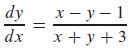
Each of the differential equations in Problems 31 through 36 is of two different types considered in this chapter—separable, linear, homogeneous, Bernoulli, exact, etc. Hence, derive general solutions for each of these equations in two different ways; then reconcile your results. dy dx x + 3y y -
In Problems 31 through 42, verify that the given differential equation is exact; then solve it. (2xy2 + 3x2) dx + (2x2y + 4y³) dy = 0
Each of the differential equations in Problems 31 through 36 is of two different types considered in this chapter—separable, linear, homogeneous, Bernoulli, exact, etc. Hence, derive general solutions for each of these equations in two different ways; then reconcile your results. dy dx 3.x² +
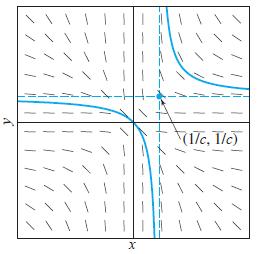
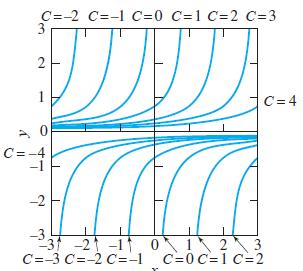
If c ≠ 0, verify that the function defined by y(x) x/(cx - 1) (with the graph illustrated in Fig. 1.3.26) sat- isfies the differential equation x2y' + y2 = 0 if x ≠ 1/c. Sketch a variety of such solution curves for different val- ues of c. Also, note the constant-valued function y(x) ≡ 0 that
Problems 33 and 34 explore vertical motion on a planet with gravitational acceleration different than the Earth’s.A person can throw a ball straight upward from the surface of the earth to a maximum height of 144 ft. How high could this person throw the ball on the planet Gzyx of Problem
In Problems 31 through 42, verify that the given differential equation is exact; then solve it. (3x² + 2y2) dx + (4xy + 6y2) dy = 0
In Problems 32 through 36, write—in the manner of Eqs. (3) through (6) of this section—a differential equation that is a mathematical model of the situation described.The acceleration dv=dt of a Lamborghini is proportional to the difference between 250 km=h and the velocity of the car.
In a certain culture of bacteria, the number of bacteria increased sixfold in 10 h. How long did it take for the population to double?
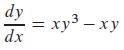
Each of the differential equations in Problems 31 through 36 is of two different types considered in this chapter—separable, linear, homogeneous, Bernoulli, exact, etc. Hence, derive general solutions for each of these equations in two different ways; then reconcile your results. dy dx =xy³ - xy
Problems 33 and 34 explore vertical motion on a planet with gravitational acceleration different than the Earth’s.On the planet Gzyx, a ball dropped from a height of 20 ft hits the ground in 2 s. If a ball is dropped from the top of a 200-ft-tall building on Gzyx, how long will it take to hit the
In Problems 32 through 36, write—in the manner of Eqs. (3) through (6) of this section—a differential equation that is a mathematical model of the situation described.The time rate of change of the velocity v of a coasting motorboat is proportional to the square of v.
In Problems 31 through 42, verify that the given differential equation is exact; then solve it. (4x - y) dx + (6y-x) dy = 0
Problems 29 through 32 explore the connections among general and singular solutions, existence, and uniqueness.Find a general solution and any singular solutions of the differential equation dy/dx = y√y2 - 1. Determine the points (a, b) in the plane for which the initial value problem y' = y√y2
Problems 30 through 32 explore the relation between the speed of an auto and the distance it skids when the brakes are applied.Suppose that a car skids 15 m if it is moving at 50 km/h when the brakes are applied. Assuming that the car has the same constant deceleration, how far will it skid if it
In Problems 32 through 36, write—in the manner of Eqs. (3) through (6) of this section—a differential equation that is a mathematical model of the situation described.The time rate of change of a population P is proportional to the square root of P.
Carry out an investigation similar to that in Problem 30, except with the differential equation y' = +√1- y2. Does it suffice simply to replace cos(x - c) with sin(x - c) in piecing together a solution that is defined for all x?
Problems 30 through 32 explore the relation between the speed of an auto and the distance it skids when the brakes are applied.The skid marks made by an automobile indicated that its brakes were fully applied for a distance of 75 m before it came to a stop. The car in question is known to have a
Discuss the difference between the differential equations (dy/dx)2 = 4y and dy/dx = 2√y. Do they have the same solution curves? Why or why not? Determine the points (a, b) in the plane for which the initial value problem y' = 2√y, y(a) = b has(a) No solution,(b) A unique solution,(c) Infinitely
In Problems 31 through 42, verify that the given differential equation is exact; then solve it. 2x5/2-3y5/3 2x5/2y2/3 - dx + 3y5/3-2x5/2 3x3/2y5/3 - dy = 0
Find a general solution of each reducible second-order differential equation in Problems 43–54. Assume x, y and/or y' positive where helpful (as in Example 11).yy" + (y')2 = 0 Example 11 Solve the equation yy" = (y')2 in which the independent variable x is missing.
In Problems 31 through 42, verify that the given differential equation is exact; then solve it. (ex sin y + tan y) dx + (ex cos y + x sec² y) dy = 0
Find a general solution of each reducible second-order differential equation in Problems 43–54. Assume x, y and/or y' positive where helpful (as in Example 11).xy" = y' Example 11 Solve the equation yy" = (y')2 in which the independent variable x is missing.
In Problems 31 through 42, verify that the given differential equation is exact; then solve it. 2x y 3y² x4 dx + + -15 dy = 0
In Problems 31 through 42, verify that the given differential equation is exact; then solve it. (x + tan-¹ y) dx + x + y 1+ y2 dy = 0
In Problems 31 through 42, verify that the given differential equation is exact; then solve it. 3,2 (3x²y³ + y4) dx + (3x³y² + y² + 4xy³) dy = 0
In Problems 31 through 42, verify that the given differential equation is exact; then solve it. (cosx + Iny) dx + G ( + e ²³ ) dy = 0
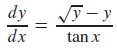
Each of the differential equations in Problems 31 through 36 is of two different types considered in this chapter—separable, linear, homogeneous, Bernoulli, exact, etc. Hence, derive general solutions for each of these equations in two different ways; then reconcile your results. dy dx y-y tan x
In Problems 31 through 42, verify that the given differential equation is exact; then solve it. (1+ yexy) dx + (2y + xexy) dy = 0
Suppose that sodium pentobarbital is used to anesthetize a dog. The dog is anesthetized when its bloodstream contains at least 45 milligrams (mg) of sodium pentobarbitol per kilogram of the dog’s body weight. Suppose also that sodium pentobarbitol is eliminated exponentially from the dog’s
Suppose that you discover in your attic an overdue library book on which your grandfather owed a fine of 30 cents 100 years ago. If an overdue fine grows exponentially at a 5% annual rate compounded continuously, how much would you have to pay if you returned the book today?
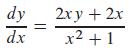
Each of the differential equations in Problems 31 through 36 is of two different types considered in this chapter—separable, linear, homogeneous, Bernoulli, exact, etc. Hence, derive general solutions for each of these equations in two different ways; then reconcile your results. dy dx 2xy +
In Problems 32 through 36, write—in the manner of Eqs. (3) through (6) of this section—a differential equation that is a mathematical model of the situation described.In a city with a fixed population of P persons, the time rate of change of the number N of those persons infected with a certain
Problems 33 through 37 illustrate the application of linear first-order differential equations to mixture problems.A tank initially contains 60 gal of pure water. Brine containing 1 lb of salt per gallon enters the tank at 2 gal/min, and the (perfectly mixed) solution leaves the tank at 3 gal/min;
Carbon taken from a purported relic of the time of Christ contained 4.6 x 10¹⁰ atoms of 14C per gram. Carbon extracted from a present-day specimen of the same substance contained 5.0 x 10¹⁰ atoms of 14C per gram. Compute the approximate age of the relic. What is your opinion as to its authenticity?
Problems 33 through 37 illustrate the application of linear first-order differential equations to mixture problems.Rework Example 4 for the case of Lake Ontario, which empties into the St. Lawrence River and receives inflow from Lake Erie (via the Niagara River). The only differences are that this
A stone is dropped from rest at an initial height h above the surface of the earth. Show that the speed with which it strikes the ground is v = √2gh.
Carbon extracted from an ancient skull contained only one sixth as much 14C as carbon extracted from present-day bone. How old is the skull?
In Problems 32 through 36, write—in the manner of Eqs. (3) through (6) of this section—a differential equation that is a mathematical model of the situation described.In a city having a fixed population of P persons, the time rate of change of the number N of those persons who have heard a
Problems 43 through 46 concern the differential equationwhere k is a constant.Suppose the velocity v of a motorboat coasting in water satisfies the differential equation dv/dt = kv2. The initial speed of the motorboat is v(0) = 10 meters per second (m/s), and v is decreasing at the rate of 1 m/s2
Find a general solution of each reducible second-order differential equation in Problems 43–54. Assume x, y and/or y' positive where helpful (as in Example 11).xy" + y' = 4x Example 11 Solve the equation yy" = (y')2 in which the independent variable x is missing.
Problems 43 through 46 concern the differential equationwhere k is a constant.Suppose a population P of rodents satisfies the differential equation dP/dt = kP2. Initially, there are P(0) = 2 rodents, and their number is increasing at the rate of dP/dt = 1 rodent per month when there are P = 10
Find a general solution of each reducible second-order differential equation in Problems 43–54. Assume x, y and/or y' positive where helpful (as in Example 11).y" = (y')2 Example 11 Solve the equation yy" = (y')2 in which the independent variable x is missing.
Find a general solution of each reducible second-order differential equation in Problems 43–54. Assume x, y and/or y' positive where helpful (as in Example 11).x2y" + 3xy' = 2 Example 11 Solve the equation yy" = (y')2 in which the independent variable x is missing.
Find a general solution of each reducible second-order differential equation in Problems 43–54. Assume x, y and/or y' positive where helpful (as in Example 11).yy" + (y')2 = yy' Example 11 Solve the equation yy" = (y')2 in which the independent variable x is missing.
Find a general solution of each reducible second-order differential equation in Problems 43–54. Assume x, y and/or y' positive where helpful (as in Example 11).y" = (x + y')2 Example 11 Solve the equation yy" = (y')2 in which the independent variable x is missing.
Find a general solution of each reducible second-order differential equation in Problems 43–54. Assume x, y and/or y' positive where helpful (as in Example 11).y3y" = 1 Example 11 Solve the equation yy" = (y')2 in which the independent variable x is missing.
Find a general solution of each reducible second-order differential equation in Problems 43–54. Assume x, y and/or y' positive where helpful (as in Example 11).y" = 2y (y')3 Example 11 Solve the equation yy" = (y')2 in which the independent variable x is missing.
Find a general solution of each reducible second-order differential equation in Problems 43–54. Assume x, y and/or y' positive where helpful (as in Example 11).y" = 2yy' Example 11 Solve the equation yy" = (y')2 in which the independent variable x is missing.
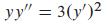
Find a general solution of each reducible second-order differential equation in Problems 43–54. Assume x, y and/or y' positive where helpful (as in Example 11).yy" = 3(y')2 Example 11 Solve the equation yy" = (y')2 in which the independent variable x is missing.
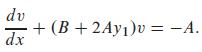
Suppose that n ≠ 0 and n ≠ 1. Show that the substitution v = y1-n transforms the Bernoulli equation dy/dx + P(x)y = Q(x)yn into the linear equation. dv dx +(1-n)P(x)v(x)=(1-n)Q(x).
Problems 54 through 64 illustrate the application of Torricelli’s law.A water tank has the shape obtained by revolving the curve y = x4/3 around the y-axis. A plug at the bottom is removed at 12 noon, when the depth of water in the tank is 12 ft. At 1 P.M. the depth of the water is 6 ft. When
Show that the substitution v = ln y transforms the differential equation dy/dx + P(x)y = Q(x)(y ln y) into the linear equation dv/dx + P(x) = Q(x)v(x).
Problems 54 through 64 illustrate the application of Torricelli’s law.At time t = 0 the bottom plug (at the vertex) of a full conical water tank 16 ft high is removed. After 1 h the water in the tank is 9 ft deep. When will the tank be empty?
Show that the substitution v = ax + by + c transforms the differential equation dy/dx = F(ax + by + c) into a separable equation.
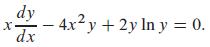
Use the idea in Problem 57 to solve the equationProblem 57Show that the substitution v = ln y transforms the differential equation dy/dx + P(x)y = Q(x)(y ln y) into the linear equation dv/dx + P(x) = Q(x)v(x). x dy dx - 4x2y + 2y ln y = 0.
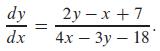
Use the method in Problem 59 to solve the differential equationProblem 59Solve the differential equationby finding h and k so that the substitutions x = u + h, y = v + k transform it into the homogeneous equation dy dx 2y-x + 7 4x3y 18
Problems 54 through 64 illustrate the application of Torricelli’s law.A cylindrical tank with length 5 ft and radius 3 ft is situated with its axis horizontal. If a circular bottom hole with a radius of 1 in. is opened and the tank is initially half full of water, how long will it take for the
Make an appropriate substitution to find a solution of the equation dy/dx = sin(x - y). Does this general solution contain the linear solution y(x) = x - π/2 that is readily verified by substitution in the differential equation?
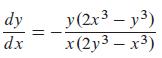
Show that the solution curves of the differential equationare of the form x3 + y3 = Cxy. dy dx =- || y (2x³ - y³) x(2y3x3)
Use the method of Problem 63 to solve the equations in Problems 64 and 65, given that y1(x) = x is a solution of each.Problem 63The equation dy/dx = A(x)y2 + B(x)y + C(x) is called a Riccati equation. Suppose that one particular solution y1(x) of this equation is known. Show that the
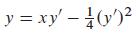
An equation of the formis called a Clairaut equation. Show that the one-parameter family of straight lines described byis a general solution of Eq. (37). y = xy' + g(y) (37)
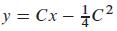
Consider the Clairaut equationfor which g(y') = -1/4 (y')2 in Eq. (37). Show that the lineis tangent to the parabolaExplain why this implies that y = x2 is a singular solution of the given Clairaut equation. This singular solution and the one-parameter family of straight line solutions are
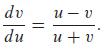
Derive Eq. (18) in this section from Eqs. (16) and (17). In (v + √√1 + v²) = -k ln x + C, (16)
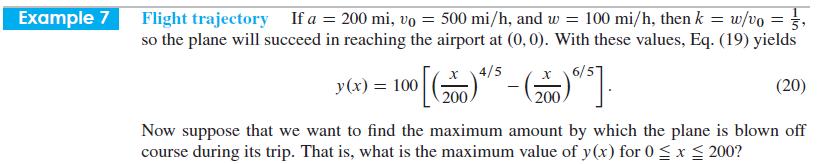
In the situation of Example 7, suppose that a = 100 mi, v0 = 400 mi/h, and w = 40 mi/h. Now how far northward does the wind blow the airplane? Example 7 Flight trajectory If a = 200 mi, vo = 500 mi/h, and w= 100 mi/h, then k = w/v₁ = //, so the plane will succeed in reaching the airport at (0,0).
As in the text discussion, suppose that an airplane maintains a heading toward an airport at the origin. If v0 = 500 mi/h and w = 50 mi/h (with the wind blowing due north), and the plane begins at the point (200,150), show that its trajectory is described by y+√√x² + y² = 2(200x9)1/10
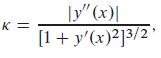
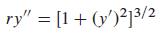
In the calculus of plane curves, one learns that the curvature k of the curve y = y(x) at the point (x, y) is given byand that the curvature of a circle of radius r is k = 1/r.Conversely, substitute ρ = y' to derive a general solution of the second-order differential equation(with r constant) in
A river 100 ft wide is flowing north at w feet per second. A dog starts at (100, 0) and swims at v0 = 4 ft/s, always heading toward a tree at (0, 0) on the west bank directly across from the dog’s starting point.(a) If w = 2 ft/s, show that the dog reaches the tree.(b) If w = 4 ft/s, show that
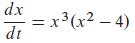
In Problems 13 through 18, use a computer system or graphing calculator to plot a slope field and/or enough solution curves to indicate the stability or instability of each critical point of the given differential equation. dx di = x³ (x²-4)
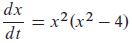
In Problems 13 through 18, use a computer system or graphing calculator to plot a slope field and/or enough solution curves to indicate the stability or instability of each critical point of the given differential equation. dx dt = x²(x² - 4)
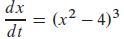
In Problems 13 through 18, use a computer system or graphing calculator to plot a slope field and/or enough solution curves to indicate the stability or instability of each critical point of the given differential equation. dx dt (x²-4)³ =
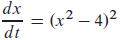
In Problems 13 through 18, use a computer system or graphing calculator to plot a slope field and/or enough solution curves to indicate the stability or instability of each critical point of the given differential equation. dx dt (x² - 4)²
Suppose that the population P(t) of a country satisfies the differential equation dP/dt = kP(200 - P) with k constant. Its population in 1960 was 100 million and was then growing at the rate of 1 million per year. Predict this country’s population for the year 2020.
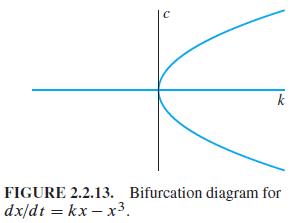
Consider the differential equation dx/dt = kx - x3. (a) If k ≦ 0, show that the only critical value c = 0 of x is stable.(b) If k > 0, show that the critical point c = 0 is now unstable, but that the critical points c = ±√k are stable. Thus the qualitative nature of the solutions changes
Consider two population functions P1(t) and P2(t), both of which satisfy the logistic equation with the same limiting population M but with different values k1 and k2 of the constant k in Eq. (3). Assume that k12. Which population approaches M the most rapidly? You can reason geometrically by
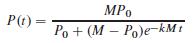
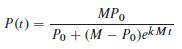
Derive the solutionof the logistic initial value problem P' = kP(M - P), P(0) = P0. Make it clear how your derivation depends on whether 0 0 0 > M. P(t)= MPo Po+(M-Po)e-kMt
(a) Derive the solutionof the extinction-explosion initial value problem P' = kP(P - M), P(0) = P0.(b) How does the behavior of P(t) as t increases depend on whether 0 0 0 > M? P(t)= MPo Po +(M-Po)ek Mt
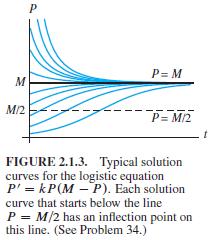
If P(t) satisfies the logistic equation in (3), use the chain rule to show thatConclude that P'' > 0 if 0 0 if P > M. In particular, it follows that any solution curve that crosses the line P = 1/2M has an inflection point where it crosses that line, and therefore resembles one of the lower
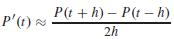
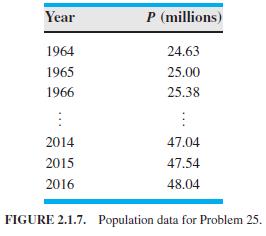
The data in the table in Fig. 2.1.7 are given for a certain population P(t) that satisfies the logistic equation in (3).(a) What is the limiting population M? (Suggestion: Use the approximationwith h = 1 to estimate the values of P'(t) when P = 25.00 and when P = 47.54. Then substitute these values
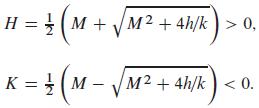
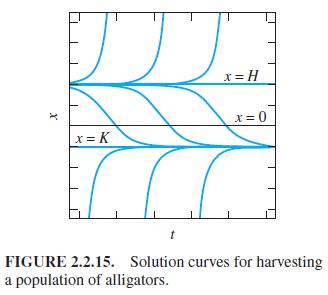
This problem deals with the differential equation dx/dt = kx(x - M) - h that models the harvesting of an unsophisticated population (such as alligators). Show that this equation can be rewritten in the form dx/dt = kx(x - H)(x - K), whereShow that typical solution curves look as illustrated in Fig.
During the period from 1790 to 1930, the U.S. population P(t) (t in years) grew from 3.9 million to 123.2 million. Throughout this period, P(t) remained close to the solution of the initial value problem(a) What 1930 population does this logistic equation predict?(b) What limiting population does
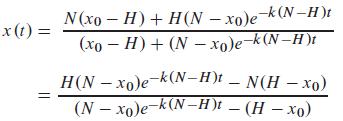
Use the alternative formsof the solution in (15) to establish the conclusions stated in (17) and (18). x (t) = N(xo-H) + H(N-xo)e-k(N-H)t (xo-H)+(N-xo)e-k(N-H)t H(N-xo)e-k(N-H)t - N(H - xo) (N − xo)e-k(N-H)t – (H — xo)
Separate variables in the logistic harvesting equation dx/dt = k(N - x)(x - H) and then use partial fractions to derive the solution given in Eq. (15). x(t) = N(xo-H)-H(xo-N)e-k(N-H)t (xo-H)-(xo-N)e-k(N-H)t (15)
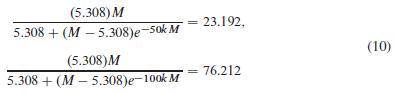
To solve the two equations in (10) for the values of k and M, begin by solving the first equation for the quantity x = e-50kM and the second equation for x2 = e-100kM. Upon equating the two resulting expressions for x2 in terms of M, you get an equation that is readily solved for M. With M now
A 30-year-old woman accepts an engineering position with a starting salary of $30,000 per year. Her salary S(t) increases exponentially, with S(t) = 30et/20 thousand dollars after t years. Meanwhile, 12% of her salary is deposited continuously in a retirement account, which accumulates interest at
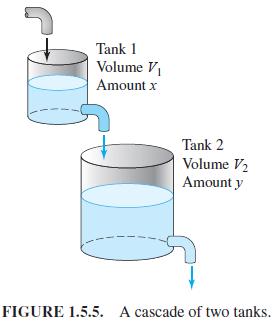
Suppose that in the cascade shown in Fig. 1.5.5, tank 1 initially contains 100 gal of pure ethanol and tank 2 initially contains 100 gal of pure water. Pure water flows into tank 1 at 10 gal/min, and the other two flow rates are also 10 gal/min.(a) Find the amounts x(t) and y(t) of ethanol in the
The half-life of radioactive cobalt is 5.27 years. Suppose that a nuclear accident has left the level of cobalt radiation in a certain region at 100 times the level acceptable for human habitation. How long will it be until the region is again habitable? (Ignore the probable presence of other
(a) Use the direction field of Problem 6 to estimate the values at x = 2 of the two solutions of the differential equation y' = x - y + 1 with initial values y(-3) = -0.2 and y(-3) = +0.2.(b) Use a computer algebra system to estimate the values at x = 2 of the two solutions of this differential
(a) Use the direction field of Problem 5 to estimate the values at x = 1 of the two solutions of the differential equation y' = y - x + 1 with initial values y(-1) = -1.2 and y(-1) = -0.8.(b) Use a computer algebra system to estimate the values at x = 3 of the two solutions of this differential
A certain city had a population of 25,000 in 1960 and a population of 30,000 in 1970. Assume that its population will continue to grow exponentially at a constant rate. What population can its city planners expect in the year 2000?
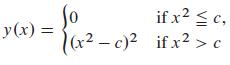
Verify that if c > 0, then the function defined piecewise bysatisfies the differential equation y' = 4x √y for all x. Sketch a variety of such solution curves for different values of c. Then determine (in terms of a and b) how many different solutions the initial value problem y' = 4x √y,
In Problems 27 through 31, a function y = g(x) is described by some geometric property of its graph. Write a differential equation of the form dy/dx = f (x, y) having the function g as its solution (or as one of its solutions).The line tangent to the graph of g at (x, y) passes through the point
Showing 1700 - 1800
of 2513
First
11
12
13
14
15
16
17
18
19
20
21
22
23
24
25
Last
Step by Step Answers

 Get 50% OFF
Claim Now
Get 50% OFF
Claim Now