New Semester
Started
Get
50% OFF
Study Help!
--h --m --s
Claim Now
Question Answers
Textbooks
Find textbooks, questions and answers
Oops, something went wrong!
Change your search query and then try again
S
Books
FREE
Study Help
Expert Questions
Accounting
General Management
Mathematics
Finance
Organizational Behaviour
Law
Physics
Operating System
Management Leadership
Sociology
Programming
Marketing
Database
Computer Network
Economics
Textbooks Solutions
Accounting
Managerial Accounting
Management Leadership
Cost Accounting
Statistics
Business Law
Corporate Finance
Finance
Economics
Auditing
Tutors
Online Tutors
Find a Tutor
Hire a Tutor
Become a Tutor
AI Tutor
AI Study Planner
NEW
Sell Books
Search
Search
Sign In
Register
study help
mathematics
first course differential equations
A First Course in Differential Equations with Modeling Applications 11th edition Dennis G. Zill - Solutions
In problem verify that the given functions form a fundamental set of solutions of the differential equation on the indicated interval. Form the general solution.x2y'' + xy' + y = 0; cos(ln x), sin(ln x), (0, ∞)
In problem verify that the given functions form a fundamental set of solutions of the differential equation on the indicated interval. Form the general solution.x2y'' ‑ 6xy' + 12y = 0; x3, x4, (0, ∞)
In problem verify that the given functions form a fundamental set of solutions of the differential equation on the indicated interval. Form the general solution.4y'' ‑ 4y' + y = 0; ex/2, xex/2, (‑∞, ∞)
In problem verify that the given functions form a fundamental set of solutions of the differential equation on the indicated interval. Form the general solution.y'' ‑ 2y' + 5y = 0; ex cos 2x, ex sin 2x, (‑∞, ∞)
In problem verify that the given functions form a fundamental set of solutions of the differential equation on the indicated interval. Form the general solution.y'' ‑ 4y = 0; cosh 2x, sinh 2x, (‑∞, ∞)
In problem verify that the given functions form a fundamental set of solutions of the differential equation on the indicated interval. Form the general solution.y'' – y' ‑ 12y = 0; e‑3x, e4x, (‑∞, ∞)
In Problem determine whether the given set of functions is linearly independent on the interval (‑∞, ∞).f1(x) = ex, f2(x) = e‑x, f3(x) = sinh x
In Problem determine whether the given set of functions is linearly independent on the interval (‑∞, ∞).f1(x) = 1 + x, f2(x) = x, f3(x) = x2
In Problem determine whether the given set of functions is linearly independent on the interval (‑∞, ∞).f1(x) = 2 + x, f2(x) = 2 + |x|
In Problem determine whether the given set of functions is linearly independent on the interval (‑∞, ∞).f1(x) = x, f2(x) = 1, f3(x) = x + 3
In Problem determine whether the given set of functions is linearly independent on the interval (‑∞, ∞).f1(x) = cox 2x, f2(x) = 1, f3(x) = cos2 x
In Problem determine whether the given set of functions is linearly independent on the interval (‑∞, ∞).f1(x) = 5, f2(x) = cos2 x, f3(x) = sin2 x
In Problem determine whether the given set of functions is linearly independent on the interval (‑∞, ∞).f1(x) = 0, f2(x) = x2, f3(x) = ex
In Problem determine whether the given set of functions is linearly independent on the interval (‑∞, ∞).f1(x) = x, f2(x) = x2, f3(x) = 4x ‑ 3x2
In Problem the given two-parameter family is a solution of the indicated differential equation on the interval (‑∞, ∞). Determine whether a member of the family can be found that satisfies the boundary conditions.y = c1x2 + c2x4 + 3; x2y'' ‑ 5xy' + 8y = 24(a) y(‑1) = 0, y(1) =
In Problem the given two-parameter family is a solution of the indicated differential equation on the interval (‑∞, ∞). Determine whether a member of the family can be found that satisfies the boundary conditions.y = c1ex cos x + c2ex sin x; y'' ‑ 2y' + 2y = 0(a) y(0) = 1, y'(π)
Use the family in Problem 5 to find a solution of xy'' – y' = 0 that satisfies the boundary conditions y(0) = 1, y'(1) = 6.Data from problem 5Given that y = c1 + c2x2 is a two-parameter family of solutions of xy'' – y' = 0 on the interval (‑∞, ∞), show that constants c1 and c2
(a) Use the family in Problem 1 to find a solution of y'' ‑ y = 0 that satisfies the boundary conditions y(0) = 0, y(1) = 1.(b) The DE in part (a) has the alternative general solution y = c3 cosh x + c4 sinh x on (‑∞,∞). Use this family to find a solution that satisfies the
In Problem find an interval centered about x = 0 for which the given initial-value problem has a unique solution.y'' = (tan x)y = ex, y(0) = 1, y'(0) = 0
In Problem find an interval centered about x = 0 for which the given initial-value problem has a unique solution.(x ‑ 2)y'' + 3y = x, y(0) = 0, y'(0) = 1
Use the general solution of x'' + ω2x = 0 given in Problem 7 to show that a solution satisfying the initial conditions x(t0) x0, x'(t0) = x1 is the solution given in Problem 7 shifted by an amount t0:x(t) = x0 cos ω(t - t0) + x1/ω sin ω(t - t0).
Given that x(t) = c1 cos ωt + c2 sin ωt is the general solution of x'' = ω2x = 0 on the interval (‑∞,∞), show that a solution satisfying the initial conditions x(0) = x0, x'(0) = x1 is given byx(t) = x0 cos ωt + x1/ω sin ωt.
Find two members of the family of solutions in Problem 5 that satisfy the initial conditions y(0) = 0, y'(0) = 0.
Given that y = c1 + c2x2 is a two-parameter family of solutions of xy'' – y' = 0 on the interval (‑∞, ∞), show that constants c1 and c2 cannot be found so that a member of the family satisfies the initial conditions y(0) = 0, y'(0) = 1. Explain why this does not violate Theorem
In Problem the given family of functions is the general solution of the differential equation on the indicated interval. Find a member of the family that is a solution of the initial-value problem.y = c1 + c2 cos x = c3 sin x, (‑∞, ∞);y''' + y' = 0, y(π) = 0, y'(π) = 2, y''(π) =
In Problem the given family of functions is the general solution of the differential equation on the indicated interval. Find a member of the family that is a solution of the initial-value problem.y = c1x + c2x ln x, (0, ∞);x2y'' – xy' + y = 0, y(1) = 3, y'(1) = ‑1
In Problem the given family of functions is the general solution of the differential equation on the indicated interval. Find a member of the family that is a solution of the initial-value problem.y = c1e4x + c2e‑x, (‑∞, ∞);y'' ‑ 3y' ‑ 4y = 0, y(0) = 1, y'(0) = 2
In Problem the given family of functions is the general solution of the differential equation on the indicated interval. Find a member of the family that is a solution of the initial-value problem.y = c1ex + c2e‑x, (‑∞, ∞);y'' ‑ y = 0, y(0) = 0, y'(0) = 1
Under the same assumptions that underlie the model in (1), determine a differential equation for the population P(t) of a country when individuals are allowed to immigrate into the country at a constant rate r > 0. What is the differential equation for the population P(t) of the country when
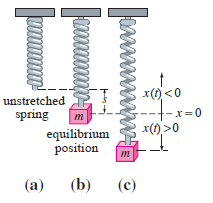
In Problem 19, what is a differential equation for the displacement x(t) if the motion takes place in a medium that imparts a damping force on the spring/ mass system that is proportional to the instantaneous velocity of the mass and acts in a direction opposite to that of motion?Data from problem
A mathematical model for the rate at which a drug disseminates into the bloodstream is given bydx/dt = r - kx,where r and k are positive constants. The function x(t) describes the concentration of the drug in the bloodstream at time t.(a) Since the DE is autonomous, use the phase portrait concept
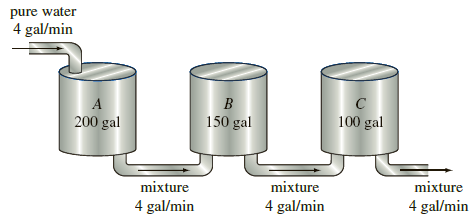
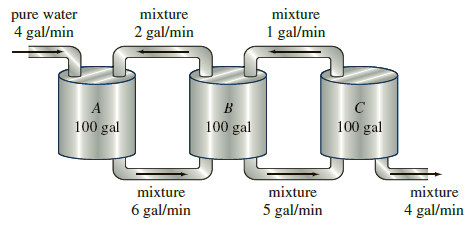
Three large tanks contain brine, as shown in the following figure. Use the information in the figure to construct a mathematical model for the number of pounds of salt x1(t), x2(t), and x3(t) at time t in tanks A, B, and C, respectively. Without solving the system, predict limiting values of
Consider the Lotka-Volterra predator-prey model defined bydx/dt = 20.1x + 0.02xydy/dt = 0.2y - 0.025xy,where the populations x(t) (predators) and y(t) (prey) are measured in thousands. Suppose x(0) = 6 and y(0) = 6. Use a numerical solver to graph x(t) and y(t). Use the graphs to approximate the
Consider the competition model defined bydx/dt = x(2 - 0.4x - 0.3y)dy/dt = y(1 - 0.1y - 0.3x),where the populations x(t) and y(t) are measured in thousands and t in years. Use a numerical solver to analyze the populations over a long period of time for each of the following cases:(a) x(0) = 1.5,
Consider the competition model defined bydx/dt = x(1 - 0.1x - 0.05y)dy/dt = y(1.7 - 0.1y - 0.15x),where the populations x(t) and y(t) are measured in thousands and t in years. Use a numerical solver to analyze the populations over a long period of time for each of the following cases:(a) x(0) =
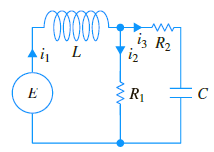
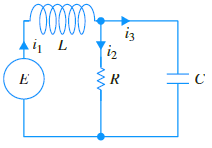
Show that a system of differential equations that describes the currents i2(t) and i3(t) in the electrical network shown in the following figure isL di2/dt + L di3/dt + R1i2 = E(t)-R1 di2/dt + R2 di3/dt + 1/C i3 = 0. ГМD i3 R2 (iz R1
By Kirchhoff’s first law we have i1 = i2 + i3. By Kirchhoff’s second law, on each loop we have E(t) = Li′1 + R1i2 and E(t) = Li′1 + R2i3 + q/C so that q = CR1i2 − CR2i3. Theni3 = q′ = CR1i′2 − CR2i3 so that the system isLi′2 + Li′3 + R1i2 = E(t)−R1i′2 + R2i′3 + 1/C i3 = 0.
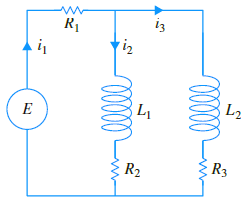
Determine a system of first-order differential equations that describes the currents i2(t) and i3(t) in the electrical network shown in the following figure. iz R1 L2 L1 E R3 R2 000 000
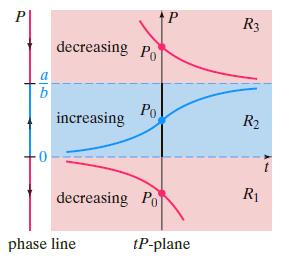
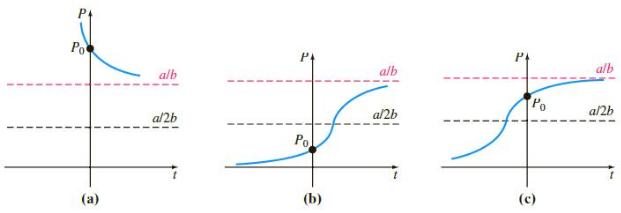
With the identifications a = r, b = r/K, and a/b = K, Figures (1) and (2) show that the logistic population model, (3) of Section 3.2, predicts that for an initial population P0, < 0 < P0, K, regardless of how small P0is, the population increases over time but does not surpass the carrying
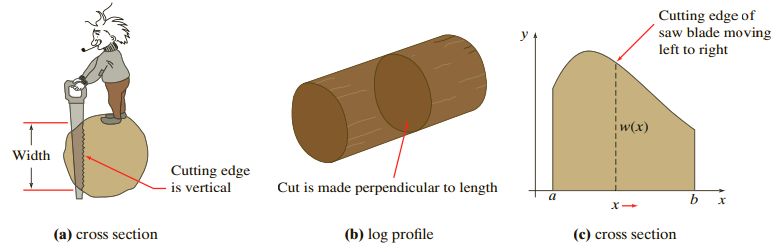
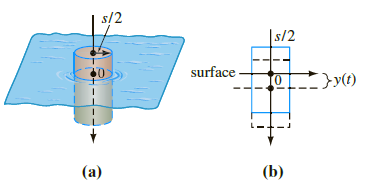
A long uniform piece of wood (cross sections are the same) is cut through perpendicular to its length by a vertical saw blade. See the figures . If the friction between the sides of the saw blade and the wood through which the blade passes is ignored, then it can be assumed that the rate at which
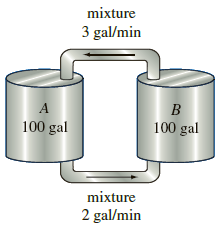
Two very large tanks A and B are each partially filled with 100gallons of brine. Initially, 100 pounds of salt is dissolved in the solution in tank A and 50 pounds of salt is dissolved in thesolution in tank B. The system is closed in that the well-stirred liquid is pumped only between the
Use the information given in the following figure to construct a mathematical model for the number of pounds of salt x1(t), x2(t), and x3(t) at time t in tanks A, B, and C, respectively. mixture mixture pure water 1 gal/min 4 gal/min 2 gal/min A 100 gal 100 gal 100 gal mixture mixture mixture 5
Consider two tanks A and B, with liquid being pumped in and out at the same rates, as described by the system of equations (3). What is the system of differential equations if,instead of pure water, a brine solution containing 2 pounds of salt per gallon is pumped into tank A?
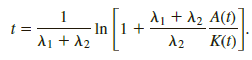
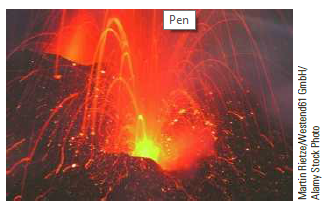
The knowledge of how K-40 decays can be used to determine the age of very old igneous rocks. See the following figure.(a) Use the solutions obtained in part (a) of Problem 5 to find the ratio A(t)/K(t).(b) Use A(t)/K(t) found in part (a) to show that(c) Suppose it is determined that each gram
The chemical element potassium is a soft metal that can be found extensively throughout the Earth’s crust and oceans. Although potassium occurs naturally in the form of three isotopes, only the isotope potassium-40 (K-40) is radioactive. This isotope is also unusual in that it decays by two
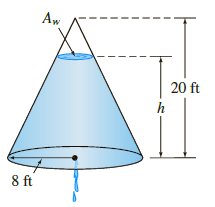
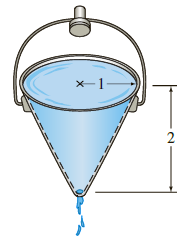
Suppose that the conical tank in Problem 13(a) is inverted, as shown in the following figure, and that water leaks out a circular hole of radius 2 inches in the center of its circular base. Is the time it takes to empty a full tank the same as for the tank with vertex down in Problem 13? Take the
Suppose that the conical tank in Problem 13(a) is inverted, as shown in the following figure, and that water leaks out a circular hole of radius 2 inches in the center of its circular base. Is the time it takes to empty a full tank the same as for the tank with vertex down in Problem 13? Take the
Show that the linear system given in (18) describes the currents i1(t) and i2(t) in the network shown in the following figure. i3 i2 ER
A communicable disease is spread throughout a small community, with a fixed population of n people, by contact between infected individuals and people who are susceptible to the disease. Suppose that everyone is initially susceptible to the disease and that no one leaves the community while the
(a) In Problem 17, explain why it is sufficient to analyze onlyds/dt = 2k1sidi/dt = 2k2i + k1si.(b) Suppose k1 = 0.2, k2 = 0.7, and n = 10. Choose various values of i(0) = i0, 0 < i0 < 10. Use a numerical solver to determine what the model predicts about the epidemic in the two cases s0
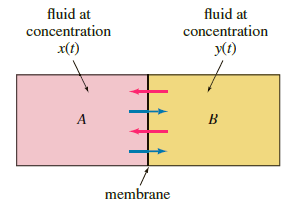
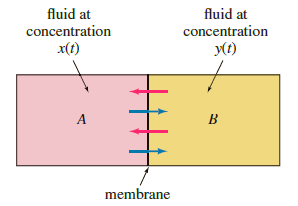
Suppose compartments A and B shown in the following figure are filled with fluidsand are separated by a permeable membrane. The figure is a compartmental representation of the exterior and interior of a cell. Suppose, too, that a nutrient necessary for cell growth passes through the
The system in Problem 19, like the system in (2), canbe solved with no advanced knowledge. Solve for x(t) and y(t) and compare their graphs with your sketches in Problem 19. Determine the limiting values of x(t) and y(t) as t †’ ˆž. Explain why the answer to the last question
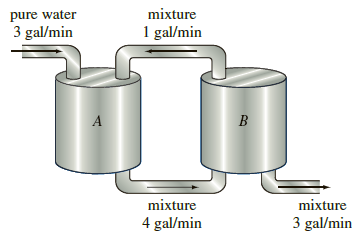
Solely on the basis of the physical description of the mixture problem on page 108 and in the following figure, discuss the nature of the functions x1(t) and x2(t). What is the behavior of each function over a long period of time? Sketch possible graphs of x1(t)and x2(t). Check your conjectures by
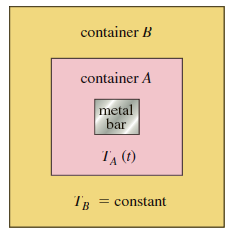
As shown in the following figure, a small metal bar is placed inside container A, and container A then is placed within a much larger container B. As the metal bar cools, the ambient temperature TA(t) of the medium within container A changes according to Newton€™s law of cooling. As
Fill in the blank or answer true or false.If P(t) = P0e0.15t gives the population in an environment at time t, then a differential equation satisfied by P(t) is __________.
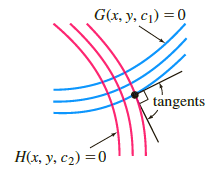
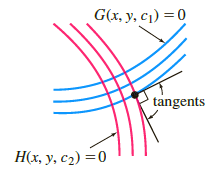
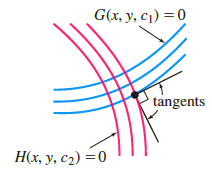
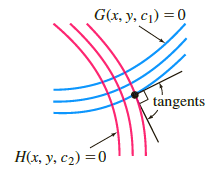
When all the curves in a family G(x, y, c1) = 0 intersect orthogonally all the curves in another family H(x, y, c2) = 0, the families are said to be orthogonal trajectories of each other. See the following figure. If dy/dx = f (x, y) is the differential equation of one family, then the differential
When all the curves in a family G(x, y, c1) = 0 intersect orthogonally all the curves in another family H(x, y, c2) = 0, the families are said to be orthogonal trajectories of each other. See the following figure. If dy/dx = f (x, y) is the differential equation of one family, then the differential
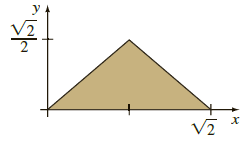
Solve the initial-value problem in Problem 20 when a cross section of a uniform piece of wood is the triangular region given in the following figure. Assume again that k = 1. How long does it take to cut through this piece of wood?
Suppose a gas consists of molecules of type A. When the gas is heated a second substance B is formed by molecular collision. Let A(t) and B(t) denote, in turn, the number of molecules of types A and B present at time t ≥ 0. A mathematical model for the rate at which the number of molecules of
When all the curves in a family G(x, y, c1) = 0 intersect orthogonally all the curves in another family H(x, y, c2) = 0, the families are said to be orthogonal trajectories of each other. See the following figure. If dy/dx = f (x, y) is the differential equation of one family, then the differential
Fill in the blank or answer true or false.If the rate of decay of a radioactive substance is proportional to the amount A(t) remaining at time t, then the half-life of the substance is necessarily T = 2(ln 2)/k. The rate of decay of the substance at time t = T is one-half the rate of decay at t =
In March 1976 the world population reached 4 billion. At that time, a popular news magazine predicted that with an average yearly growth rate of 1.8%, the world population would be 8 billion in 45 years. How does this value compare with the value predicted by the model that assumes that the rate of
Air containing 0.06% carbon dioxide is pumped into a room whose volume is 8000 ft3. The air is pumped inat a rate of 2000 ft3/min, and the circulated air is then pumped out at the same rate. If there is an initial concentration of 0.2% carbon dioxide in the room, determine the subsequent amount in
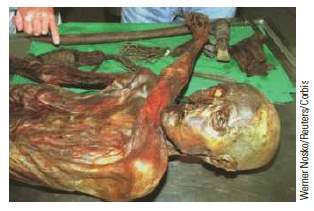
In September of 1991 two German tourists found the well-preserved body of a man partially frozen in a glacier in the Ötztal Alps on the border between Austria and Italy. See the following figure. Through the carbon-dating technique it was found that the body of Ötzi the
In the treatment of cancer of the thyroid, the radioactive liquid Iodine-131 is often used. Suppose that after one day in storage, analysis shows that an initial amount A0 of iodine-131 in a sample has decreased by 8.3%.(a) Find the amount of iodine-131 remaining in the sample after 8 days.(b)
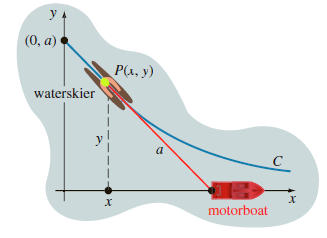
Solve the differential equationdy/dx = - y/ˆš(a2 - y2)of the tractrix. See Problem 28 in Exercises 1.3. Assume that the initial point on the y-axis in (0, 10) and that the length of the rope is x = 10 ft.Data from problem 28 (0, a) P(x, y) waterskier х х motorboat
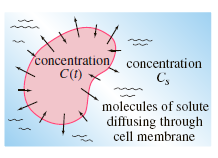
Suppose a cell is suspended in a solution containing a solute of constant concentration Cs. Suppose further thatthe cell has constant volume V and that the area of its permeable membrane is the constant A. By Fick€™s lawthe rate of change of its massm is directly proportional tothe area A
Suppose that as a body cools, the temperature of the surrounding medium increases because it completely absorbs the heat being lost by the body. Let T(t) and Tm(t) be the temperatures of the body and the medium at time t, respectively.If the initial temperature of the body is T1 and the initial
According to Stefan’s law of radiation the absolute temperature T of a body cooling in a medium at constant absolute temperature Tm is given bydT/dt = k(T4 - T4m),where k is a constant. Stefan’s law can be used over a greater temperature range than Newton’s law of cooling.(a) Solve the
Suppose an RC-series circuit has a variable resistor. If the resistance at time t is defined by R(t) = k1 + k2t, where k1 and k2 are known positive constants, then the differential equation in (9) of Section 3.1 becomes(k1 + k2t) dq/dt + 1/C q = E(t),where C is a constant. If E(t) = E0 and q(0) =
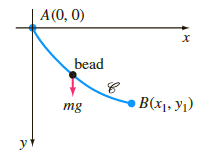
A classical problem in the calculus of variations is to find the shape of a curve C such that a bead, under the influence of gravity, will slide from point A(0, 0) to point B(x1, y1) in the least time. See the following figure. It can be shown that a nonlinear differential for
A model for the populations of two interacting species of animals isdx/dt = k1x(α - x)dy/dt = k2xy.Solve for x and y in terms of t.
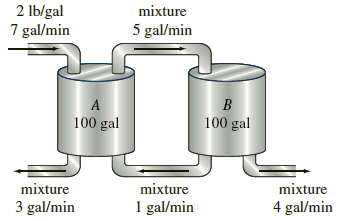
Initially, two large tanks A and B each hold 100 gallons of brine. The well-stirred liquid is pumped between the tanks as shown in the following figure. Use the information given in the figure to construct a mathematical model for the number of pounds of salt x1(t) and x2(t) at time t in tanks
When all the curves in a family G(x, y, c1) = 0 intersect orthogonally all the curves in another family H(x, y, c2) = 0, the families are said to be orthogonal trajectories of each other. See the following figure. If dy/dx = f (x, y) is the differential equation of one family, then the differential
Construct a mathematical model for a radioactive series of four elements W, X, Y, and Z, where Z is a stable element.
In Problem 1 suppose that time is measured in days, that the decay constants are k1 = 20.138629 and k2 = 20.004951, and that x0 = 20. Use a graphing utility to obtain the graphs of the solutions x(t), y(t), and z(t) on the same set of coordinate axes. Use the graphs to approximate the half-lives of
We have not discussed methods by which systems of first-order differential equations can be solved. Nevertheless, systems such as (2) can be solved with no knowledge other than how to solve a single linear first-order equation. Find a solution of (2) subject to the initial conditions x(0) = x0,
Suppose that r = f(h) defines the shape of a water clock for which the time marks are equally spaced. Use the differential equation in Problem 12 to find f(h) and sketch a typical graph of h as a function of r. Assume that the cross-sectional area Ah of the hole is constant.Data from problem
(a) Suppose that a glass tank has the shape of a cone with circular cross section as shown in the following figure. As in part (a) of Problem 33, assume that h(0) = 2 ft corresponds to water filled to the top of the tank, a hole in the bottom is circular with radius 1/32 in., g = 32 ft/s2, and
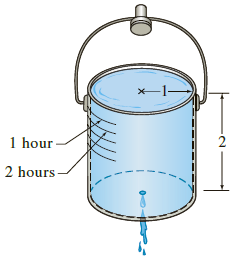
The clepsydra, or water clock, was a device that the ancient Egyptians, Greeks, Romans, and Chinese used to measure the passage of time by observing the change in the height of water that was permitted to flow out of a small hole in the bottom of a container or tank.(a) Suppose a tank is made of
When a bottle of liquid refreshment was opened recently, the following factoid was found inside the bottle cap:The average velocity of a falling raindrop is 7 miles/hour. A quick search of the Internet found that meteorologist Jeff Haby offers the additional information that an
The current speed vrof a straight river such as that in Problem 28 is usually not a constant. Rather, an approximation to the current speed (measured in miles per hour) could be a function such as vr(x) = 30x(1 - x), 0 ‰¤ x ‰¤ 1, whose values are small at the shores (in this
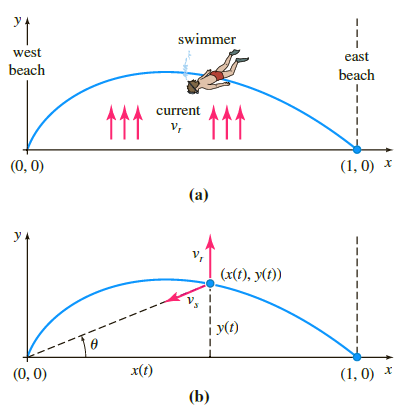
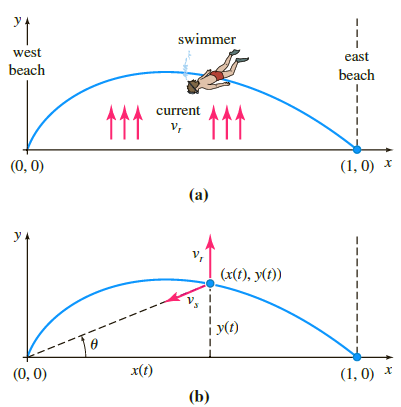
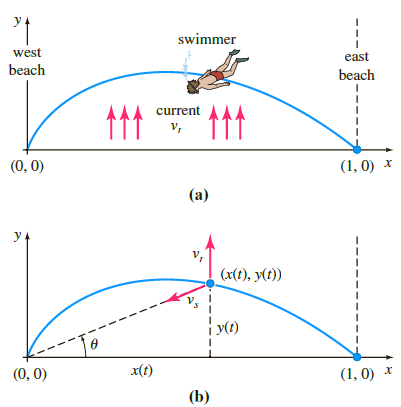
Suppose the manin Problem 28 again enters the current at (1, 0) but this time decides to swim so that his velocity vector vsis always directed toward the west beach. Assume that the speed |vs| = vsmi/h is a constant. Show that a mathematical model for the path of the swimmer in the river is
(a) Solve the DE in Problem 28 subject to y(1) = 0. For convenience let k = vr/vs.(b) Determine the values of vs for which the swimmer will reach the point (0, 0) by examining lim x †’0+ y(x) in the cases k = 1, k > 1, and 0 < k > 1.Data from problem 28In the
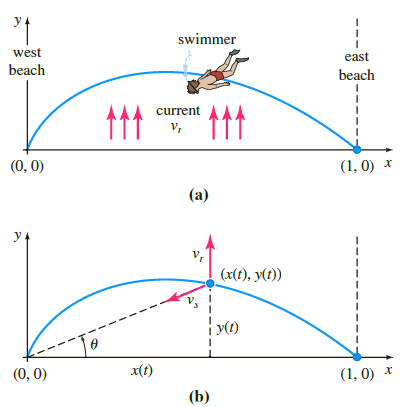
In the following figure (a) suppose that the y-axis and the dashed vertical line x = 1 represent, respectively, the straight west and east beaches of a river that is 1 mile wide. The river €“flows northward with a velocity vr, where |vr| = vrmi/h is a constant. A man enters the current at
A helicopter hovers 500 feet above a large open tank full of liquid (not water). A dense compact object weighing 160 pounds is dropped (released from rest) from the helicopter into the liquid. Assume that air resistance is proportional to instantaneous velocity v while the object is in the air and
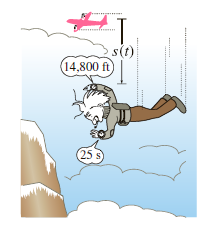
A skydiver is equipped with a stopwatch and an altimeter. As shown in the following figure, he opens his parachute 25seconds after exiting a plane flying at an altitude of 20,000 feet and observes that his altitude is 14,800 feet. Assume that air resistance is proportionalto the square of the
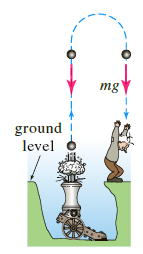
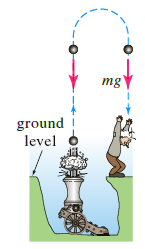
In Problem 16 let ta be the time it takes the cannonball to attain its maximum height and let td be the time it takes the cannonball to fall from the maximum height to the ground. Compare the value of ta with the value of td and compare the magnitude of the impact velocity vi with the initial
(a) In Examples 3 and 4 of Section 2.1 we saw that any solution P(t) of (4) possesses the asymptotic behavior P(t) :a/b as t → ∞ for P0 > a/b and for 0 > P0 , a/b; as a consequence the equilibrium solution P = a/b is called an attractor. Use a root-finding application of a CAS (or a
Read the documentation for your CAS on scatter plots (or scatter diagrams) and least squares linear fit. The straight line that best fits a setof data points is called a regression line or a least squares line. Your task is to construct a logistic model for the population of the United States,
Suppose the population model (4) is modified to bedP/dt = P(bP - a).(a) If a > 0, b > 0 show by means of a phase portrait (see page 40) that, depending on the initial condition P(0) = P0, the mathematical model could include a doomsday scenario (P(t) → ∞) or an extinction scenario (P(t)
Consider the differential equationdP/dt = kP1+c,where k > 0 and c ≥ 0. In Section 3.1 we saw that in thecase c = 0 the linear differential equation dP/dt = kP is a mathematical model of a population P(t) that exhibits unbounded growth over the infinite time interval [0, ∞), that is, P(t)
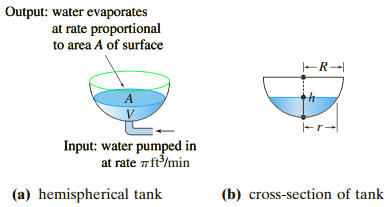
An outdoor decorative pond in the shape of a hemispherical tank is to be lled with water pumped into the tank through an inlet in its bottom. Suppose that the radius ofthe tank is R = 10 ft, that water is pumped in at a rate of πft3/min, and that the tank is initially empty. See the
A differential equation for the velocity v of a falling mass m subjected to air resistance proportional to the square of the instantaneous velocity ism dv/dt = mg - kv2,where k > 0 is a constant of proportionality. The positive direction is downward.(a) Solve the equation subject to the initial
Consider the 16-pound cannonball shot vertically upward in Problems 36 and 37 in Exercises 3.1 with an initial velocity v0= 300 ft/s. Determine the maximum height attained by the cannonball if air resistance is assumed to be proportional to the square of the instantaneous velocity. Assume that the
(a) Determine a differential equation for the velocity v(t) of a mass m sinking in water that imparts a resistance proportional to the square of the instantaneous velocity and also exerts an upward buoyant force whose magnitude is given by Archimedes€™ principle. See Problem 18 in
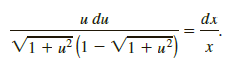
The differential equationdy/dx = -x + ˆš(x2 + y2)/ydescribes the shape of a plane curve C that will reflect all incoming light beams to the same point and could bea model for the mirror of a reflecting telescope, a satellite antenna, or a solar collector. See Problem 29 in Exercises 1.3.
(a) A simple model for the shape of a tsunami is given bydW/dx = W√(4 - 2W),where W(x) > 0 is the height of the wave expressed as a function of its position relative to a point offshore. By inspection, find all constant solutions of the DE.(b) Solve the differential equation in part (a). A
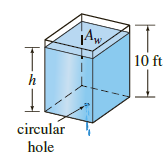
A tank in the form of a right-circular cone standing on end, vertex down, is leaking water through a circular hole in its bottom.(a) Suppose the tank is 20 feet high and has radius 8feet and the circular hole has radius 2 inches.In Problem 14 in Exercises 1.3 you were asked to show that the
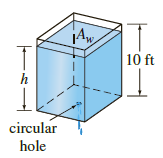
When friction and contraction of the water at the hole are taken into account, the model in Problem 11 becomesdh/dt = -c Ah/Aw ˆš2gh,where 0 < c < 1. How long will it take the tank in Problem 11(b) to empty if c = 0.6? See Problem 13 in Exercises 1.3.Data from problem 13 (Exercise
Showing 2000 - 2100
of 2513
First
12
13
14
15
16
17
18
19
20
21
22
23
24
25
26
Step by Step Answers

 Get 50% OFF
Claim Now
Get 50% OFF
Claim Now