New Semester
Started
Get
50% OFF
Study Help!
--h --m --s
Claim Now
Question Answers
Textbooks
Find textbooks, questions and answers
Oops, something went wrong!
Change your search query and then try again
S
Books
FREE
Study Help
Expert Questions
Accounting
General Management
Mathematics
Finance
Organizational Behaviour
Law
Physics
Operating System
Management Leadership
Sociology
Programming
Marketing
Database
Computer Network
Economics
Textbooks Solutions
Accounting
Managerial Accounting
Management Leadership
Cost Accounting
Statistics
Business Law
Corporate Finance
Finance
Economics
Auditing
Tutors
Online Tutors
Find a Tutor
Hire a Tutor
Become a Tutor
AI Tutor
AI Study Planner
NEW
Sell Books
Search
Search
Sign In
Register
study help
mathematics
first course differential equations
Differential Equations And Linear Algebra 4th Edition C. Edwards, David Penney, David Calvis - Solutions
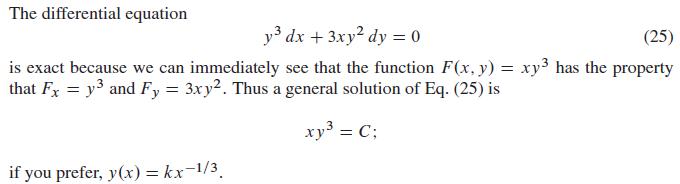
Find general solutions of the differential equations in Problems 1 through 30. Primes denote derivatives with respect to x.x3y' = x2y - y3
Find general solutions of the differential equations in Problems 1 through 30. Primes denote derivatives with respect to x.4xy2 + y' = 5x4y2
Find general solutions of the differential equations in Problems 1 through 30. Primes denote derivatives with respect to x.y' + 3y = 3x2e-3x
Find general solutions of the differential equations in Problems 1 through 30. Primes denote derivatives with respect to x throughout.x(x + y)y' + y(3x + y) = 0
Find general solutions of the differential equations in Problems 1 through 30. Primes denote derivatives with respect to x.y' = x2 - 2xy + y2
Find general solutions of the differential equations in Problems 1 through 30. Primes denote derivatives with respect to x.ex + yexy + (ey + xeyx) y' = 0
Find general solutions of the differential equations in Problems 1 through 30. Primes denote derivatives with respect to x throughout.y' = (4x + y)2
Find general solutions of the differential equations in Problems 1 through 30. Primes denote derivatives with respect to x.2x2y - x3y' = y3
Find general solutions of the differential equations in Problems 1 through 30. Primes denote derivatives with respect to x throughout.(x + y)y' = 1
Find general solutions of the differential equations in Problems 1 through 30. Primes denote derivatives with respect to x throughout.x2y' + 2xy = 5y3
Find a general solution of each reducible second-order differential equation in Problems 43–54. Assume x, y and/or y' positive where helpful (as in Example 11).y" + 4y = 0 Example 11 Solve the equation yy" = (y')2 in which the independent variable x is missing.
Consider the initially full hemispherical water tank of Example 8, except that the radius r of its circular bottom hole is now unknown. At 1 P.M. the bottom hole is opened and at 1:30 P.M. the depth of water in the tank is 2 ft.(a) Use Torricelli’s law in the form dV/dt = (-0.6) π r2 √2gy
Separate variables and use partial fractions to solve the initial value problems in Problems 1–8. Use either the exact solution or a computer-generated slope field to sketch the graphs of several solutions of the given differential equation, and highlight the indicated particular solution.
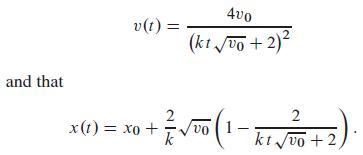
Assume that a body moving with velocity v encounters resistance of the form dv/dt = -kv3/2. Show thatConclude that under a 3/2 -power resistance a body coasts only a finite distance before coming to a stop. and that v(t): = 4v0 (kt √√vo + 2)² 2 x(t) = xo + √vo 1 - 1/2 √00 (1) kt√√vo +2,
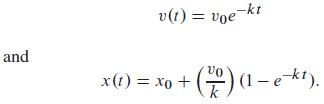
Suppose that a body moves through a resisting medium with resistance proportional to its velocity v, so that dv/dt = -kv.(a) Show that its velocity and position at time t are given by(b) Conclude that the body travels only a finite distance, and find that distance. and v(t) = voe-kt x(t) = xo + (2)
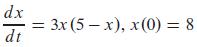
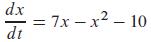
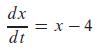
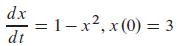
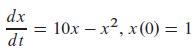
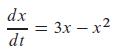
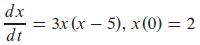
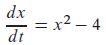
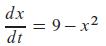
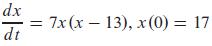
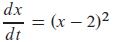
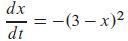
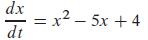
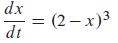
In Problems 1 through 12 first solve the equation f (x) = 0 to find the critical points of the given autonomous differential equation dx/dt = f (x) Then analyze the sign of f (x) to determine whether each critical point is stable or unstable, and construct the corresponding phase diagram for the
Find general solutions of the differential equations in Problems 1 through 30. Primes denote derivatives with respect to x.3x5y2 + x3y' = 2y2
Find general solutions of the differential equations in Problems 1 through 30. Primes denote derivatives with respect to x.xy' + 3y = 3x-3/2
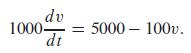
A motorboat weighs 32,000 lb and its motor provides a thrust of 5000 lb. Assume that the water resistance is 100 pounds for each foot per second of the speed v of the boat. ThenIf the boat starts from rest, what is the maximum velocity that it can attain? dv 1000- dt 5000 - 100v.
In Problems 1 through 12 first solve the equation f (x) = 0 to find the critical points of the given autonomous differential equation dx/dt = f (x) Then analyze the sign of f (x) to determine whether each critical point is stable or unstable, and construct the corresponding phase diagram for the
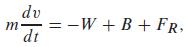
It is proposed to dispose of nuclear wastes—in drums with weight W = 640 lb and volume 8 ft3—by dropping them into the ocean (v0 = 0). The force equation for a drum falling through water iswhere the buoyant force B is equal to the weight (at 62.5 lb/ft3) of the volume of water displaced by the
Integrate the velocity function in Eq. (13) to obtain the upward-motion position function given in Eq. (14) with initial condition y(0) = y0. v (t) = = √tan (C₁-1 √/PB) with C₁ = tan¹ (UO √ ) (13)
Suppose that a car starts from rest, its engine providing an acceleration of 10 ft/s2, while air resistance provides 0.1 ft/s2 of deceleration for each foot per second of the car’s velocity.(a) Find the car’s maximum possible (limiting) velocity.(b) Find how long it takes the car to attain 90%
Separate variables in Eq. (15) and substitute u = v √ρ/g to obtain the downward-motion velocity function given in Eq. (16) with initial condition v(0) = v0. * =-x + 3 =-x(1-4+). dv dt pv² (15)
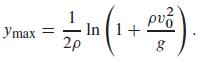
If a ball is projected upward from the ground with initial velocity v0 and resistance proportional to v2, deduce from Eq. (14) that the maximum height it attains is ymax =l 20 In]1 + ρυτ to g
Separate variables in Eq. (12) and substitute u = v√ρ/g to obtain the upward-motion velocity function given in Eq. (13) with initial condition v(0) = v0. ap dt -g-pu² = -8 (1 + 20²). (12)
A woman bails out of an airplane at an altitude of 10,000 ft, falls freely for 20 s, then opens her parachute. How long will it take her to reach the ground? Assume linear air resistance ρv ft/s2, taking ρ = 0.15 without the parachute and ρ = 1.5 with the parachute.
Suppose that ρ = 0.075 (in fps units, with g = 32 ft/s2) in Eq. (15) for a paratrooper falling with parachute open. If he jumps from an altitude of 10,000 ft and opens his parachute immediately, what will be his terminal speed? How long will it take him to reach the ground? dv dt = -8 + pv²
Integrate the velocity function in Eq. (16) to obtain the downward-motion position function given in Eq. (17) with initial condition y(0) = y0. √tan v(t) = tanh(Cz−t Vpg) with 1-¹ ( 10 √²). C₂ = tanh (16)
According to a newspaper account, a paratrooper survived a training jump from 1200 ft when his parachute failed to open but provided some resistance by flapping unopened in the wind. Allegedly he hit the ground at 100 mi/h after falling for 8 s. Test the accuracy of this account.
Suppose that the fish population P(t) in a lake is attacked by a disease at time t = 0, with the result that the fish cease to reproduce (so that the birth rate is β = 0) and the death rate ı (deaths per week per fish) is thereafter proportional to 1/√P. If there were initially 900 fish
Suppose that the paratrooper of Problem 22 falls freely for 30 s with ρ = 0.00075 before opening his parachute. How long will it now take him to reach the ground?Problem 22Suppose that ρ = 0.075 (in fps units, with g = 32 ft/s2) in Eq. (15) for a paratrooper falling with parachute open. If
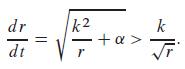
(a) Suppose a projectile is launched vertically from the surface r = R of the earth with initial velocity v0 = √2GM/R, so v20 = k2/R where k2 = 2GM. Solve the differential equation dr/dt = k/√r (from Eq. (23) in this section) explicitly to deduce that r(t) → ∞ as t → ∞.(b) If the
A motorboat starts from rest (initial velocity v(0) = v0 = 0). Its motor provides a constant acceleration of 4 ft/s2 but water resistance causes a deceleration of v2/400 ft/s2. Find v when t = 10 s, and also find the limiting velocity as t → + ∞ (that is, the maximum possible speed of the
An arrow is shot straight upward from the ground with an initial velocity of 160 ft/s. It experiences both the deceleration of gravity and deceleration v2/800 due to air resistance. How high in the air does it go?
(a) Suppose that a body is dropped (v0 = 0) from a distance r0 > R from the earth's center, so its acceleration is dv/dt = -GM/r2. Ignoring air resistance, show that it reaches the height r < r0 at time(b) If a body is dropped from a height of 1000 km above the earth’s surface and air
Suppose that at time t = 0, half of a “logistic” population of 100,000 persons have heard a certain rumor, and that the number of those who have heard it is then increasing at the rate of 1000 persons per day. How long will it take for this rumor to spread to 80%of the population?
Suppose that you are stranded—your rocket engine has failed—on an asteroid of diameter 3 miles, with density equal to that of the earth with radius 3960 miles. If you have enough spring in your legs to jump 4 feet straight up on earth while wearing your space suit, can you blast off from this
The mass of the sun is 329,320 times that of the earth and its radius is 109 times the radius of the earth.(a) To what radius (in meters) would the earth have to be compressed in order for it to become a black hole—the escape velocity from its surface equal to the velocity c = 3 x 10⁸ m/s of
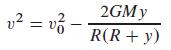
Suppose that a projectile is fired straight upward from the surface of the earth with initial velocity v0 < √2GM/R. Then its height y(t) above the surface satisfies the initial value problemSubstitute dv/dt = v(dv/dy) and then integrate to obtainfor the velocity v of the projectile at height
In Jules Verne’s original problem, the projectile launched from the surface of the earth is attracted by both the earth and the moon, so its distance r(t) from the center of the earth satisfies the initial value problemwhere Me and Mm denote the masses of the earth and the moon, respectively; R
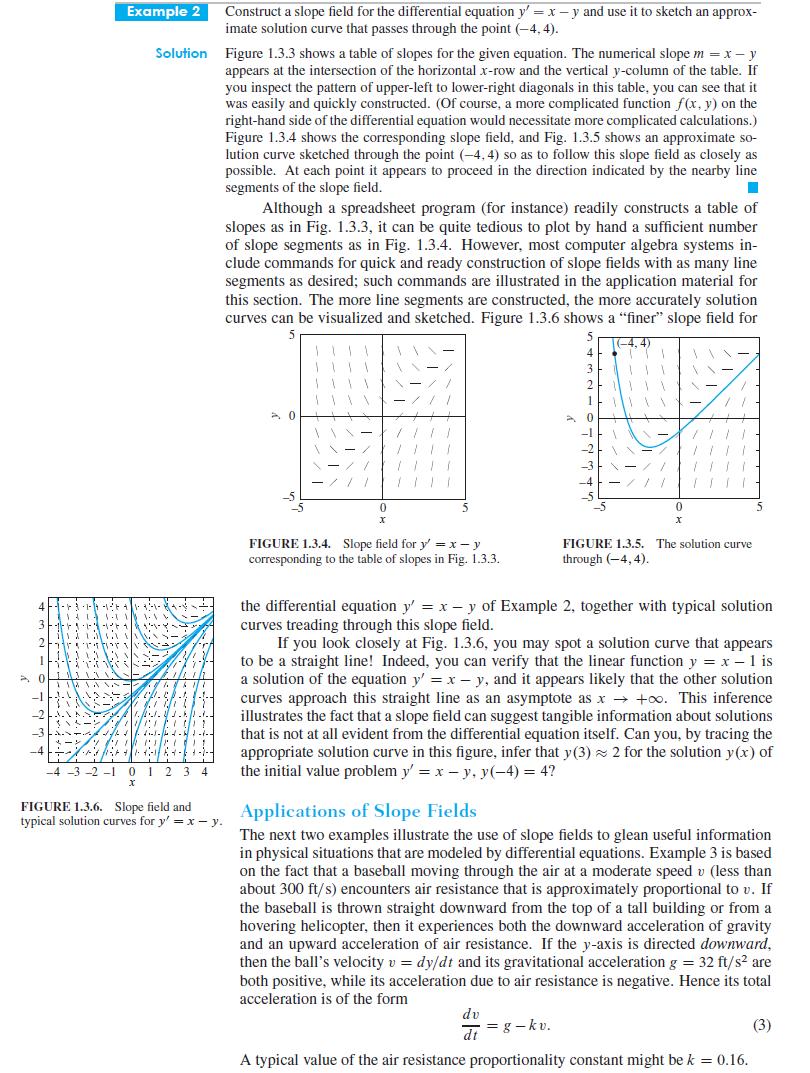
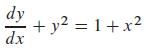
In Problems 21 and 22, first use the method of Example 2 to construct a slope field for the given differential equation. Then sketch the solution curve corresponding to the given initial condition. Finally, use this solution curve to estimate the desired value of the solution y(x).y' = y - x, y(4)
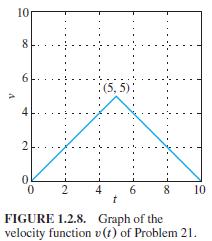
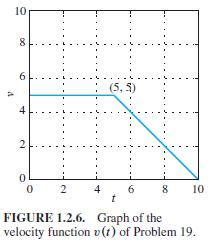
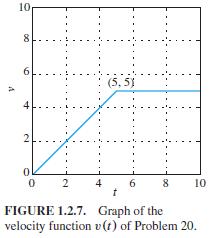
In Problems 19 through 22, a particle starts at the origin and travels along the x-axis with the velocity function v(t) whose graph is shown in Figs. 1.2.6 through 1.2.9. Sketch the graph of the resulting position function x(t) for 0 ≦ t ≦ 10.Figs. 1.2.6 through 1.2.9. 10 8 6 2 0 0 (5,5): 6 2 t
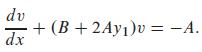
The equation dy/dx = A(x)y2 + B(x)y + C(x) is called a Riccati equation. Suppose that one particular solution y1(x) of this equation is known. Show that the substitutiontransforms the Riccati equation into the linear equation 1 P = 1 + − บ
In Problems 1 through 10, an initial value problem and its exact solution y(x) are given. Apply Euler’s method twice to approximate to this solution on the interval [0, 1/2], first with step size h = 0.25, then with step size h = 0.1. Compare the three-decimal-place values of the two
In Problems 1 through 12 first solve the equation f (x) = 0 to find the critical points of the given autonomous differential equation dx/dt = f (x) Then analyze the sign of f (x) to determine whether each critical point is stable or unstable, and construct the corresponding phase diagram for the
Use the method of Problem 63 to solve the equations in Problems 64 and 65, given that y1(x) = x is a solution of each.Problem 63The equation dy/dx = A(x)y2 + B(x)y + C(x) is called a Riccati equation. Suppose that one particular solution y1(x) of this equation is known. Show that the
Separate variables and use partial fractions to solve the initial value problems in Problems 1–8. Use either the exact solution or a computer-generated slope field to sketch the graphs of several solutions of the given differential equation, and highlight the indicated particular solution.
Find general solutions of the differential equations in Problems 1 through 30. Primes denote derivatives with respect to x.(x2 - 1)y' + (x - 1)y = 1
In Problems 1 through 10, an initial value problem and its exact solution y(x) are given. Apply Euler’s method twice to approximate to this solution on the interval [0, 1/2], first with step size h = 0.25, then with step size h = 0.1. Compare the three-decimal-place values of the two
In Problems 1 through 10, an initial value problem and its exact solution y(x) are given. Apply Euler’s method twice to approximate to this solution on the interval [0, 1/2], first with step size h = 0.25, then with step size h = 0.1. Compare the three-decimal-place values of the two
Find general solutions of the differential equations in Problems 1 through 30. Primes denote derivatives with respect to x throughout.y' = y + y3
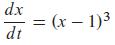
In Problems 1 through 12 first solve the equation f (x) = 0 to find the critical points of the given autonomous differential equation dx/dt = f (x) Then analyze the sign of f (x) to determine whether each critical point is stable or unstable, and construct the corresponding phase diagram for the
Find general solutions of the differential equations in Problems 1 through 30. Primes denote derivatives with respect to x throughout.x2y' + 2xy = 5y4
Separate variables and use partial fractions to solve the initial value problems in Problems 1–8. Use either the exact solution or a computer-generated slope field to sketch the graphs of several solutions of the given differential equation, and highlight the indicated particular solution.
Find general solutions of the differential equations in Problems 1 through 30. Primes denote derivatives with respect to x.xy' = 6y + 12x4y2/3
In Problems 1 through 10, an initial value problem and its exact solution y(x) are given. Apply Euler’s method twice to approximate to this solution on the interval [0, 1/2], first with step size h = 0.25, then with step size h = 0.1. Compare the three-decimal-place values of the two
In Problems 1 through 12 first solve the equation f (x) = 0 to find the critical points of the given autonomous differential equation dx/dt = f (x) Then analyze the sign of f (x) to determine whether each critical point is stable or unstable, and construct the corresponding phase diagram for the
Separate variables and use partial fractions to solve the initial value problems in Problems 1–8. Use either the exact solution or a computer-generated slope field to sketch the graphs of several solutions of the given differential equation, and highlight the indicated particular solution.
In Problems 1 through 12 first solve the equation f (x) = 0 to find the critical points of the given autonomous differential equation dx/dt = f (x) Then analyze the sign of f (x) to determine whether each critical point is stable or unstable, and construct the corresponding phase diagram for the
In Problems 1 through 12 first solve the equation f (x) = 0 to find the critical points of the given autonomous differential equation dx/dt = f (x) Then analyze the sign of f (x) to determine whether each critical point is stable or unstable, and construct the corresponding phase diagram for the
Separate variables and use partial fractions to solve the initial value problems in Problems 1–8. Use either the exact solution or a computer-generated slope field to sketch the graphs of several solutions of the given differential equation, and highlight the indicated particular solution.
In Problems 1 through 10, an initial value problem and its exact solution y(x) are given. Apply Euler’s method twice to approximate to this solution on the interval [0, 1/2], first with step size h = 0.25, then with step size h = 0.1. Compare the three-decimal-place values of the two
Separate variables and use partial fractions to solve the initial value problems in Problems 1–8. Use either the exact solution or a computer-generated slope field to sketch the graphs of several solutions of the given differential equation, and highlight the indicated particular solution.
In Problems 1 through 12 first solve the equation f (x) = 0 to find the critical points of the given autonomous differential equation dx/dt = f (x) Then analyze the sign of f (x) to determine whether each critical point is stable or unstable, and construct the corresponding phase diagram for the
In Problems 1 through 10, an initial value problem and its exact solution y(x) are given. Apply Euler’s method twice to approximate to this solution on the interval [0, 1/2], first with step size h = 0.25, then with step size h = 0.1. Compare the three-decimal-place values of the two
In Problems 1 through 12 first solve the equation f (x) = 0 to find the critical points of the given autonomous differential equation dx/dt = f (x) Then analyze the sign of f (x) to determine whether each critical point is stable or unstable, and construct the corresponding phase diagram for the
In Problems 1 through 10, an initial value problem and its exact solution y(x) are given. Apply Euler’s method twice to approximate to this solution on the interval [0, 1/2], first with step size h = 0.25, then with step size h = 0.1. Compare the three-decimal-place values of the two
In Problems 1 through 10, an initial value problem and its exact solution y(x) are given. Apply Euler’s method twice to approximate to this solution on the interval [0, 1/2], first with step size h = 0.25, then with step size h = 0.1. Compare the three-decimal-place values of the two
In Problems 1 through 12 first solve the equation f (x) = 0 to find the critical points of the given autonomous differential equation dx/dt = f (x) Then analyze the sign of f (x) to determine whether each critical point is stable or unstable, and construct the corresponding phase diagram for the
In Problems 1 through 12 first solve the equation f (x) = 0 to find the critical points of the given autonomous differential equation dx/dt = f (x) Then analyze the sign of f (x) to determine whether each critical point is stable or unstable, and construct the corresponding phase diagram for the
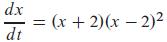
In Problems 13 through 18, use a computer system or graphing calculator to plot a slope field and/or enough solution curves to indicate the stability or instability of each critical point of the given differential equation. dx dt = (x + 2)(x - 2)2
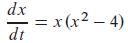
In Problems 13 through 18, use a computer system or graphing calculator to plot a slope field and/or enough solution curves to indicate the stability or instability of each critical point of the given differential equation. dx = x (x2 - 4) dt =
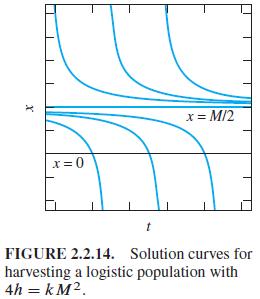
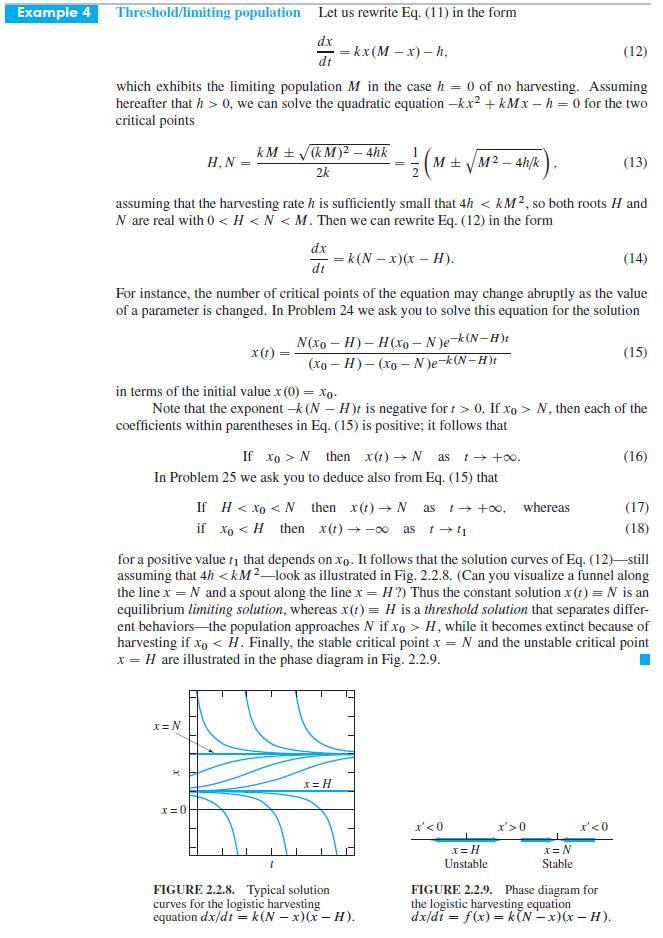
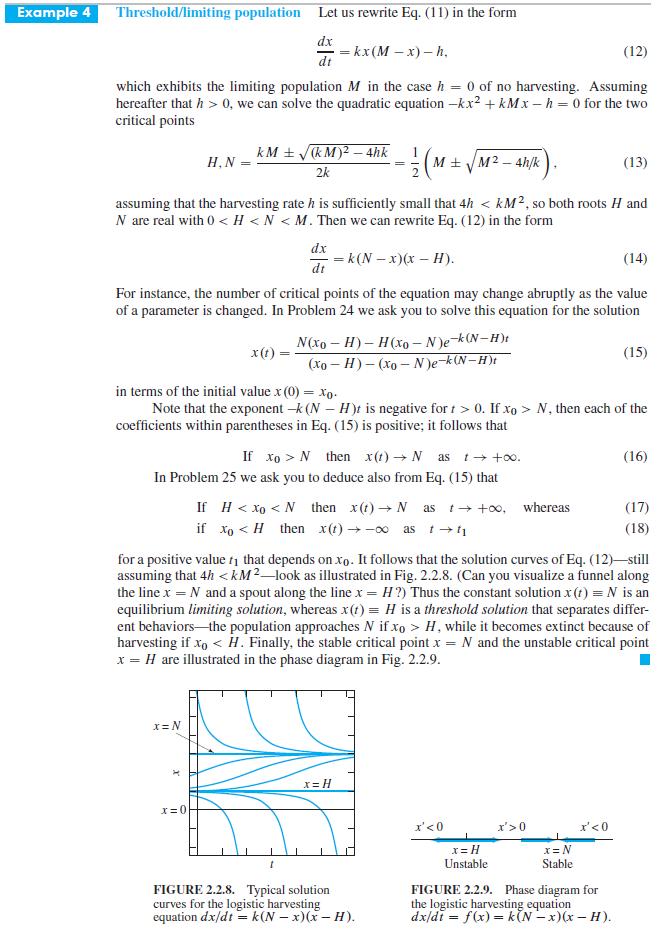
Example 4 dealt with the case 4h > kM2 in the equation dx/dt = kx (M - x) - h that describes constant-rate harvesting of a logistic population. Problems 26 and 27 deal with the other cases.If 4h = kM2, show that typical solution curves look as illustrated in Fig. 2.2.14. Thus if x0 ≧ M/2, then
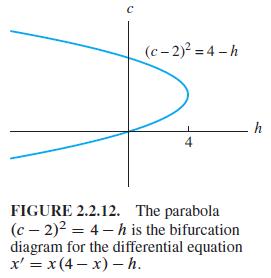
The differential equation dx/dt = 1/10x(10 -x) - h models a logistic population with harvesting at rate h. Determine (as in Example 6) the dependence of the number of critical points on the parameter h, and then construct a bifurcation diagram like Fig. 2.2.12. C (c-2)² =4-h 4 FIGURE 2.2.12. The
Example 4 dealt with the case 4h > kM2 in the equation dx/dt = kx (M - x) - h that describes constant-rate harvesting of a logistic population. Problems 26 and 27 deal with the other cases.If 4h > kM2, show that x(t) = 0 after a finite period of time, so the lake is fished out (whatever the
The time rate of change of a rabbit population P is proportional to the square root of P. At time t = 0 (months) the population numbers 100 rabbits and is increasing at the rate of 20 rabbits per month. How many rabbits will there be one year later? 10.
The time rate of change of an alligator population P in a swamp is proportional to the square of P. The swamp contained a dozen alligators in 1988, two dozen in 1998. When will there be four dozen alligators in the swamp? What happens thereafter?
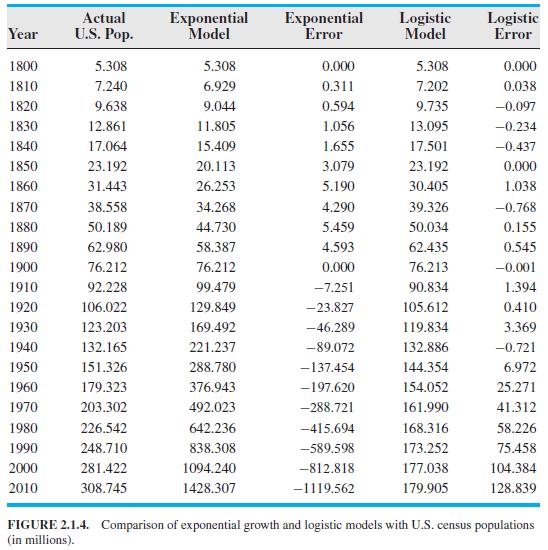
Use the method of Problem 36 to fit the logistic equation to the actual U.S. population data (Fig. 2.1.4) for the years 1850, 1900, and 1950. Solve the resulting logistic equation and compare the predicted and actual populations for the years 1990 and 2000.Problem 36To solve the two equations in
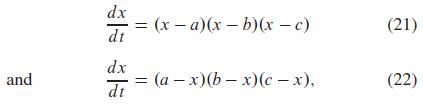
Consider the two differential equationseach having the critical points a, b, and c; suppose that a < b < c. For one of these equations, only the critical point b is stable; for the other equation, b is the only unstable critical point. Construct phase diagrams for the two equations to
The differential equation dx/dt = 1/100x(x - 5) + s models a population with stocking at rate s. Determine the dependence of the number of critical points c on the parameter s, and then construct the corresponding bifurcation diagram in the sc-plane.
Consider the differential equation dx/dt = x + kx3 containing the parameter k. Analyze (as in Problem 21) the dependence of the number and nature of the critical points on the value of k, and construct the corresponding bifurcation diagram.
Suppose that a community contains 15,000 people who are susceptible to Michaud’s syndrome, a contagious disease. At time t = 0 the number N(t) of people who have developed Michaud’s syndrome is 5000 and is increasing at the rate of 500 per day. Assume that N'(t) is proportional to the product
Fit the logistic equation to the actual U.S. population data (Fig. 2.1.4) for the years 1900, 1930, and 1960. Solve the resulting logistic equation, then compare the predicted and actual populations for the years 1980, 1990, and 2000.
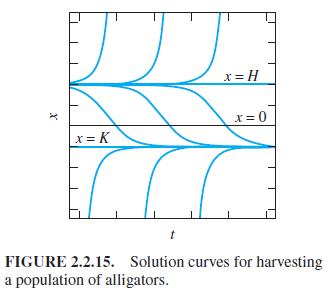
Suppose that the number x(t) (with t in months) of alligators in a swamp satisfies the differential equation dx/dt = 0.0001x2 - 0.01x.(a) If initially there are 25 alligators in the swamp, solve this differential equation to determine what happens to the alligator population in the long run.(b)
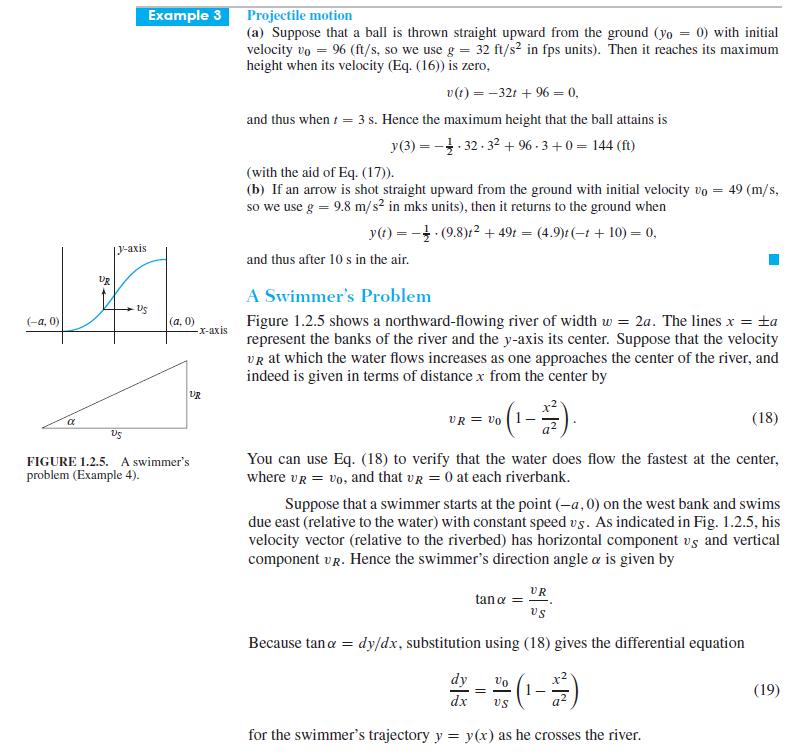
Problems 23 through 28 explore the motion of projectiles under constant acceleration or deceleration.What is the maximum height attained by the arrow of part (b) of Example 3? (-a, 0) α VR 13-axis US -US Example 3 (a,0) -x-axis UR FIGURE 1.2.5. A swimmer's problem (Example 4). Projectile
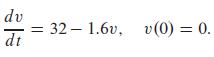
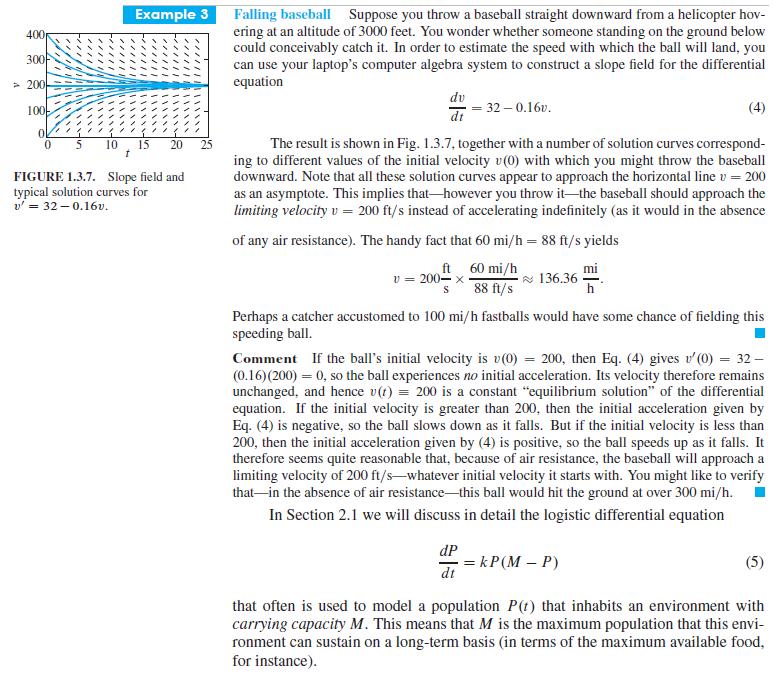
You bail out of the helicopter of Example 3 and pull the ripcord of your parachute. Now k = 1.6 in Eq. (3), so your downward velocity satisfies the initial value problemIn order to investigate your chances of survival, construct a slope field for this differential equation and sketch the
Find general solutions of the differential equations in Problems 1 through 30. Primes denote derivatives with respect to x throughout.xy' + 6y = 3xy4/3
Find general solutions of the differential equations in Problems 1 through 30. Primes denote derivatives with respect to x.ey + y cos x + (xey + sinx)y' = 0
Find general solutions of the differential equations in Problems 1 through 30. Primes denote derivatives with respect to x throughout.2xy' + y3 e-2x = 2xy
Find general solutions of the differential equations in Problems 1 through 30. Primes denote derivatives with respect to x.9x2y2 + x3/2y' = y2
Find general solutions of the differential equations in Problems 1 through 30. Primes denote derivatives with respect to x throughout.y2(xy' + y)(1 + x4)1/2 = x
Find general solutions of the differential equations in Problems 1 through 30. Primes denote derivatives with respect to x.2y + (x + 1)y' = 3x + 3
Find general solutions of the differential equations in Problems 1 through 30. Primes denote derivatives with respect to x throughout.3y2y' + y3 = e-x
Find general solutions of the differential equations in Problems 1 through 30. Primes denote derivatives with respect to x.9x1/2 y4/3 - 12x1/5 y3/2 + (8x3/2 y1/3 - 15x6/5 y1/2) y'= 0
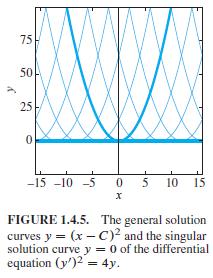
Solve the differential equation (dy/dx)2 = 4y to verify the general solution curves and singular solution curve that are illustrated in Fig. 1.4.5. Then determine the points (a, b) in the plane for which the initial value problem (y')2 = 4y, y(a) = b has (a) no solution,(b) Infinitely many
Find general solutions of the differential equations in Problems 1 through 30. Primes denote derivatives with respect to x throughout.3xy2y' = 3x4 + y3
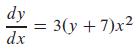
Each of the differential equations in Problems 31 through 36 is of two different types considered in this chapter—separable, linear, homogeneous, Bernoulli, exact, etc. Hence, derive general solutions for each of these equations in two different ways; then reconcile your results. dy dx = 3(y +
Find general solutions of the differential equations in Problems 1 through 30. Primes denote derivatives with respect to x.3y + x3y4 + 3xy' = 0
Find general solutions of the differential equations in Problems 1 through 30. Primes denote derivatives with respect to x throughout.xey y' = 2(ey + x3 e2x)
Showing 1600 - 1700
of 2513
First
10
11
12
13
14
15
16
17
18
19
20
21
22
23
24
Last
Step by Step Answers

 Get 50% OFF
Claim Now
Get 50% OFF
Claim Now