New Semester
Started
Get
50% OFF
Study Help!
--h --m --s
Claim Now
Question Answers
Textbooks
Find textbooks, questions and answers
Oops, something went wrong!
Change your search query and then try again
S
Books
FREE
Study Help
Expert Questions
Accounting
General Management
Mathematics
Finance
Organizational Behaviour
Law
Physics
Operating System
Management Leadership
Sociology
Programming
Marketing
Database
Computer Network
Economics
Textbooks Solutions
Accounting
Managerial Accounting
Management Leadership
Cost Accounting
Statistics
Business Law
Corporate Finance
Finance
Economics
Auditing
Tutors
Online Tutors
Find a Tutor
Hire a Tutor
Become a Tutor
AI Tutor
AI Study Planner
NEW
Sell Books
Search
Search
Sign In
Register
study help
mathematics
first course differential equations
Differential Equations And Linear Algebra 4th Edition C. Edwards, David Penney, David Calvis - Solutions
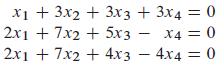
In Problems 19–22, reduce the given system to echelon form to find a single solution vector u such that the solution space is the set of all scalar multiples of u. x1 + 3x2 + 3x3 + 3x4 = 0 2x1 + 7x2 + 5x3 - X4 = 0 2x1 + 7x2 + 4x3 - 4x4 = 0
In Problems 19–22, use the method of Example 5 to find the constants A, B, and C in the indicated partial-fraction decompositions. 2x (x + 1)(x + 2)(x + 3) A x+1 + B x+2 + с x+3
In Problems 19–24, use the method of Example 3 to determine whether the given vectors u, v, and w are linearly independent or dependent. If they are linearly dependent, find scalars a, b, and c not all zero such that au + bv + cw = 0.u = (1, 1,0), v = (5, 1, 3), w = (0, 1, 2)
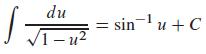
Use the method of Example 9 and the standard integralto derive the general solution y(x) = A cos x + B sin x of the second-order differential equation y'' + y = 0. Thus its solution space has basis {cos x, sin x}. S du √1-u² = sin¹ u + C
In Problems 25–28, express the vector t as a linear combination of the vectors u, v, and w.t = (0, 0, 19), u = (1,4,3), v = (-1, -2,2), w = (4,4, 1)
In Problems 25–28, express the vector t as a linear combination of the vectors u, v, and w.t = (7,7,7), u = (2, 5, 3), v = (4, 1, -1), w = (1, 1, 5)
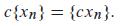
Let V be the set of all infinite sequences {xn} = {x1, x2, x3, ....} of real numbers. Let addition of elements of V and multiplication by scalars be defined as follows:and(a) Show that V is a vector space with these operations.(b) Prove that V is infinite dimensional. {Xn} + {yn} = {xn+yn}
In Problems 29–32, show that the given set V is closed under addition and under multiplication by scalars and is therefore a subspace of R3.V is the set of all (x, y, z) such that x = 0.
In Problems 29–32, show that the given set V is closed under addition and under multiplication by scalars and is therefore a subspace of R3.V is the set of all (x, y, z) such that z = 2x + 3y.
In Problems 29–32, show that the given set V is closed under addition and under multiplication by scalars and is therefore a subspace of R3.V is the set of all (x, y, z) such that 2x + 3y.
In Problems 29–32, show that the given set V is closed under addition and under multiplication by scalars and is therefore a subspace of R3.V is the set of all (x, y, z) such that x + y + z = 0.
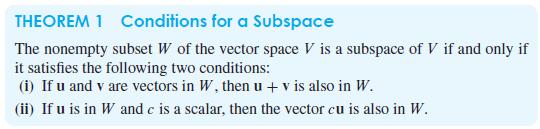
In Problems 1–14, a subset W of some n-space Rn is defined by means of a given condition imposed on the typical vector (x1, x2, ...., xn). Apply Theorem 1 to determine whether or not W is a subspace of Rn.W is the set of all vectors in R3 such that x3 = 0. THEOREM 1 Conditions for a Subspace The
A sphere in space with center (h, k, l) and radius r has equationFour given points in space suffice to determine the values of h, k, l, and r. In Problems 21 and 22, find the center and radius of the sphere that passes through the four given points P, Q,R, and S.P(11, 17, 17), Q(29, 1, 15), R(13, -
Use Cramer’s rule to solve the systems in Problems 21–32.11x + 15y = 108x + 11y = 7
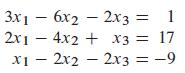
Use the method of Gauss-Jordan elimination (transforming the augmented matrix into reduced echelon form) to solve Problems 11–20 in Section 3.2. 3x16x22x3 = 1 2x14x2 + x3 = 17 x12x2 - 2x3 = -9
In Problems 23–28, use the method of Example 8 to find a matrix X such that AX = B. = [39] · ₁ 9 1₁ B = [2 |, 87 0 A = 05 0 5 -3
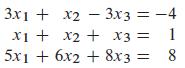
Use the method of Gauss-Jordan elimination (transforming the augmented matrix into reduced echelon form) to solve Problems 11–20 in Section 3.2. 3x1 + x2 3x3 = -4 - x1 + x₂ + x3 = x2 1 8 5x1 + 6x2 + 8x3 =
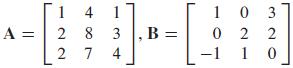
In Problems 23–28, use the method of Example 8 to find a matrix X such that AX = B. A = 4 8 27 4 1 3 , B= 122 103 02 2 -1 10
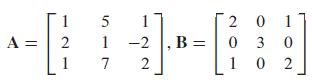
In Problems 23–28, use the method of Example 8 to find a matrix X such that AX = B. A = 1 2 1 5 1 7 -2 2 , B = 201 3 0 02 0 1
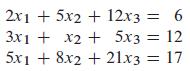
Use the method of Gauss-Jordan elimination (transforming the augmented matrix into reduced echelon form) to solve Problems 11–20 in Section 3.2. 2x1 + 5x2 + 12x3 = 6 3x1 + x2 + 5x3 = 12 5x1 + 8x2 + 21x3: : 17
Use Cramer’s rule to solve the systems in Problems 21–32.5x + 6y = 123x + 4y = 6
Use Cramer’s rule to solve the systems in Problems 21–32.6x + 7y = 38x + 9y = 4
In each of Problems 23-30, a second-order differential equation and its general solution y(x) are given. Determine the constants A and B so as to find a solution of the differential equation that satisfies the given initial conditions involving y (0) and y' (0).y" - 121y = 0, y(x) = Ae11x + Be-11x,
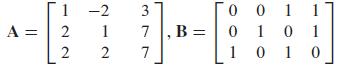
In Problems 23–28, use the method of Example 8 to find a matrix X such that AX = B. A = 1 2 2 -2 1 2 3 7 7 -[i 0 0 1 B = 01 1 101 0 1 0
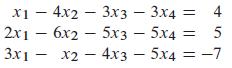
Use the method of Gauss-Jordan elimination (transforming the augmented matrix into reduced echelon form) to solve Problems 11–20 in Section 3.2. х1 - 4х2 - 3x3 - 3x4 X1 2х1 - 6х2 - 5х3 - 5х4 3x1 - X2 - 4x3 - 5x4 = = 4 = 5 -7
Use Cramer’s rule to solve the systems in Problems 21–32.5x1 + 2x2 - 2x3 = 1x1 + 5x2 - 3x3 = -25x1 - 3x2 + 5x3 = 2
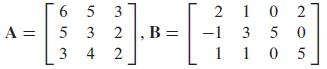
In Problems 23–28, use the method of Example 8 to find a matrix X such that AX = B. A = 653 5 3 342 2 , B= 210 2 -1 3 3 5 0 1105
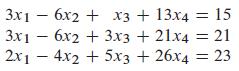
Use the method of Gauss-Jordan elimination (transforming the augmented matrix into reduced echelon form) to solve Problems 11–20 in Section 3.2. 3x16x2 + x3 + 13x4 = 15 3х1 - 6х2 + 3x3 + 21x4 = 21 2x14x2 + 5x3 + 26x4 = 23
Use Cramer’s rule to solve the systems in Problems 21–32.5x1 + 4x2 - 2x3 = 42x1 + 3x3 = 22x1 - x2 + x3 = 1
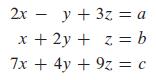
Under what condition on the constants a, b, and c does the systemhave a unique solution? No solution? Infinitely many solutions? 2x = y + 3z = a x + 2y + z = b 7x + 4y + 9z = c
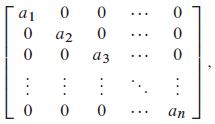
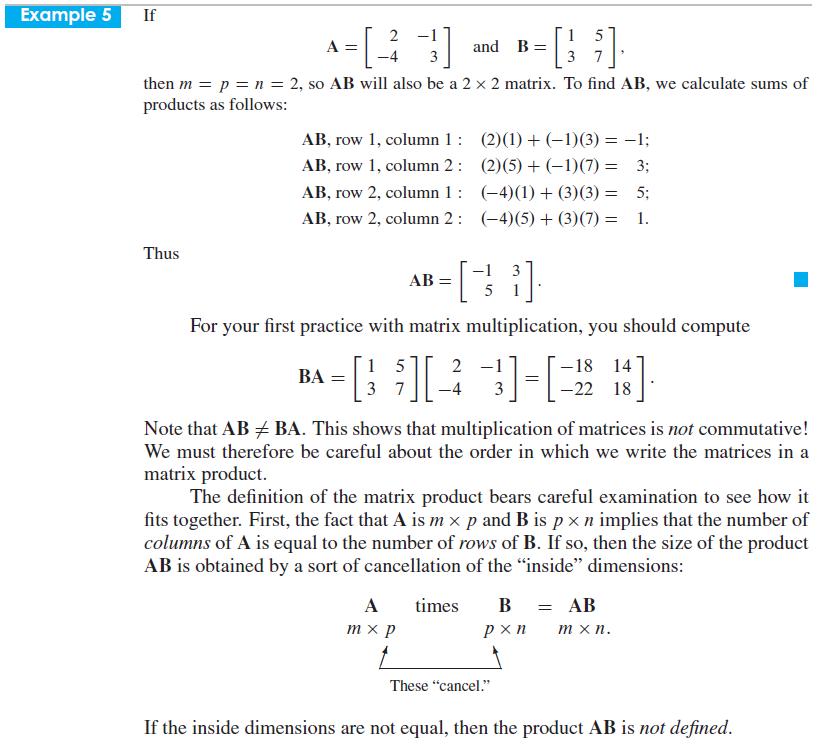
A diagonal matrix is a square matrix of the form in which every element off the main diagonal is zero. Show that the product AB of two n x n diagonal matrices A and B is again a diagonal matrix. State a concise rule for quickly computing AB. Is it clear that AB = BA? Explain. a₁ 0 0 00 a2
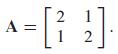
The formula in Problem 29 can be used to compute A2 without an explicit matrix multiplication. It follows thatwithout an explicit matrix multiplicationand so on. Use this method to compute A2, A3, A4, and A5 givenProblems 28 through 30 develop a method of computing powers of a square matrix.Problem
The positive integral powers of a square matrix A are defined as follows:Suppose that r and s are positive integers. Prove that Ar As = Ar+s and that (Ar)s = Ars (in close analogy with the laws of exponents for real numbers). A¹ = A, A4 = AA³,.... A² = AA, A³ = AA², An+1 = AA",...
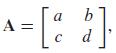
Problems 28 through 30 develop a method of computing powers of a square matrix.Ifthen show thatwhere I denotes the 2 x 2 identity matrix. Thus every 2 x 2 matrix A satisfies the equationwhere det A = ad - bc denotes the determinant of the matrix A, and trace A denotes the sum of its diagonal
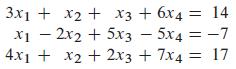
Use the method of Gauss-Jordan elimination (transforming the augmented matrix into reduced echelon form) to solve Problems 11–20 in Section 3.2. 3x1 + x2 + x3 + 6x4 = 14 x12x2 + 5x3 - 5x4 = -7 4x1 + x2 + 2x3 + 7x4 = 17
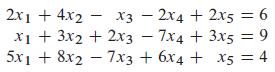
Use the method of Gauss-Jordan elimination (transforming the augmented matrix into reduced echelon form) to solve Problems 11–20 in Section 3.2. 2x1 + 4x2 x3 2x4 + 2x5 = 6 x1 + 3x2 + 2x3-7x4 + 3x5 = 9 5x1 + 8x27x3 + 6x4 + x5 = 4
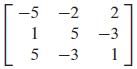
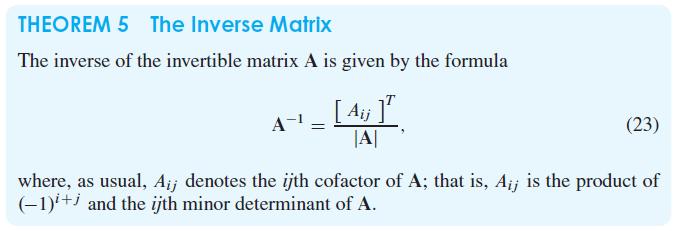
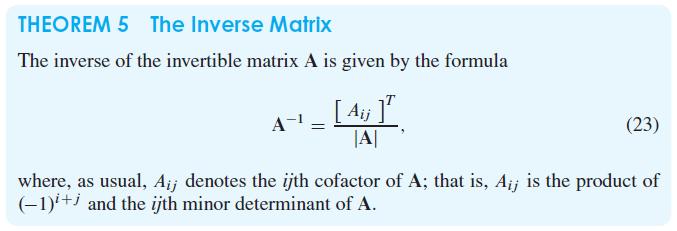
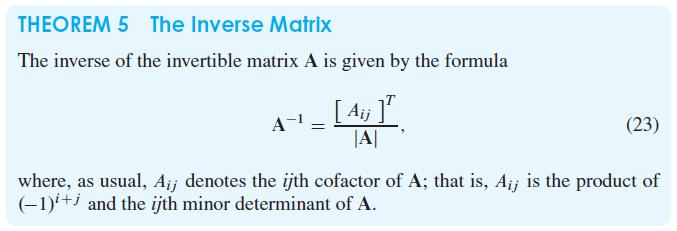
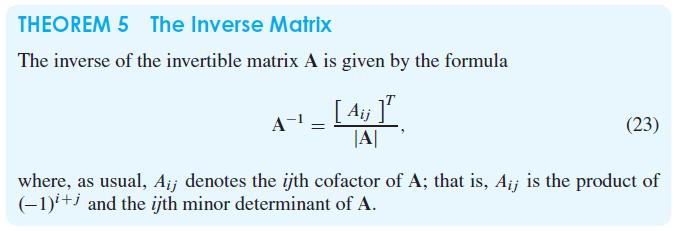
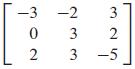
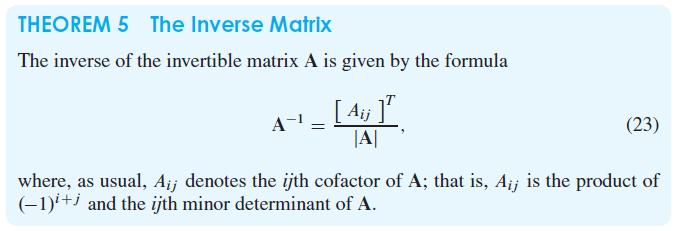
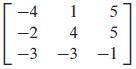
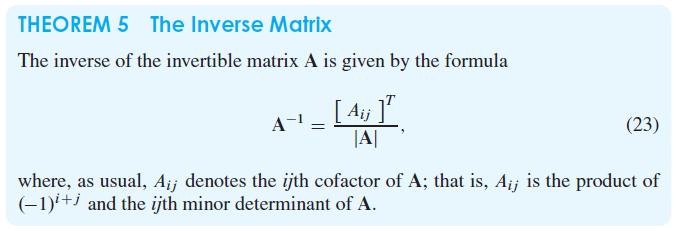
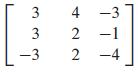
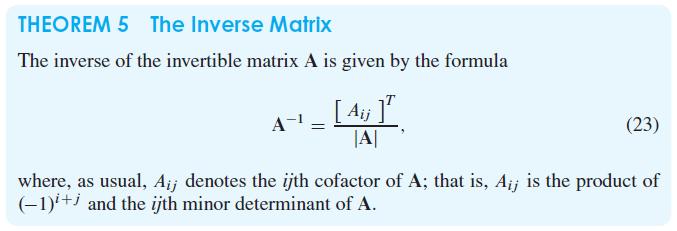
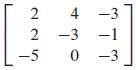
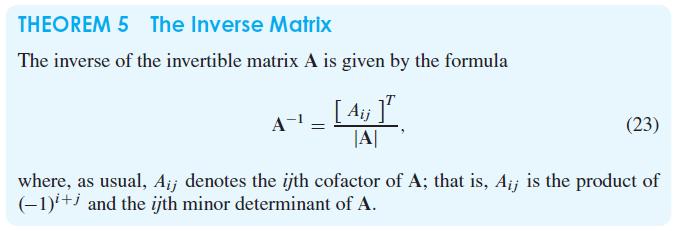
Apply Theorem 5 to find the inverse A-1 of each matrix A given in Problems 33–40. -5-2 2 1 5 L 5 -3 23 -3 1
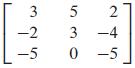
Apply Theorem 5 to find the inverse A-1 of each matrix A given in Problems 33–40. 3 5 -2 3 دیا L -5 2 -4 0 -5
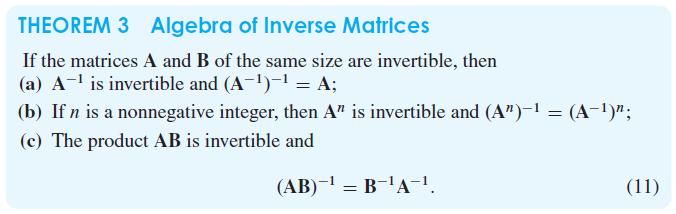
Verify parts (a) and (b) of Theorem 3. THEOREM 3 Algebra of Inverse Matrices If the matrices A and B of the same size are invertible, then (a) A¹ is invertible and (A-1)-¹ = A; (b) If n is a nonnegative integer, then A" is invertible and (A")-¹ = (A-¹)"; (c) The product AB is invertible
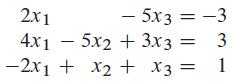
Use Cramer’s rule to solve the systems in Problems 21–32. 2х1 4х1 - 5x2 + 3x3 = -2x1 + x2 + X3 = Х2 5x3 =-3 3 1
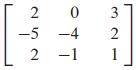
Apply Theorem 5 to find the inverse A-1 of each matrix A given in Problems 33–40. 37 2 0 -5 -4 L 2 -1 1 32
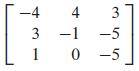
Apply Theorem 5 to find the inverse A-1 of each matrix A given in Problems 33–40. L -4 4 3 -1 1 0 3 355 -5 -5
Apply Theorem 5 to find the inverse A-1 of each matrix A given in Problems 33–40. NOW نیا ترا 3-5
Apply Theorem 5 to find the inverse A-1 of each matrix A given in Problems 33–40. -4 พ 15 55 4 -3 -1
Apply Theorem 5 to find the inverse A-1 of each matrix A given in Problems 33–40. -3 116
Use Cramer’s rule to solve the systems in Problems 21–32.3x1 - x2 - 5x3 = 34x1 - 4x2 - 3x3 = -4x1 - 5x3 = 2
Apply Theorem 5 to find the inverse A-1 of each matrix A given in Problems 33–40. 4 -3 -5 0 225 ㅗ
In each of Problems 23-30, a second-order differential equation and its general solution y(x) are given. Determine the constants A and B so as to find a solution of the differential equation that satisfies the given initial conditions involving y (0) and y' (0).y" - 10y' + 21y = 0, y(x) = Ae3x +
Use Cramer’s rule to solve the systems in Problems 21–32.x1 + 4x2 + 2x3 = 34x1 + 2x2 + x3 = 12x1 - 2x2 - 5x3 = -3
In each of Problems 23-30, a second-order differential equation and its general solution y(x) are given. Determine the constants A and B so as to find a solution of the differential equation that satisfies the given initial conditions involving y (0) and y' (0).6y" - 5y' + y = 0, y(x) = Aex/2 +
Show that the i th row of the product AB is AiB, where Ai is the i th row of the matrix A. AIA and IB = B (2)
Suppose that A is an invertible matrix and that r and s are negative integers. Verify that Ar As = Ar+s and that (Ar)s = Ars.
Suppose that A, B, and C are invertible matrices of the same size. Show that the product ABC is invertible and that (ABC)-1 = C-1 B-1 A-1.
In each of Problems 23-30, a second-order differential equation and its general solution y(x) are given. Determine the constants A and B so as to find a solution of the differential equation that satisfies the given initial conditions involving y (0) and y' (0).15y" + y' - 28y = 0, y(x) =
In each of Problems 23-30, a second-order differential equation and its general solution y(x) are given. Determine the constants A and B so as to find a solution of the differential equation that satisfies the given initial conditions involving y (0) and y' (0).y" + 4y = 0, y(x) = A cos 2x + B sin
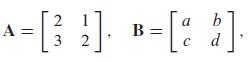
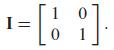
Problems 23 through 26 introduce the idea—developed more fully in the next section—of a multiplicative inverse of a square matrix.LetandFind B so that AB = I = BA as follows: First equate entries on the two sides of the equation AB = I. Then solve the resulting four equations for a, b, c, and
In Problems 23–28, use the method of Example 8 to find a matrix X such that AX = B. ^= A 4 [$ 3]. B = [-1 [₁ 5 - ] 3 -2 -5 5
Use Cramer’s rule to solve the systems in Problems 21–32.17x + 7y = 612x + 5y = 4
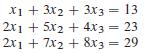
Use the method of Gauss-Jordan elimination (transforming the augmented matrix into reduced echelon form) to solve Problems 11–20 in Section 3.2. X1 + 3x2 + 3x3 = 13. 2x1 + 5x2 + 4x3 = 23 2x1 + 7x2 + 8x3 = 29
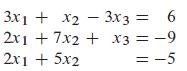
Use the method of Gauss-Jordan elimination (transforming the augmented matrix into reduced echelon form) to solve Problems 11–20 in Section 3.2. 3x1 + X2 - 3x3 = 6 2x1 + 7x2 + x3 =-9 2x1 + 5x2 = -5
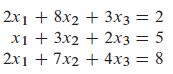
Use the method of Gauss-Jordan elimination (transforming the augmented matrix into reduced echelon form) to solve Problems 11–20 in Section 3.2. 2x1 + 8x2 + 3x3 = 2 x1 + 3x2 + 2x3 = 5 2x1 + 7x2 + 4x3 = = 8
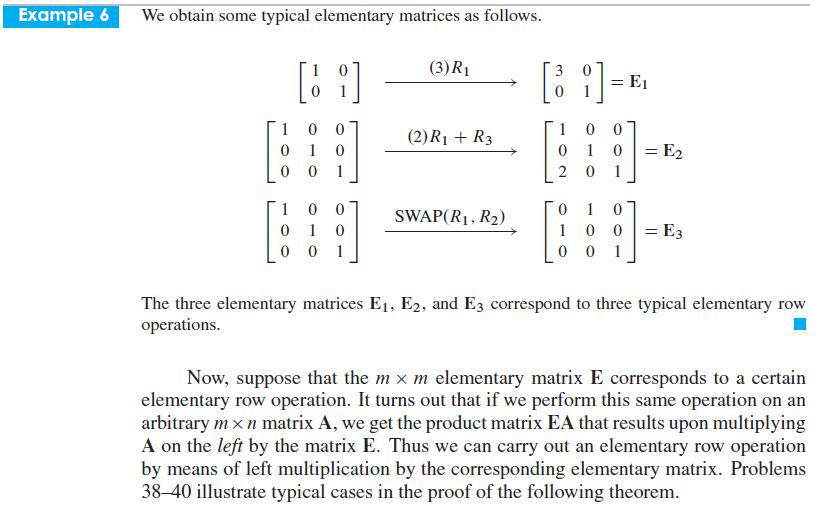
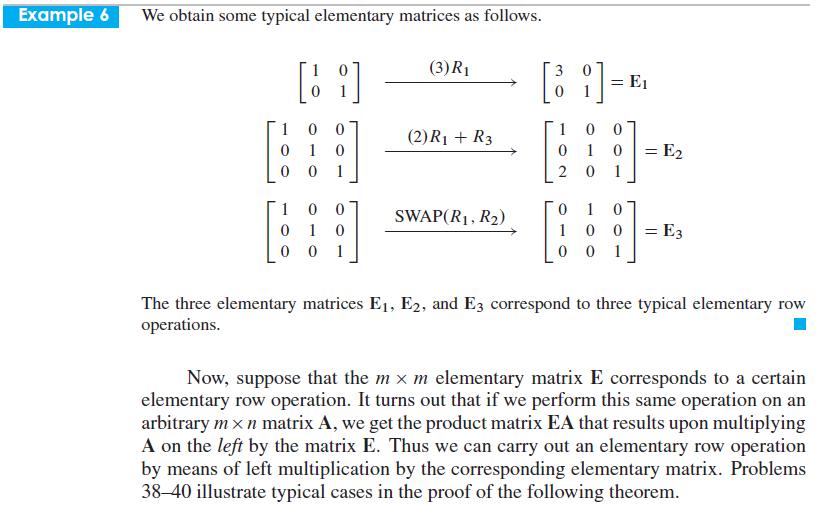
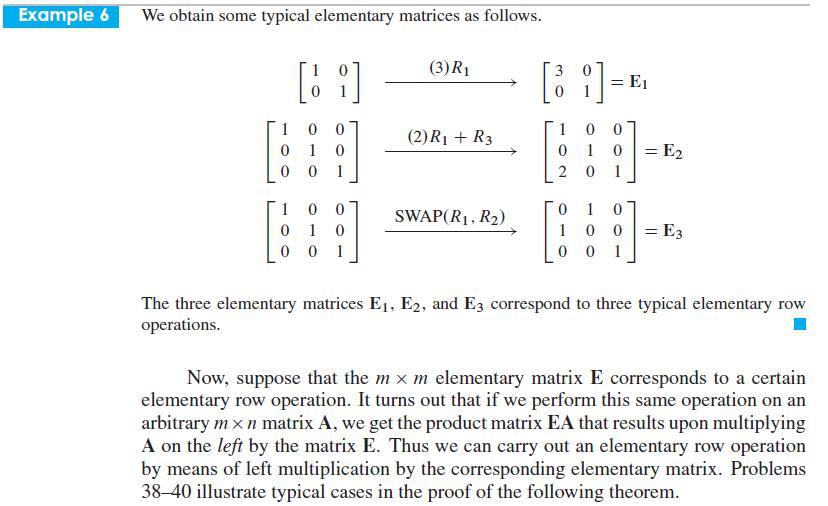
Let E be the elementary matrix E1 of Example 6. If A is a 2 x 2 matrix, show that EA is the result of multiplying the first row of A by 3.Example 6 Example 6 We obtain some typical elementary matrices as follows. 1 0 0 1 0 [9] 0 1 0 0 0 1 0 1 001 0 0 (3) R₁ (2) R₁ + R3 SWAP(R₁,
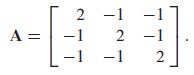
Consider the 3 x 3 matrixFirst verify by direct computation that A2 = 3A. Then conclude that An+1 = 3nA for every positive integer n. A = 2-1 -1 -1 2 -1 -1 2 -1
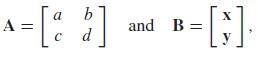
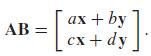
Consider the 2 x 2 matriceswhere x and y denote the row vectors of B. Then the product AB can be written in the formUse this expression and the properties of determinants to show thatThus the determinant of a product of 2 x 2 matrices is equal to the product of their determinants. a X A = b] [22]
Problems 31-38 illustrate ways in which the algebra of matrices is not analogous to the algebra of real numbers.This is a continuation of the previous two problems. Find two nonzero 2 x 2 matrices A and B such that A2 + B2 = 0.
Let E be the elementary matrix E3 of Example 6. Show that EA is the result of interchanging the first two rows of the matrix A.Example 6 Example 6 We obtain some typical elementary matrices as follows. 1 0 0 1 0 [9] 0 1 0 0 0 1 0 1 001 0 0 (3) R₁ (2) R₁ + R3 SWAP(R₁, R₂) [3]= 1 0 2 = E₁ 0
Let E be the elementary matrix E2 of Example 6 and suppose that A is a 3 x 3 matrix. Show that EA is the result upon adding twice the first row of A to its third row.Example 6 Example 6 We obtain some typical elementary matrices as follows. 1 0 0 1 0 [9] 0 1 0 0 0 1 0 1 001 0 0 (3) R₁ (2) R₁ +
Use the formula of Problem 29 to find a 2 x 2 matrix A such that A ≠ 0 and A ≠ I but such that A2 = A.Problem 29where I denotes the 2 x 2 identity matrix. Thus every 2 x 2 matrix A satisfies the equation 2 A² = (a + d)A - (ad - bc)I,
Find a 2 x 2 matrix A with each element +1 or -1 such that A2 = 0. The formula of Problem 29 may be helpful.Problem 29where I denotes the 2 x 2 identity matrix. Thus every 2 x 2 matrix A satisfies the equation 2 A² = (a + d)A - (ad - bc)I,
Use matrix multiplication to show that if x1 and x2 are two solutions of the homogeneous system Ax = 0 and c1 and c2 are real numbers, then c1x1 + c2x2 is also a solution.
Find a 2 x 2 matrix A with each main diagonal element zero such that A2 = -I.
Find a 2 x 2 matrix A with each main diagonal element zero such that A2 = I.
Problems 31-38 illustrate ways in which the algebra of matrices is not analogous to the algebra of real numbers.(a) Suppose that A and B are the matrices of Example 5. Show that (A + B)(A - B) ≠ A2 - B2.(b) Suppose that A and B are square matrices with the property that AB = BA. Show that (A +
List all possible reduced row-echelon forms of a 2 x 2 matrix, using asterisks to indicate elements that may be either zero or nonzero.
Find four different 2 x 2 matrices A, with each main diagonal element either +1 or -1, such that A2 = I.
Use Cramer’s rule to solve the systems in Problems 21–32.3x1 + 4x2 - 3x3 = 53x1 - 2x2 + 4x3 = 73x1 + 2x2 - x3 = 3
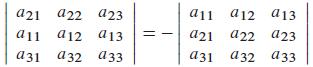
Each of Problems 43–46 lists a special case of one of Property 1 through Property 5. Verify it by expanding the determinant on the left-hand side along an appropriate row or column. a21 922 923 a11 a12 a13 a31 432 433 a11 912 913 a21 422 423 a31 432 433
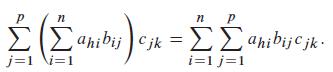
Let A = [ahi], B = [bij], and C = [Cjk] be matrices of sizes m x n, n x p, and p x q, respectively. To establish the associative law A(BC) = (AB)C, proceed as follows. By Equation (16) the hjth element of AB isBy another application of Equation (16), the hkth element of (AB)C isShow similarly that
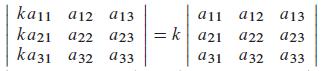
Each of Problems 43–46 lists a special case of one of Property 1 through Property 5. Verify it by expanding the determinant on the left-hand side along an appropriate row or column. kan a12 a13 ka21 a22 a23 ka31 932 933 a11 912 913 422 a23 932 933 = k a21 a31
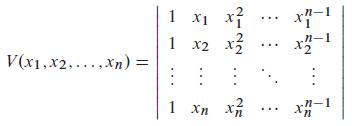
Problems 61–64 deal with the Vandermonde determinant that will play an important role in Section 3.7.Show by direct computation that V(a, b) = b - a and that V(x1,X2,....Xn) = 1 X1 1 x2 기글 212 1 Xn ... 2 : .. -1 -1 -1
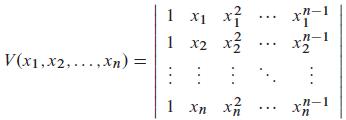
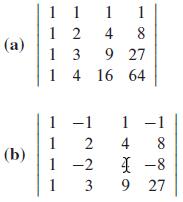
Problems 61–64 deal with the Vandermonde determinantUse the formula in (25) to evaluate the two determinants given next. V(x1,x2,...,xn): = 1 1 X1 x² x2 x2 x2 LE 1 xn x 2 A xn-1 n-1 ... n .n-1 n
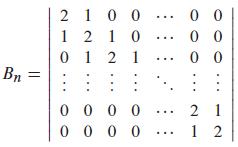
Consider the n x n determinantin which each entry on the main diagonal is a 2, each entry on the two adjacent diagonals is a 1, and every other entry is zero.(a) Expand along the first row to show that Bn = 2Bn-1 - Bn-2.(b) Prove by induction on n that Bn = n + 1 for n ≥ 2. Bn = 2100 2
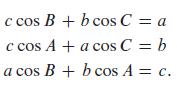
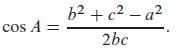
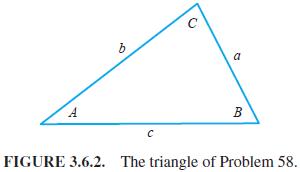
Figure 3.6.2 shows an acute triangle with angles A, B, and C and opposite sides a, b, and c. By dropping a perpendicular from each vertex to the opposite side, derive the equationsRegarding these as linear equations in the unknowns cosA, cosB, and cosC, use Cramer’s rule to derive the law of
Each of Problems 43–46 lists a special case of one of Property 1 through Property 5. Verify it by expanding the determinant on the left-hand side along an appropriate row or column. a₁ b₁ c₁ +d₁ az b2 c₂ + d₂ a3 b3 c3 +d3 = a₁ b₁ c₁ az b₂ c₂ C2 a3 b3 c3 + a₁ b₁ di a2
Suppose that A2 = A. Prove that |A| = 0 or |A| = 1.
Let A = [aij ] be a 3 x 3 matrix. Show that det(AT) = det A by expanding det A along its first row and det(AT) along its first column.
Problems 47 through 49 develop properties of matrix transposes.Suppose that A and B are matrices of the same size. Show that:(a) (AT)T = A;(b) (CA)T = CAT; and(c) (A + B)T = AT + BT.
Each of Problems 43–46 lists a special case of one of Property 1 through Property 5. Verify it by expanding the determinant on the left-hand side along an appropriate row or column. a11 +ka12 a21+ka22 a31+ka32 a12 a13 a22 923 a32 433 a11 a12 a13 a21 922 923 a31 a32 a33
A computer with a printer is required for Problems 17 through 24. In these initial value problems, use the improved Euler method with step sizes h = 0.1, 0.02, 0.004, and 0.0008 to approximate to five decimal places the values of the solution at ten equally spaced points of the given interval.
A computer with a printer is required for Problems 17 through 24. In these initial value problems, use Euler’s method with step sizes h = 0.1, 0.02, 0.004, and 0.0008 to approximate to four decimal places the values of the solution at ten equally spaced points of the given interval. Print the
A computer with a printer is required for Problems 17 through 24. In these initial value problems, use the Runge–Kutta method with step sizes h = 0.2, 0.1, 0.05, and 0.025 to approximate to six decimal places the values of the solution at five equally spaced points of the given interval. Print
Consider the crossbow bolt of Example 3, shot straight upward from the ground (y = 0) at time t = 0 with initial velocity v0 = 49 m/s. Take g = 9.8 m/s2 and ρ = 0.0011 in Eq. (12). Then use Eqs. (13) and (14) to show that the bolt reaches its maximum height of about 108.47 m in about 4.61 s.
A computer with a printer is required for Problems 17 through 24. In these initial value problems, use the improved Euler method with step sizes h = 0.1, 0.02, 0.004, and 0.0008 to approximate to five decimal places the values of the solution at ten equally spaced points of the given interval.
A computer with a printer is required for Problems 17 through 24. In these initial value problems, use Euler’s method with step sizes h = 0.1, 0.02, 0.004, and 0.0008 to approximate to four decimal places the values of the solution at ten equally spaced points of the given interval. Print the
A computer with a printer is required for Problems 17 through 24. In these initial value problems, use the Runge–Kutta method with step sizes h = 0.2, 0.1, 0.05, and 0.025 to approximate to six decimal places the values of the solution at five equally spaced points of the given interval. Print
A computer with a printer is required for Problems 17 through 24. In these initial value problems, use the improved Euler method with step sizes h = 0.1, 0.02, 0.004, and 0.0008 to approximate to five decimal places the values of the solution at ten equally spaced points of the given interval.
A computer with a printer is required for Problems 17 through 24. In these initial value problems, use Euler’s method with step sizes h = 0.1, 0.02, 0.004, and 0.0008 to approximate to four decimal places the values of the solution at ten equally spaced points of the given interval. Print the
In each of Problems 23-30, a second-order differential equation and its general solution y(x) are given. Determine the constants A and B so as to find a solution of the differential equation that satisfies the given initial conditions involving y (0) and y' (0).y" - 25y = 0, y(x) = Ae5x +
In each of Problems 23-30, a second-order differential equation and its general solution y(x) are given. Determine the constants A and B so as to find a solution of the differential equation that satisfies the given initial conditions involving y (0) and y' (0).y" - 9y = 0, y(x) = A cosh 3x + B
A computer with a printer is required for Problems 17 through 24. In these initial value problems, use the Runge–Kutta method with step sizes h = 0.2, 0.1, 0.05, and 0.025 to approximate to six decimal places the values of the solution at five equally spaced points of the given interval. Print
Showing 1400 - 1500
of 2513
First
8
9
10
11
12
13
14
15
16
17
18
19
20
21
22
Last
Step by Step Answers

 Get 50% OFF
Claim Now
Get 50% OFF
Claim Now