New Semester
Started
Get
50% OFF
Study Help!
--h --m --s
Claim Now
Question Answers
Textbooks
Find textbooks, questions and answers
Oops, something went wrong!
Change your search query and then try again
S
Books
FREE
Study Help
Expert Questions
Accounting
General Management
Mathematics
Finance
Organizational Behaviour
Law
Physics
Operating System
Management Leadership
Sociology
Programming
Marketing
Database
Computer Network
Economics
Textbooks Solutions
Accounting
Managerial Accounting
Management Leadership
Cost Accounting
Statistics
Business Law
Corporate Finance
Finance
Economics
Auditing
Tutors
Online Tutors
Find a Tutor
Hire a Tutor
Become a Tutor
AI Tutor
AI Study Planner
NEW
Sell Books
Search
Search
Sign In
Register
study help
mathematics
first course differential equations
Differential Equations And Linear Algebra 4th Edition C. Edwards, David Penney, David Calvis - Solutions
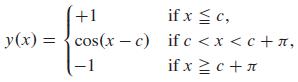
Verify that if c is a constant, then the function defined piecewise bysatisfies the differential equation y' = -√1- y2 for all x. (Perhaps a preliminary sketch with c = 0 will be helpful.) Sketch a variety of such solution curves. Then determine (in terms of a and b) how many different solutions
Problems 30 through 32 explore the relation between the speed of an auto and the distance it skids when the brakes are applied.A car traveling at 60 mi/h (88 ft/s) skids 176 ft after its brakes are suddenly applied. Under the assumption that the braking system provides constant deceleration, what
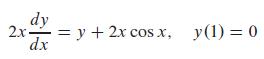
Express the solution of the initial value problemas an integral as in Example 3 of this section. 2x- = y + 2x cos x, y(1) = 0 dy dx
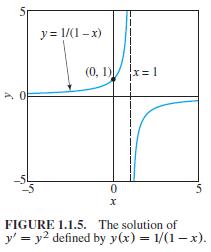
Problems 29 through 32 explore the connections among general and singular solutions, existence, and uniqueness.(a) Find a general solution of the differential equation dy/dx = y2.(b) Find a singular solution that is not included in the general solution.(c) Inspect a sketch of typical solution
Problems 23 through 28 explore the motion of projectiles under constant acceleration or deceleration.A ball is thrown straight downward from the top of a tall building. The initial speed of the ball is 10 m/s. It strikes the ground with a speed of 60 m/s. How tall is the building?
Verify that if k is a constant, then the function y(x) ≡ kx satisfies the differential equation xy' = y for all x. Construct a slope field and several of these straight line solution curves. Then determine (in terms of a and b) how many different solutions the initial value problem xy' = y, y(a)
In Problems 27 through 31, a function y = g(x) is described by some geometric property of its graph. Write a differential equation of the form dy/dx = f (x, y) having the function g as its solution (or as one of its solutions).Every straight line normal to the graph of g passes through the point
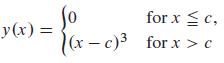
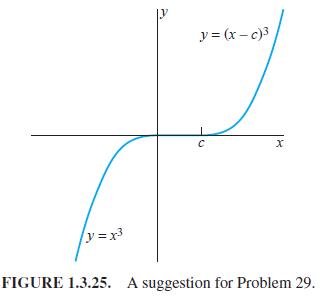
Verify that if c is a constant, then the function defined piecewise bysatisfies the differential equation y' = 3y2/3 for all x. Can you also use the "left half" of the cubic y = (x - c)3 in piecing together a solution curve of the differential equation? (See Fig. 1.3.25.) Sketch a variety of such
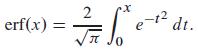
Express the general solution of dy/dx = 1 + 2xy in terms of the error function erf(x) = 2 元 e-1² dt.
Find explicit particular solutions of the initial value problems in Problems 19 through 28. dy 2√√x. dx cos² y, y(4) = π/4
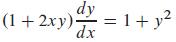
Solve the differential equations in Problems 26 through 28 by regarding y as the independent variable rather than x. dy (1 + 2xy) = 1 + y² dx
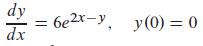
Find explicit particular solutions of the initial value problems in Problems 19 through 28. dy dx 6e2x-y, y(0) = 0
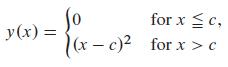
The next seven problems illustrate the fact that, if the hypotheses of Theorem 1 are not satisfied, then the initial value problem y' = f (x,y), y(a) = b may have either no solutions, finitely many solutions, or infinitely many solutions.(a) Verify that if c is a constant, then the function defined
In Problems 27 through 31, a function y = g(x) is described by some geometric property of its graph. Write a differential equation of the form dy/dx = f (x, y) having the function g as its solution (or as one of its solutions).The slope of the graph of g at the point (x, y) is the sum of x and y.
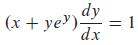
Solve the differential equations in Problems 26 through 28 by regarding y as the independent variable rather than x. (x + yey) dy = 1 dx
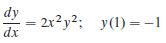
Find explicit particular solutions of the initial value problems in Problems 19 through 28. dy dx = 2xy²+3x²y²,y(1) = -1
Problems 23 through 28 explore the motion of projectiles under constant acceleration or deceleration.A projectile is fired straight upward with an initial velocity of 100 m=s from the top of a building 20 m high and falls to the ground at the base of the building. Find (a) Its maximum height
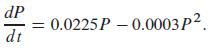
Suppose the deer population P(t) in a small forest satisfies the logistic equationConstruct a slope field and appropriate solution curve to answer the following questions: If there are 25 deer at time t = 0 and t is measured in months, how long will it take the number of deer to double? What will
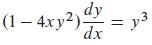
Solve the differential equations in Problems 26 through 28 by regarding y as the independent variable rather than x. (1 - 4xy2) dy dx = y3
Find explicit particular solutions of the initial value problems in Problems 19 through 28. dy x=y=2x²y, y(1) = 1 dx
Find explicit particular solutions of the initial value problems in Problems 19 through 28. dy dx = y cotx, y ( 1 n ) = ½ n
Problems 23 through 28 explore the motion of projectiles under constant acceleration or deceleration.The brakes of a car are applied when it is moving at 100 km/h and provide a constant deceleration of 10 meters per second per second (m/s2). How far does the car travel before coming to a stop?
Problems 23 through 28 explore the motion of projectiles under constant acceleration or deceleration.A ball is dropped from the top of a building 400 ft high. How long does it take to reach the ground? With what speed does the ball strike the ground?
Problems 23 and 24 are like Problems 21 and 22, but now use a computer algebra system to plot and print out a slope field for the given differential equation. If you wish (and know how), you can check your manually sketched solution curve by plotting it with the computer.y' = x + 1/2y2, y(-2) = 0;
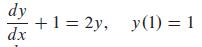
Find explicit particular solutions of the initial value problems in Problems 19 through 28. dy dx +1= 2y, y(1) = 1
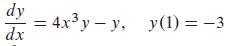
Find explicit particular solutions of the initial value problems in Problems 19 through 28. dy dx = 4x³yy, y(1) = -3
Problems 23 and 24 are like Problems 21 and 22, but now use a computer algebra system to plot and print out a slope field for the given differential equation. If you wish (and know how), you can check your manually sketched solution curve by plotting it with the computer.y' = x2 + y2 - 1, y(0) = 0;
Find explicit particular solutions of the initial value problems in Problems 19 through 28. dy 2y dx X √x²-16 2 y (5) = 2
Find explicit particular solutions of the initial value problems in Problems 19 through 28. dy dx = 3x² (y² + 1), y(0) = 1
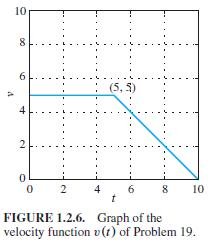
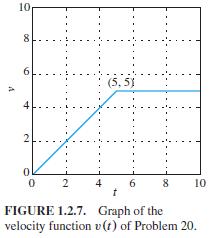
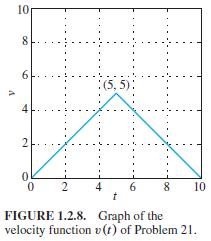
In Problems 19 through 22, a particle starts at the origin and travels along the x-axis with the velocity function v(t) whose graph is shown in Figs. 1.2.6 through 1.2.9. Sketch the graph of the resulting position function x(t) for 0 ≦ t ≦ 10. 10 8 00 6 2 0 0 2 4 (5,5) 6 8 10 t FIGURE 1.2.6.
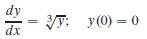
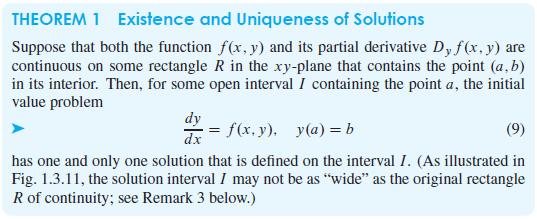
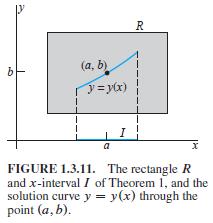
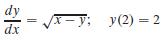
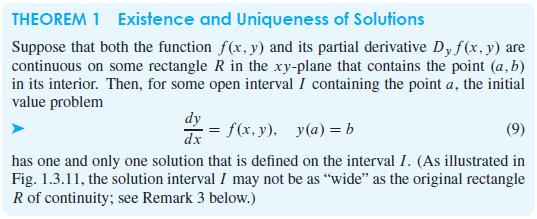
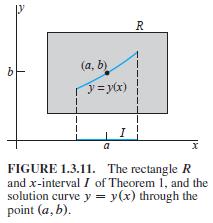
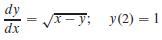
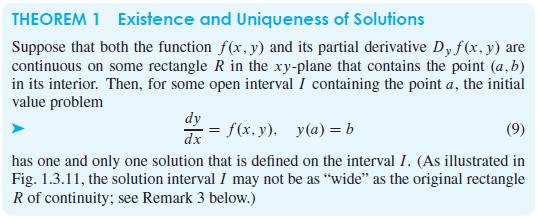
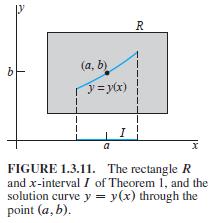
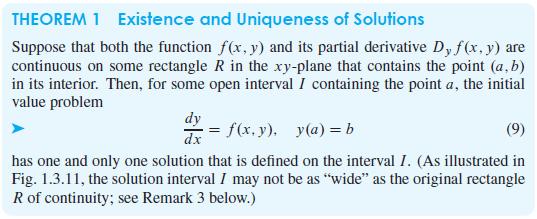
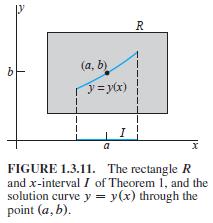
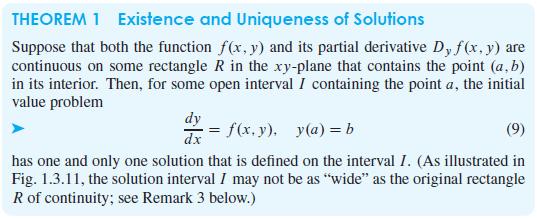
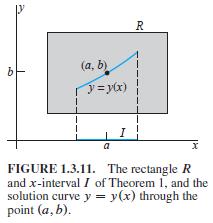
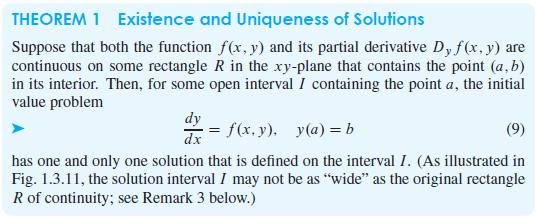
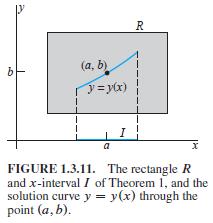
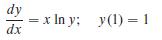
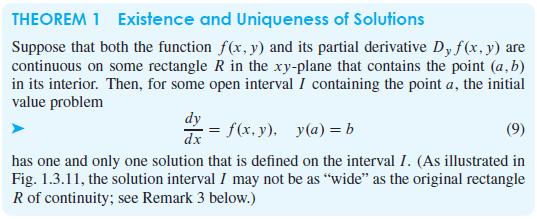
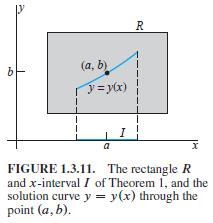
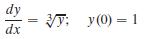
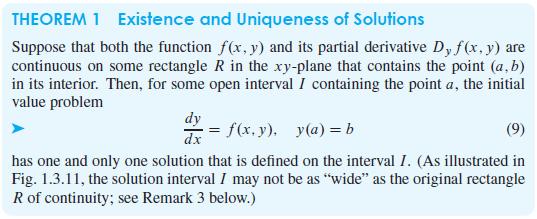
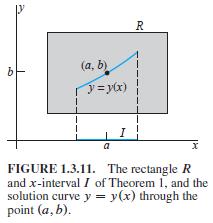
A more detailed version of Theorem 1 says that, if the function f (x, y) is continuous near the point (a, b), then at least one solution of the differential equation y' = f (x, y) exists on some open interval I containing the point x = a and, moreover, that if in addition the partial derivative
A more detailed version of Theorem 1 says that, if the function f (x, y) is continuous near the point (a, b), then at least one solution of the differential equation y' = f (x, y) exists on some open interval I containing the point x = a and, moreover, that if in addition the partial derivative
A more detailed version of Theorem 1 says that, if the function f (x, y) is continuous near the point (a, b), then at least one solution of the differential equation y' = f (x, y) exists on some open interval I containing the point x = a and, moreover, that if in addition the partial derivative
A more detailed version of Theorem 1 says that, if the function f (x, y) is continuous near the point (a, b), then at least one solution of the differential equation y' = f (x, y) exists on some open interval I containing the point x = a and, moreover, that if in addition the partial derivative
A more detailed version of Theorem 1 says that, if the function f (x, y) is continuous near the point (a, b), then at least one solution of the differential equation y' = f (x, y) exists on some open interval I containing the point x = a and, moreover, that if in addition the partial derivative
A more detailed version of Theorem 1 says that, if the function f (x, y) is continuous near the point (a, b), then at least one solution of the differential equation y' = f (x, y) exists on some open interval I containing the point x = a and, moreover, that if in addition the partial derivative
In Problems 11 through 18, find the position function x(t) of a moving particle with the given acceleration a(t), initial position x0 = x (0), and initial velocity v0 = v(0).a(t) = 2t + 1, v0 = -7, x0 = 4
In Problems 11 through 18, find the position function x(t) of a moving particle with the given acceleration a(t), initial position x0 = x (0), and initial velocity v0 = v(0). a(t): = 1 (t+1)3 vo= 0, xo=0
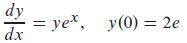
Find explicit particular solutions of the initial value problems in Problems 19 through 28. dy dx = yet, y(0) = 2e
In Problems 11 through 18, find the position function x(t) of a moving particle with the given acceleration a(t), initial position x0 = x (0), and initial velocity v0 = v(0).a(t) = 4(t + 3)2, v0 = -1, x0 = 1
In Problems 11 through 18, find the position function x(t) of a moving particle with the given acceleration a(t), initial position x0 = x (0), and initial velocity v0 = v(0).a(t) = 50 sin 5t, v0 = -10, x0 = 8
In Problems 11 through 18, find the position function x(t) of a moving particle with the given acceleration a(t), initial position x0 = x (0), and initial velocity v0 = v(0). I = 0x 'I = 0a /1+4 1 a(t) =
Problems 54 through 64 illustrate the application of Torricelli’s law.A spherical tank of radius 4 ft is full of water when a circular bottom hole with radius 1 in. is opened. How long will be required for all the water to drain from the tank?
A more detailed version of Theorem 1 says that, if the function f (x, y) is continuous near the point (a, b), then at least one solution of the differential equation y' = f (x, y) exists on some open interval I containing the point x = a and, moreover, that if in addition the partial derivative
A more detailed version of Theorem 1 says that, if the function f (x, y) is continuous near the point (a, b), then at least one solution of the differential equation y' = f (x, y) exists on some open interval I containing the point x = a and, moreover, that if in addition the partial derivative
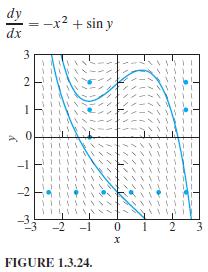
In Problems 1 through 10, we have provided the slope field of the indicated differential equation, together with one or more solution curves. Sketch likely solution curves through the additional points marked in each slope field. dx 3 2 1 -1 -2 -x² + sin y -2 FIGURE 1.3.24. 0 X - 2 3.
A more detailed version of Theorem 1 says that, if the function f (x, y) is continuous near the point (a, b), then at least one solution of the differential equation y' = f (x, y) exists on some open interval I containing the point x = a and, moreover, that if in addition the partial derivative
In Problems 11 through 18, find the position function x(t) of a moving particle with the given acceleration a(t), initial position x0 = x (0), and initial velocity v0 = v(0).a(t) = 50, v0 = 10, x0 = 20
In Problems 11 through 18, find the position function x(t) of a moving particle with the given acceleration a(t), initial position x0 = x (0), and initial velocity v0 = v(0).a(t) = -20, v0 = -15, x0 = 5
In Problems 11 through 18, find the position function x(t) of a moving particle with the given acceleration a(t), initial position x0 = x (0), and initial velocity v0 = v(0).a(t) = 3t, v0 = 5, x0 = 0
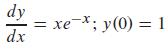
In Problems 1 through 10, find a function y = f (x) satisfying the given differential equation and the prescribed initial condition. dy dx = : xe *; y(0) = 1
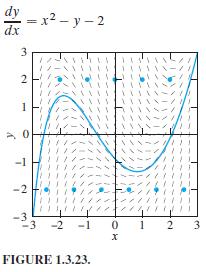
In Problems 1 through 10, we have provided the slope field of the indicated differential equation, together with one or more solution curves. Sketch likely solution curves through the additional points marked in each slope field. dy dx =x²-y-2 3 2 0 -1 -2 -1 0 X FIGURE 1.3.23. +- 1 2 3
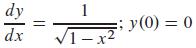
In Problems 1 through 10, find a function y = f (x) satisfying the given differential equation and the prescribed initial condition. dy dx || 1 1-x +2 (0) = 0
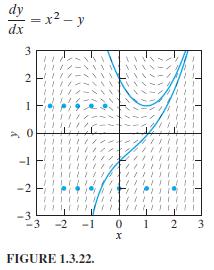
In Problems 1 through 10, we have provided the slope field of the indicated differential equation, together with one or more solution curves. Sketch likely solution curves through the additional points marked in each slope field. dy dx 3 =x²-y 2 1 0 -1 2200 -3 -2 -1 FIGURE 1.3.22. XX >X 13 0
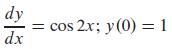
In Problems 1 through 10, find a function y = f (x) satisfying the given differential equation and the prescribed initial condition. dy dx = cos 2x; y(0) = 1
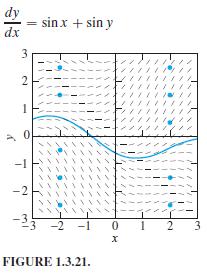
In Problems 1 through 10, we have provided the slope field of the indicated differential equation, together with one or more solution curves. Sketch likely solution curves through the additional points marked in each slope field. dy dx 3 2 1 0 -1 -2 sin x + sin y -2 -1 I FIGURE
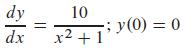
In Problems 1 through 10, find a function y = f (x) satisfying the given differential equation and the prescribed initial condition. dy dx 10 2 x + 1 -; y(0) = 0
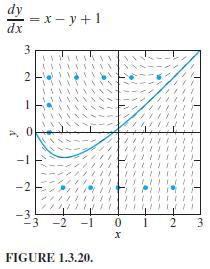
In Problems 1 through 10, we have provided the slope field of the indicated differential equation, together with one or more solution curves. Sketch likely solution curves through the additional points marked in each slope field. dy dx =x-y+1 3 2 1 2 0 10 -1 -2 -2 -1 FIGURE 1.3.20. 0 X 1 2 3
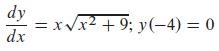
In Problems 1 through 10, find a function y = f (x) satisfying the given differential equation and the prescribed initial condition. dy dx -2 =xx +9; y(-4) = 0
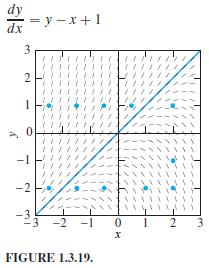
In Problems 1 through 10, we have provided the slope field of the indicated differential equation, together with one or more solution curves. Sketch likely solution curves through the additional points marked in each slope field. dy dx =y=x+1 3 2 1 0 -1 -2 -3 17 17 -2 -1 FIGURE
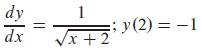
In Problems 1 through 10, find a function y = f (x) satisfying the given differential equation and the prescribed initial condition. dy dx la || 1 x + 2 ; (2) = -1
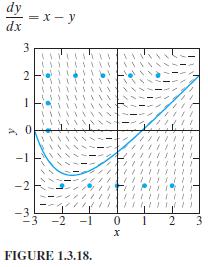
In Problems 1 through 10, we have provided the slope field of the indicated differential equation, together with one or more solution curves. Sketch likely solution curves through the additional points marked in each slope field. dy dx =x-y 3 2 1 0 -1 -2 -3 -3 -2 -1 FIGURE 1.3.18. 77 0 1 X 2 3
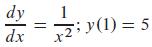
In Problems 1 through 10, find a function y = f (x) satisfying the given differential equation and the prescribed initial condition. dy dx x ; y(1) = 5
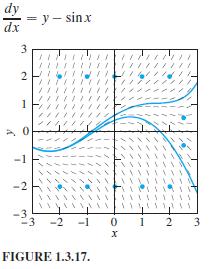
In Problems 1 through 10, we have provided the slope field of the indicated differential equation, together with one or more solution curves. Sketch likely solution curves through the additional points marked in each slope field. dy dx 3 = 2 -1 2 - y - sinx دیا 11 12 FIGURE 1.3.17. 0 OK X 11 12
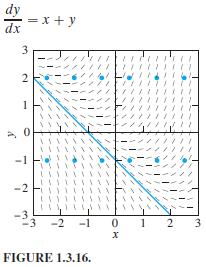
In Problems 1 through 10, we have provided the slope field of the indicated differential equation, together with one or more solution curves. Sketch likely solution curves through the additional points marked in each slope field. dy dx = x + y 3 2 1 0 3 -2 FIGURE 1.3.16. 11 17 0 1 2 3
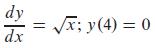
In Problems 1 through 10, find a function y = f (x) satisfying the given differential equation and the prescribed initial condition. dy dx || x; y (4) = 0
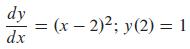
In Problems 1 through 10, find a function y = f (x) satisfying the given differential equation and the prescribed initial condition. dy dx = (x - 2); y(2) = 1
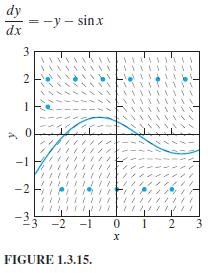
In Problems 1 through 10, we have provided the slope field of the indicated differential equation, together with one or more solution curves. Sketch likely solution curves through the additional points marked in each slope field. dy dx = 3 2 1 0 =-y-sinx -1 -2 11 Z -3 -2 -1 FIGURE 1.3.15. 0 1 X 2 3
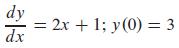
In Problems 1 through 10, find a function y = f (x) satisfying the given differential equation and the prescribed initial condition. dy dx = 2x + 1; y(0) = 3
Just before midday the body of an apparent homicide victim is found in a room that is kept at a constant temperature of 70°F. At 12 noon the temperature of the body is 80°F and at 1 P.M. it is 75°F. Assume that the temperature of the body at the time of death was 98.6°F and that it has cooled
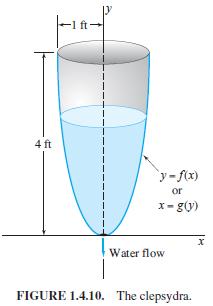
A 12 h water clock is to be designed with the dimensions shown in Fig. 1.4.10, shaped like the surface obtained by revolving the curve y = f (x) around the y-axis. What should this curve be, and what should the radius of the circular bottom hole be, in order that the water level will fall at the
A water tank has the shape obtained by revolving the parabola x2 = by around the y-axis. The water depth is 4 ft at 12 noon, when a circular plug in the bottom of the tank is removed. At 1 P.M. the depth of the water is 1 ft.(a) Find the depth y(t) of water remaining after t hours.(b) When will the
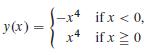
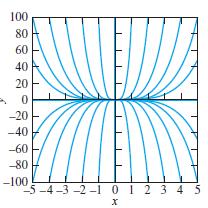
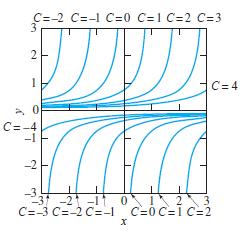
(a) Show that y(x) = Cx4 defines a one-parameter family of differentiable solutions of the differential equation xy' = 4y (Fig. 1.1.9).(b) Show thatdefines a differentiable solution of xy' = 4y for all x, but is not of the form y(x) = Cx4.(c) Given any two real numbers a and b, explain why-in
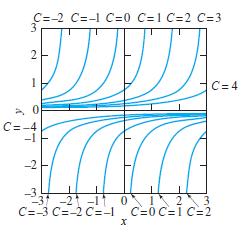
In Example 7 we saw that y(x) = 1/(C - x) defines a one-parameter family of solutions of the differential equation dy/dx = y2.(a) Determine a value of C so that y (10) = 10.(b) Is there a value of C such that y(0) = 0? Can you nevertheless find by inspection a solution of dy/dx = y2 such that y(0)
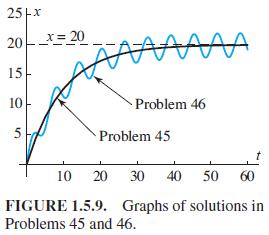
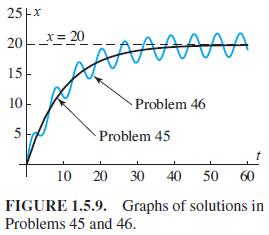
Problems 45 and 46 deal with a shallow reservoir that has a one-square-kilometer water surface and an average water depth of 2 meters. Initially it is filled with fresh water, but at time t = 0 water contaminated with a liquid pollutant begins flowing into the reservoir at the rate of 200 thousand
Problems 45 and 46 deal with a shallow reservoir that has a one-square-kilometer water surface and an average water depth of 2 meters. Initially it is filled with fresh water, but at time t = 0 water contaminated with a liquid pollutant begins flowing into the reservoir at the rate of 200 thousand
Problems 43 through 46 concern the differential equationwhere k is a constant.(a) Assume that k is positive, and then sketch graphs of solutions of x' = kx2 with several typical positive values of x(0).(b) How would these solutions differ if the constant k were negative? dx dt = kx2,
The barometric pressure p (in inches of mercury) at an altitude x miles above sea level satisfies the initial value problem dp/dx = (-0.2)p, p(0) = 29.92.(a) Calculate the barometric pressure at 10,000 ft and again at 30,000 ft.(b) Without prior conditioning, few people can survive when the
The intensity I of light at a depth of x meters below the surface of a lake satisfies the differential equation dI/dx = (-1.4)I.(a) At what depth is the intensity half the intensity I0 at the surface (where x = 0)?(b) What is the intensity at a depth of 10 m (as a fraction of I0)?(c) At what depth
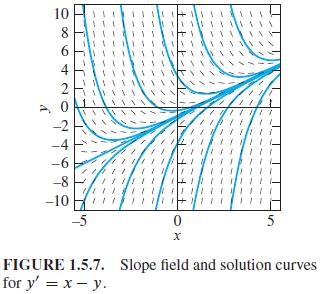
Figure 1.5.7 shows a slope field and typical solution curves for the equation y' = x - y.(a) Show that every solution curve approaches the straight line y = x - 1 as x → + ∞.(b) For each of the five values y1 = 3.998, 3.999, 4.000, 4.001, and 4.002, determine the initial value y0 (accurate to
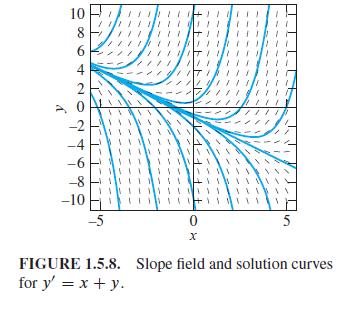
Figure 1.5.8 shows a slope field and typical solution curves for the equation y' = x + y.(a) Show that every solution curve approaches the straight line y = - x - 1 as x → - ∞.(b) For each of the five values y1 = -10, -5, 0, 5, and 10, determine the initial value y0 (accurate to five decimal
A spacecraft is in free fall toward the surface of the moon at a speed of 1000 mph (mi/h). Its retrorockets, when fired, provide a constant deceleration of 20,000 mi/h2. At what height above the lunar surface should the astronauts fire the retrorockets to insure a soft touchdown? (As in Example 2,
When sugar is dissolved in water, the amount A that remains undissolved after t minutes satisfies the differential equation dA/dt = -kA (k > 0). If 25% of the sugar dissolves after 1 min, how long does it take for half of the sugar to dissolve?
A pitcher of buttermilk initially at 25°C is to be cooled by setting it on the front porch, where the temperature is 0°C. Suppose that the temperature of the buttermilk has dropped to 15°C after 20 min. When will it be at 5°C?
In Problems 37 through 42, determine by inspection at least one solution of the given differential equation. That is, use your knowledge of derivatives to make an intelligent guess. Then test your hypothesis.y'' + y = 0
A certain moon rock was found to contain equal numbers of potassium and argon atoms. Assume that all the argon is the result of radioactive decay of potassium (its half-life is about 1.28 x 10⁹ years) and that one of every nine potassium atom disintegrations yields an argon atom. What is the age of
The amount A(t) of atmospheric pollutants in a certain mountain valley grows naturally and is tripling every 7.5 years.(a) If the initial amount is 10 pu (pollutant units), write a formula for A(t) giving the amount (in pu) present after t years.(b) What will be the amount (in pu) of pollutants
An accident at a nuclear power plant has left the surrounding area polluted with radioactive material that decays naturally. The initial amount of radioactive material present is 15 su (safe units), and 5 months later it is still 10 su.(a) Write a formula giving the amount A(t) of radioactive
According to one cosmological theory, when uranium was first generated in the early evolution of the universe following the “big bang,” the isotopes 235U and 238U were produced in equal amounts. Given the half-lives of 4.51 x 10⁹ years for 238U and 7.10 x 10⁸ years for 235U,
Problems 54 through 64 illustrate the application of Torricelli’s law.A tank is shaped like a vertical cylinder; it initially contains water to a depth of 9 ft, and a bottom plug is removed at time t = 0 (hours). After 1 h the depth of the water has dropped to 4 ft. How long does it take for all
In Problems 1 through 12, verify by substitution that each given function is a solution of the given differential equation.Throughout these problems, primes denote derivatives with respect to x. x²y" - xy' + 2y = 0; y₁ = x cos(lnx), y2 = x sin(In x)
Suppose a woman has enough “spring” in her legs to jump (on earth) from the ground to a height of 2.25 feet. If she jumps straight upward with the same initial velocity on the moon—where the surface gravitational acceleration is (approximately) 5.3 ft/s2—how high above the surface will she
In Problems 37 through 42, determine by inspection at least one solution of the given differential equation. That is, use your knowledge of derivatives to make an intelligent guess. Then test your hypothesis.y'' = 0
At noon a car starts from rest at point A and proceeds at constant acceleration along a straight road toward point B. If the car reaches B at 12:50 P.M. with a velocity of 60 mi/h, what is the distance from A to B?
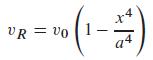
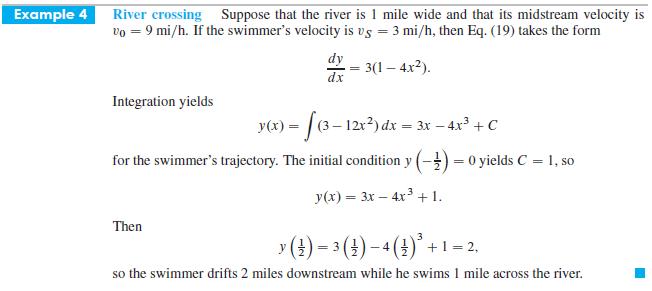
Suppose that a = 0.5 mi, v0 = 9 mi/h, and vS = 3 mi/h as in Example 4, but that the velocity of the river is given by the fourth-degree function rather than the quadratic function in Eq. (18). Now find how far downstream the swimmer drifts as he crosses the river.Example 4 UR = Uo | 1 UD x4
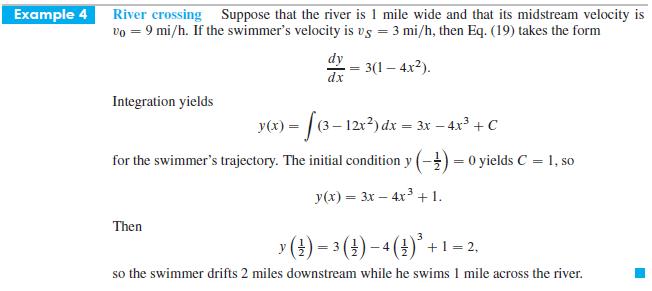
If a = 0.5 mi and v0 = 9 mi/h as in Example 4, what must the swimmer’s speed vS be in order that he drifts only 1 mile downstream as he crosses the river?Example 4 Example 4 River crossing Suppose that the river is 1 mile wide and that its midstream velocity is vo = 9 mi/h. If the swimmer's
In Problems 37 through 42, determine by inspection at least one solution of the given differential equation. That is, use your knowledge of derivatives to make an intelligent guess. Then test your hypothesis.y' = y
At noon a car starts from rest at point A and proceeds with constant acceleration along a straight road toward point C, 35 miles away. If the constantly accelerated car arrives at C with a velocity of 60 mi/h, at what time does it arrive at C?
Problems 43 through 46 concern the differential equationwhere k is a constant.(a) If k is a constant, show that a general (one-parameter) solution of the differential equation is given by x(t) = 1/(C - k t), where C is an arbitrary constant.(b) Determine by inspection a solution of the initial
A driver involved in an accident claims he was going only 25 mph. When police tested his car, they found that when its brakes were applied at 25 mph, the car skidded only 45 feet before coming to a stop. But the driver’s skid marks at the accident scene measured 210 feet. Assuming the same
Showing 1800 - 1900
of 2513
First
12
13
14
15
16
17
18
19
20
21
22
23
24
25
26
Step by Step Answers

 Get 50% OFF
Claim Now
Get 50% OFF
Claim Now