New Semester
Started
Get
50% OFF
Study Help!
--h --m --s
Claim Now
Question Answers
Textbooks
Find textbooks, questions and answers
Oops, something went wrong!
Change your search query and then try again
S
Books
FREE
Study Help
Expert Questions
Accounting
General Management
Mathematics
Finance
Organizational Behaviour
Law
Physics
Operating System
Management Leadership
Sociology
Programming
Marketing
Database
Computer Network
Economics
Textbooks Solutions
Accounting
Managerial Accounting
Management Leadership
Cost Accounting
Statistics
Business Law
Corporate Finance
Finance
Economics
Auditing
Tutors
Online Tutors
Find a Tutor
Hire a Tutor
Become a Tutor
AI Tutor
AI Study Planner
NEW
Sell Books
Search
Search
Sign In
Register
study help
mathematics
first course differential equations
Differential Equations And Linear Algebra 4th Edition C. Edwards, David Penney, David Calvis - Solutions
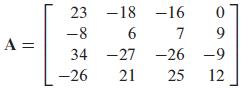
In Problems 42 through 50, use a calculator or computer system to calculate the eigenvalues and eigenvectors in order to find a general solution of the linear system x' = Ax with the given coefficient matrix A. A = 23 -8 34 -26 21 -18 -16 6 7 -27 -26 25 0 9 -9 12
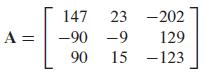
In Problems 42 through 50, use a calculator or computer system to calculate the eigenvalues and eigenvectors in order to find a general solution of the linear system x' = Ax with the given coefficient matrix A. A = 147 -90 90 23 -9 15 15 -202 129 -123
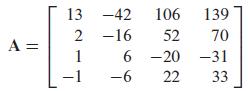
In Problems 42 through 50, use a calculator or computer system to calculate the eigenvalues and eigenvectors in order to find a general solution of the linear system x' = Ax with the given coefficient matrix A. A = 13 -42 2 -16 1 6 -6 106 52 -20 22 139 70 -31 33
Apply the method of undetermined coefficients to find a particular solution of each of the systems in Problems 1 through 14. If initial conditions are given, find the particular solution that satisfies these conditions. Primes denote derivatives with respect to t.x' = 2x + 3y + 5, y' = 2x + y - 2t
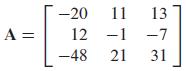
In Problems 42 through 50, use a calculator or computer system to calculate the eigenvalues and eigenvectors in order to find a general solution of the linear system x' = Ax with the given coefficient matrix A. A = -20 12 -48 11 13 -1 -7 21 31
Apply the method of undetermined coefficients to find a particular solution of each of the systems in Problems 1 through 14. If initial conditions are given, find the particular solution that satisfies these conditions. Primes denote derivatives with respect to t.x' = x + 2y + 3, y' = 2x + y - 2
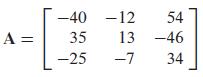
In Problems 42 through 50, use a calculator or computer system to calculate the eigenvalues and eigenvectors in order to find a general solution of the linear system x' = Ax with the given coefficient matrix A. A = -40 35 -25 -12 54 13 -46 -7 34
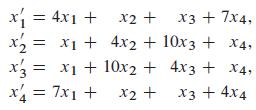
The coefficient matrix A of the 4 x 4 systemhas eigenvalues λ1 = -3, λ2 = -6, λ3 = 10, and λ4 = 15. Find the particular solution of this system that satisfies the initial conditions x₁ = 4x1 + x2 + x3 + 7x4, x₂ = x₁ + 4x₂ + 10x3 + x4, x3 = x₁ + 10x₂ + 4x3 + x4, x3 + 4x4 x₁ = 7x₁
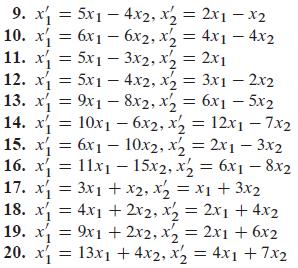
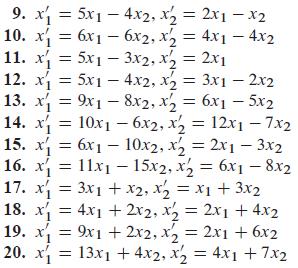
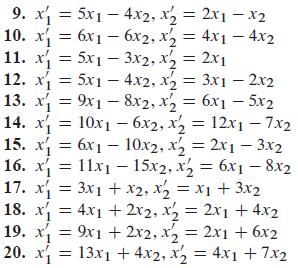
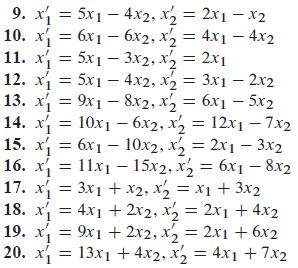
Compute the matrix exponential eAt for each system x' = Ax given in Problems 9 through 20.x'1 = 4x1 + 2x2, x'2 = 2x1 + 4x2Data in Problem 9 through 20 9. x = 5x14x2, x = 2x1-x2 x = 4x14x2 10. x = 6x16x2, x/2 11. x = 5x13x2, x = 2x1 12. x = 5x1 - 4x2, x = 3x1 - 2x2 13. x = 9x18x2, x = 6x1 - 5x2 14.
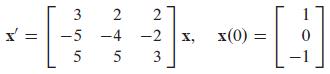
Use projection matrices to find a fundamental matrix solution x(t) = eAt of each of the linear systems x' = Ax given in Problems 1 through 20.Problem 18 x1 = x1 + 2x2 + 2x3, x2 = 2x1 +7x2 + x3, x3 = 2x1 + x2 +7x3
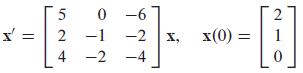
Use projection matrices to find a fundamental matrix solution x(t) = eAt of each of the linear systems x' = Ax given in Problems 1 through 20.Problem 20 5x1 + x2 + 3x3, x = x + 7x + x3, x3 = 3x1 + x2 + 5x3
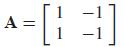
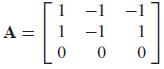
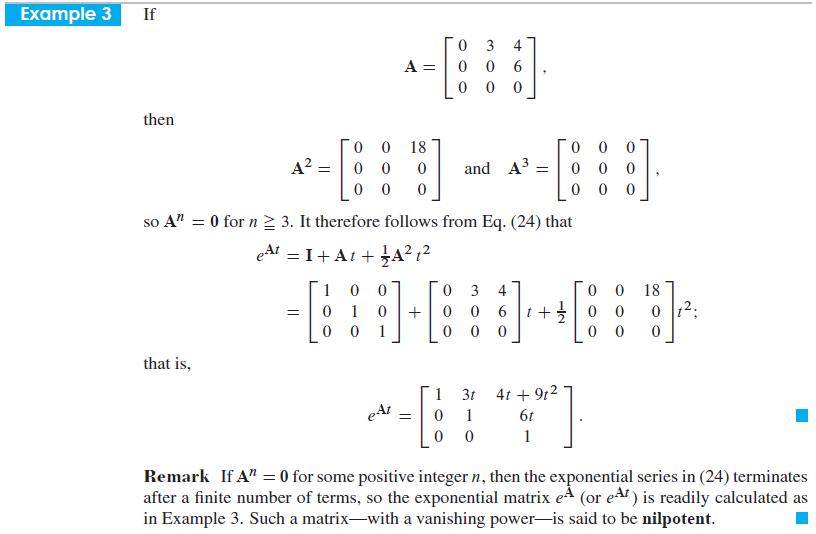
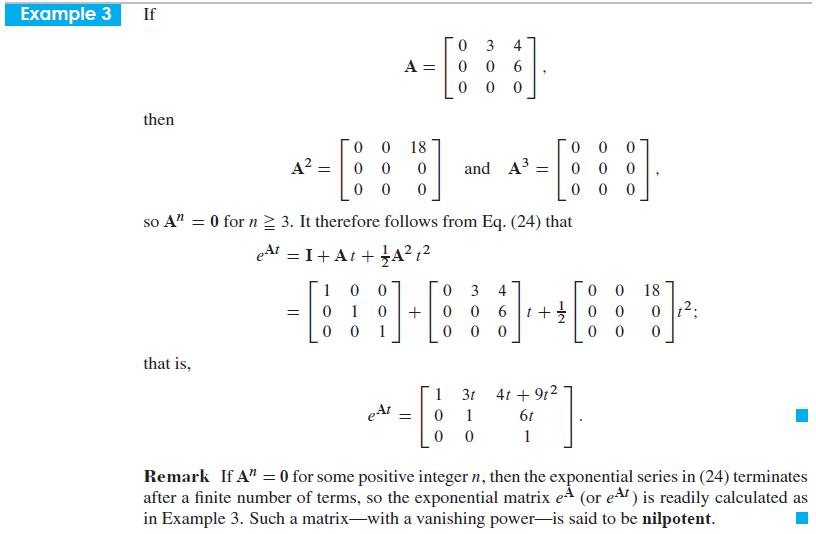
In Problems 21 through 24, show that the matrix A is nilpotent and then use this fact to find (as in Example 3) the matrix exponential eAt. A = 1 -1 1 -1
In Problems 21 through 24, show that the matrix A is nilpotent and then use this fact to find (as in Example 3) the matrix exponential eAt. A = 1 ㅜㅜㅇ 1
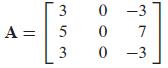
In Problems 21 through 24, show that the matrix A is nilpotent and then use this fact to find (as in Example 3) the matrix exponential eAt. A = 3 0 5 0 3 0 -3 7 -3
Compute the matrix exponential eAt for each system x' = Ax given in Problems 9 through 20.x'1 = 9x1 + 2x2, x'2 = 2x1 + 6x2Data in Problem 9 through 20 9. x = 5x14x2, x = 2x1-x2 x = 4x14x2 10. x = 6x16x2, x/2 11. x = 5x13x2, x = 2x1 12. x = 5x1 - 4x2, x = 3x1 - 2x2 13. x = 9x18x2, x = 6x1 - 5x2 14.
Compute the matrix exponential eAt for each system x' = Ax given in Problems 9 through 20.x'1 = 13x1 + 4x2, x'2 = 4x1 + 7x2Data in Problem 9 through 20 9. x = 5x14x2, x = 2x1-x2 x = 4x14x2 10. x = 6x16x2, x/2 11. x = 5x13x2, x = 2x1 12. x = 5x1 - 4x2, x = 3x1 - 2x2 13. x = 9x18x2, x = 6x1 - 5x2 14.
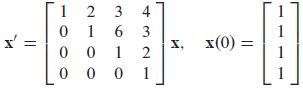
Each coefficient matrix A in Problems 25 through 30 is the sum of a nilpotent matrix and a multiple of the identity matrix. Use this fact (as in Example 6) to solve the given initial value problem. х = 1 2 3 4 0163 0 1 0001 0 2 X, x(0) E
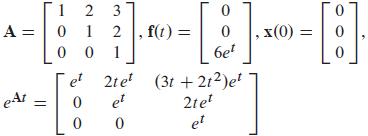
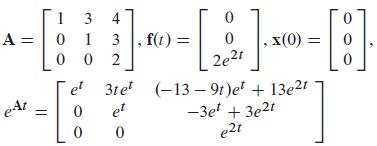
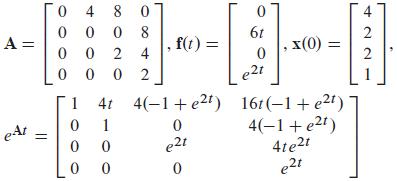
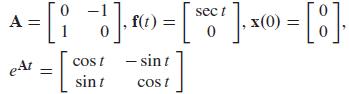
In Problems 17 through 34, use the method of variation of parameters (and perhaps a computer algebra system) to solve the initial value problemIn each problem we provide the matrix exponential eAt as provided by a computer algebra system. x = Ax+ f(t), x(a) = Xa.
In Problems 17 through 34, use the method of variation of parameters (and perhaps a computer algebra system) to solve the initial value problemIn each problem we provide the matrix exponential eAt as provided by a computer algebra system. x = Ax+ f(t), x(a) = Xa.
Use projection matrices to find a fundamental matrix solution of each of the linear systems given in Problems 1 through 10.m1 = m2 = 1; k1 = 0, k2 = 2, k3 = 0 (no walls)
Use projection matrices to find a fundamental matrix solution of each of the linear systems given in Problems 1 through 10.m1 = m2 = 1; k1 = 1, k2 = 4, k3 = 1
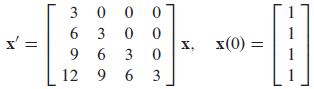
Each coefficient matrix A in Problems 25 through 30 is the sum of a nilpotent matrix and a multiple of the identity matrix. Use this fact (as in Example 6) to solve the given initial value problem. x' = 300 00 6 3 00 96 3 0 12 9 6 3 X, x(0)
In Problems 17 through 34, use the method of variation of parameters (and perhaps a computer algebra system) to solve the initial value problemIn each problem we provide the matrix exponential eAt as provided by a computer algebra system. x = Ax+ f(t), x(a) = Xa.
Use projection matrices to find a fundamental matrix solution of each of the linear systems given in Problems 1 through 10.m1 = 1 , m2 = 2; k1 = 1, k2 = k3 = 2
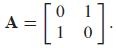
Suppose thatShow that A2n = I and that A2n+1 = A if n is a positive integer. Conclude thatand apply this fact to find a general solution of x' = Ax. Verify that it is equivalent to the general solution found by the eigenvalue method. Α =[ d]: 0 1 1 0
In Problems 17 through 34, use the method of variation of parameters (and perhaps a computer algebra system) to solve the initial value problemIn each problem we provide the matrix exponential eAt as provided by a computer algebra system. x = Ax+ f(t), x(a) = Xa.
In Problems 17 through 34, use the method of variation of parameters (and perhaps a computer algebra system) to solve the initial value problemIn each problem we provide the matrix exponential eAt as provided by a computer algebra system. x = Ax+ f(t), x(a) = Xa.
Use projection matrices to find a fundamental matrix solution of each of the linear systems given in Problems 1 through 10.m1 = m2 = 1 ; k1 = 1, k2 = 2, k3 = 1
Use projection matrices to find a fundamental matrix solution of each of the linear systems given in Problems 1 through 10.m1 = m2 = 1; k1 = 2, k2 = 1, k3 = 2
Use projection matrices to find a fundamental matrix solution of each of the linear systems given in Problems 1 through 10.m1 = m2 = 1; k1 = 4, k2 = 6, k3 = 4
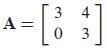
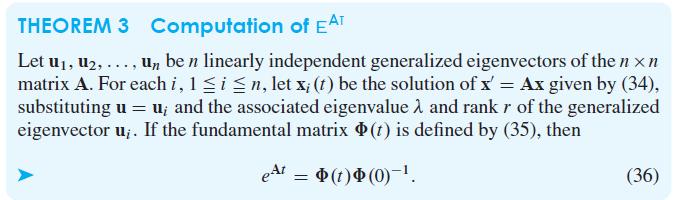
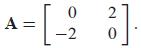
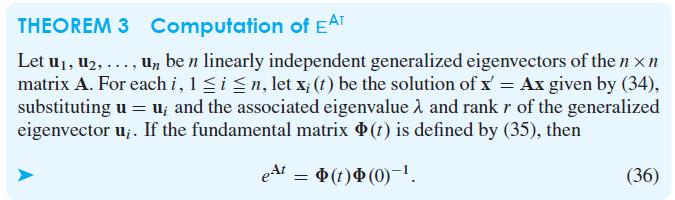
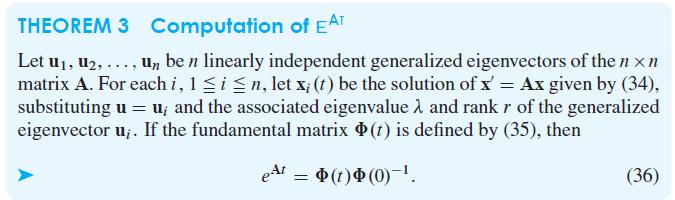
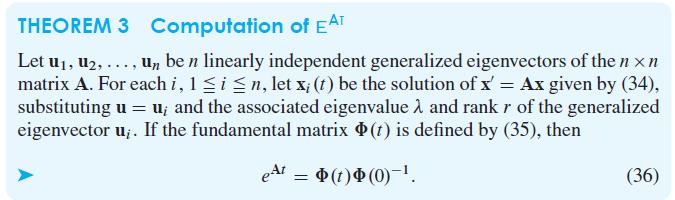
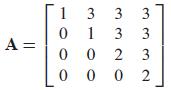
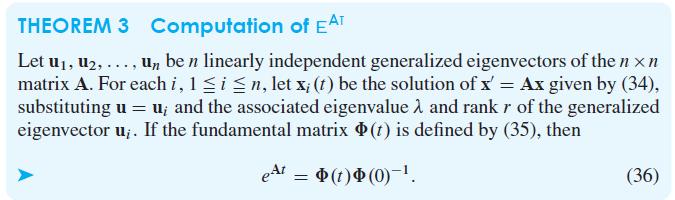
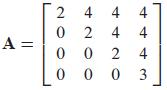
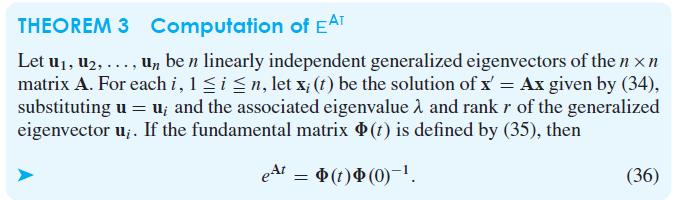
Apply Theorem 3 to calculate the matrix exponential eAt for each of the matrices in Problems 35 through 40. A = 34 03
Use projection matrices to find a fundamental matrix solution of each of the linear systems given in Problems 1 through 10.The mass-and-spring system of Problem 3, with F1(t) Ξ 0, F2(t) = 120 cos 3tProblem 3m1 = 1 , m2 = 2; k1 = 1, k2 = k3 = 2
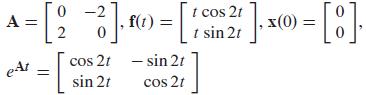
Suppose thatShow that eAt = I cos 2t + 1/2 Asin 2t . Apply this fact to find a general solution of x' = Ax, and verify that it is equivalent to the solution found by the eigenvalue method. -[- A = 0 -2 2 20 0
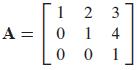
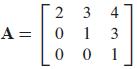
Apply Theorem 3 to calculate the matrix exponential eAt for each of the matrices in Problems 35 through 40. A = 123 01 4 00 1
Apply Theorem 3 to calculate the matrix exponential eAt for each of the matrices in Problems 35 through 40. A = 2 0 3 4 1 3 001
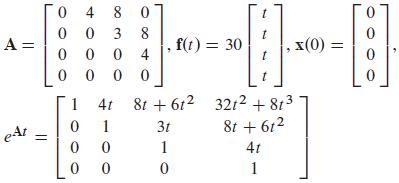
Use projection matrices to find a fundamental matrix solution of each of the linear systems given in Problems 1 through 10.The mass-and-spring system of Problem 7, with F1(t) = 30 cost, F2(t) = 60 costProblem 7m1 = m2 = 1; k1 = 4, k2 = 6, k3 = 4
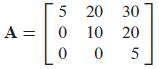
Apply Theorem 3 to calculate the matrix exponential eAt for each of the matrices in Problems 35 through 40. 5 A = 0 L 0 20 10 0 30 20 5
Apply Theorem 3 to calculate the matrix exponential eAt for each of the matrices in Problems 35 through 40. A = 13 3 3 3 01 3 3 00 23 0002
Apply Theorem 3 to calculate the matrix exponential eAt for each of the matrices in Problems 35 through 40. A = 244 4 420 0 4 00 2 00 4443 4 003
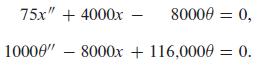
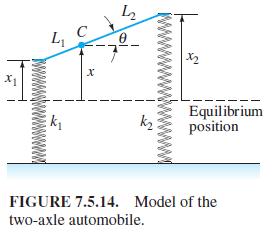
In each of Problems 41 through 46, use the spectral decomposition methods of this section to find a fundamental matrix solution x(t) = eAt for the linear system x' = Ax given in the problem.Problem 25 in Section 7.5Suppose that m = 75 slugs (the car weighs 2400 lb), L1 = 7 ft, L2 = 3 ft (it's a
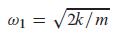
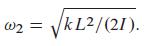
In each of Problems 41 through 46, use the spectral decomposition methods of this section to find a fundamental matrix solution x(t) = eAt for the linear system x' = Ax given in the problem.Problem 26 in Section 7.5Suppose that k1 = k2 = k and L1 = L2 = 1/2L in Fig. 7.5.14 (the symmetric
Use projection matrices to find a fundamental matrix solution x(t) = eAt of each of the linear systems x' = Ax given in Problems 1 through 20.Problem 14 x = 3x14x2, x = 4x1+3x2
Apply the method of undetermined coefficients to find a particular solution of each of the systems in Problems 1 through 14. If initial conditions are given, find the particular solution that satisfies these conditions. Primes denote derivatives with respect to t.x' = 3x + 4y, y' = 3x + 2y + t2; x
Find a fundamental matrix of each of the systems in Problems 1 through 8, then apply Eq. (8) to find a solution satisfying the given initial conditions. x(t) = Φ(t)Φ(0) xo. = (8)
Find a fundamental matrix of each of the systems in Problems 1 through 8, then apply Eq. (8) to find a solution satisfying the given initial conditions. x(t) = Φ(t)Φ(0) xo. = (8)
Find a fundamental matrix of each of the systems in Problems 1 through 8, then apply Eq. (8) to find a solution satisfying the given initial conditions. x(t) = Φ(t)Φ(0) xo. = (8)
Use projection matrices to find a fundamental matrix solution x(t) = eAt of each of the linear systems x' = Ax given in Problems 1 through 20.Problem 6 x = 9x1 +5x2, x = -6x1-2x2; x1 (0)=1, x2 (0) = 0
Find a fundamental matrix of each of the systems in Problems 1 through 8, then apply Eq. (8) to find a solution satisfying the given initial conditions. x(t) = Φ(t)Φ(0) xo. = (8)
Find a fundamental matrix of each of the systems in Problems 1 through 8, then apply Eq. (8) to find a solution satisfying the given initial conditions. x(t) = Φ(t)Φ(0) xo. = (8)
Apply the method of undetermined coefficients to find a particular solution of each of the systems in Problems 1 through 14. If initial conditions are given, find the particular solution that satisfies these conditions. Primes denote derivatives with respect to t.x' = 2x + 4y + 2, y' = x + 2y + 3;
Compute the matrix exponential eAt for each system x' = Ax given in Problems 9 through 20.x'1 = 10x1 - 6x2, x'2 = 12x1 - 7x2Data in Problem 9 through 20 9. x = 5x14x2, x = 2x1-x2 x = 4x14x2 10. x = 6x16x2, x/2 11. x = 5x13x2, x = 2x1 12. x = 5x1 - 4x2, x = 3x1 - 2x2 13. x = 9x18x2, x = 6x1 - 5x2
Compute the matrix exponential eAt for each system x' = Ax given in Problems 9 through 20.x'1 = 6x1 - 10x2, x'2 = 2x1 - 3x2Data in Problem 9 through 20 9. x = 5x14x2, x = 2x1-x2 x = 4x14x2 10. x = 6x16x2, x/2 11. x = 5x13x2, x = 2x1 12. x = 5x1 - 4x2, x = 3x1 - 2x2 13. x = 9x18x2, x = 6x1 - 5x2 14.
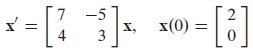
Use projection matrices to find a fundamental matrix solution x(t) = eAt of each of the linear systems x' = Ax given in Problems 1 through 20.Problems 15 x = 7x5x2, x2 = 4x1+3x2
Use projection matrices to find a fundamental matrix solution x(t) = eAt of each of the linear systems x' = Ax given in Problems 1 through 20.Problem 16 x = -50x +20x2, x = 100x60x2
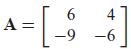
In Problems 21 through 24, show that the matrix A is nilpotent and then use this fact to find (as in Example 3) the matrix exponential eAt. ¹ = [₁ A: V 6 4 9- 6-
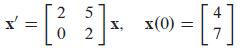
Each coefficient matrix A in Problems 25 through 30 is the sum of a nilpotent matrix and a multiple of the identity matrix. Use this fact (as in Example 6) to solve the given initial value problem. I 2 = [² 0 || 52 X, x(0) 4 7
In Problems 17 through 34, use the method of variation of parameters (and perhaps a computer algebra system) to solve the initial value problemIn each problem we provide the matrix exponential eAt as provided by a computer algebra system. x = Ax+ f(t), x(a) = Xa.
Each coefficient matrix A in Problems 25 through 30 is the sum of a nilpotent matrix and a multiple of the identity matrix. Use this fact (as in Example 6) to solve the given initial value problem. 7 11 0 ;]₁ 7 I, x(0) 5 -10
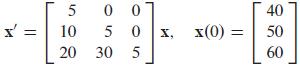
Each coefficient matrix A in Problems 25 through 30 is the sum of a nilpotent matrix and a multiple of the identity matrix. Use this fact (as in Example 6) to solve the given initial value problem. M 00 5 10 50 0 20 30 5 X, x(0) 40 50 60
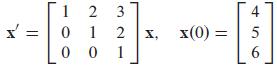
Each coefficient matrix A in Problems 25 through 30 is the sum of a nilpotent matrix and a multiple of the identity matrix. Use this fact (as in Example 6) to solve the given initial value problem. 12 23 01 2 00 01 X, x(0) = 4 5 6
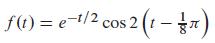
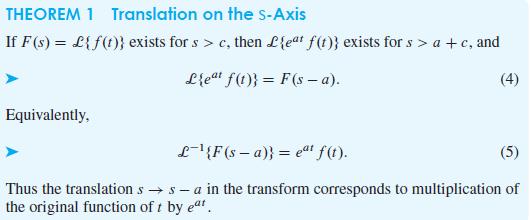
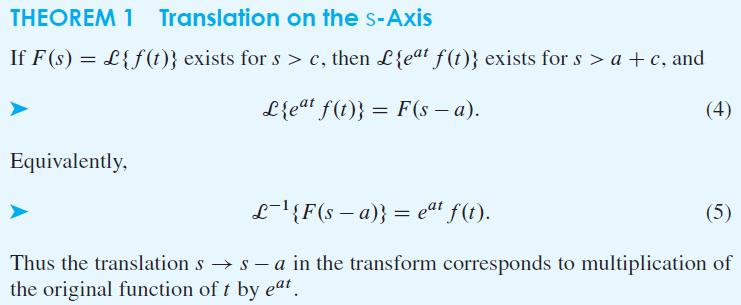
Apply the translation theorem to find the Laplace transforms of the functions in Problems 1 through 4. f(t) = e-1/2 cos 2 (1 – हेर) gr
Apply the definition in (1) to find directly the Laplace transforms of the functions described (by formula or graph) in Problems 1 through 10.f(t) = sinh t
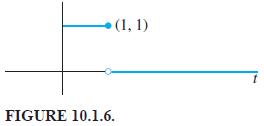
Apply the definition in (1) to find directly the Laplace transforms of the functions described (by formula or graph) in Problems 1 through 10. FIGURE 10.1.6. (1, 1) t
Use Laplace transforms to solve the initial value problems in Problems 1 through 16.x'' + 9x = 1; x(0) = 0 = x' (0)
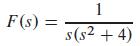
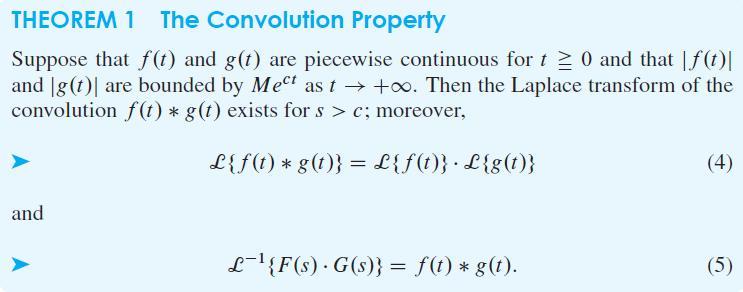
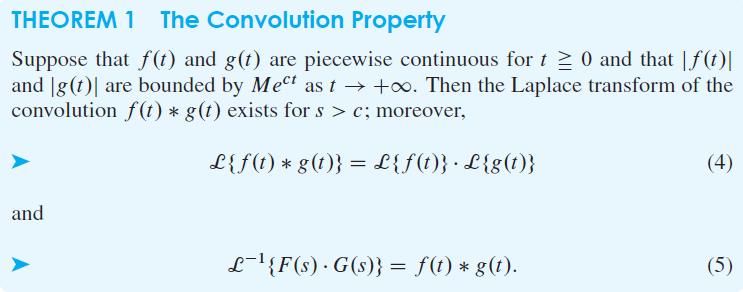
Apply the convolution theorem to find the inverse Laplace transforms of the functions in Problems 7 through 14. F(s) = 1 s(s + 4)
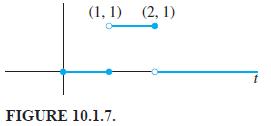
Apply the definition in (1) to find directly the Laplace transforms of the functions described (by formula or graph) in Problems 1 through 10. (1, 1) (2, 1) FIGURE 10.1.7.
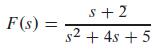
Apply the translation theorem to find the inverse Laplace transforms of the functions in Problems 5 through 10. F(s) = s+2 s + 4s +5
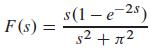
Find the inverse Laplace transform f (t) of each function given in Problems 1 through 10. Then sketch the graph of f. F(s) = s(1-e-2s) s² + π² 2
Use Laplace transforms to solve the initial value problems in Problems 1 through 16.x" + 4x' + 3x = 1; x (0) = 0 = x'(0)
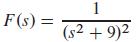
Apply the convolution theorem to find the inverse Laplace transforms of the functions in Problems 7 through 14. F(s) = 1 ($2 (s + 9)
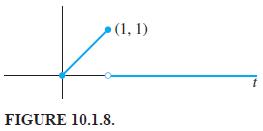
Apply the definition in (1) to find directly the Laplace transforms of the functions described (by formula or graph) in Problems 1 through 10. (1, 1) FIGURE 10.1.8.
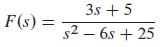
Apply the translation theorem to find the inverse Laplace transforms of the functions in Problems 5 through 10. F(s) = 3s +5 $26s+25
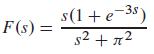
Find the inverse Laplace transform f(t) of each function given in Problems 1 through 10. Then sketch the graph of f. F(s) = s(1+e-38) 52 s² +r²
Use Laplace transforms to solve the initial value problems in Problems 1 through 16.x" + 3x' + 2x = t; x (0) = 0, x'(0) = 2
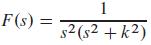
Apply the convolution theorem to find the inverse Laplace transforms of the functions in Problems 7 through 14. F(s) = 1 s (s+k)
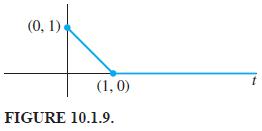
Apply the definition in (1) to find directly the Laplace transforms of the functions described (by formula or graph) in Problems 1 through 10. (0, 1) (1,0) FIGURE 10.1.9.
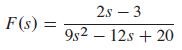
Apply the translation theorem to find the inverse Laplace transforms of the functions in Problems 5 through 10. 2s 3 F(s) = 9s2 12s + 20
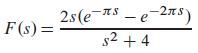
Find the inverse Laplace transform f(t) of each function given in Problems 1 through 10. Then sketch the graph of f. F(s)= е-лs -e-2πs) 2s(e-s s² +4
In Problems 1 through 8, determine whether x = 0 is an ordinary point, a regular singular point, or an irregular singular point. If it is a regular singular point, find the exponents of the differential equation at x = 0.xy'' + (x - x3)y' + (sin x)y = 0
Find general solutions in powers of x of the differential equations in Problems 1 through 15. State the recurrence relation and the guaranteed radius of convergence in each case.(x2 - 1)y'' + 4xy' + 2y = 0
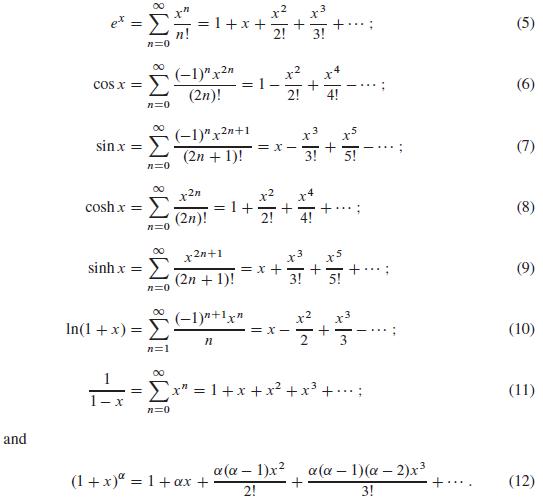
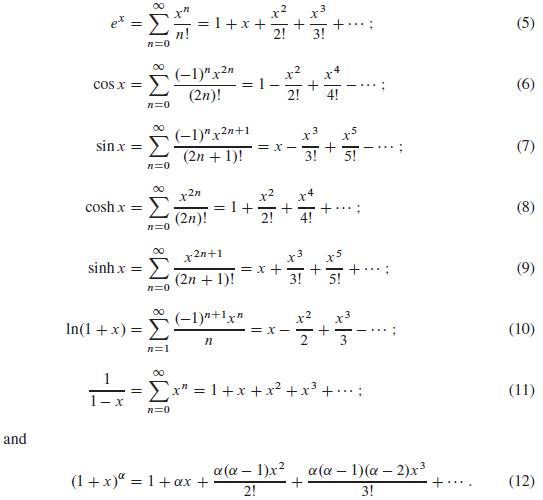
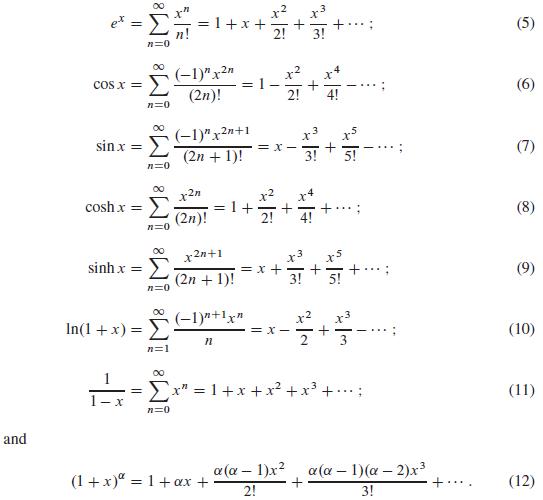
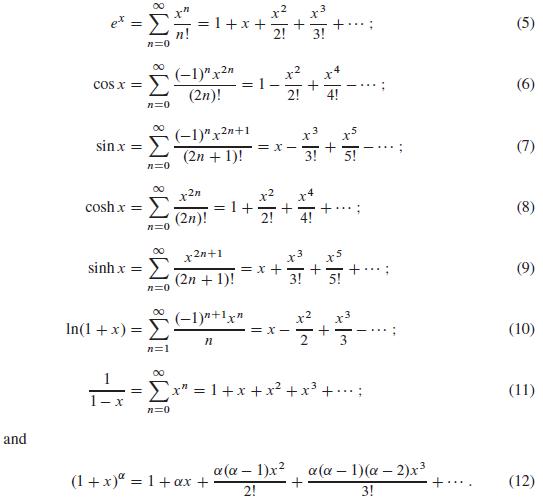
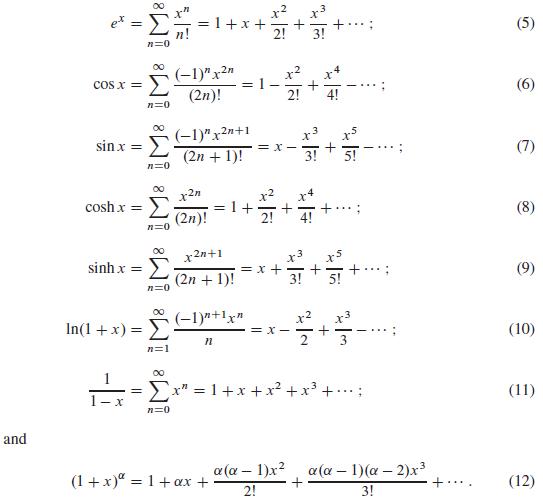
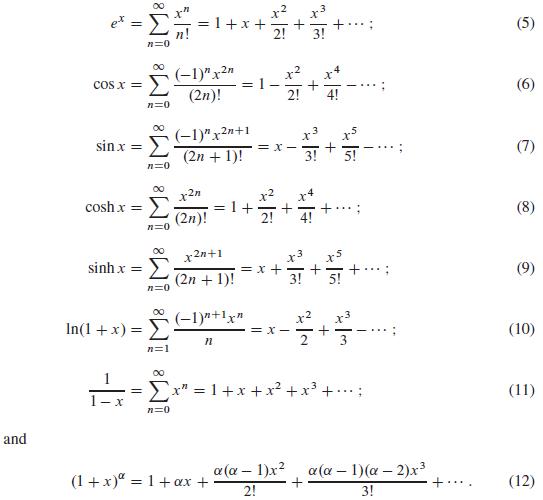
In Problems 1 through 10, find a power series solution of the given differential equation. Determine the radius of convergence of the resulting series, and use the series in Eqs. (5) through (12) to identify the series solution in terms of familiar elementary functions. y' = y and || COS X = sin.x
In Problems 1 through 8, determine whether x = 0 is an ordinary point, a regular singular point, or an irregular singular point. If it is a regular singular point, find the exponents of the differential equation at x = 0.xy" + x2y' + (ex - 1) y = 0
(a) Deduce from Eqs. (10) and (12) that(b) Use the result of part (a) to verify the formulas in Eq (19) for J1/2(x) and J-1/2(x). 1.3.5 (2n-1) 旦 r(n + 1) = 2²²
Find general solutions in powers of x of the differential equations in Problems 1 through 15. State the recurrence relation and the guaranteed radius of convergence in each case.(x2 + 2)y'' + 4xy' + 2y = 0
In Problems 1 through 10, find a power series solution of the given differential equation. Determine the radius of convergence of the resulting series, and use the series in Eqs. (5) through (12) to identify the series solution in terms of familiar elementary functions.y' = 4y and || COS X = sin.x
In Problems 1 through 8, determine whether x = 0 is an ordinary point, a regular singular point, or an irregular singular point. If it is a regular singular point, find the exponents of the differential equation at x = 0.x2 y" + (cos x)y' + xy = 0
Find general solutions in powers of x of the differential equations in Problems 1 through 15. State the recurrence relation and the guaranteed radius of convergence in each case.y'' + xy' + y = 0
In Problems 1 through 10, find a power series solution of the given differential equation. Determine the radius of convergence of the resulting series, and use the series in Eqs. (5) through (12) to identify the series solution in terms of familiar elementary functions.2y' + 3y = 0 and || COS X
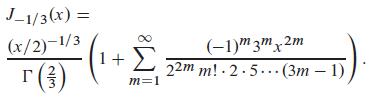
(a) Suppose that m is a positive integer. Show that(b) Conclude from part (a) and Eq. (13) that r (m + 3) ¹ = 2.5.8...(3m-¹) (3). 3
In Problems 1 through 8, determine whether x = 0 is an ordinary point, a regular singular point, or an irregular singular point. If it is a regular singular point, find the exponents of the differential equation at x = 0.3x3y" + 2x2y' + (1 - x2)y = 0
Find general solutions in powers of x of the differential equations in Problems 1 through 15. State the recurrence relation and the guaranteed radius of convergence in each case.(x2 + 1)y" + 6xy' + 4y = 0
In Problems 1 through 10, find a power series solution of the given differential equation. Determine the radius of convergence of the resulting series, and use the series in Eqs. (5) through (12) to identify the series solution in terms of familiar elementary functions. and || COS X = sin.x = coshx
Apply Eqs. (19), (26), and (27) to show thatand J3/2(x) = 2 πx3 (sin x - x cos x)
In Problems 1 through 8, determine whether x = 0 is an ordinary point, a regular singular point, or an irregular singular point. If it is a regular singular point, find the exponents of the differential equation at x = 0.x(1 + x)y" + 2y' + 3xy = 0
Find general solutions in powers of x of the differential equations in Problems 1 through 15. State the recurrence relation and the guaranteed radius of convergence in each case.(x2 - 3)y" + 2xy' = 0
In Problems 1 through 10, find a power series solution of the given differential equation. Determine the radius of convergence of the resulting series, and use the series in Eqs. (5) through (12) to identify the series solution in terms of familiar elementary functions.y' = x2y and || COS X = sin.x
Express J4(x) in terms of J0(x) and J1(x).
In Problems 1 through 10, find a power series solution of the given differential equation. Determine the radius of convergence of the resulting series, and use the series in Eqs. (5) through (12) to identify the series solution in terms of familiar elementary functions.(x - 2)y' + y = 0 and || COS
In Problems 1 through 8, determine whether x = 0 is an ordinary point, a regular singular point, or an irregular singular point. If it is a regular singular point, find the exponents of the differential equation at x = 0.x2y" + (6 sin x) y' + 6y = 0
Find general solutions in powers of x of the differential equations in Problems 1 through 15. State the recurrence relation and the guaranteed radius of convergence in each case.(x2 + 3)y" - 7xy' + 16y = 0
Showing 1200 - 1300
of 2513
First
6
7
8
9
10
11
12
13
14
15
16
17
18
19
20
Last
Step by Step Answers

 Get 50% OFF
Claim Now
Get 50% OFF
Claim Now