New Semester
Started
Get
50% OFF
Study Help!
--h --m --s
Claim Now
Question Answers
Textbooks
Find textbooks, questions and answers
Oops, something went wrong!
Change your search query and then try again
S
Books
FREE
Study Help
Expert Questions
Accounting
General Management
Mathematics
Finance
Organizational Behaviour
Law
Physics
Operating System
Management Leadership
Sociology
Programming
Marketing
Database
Computer Network
Economics
Textbooks Solutions
Accounting
Managerial Accounting
Management Leadership
Cost Accounting
Statistics
Business Law
Corporate Finance
Finance
Economics
Auditing
Tutors
Online Tutors
Find a Tutor
Hire a Tutor
Become a Tutor
AI Tutor
AI Study Planner
NEW
Sell Books
Search
Search
Sign In
Register
study help
mathematics
first course differential equations
A First Course in Differential Equations with Modeling Applications 11th edition Dennis G. Zill - Solutions
A critical point c of an autonomous first-order DE is said to be isolated if there exists some open interval that contains c but no other critical point. Can there exist an autonomous DE of the form given in (2) for which every critical point is nonisolated? Discuss; do not think profound
Consider the autonomous DE dy/dx = (2/πy)y - sin y. Determine the critical points of the equation. Discuss a way of obtaining a phase portrait of the equation. Classify the critical points as asymptotically stable, unstable, or semi-stable.
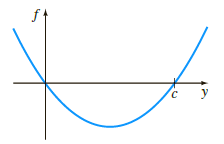
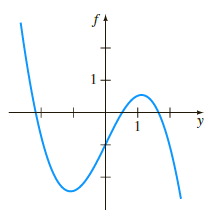
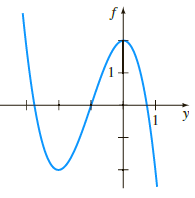
Consider the autonomous differential equation dy/dx = f (y), where the graph of f is given. Use the graph to locate the critical points of each differential equation. Sketch a phase portrait of each differential equation. By hand, sketch typical solution curves in the subregions in the xy-plane
Find the critical points and phase portrait of the given autonomous first-order differential equation. Classify each critical point as asymptotically stable, unstable, or semi-stable. By hand, sketch typical solution curves in the regions in the xy-plane determined by the graphs of the
Consider the autonomous rst-order differential equation dy/dx = y2 - y4 and the initial condition y(0) = y0. By hand, sketch the graph of a typical solution y(x) when y0 has the given values.(a) y0 > 1(b) 0 < y0 < 1(c) -1 < y0 < 0(d) y0 < -1
Consider the autonomous first-order differential equation dy/dx = y - y3 and the initial condition y(0) = y0. By hand, sketch the graph of a typical solution y(x) when y0 has the given values.(a) y0 > 1(b) 0 < y0 < 1(c) -1 < y0 < 0(d) y0 < -1
(a) Identify the nullclines (see Problem 17) in Problems€‘1, 3, and 4. With a colored pencil, circle any lineal elements in figures (1), (2) and (3) that you think may be a lineal element at a point on a nullcline.(b) What are the nullclines of an autonomous first-order
For a first-order DE dy/dx = f (x, y) a curve in the plane defined by f (x, y) = 0 is called a nullcline of the equation, since a lineal element at a point on the curve has zero slope. Use computer software to obtain a direction field over a rectangular grid of points for dy/dx = x2 - 2y, and
(a) Consider the direction field of the differential equation dy/dx = x(y - 4)2 - 2, but do not use technology to obtain it. Describe the slopes of the lineal elements on the lines x = 0, y = 3, y = 4, and y = 5.(b) Consider the IVP dy/dx = x(y - 4)2 - 2, y(0) = y0, where y0 < 4. Can a
In parts (a) and (b) sketch isoclines f (x, y) = c for the given differential equation using the indicated values of c. Construct a direction field over a grid by carefully drawing lineal elements with the appropriate slope at chosen points on each isocline. In each case, use this rough direction
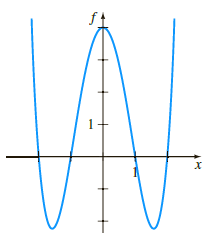
The given figure represents the graph of f (y) and f (x), respectively. By hand, sketch a direction field over an appropriate grid for dy/dx = f (y) (Problem 13) and then for dy/dx = f (x) (Problem 14).1. 2. ft y х
Use computer software to obtain a direction field for the given differential equation. By hand, sketch an approximate solution curve passing through each of the given points.1. y' = x(a) y(0) = 0(b) (-2)2. y' = x + y(a) y(-2) = 2(b) y(1) -33. y dy/dx = -x(a) y(1) = 1(b) y(0) = 44. dy/dx = 1/y(a)
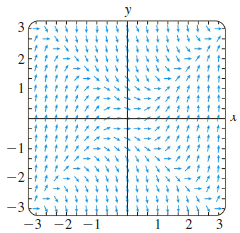
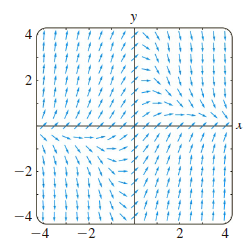
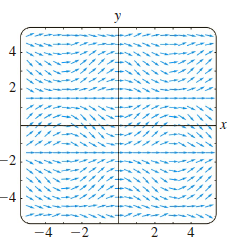
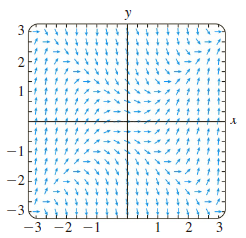
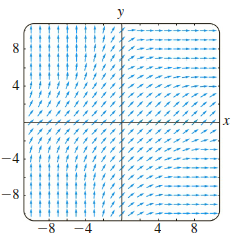
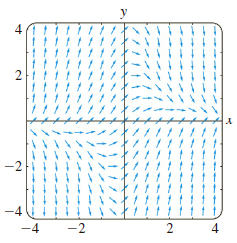
Reproduce the given computer-generated direction field. Then sketch, by hand, an approximate solution curve that passes through each of the indicated points. Use different colored pencils for each solution curve.1. dy/dx = x2 €“y2(a) y(-2) = 1(b) y(3) = 0(c) y(0) = 2(d) y(0) =
Showing 2500 - 2600
of 2513
First
12
13
14
15
16
17
18
19
20
21
22
23
24
25
26
Step by Step Answers

 Get 50% OFF
Claim Now
Get 50% OFF
Claim Now