New Semester
Started
Get
50% OFF
Study Help!
--h --m --s
Claim Now
Question Answers
Textbooks
Find textbooks, questions and answers
Oops, something went wrong!
Change your search query and then try again
S
Books
FREE
Study Help
Expert Questions
Accounting
General Management
Mathematics
Finance
Organizational Behaviour
Law
Physics
Operating System
Management Leadership
Sociology
Programming
Marketing
Database
Computer Network
Economics
Textbooks Solutions
Accounting
Managerial Accounting
Management Leadership
Cost Accounting
Statistics
Business Law
Corporate Finance
Finance
Economics
Auditing
Tutors
Online Tutors
Find a Tutor
Hire a Tutor
Become a Tutor
AI Tutor
AI Study Planner
NEW
Sell Books
Search
Search
Sign In
Register
study help
mathematics
precalculus
Thomas Calculus Early Transcendentals 13th Edition Joel R Hass, Christopher E Heil, Maurice D Weir - Solutions
Determine the convergence or divergence of the series using any appropriate test from this chapter. Identify the test used. 18 n=1 COS n 3″
Determine the convergence or divergence of the series using any appropriate test from this chapter. Identify the test used. 18 n=2 (-1)" n ln n
Determine the convergence or divergence of the series using any appropriate test from this chapter. Identify the test used. 18 n=1 n! n7"
Determine the convergence or divergence of the series using any appropriate test. Identify the test used. 18 n In n n²
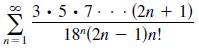
Determine the convergence or divergence of the series using any appropriate test from this chapter. Identify the test used. n=1 3.5.7 (2n + 1) 18" (2n-1)n!
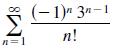
Determine the convergence or divergence of the series using any appropriate test from this chapter. Identify the test used. 18 n=1 (-1) 3n-1 n!
Determine the convergence or divergence of the series and identify the test used. 18 n=1 8 n
Determine the convergence or divergence of the series using any appropriate test from this chapter. Identify the test used. 18 n=1 (-1) 3n n2n
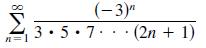
Determine the convergence or divergence of the series using any appropriate test from this chapter. Identify the test used. 8 n=1 (-3)" 3.5.7 (2n + 1)
Give an example of convergent alternating series Σ an and Σ bn such that Σ anbn diverges.
Determine the convergence or divergence of the series and identify the test used. 18 n=1 Al∞0
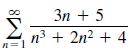
Determine the convergence or divergence of the series and identify the test used. M8 3n + 5 n³ + 2n² + 4
Determine the convergence or divergence of the series and identify the test used. 00 n 1=u 3″ n
Determine the convergence or divergence of the series and identify the test used. 18 n=1 1 6 - 5
Suppose that Σ an is a series with positive terms. Prove that if Σ an converges, then Σ sin an also converges.
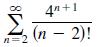
Write an equivalent series with the index of summation beginning at n = 0. 18 n 2 4+1 (n − 2)!
Determine the convergence or divergence of the series and identify the test used. 18 n=1 2n² (n + 1)²
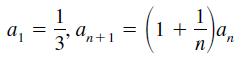
The terms of a seriesan are defined recursively. Determine the convergence or divergence of the series. Explain your reasoning. 18 n=1 an
Determine the convergence or divergence of the series and identify the test used. 18 Σ 100e-n/2 n=1
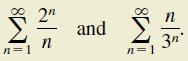
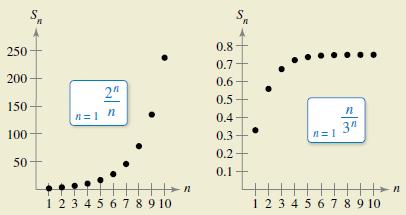
The graphs show the sequences of partial sums of the seriesUsing the Ratio Test, the first series diverges and the second series converges. Explain how the graphs show this. 8I 2″ n and 18 n 3n²
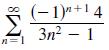
Determine the convergence or divergence of the series and identify the test used. 18 n=0 (-1)" n+ 4
Determine the convergence or divergence of the series and identify the test used. 18 n=1 (-1)+¹4 3n² - 1
Determine the convergence or divergence of the series and identify the test used. 18 n=2 In n n
Verify that the Ratio Test is inconclusive for the p-series. 18 n 1 1 ,0.05 nº
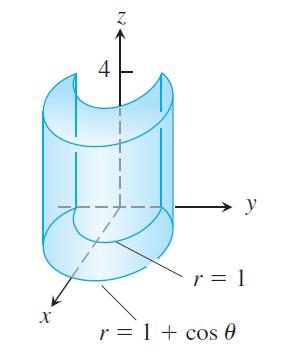
The iterated integral for evaluating ∫∫∫D ƒ(r, θ, z) dθ r dr du over the given region D.D is the solid right cylinder whose base is the region in the xyplane that lies inside the cardioid r = 1 + cos θ and outside the circle r = 1 and whose top lies in the plane z = 4. X Z -+ y r = 1 r =
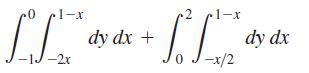
The integrals and sums of integrals give the areas of regions in the xy-plane. Sketch each region, label each bounding curve with its equation, and give the coordinates of the points where the curves intersect. Then find the area of the region. -1-X 1-x [[!__ dy dx + f[/^dy. 0 -x/2 TJ -2x dx
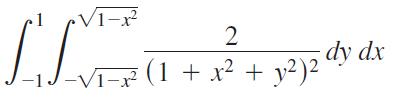
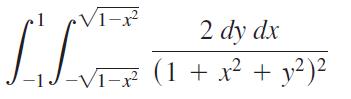
Change the Cartesian integral into an equivalent polar integral. Then evaluate the polar integral. JJ 1-x² /1-x²2² 2 (1 + x² + y²)² dy dx
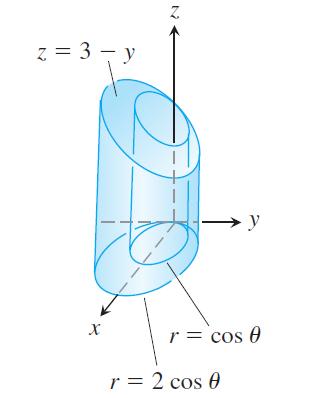
The iterated integral for evaluating ∫∫∫D ƒ(r, θ, z) dθ r dr du over the given region D.D is the solid right cylinder whose base is the region between the circles r = cos θ and r = 2 cos θ and whose top lies in the plane z = 3 - y. z = 3-y X N y r = cos 0 r = 2 cos 0
Evaluate the double integral over the given region R. If y sin (x + y) dA, R R: T ≤ x ≤ 0, 0≤ y ≤ T
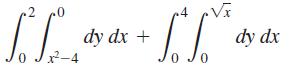
The integrals and sums of integrals give the areas of regions in the xy-plane. Sketch each region, label each bounding curve with its equation, and give the coordinates of the points where the curves intersect. Then find the area of the region. Vx [. ._ dy dx + [. . * day d dx 0 0
Evaluate the integrals by changing to polar coordinates. SJ 1-x² 2 dy dx -x² (1 + x² + y²)² V1-x²
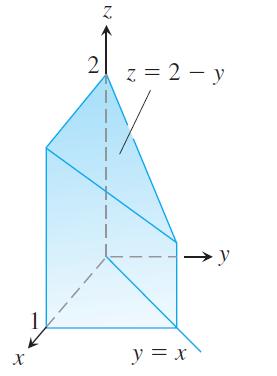
The iterated integral for evaluating ∫∫∫D ƒ(r, θ, z) dθ r dr du over the given region D.D is the prism whose base is the triangle in the xy-plane bounded by the x-axis and the lines y = x and x = 1 and whose top lies in the plane z = 2 - y. X 2 2 z=2-y 个 少 y = x
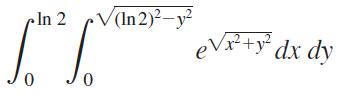
Change the Cartesian integral into an equivalent polar integral. Then evaluate the polar integral. 0 In 2 0 √(In 2)²-y² eVx² + y² dx dy
Evaluate the double integral over the given region R. Se R ex-y dA, R: 0≤x≤ In 2, 0 ≤ y ≤ In 2
Find the center of mass and the moment of inertia about the x-axis of a thin rectangular plate bounded by the lines x = 0, x = 20, y = -1, and y = 1 if δ(x, y) = 1 + (x/20).
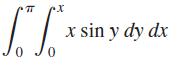
Sketch the region of integration and evaluate the integral. I px 0 x sin y dy dx
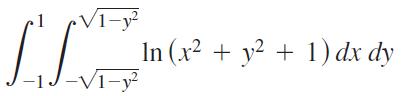
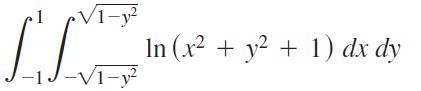
Change the Cartesian integral into an equivalent polar integral. Then evaluate the polar integral. JJ 1-y² -V1-y² In (x² + y² + 1) dx dy
Write an iterated integral for ∫∫R dA over the described region R using (a) Vertical cross-sections, (b) Horizontal cross-sections.Bounded by y = x2 and y = x + 2
Find the average value of ƒ(x, y) = xy over the regions.The quarter circle x2 + y2 ≤ 1 in the first quadrant
Find the centroid of the boomerangshaped region between the parabolas y2 = -4(x - 1) and y2 = -2(x - 2) in the xy-plane.
Evaluate the double integral over the given region R. JS xyet² da, R R: 0≤x≤ 2, 0≤ y ≤ 1
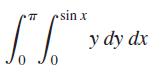
Sketch the region of integration and evaluate the integral. TT Jo Jo sin x y dy dx
Evaluate the integrals by changing to polar coordinates. IS 1-y² -1J-V1-y² In (x² + y² + 1) dx dy
Find the center of mass, the moment of inertia about the coordinate axes, and the polar moment of inertia of a thin triangular plate bounded by the lines y = x, y = -x, and y = 1 if δ(x, y) = y + 1.
Evaluate the double integral over the given region R. JS R xy³ x² + 1 dA, R: 0≤x≤ 1, 0≤ y ≤ 2
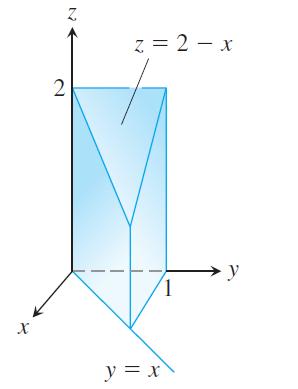
The iterated integral for evaluating ∫∫∫D ƒ(r, θ, z) dθ r dr du over the given region D.D is the prism whose base is the triangle in the xy-plane bounded by the y-axis and the lines y = x and y = 1 and whose top lies in the plane z = 2 - x. X N 2 z = 2 x y = x 1 →y
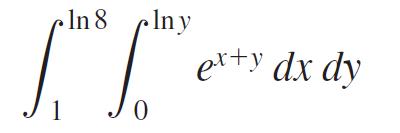
Sketch the region of integration and evaluate the integral. Jord To 1 0 In8 plny exty dx dy
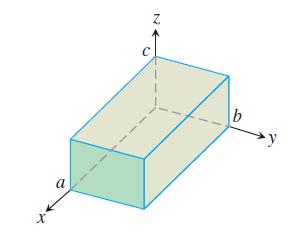
Find the moments of inertia of the rectangular solid shown here with respect to its edges by calculating Ix, Iy, and Iz. X a Z b
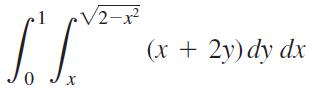
Change the Cartesian integral into an equivalent polar integral. Then evaluate the polar integral. √2-x²2 I'l 0 X (x + 2y) dy dx
Find the average value of ƒ(x, y) = sin (x + y) overa. The rectangle 0 ≤ x ≤ π, 0 ≤ y ≤ π.b. The rectangle 0 ≤ x ≤ π, 0 ≤ y ≤ π/2.
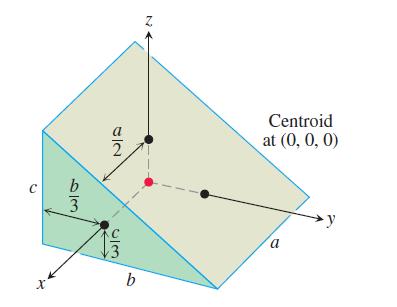
The coordinate axes in the figure run through the centroid of a solid wedge parallel to the labeled edges. Find Ix, Iy, and Iz if a = b = 6 and c = 4. C X 63 72 دانا b N Centroid at (0, 0, 0) a
Evaluate the double integral over the given region R. SS R y x²y² + 1 dA, R: 0≤x≤ 1, 0≤ y ≤ 1
Repeat Exercise 19 for δ(x, y) = 3x2 + 1.Data from Exercise 19Find the center of mass, the moment of inertia about the coordinate axes, and the polar moment of inertia of a thin triangular plate bounded by the lines y = x, y = -x, and y = 1 if δ(x, y) = y + 1.
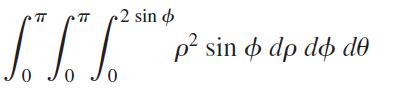
Evaluate the spherical coordinate integrals. 2 sin L L L 0 0 0 p² sin & dp do de
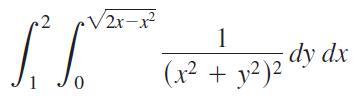
Change the Cartesian integral into an equivalent polar integral. Then evaluate the polar integral. √2x-x² 2 S S 0 1 (x² + y2)2 dy dx
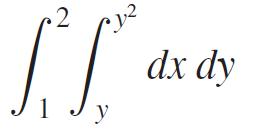
Sketch the region of integration and evaluate the integral. 2 ry ² y dx dy
Which do you think will be larger, the average value of ƒ(x, y) = xy over the square 0 ≤ x ≤ 1, 0 ≤ y ≤ 1, or the average value of ƒ over the quarter circle x2 + y2 ≤ 1 in the first quadrant? Calculate them to find out.
Evaluate the spherical coordinate integrals. 2πT π/4 »2 [³T² 0 0 (p cos d) p² sin o dp do de
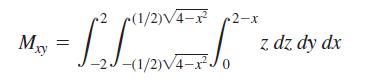
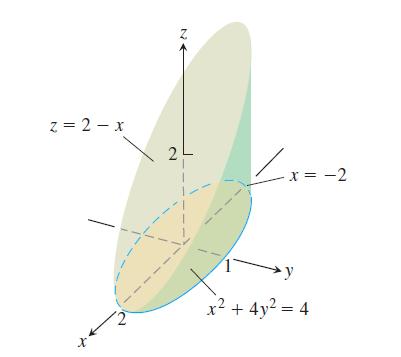
A solid of constant density is bounded below by the plane z = 0, on the sides by the elliptical cylinder x2 + 4y2 = 4, and above by the plane z = 2 - x.a. Find x and y.b. Evaluate the integralusing integral tables to carry out the final integration with respect to x. Then divide Mxy by M to verify
Integrate the function ƒ(x, y) = 1/(1 + x2 + y2)2 over the region enclosed by one loop of the lemniscate (x2 + y2)2 - (x2 - y2) = 0.
Sketch the region of integration and convert each polar integral or sum of integrals to a Cartesian integral or sum of integrals. Do not evaluate the integrals. ᎾᏢ ᏗᏢ Ꮎ soᏇ Ꮎ UIS cᏗ 0 0 JJ TT/2
Integrate ƒ(x, y) = 1/(1 + x2 + y2)2 overa. The triangle with vertices (0, 0), (1, 0), and (1, √3).b. The first quadrant of the xy-plane.
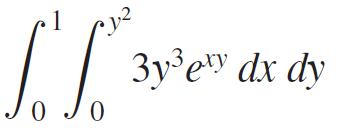
Sketch the region of integration and evaluate the integral. IS 0 0 22 3y³exy dx dy
Find the average height of the paraboloid z = x2 + y2 over the square 0 ≤ x ≤ 2, 0 ≤ y ≤ 2.
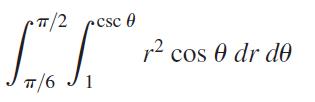
Sketch the region of integration and convert each polar integral or sum of integrals to a Cartesian integral or sum of integrals. Do not evaluate the integrals. -/2_ /csc Ꮎ 71/6 1 r2 cos Ꮎ dr dᎾ
Find the volumes of the region. The region between the cylinder z = y2 and the xy-plane that is bounded by the planes x = 0, x = 1, y = -1, y = 1 X N y
Evaluate the spherical coordinate integrals. •2πT ITT 0 0 (1-cos)/2 p² sin o dp do de
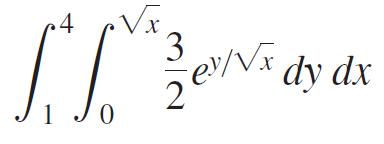
Sketch the region of integration and evaluate the integral. 4 Vx 3 SS 2 es dy dx y/Vx 0
Find the average value of ƒ(x, y) = 1/(xy) over the square ln 2 ≤ x ≤ 2 ln 2, ln 2 ≤ y ≤ 2 ln 2.
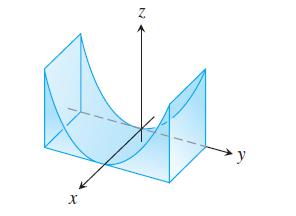
A solid “trough” of constant density is bounded below by the surface z = 4y2, above by the plane z = 4, and on the ends by the planes x = 1 and x = -1. Find the center of mass and the moments of inertia with respect to the three axes.
Integrate ƒ over the given region.ƒ(x, y) = 1/(xy) over the square 1 ≤ x ≤ 2, 1 ≤ y ≤ 2
Integrate ƒ over the given region. ƒ(x, y) = y cos xy over the rectangle 0 ≤ x ≤ π, 0 ≤ y ≤ 1
Evaluate the spherical coordinate integrals. 0 3π/2 IT'S 0 0 5p³ sin³ o dp do de
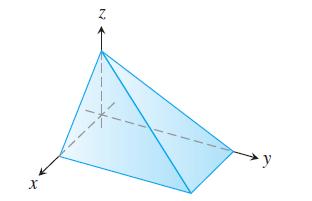
Find the volumes of the region. The region in the first octant bounded by the coordinate planes and the planes x + z = 1, y + 2z = 2 X
Find the area of the circular washer with outer radius 2 and inner radius 1, using (a) Fubini’s Theorem, (b) Simple geometry.
a. Find the center of mass of a solid of constant density bounded below by the paraboloid z = x2 + y2 and above by the plane z = 4.b. Find the plane z = c that divides the solid into two parts of equal volume. This plane does not pass through the center of mass.
Find the volume of the region bounded above by the paraboloid z = x2 + y2 and below by the square R: -1 ≤ x ≤ 1, -1 ≤ y ≤ 1.
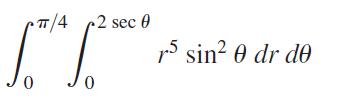
Sketch the region of integration and convert each polar integral or sum of integrals to a Cartesian integral or sum of integrals. Do not evaluate the integrals. 0 π/4 0 2 sec 0 r5 sin² 0 dr de
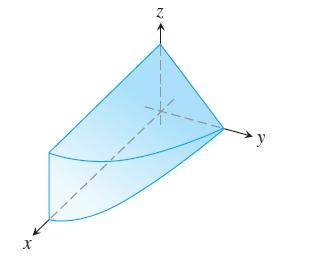
Find the volumes of the region. The region in the first octant bounded by the coordinate planes, the plane y + z = 2, and the cylinder x = 4 - y2 N X
Integrate ƒ over the given region. ƒ(x, y) = x/y over the region in the first quadrant bounded by the lines y = x, y = 2x, x = 1, and x = 2
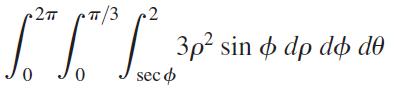
Evaluate the spherical coordinate integrals. . 2 0 π/3 2 seco өр фр др ф u!s zde
If ƒ(x, y) = (10,000ey)/(1 + |x| /2) represents the “population density” of a certain bacterium on the xy-plane, where x and y are measured in centimeters, find the total population of bacteria within the rectangle -5 ≤ x ≤ 5 and -2 ≤ y ≤ 0.
A solid cube, 2 units on a side, is bounded by the planes x = ±1, z = ±1, y = 3, and y = 5. Find the center of mass and the moments of inertia about the coordinate axes.
Find the volume of the region bounded above by the elliptical paraboloid z = 16 - x2 - y2 and below by the square R: 0 ≤ x ≤ 2, 0 ≤ y ≤ 2.
Sketch the region of integration and convert each polar integral or sum of integrals to a Cartesian integral or sum of integrals. Do not evaluate the integrals. 3 sec 0 T/2 4 csc 0 [²²+ [² r¹ dr do + 0 tan 0 tan r¹ dr de
Integrate ƒ over the given region.ƒ(x, y) = x2 + y2 over the triangular region with vertices (0, 0), (1, 0), and (0, 1)
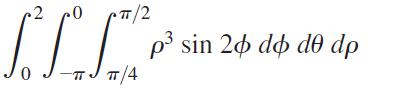
The previous integrals suggest there are preferred orders of integration for spherical coordinates, but other orders give the same value and are occasionally easier to evaluate. Evaluate the integrals.Previous integrals SJ 0 Pπ/2 π/4 p³ sin 20 do d0 dp
Integrate ƒ over the given region.ƒ(u, ν) = ν - √u over the triangular region cut from the first quadrant of the uy-plane by the line u + ν = 1
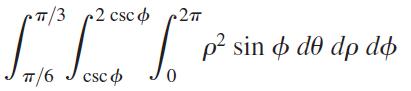
The previous integrals suggest there are preferred orders of integration for spherical coordinates, but other orders give the same value and are occasionally easier to evaluate. Evaluate the integrals.Previous integrals PTT/3 Lot TT/6 2 csc 2n csc 0 p² sin o de dp do
Integrate ƒ over the given region.ƒ(s, t) = es ln t over the region in the first quadrant of the st-plane that lies above the curve s = ln t from t = 1 to t = 2
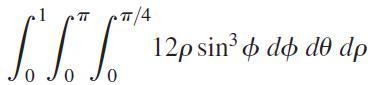
The previous integrals suggest there are preferred orders of integration for spherical coordinates, but other orders give the same value and are occasionally easier to evaluate. Evaluate the integrals.Previous integrals 0 0 0 π/4 12p sin³o do de dp
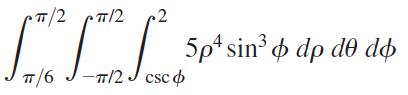
The previous integrals suggest there are preferred orders of integration for spherical coordinates, but other orders give the same value and are occasionally easier to evaluate. Evaluate the integrals.Previous integrals -/2 $2 [72²_5p³ sin³ ob dp 10 dó π/6 J-T/2 csc
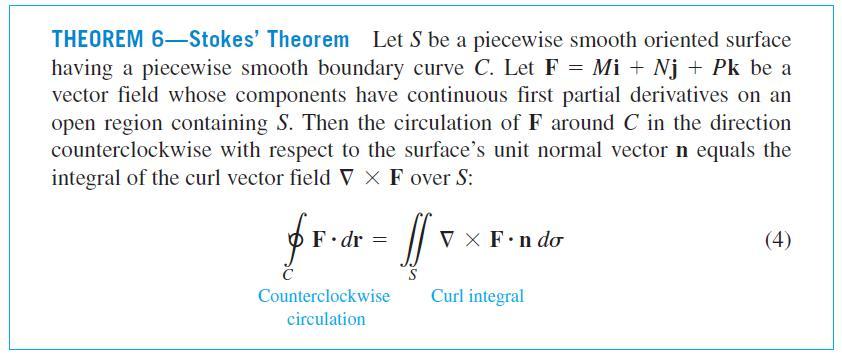
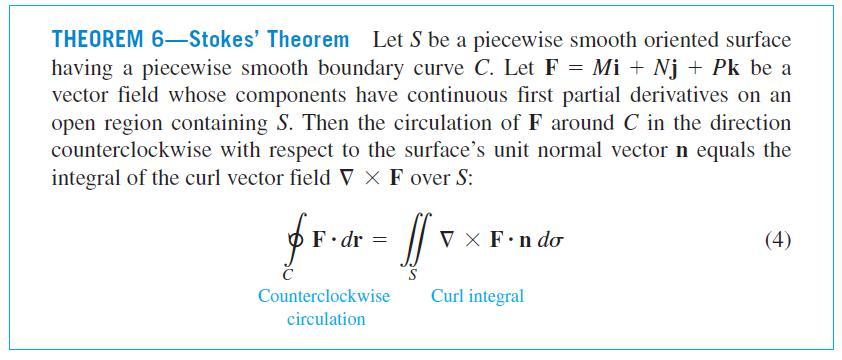
Use the surface integral in Stokes’ Theorem to calculate the circulation of the field F around the curve C in the indicated direction.F = x2i + 2xj + z2kC: The ellipse 4x2 + y2 = 4 in the xy-plane, counterclockwise when viewed from above THEOREM 6-Stokes' Theorem Let S be a piecewise smooth
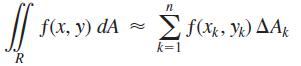
Approximate the double integral of ƒ(x, y) over the region R partitioned by the given vertical lines x = a and horizontal lines y = c. In each sub-rectangle, use (xk, yk) as indicated for your approximation.ƒ(x, y) = x + y over the region R bounded above by the semicircle y = √1 - x2 and below
Verify the conclusion of Green’s Theorem by evaluating both sides of Equations (3) and (4) for the field F = Mi + Nj. Take the domains of integration in each case to be the disk R: x2 + y2 ≤ a2 and its bounding circle C: r = (a cos t)i + (a sin t)j, 0 ≤ t ≤ 2π.F = -yi + xj ƏN fF-T ds = 6M
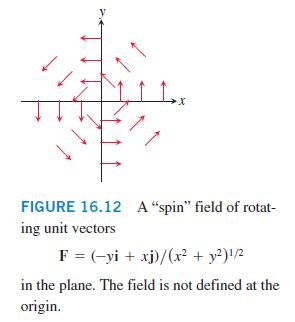
Find the divergence of the field.The spin field in Figure 16.12 11 Ix FIGURE 16.12 A "spin" field of rotat- ing unit vectors F = (-yi + xj)/(x² + y²)¹/2 in the plane. The field is not defined at the origin.
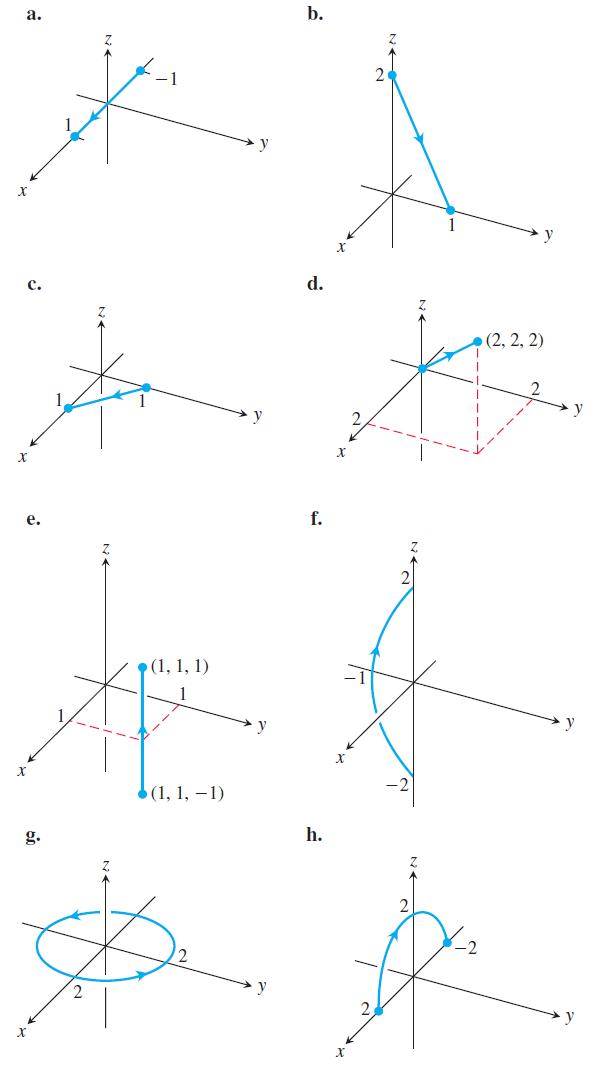
Match the vector equations with the graphs (a)–(h) given here.r(t) = ti + (1 - t)j, 0 ≤ t ≤ 1 a. C. e. 2 1 (1, 1, 1) (1, 1, -1) b. d. f. h. X X X (2, 2, 2) y
Find the gradient fields of the function. f(x, y, z) = (x + y + z)-1/2
Use the surface integral in Stokes’ Theorem to calculate the circulation of the field F around the curve C in the indicated direction.F = 2yi + 3xj - z2kC: The circle x2 + y2 = 9 in the xy-plane, counterclockwise when viewed from above THEOREM 6-Stokes' Theorem Let S be a piecewise smooth
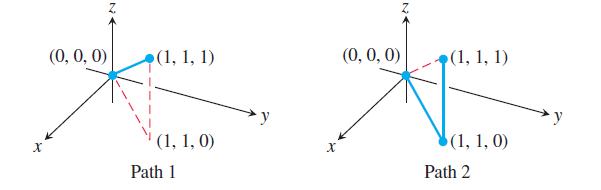
The accompanying figure shows two polygonal paths in space joining the origin to the point (1, 1, 1). Integrate ƒ(x, y, z) = 2x - 3y2 - 2z + 3 over each path. NE (0, 0, 0) (1, 1, 1) (1, 1, 0) Path 1 (0, 0, 0) (1, 1, 1) (1, 1, 0) Path 2
Showing 6900 - 7000
of 29454
First
63
64
65
66
67
68
69
70
71
72
73
74
75
76
77
Last
Step by Step Answers

 Get 50% OFF
Claim Now
Get 50% OFF
Claim Now