New Semester
Started
Get
50% OFF
Study Help!
--h --m --s
Claim Now
Question Answers
Textbooks
Find textbooks, questions and answers
Oops, something went wrong!
Change your search query and then try again
S
Books
FREE
Study Help
Expert Questions
Accounting
General Management
Mathematics
Finance
Organizational Behaviour
Law
Physics
Operating System
Management Leadership
Sociology
Programming
Marketing
Database
Computer Network
Economics
Textbooks Solutions
Accounting
Managerial Accounting
Management Leadership
Cost Accounting
Statistics
Business Law
Corporate Finance
Finance
Economics
Auditing
Tutors
Online Tutors
Find a Tutor
Hire a Tutor
Become a Tutor
AI Tutor
AI Study Planner
NEW
Sell Books
Search
Search
Sign In
Register
study help
mathematics
precalculus
Calculus Of A Single Variable 11th Edition Ron Larson, Bruce H. Edwards - Solutions
Verify the conclusion of Green’s Theorem by evaluating both sides of Equations (3) and (4) for the field F = Mi + Nj. Take the domains of integration in each case to be the disk R: x2 + y2 ≤ a2 and its bounding circle C: r = (a cos t)i + (a sin t)j, 0 ≤ t ≤ 2π.F = yi ƏN fF-T ds = 6M dx +
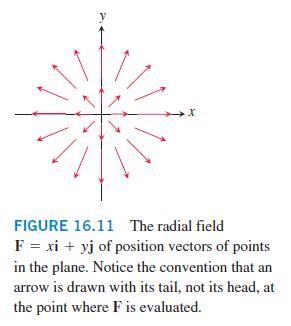
Find the divergence of the field.The radial field in Figure 16.11 FIGURE 16.11 The radial field F = xi + yj of position vectors of points in the plane. Notice the convention that an arrow is drawn with its tail, not its head, at the point where F is evaluated.
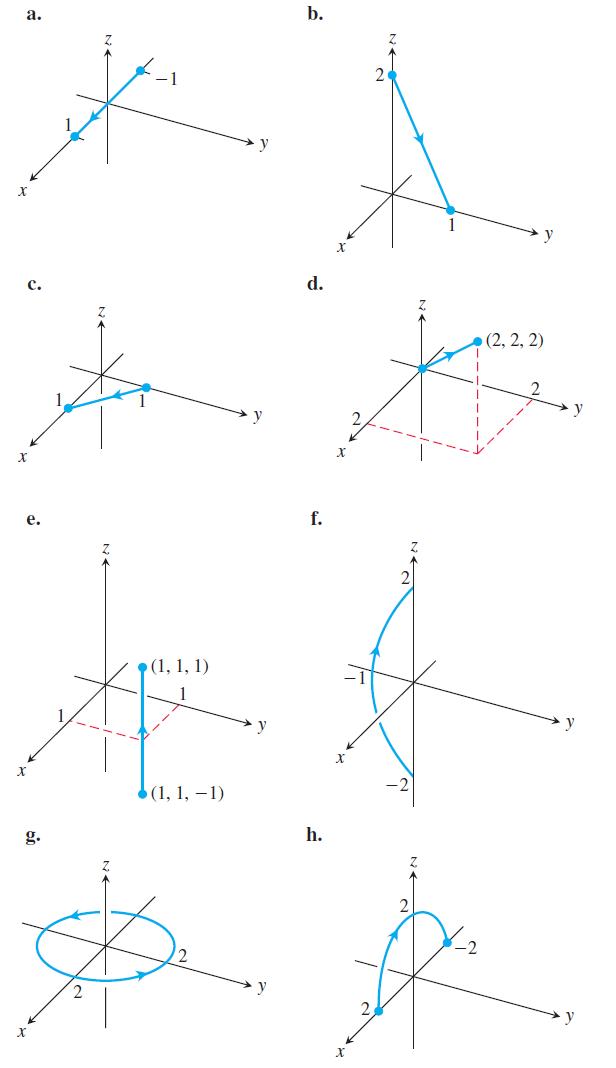
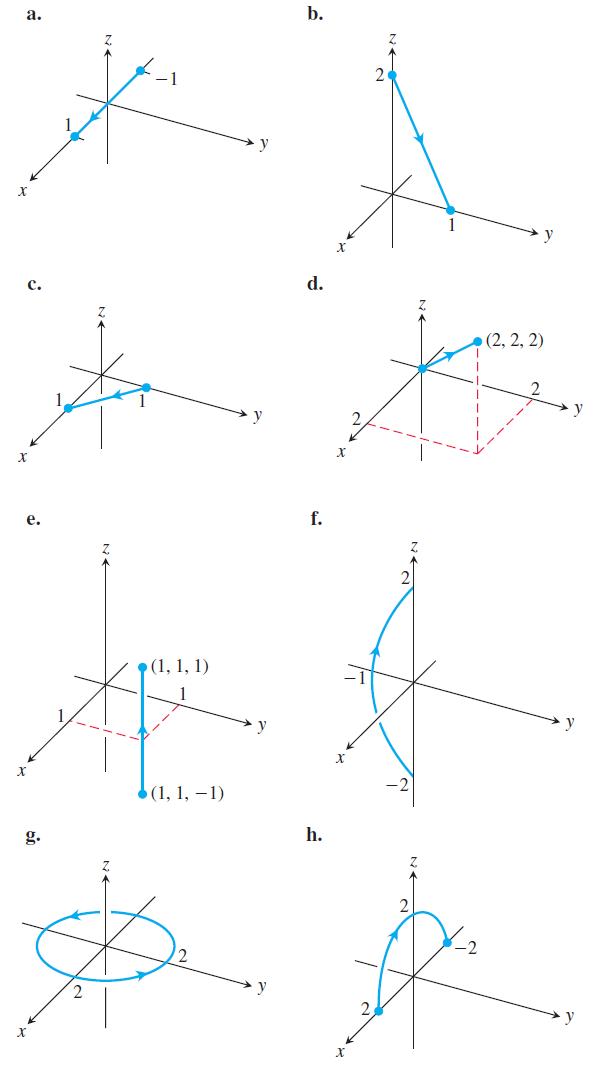
Match the vector equations with the graphs (a)–(h) given here.r(t) = i + j + tk, -1 ≤ t ≤ 1 a. C. e. 2 1 (1, 1, 1) (1, 1, -1) b. d. f. h. X X X (2, 2, 2) y
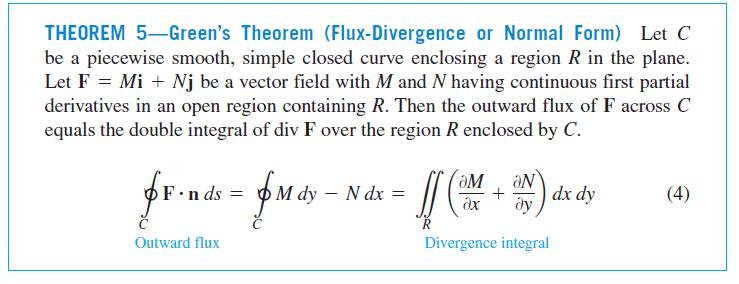
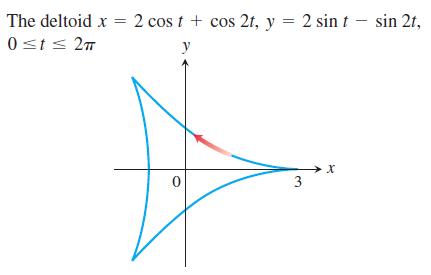
Use the Green’s Theorem area formula in Exercises 16.4 to find the areas of the regions enclosed by the curves THEOREM 5-Green's Theorem (Flux-Divergence or Normal Form) Let C be a piecewise smooth, simple closed curve enclosing a region R in the plane. Let F = Mi + Nj be a vector field with M
Find a parametrization of the surface.The paraboloid z = x2 + y2, z ≤ 4
Integrate the given function over the given surface.G(x, y, z) = x, over the parabolic cylinder y = x2, 0 ≤ x ≤ 2, 0 ≤ z ≤ 3
Find the gradient fields of the function. 2 f(x, y, z)= InVx + y + z
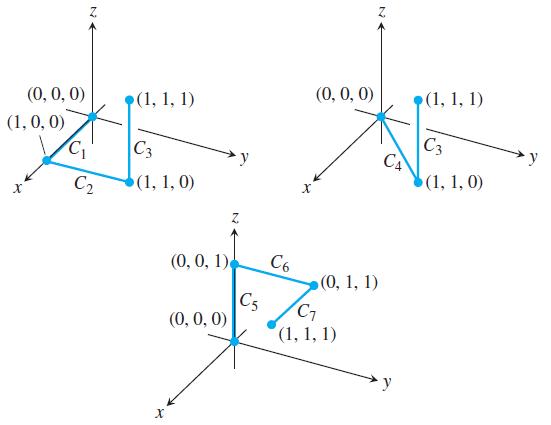
The accompanying figure shows three polygonal paths joining the origin to the point (1, 1, 1). Integrate ƒ(x, y, z) = x2 + y - z over each path. (0, 0, 0) (1, 0, 0) N C₁ C2 (1, 1, 1) C3 (1, 1, 0) X (0, 0, 1) (0, 0, 0) Z C₂ C6 (0, 0, 0) (0, 1, 1) C₁ (1, 1, 1) N CA (1, 1, 1) C3 (1, 1, 0)
Verify the conclusion of Green’s Theorem by evaluating both sides of Equations (3) and (4) for the field F = Mi + Nj. Take the domains of integration in each case to be the disk R: x2 + y2 ≤ a2 and its bounding circle C: r = (a cos t)i + (a sin t)j, 0 ≤ t ≤ 2π.F = 2xi - 3yj ƏN fF-T ds =
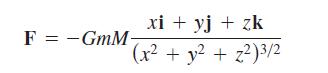
Find the divergence of the field.The gravitational field in Figure 16.8Data from Exercise 38aa. Find a potential function for the gravitational field xi + yj + zk (x² + y² + z²)³/2 F = -GmM-
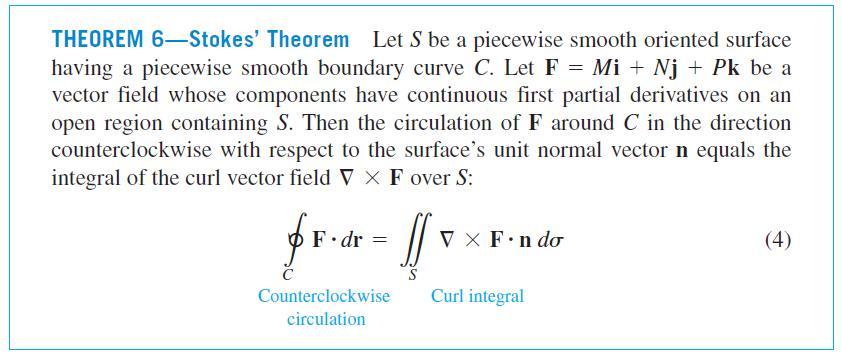
Use the surface integral in Stokes’ Theorem to calculate the circulation of the field F around the curve C in the indicated direction.F = yi + xzj + x2kC: The boundary of the triangle cut from the plane x + y + z = 1 by the first octant, counterclockwise when viewed from above THEOREM 6-Stokes'
What are line integrals of scalar functions? How are they evaluated? Give examples.
Which fields are conservative, and which are not?F = yzi + xzj + xyk
Match the vector equations with the graphs (a)–(h) given here.r(t) = (2 cos t)i + (2 sin t)j, 0 ≤ t ≤ 2π a. C. e. 2 1 (1, 1, 1) (1, 1, -1) b. d. f. h. X X X (2, 2, 2) y
Find a parametrization of the surface.The paraboloid z = 9 - x2 - y2, z ≥ 0
Find the gradient fields of the function. g(x, y, z)= e - In (x + y)
Integrate the given function over the given surface.G(x, y, z) = z, over the cylindrical surface y2 + z2 = 4, z ≥ 0, 1 ≤ x ≤ 4
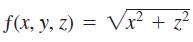
Integrateover the circle r(t) = (a cos t)j + (a sin t)k, 0 ≤ t ≤ 2π. f(x, y, z)=√x² + z²
How can you use line integrals to find the centers of mass of springs or wires? Explain.
Which fields are conservative, and which are not?F = (y sin z)i + (x sin z)j + (xy cos z)k
Find a parametrization of the surface.The first-octant portion of the cone z = √x2 + y2/2 between the planes z = 0 and z = 3
Integrate the given function over the given surface.G(x, y, z) = x2, over the unit sphere x2 + y2 + z2 = 1
The counterweight of a flywheel of constant density 1 has the form of the smaller segment cut from a circle of radius a by a chord at a distance b from the center (b < a). Find the mass of the counterweight and its polar moment of inertia about the center of the wheel.
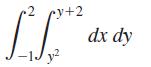
The integrals and sums of integrals give the areas of regions in the xy-plane. Sketch each region, label each bounding curve with its equation, and give the coordinates of the points where the curves intersect. Then find the area of the region. py+2 -1.Jy² dx dy
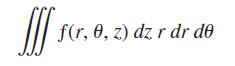
Give the limits of integration for evaluating the integralas an iterated integral over the region that is bounded below by the plane z = 0, on the side by the cylinder r = cos θ, and on top by the paraboloid z = 3r2. III f(r, 0, z) dz r dr de
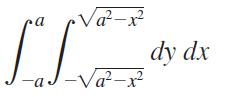
Change the Cartesian integral into an equivalent polar integral. Then evaluate the polar integral. •√a²-x² a IS -a 1-√a²-x² dy dx
Write an iterated integral for ∫∫R dA over the described region R using (a) Vertical cross-sections, (b) Horizontal cross-sections.Bounded by y = tan x, x = 0, and y = 1
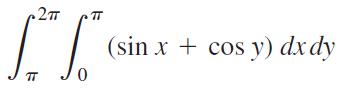
Evaluate the iterated integral. . 2 ㅠ f TT (sin x + cos y) dx dy
Find the volume of the region in the first octant that lies between the cylinders r = 1 and r = 2 and that is bounded below by the xy-plane and above by the surface z = xy.
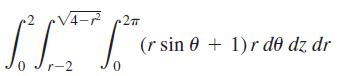
The integrals we have seen so far suggest that there are preferred orders of integration for cylindrical coordinates, but other orders usually work well and are occasionally easier to evaluate. Evaluate the integrals. √4-² -2πT INT r-2 (r sin 0 + 1) r do dz dr
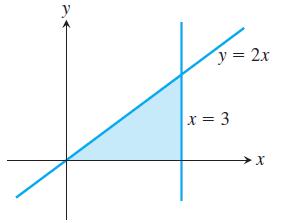
Write an iterated integral for ∫∫R dA over the described region R using (a) Vertical cross-sections, (b) Horizontal cross-sections. y = 2x x=3
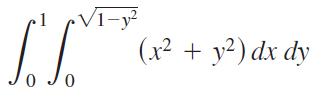
Change the Cartesian integral into an equivalent polar integral. Then evaluate the polar integral. 1 1-y² LS 0 0 (x² + y²) dx dy
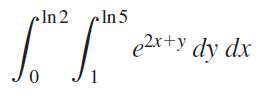
Evaluate the iterated integral. In 2 In 5 [." [² K 0 1 e2x+y dy dx
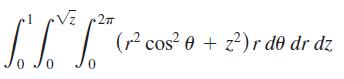
The integrals we have seen so far suggest that there are preferred orders of integration for cylindrical coordinates, but other orders usually work well and are occasionally easier to evaluate. Evaluate the integrals. •√z 2π IT T 0 0 (r² cos² 0 + z²) r do dr dz
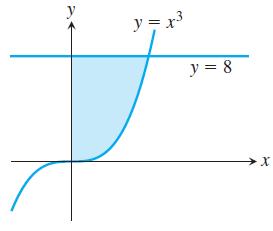
Write an iterated integral for ∫∫R dA over the described region R using (a) Vertical cross-sections, (b) Horizontal cross-sections. y = 8 J X
Find the centroid of the infinite region in the second quadrant enclosed by the coordinate axes and the curve y = ex.
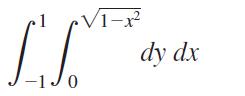
Change the Cartesian integral into an equivalent polar integral. Then evaluate the polar integral. V √1-x² LS -1 JO dy dx
Sketch the region bounded by the given lines and curves. Then express the region’s area as an iterated double integral and evaluate the integral.The lines y = x, y = x/3, and y = 2
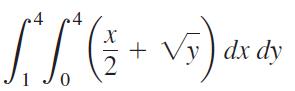
Evaluate the iterated integral. 4 [*S* ( + Vy) dx dy 1
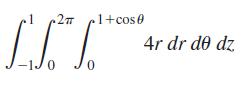
The integrals we have seen so far suggest that there are preferred orders of integration for cylindrical coordinates, but other orders usually work well and are occasionally easier to evaluate. Evaluate the integrals. LIT 0 0 c2π 1+cos0 4r dr do dz
Find the moment of inertia with respect to the y-axis of a thin sheet of constant density δ = 1 bounded by the curve y = (sin2 x) /x2 and the interval π ≤ x ≤ 2π of the x-axis.
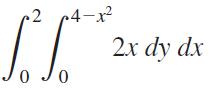
Sketch the region of integration and write an equivalent integral with the order of integration reversed. Then evaluate both integrals. 2 p4-x² 0 0 2x dy dx
Sketch the region bounded by the given lines and curves. Then express the region’s area as an iterated double integral and evaluate the integral.The parabolas x = y2 - 1 and x = 2y2 - 2
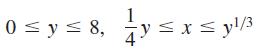
Sketch the described regions of integration. 0 ≤ y ≤ 8, 1 4" y≤ x ≤yl/3
Find the volume of material cut from the solid sphere r2 + z2 ≤ 9 by the cylinder r = 3 sin θ.
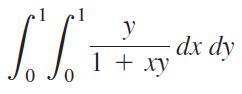
Evaluate the iterated integral. S.S. 0 0 y 1 + xy - dx dy
How are triple integrals defined in cylindrical and spherical coordinates? Why might one prefer working in one of these coordinate systems to working in rectangular coordinates?
Find the moment of inertia about the x-axis of a thin plate of density δ = 1 bounded by the circle x2 + y2 = 4. Then use your result to find Iy and I0 for the plate.
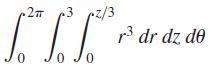
The integrals we have seen so far suggest that there are preferred orders of integration for cylindrical coordinates, but other orders usually work well and are occasionally easier to evaluate. Evaluate the integrals. 2π СЕГ 0 JO 2/3 r³ dr dz de
Sketch the region bounded by the given lines and curves. Then express the region’s area as an iterated double integral and evaluate the integral.The parabolas x = y2 and x = 2y - y2
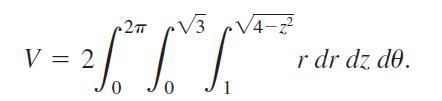
A circular cylindrical hole is bored through a solid sphere, the axis of the hole being a diameter of the sphere. The volume of the remaining solid isa. Find the radius of the hole and the radius of the sphere.b. Evaluate the integral. p2π IT T 0 1 V = 2 √3 √4-2² r dr dz de.
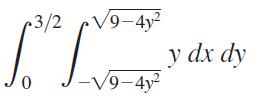
Sketch the region of integration and write an equivalent integral with the order of integration reversed. Then evaluate both integrals. 3/2 V9-4y² TO 0 y dx dy √√9-4y²
Sketch the described regions of integration.0 ≤ y ≤ 1, 0 ≤ x ≤ sin-1 y
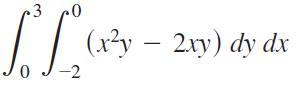
Evaluate the iterated integral. 3 [[ (x²y - 2xy) dy dx 0 -2
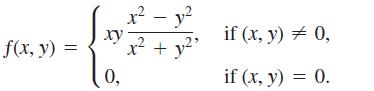
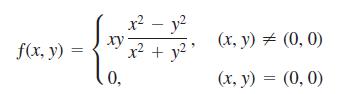
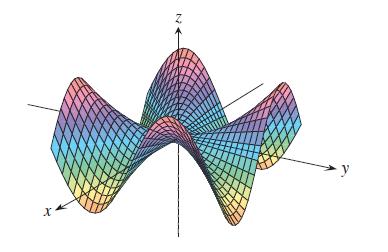
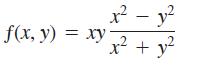
Let The graph of ƒ is shown. f(x, y) = xy 0, x² - y² x² + y²⁹ if (x, y) = 0, if (x, y) = 0.
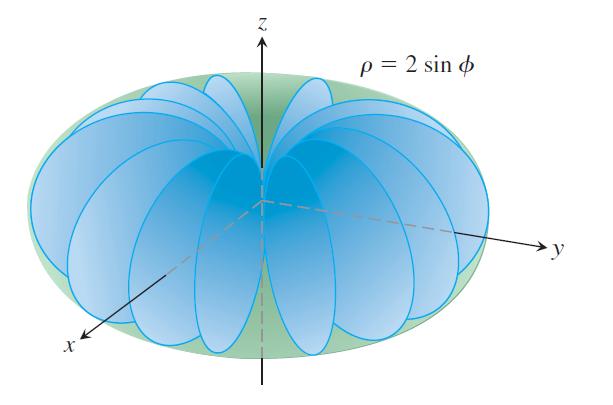
Find the volume of the region enclosed by the spherical coordinate surface ρ = 2 sin ϕ X N p = 2 sin
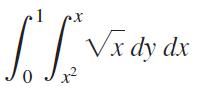
Sketch the region of integration and write an equivalent integral with the order of integration reversed. Then evaluate both integrals. X ff V x dy dx 0x2²
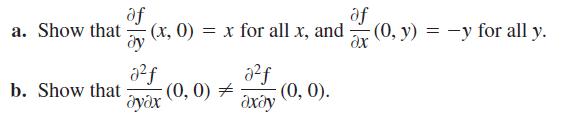
If you did Exercise 60, you know that the functionis continuous at (0, 0). Find ƒxy(0, 0) and ƒyx(0, 0).Data from Exercise 60Define ƒ(0, 0) in a way that extendsto be continuous at the origin. f(x, y) x² - y² xy x² + y² 0, (x, y) = (0, 0) (x, y) = (0, 0)
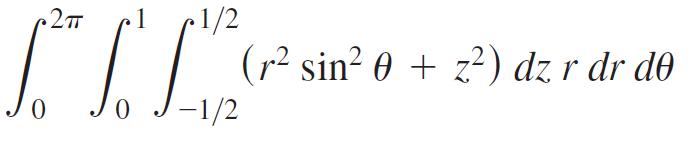
Evaluate the cylindrical coordinate integrals. c2π 1 0 0 1/2 (r² sin² 0 + z²) dz r dr de -1/2
How are double and triple integrals in rectangular coordinates used to calculate volumes, average values, masses, moments, and centers of mass? Give examples.
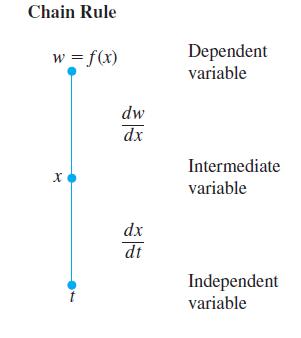
(a) Express dw/dt as a function of t, both by using the Chain Rule and by expressing w in terms of t and differentiating directly with respect to t. Then (b) Evaluate dw/dt at the given value of t. : x² + y², x = X = w = cost, cost, y sin t; y = sin t; t = π
Find the centroid of the region between the x-axis and the arch y = sin x, 0 ≤ x ≤ π.
Sketch the region bounded by the given lines and curves. Then express the region’s area as an iterated double integral and evaluate the integral.The curves y = ln x and y = 2 ln x and the line x = e, in the first quadrant
Let D be the region bounded by the paraboloid z = x2 + y2 and the plane z = 2y. Write triple iterated integrals in the order dz dx dy and dz dy dx that give the volume of D. Do not evaluate either integral.
Find the volume of the portion of the solid cylinder x2 + y2 ≤ 1 that lies between the planes z = 0 and x + y + z = 2.
In begin by drawing a diagram that shows the relations among the variables.If w = x2 + y2 + z2 and z = x2 + y2, find a. dw dy N b. ow əz X C. Əw əz y
a. Use Corollary 2 of the Mean Value Theorem for scalar functions to show that if two vector functions R1(t) and R2(t) have identical derivatives on an interval I, then the functions differ by a constant vector value throughout I.b. Use the result in part (a) to show that if R(t) is any
When is a function of two (three) independent variables continuous at a point in its domain? Give examples of functions that are continuous at some points but not others.
Find the gradient of the function at the given point. Then sketch the gradient together with the level curve that passes through the point.ƒ(x, y) = y - x, (2, 1)
Find the domain and range of the given function and identify its level curves. Sketch a typical level curve.ƒ(x, y) = 9x2 + y2
What is a real-valued function of two independent variables? Three independent variables? Give examples.
Use the Integral Test to determine the convergence or divergence of the p-series. 00 n=1 7
Find the sum of the convergent series. 18 n=0 al n
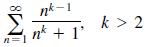
Use the Limit Comparison Test to determine the convergence or divergence of the series. n=1 nk-1 nk + 1' k > 2
Find the limit of the sequence with the given nth term. an = cos n
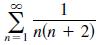
Verify that the infinite series converges. 18 n=1 1 n(n + 2)
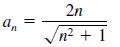
Find the limit of the sequence with the given nth term. an 2n /n² + 1
Without performing any calculations, determine whether the following series converges. Explain. 1 10,000 1 10,001 1 10,002
Determine the convergence or divergence of the series. 18 n=1 n+ 1 2n 1
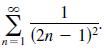
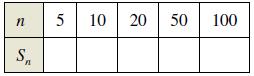
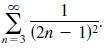
Consider the series (a) Verify that the series converges.(b) Use a graphing utility to complete the table.(c) The sum of the series is π2/8. Find the sum of the series(d) Use a graphing utility to find the sum of the series 18 n=1 1 (2n-1)²¹
Determine whether each series is a p-series. (a) 00 n=1 1.4 n (b) 00 n=1 - n (c) - n
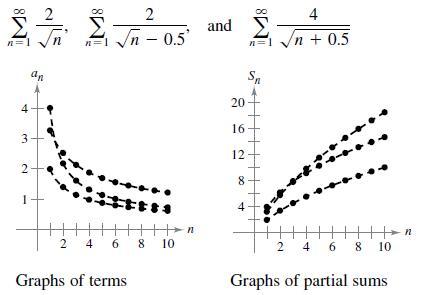
The figures show the graphs of the first 10 terms, and the graphs of the first 10 terms of the sequence of partial sums, of each series.(a) Identify the series in each figure.(b) Which series is a p-series? Does it converge or diverge?(c) For the series that are not p-series, how do the magnitudes
Which function grows faster as n approaches infinity? Explain. f(n) = 7″ g(n) = (n − 1)!
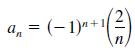
Write the first five terms of the sequence with the given nth term. a = sin n nπ 2
Write the first five terms of the sequence with the given nth term. an vi|5 n
Confirm that the Integral Test can be applied to the series. Then use the Integral Test to determine the convergence or divergence of the series. n=l οζ 18
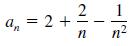
Write the first five terms of the sequence with the given nth term. an = 2 + 2 n 1 n²
Confirm that the Integral Test can be applied to the series. Then use the Integral Test to determine the convergence or divergence of the series. 00 Σ n=1 ne-n/2
Write the first five terms of the sequence with the given nth term. a 'n 3n n + 4
What does it mean for a sequence to be defined recursively?
Write the first five terms of the sequence with the given nth term. |1+u(1-) = (17)₁. an
Use the Direct Comparison Test to determine the convergence or divergence of the series. 18 n = 0 - 2
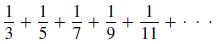
Confirm that the Integral Test can be applied to the series. Then use the Integral Test to determine the convergence or divergence of the series. 3 + 1 5 = + = + = + = +
Verify that the infinite series diverges. 18 n=0 52 R
Confirm that the Integral Test can be applied to the series. Then use the Integral Test to determine the convergence or divergence of the series. 18 n=2 In n n³
Verify that the infinite series diverges. 18 n=1 n 2n + 3
Write the first five terms of the sequence with the given nth term.an = 3n
Confirm that the Integral Test can be applied to the series. Then use the Integral Test to determine the convergence or divergence of the series. 18 n=1 arctan n n² + 1
Use the Direct Comparison Test to determine the convergence or divergence of the series. 18 n=1 6" + n 5 1
Confirm that the Integral Test can be applied to the series. Then use the Integral Test to determine the convergence or divergence of the series. 18 n=1 In n n²
Showing 7000 - 7100
of 29454
First
64
65
66
67
68
69
70
71
72
73
74
75
76
77
78
Last
Step by Step Answers

 Get 50% OFF
Claim Now
Get 50% OFF
Claim Now