New Semester
Started
Get
50% OFF
Study Help!
--h --m --s
Claim Now
Question Answers
Textbooks
Find textbooks, questions and answers
Oops, something went wrong!
Change your search query and then try again
S
Books
FREE
Study Help
Expert Questions
Accounting
General Management
Mathematics
Finance
Organizational Behaviour
Law
Physics
Operating System
Management Leadership
Sociology
Programming
Marketing
Database
Computer Network
Economics
Textbooks Solutions
Accounting
Managerial Accounting
Management Leadership
Cost Accounting
Statistics
Business Law
Corporate Finance
Finance
Economics
Auditing
Tutors
Online Tutors
Find a Tutor
Hire a Tutor
Become a Tutor
AI Tutor
AI Study Planner
NEW
Sell Books
Search
Search
Sign In
Register
study help
mathematics
precalculus
Thomas Calculus Early Transcendentals 13th Edition Joel R Hass, Christopher E Heil, Maurice D Weir - Solutions
Show that the only possible maxima and minima of z on the surface z = x3 + y3 - 9xy + 27 occur at (0, 0) and (3, 3). Show that neither a maximum nor a minimum occurs at (0, 0). Determine whether z has a maximum or a minimum at (3, 3).
Find and sketch the domain for each function. f(x, y) = √(x² − 4)(y² – 9)
Use the method of Lagrange multipliers to find the dimensions of the rectangle of greatest area that can be inscribed in the ellipse x2/16 + y2/9 = 1 with sides parallel to the coordinate axes.
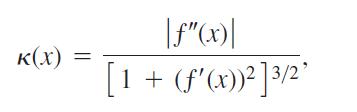
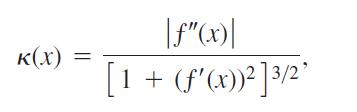
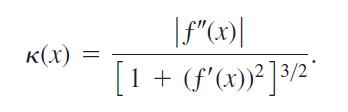
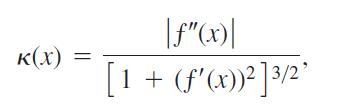
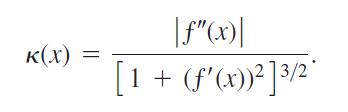
The formuladerived in Exercise 5, expresses the curvature k(x) of a twice-differentiable plane curve y = ƒ(x) as a function of x. Find the curvature function of each of the curves. Then graph ƒ(x) together with k(x) over the given interval. You will find some surprises.y = x2, -2 ≤ x ≤ 2Data
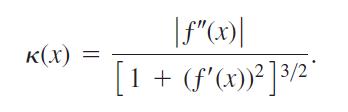
The formuladerived in Exercise 5, expresses the curvature k(x) of a twice-differentiable plane curve y = ƒ(x) as a function of x. Find the curvature function of each of the curves. Then graph ƒ(x) together with k(x) over the given interval. You will find some surprises.y = sin x, 0 ≤ x ≤
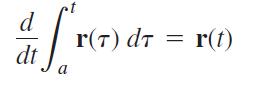
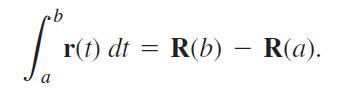
The Fundamental Theorem of Calculus for scalar functions of a real variable holds for vector functions of a real variable as well. Prove this by using the theorem for scalar functions to show first that if a vector function r(t) is continuous for a ≤ t ≤ b, thenat every point t of (a, b). Then
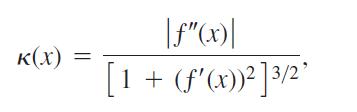
The formuladerived in Exercise 5, expresses the curvature k(x) of a twice-differentiable plane curve y = ƒ(x) as a function of x. Find the curvature function of each of the curves. Then graph ƒ(x) together with k(x) over the given interval. You will find some surprises.y = x4/4, -2 ≤ x ≤
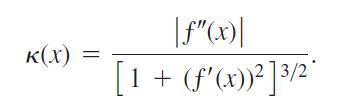
The formuladerived in Exercise 5, expresses the curvature k(x) of a twice-differentiable plane curve y = ƒ(x) as a function of x. Find the curvature function of each of the curves. Then graph ƒ(x) together with k(x) over the given interval. You will find some surprises.y = ex, -1 ≤ x ≤ 2Data
Consider again the baseball problem in Example 5. This time assume a drag coefficient of 0.08 and an instantaneous gust of wind that adds a component of -17.6i (ft/sec) to the initial velocity at the instant the baseball is hit.a. Find a vector equation for the path of the baseball.b. How high does
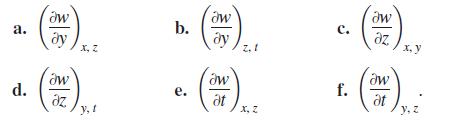
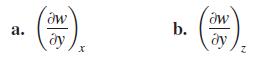
In begin by drawing a diagram that shows the relations among the variables.If w = x2 + y - z + sin t and x + y = t, find a. d. Əw ay dw əz X, Z y, t b. e. ow dy ow at X, Z C. f. dw az aw at x.y y, z
(a) Express dw/dt as a function of t, both by using the Chain Rule and by expressing w in terms of t and differentiating directly with respect to t. Then (b) Evaluate dw/dt at the given value of t. W = x² + y², x = cost + sin t, y = cos t - sin t; t = 0
Use Taylor’s formula for ƒ(x, y) at the origin to find quadratic and cubic approximations of ƒ near the origin.ƒ(x, y) = xey
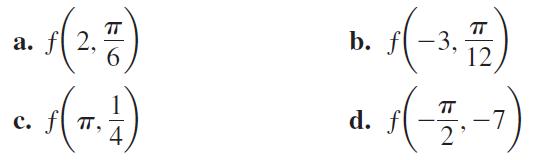
Find the specific function values.ƒ(x, y) = sin (xy) a. 2₁ c. f(²1) ㅠ. 4 b. f (-3.픔) 12 d. 1. (-)
Find equations for the(a) Tangent plane and(b) Normal line at the point P0 on the given surface.x2 + y2 + z2 = 3, P0(1, 1, 1)
Find the points on the ellipse x2 + 2y2 = 1 where ƒ(x, y) = xy has its extreme values.
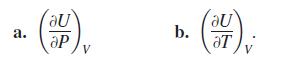
In begin by drawing a diagram that shows the relations among the variables.Let U = ƒ(P, V, T ) be the internal energy of a gas that obeys the ideal gas law PV = nRT (n and R constant). Find a. (SP)V b. (7)
Find the specific function values.ƒ(x, y) = x2 + xy3a. ƒ(0, 0) b. ƒ(-1, 1)c. ƒ(2, 3) d. ƒ(-3, -2)
Use Taylor’s formula for ƒ(x, y) at the origin to find quadratic and cubic approximations of ƒ near the origin.ƒ(x, y) = ex cos y
What does it mean for sets in the plane or in space to be open? Closed? Give examples. Give examples of sets that are neither open nor closed.
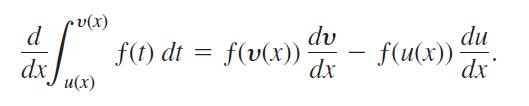
Leibniz’s Rule says that if ƒ is continuous on [a, b] and if u(x) and ν(x) are differentiable functions of x whose values lie in [a, b], thenProve the rule by settingand calculating dg / dx with the Chain Rule. d dx •v(x) u(x) f(t) dt = f(v(x)) dv dx - du dx - f(u(x)).
(a) Express dw/dt as a function of t, both by using the Chain Rule and by expressing w in terms of t and differentiating directly with respect to t. Then (b) Evaluate dw/dt at the given value of t. W || XIN y IN x = cos² t, cos² t, y y = sin² t, z = 1/t; t = 3
Find the gradient of the function at the given point. Then sketch the gradient together with the level curve that passes through the point.ƒ(x, y) = ln (x2 + y2), (1, 1)
Find the domain and range of the given function and identify its level curves. Sketch a typical level curve.ƒ(x, y) = ex+y
Find a function w = ƒ(x, y) whose first partial derivatives are ∂w/∂x = 1 + ex cos y and ∂w/∂y = 2y - ex sin y and whose value at the point (ln 2, 0) is ln 2.
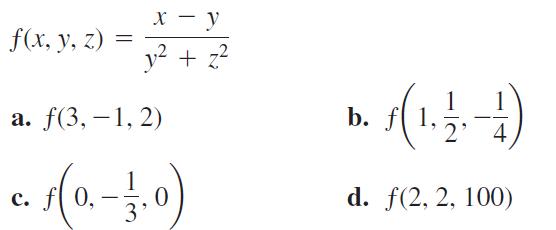
Find the specific function values. f(x, y, z) = C. x - y ,2 y² + z² a. f(3,-1, 2) as(a-1-0) 1 (1.-1.-4) d. f(2, 2, 100) b.
Find equations for the(a) Tangent plane and(b) Normal line at the point P0 on the given surface.x2 + y2 - z2 = 18, P0(3, 5, -4)
Find the extreme values of ƒ(x, y) = xy subject to the constraint g(x, y) = x2 + y2 - 10 = 0.
Use Taylor’s formula for ƒ(x, y) at the origin to find quadratic and cubic approximations of ƒ near the origin.ƒ(x, y) = y sin x
(a) Express dw/dt as a function of t, both by using the Chain Rule and by expressing w in terms of t and differentiating directly with respect to t. Then (b) Evaluate dw/dt at the given value of t. W = · In (x² + y² + z²), x = cost, y = sin t, t = 3 z = 4√t:
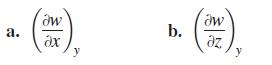
Findat the point (x, y, z) = (0, 1, π) if w = x2 + y2 + z2 and y sin z + z sin x = 0. a. dw ax y b. dw Əz
How can you display the values of a function ƒ(x, y) of two independent variables graphically? How do you do the same for a function ƒ(x, y, z) of three independent variables?
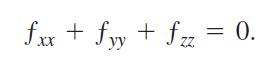
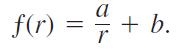
Suppose that ƒ is a twice-differentiable function of r, that r = √x2 + y2 + z2, and thatShow that for some constants a and b, fxx + fyy + f₂z = 0.
Find the gradient of the function at the given point. Then sketch the gradient together with the level curve that passes through the point.g(x, y) = xy2, (2, -1)
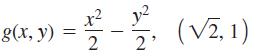
Find the gradient of the function at the given point. Then sketch the gradient together with the level curve that passes through the point. g(x, y) --/ 2 2' (√2, 1)
Find the domain and range of the given function and identify its level curves. Sketch a typical level curve.g(x, y) = 1/xy
Find equations for the(a) Tangent plane and(b) Normal line at the point P0 on the given surface.2z - x2 = 0, P0(2, 0, 2)
Find the maximum value of ƒ(x, y) = 49 - x2 - y2 on the line x + 3y = 10.
Use Taylor’s formula for ƒ(x, y) at the origin to find quadratic and cubic approximations of ƒ near the origin.ƒ(x, y) = sin x cos y
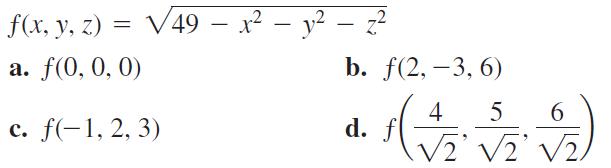
Find the specific function values. f(x, y, z) = √49 — x² - y² — z² - f(0, 0, 0) c. f(-1, 2, 3) b. f(2,-3, 6) d. 4 5 6 ( √/2² √/2 √2) V2
(a) Express dw/dt as a function of t, both by using the Chain Rule and by expressing w in terms of t and differentiating directly with respect to t. Then (b) Evaluate dw/dt at the given value of t. W = 2ye Inz, x = In (² + 1), y = tan ¹1, z = e¹; t = 1
What does it mean for a function ƒ(x, y) to have limit L as (x, y) → (x0, y0)? What are the basic properties of limits of functions of two independent variables?
Findat the point (w, x, y, z) = (4, 2, 1, -1) if w = x2y2 + yz - z3 and x2 + y2 + z2 = 6. а. Г b. dw 2
Find the gradient of the function at the given point. Then sketch the gradient together with the level curve that passes through the point. f(x, y) = √2x + 3y, (-1,2)
Find the domain and range of the given function and identify its level curves. Sketch a typical level curve.g(x, y) = √x2 - y
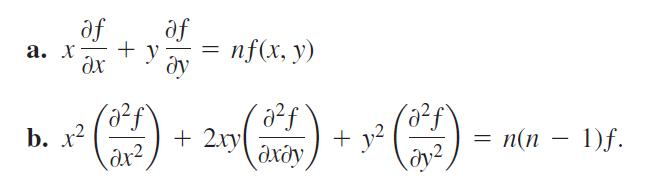
A function ƒ(x, y) is homogeneous of degree n (n a nonnegative integer) if ƒ(tx, ty) = tnƒ(x, y) for all t, x, and y. For such a function (sufficiently differentiable), prove that af əx a. X- b. x² + y 2x² af dy = nf(x, y) (avis) + 3² (10²1) + 2xy = n(n − 1)f.
Find equations for the(a) Tangent plane and(b) Normal line at the point P0 on the given surface.x2 + 2xy - y2 + z2 = 7, P0(1, -1, 3)
Find the local extreme values of ƒ(x, y) = x2y on the line x + y = 3.
Find and sketch the domain for each function. f(x, y) = √y - x − 2 Vy
(a) Express dw/dt as a function of t, both by using the Chain Rule and by expressing w in terms of t and differentiating directly with respect to t. Then (b) Evaluate dw/dt at the given value of t. w = z - sin xy, x=t, y = ln t, z = e¹-¹; t = 1
Use Taylor’s formula for ƒ(x, y) at the origin to find quadratic and cubic approximations of ƒ near the origin.ƒ(x, y) = ex ln (1 + y)
Find the gradient of the function at the given point. Then sketch the gradient together with the level curve that passes through the point. f(x, y) = = Vx tan¯1 y (4,-2)
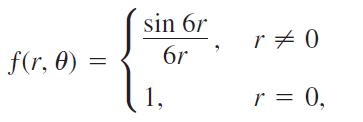
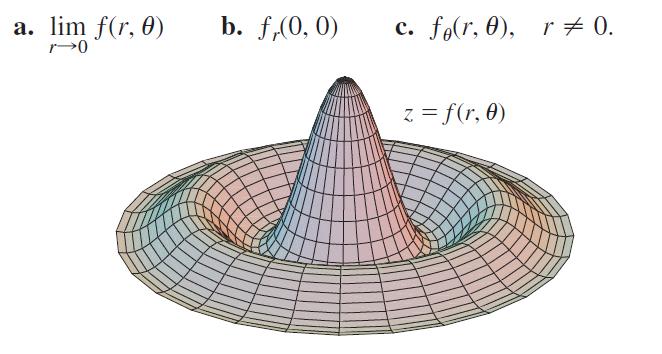
Letwhere r and θ are polar coordinates. Find f(r, 0) = sin 6r 6r 1, r = 0 r = 0,
Find the domain and range of the given function and identify its level surfaces. Sketch a typical level surface.ƒ(x, y, z) = x2 + y2 - z
Find the points on the curve xy2 = 54 nearest the origin.
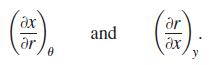
Suppose that x2 + y2 = r2 and x = r cos θ, as in polar coordinates. Find and y
Use Taylor’s formula for ƒ(x, y) at the origin to find quadratic and cubic approximations of ƒ near the origin.ƒ(x, y) = ln (2x + y + 1)
Find and sketch the domain for each function. f(x, y) = ln (x² + y² - 4)
(a) Express ∂z/∂u and ∂z/∂ν as functions of u and ν both by using the Chain Rule and by expressing z directly in terms of u and ν before differentiating. Then (b) Evaluate ∂z/∂u and ∂z/∂y at the given point (u, ν). Z = 4e In y, x = ln (u cos v), y = u sin v; (u, v) = (2, π/4)
Find (∂u/∂y)x at the point (u, y) = (√2, 1) if x = u2 + ν2 and y = uν.
What can be said about algebraic combinations and composites of continuous functions?
Find the domain and range of the given function and identify its level surfaces. Sketch a typical level surface.g(x, y, z) = x2 + 4y2 + 9z2
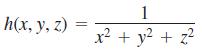
Find the domain and range of the given function and identify its level surfaces. Sketch a typical level surface. h(x, y, z) 1 x² + y² + z²
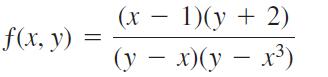
Find and sketch the domain for each function. f(x, y) = (x - 1)(y + 2) (y - x)(y- x³)
Find the points on the curve x2y = 2 nearest the origin.
Use Taylor’s formula for ƒ(x, y) at the origin to find quadratic and cubic approximations of ƒ near the origin.ƒ(x, y) = sin (x2 + y2)
Suppose that w = x2 - y2 + 4z + t and x + 2z + t = 25. Show that the equationseach give ∂w/∂x, depending on which variables are chosen to be dependent and which variables are chosen to be independent. Identify the independent variables in each case. dw ax = = 2x 1 and aw ax = = 2x2
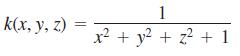
Find the domain and range of the given function and identify its level surfaces. Sketch a typical level surface. k(x, y, z) 1 x² + y² + z² + 1
Explain the two-path test for nonexistence of limits.
(a) Express ∂z/∂u and ∂z/∂ν as functions of u and ν both by using the Chain Rule and by expressing z directly in terms of u and ν before differentiating. Then (b) Evaluate ∂z/∂u and ∂z/∂y at the given point (u, ν). z = tan¹ (x/y), X = U COS U, (u, v) = (1.3, π/6) y = u sin v:
Find ∇f at the given point.ƒ(x, y, z) = x2 + y2 - 2z2 + z ln x, (1, 1, 1)
Let r = xi + yj + zk and let r = |r|.a. Show that ∇r = r/r.b. Show that ∇(rn) = nrn-2r.c. Find a function whose gradient equals r.d. Show that r · dr = r dr.e. Show that ∇(A · r) = A for any constant vector A.
Find equations for the(a) Tangent plane and(b) Normal line at the point P0 on the given surface.x + y + z = 1, P0(0, 1, 0)
Use the method of Lagrange multipliers to finda. The minimum value of x + y, subject to the constraints xy = 16, x > 0, y > 0b.The maximum value of xy, subject to the constraint x + y = 16. Comment on the geometry of each solution.
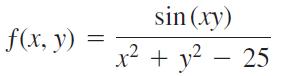
Find and sketch the domain for each function. f(x, y) = sin (xy) x² + y² - 25
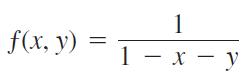
Use Taylor’s formula for ƒ(x, y) at the origin to find quadratic and cubic approximations of ƒ near the origin. f(x, y) 1 1- x - y
Use Taylor’s formula for ƒ(x, y) at the origin to find quadratic and cubic approximations of ƒ near the origin.ƒ(x, y) = cos (x2 + y2)
Find and sketch the domain for each function. f(x, y) = cos ¹(y - x²)
How are the partial derivatives ∂ƒ/∂x and ∂ƒ/∂y of a function ƒ(x, y) defined? How are they interpreted and calculated?
(a) Express ∂w/∂u and ∂w/∂ν as functions of u and y both by using the Chain Rule and by expressing w directly in terms of u and ν before differentiating. Then (b) Evaluate ∂w/∂u and ∂w/∂y at the given point (u, ν). w = xy + yz + xz, (u, v) = (1/2, 1) x = u x = u + v, y = u -
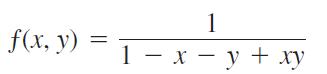
Use Taylor’s formula for ƒ(x, y) at the origin to find quadratic and cubic approximations of ƒ near the origin. f(x, y) = 1 1 - x - y + xy
(a) Express ∂w/∂u and ∂w/∂ν as functions of u and y both by using the Chain Rule and by expressing w directly in terms of u and ν before differentiating. Then (b) Evaluate ∂w/∂u and ∂w/∂y at the given point (u, ν). w = ln (x² + y² + z²), x = ue sin u, y = ue" cos u, Z z =
Find ∇f at the given point.ƒ(x, y, z) = 2z3 - 3(x2 + y2)z + tan-1 xz, (1, 1, 1)
Suppose that a differentiable function ƒ(x, y) has the constant value c along the differentiable curve x = g(t), y = h(t); that is, ƒ(g(t), h(t)) = c for all values of t. Differentiate both sides of this equation with respect to t to show that ∇ƒ is orthogonal to the curve’s tangent vector
Find equations for the(a) Tangent plane and(b) Normal line at the point P0 on the given surface.x2 + y2 - 2xy - x + 3y - z = -4, P0(2, -3, 18)
Find the points on the curve x2 + xy + y2 = 1 in the xy-plane that are nearest to and farthest from the origin.
How does the relation between first partial derivatives and continuity of functions of two independent variables differ from the relation between first derivatives and continuity for real-valued functions of a single independent variable? Give an example.
Find and sketch the domain for each function. f(x, y) = ln (xy + x - y - 1)
Find ∇f at the given point.ƒ(x, y, z) = (x2 + y2 + z2)-1/2 + ln (xyz), (-1, 2, -2)
Find the dimensions of the closed right circular cylindrical can of smallest surface area whose volume is 16π cm3.
What is the Mixed Derivative Theorem for mixed second-order partial derivatives? How can it help in calculating partial derivatives of second and higher orders? Give examples.
Find ∇f at the given point.ƒ(x, y, z) = ex+y cos z + (y + 1) sin-1 x, (0, 0, π/6)
Find the radius and height of the open right circular cylinder of largest surface area that can be inscribed in a sphere of radius a. What is the largest surface area?
(a) Express ∂u/∂x, ∂u/∂y, and ∂u/∂z as functions of x, y, and z both by using the Chain Rule and by expressing u directly in terms of x, y, and z before differentiating. Then (b) Evaluate ∂u/∂x, ∂u/∂y, and ∂u/∂z at the given point (x, y, z). -1 u = ear sin ¹ p, p = sin x,
Use Taylor’s formula to find a quadratic approximation of ƒ(x, y) = cos x cos y at the origin. Estimate the error in the approximation if |x| ≤ 0.1 and |y| ≤ 0.1.
What does it mean for a function ƒ(x, y) to be differentiable? What does the Increment Theorem say about differentiability?
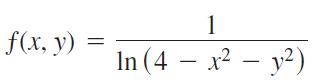
Find and sketch the domain for each function. f(x, y) = 1 In (4- x² - y²)
Draw a branch diagram and write a Chain Rule formula for each derivative. dz dt for z = = x = g(t), y = h(t) f(x, y), x
Find the derivative of the function at P0 in the direction of u. g(x, y) x - y xy + 2' Po(1,-1), u = 12i + 5j
How can you sometimes decide from examining ƒx and ƒy that a function ƒ(x, y) is differentiable? What is the relation between the differentiability of ƒ and the continuity of ƒ at a point?
Find the derivative of the function at P0 in the direction of u.ƒ(x, y) = 2x2 + y2, P0(-1, 1), u = 3i - 4j
Showing 7200 - 7300
of 29454
First
66
67
68
69
70
71
72
73
74
75
76
77
78
79
80
Last
Step by Step Answers

 Get 50% OFF
Claim Now
Get 50% OFF
Claim Now