New Semester
Started
Get
50% OFF
Study Help!
--h --m --s
Claim Now
Question Answers
Textbooks
Find textbooks, questions and answers
Oops, something went wrong!
Change your search query and then try again
S
Books
FREE
Study Help
Expert Questions
Accounting
General Management
Mathematics
Finance
Organizational Behaviour
Law
Physics
Operating System
Management Leadership
Sociology
Programming
Marketing
Database
Computer Network
Economics
Textbooks Solutions
Accounting
Managerial Accounting
Management Leadership
Cost Accounting
Statistics
Business Law
Corporate Finance
Finance
Economics
Auditing
Tutors
Online Tutors
Find a Tutor
Hire a Tutor
Become a Tutor
AI Tutor
AI Study Planner
NEW
Sell Books
Search
Search
Sign In
Register
study help
mathematics
precalculus
Thomas Calculus Early Transcendentals 13th Edition Joel R Hass, Christopher E Heil, Maurice D Weir - Solutions
Find the maximum value of ƒ(x, y) = 6xye-(2x+3y) in the closed first quadrant.
Find the dimensions of the rectangle of largest perimeter that can be inscribed in the ellipse x2/a2 + y2/b2 = 1 with sides parallel to the coordinate axes. What is the largest perimeter?
What is the general Chain Rule? What form does it take for functions of two independent variables? Three independent variables? Functions defined on surfaces? How do you diagram these different forms? Give examples. What pattern enables one to remember all the different forms?
Find the directions in which the functions increase and decrease most rapidly at P0. Then find the derivatives of the functions in these directions.ƒ(x, y) = x2 + xy + y2, P0(-1, 1)
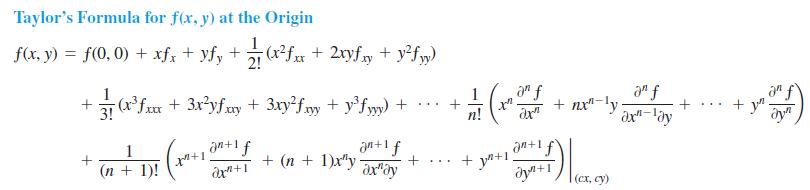
Use Taylor’s formula to find a quadratic approximation of ex sin y at the origin. Estimate the error in the approximation if |x| ≤ 0.1 and |y| ≤ 0.1. Taylor's Formula for f(x, y) at the Origin ƒ(x, y) = f(0,0) + xfx + yƒy + 1⁄/17 (x²ƒxx + 2xyƒxy + y²ƒ¸) 2! + 370x³fxxx ³fxxx +
Find the extreme values of ƒ(x, y) = x2 + y2 - 3x - xy on the disk x2 + y2 ≤ 9.
Find the extreme values of ƒ(x, y, z) = x - y + z on the unit sphere x2 + y2 + z2 = 1.
Define the double integral of a function of two variables over a bounded region in the coordinate plane.
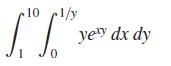
Sketch the region of integration and evaluate the double integral. 10 l/y 0 yexy dx dy
Sketch the described regions of integration.0 ≤ x ≤ 3, 0 ≤ y ≤ 2x
Find the moments of inertia about the coordinate axes of a thin rectangular plate of constant density δ bounded by the lines x = 3 and y = 3 in the first quadrant.
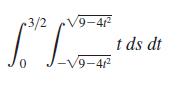
Sketch the region of integration and evaluate the double integral. 3/2 √9-41² Jo -V9-42² t ds dt
Sketch the described regions of integration.-2 ≤ y ≤ 2, y2 ≤ x ≤ 4
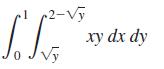
Sketch the region of integration and evaluate the double integral. 2-Vy S.S xy dx dy
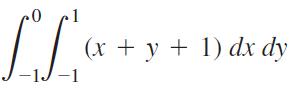
Evaluate the iterated integral. 0 1 L₁L₁a + -1J-1 (x + y + 1) dx dy
Sketch the described regions of integration.0 ≤ y ≤ 1, y ≤ x ≤ 2y
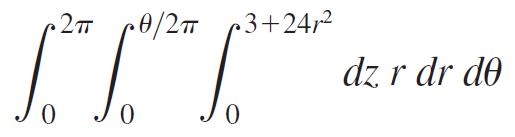
Evaluate the cylindrical coordinate integrals. 2πT 0/2π ·3+24/² ²." "T" T 0 0 0 dz r dr do
How can you change a double integral in rectangular coordinates into a double integral in polar coordinates? Why might it be worthwhile to do so? Give an example.
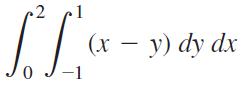
Evaluate the iterated integral. -1 (x - y) dy dx
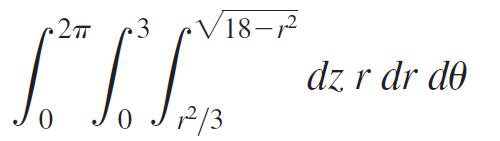
Evaluate the cylindrical coordinate integrals. •2TT 3 V18-²2² 0 0 12/3 dz r dr de
Find the centroid of the region in the first quadrant bounded by the x-axis, the parabola y2 = 2x, and the line x + y = 4.
Sketch the region bounded by the given lines and curves. Then express the region’s area as an iterated double integral and evaluate the integral.The parabola x = -y2 and the line y = x + 2
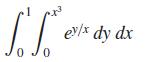
Sketch the region of integration and evaluate the double integral. S.S. 0 0 ey/x dy dx
Write six different iterated triple integrals for the volume of the tetrahedron cut from the first octant by the plane 6x + 3y + 2z = 6. Evaluate one of the integrals.
How are double integrals used to calculate areas and average values. Give examples.
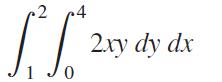
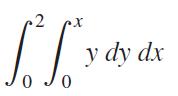
Evaluate the iterated integral. 2 4 SS /0 2xy dy dx
Sketch the region bounded by the given lines and curves. Then express the region’s area as an iterated double integral and evaluate the integral.The lines x = 0, y = 2x, and y = 4
A hemispherical bowl of radius 5 cm is filled with water to within 3 cm of the top. Find the volume of water in the bowl.
Write six different iterated triple integrals for the volume of the rectangular solid in the first octant bounded by the coordinate planes and the planes x = 1, y = 2, and z = 3. Evaluate one of the integrals.
Sketch the described regions of integration.-1 ≤ x ≤ 2, x - 1 ≤ y ≤ x2
How are double integrals evaluated as iterated integrals? Does the order of integration matter? How are the limits of integration determined? Give examples.
Find the center of mass of a thin plate of density δ = 3 bounded by the lines x = 0, y = x, and the parabola y = 2 - x2 in the first quadrant.
Evaluate the integral in Example 2 taking F(x, y, z) = 1 to find the volume of the tetrahedron in the order dz dx dy. EXAMPLE 2 Set up the limits of integration for evaluating the triple integral of a function F(x, y, z) over the tetrahedron D with vertices (0, 0, 0), (1, 1, 0), (0, 1, 0), and (0,
Sketch the region bounded by the given lines and curves. Then express the region’s area as an iterated double integral and evaluate the integral.The coordinate axes and the line x + y = 2
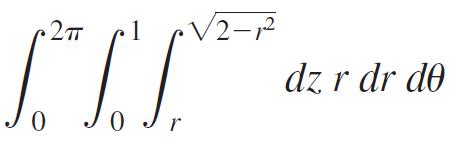
Evaluate the cylindrical coordinate integrals. .2 Jo 1 •√2-p² 0 Jr dz r dr de
The base of a sand pile covers the region in the xy-plane that is bounded by the parabola x2 + y = 6 and the line y = x. The height of the sand above the point (x, y) is x2. Express the volume of sand as (a) A double integral, (b) A triple integral. Then (c) Find the volume.
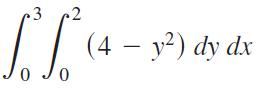
Evaluate the iterated integral. 3 2 СА 0 0 (4 — y2) dy dx -
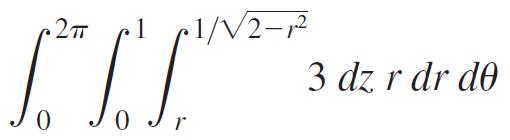
Evaluate the cylindrical coordinate integrals. •1/√/2-p² 2πT KIT 0 0 r 3 dz r dr de
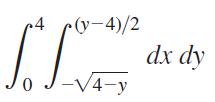
Sketch the region of integration and write an equivalent integral with the order of integration reversed. Then evaluate both integrals. 4 p(x-4)/2 SS 0 -√4-y dx dy
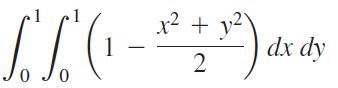
Evaluate the iterated integral. L L ( ₁ - 1 ² + 1 ²) dx c dy 2 0 0
Sketch the described regions of integration.1 ≤ x ≤ e2, 0 ≤ y ≤ ln x
How are triple integrals in rectangular coordinates evaluated? How are the limits of integration determined? Give an example.
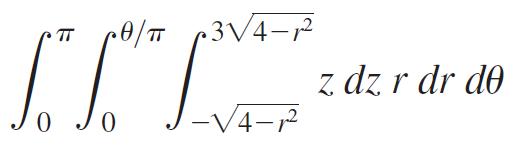
Evaluate the cylindrical coordinate integrals. 0 TT CO/π ·3√4-p2² ㅠ 0 -√4-²2² z dz r dr de
Find the centroid of the region cut from the first quadrant by the circle x2 + y2 = a2.
Sketch the region bounded by the given lines and curves. Then express the region’s area as an iterated double integral and evaluate the integral.The curve y = ex and the lines y = 0, x = 0, and x = ln 2
Find the volume of the region bounded above by the paraboloid z = 3 - x2 - y2 and below by the paraboloid z = 2x2 + 2y2.
Let D be the region bounded by the paraboloids z = 8 - x2 - y2 and z = x2 + y2. Write six different triple iterated integrals for the volume of D. Evaluate one of the integrals.
Sketch the described regions of integration.0 ≤ x ≤ 1, ex ≤ y ≤ e
Define the triple integral of a function ƒ(x, y, z) over a bounded region in space.
Find the centroid of the triangular region cut from the first quadrant by the line x + y = 3.
Sketch the region bounded by the given lines and curves. Then express the region’s area as an iterated double integral and evaluate the integral.The parabola x = y - y2 and the line y = -x
Find the volume of the region bounded above by the sphere x2 + y2 + z2 = 2 and below by the paraboloid z = x2 + y2.
Write six different iterated triple integrals for the volume of the region in the first octant enclosed by the cylinder x2 + z2 = 4 and the plane y = 3. Evaluate one of the integrals.
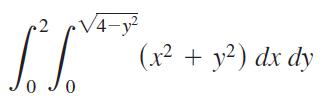
Change the Cartesian integral into an equivalent polar integral. Then evaluate the polar integral. 0 0 √4-y² (x² + y²) dx dy
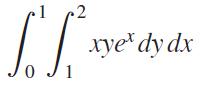
Evaluate the iterated integral. LE 0 1 2 xyedy dx
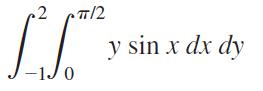
Evaluate the iterated integral. 2 π/2 0 y sin x dx dy
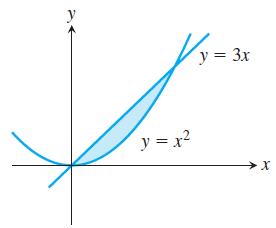
Write an iterated integral for ∫∫R dA over the described region R using (a) Vertical cross-sections, (b) Horizontal cross-sections. y = x² y = 3x X
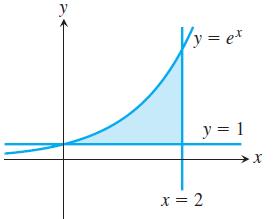
Write an iterated integral for ∫∫R dA over the described region R using (a) Vertical cross-sections, (b) Horizontal cross-sections. y //y = ex y = 1 x = 2 ·X
Sketch the region bounded by the given lines and curves. Then express the region’s area as an iterated double integral and evaluate the integral.Sketch the region bounded by the given lines and curves. Then express the region’s area as an iterated double integral and evaluate the integral.The
Find the first moment about the y-axis of a thin plate of density δ(x, y) = 1 covering the infinite region under the curve y = e-x2/2 in the first quadrant.
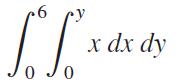
Change the Cartesian integral into an equivalent polar integral. Then evaluate the polar integral. 6 0 JO 0 x dx dy
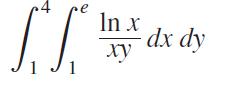
Evaluate the iterated integral. SS In x - dx dy ху 1
Let D be the region bounded below by the plane z = 0, above by the sphere x2 + y2 + z2 = 4, and on the sides by the cylinder x2 + y2 = 1. Set up the triple integrals in cylindrical coordinates that give the volume of D using the following orders of integration.a. dz dr dθ b. dr dz dθ c.
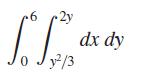
The integrals and sums of integrals give the areas of regions in the xy-plane. Sketch each region, label each bounding curve with its equation, and give the coordinates of the points where the curves intersect. Then find the area of the region. 6 2y Jy²/3 dx dy
Sketch the region bounded by the given lines and curves. Then express the region’s area as an iterated double integral and evaluate the integral.The lines y = 2x, y = x/2, and y = 3 - x
Find the moment of inertia about the x-axis of a thin plate bounded by the parabola x = y - y2 and the line x + y = 0 if δ(x, y) = x + y.
Change the Cartesian integral into an equivalent polar integral. Then evaluate the polar integral. Llyayar 0 0 хр Ар &
Let D be the region bounded below by the cone z = √x2 + y2 and above by the paraboloid z = 2 - x2 - y2. Set up the triple integrals in cylindrical coordinates that give the volume of D using the following orders of integration.a. dz dr dθ b. dr dz dθ c. dθ dz dr
Sketch the region bounded by the given lines and curves. Then express the region’s area as an iterated double integral and evaluate the integral.The lines y = x - 2 and y = -x and the curve y = √x
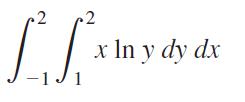
Evaluate the iterated integral. 2 2 Lfxmy -1 J1 x ln y dy dx
Find the mass of a thin plate occupying the smaller region cut from the ellipse x2 + 4y2 = 12 by the parabola x = 4y2 if δ(x, y) = 5x.
Find the center of mass of a thin triangular plate bounded by the y-axis and the lines y = x and y = 2 - x if δ(x, y) = 6x + 3y + 3.
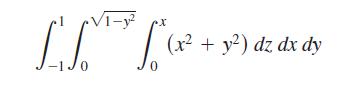
Convert the integralto an equivalent integral in cylindrical coordinates and evaluate the result. V1-y² [[[[ 0 0 (x² + y2) dz dx dy ²
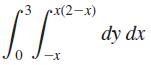
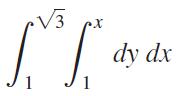
The integrals and sums of integrals give the areas of regions in the xy-plane. Sketch each region, label each bounding curve with its equation, and give the coordinates of the points where the curves intersect. Then find the area of the region. 3 px(2-x) S. 0 -X dy dx
Write an iterated integral for ∫∫R dA over the described region R using (a) Vertical cross-sections, (b) Horizontal cross-sections.Bounded by y = √x, y = 0, and x = 9
Find the area of the region enclosed by the line y = 2x + 4 and the parabola y = 4 - x2 in the xy-plane.
Change the Cartesian integral into an equivalent polar integral. Then evaluate the polar integral. 1 √3 X dy dx
Evaluate the double integral over the given region R. ff (6y²– 2x) dA, R R: 0≤x≤ 1, 0≤ y ≤2
Find the center of mass and moment of inertia about the x-axis of a thin plate bounded by the curves x = y2 and x = 2y - y2 if the density at the point (x, y) is δ(x, y) = y + 1.
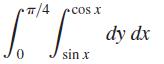
The integrals and sums of integrals give the areas of regions in the xy-plane. Sketch each region, label each bounding curve with its equation, and give the coordinates of the points where the curves intersect. Then find the area of the region. 0 π/4 cos x sin x dy dx
Evaluate the double integral over the given region R. [[()dA. R R: 0≤x≤ 4, 1 ≤ y ≤ 2
Find the area of the “triangular” region in the xy-plane that is bounded on the right by the parabola y = x2, on the left by the line x + y = 2, and above by the line y = 4.
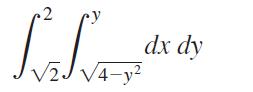
Change the Cartesian integral into an equivalent polar integral. Then evaluate the polar integral. √2J √4-y² dx dy
Find the center of mass and the moment of inertia about the y-axis of a thin rectangular plate cut from the first quadrant by the lines x = 6 and y = 1 if δ(x, y) = x + y + 1.
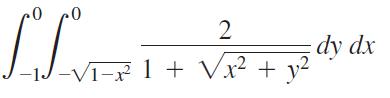
Change the Cartesian integral into an equivalent polar integral. Then evaluate the polar integral. علم 0 .0 2 -VI-2²1 + √√x² + y² dy dx
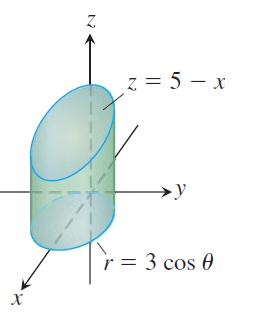
D is the right circular cylinder whose base is the circle r = 3 cos θ and whose top lies in the plane z = 5 - x. Z z = 5 x ∙y r = 3 cos 0
Write an iterated integral for ∫∫R dA over the described region R using (a) Vertical cross-sections, (b) Horizontal cross-sections.Bounded by y = e-x, y = 1, and x = ln 3
Find the volume under the paraboloid z = x2 + y2 above the triangle enclosed by the lines y = x, x = 0, and x + y = 2 in the xy-plane.
A thin plate of constant density is to occupy the triangular region in the first quadrant of the xy-plane having vertices (0, 0), (a, 0), and (a, 1 / a). What value of a will minimize the plate’s polar moment of inertia about the origin?
Evaluate the double integral over the given region R. If x R xy cos y dA, R: -1 ≤ x ≤ 1, 0≤ y ≤ T
Find the center of mass and the moment of inertia about the y-axis of a thin plate bounded by the line y = 1 and the parabola y = x2 if the density is δ(x, y) = y + 1.
Write an iterated integral for ∫∫R dA over the described region R using (a) Vertical cross-sections, (b) Horizontal cross-sections.Bounded by y = 0, x = 0, y = 1, and y = ln x
Find the volume under the parabolic cylinder z = x2 above the region enclosed by the parabola y = 6 - x2 and the line y = x in the xy-plane.
Find the polar moment of inertia about the origin of a thin triangular plate of constant density δ = 3 bounded by the y-axis and the lines y = 2x and y = 4 in the xy-plane.
Find the center of mass and the moment of inertia about the y-axis of a thin plate bounded by the x-axis, the lines x = ±1, and the parabola y = x2 if δ(x, y) = 7y + 1.
Write an iterated integral for ∫∫R dA over the described region R using (a) Vertical cross-sections, (b) Horizontal cross-sections.Bounded by y = 3 - 2x, y = x, and x = 0
Find the average value of ƒ(x, y) = xy over the regions.The square bounded by the lines x = 1, y = 1 in the first quadrant
Find the average height of the hemispherical surfaceabove the disk x2 + y2 ≤ a2 in the xy-plane. z = Va2 – x2 - 12
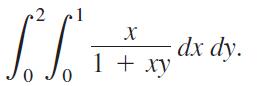
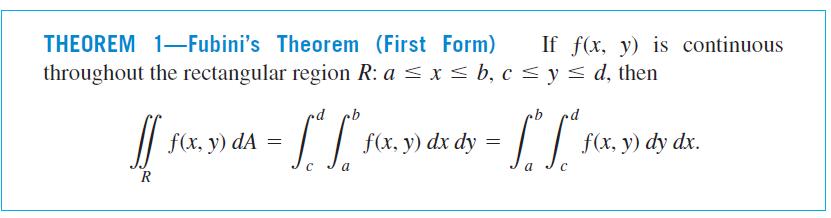
Use Fubini’s Theorem to evaluate X S.S. 1 1 dx dy. + xy 0
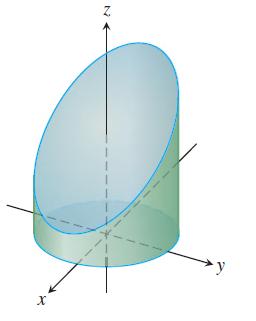
Find the volumes of the region. The region cut from the cylinder x2 + y2 = 4 by the plane z = 0 and the plane x + z = 3 X N
Showing 7300 - 7400
of 29454
First
67
68
69
70
71
72
73
74
75
76
77
78
79
80
81
Last
Step by Step Answers

 Get 50% OFF
Claim Now
Get 50% OFF
Claim Now