New Semester
Started
Get
50% OFF
Study Help!
--h --m --s
Claim Now
Question Answers
Textbooks
Find textbooks, questions and answers
Oops, something went wrong!
Change your search query and then try again
S
Books
FREE
Study Help
Expert Questions
Accounting
General Management
Mathematics
Finance
Organizational Behaviour
Law
Physics
Operating System
Management Leadership
Sociology
Programming
Marketing
Database
Computer Network
Economics
Textbooks Solutions
Accounting
Managerial Accounting
Management Leadership
Cost Accounting
Statistics
Business Law
Corporate Finance
Finance
Economics
Auditing
Tutors
Online Tutors
Find a Tutor
Hire a Tutor
Become a Tutor
AI Tutor
AI Study Planner
NEW
Sell Books
Search
Search
Sign In
Register
study help
mathematics
precalculus
Thomas Calculus Early Transcendentals 13th Edition Joel R Hass, Christopher E Heil, Maurice D Weir - Solutions
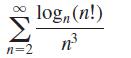
Which of the series defined by the formulas converge, and which diverge? Give reasons for your answers. α x n=1n
What points in the xy-plane satisfy the equations and inequalities? Draw a figure for each exercise.(x + y)(x2 + y2 - 1) = 0
Find parametric equations for the given curve.a. Line through (1, -2) with slope 3b. (x - 1)2 + ( y + 2)2 = 9c. y = 4x2 - xd. 9x2 + 4y2 = 36
Which of the series defined by the formulas converge, and which diverge? Give reasons for your answers. x n=1n
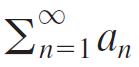
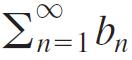
Is there a “largest” convergent series of positive numbers? Explain.Exercise 45Is it true that ifis a divergent series of positive numbers, then there is also a divergent seriesof positive numbers with bnn for every n? Is there a “smallest” divergent series of positive numbers? Give reasons
Give parametric equations and parameter intervals for the motion of a particle in the xy-plane. Identify the particle’s path by finding a Cartesian equation for it. Graph the Cartesian equation and indicate the direction of motion and the portion traced by the particle.x = (1/2) tan t, y = (1/2)
Find the areas of the region.Inside the oval limaçon r = 4 + 2 cos θ
What is a cycloid? What are typical parametric equations for cycloids? What physical properties account for the importance of cycloids?
Can you make an infinite series of nonzero terms that converges to any number you want? Explain.
According to the Alternating Series Estimation Theorem, how many terms of the Taylor series for tan-1 1 would you have to add to be sure of finding π/4 with an error of magnitude less than 10-3? Give reasons for your answer.
How many terms of the Taylor series for ln (1 + x) should you add to be sure of calculating ln (1.1) with an error of magnitude less than 10-8? Give reasons for your answer.
Does a Taylor series always converge to its generating function? Explain.
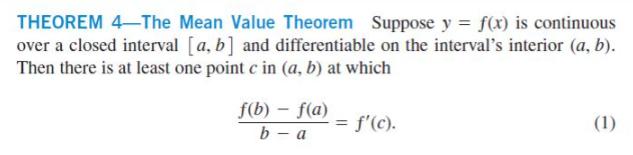
Explain how the Mean Value Theorem (Section 4.2, Theorem 4) is a special case of Taylor’s Theorem. THEOREM 4-The Mean Value Theorem Suppose y = f(x) is continuous over a closed interval [a, b] and differentiable on the interval's interior (a, b). Then there is at least one point c in (a, b) at
Which of the series defined by the formulas converge, and which diverge? Give reasons for your answers. x n=1n
Which of the series defined by the formulas converge, and which diverge? Give reasons for your answers. x n=1n
Which of the series defined by the formulas converge, and which diverge? Give reasons for your answers. x n=1n
Prove that if u is the vector function with the constant value C, then du/dt = 0.
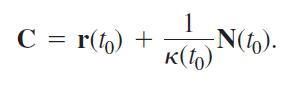
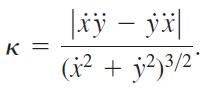
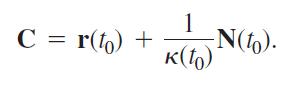
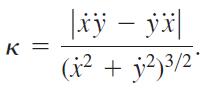
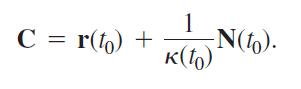
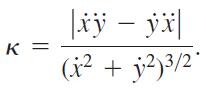
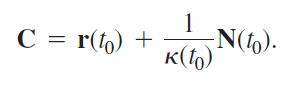
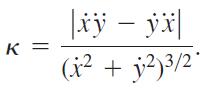
You will use a CAS to explore the osculating circle at a point P on a plane curve where κ ≠ 0. Use a CAS to perform the following steps:a. Plot the plane curve given in parametric or function form over the specified interval to see what it looks like.b. Calculate the curvature k of the curve at
You will use a CAS to explore the osculating circle at a point P on a plane curve where κ ≠ 0. Use a CAS to perform the following steps:a. Plot the plane curve given in parametric or function form over the specified interval to see what it looks like.b. Calculate the curvature k of the curve at
A volleyball is hit when it is 4 ft above the ground and 12 ft from a 6-ft-high net. It leaves the point of impact with an initial velocity of 35 ft / sec at an angle of 27° and slips by the opposing team untouched.a. Find a vector equation for the path of the volleyball.b. How high does the
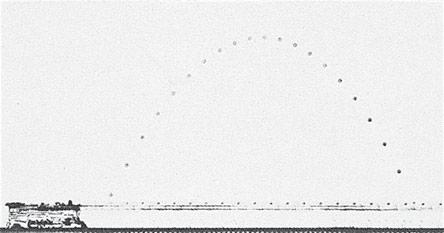
The accompanying multiflash photograph shows a model train engine moving at a constant speed on a straight horizontal track. As the engine moved along, a marble was fired into the air by a spring in the engine’s smokestack. The marble, which continued to move with the same forward speed as the
Use a CAS to perform the following steps.a. Plot the space curve traced out by the position vector r.b. Find the components of the velocity vector dr / dt.c. Evaluate dr / dt at the given point t0 and determine the equation of the tangent line to the curve at r(t0).d. Plot the tangent line together
A baseball is hit when it is 2.5 ft above the ground. It leaves the bat with an initial velocity of 145 ft / sec at a launch angle of 23°. At the instant the ball is hit, an instantaneous gust of wind blows against the ball, adding a component of -14i (ft/sec) to the ball’s initial velocity. A
Use a CAS to perform the following steps.a. Plot the space curve traced out by the position vector r.b. Find the components of the velocity vector dr / dt.c. Evaluate dr / dt at the given point t0 and determine the equation of the tangent line to the curve at r(t0).d. Plot the tangent line together
Use a CAS to perform the following steps.a. Plot the space curve traced out by the position vector r.b. Find the components of the velocity vector dr / dt.c. Evaluate dr / dt at the given point t0 and determine the equation of the tangent line to the curve at r(t0).d. Plot the tangent line together
You will explore graphically the behavior of the helixas you change the values of the constants a and b. Use a CAS to perform the steps in each exercise. Set b = 1. Plot the helix r(t) together with the tangent line to the curve at t = 3π/2 for a = 1, 2, 4, and 6 over the interval 0 ≤ t ≤
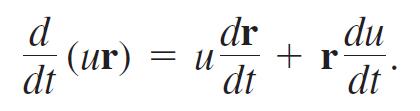
Suppose that the scalar function u(t) and the vector function r(t) are both defined for a ≤ t ≤ b.a. Show that ur is continuous on [a, b] if u and r are continuous on [a, b].b. If u and r are both differentiable on [a, b], show that ur is differentiable on [a, b] and that d dt (ur) = dr dt +
You will explore graphically the behavior of the helixas you change the values of the constants a and b. Use a CAS to perform the steps in each exercise.Set a = 1. Plot the helix r(t) together with the tangent line to the curve at t = 3π/2 for b = 1/4, 1/2, 2, and 4 over the interval 0 ≤ t ≤
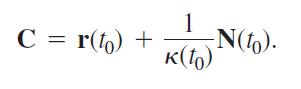
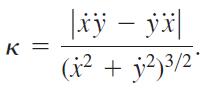
You will use a CAS to explore the osculating circle at a point P on a plane curve where k ≠ 0. Use a CAS to perform the following steps:a. Plot the plane curve given in parametric or function form over the specified interval to see what it looks like.b. Calculate the curvature k of the curve at
Show that a projectile attains threequarters of its maximum height in half the time it takes to reach the maximum height.
Prove the Sum and Difference Rules for vector functions. d [u(t)= v(t)] = u' (t) - v' (t) dt
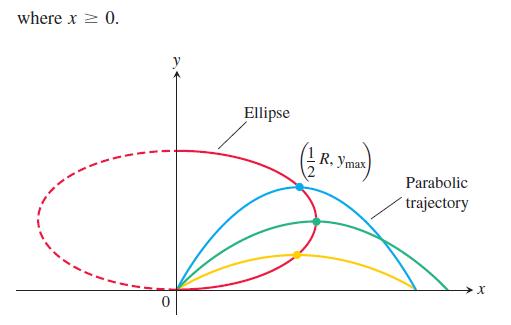
For a projectile fired from the ground at launch angle α with initial speed ν0, consider a as a variable and ν0 as a fixed constant. For each a, 0 22 4 2²2 + 4(y - ²0²)² - 40²² 4g
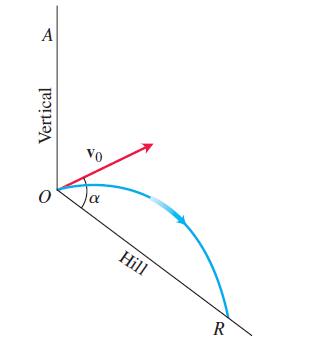
An ideal projectile is launched straight down an inclined plane as shown in the accompanying figure.a. Show that the greatest downhill range is achieved when the initial velocity vector bisects angle AOR.b. If the projectile were fired uphill instead of down, what launch angle would maximize its
You will use a CAS to explore the osculating circle at a point P on a plane curve where κ ≠ 0. Use a CAS to perform the following steps:a. Plot the plane curve given in parametric or function form over the specified interval to see what it looks like.b. Calculate the curvature k of the curve at
Show that the vector function r defined by r(t) = ƒ(t)i + g(t)j + h(t)k is continuous at t = t0 if and only if ƒ, g, and h are continuous at t0.
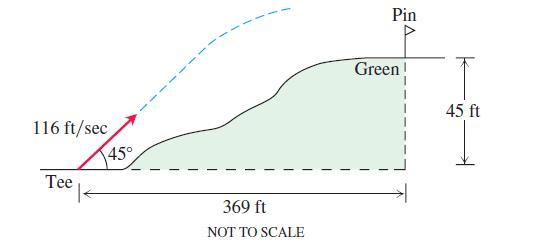
A golf ball is hit with an initial speed of 116 ft/sec at an angle of elevation of 45° from the tee to a green that is elevated 45 ft above the tee as shown in the diagram. Assuming that the pin, 369 ft downrange, does not get in the way, where will the ball land in relation to the pin? 116
Suppose that r1(t) = ƒ1(t)i + ƒ2(t)j + ƒ3(t)k, r2(t) = g1(t)i + g2(t)j + g3(t)k, limt→t0r1(t) = A, and limt→t0 r2(t) = B. Use the determinant formula for cross products and the Limit Product Rule for scalar functions to show that lim (r(t) x r₂(t)) = A x B. t-to
You will use a CAS to explore the osculating circle at a point P on a plane curve where κ ≠ 0. Use a CAS to perform the following steps:a. Plot the plane curve given in parametric or function form over the specified interval to see what it looks like.b. Calculate the curvature k of the curve at
In Moscow in 1987, Natalya Lisouskaya set a women’s world record by putting an 8 lb 13 oz shot 73 ft 10 in. Assuming that she launched the shot at a 40° angle to the horizontal from 6.5 ft above the ground, what was the shot’s initial speed?
Show that if r(t) = ƒ(t)i + g(t)j + h(t)k is differentiable at t = t0, then it is continuous at t0 as well.
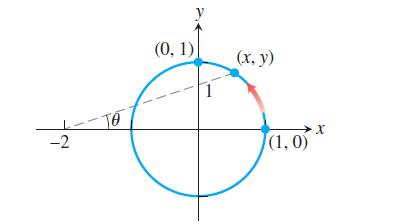
Find a parametrization for the circle x2 + y2 = 1 starting at (1, 0) and moving counterclockwise to the terminal point (0, 1), using the angle θ in the accompanying figure as the parameter. -2 - то (0, 1) 1 (x,y) (1, 0) X
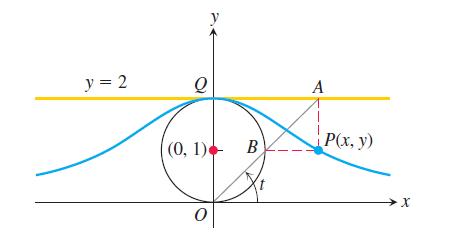
The bell-shaped witch of Maria Agnesi can be constructed in the following way. Start with a circle of radius 1, centered at the point (0, 1), as shown in the accompanying figure. Choose a point A on the line y = 2 and connect it to the origin with a line segment. Call the point where the segment
Replace the polar equations with equivalent Cartesian equations. Then describe or identify the graph.Replace the polar equations with equivalent Cartesian equations. Then describe or identify the graph.r cos θ + r sin θ = 1
Find the areas of the surfaces generated by revolving the curves bout the indicated axes.x = t + √2, y = (t2/2) + √2t, -√2 ≤ t ≤ √2; y-axis
Find polar equations for the circles. Sketch each circle in the coordinate plane and label it with both its Cartesian and polar equations.x2 + y2 + 5y = 0
Give the eccentricities of conic sections with one focus at the origin along with the directrix corresponding to that focus. Find a polar equation for each conic section.e = 1/2, x = 1
Graph the roses r = cos mθ for m = 1/3, 2, 3, and 7.
Give equations for hyperbolas. Put each equation in standard form and find the hyperbola’s asymptotes. Then sketch the hyperbola. Include the asymptotes and foci in your sketch.8y2 - 2x2 = 16
Replace the polar equations with equivalent Cartesian equations. Then describe or identify the graph.r sin θ = r cos θ
Find the areas of the surfaces generated by revolving the curves bout the indicated axes.x = ln (sec t + tan t) - sin t, y = cos t, 0 ≤ t ≤ π/3; x-axis
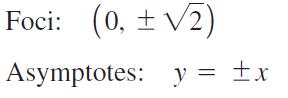
Give information about the foci, vertices, and asymptotes of hyperbolas centered at the origin of the xy-plane. In each case, find the hyperbola’s standard-form equation from the information given. Foci: (0, ± √2) Asymptotes: y = ±x
Find polar equations for the circles. Sketch each circle in the coordinate plane and label it with both its Cartesian and polar equations.x2 + y2 - 2y = 0
Give the eccentricities of conic sections with one focus at the origin along with the directrix corresponding to that focus. Find a polar equation for each conic section.e = 1/4, x = -2
Polar coordinates are just the thing for defining spirals. Graph the following spirals.a. r = θb. r = -θc. A logarithmic spiral: r = eθ/10d. A hyperbolic spiral: r = 8/θe. An equilateral hyperbola: r = ±10/√θ
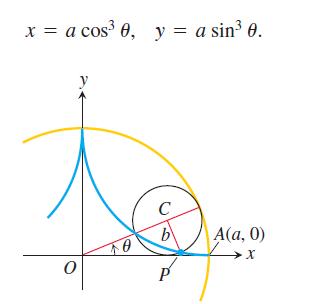
When a circle rolls on the inside of a fixed circle, any point P on the circumference of the rolling circle describes a hypocycloid. Let the fixed circle be x2 + y2 = a2, let the radius of the rolling circle be b, and let the initial position of the tracing point P be A(a, 0). Find parametric
Give equations for hyperbolas. Put each equation in standard form and find the hyperbola’s asymptotes. Then sketch the hyperbola. Include the asymptotes and foci in your sketch.64x2 - 36y2 = 2304
Replace the polar equations with equivalent Cartesian equations. Then describe or identify the graph.r2 = 1
The line segment joining the points (0, 1) and (2, 2) is revolved about the x-axis to generate a frustum of a cone. Find the surface area of the frustum using the parametrization x = 2t, y = t + 1, 0 ≤ t ≤ 1. Check your result with the geometry formula: Area = π(r1 + r2)(slant height).
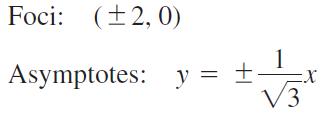
Give information about the foci, vertices, and asymptotes of hyperbolas centered at the origin of the xy-plane. In each case, find the hyperbola’s standard-form equation from the information given. Foci: (±2, 0) Asymptotes: y = ± 1 √3 X
Find polar equations for the circles. Sketch each circle in the coordinate plane and label it with both its Cartesian and polar equations.x2 + y2 - 3x = 0
Give the eccentricities of conic sections with one focus at the origin along with the directrix corresponding to that focus. Find a polar equation for each conic section.e = 1/5, y = -10
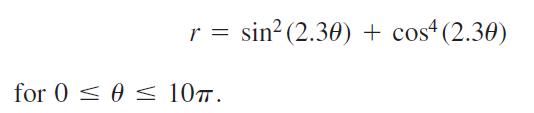
Graph the equation r = sin² (2.30) + cos¹ (2.30) for 0 ≤ 0 ≤ 10TT.
Find the coordinates of the centroid of the curve x = cost + t sint, y y = = sin t sin t t cost, 0≤ t ≤ π/2. t cos t,
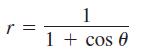
Include the directrix that corresponds to the focus at the origin. Label the vertices with appropriate polar coordinates. Label the centers of the ellipses as well. r 1 1 + cos 0
Graph the equation r = sin (8/7 θ) for 0 ≤ θ ≤ 14π.
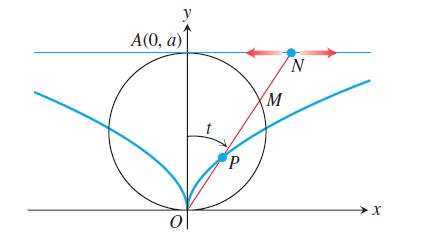
As the point N moves along the line y = a in the accompanying figure, P moves in such a way that OP = MN. Find parametric equations for the coordinates of P as functions of the angle t that the line ON makes with the positive y-axis. y A(0, a) P M N X
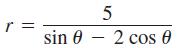
Replace the polar equations with equivalent Cartesian equations. Then describe or identify the graph. r = sin 0 5 2 cos 0
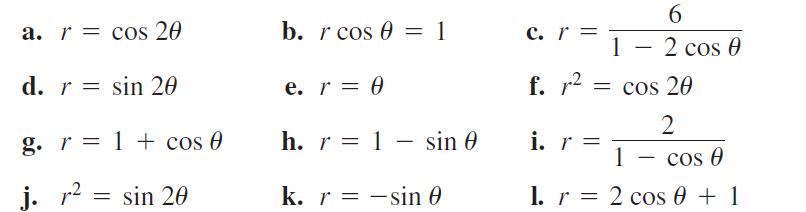
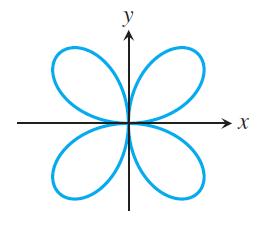
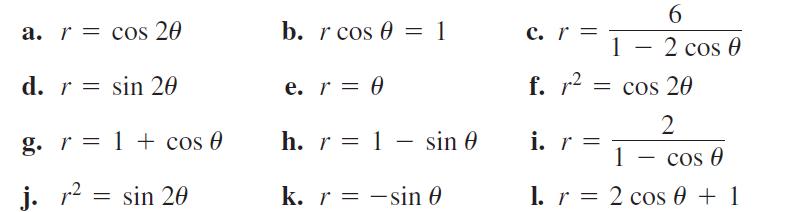
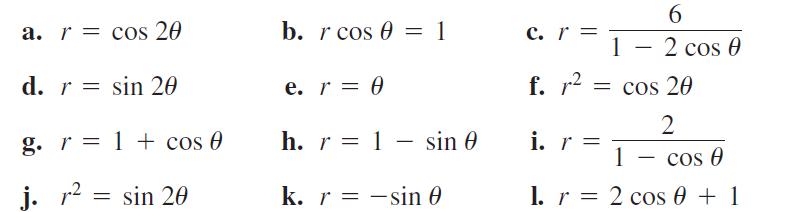
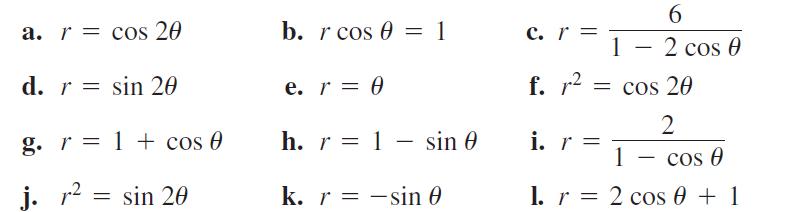
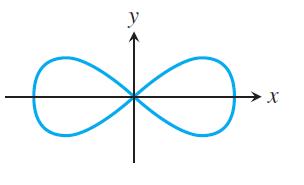
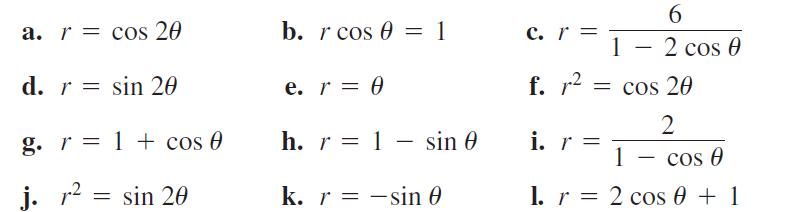
Match each graph with the appropriate equation (a)–(l). There are more equations than graphs, so some equations will not be matched.Four-leaved rose a. r= cos 20 d. r = sin 20 g. r= 1 + cos 0 j. r² = = sin 20 b. r cos 0 = 1 e. r = 0 h. r 1 sin = k. r = -sin 0 - 0 c. r 6 1 - 2 cos 0 f. ² = cos
Replace the polar equations with equivalent Cartesian equations. Then describe or identify the graph.r2 = 4r sin θ
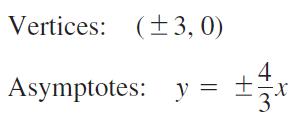
Give information about the foci, vertices, and asymptotes of hyperbolas centered at the origin of the xy-plane. In each case, find the hyperbola’s standard-form equation from the information given. Vertices: (3, 0) Asymptotes: y = + = x 3 zx
The line segment joining the origin to the point (h, r) is revolved about the x-axis to generate a cone of height h and base radius r. Find the cone’s surface area with the parametric equations x = ht, y = rt, 0 ≤ t ≤ 1. Check your result with the geometry formula: Area = πr(slant height).
Find polar equations for the circles. Sketch each circle in the coordinate plane and label it with both its Cartesian and polar equations.x2 + y2 + 4x = 0
Give the eccentricities of conic sections with one focus at the origin along with the directrix corresponding to that focus. Find a polar equation for each conic section.e = 1/3, y = 6
Find the coordinates of the centroid of the curve x = et cos t, y = = et et sin t, sin t, 0≤ t ≤ T.
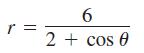
Include the directrix that corresponds to the focus at the origin. Label the vertices with appropriate polar coordinates. Label the centers of the ellipses as well. r = 6 2 + cos 0
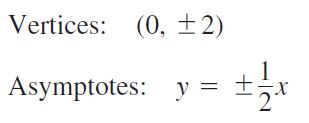
Give information about the foci, vertices, and asymptotes of hyperbolas centered at the origin of the xy-plane. In each case, find the hyperbola’s standard-form equation from the information given. Vertices: (0, ±2) Asymptotes: y= = +2x
Find the coordinates of the centroid of the curve x = cos t, y = t + sin t, 0≤t≤TT.
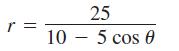
Include the directrix that corresponds to the focus at the origin. Label the vertices with appropriate polar coordinates. Label the centers of the ellipses as well. r = 25 10 - 5 cos 0
Sketch the regions defined by the polar coordinate inequalities.0 ≤ r ≤ 6 cos θ
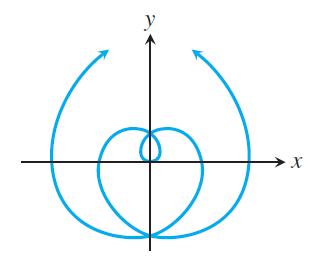
Match each graph with the appropriate equation (a)–(l). There are more equations than graphs, so some equations will not be matched.Spiral a. r= cos 20 d. r = sin 20 g. r= 1 + cos 0 j. r² = = sin 20 b. r cos 0 = 1 e. r = 0 h. r 1 sin = k. r = -sin 0 - 0 c. r 6 1 - 2 cos 0 f. ² = cos 20 i. r
A wheel of radius a rolls along a horizontal straight line without slipping. Find parametric equations for the curve traced out by a point P on a spoke of the wheel b units from its center. As parameter, use the angle θ through which the wheel turns. The curve is called a trochoid, which is a
Replace the polar equations with equivalent Cartesian equations. Then describe or identify the graph.r2 sin 2θ = 2
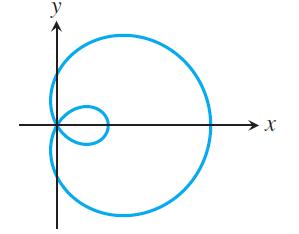
Match each graph with the appropriate equation (a)–(l). There are more equations than graphs, so some equations will not be matched.Limaçon a. r= cos 20 d. r = sin 20 g. r= 1 + cos 0 j. r² = = sin 20 b. r cos 0 = 1 e. r = 0 h. r 1 sin = k. r = -sin 0 - 0 c. r 6 1 - 2 cos 0 f. ² = cos 20 i. r
Sketch the regions defined by the polar coordinate inequalities.-4 sin θ ≤ r ≤ 0
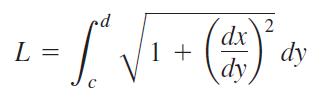
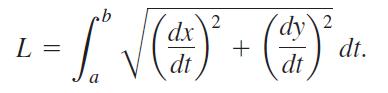
a. Show that the Cartesian formulafor the length of the curve x = g(y), c ≤ y ≤ d (Equation 4), is a special case of the parametric length formulaUse this result to find the length of each curve.b. x = y3/2, 0 ≤ y ≤ 4/3c. L = rd C V 1 + 2 dx (+)² dy dy
Most centroid calculations for curves are done with a calculator or computer that has an integral evaluation program. As a case in point, find, to the nearest hundredth, the coordinates of the centroid of the curve x = 1³, y = 31²/2, 0≤ t ≤ √3.
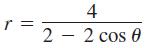
Include the directrix that corresponds to the focus at the origin. Label the vertices with appropriate polar coordinates. Label the centers of the ellipses as well. r || 4 2 - 2 cos 0
Find the point on the parabola x = t, y = t2, -∞ < t < ∞, closest to the point (2, 1/2).
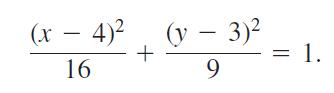
The ellipse (x2/16) + (y2/9) = 1 is shifted 4 units to the right and 3 units up to generate the ellipsea. Find the foci, vertices, and center of the new ellipse.b. Plot the new foci, vertices, and center, and sketch in the new ellipse. (x-4)² (y - 3)² + 16 9 = 1.
Replace the polar equations with equivalent Cartesian equations. Then describe or identify the graph.r = cot θ csc θ
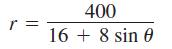
Include the directrix that corresponds to the focus at the origin. Label the vertices with appropriate polar coordinates. Label the centers of the ellipses as well. r = 400 16 + 8 sin 0
The parabola y2 = 8x is shifted down 2 units and right 1 unit to generate the parabola ( y + 2)2 = 8(x - 1).a. Find the new parabola’s vertex, focus, and directrix.b. Plot the new vertex, focus, and directrix, and sketch in the parabola.
Find the point on the ellipse x = 2 cos t, y = sin t, 0 ≤ t ≤ 2π closest to the point (3/4, 0).
Match each graph with the appropriate equation (a)–(l). There are more equations than graphs, so some equations will not be matched.Lemniscate a. r= cos 20 d. r = sin 20 g. r= 1 + cos 0 j. r² = = sin 20 b. r cos 0 = 1 e. r = 0 h. r 1 sin = k. r = -sin 0 - 0 c. r 6 1 - 2 cos 0 f. ² = cos 20 i. r
The parabola x2 = -4y is shifted left 1 unit and up 3 units to generate the parabola (x + 1)2 = -4(y - 3).a. Find the new parabola’s vertex, focus, and directrix.b. Plot the new vertex, focus, and directrix, and sketch in the parabola.
Replace the polar equations with equivalent Cartesian equations. Then describe or identify the graph.r = 4 tan θ sec θ
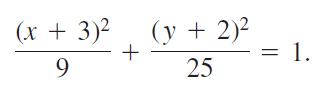
The ellipse (x2/9) + (y2/25) = 1 is shifted 3 units to the left and 2 units down to generate the ellipsea. Find the foci, vertices, and center of the new ellipse.b. Plot the new foci, vertices, and center, and sketch in the new ellipse. (x + 3)² 9 + (y + 2)² 25 1.
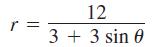
Include the directrix that corresponds to the focus at the origin. Label the vertices with appropriate polar coordinates. Label the centers of the ellipses as well. 12 3 + 3 sin 0
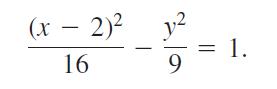
The hyperbola (x2/16) - (y2/9) = 1 is shifted 2 units to the right to generate the hyperbola (x - 2)² 16 y² 9 1.
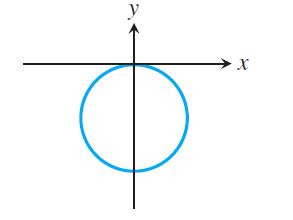
Match each graph with the appropriate equation (a)–(l). There are more equations than graphs, so some equations will not be matched.Circle a. r= cos 20 d. r = sin 20 g. r= 1 + cos 0 j. r² = = sin 20 b. r cos 0 = 1 e. r = 0 h. r 1 sin = k. r = -sin 0 - 0 c. r 6 1 - 2 cos 0 f. ² = cos 20 i. r
Showing 8100 - 8200
of 29454
First
75
76
77
78
79
80
81
82
83
84
85
86
87
88
89
Last
Step by Step Answers

 Get 50% OFF
Claim Now
Get 50% OFF
Claim Now