New Semester
Started
Get
50% OFF
Study Help!
--h --m --s
Claim Now
Question Answers
Textbooks
Find textbooks, questions and answers
Oops, something went wrong!
Change your search query and then try again
S
Books
FREE
Study Help
Expert Questions
Accounting
General Management
Mathematics
Finance
Organizational Behaviour
Law
Physics
Operating System
Management Leadership
Sociology
Programming
Marketing
Database
Computer Network
Economics
Textbooks Solutions
Accounting
Managerial Accounting
Management Leadership
Cost Accounting
Statistics
Business Law
Corporate Finance
Finance
Economics
Auditing
Tutors
Online Tutors
Find a Tutor
Hire a Tutor
Become a Tutor
AI Tutor
AI Study Planner
NEW
Sell Books
Search
Search
Sign In
Register
study help
physics
conceptual physical science
Conceptual Physical Science 6th Edition Paul G. Hewitt, John A. Suchocki, Leslie A. Hewitt - Solutions
Double-pane windows have nitrogen gas or very dry air between the panes. Why is using ordinary air between the panes a poor idea?
Erik Wong crunches an aluminum soft-drink. Is the can sucked in by the partial vacuum created, or pushed inward by atmospheric pressure? Or both?
You can determine wind direction by wetting your finger and holding it up in the air. Explain.
Whatt does the planet Venus have to do with Earth’s greenhouse effect?
Consider the solar energy that enters a florist’s greenhouse and is absorbed by plants. Why is the energy that is reradiated by the plants of much lower frequency than the solar energy?
Why is a water-based white solution (whitewash) sometimes applied to the glass of florists’ greenhouses? Would you expect this practice to be more prevalent in the winter or in the summer?
Which will warm by 15°C quicker in a 100°C oven: a 10°C piece of pie or a 20°C piece of pie?
Which decreases in temperature more rapidly, a white-hot poker or a red-hot poker? Or do they cool at the same rate?
You enter a crowded and chilly classroom early in the morning on a cold winter day. Before the end of the hour, the room temperature increases to a comfortable level, even if heat is not provided by the school heating system. Why the difference?
What is the name given to radiant energy emitted by Earth? How does it differ from radiation emitted by the Sun?
If everything radiates, why doesn’t everything zoom downward in temperature?
What does the formula f ~ T tell us about what radiates and what doesn’t?
What is the purpose of the copper or aluminum layer on the bottom of a stainless-steel pot?
Which will cool your finger faster, touching a nail stuck in ice or touching the surface of the ice? Explain.
Between the act of standing barefoot on top of an igloo and being inside, when does snow act as a conductor and when does it act as an insulator?
From greatest to least, rank the frequency of radiation of these emitters of radiant energy:(a) Red-hot star.(b) Blue-hot star.(c) Sun.
The heat of vaporization of ethyl alcohol Lv is about 200 cal/g. Show that if 4 kg of this refrigerant were allowed to vaporize in a refrigerator, it could freeze 10 kg of 0°C water to ice.
A 100-g chunk of 80°C iron is dropped into a cavity in a very large block of ice at 0°C. Show that the mass of ice that melts is 11 g. (The specific heat capacity c of iron is 0.11 cal/g°C.)
A small block of ice at 0°C is subjected to 10 g of 100°C steam and melts completely. Show that the mass of the block of ice can be no more than 80 g.
Show that 9300 cal of heat is needed to change 15 g of 20°C water to 100°C steam.
Show that a total of 36,000 calories is needed to change 50 g of 0°C ice to steam at 100°C.
Calculate the quantity of heat needed to turn 200 g of 100°C water to steam at the same temperature.
Show that 27,000 cal is needed to turn 50 g of 100°C boiling water into steam. The heat of vaporization for water Lv is 540 cal/g.
Show that 4000 cal of heat is needed to melt 50 g of 0°C ice. The heat of fusion Lf for water is 80 cal/g.
Suspend an open-topped container of water in a pan of boiling water, with its top above the surface of the boiling water. You’ll note that although water in the inner container can reach 100°C, it can’t boil. Can you explain why this is so?
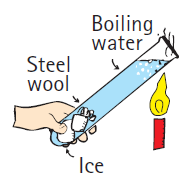
Hold the bottom end of a test tube full of cold water in your hand. Heat the top part in a flame until the water boils. That you can still hold the bottom shows that water (as well as glass) is a poor conductor of heat. This is even more dramatic when you wedge chunks of ice with steel wool at the
If you live where there is snow, do as Benjamin Franklin did more than 200 years ago, lay samples of light and dark cloth on the snow and note the differences among the rates of melting beneath the samples of cloth.
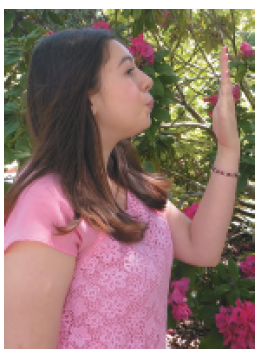
Do as Megan shows in Figure 7.7 and blow on your hand, first with your mouth wide open, then with your lips puckered so that air expands more when exiting your mouth. Account for the temperature differences.Figure 7.7
Does a gas give off energy or absorb energy when it changes into a liquid? How about a solid changing into a liquid?
Why doesn’t water freeze at 0°C when it contains dissolved material?
Why does decreasing the temperature of a liquid make it freeze?
Why does water not boil at 100°C when it is under greater-than-normal atmospheric pressure?
What is condensation, how does it differ from evaporation, and why is it a warming process?
What is sublimation?
Does a red-hot poker radiate more when it is placed in a warm oven, or when it is placed in a cold room? (Or does it radiate the same in both)?
What is terrestrial radiation? How does it differ from solar radiation?
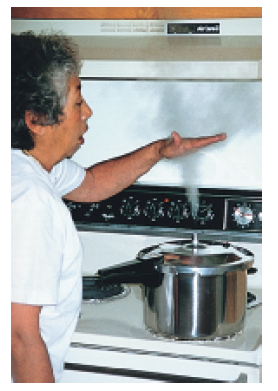
Why is Millie€™s hand not burned when she holds it above the escape valve of the pressure cooker(Figure 7.8)?
What happens to the temperature of air when it expands?
By what means is heat transferred by convection?
What is the explanation for a barefoot firewalker being able to walk safely on red-hot wooden coals?
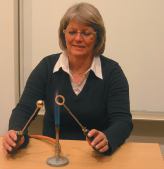
A metal ball is barely able to pass through a metal ring. When Anette Zetterberg heats the ball, it does not pass through the ring. What happens if she instead heats the ring (as shown)? Does the size of the hole increase, stay the same, or decrease?
Compared with conventional water heaters in the United States, why do propane tankless water heaters (which are common in other parts of the world) cost up to 60% less to operate?
Which undergoes a greater change in temperature when heat is applied: 1 kg of water or 1 kg of iron? Defend your answer.
Why does jello stay cooler for a longer time than sandwiches when both are removed from a picnic cooler on a hot day?
Entropy is a measure of how energy becomes disorderly in a system. Disorder increases and entropy increases. How is this related to opening a bottle of perfume in the corner of a room?
Under what conditions can thermal energy in a system move from cold to hot?
Which law of thermodynamics involves absolute zero?
Which law of thermodynamics tells us what is most probable in nature?
If 100 joules of heat is added to a system that does 40 joules of external work, by how much is the thermal energy of the system raised?
If 100 joules of heat is added to a system that does no external work, by how much is the thermal energy of the system raised?
Which raises the temperature of water more: the addition of 1 calorie or of 1 joule?
Which of these involves the least thermal energy: 1 calorie, 1 Calorie, or 1 joule?
Which of these involves the most thermal energy: 1 calorie, 1 Calorie, or 1 joule?
What is the general direction of the flow of thermal energy? What is the name of that flow?
Instead of saying a red-hot horseshoe contains heat, it is correct to say a red-hot horseshoe contains what?
What name is given to “thermal energy in transit”?
What will be the temperature of 0°C helium gas if its thermal energy is halved?
What will be the temperature of a 0°C steel block if its thermal energy is doubled?
On which temperature scale does the average kinetic energy of molecules double when the temperature doubles?
Which contains the greater amount of thermal energy: an iceberg or a cup of hot coffee? Defend your answer.
A friend tells you that the surface temperature of a particular star is 50,000 degrees. You’re not sure whether your friend meant Celsius degrees or kelvins. How much difference is involved in this ambiguity?
In the lab, you submerge 100 g of 40°C nails in 200 g of 20°C water. (The specific heat of iron is 0.12 cal/g · °C.) Equate the heat gained by the water to the heat lost by the nails, and show that the final temperature of the water is about 21°C.
Use the formula above to show that it takes 3000 cal to raise the temperature of 300 g of water from 20°C to 30°C. For the specific heat capacity c, use (1 cal/g · °C).Q = cmT
At what temperature do the combined effects of contraction and expansion produce the smallest volume of water?
What is the relationship between water’s high specific heat capacity and Europe’s climate?
Which warms faster when heat is applied: iron or silver? Which has the lower specific heat capacity?
Under what condition can the entropy of a system be decreased?
When disorder in a system increases, does entropy increase or decrease?
Which law of thermodynamics is related to a system reaching 0 K?
When can thermal energy in a system move from lower to higher temperatures?
Which law of thermodynamics is related to the direction of heat transfer?
Which law of thermodynamics consists of the conservation of energy applied to thermal systems?
Why is heat measured in joules?
What role does temperature have in the direction of thermal energy flow?
How does heat differ from thermal energy?
Does a hot object contain thermal energy, or does it contain heat?
In which direction does thermal energy flow between hot and cold objects?
How much energy can be removed from a system at 0 K?
What pressure would you expect in a rigid container of 0°C gas cooled to –273°C?
By how much does the pressure of a gas in a rigid vessel decrease when the temperature is decreased from 0°C to –1°C?
Under what condition does a thermometer measure the temperature of its surroundings? (Why do we say that “a thermometer measures its own temperature”?)
Is the temperature of an object a measure of the total translational kinetic energy of molecules in the object or a measure of the average translational kinetic energy per molecule in the object?
Your study partner says he doesn’t believe in Bernoulli’s principle and cites as evidence the fact that a stream of water can knock over a building. The pressure that the water exerts on the building is not reduced, as Bernoulli claims. What distinction is your partner missing?
If you bring an airtight bag of potato chips aboard an airplane, you’ll note that it puffs up as the plane ascends to high altitude. Why?
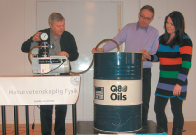
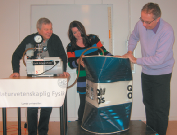
In the classroom demonstration at Lund University, a vacuum pump evacuates air from a large, empty oil drum, which slowly and dramatically crumples as shown. A student friend says that the vacuum sucks in the sides of the drum. What is your explanation? Naturvetenskeplig fysk Oils OF turtenskaplig
Why is blood pressure measured in the upper arm, at the elevation of your heart?
How does an airplane adjust its angle of attack so that it is able to fly upside down?
Why will the strong man in the previous exercise be more successful in lifting the 10-kg block if he switches places and pushes down on the smaller piston with the block on the larger piston?
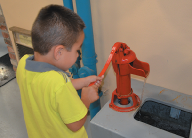
Richard€™s pump can operate at a certain maximum well depth in Pocatello, Idaho. Would this maximum depth be greater than, less than, or the same as if he pumps water in San Francisco?
Why is the pressure in an automobile’s tires slightly greater after the car has been driven several kilometers?
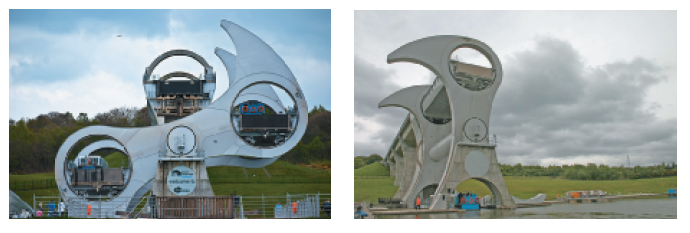
The Falkirk Wheel in Scotland (Figure 5.17) rotates with the same low energy no matter what the weight of the boats it lifts. What would be different in its operation if, instead of carrying floating boats, it carried scrap metal that doesn€™t float?Figure 5.17
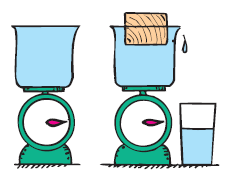
Give a reason why canal enthusiasts in Scotland appreciate the physics illustrated in Figure 5.16 (the block of wood floating in a vessel brim-filled with water).Figure 5.16
Why are people who are confined to bed less likely to develop bedsores on their bodies if they use a waterbed rather than a standard mattress?
Stand on a bathroom scale and read your weight. When you lift one foot up so that you’re standing on one foot, does the reading change? Does a scale read force or pressure?
A can of diet soft drink floats in water, whereas a can of regular soft drink sinks. Discuss this phenomenon first in terms of density, then in terms of weight versus buoyant force.
When you squeeze a party balloon between your hands, what happens to the mass of the balloon? To its volume? To its density?
A vacationer floats lazily in the ocean with 90% of her body below the surface. The density of the ocean water is 1025 kg/m3. Show that the vacationer’s average density is 0923 kg/m3.
A rectangular barge, 5 m long and 2 m wide, floats in fresh water. Suppose that a 400-kg crate of auto parts is loaded onto the barge. Show that the barge floats 4 cm deeper.
A 1-m-tall barrel is closed on top except for a thin pipe extending 5 m up from the top. When the barrel is filled with water up to the base of the pipe (1 m deep) the water pressure on the bottom of the barrel is 9.8 kPa. What is the pressure on the bottom when water is added to fill the pipe to
Suppose that you balance a 2-kg ball on the tip of your finger, which has an area of 1 cm2. Show that the pressure on your finger is 20 N/cm2, which is 200 kPa.
Showing 3100 - 3200
of 3486
First
21
22
23
24
25
26
27
28
29
30
31
32
33
34
35
Step by Step Answers

 Get 50% OFF
Claim Now
Get 50% OFF
Claim Now