New Semester
Started
Get
50% OFF
Study Help!
--h --m --s
Claim Now
Question Answers
Textbooks
Find textbooks, questions and answers
Oops, something went wrong!
Change your search query and then try again
S
Books
FREE
Study Help
Expert Questions
Accounting
General Management
Mathematics
Finance
Organizational Behaviour
Law
Physics
Operating System
Management Leadership
Sociology
Programming
Marketing
Database
Computer Network
Economics
Textbooks Solutions
Accounting
Managerial Accounting
Management Leadership
Cost Accounting
Statistics
Business Law
Corporate Finance
Finance
Economics
Auditing
Tutors
Online Tutors
Find a Tutor
Hire a Tutor
Become a Tutor
AI Tutor
AI Study Planner
NEW
Sell Books
Search
Search
Sign In
Register
study help
physics
conceptual physical science
Conceptual Physical Science 6th Edition Paul G. Hewitt, John A. Suchocki, Leslie A. Hewitt - Solutions
Starting from rest, Megan zooms down a frictionless slide from an initial height of 4.0 m. Show that her speed at the bottom of the slide is √80 m/s, or 8.9 m/s.
When an average force F is exerted over a certain distance on a shopping cart of mass m, its kinetic energy increases by ½mv2.(a) Use the work–energy theorem to show that the distance over which the force acts is mv2/2F.(b) If twice the force is exerted over twice the distance, how does the
Show that 480 W of power is expended by a weightlifter who lifts a 60-kg barbell a vertical distance of 1.2 m in a time interval of 1.5 s.
How many watts of power do you expend when you exert a force of 6 N that moves a book 2 m in a time interval of 3 s?
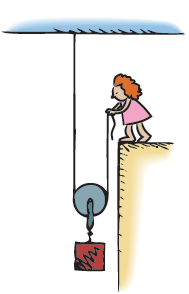
The girl steadily pulls her end of the rope upward a distance of 0.4 m with a constant force of 50 N. By how much does the PE of the block increase? Show that the mass of the block is 10 kg.
In raising a 6000-N piano with a pulley system, the movers note that for every 2 m of rope pulled down, the piano rises 0.2 m. Show that, ideally, the force required to lift the piano is 600 N.
The following questions refer to Problem 60:(a) How much work is done by the 60-N force?(b) What is the gain in PE of the load?(c) How does the work done compare with the increased PE of the load?
A simple lever is used to lift a heavy load. When a 60-N force pushes one end of the lever downward 1.2 m, the load rises 0.2 m. Show that the weight of the load is 360 N.
If you push a crate horizontally with a force of 100 N across a 10-m factory floor, and the friction force between the crate and the floor is a steady 70 N, how much kinetic energy is gained by the crate?
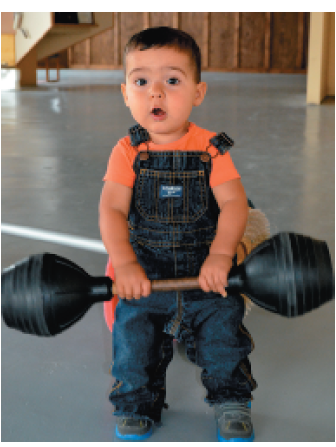
Little Hudson holds the 10-kg barbell 0.3 m above the floor.(a) What is the PE of the barbell relative to the floor?(b) How much additional work will Hudson do when he lifts the barbell to a height 1.0 m above the floor?(c) If Hudson then drops the barbell, what will be its KE of impact with the
Jeannie Beanie (mass 40 kg), standing on slippery ice, catches her leaping dog, Daisy (mass 20 kg), who leapt into her arms after running across an adjacent field at 6 m/s. Use the conservation of momentum to show that the speed of Jeannie and her dog after the catch is 2 m/s.
At a baseball game, a ball of mass m = 0.15 kg moving at a speed v = 30 m/s is caught by a fan.(a) Show that the impulse supplied to bring the ball to rest is 4.5 N · s.(b) Show that if the ball is stopped in 0.02 s, then the average force of the ball on the catcher’s hand is 225 N.
A 6-kg ball rolling at 3 m/s bumps into a pillow and stops in 0.5 s.(a) Show that the force exerted by the pillow is 36 N.(b) How much force does the ball exert on the pillow?
A 10-kg bag of groceries is tossed onto a table at 3 m/s and slides to a stop in 2 s. Begin with the equation you derived in Problem 50, and show that the force of friction is 15 N.
In Chapter 1 we learned that acceleration a = Δv/Δt, and in Chapter 2 we learned that the cause of acceleration involves net force, where a = F/m. Equate these two equations for acceleration and show that, for constant mass, FΔt = Δ(mv).
Show that the efficiency of a machine that has an input of 100 J and an output of 40 J is 0.40.
Show that nearly 786 W of power is expended when a 500-N barbell is lifted 2.2 m above the floor in 1.4 s. useful energy output total energy input Efficiency
Show that 50 W of power is required to give a brick 100 J of PE in a time of 2 s.
Show that a 2,500,000-J change in kinetic energy occurs for an airplane that is moved 500 m in takeoff by a sustained force of 5000 N. work Power %| time
Show that 24 J of work is done when a 3.0-kg block of ice is moved from rest to a speed of 4.0 m/s.
Calculate the kinetic energy of a 84-kg scooter moving at 10 m/s. Work-energy theorem; W = ΔKE.
Show that the kinetic energy of a 1.0-kg book tossed across the room at a speed of 3.0 m/s is 4.5 J. (1 J is equivalent to 1 kg(m/s)2.)
Show that the gravitational potential energy of a 1000-kg boulder raised 5 m above ground level is 50,000 J. (You can express g in units of N/kg, because m/s2 is equivalent to N/kg.) Kinetic energy = 1/2 mass × velocity2; KE = 1/2 mv2.
Show that when a 3.0-kg book is lifted 2.0 m, its increase in gravitational potential energy is 60 J.
Calculate the work done when a 20-N force pushes a cart 3.5 m.Gravitational potential energy = mass × acceleration due to gravity × height; PE = mgh
Show that 2.4 J of work is done when a force of 2.0 N moves a book 1.2 m. (1 N · m = 1 J)
Show that when an impulse produced by a 12-N force acts over 2.0 s on an ice puck initially at rest on an air table, the change in momentum is 24 kg · m/s. Work = force × distance; W = Fd
Show that when a 10-kg cart undergoes a 2.0-m/s increase in speed, the impulse on the cart is 20 N · s. (The unit N · s is equivalent to kg · m/s.)
Show that the impulse on a baseball that is hit with 100 N of force in a time of 0.5 s is 50 N.s. Impulse = change in momentum; Ft = ????mv
Show that the momentum for a 2-kg brick parachuting straight downward at a constant speed of 8 m/s is 16 kg · m/s.Impulse = FtMomentum = mv
Place a small rubber ball on top of a basketball or soccer ball, and then drop them together. If vertical alignment remains as they fall to the floor, you’ll see that the small ball bounces unusually high. Can you reconcile this with energy conservation?
Pour some dry sand into a tin can with a cover. Compare the temperature of the sand before and after you vigorously shake the can for a couple of minutes. Predict what occurs. What is your explanation?
When you get a bit ahead in your studies, cut classes some afternoon and visit your local pool or billiards parlor to bone up on momentum conservation. Note that, no matter how complicated the collision of balls, the momentum along the line of action of the cue ball before impact is the same as the
If your instructor has an air table or air track, play around with carts or air pucks. Most important, predict what will happen before you initiate collisions.
Can we correctly say that hydrogen is a relatively new source of energy? Why or why not?
What is the ultimate source of geothermal energy?
What is the ultimate source of the energy supplied by fossil fuels, dams, and windmills?
What becomes of energy when efficiency is lowered in a machine?
What is the efficiency of a machine that miraculously converts all the input energy to useful output energy?
If a machine multiplies force by a factor of 4, what other quantity is diminished, and by how much?
Can a machine multiply input force? Input distance? Input energy? (If your three answers are the same, seek help, because this is an important question.)
An apple hanging from a limb has potential energy because of its height. If the apple falls, what becomes of this energy just before the apple hits the ground? When it hits the ground?
What will be the kinetic energy of the ram of a pile driver when it suddenly undergoes a 10-kJ decrease in potential energy?
Compared with the work that the brakes must supply to stop a car moving at some original speed, how much more work must the brakes supply to stop that car if it is moving four times as fast as the original speed? How do the respective stopping distances compare?
What is the relationship between the gain in kinetic energy and the work when work is done?
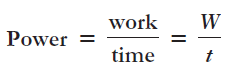
What is the relationship between work and power?
If a moving car speeds up until it is going three times as fast as it was, how much kinetic energy does it have compared with its initial kinetic energy?
Two cars are raised to the same elevation on service station lifts. If one car is twice as massive as the other, how do their potential energies compare?
A car is raised a certain distance in a service station lift and therefore has potential energy relative to the floor. If it were raised twice as high, how much potential energy would it have compared with what it had in the first case?
Which requires more work: lifting a 50-kg sack a vertical distance of 2 m or lifting a 25-kg sack a vertical distance of 4 m?
In which of cases (1), (2), and (3) in Question 7 is the greatest impulse required?Question 7If a ball has the same speed just before being caught and just after being thrown, in which case does the ball undergo the greatest change in momentum: (1) When it is caught, (2) when it is thrown, or (3)
If a ball has the same speed just before being caught and just after being thrown, in which case does the ball undergo the greatest change in momentum: (1) When it is caught, (2) when it is thrown, or (3) when it is caught and then thrown back?
In boxing, why is it advantageous to roll with the punch?
Why is it advantageous, in karate, to apply a force for a short time?
Why is it a good idea to extend your bare hand forward when you are getting ready to catch a fast-moving baseball?
When a ball is hit with a given force, why does contact over a long time impart more speed to the ball than contact over a short time?
Which has greater momentum: an automobile at rest or a moving skateboard?
Can a dog wag its tail without the tail in turn “wagging the dog”? (Consider a dog with a relatively massive tail.)
Two equal-mass blocks are connected by a length of string. One block is placed at rest on a very smooth table, and the other block dangles off the table’s edge. You hold the blocks so they don’t move. When released, the hanging one accelerates downward, pulling the top block horizontally across
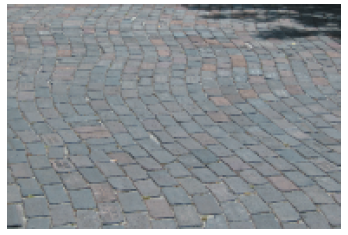
The bricks in this road were originally straight. Describe evidence for tires pushing the bricks in the wavy pattern, and explain why they do so.
If and when Galileo dropped two balls from the top of the Leaning Tower of Pisa, air resistance was not really negligible. Assuming that both balls were the same size, yet one was much heavier than the other, which ball actually struck the ground first? Discuss your reasoning.
A couple of your friends say that before a falling body reaches terminal velocity, it gains speed while acceleration decreases. Do you agree or disagree with your friends? Defend your answer.
You throw a ball straight upward. Compared with its initial speed when thrown, how fast does it return to its starting point? Answer this for the case of no air resistance, and for the case where air resistance does affect motion.
Can you think of a reason why the acceleration of the object thrown downward through the air in Exercise 106 would actually be less than 10 m/s2?Exercise 106If you drop an object, its acceleration toward the ground is 10 m/s2. If you throw it down instead, would its acceleration after leaving your
If you’re in a car at rest that gets hit from behind, you can suffer a serious neck injury called whiplash. Discuss how whiplash involves Newton’s first law and why headrests are standard on today’s cars.
The opening photo in this chapter shows a favorite demonstration of author Paul Hewitt lying on his back with a blacksmith€™s anvil placed on his chest. When assistant Will Maynez whacks the anvil with a strong sledgehammer blow, Hewitt is not injured. How is the physics here similar to
Each of the vertebrae forming your spine is separated from its neighbors by discs of elastic tissue. Each step you take acts on your spine like a small jump. Can you think of a reason why you are a little shorter in the evening than you are in the morning?
In an orbiting space craft, you are handed two identical closed boxes, one filled with sand and the other filled with feathers. Discuss at least a couple of ways that you can tell which is which without opening the boxes.
Discuss whether or not a stick of dynamite contains force. Similarly, does a fist contain force? A hammer? Defend your answers.
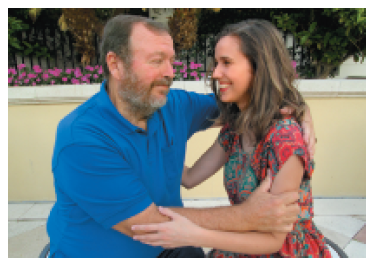
The photo shows Steve Hewitt and his daughter Gretchen. Is Gretchen touching her dad, or is he touching her? Explain.
Suppose that one of the people in Exercise 87 has twice the mass of the other. How far does each person slide before they meet?
If a Mack truck and a motorcycle have a head-on collision, upon which vehicle is the impact force greater? Which vehicle undergoes the greater change in its motion? Defend your answers.
When you rub your hands together, can you push harder on one hand than on the other?
Why can a boxer hit a heavy opponent harder for the same punch than she or he can hit a light opponent?
A friend says that Al̩ cannot push on the tree unless the tree pushes back on her, and another friend says that if Al̩ pushes quickly, the tree won۪t push as hard on her. Which friend do you agree with, and why? AY
We know that Earth pulls on the Moon. Does it follow that the Moon also pulls on Earth?
You tell your friend that the acceleration of a skydiver decreases as falling progresses. What is your response when your friend asks if this means the skydiver is slowing down?
How does the weight of a falling body compare with the air resistance it encounters just before it reaches terminal velocity? Just after it reaches terminal velocity?
As you leap upward from the ground, how does the force that you exert on the ground compare with your weight?
Aristotle claimed that the speed of a falling object depends on its weight. We now know that all objects in free fall, whatever their weight, undergo the same rate of change in speed. Why does weight not affect acceleration?
The Moon travels in a nearly circular path around Earth. If somehow gravitation between Earth and Moon disappeared, how would the Moon’s path differ?
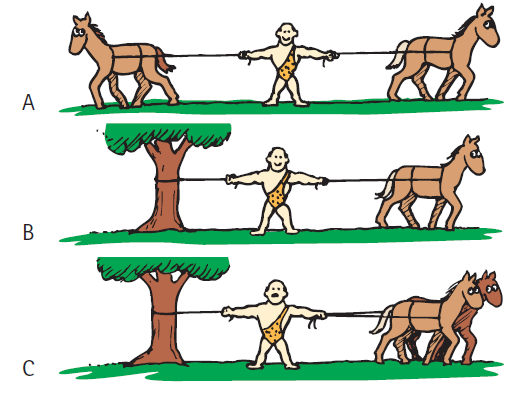
The strong man is pulled in the three situations shown. Rank, from least to greatest, the amount of tension in the rope in his right hand (the one attached to the tree in B and C). A Itd В
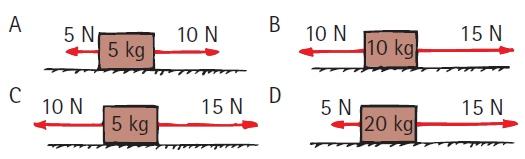
Boxes of various masses are on a friction-free level table.(a) Rank, from greatest to least, the net forces on the boxes.(b) Rank, from greatest to least, the accelerations of the boxes. 5 N A5 kg 10 N 10 N 15 N 10 kg D 15 N 10 N 15 N 5 N 20 kg 5 kg
A firefighter of mass 80 kg slides down a vertical pole with an acceleration of 4 m/s2. Show that the friction force that acts on the firefighter is 480 N.
A force F acts in the forward direction on a cart of mass m. A friction force f opposes this motion.(a) Use Newton’s second law and show that the acceleration of the cart is F - f/m.(b) Show that if the cart’s mass is 4.0 kg, the applied force is 12.0 N, and the friction force is 6.0 N, the
If you stand next to a wall on a frictionless skateboard and push the wall with a force of 40 N, how hard does the wall push on you? Show that if your mass is 80 kg, your acceleration is 0.5 m/s2 away from the wall.
Suzie Skydiver with her parachute has a mass of 50 kg.(a) Before opening her chute, what force of air resistance will she encounter when she reaches terminal velocity?(b) What force of air resistance will she encounter when she reaches a lower terminal velocity after the chute is open?(c) Discuss
The heavyweight boxing champion of the world punches a sheet of paper in midair, bringing it from rest up to a speed of 25.0 m/s in 0.050 s. The mass of the paper is 0.003 kg. Show that the force of the punch on the paper is only 1.5 N.
For 3.0 s, Allison exerts a net force of 10.0 N on a 6.7-kg shopping cart that was initially at rest. Find the acceleration of the cart, and show that it moves a distance of 6.7 m.
Calculate the horizontal force that must be applied to a 1-kg puck for it to accelerate on a horizontal friction-free air table with the same acceleration it would have if it were dropped and fell freely.
A rocket of mass 100,000 kg undergoes an acceleration of 2 m/s2. Show that the net force acting on it is 200,000 N.
Sophia pushes with a 40-N horizontal force on a 4.0-kg box resting on a lab bench. The box slides against a horizontal friction force of 24 N. Show that the box accelerates at 4.0 m/s2.
Madison pushes with a 160-N horizontal force on a 20-kg crate of coffee resting on a warehouse floor. The force of friction on the crate is 80 N. Show that the acceleration is 4.0 m/s2.
A 120-kg astronaut recedes from her spacecraft by activating a small propulsion unit attached to her back. The force generated by a spurt from this device is 30 N. Show that her acceleration is 0.25 m/s2.
When two horizontal forces are exerted on the car in Problem 39, 220 N forward and 180 N backward, the car undergoes acceleration. What additional force is needed to produce non-accelerated motion?
A Honda Civic hybrid weighs about 2900 pounds. Calculate the weight of the car in newtons and its mass in kilograms. (FYI, 0.22 lb = 1 N; 1 kg on Earth’s surface has a weight of 10 N.)
If you drop a sheet of paper and a book side by side, not surprisingly the book falls faster than the paper. If you place the paper against the lower surface of the raised book and again drop them at the same time, they hit the floor at the same time. The book simply pushes the paper with it as it
Which of Newton’s laws focuses on inertia? Which on acceleration? Which on action–reaction?
To what law of physics do we refer when we say you cannot touch without being touched?
How does a helicopter get its lifting force?
Showing 3300 - 3400
of 3486
First
21
22
23
24
25
26
27
28
29
30
31
32
33
34
35
Step by Step Answers

 Get 50% OFF
Claim Now
Get 50% OFF
Claim Now