New Semester
Started
Get
50% OFF
Study Help!
--h --m --s
Claim Now
Question Answers
Textbooks
Find textbooks, questions and answers
Oops, something went wrong!
Change your search query and then try again
S
Books
FREE
Study Help
Expert Questions
Accounting
General Management
Mathematics
Finance
Organizational Behaviour
Law
Physics
Operating System
Management Leadership
Sociology
Programming
Marketing
Database
Computer Network
Economics
Textbooks Solutions
Accounting
Managerial Accounting
Management Leadership
Cost Accounting
Statistics
Business Law
Corporate Finance
Finance
Economics
Auditing
Tutors
Online Tutors
Find a Tutor
Hire a Tutor
Become a Tutor
AI Tutor
AI Study Planner
NEW
Sell Books
Search
Search
Sign In
Register
study help
physics
physics scientists and engineers
Physics for Scientists and Engineers A Strategic Approach with Modern Physics 4th edition Randall D. Knight - Solutions
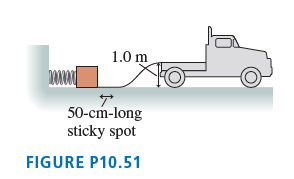
A freight company uses a compressed spring to shoot 2.0 kg packages up a 1.0-m-high frictionless ramp into a truck, as FIGURE P10.51 shows. The spring constant is 500 N/m and the spring is compressed 30 cm. a. What is the speed of the package when it reaches the truck?b. A careless worker spills
Truck brakes can fail if they get too hot. In some mountainous areas, ramps of loose gravel are constructed to stop runaway trucks that have lost their brakes. The combination of a slight upward slope and a large coefficient of rolling resistance as the truck tires sink into the gravel brings the
A horizontal spring with spring constant 100 N/m is compressed 20 cm and used to launch a 2.5 kg box across a frictionless, horizontal surface. After the box travels some distance, the surface becomes rough. The coefficient of kinetic friction of the box on the surface is 0.15. Use work and energy
Sam, whose mass is 75 kg, straps on his skis and starts down a 50-m-high, 20° frictionless slope. A strong headwind exerts a horizontal force of 200 N on him as he skies. Use work and energy to find Sam’s speed at the bottom.
You have a ball of unknown mass, a spring with spring constant 950 N/m, and a meter stick. You use various compressions of the spring to launch the ball vertically, then use the meter stick to measure the ball’s maximum height above the launch point.Your data are as follows:Compression (cm)
A 1000 kg safe is 2.0 m above a heavy-duty spring when the rope holding the safe breaks. The safe hits the spring and compresses it 50 cm. What is the spring constant of the spring?
A block of mass m slides down a frictionless track, then around the inside of a circular loop-the-loop of radius R. From what minimum height h must the block start to make it around without falling off? Give your answer as a multiple of R.
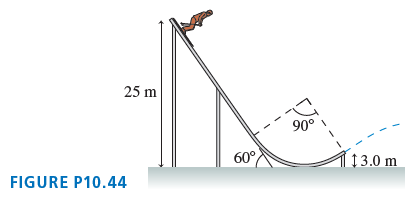
It€™s been a great day of new, frictionless snow. Julie starts at the top of the 60° slope shown in FIGURE P10.44. At the bottom, a circular arc carries her through a 90 turn, and she then launches off a 3.0-m-high ramp. How far horizontally is her touchdown point from the end of the
You have been hired to design a spring-launched roller coaster that will carry two passengers per car. The car goes up a 10-m-high hill, then descends 15 m to the track’s lowest point. You’ve determined that the spring can be compressed a maximum of 2.0 m and that a loaded car will have a
A 50 g ice cube can slide up and down a frictionless 30° slope. At the bottom, a spring with spring constant 25 N/m is compressed 10 cm and used to launch the ice cube up the slope. How high does it go above its starting point?
A very slippery ice cube slides in a vertical plane around the inside of a smooth, 20-cm-diameter horizontal pipe. The ice cube’s speed at the bottom of the circle is 3.0 m/s. What is the ice cube’s speed at the top?
A cable with 20.0 N of tension pulls straight up on a 1.50 kg block that is initially at rest. What is the block’s speed after being lifted 2.00 m? Solve this problem using work and energy.
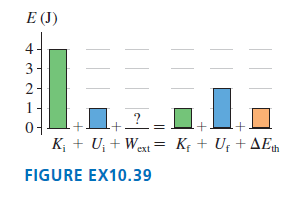
How much work is done by the environment in the process shown in FIGURE EX10.39? Is energy transferred from the environment to the system or from the system to the environment? E (J) 1,2.1 01 K; + U + Wext = K; + U; + AE FIGURE EX10.39 4)
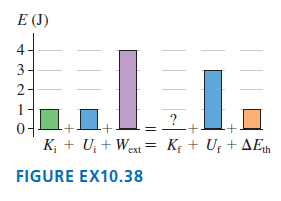
What is the final kinetic energy of the system for the process shown in FIGURE EX10.38? E (J) 4 3 K; + U; + Wext = K; + U; + AE FIGURE EX10.38
A system loses 400 J of potential energy. In the process, it does 400 J of work on the environment and the thermal energy increases by 100 J. Show this process on an energy bar chart.
A force does work on a 50 g particle as the particle moves along the following straight paths in the xy-plane: 25 J from (0 m, 0 m) to (5 m, 0 m); 35 J from (0 m, 0 m) to (0 m, 5 m); –5 J from (5 m, 0 m) to (5 m, 5 m); –15 J from (0 m, 5 m) to (5 m, 5 m); and 20 J from (0 m, 0 m) to (5 m, 5
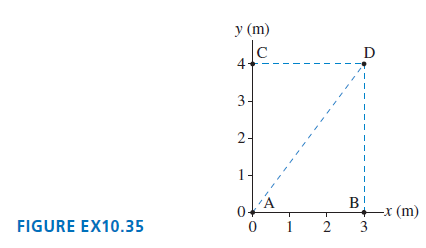
A particle moves from A to D in FIGURE EX10.35 while experiencing force F = (6î + 8ĵ) N. How much work does the force do if the particle follows path(a) ABD,(b) ACD, (c) AD? Is this a conservative force? Explain. y (m) D 3- 2- 1. B! +x (m) 3 FIGURE EX10.35 1
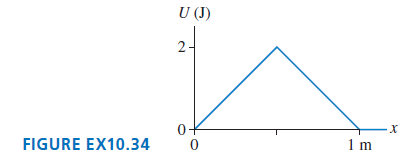
FIGURE EX10.34 shows the potential energy of a system in which a particle moves along the x-axis. Draw a graph of the force Fxas a function of position x. U (J) 2- 04 FIGURE EX10.34
A particle moving along the x-axis is in a system with potential energy U = 10/x J, where x is in m. What is the x-component of the force on the particle at x = 2 m, 5 m, and 8 m?
A particle moving along the y-axis is in a system with potential energy U = 4y3 J, where y is in m. What is the y-component of the force on the particle at y = 0 m, 1 m, and 2 m?
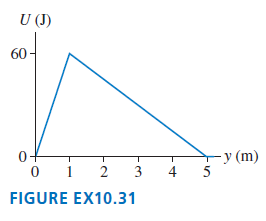
A system in which only one particle can move has the potential energy shown in FIGURE EX10.31. What is the y component of the force on the particle at y = 0.5 m and 4 m? U (J) 60 ry (m) 5 0- 2 FIGURE EX10.31 3.
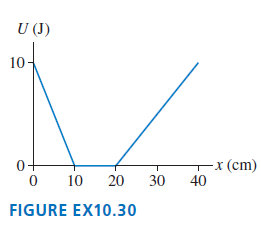
A system in which only one particle can move has the potential energy shown in FIGURE EX10.30. What is the x component of the force on the particle at x = 5, 15, and 25 cm? U (J) 10- 0+ -x (cm) 40 T 30 10 20 FIGURE EX10.30
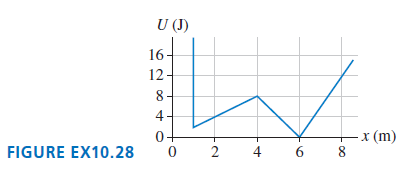
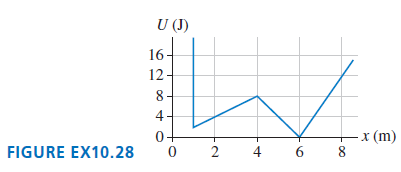
In FIGURE EX10.28, what is the maximum speed a 200 g particle could have at x = 2.0 m and never reach x = 6.0 m? U (J) 16- 12 - 8- 4. 0+ x (m) FIGURE EX10.28 4 2.
FIGURE EX10.28 shows the potential energy of a 500 g particle as it moves along the x-axis. Suppose the particle??s mechanical energy is 12 J. a. Where are the particle??s turning points?b. What is the particle??s speed when it is at x = 4.0 m?c. What is the particle??s maximum speed? At what
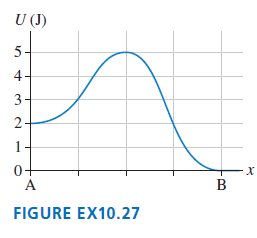
a. In FIGURE EX10.27, what minimum speed does a 100 g particle need at point A to reach point B?b. What minimum speed does a 100 g particle need at point B to reach point A? U (J) 5- 2- 0+ B FIGURE EX10.27 4, 3.
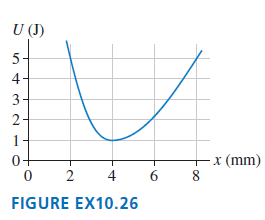
In FIGURE EX10.26, what is the maximum speed of a 2.0 g particle that oscillates between x = 2.0 mm and x = 8.0 mm? U (J) 5- 4 3- 2- 0+ x (mm) 4 FIGURE EX10.26
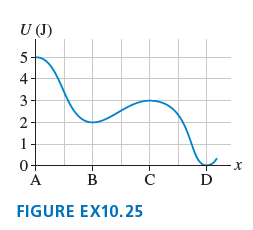
FIGURE EX10.25 is the potential-energy diagram for a 500 g particle that is released from rest at A. What are the particle€™s speeds at B, C, and D? U (J) 5- 4 3 2- 0+ B D FIGURE EX10.25
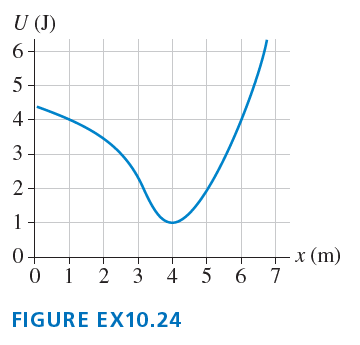
FIGURE EX10.24 is the potential-energy diagram for a 20 g particle that is released from rest at x = 1.0 m.a. Will the particle move to the right or to the left?b. What is the particle€™s maximum speed? At what position does it have this speed?c. Where are the turning points of the
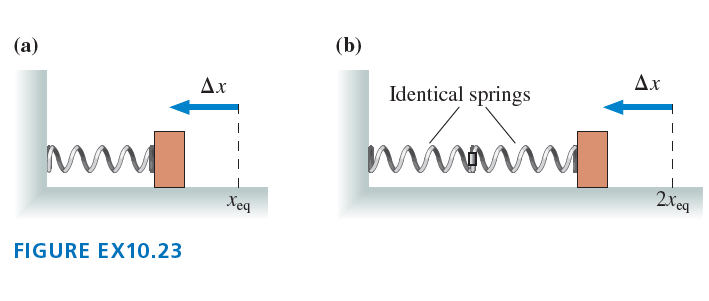
The spring in FIGURE EX10.23a is compressed by Δx. It launches the block across a frictionless surface with speed v0. The two springs in FIGURE EX10.23b are identical to the spring of Figure EX10.23a. They are compressed the same total Δx and used to launch the same block.
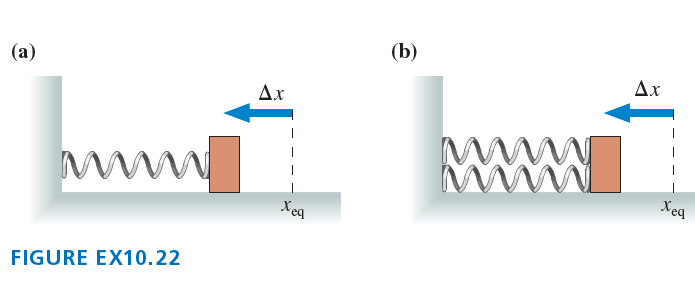
The spring in FIGURE EX10.22a is compressed by Δx. It launches the block across a frictionless surface with speed v0. The two springs in FIGURE EX10.22b are identical to the spring of Figure EX10.22a. They are compressed by the same Δx and used to launch the same block. What
The elastic energy stored in your tendons can contribute up to 35%, of your energy needs when running. Sports scientists find that (on average) the knee extensor tendons in sprinters stretch 41 mm while those of nonathletes stretch only 33 mm. The spring constant of the tendon is the same for both
As a 15,000 kg jet plane lands on an aircraft carrier, its tail hook snags a cable to slow it down. The cable is attached to a spring with spring constant 60,000 N/m. If the spring stretches 30 m to stop the plane, what was the plane’s landing speed?
A 10 kg runaway grocery cart runs into a spring with spring constant 250 N/m and compresses it by 60 cm. What was the speed of the cart just before it hit the spring?
A block sliding along a horizontal frictionless surface with speed v collides with a spring and compresses it by 2.0 cm. What will be the compression if the same block collides with the spring at a speed of 2v?
A student places her 500 g physics book on a frictionless table.She pushes the book against a spring, compressing the spring by 4.0 cm, then releases the book. What is the book’s speed as it slides away? The spring constant is 1250 N/m.
A stretched spring stores 2.0 J of energy. How much energy will be stored if the spring is stretched three times as far?
How far must you stretch a spring with k = 1000 N/m to store 200 J of energy?
In a hydroelectric dam, water falls 25 m and then spins a turbine to generate electricity.a. What is ΔUG of 1.0 kg of water?b. Suppose the dam is 80% efficient at converting the water’s potential energy to electrical energy. How many kilograms of water must pass through the turbines each second
A cannon tilted up at a 30° angle fires a cannon ball at 80 m/s from atop a 10-m-high fortress wall. What is the ball’s impact speed on the ground below?
a. If the force on a particle at some point in space is zero, must its potential energy also be zero at that point? Explain.b. If the potential energy of a particle at some point in space is zero, must the force on it also be zero at that point? Explain.
The maximum energy a bone can absorb without breaking is surprisingly small. Experimental data show that the leg bones of a healthy, 60 kg human can absorb about 200 J. From what maximum height could a 60 kg person jump and land rigidly upright on both feet without breaking his legs? Assume that
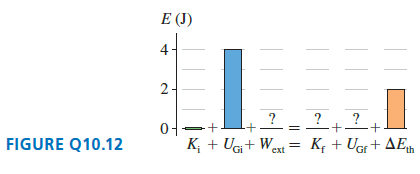
FIGURE Q10.12 is the energy bar chart for a firefighter sliding down a fire pole from the second floor to the ground. Let the system consist of the firefighter, the pole, and the earth. What are the bar heights of Wext, Kf, and UGf? E (J) 2- ? 01 K; + UGi+ W. +. K + UGr+ AEh FIGURE Q10.12 'th
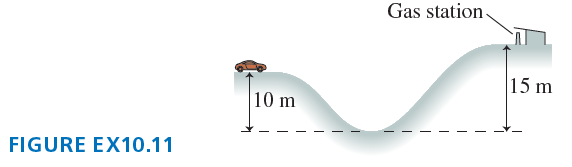
A 1500 kg car traveling at 10 m/s suddenly runs out of gas while approaching the valley shown in FIGURE EX10.11. The alert driver immediately puts the car in neutral so that it will roll.What will be the car??s speed as it coasts into the gas station on the other side of the valley? Gas station 15
A process occurs in which a system’s potential energy increases while the environment does work on the system. Does the system’s kinetic energy increase, decrease, or stay the same? Or is there not enough information to tell? Explain.
A 20 kg child is on a swing that hangs from 3.0-m-long chains. What is her maximum speed if she swings out to a 45° angle?
A process occurs in which a system’s potential energy decreases while the system does work on the environment. Does the system’s kinetic energy increase, decrease, or stay the same? Or is there not enough information to tell? Explain.
A pendulum is made by tying a 500 g ball to a 75-cm-long string. The pendulum is pulled 30° to one side, then released.What is the ball’s speed at the lowest point of its trajectory?
A compressed spring launches a block up an incline. Which objects should be included within the system in order to make an energy analysis as easy as possible?
What minimum speed does a 100 g puck need to make it to the top of a 3.0-m-long, 20° frictionless ramp?
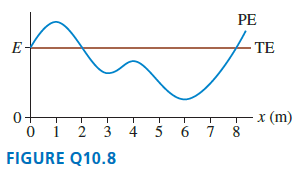
A particle with the potential energy shown in FIGURE Q10.8 is moving to the right at x = 5 m with total energy E.a. At what value or values of x is this particle€™s speed a maximum?b. Does this particle have a turning point or points in the range of x covered by the graph? If so, where?c.
A 55 kg skateboarder wants to just make it to the upper edge of a “quarter pipe,” a track that is one-quarter of a circle with a radius of 3.0 m. What speed does he need at the bottom?
A spring gun shoots out a plastic ball at speed v0. The spring is then compressed twice the distance it was on the first shot. By what factor is the ball’s speed increased? Explain.
What height does a frictionless playground slide need so that a 35 kg child reaches the bottom at a speed of 4.5 m/s?
A spring is compressed 1.0 cm. How far must you compress a spring with twice the spring constant to store the same amount of energy?
a. With what minimum speed must you toss a 100 g ball straight up to just touch the 10-m-high roof of the gymnasium if you release the ball 1.5 m above the ground?Solve this problem using energy.b. With what speed does the ball hit the ground?
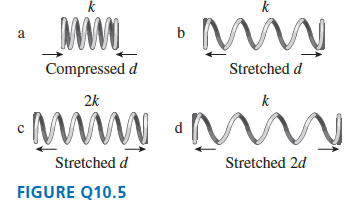
Rank in order, from most to least, the elastic potential energy (USp)ato (USp)dstored in the springs of FIGURE Q10.5. Explain. a Compressed d Stretched d 2k Stretched 2d Stretched d FIGURE Q10.5
a. What is the kinetic energy of a 1500 kg car traveling at a speed of 30 m/s (≈ 65 mph)?b. From what height would the car have to be dropped to have this same amount of kinetic energy just before impact?
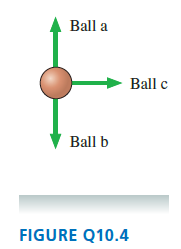
The three balls in FIGURE Q10.4, which have equal masses, are fired with equal speeds from the same height above the ground.Rank in order, from largest to smallest, their speeds va, vb, and vcas they hit the ground. Explain. Ball a Ball c Ball b FIGURE Q10.4
The lowest point in Death Valley is 85 m below sea level. The summit of nearby Mt. Whitney has an elevation of 4420 m. What is the change in potential energy when an energetic 65 kg hiker makes it from the floor of Death Valley to the top of Mt. Whitney?
A roller-coaster car rolls down a frictionless track, reaching speed v0 at the bottom. If you want the car to go twice as fast at the bottom, by what factor must you increase the height of the track? Explain.
A system of two objects has ΔKtot = 7 J and ΔUint = -5 J.a. How much work is done by interaction forces?b. How much work is done by external forces?
Can kinetic energy ever be negative? Can gravitational potential energy ever be negative? For each, give a plausible reason for your answer without making use of any equations.
Object A is stationary while objects B and C are in motion. Forces from object A do 10 J of work on object B and –5 J of work on object C. Forces from the environment do 4 J of work on object B and 8 J of work on object C. Objects B and C do not interact. What are ΔKtot and ΔUint if (a)
Upon what basic quantity does kinetic energy depend? Upon what basic quantity does potential energy depend?
A uniform solid bar with mass m and length L rotates with angular velocity ω about an axle at one end of the bar. What is the bar’s kinetic energy?
A gardener pushes a 12 kg lawnmower whose handle is tilted up 37° above horizontal. The lawnmower’s coefficient of rolling friction is 0.15. How much power does the gardener have to supply to push the lawnmower at a constant speed of 1.2 m/s? Assume his push is parallel to the handle.
A 12 kg weather rocket generates a thrust of 200 N. The rocket, pointing upward, is clamped to the top of a vertical spring.The bottom of the spring, whose spring constant is 550 N/m, is anchored to the ground.a. Initially, before the engine is ignited, the rocket sits at rest on top of the spring.
You are given the equation(s) used to solve a problem. For each of these, you are toa. Write a realistic problem for which this is the correct equation(s).b. Draw a pictorial representation.c. Finish the solution of the problem.T - (1500 kg)(9.8 m/s2) = (1500 kg)(1.0 m/s2)P = T(2.0 m/s)
You are given the equation(s) used to solve a problem. For each of these, you are toa. Write a realistic problem for which this is the correct equation(s).b. Draw a pictorial representation.c. Finish the solution of the problem.Fpush - (0.20)(30 kg)(9.8 m/s2) = 075 W = Fpush v
A 3.0-mm-diameter wire carries a 12 A current when the electric field is 0.085 V/m. What is the wire’s resistivity?
A 0.0075 V/m electric field creates a 3.9 mA current in a 1.0-mm-diameter wire. What material is the wire made of?
What electric field strength is needed to create a 5.0 A current in a 2.0-mm-diameter iron wire?
A 15-cm-long nichrome wire is connected across the terminals of a 1.5 V battery.a. What is the electric field inside the wire?b. What is the current density inside the wire?c. If the current in the wire is 2.0 A, what is the wire’s diameter?
The electric field in a 2.0 mm × 2.0 mm square aluminum wire is 0.012 V/m. What is the current in the wire?
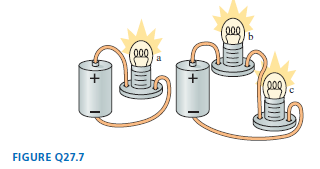
Both batteries in Figure Q27.7 are ideal and identical, and all lightbulbs are the same. Rank in order, from brightest to least bright, the brightness of bulbs a to c. Explain. 000 ь 000 FIGURE Q27.7
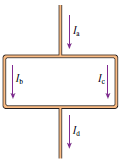
All the wires in Figure Q27.6 are made of the same material and have the same diameter. Rank in order, from largest to smallest, the currents Iato Id. Explain.
What is the difference between current and current density?
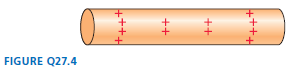
Is Figure Q27.4 a possible surface charge distribution for a current-carrying wire? If so, in which direction is the current? If not, why not? FIGURE Q27.4 ++ ++
The electron drift speed in a wire is exceedingly slow typically only a fraction of a millimeter per second. Yet when you turn on a flashlight switch, the light comes on almost instantly. Resolve this apparent paradox.
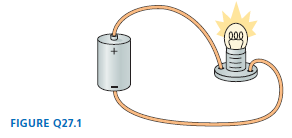
Consider a lightbulb circuit such as the one in Figure Q27.1. a. From the simple observations and measurements you can make on this circuit, can you distinguish a current composed of positive charge carriers from a current composed of negative charge carriers? If so, describe how you can tell
How much work does the electric motor of a Van de Graaff generator do to lift a positive ion (q = e) if the potential of the spherical electrode is 1.0 MV?
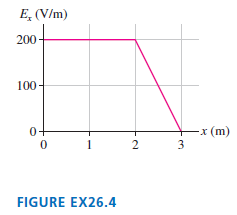
Figure EX26.4 is a graph of Ex. The potential at the origin is -50 V. What is the potential at x = 3.0 m? E, (V/m) 200 100 0+ -x (m) 3 1 FIGURE EX26.4 2.
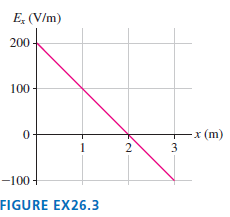
Figure EX26.3 is a graph of Ex. What is the potential difference between xi= 1.0 m and xf= 3.0 m? E, (V/m) 200 100 -x (m) 3 -100 - FIGURE EX26.3
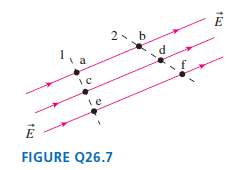
Figure Q26.7 shows an electric field diagram. Dashed lines 1 and 2 are two surfaces in space, not physical objects. a. Is the electric potential at point a higher than, lower than, or equal to the electric potential at point b? Explain.b. Rank in order, from largest to smallest, the magnitudes of
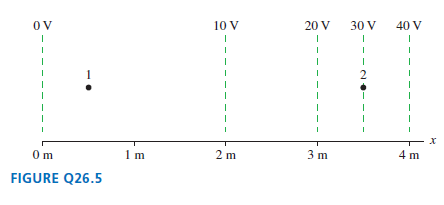
Estimate the electric fields E1and E2at points 1 and 2 in Figure Q26.5. Don€™t forget that E is a vector. OV 10 V 20 V 30 V 40 V 2 х 0m 2 m 3 m 4 m FIGURE Q26.5
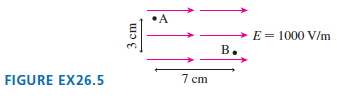
a. Which point in Figure EX26.5, A or B, has a larger electric potential?b. What is the potential difference between A and B? E = 1000 V/m B. FIGURE EX26.5 7 cm 3 cm
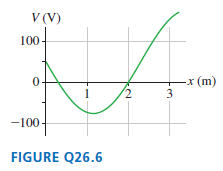
An electron is released from rest at x = 2 m in the potential shown in Figure Q26.6. Does it move? If so, to the left or to the right? Explain. V (V) 100- -x (m) 2. -100 - FIGURE Q26.6
Two flat, parallel electrodes 2.5 cm apart are kept at potentials of 20 V and 35 V. Estimate the electric field strength between them.
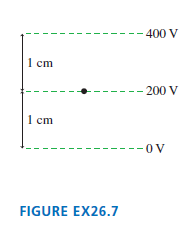
What are the magnitude and direction of the electric field at the dot in Figure EX26.7? 400 V 1 cm 200 V 1 cm --OV FIGURE EX26.7
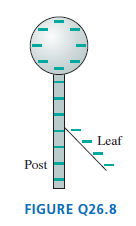
Figure Q26.8 shows a negatively charged electroscope. The gold leaf stands away from the rigid metal post. Is the electric potential of the leaf higher than, lower than, or equal to the potential of the post? Explain. Leaf Post FIGURE Q26.8
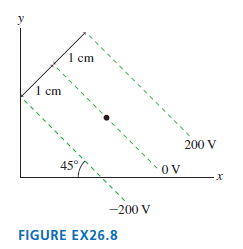
What are the magnitude and direction of the electric field at the dot in Figure EX26.8? 1 cm 1 cm 200 V 45° -200 V FIGURE EX26.8
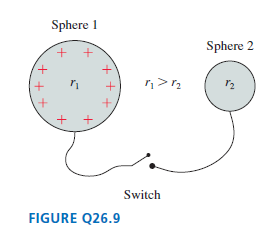
The two metal spheres in Figure Q26.9 are connected by a metal wire with a switch in the middle. Initially the switch is open. Sphere 1, with the larger radius, is given a positive charge. Sphere 2, with the smaller radius, is neutral. Then the switch is closed. Afterward, sphere 1 has charge Q1,
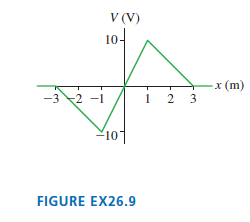
Figure EX26.9 shows a graph of V versus x in a region of space. The potential is independent of y and z. What is Exat (a) X = -2 cm, (b) X = 0 cm, (c) X = 2 cm? V (V) 10- x (m) -32 -1 1 2 3 107 FIGURE EX26.9
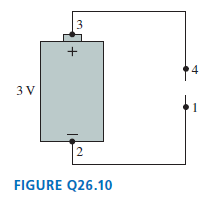
Figure Q26.10 shows a 3 V battery with metal wires attached to each end. What are the potential differences ΔV12= V2- V1, ΔV23= V3- V2, ΔV34= V4- V3, and ΔV41= V1- V4? 1 FIGURE Q26.10
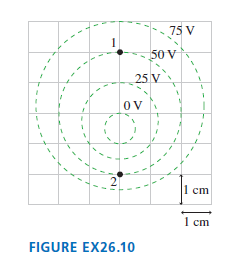
Determine the magnitude and direction of the electric field at points 1 and 2 in Figure EX26.10. 75 V 50 V 25 V OV 21 1 cm 1 cm FIGURE EX26.10
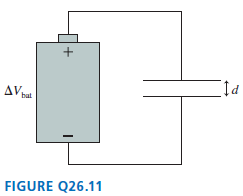
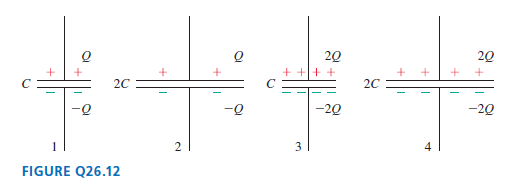
The parallel-plate capacitor in Figure Q26.11 is connected to a battery having potential difference ΔVbat. Without breaking any of the connections, insulating handles are used to increase the plate separation to 2d.a. Does the potential difference ΔVC change as the
The electric potential in a region of uniform electric field is -1000 V at x = -1.0 m and +1000 V at x = +1.0 m. What is Ex?
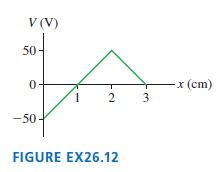
Figure EX26.12 is a graph of V versus x. Draw the corresponding graph of Exversus x. V (V) 50 -x (cm) 3 -50 FIGURE EX26.12
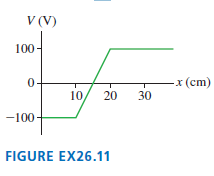
Figure EX26.11 is a graph of V versus x. Draw the corresponding graph of Exversus x. V (V) 100 - x (cm) 10 20 30 -100 FIGURE EX26.11
Rank in order, from largest to smallest, the potential differences (ΔVC)1to (ΔVC)4of the four capacitors in Figure Q26.12. Explain. 20 20 + ++ + 20 20 -20 -20 -Q 3 4 FIGURE Q26.12
Showing 2900 - 3000
of 3693
First
23
24
25
26
27
28
29
30
31
32
33
34
35
36
37
Step by Step Answers

 Get 50% OFF
Claim Now
Get 50% OFF
Claim Now