New Semester
Started
Get
50% OFF
Study Help!
--h --m --s
Claim Now
Question Answers
Textbooks
Find textbooks, questions and answers
Oops, something went wrong!
Change your search query and then try again
S
Books
FREE
Study Help
Expert Questions
Accounting
General Management
Mathematics
Finance
Organizational Behaviour
Law
Physics
Operating System
Management Leadership
Sociology
Programming
Marketing
Database
Computer Network
Economics
Textbooks Solutions
Accounting
Managerial Accounting
Management Leadership
Cost Accounting
Statistics
Business Law
Corporate Finance
Finance
Economics
Auditing
Tutors
Online Tutors
Find a Tutor
Hire a Tutor
Become a Tutor
AI Tutor
AI Study Planner
NEW
Sell Books
Search
Search
Sign In
Register
study help
physics
physics scientists and engineers
Physics for Scientists and Engineers A Strategic Approach with Modern Physics 4th edition Randall D. Knight - Solutions
The electric potential along the x-axis is V = 100x2 V, where x is in meters. What is Ex at(a) X = 0 m(b) X = 1 m?
The electric potential along the x-axis is V = 100e-2x V, where x is in meters. What is Ex at(a) X = 1.0 m(b) X = 2.0 m?
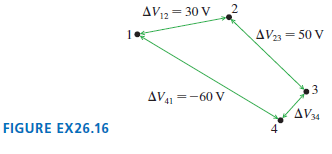
What is the potential difference ΔV34in Figure EX26.16? AV12 = 30 V AV23 = 50 V .3 AV =-60 V AV34 FIGURE EX26.16
How much charge does a 9.0 V battery transfer from the negative to the positive terminal while doing 27 J of work?
Light from the sun allows a solar cell to move electrons from the positive to the negative terminal, doing 2.4 × 10⁻¹⁹ J of work per electron. What is the emf of this solar cell?
You need to construct a 100 pF capacitor for a science project. You plan to cut two L × L metal squares and insert small spacers between their corners. The thinnest spacers you have are 0.20 mm thick. What is the proper value of L?
Two 3.0-cm-diameter aluminum electrodes are spaced 0.50 mm apart. The electrodes are connected to a 100 V battery.a. What is the capacitance?b. What is the magnitude of the charge on each electrode?
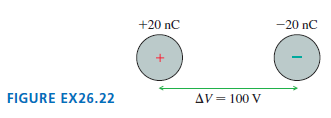
What is the capacitance of the two metal spheres shown in Figure EX26.22? -20 nC +20 nC FIGURE EX26.22 AV = 100 V
switch that connects a battery to a 10 μF capacitor is closed. Several seconds later you find that the capacitor plates are charged to ±30 μC. What is the emf of the battery?
A 6 μF capacitor, a 10 μF capacitor, and a 16 μF capacitor are connected in series. What is their equivalent capacitance?
A 6 μF capacitor, a 10 μF capacitor, and a 16 μF capacitor are connected in parallel. What is their equivalent capacitance?
Two 4.0 cm × 4.0 cm metal plates are separated by a 0.20-mm-thick piece of Teflon.a. What is the capacitance?b. What is the maximum potential difference between the plates?
The electric potential in a region of space is V = (150x2 - 200y2) V, where x and y are in meters. What are the strength and direction of the electric field at (x, y) = (2.0 m, 2.0 m)? Give the direction as an angle cw or ccw (specify which) from the positive x-axis.
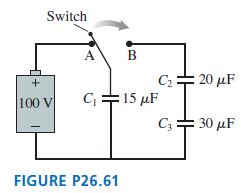
Initially, the switch in FIGURE P26.61 is in position A and capacitors C2and C3are uncharged. Then the switch is flipped to position B. Afterward, what are the charge on and the potential difference across each capacitor? Switch A : 20 μF C : C=15 µF 100 V : 30 μF C3 FIGURE P26.61
How much work does the charge escalator do to move 1.0 μC of charge from the negative terminal to the positive terminal of a 1.5 V battery?
You are given the equation(s) used to solve a problem. For each of these, you are toa. Write a realistic problem for which this is the correct equation(s).b. Draw a pictorial representation.c. Finish the solution of the problem.1/2 (2.0 kg)(4.0 m/s)2 + 0+ (0.15)(2.0 kg)(9.8 m/s2)(2.0 m) = 0 + 0 +
Six dogs pull a two-person sled with a total mass of 220 kg. The coefficient of kinetic friction between the sled and the snow is 0.080. The sled accelerates at 0.75 m/s2 until it reaches a cruising speed of 12 km/h. What is the team’s (a) Maximum power output during the acceleration
Astronomers using a 2.0-m-diameter telescope observe a distant supernova—an exploding star. The telescope’s detector records 9.1 × 10⁻¹¹ J of light energy during the first 10 s. It’s known that this type of supernova has a visible-light power output of 5.0 × 1037 W for the first 10 s of the
A Porsche 944 Turbo has a rated engine power of 217 hp. 30% of the power is lost in the drive train, and 70% reaches the wheels.The total mass of the car and driver is 1480 kg, and two-thirds of the weight is over the drive wheels.a. What is the maximum acceleration of the Porsche on a concrete
A farmer uses a tractor to pull a 150 kg bale of hay up a 15° incline to the barn at a steady 5.0 km/h. The coefficient of kinetic friction between the bale and the ramp is 0.45. What is the tractor’s power output?
When you ride a bicycle at constant speed, nearly all the energy you expend goes into the work you do against the drag force of the air. Model a cyclist as having cross-section area 0.45 m2 and, because the human body is not aerodynamically shaped, a drag coefficient of 0.90.a. What is the
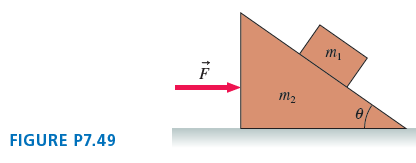
Find an expression for the magnitude of the horizontal force F in FIGURE P7.49 for which m1does not slip either up or down along the wedge. All surfaces are frictionless. m2 FIGURE P7.49
A 70 kg tightrope walker stands at the center of a rope. The rope supports are 10 m apart and the rope sags 10° at each end.The tightrope walker crouches down, then leaps straight up with an acceleration of 8.0 m/s2 to catch a passing trapeze. What is the tension in the rope as he jumps?
A 50-cm-diameter, 400 g beach ball is dropped with a 4.0 mg ant riding on the top. The ball experiences air resistance, but the ant does not. What is the magnitude of the normal force exerted on the ant when the ball’s speed is 2.0 m/s?
A long, 1.0 kg rope hangs from a support that breaks, causing the rope to fall, if the pull exceeds 40 N. A student team has built a 2.0 kg robot “mouse” that runs up and down the rope. What maximum acceleration can the robot have—both magnitude and direction—without the rope falling?
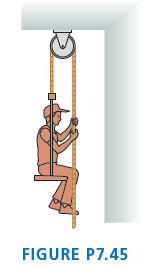
A house painter uses the chair-and pulley arrangement of FIGURE P7.45 to lift himself up the side of a house. The painter€™s mass is 70 kg and the chair€™s mass is 10 kg. With what force must he pull down on the rope in order to accelerate upward at 0.20 m/s2? FIGURE P7.45
A 3200 kg helicopter is flying horizontally. A 250 kg crate is suspended from the helicopter by a massless cable that is constantly 20° from vertical. What propulsion force Fprop is being provided by the helicopter’s rotor? Air resistance can be ignored. Give your answer in component form in a
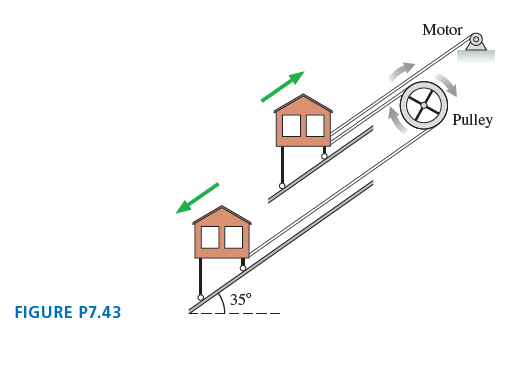
The century-old ascensores in Valparaiso, Chile, are picturesque cable cars built on stilts to keep the passenger compartments level as they go up and down the steep hillsides.As FIGURE P7.43 shows, one car ascends as the other descends. The cars use a two-cable arrangement to compensate for
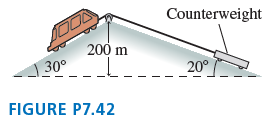
The 2000 kg cable car shown in FIGURE P7.42 descends a 200-m-high hill. In addition to its brakes, the cable car controls its speed by pulling an 1800 kg counterweight up the other side of the hill. The rolling friction of both the cable car and the counterweight are negligible.a. How much braking
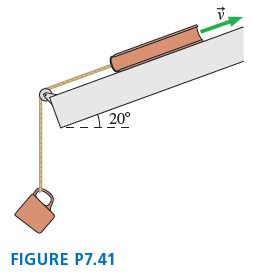
The 1.0 kg physics book in FIGURE P7.41 is connected by a string to a 500 g coffee cup.The book is given a push up the slope and released with a speed of 3.0 m/s. The coefficients of friction are μs= 0.50 and μk= 0.20.(a) How far does the book slide?(b) At the highest
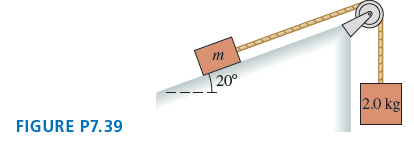
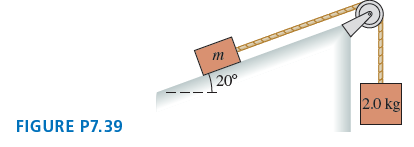
A 4.0 kg box is on a frictionless 35° slope and is connected via a massless string over a massless, frictionless pulley to a hanging 2.0 kg weight. The picture for this situation is similar to FIGURE P7.39.(a) What is the tension in the string if the 4.0 kg box is held in place, so that it
FIGURE P7.39 shows a block of mass m resting on a 20° slope. The block has coefficients of friction μs= 0.80 and μk= 0.50 with the surface. It is connected via a massless string over a massless, frictionless pulley to a hanging block of mass 2.0 kg.a. What is the
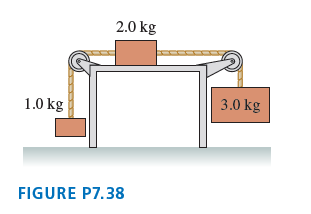
The coefficient of kinetic friction between the 2.0 kg block in FIGURE P7.38 and the table is 0.30. What is the acceleration of the 2.0 kg block? 2.0 kg 3.0 kg 1.0 kg FIGURE P7.38
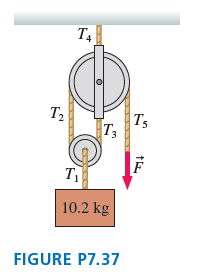
The 10.2 kg block in FIGURE P7.37 is held in place by a force applied to a rope passing over two massless, frictionless pulleys.Find the tensions T1to T5and the magnitude of force F. T4 T2 Ts т, 10.2 kg FIGURE P7.37
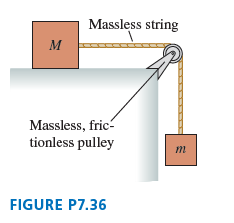
The block of mass M in FIGURE P7.36 slides on a frictionless surface. Find an expression for the tension in the string. Massless string Massless, fric- tionless pulley FIGURE P7.36
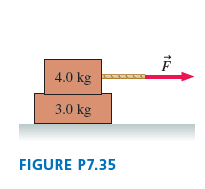
The coefficient of static friction is 0.60 between the two blocks in FIGURE P7.35. The coefficient of kinetic friction between the lower block and the floor is 0.20. Force F causes both blocks to cross a distance of 5.0 m, starting from rest. What is the least amount of time in which this motion
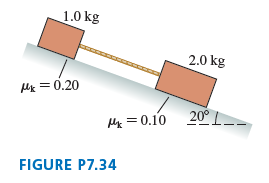
The two blocks in FIGURE P7.34 are sliding down the incline. What is the tension in the massless string? 1.0 kg 2.0 kg Hx = 0.20 Hy =0.10 20° FIGURE P7.34
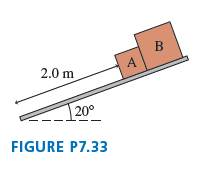
Two packages at UPS start sliding down the 20° ramp shown in FIGURE P7.33. Package A has a mass of 5.0 kg and a coefficient of friction of 0.20. Package B has a mass of 10 kg and a coefficient of friction of 0.15. How long does it take package A to reach the bottom? 2.0 m 200 FIGURE P7.33
Bob, who has a mass of 75 kg, can throw a 500 g rock with a speed of 30 m/s. The distance through which his hand moves as he accelerates the rock from rest until he releases it is 1.0 m.a. What constant force must Bob exert on the rock to throw it with this speed?b. If Bob is standing on
Your forehead can withstand a force of about 6.0 kN before fracturing, while your cheekbone can withstand only about 1.3 kN. Suppose a 140 g baseball traveling at 30 m/s strikes your head and stops in 1.5 ms.(a) What is the magnitude of the force that stops the baseball?(b) What force does the
A Federation star ship (2.0 × 10⁶ kg2) uses its tractor beam to pull a shuttle craft (2.0 × 10⁴ kg2) aboard from a distance of 10 km away. The tractor beam exerts a constant force of 4.0 × 10⁴ N on the shuttle craft. Both spacecraft are initially at rest. How far does the star ship move as it
While driving to work last year, I was holding my coffee mug in my left hand while changing the CD with my right hand. Then the cell phone rang, so I placed the mug on the flat part of my dashboard. Then, believe it or not, a deer ran out of the woods and on to the road right in front of me.
A rope of length L and mass m is suspended from the ceiling.Find an expression for the tension in the rope at position y, measured upward from the free end of the rope.
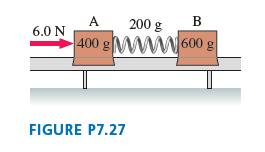
FIGURE P7.27 shows a 6.0 N force pushing two gliders along an air track. The 200 g spring between the gliders is compressed. How much force does the spring exert on (a) Glider A(b) Glider B?The spring is firmly attached to the gliders, and it does not sag. A 200 g 6.0 N 400 gW www.600 g FIGURE
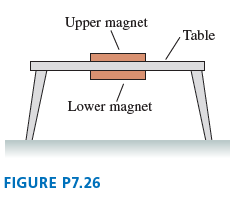
FIGURE P7.26 shows two strong magnets on opposite sides of a small table. The long-range attractive force between the magnets keeps the lower magnet in place.(a) Draw an interaction diagram and draw free-body diagrams for both magnets and the table. Use dashed lines to connect the members of an
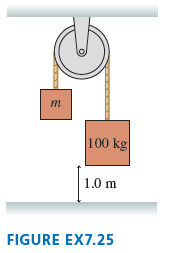
The 100 kg block in FIGURE EX7.25 takes 6.0 s to reach the floor after being released from rest. What is the mass of the block on the left? The pulley is massless and frictionless. 100 kg | 1.0 m FIGURE EX7.25
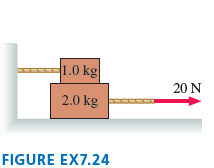
The 1.0 kg block in FIGURE EX7.24 is tied to the wall with a rope. It sits on top of the 2.0 kg block. The lower block is pulled to the right with a tension force of 20 N. The coefficient of kinetic friction at both the lower and upper surfaces of the 2.0 kg block is μk= 0.40.a. What
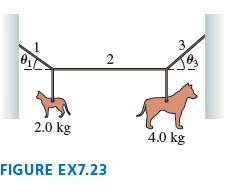
A mobile at the art museum has a 2.0 kg steel cat and a 4.0 kg steel dog suspended from a lightweight cable, as shown in FIGURE EX7.23. It is found that θ1= 20° when the center rope is adjusted to be perfectly horizontal. What are the tension and the angle of rope 3? 2 2.0 kg 4.0
A 2.0 kg rope hangs from the ceiling. What is the tension at the midpoint of the rope?
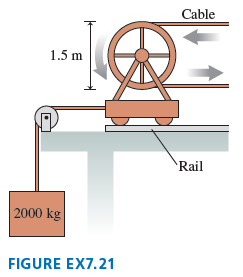
The cable cars in San Francisco are pulled along their tracks by an underground steel cable that moves along at 9.5 mph. The cable is driven by large motors at a central power station and extends, via an intricate pulley arrangement, for several miles beneath the city streets. The length of a cable
Two blocks are attached to opposite ends of a massless rope that goes over a massless, frictionless, stationary pulley. One of the blocks, with a mass of 6.0 kg, accelerates downward at 3/4 g.What is the mass of the other block?
A woman living in a third-story apartment is moving out. Rather than carrying everything down the stairs, she decides to pack her belongings into crates, attach a frictionless pulley to her balcony railing, and lower the crates by rope. How hard must she pull on the horizontal end of the rope to
A 2.0-m-long, 500 g rope pulls a 10 kg block of ice across a horizontal, frictionless surface. The block accelerates at 2.0 m/s2. How much force pulls forward on(a) The ice,(b) The rope?Assume that the rope is perfectly horizontal.
A hydroelectric power plant uses spinning turbines to transform the kinetic energy of moving water into electric energy with 80% efficiency. That is, 80% of the kinetic energy becomes electric energy. A small hydroelectric plant at the base of a dam generates 50 MW of electric power when the
A 90 kg firefighter needs to climb the stairs of a 20-m-tall building while carrying a 40 kg backpack filled with gear. How much power does he need to reach the top in 55 s?
A horizontal spring with spring constant 250 N/m is compressed by 12 cm and then used to launch a 250 g box across the floor. The coefficient of kinetic friction between the box and the floor is 0.23. What is the box’s launch speed?
A spring of equilibrium length L1 and spring constant k1 hangs from the ceiling. Mass m1 is suspended from its lower end. Then a second spring, with equilibrium length L2 and spring constant k2, is hung from the bottom of m1. Mass m2 is suspended from this second spring. How far is m2 below the
Two identical horizontal springs are attached to opposite sides of a box that sits on a frictionless table. The outer ends of the springs are clamped while the springs are at their equilibrium lengths.Then a 2.0 N force applied to the box, parallel to the springs, compresses one spring by 3.0 cm
When a 65 kg cheerleader stands on a vertical spring, the spring compresses by 5.5 cm. When a second cheerleader stands on the shoulders of the first, the spring compresses an additional 4.5 cm.What is the mass of the second cheerleader?
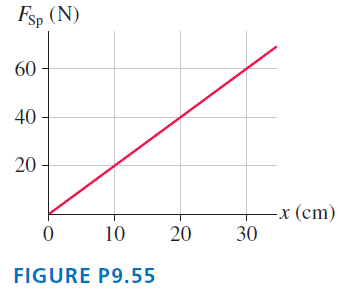
A 50 g rock is placed in a slingshot and the rubber band is stretched. The magnitude of the force of the rubber band on the rock is shown by the graph in FIGURE P9.55. The rubber band is stretched 30 cm and then released. What is the speed of the rock? Fsp (N) 60 40 - 20 -x (ст) 30 10 FIGURE P9.55
An electric dipole consists of two equal but opposite electric charges, +q and -q, separated by a small distance d. If another charge Q is distance x from the center of the dipole, in the plane perpendicular to the line between +q and -q, and if x >> d, the dipole exerts an electric force F =
The gravitational attraction between two objects with masses m1 and m2, separated by distance x, is F = Gm1m2 /x2, where G is the gravitational constant.a. How much work is done by gravity when the separation changes from x1 to x2? Assume x2 < x1.b. If one mass is much greater than the other,
The force acting on a particle is Fx = F0e-x/L. How much work does this force do as the particle moves along the x-axis from x = 0 to x = L?
Hooke’s law describes an ideal spring. Many real springs are better described by the restoring force (FSp)s = -kΔs - q(Δs)3, where q is a constant. Consider a spring with k = 250 N/m and q = 800 N/m3.a. How much work must you do to compress this spring 15 cm? Note that, by Newton’s third law,
You’re fishing from a tall pier and have just caught a 1.5 kg fish. As it breaks the surface, essentially at rest, the tension in the vertical fishing line is 16 N. Use work and energy to find the fish’s upward speed after you’ve lifted it 2.0 m.
A 50 kg ice skater is gliding along the ice, heading due north at 4.0 m/s. The ice has a small coefficient of static friction, to prevent the skater from slipping sideways, but μk = 0. Suddenly, a wind from the northeast exerts a force of 4.0 N on the skater.a. Use work and energy to find the
A pile driver lifts a 250 kg weight and then lets it fall onto the end of a steel pipe that needs to be driven into the ground. A fall of 1.5 m drives the pipe in 35 cm. What is the average force exerted on the pipe?
A ball shot straight up with kinetic energy K0 reaches height h. What height will it reach if the initial kinetic energy is doubled?
A particle of mass m moving along the x-axis has velocity vx = v0 sin (πx/2L). How much work is done on the particle as it moves (a) From x = 0 to x = L(b) From x = 0 to x = 2L?
Susan’s 10 kg baby brother Paul sits on a mat. Susan pulls the mat across the floor using a rope that is angled 30° above the floor.The tension is a constant 30 N and the coefficient of friction is 0.20. Use work and energy to find Paul’s speed after being pulled 3.0 m.
a. Starting from rest, a crate of mass m is pushed up a frictionless slope of angle θ by a horizontal force of magnitude F. Use work and energy to find an expression for the crate’s speed v when it is at height h above the bottom of the slope.b. Doug uses a 25 N horizontal force to push a 5.0 kg
A 1000 kg elevator accelerates upward at 1.0 m/s2 for 10 m, starting from rest.a. How much work does gravity do on the elevator?b. How much work does the tension in the elevator cable do on the elevator?c. What is the elevator’s kinetic energy after traveling 10 m?
The human heart pumps the average adult’s 6.0 L (6000 cm3) of blood through the body every minute. The heart must do work to overcome frictional forces that resist blood flow. The average adult blood pressure is 1.3 × 10⁴ N/m2.a. How much work does the heart do to move the 6.0 L of blood
A 70 kg human sprinter can accelerate from rest to 10 m/s in 3.0 s. During the same time interval, a 30 kg greyhound can go from rest to 20 m/s. What is the average power output of each? Average power over a time interval Δt is ΔE/Δt.
A 50 kg sprinter, starting from rest, runs 50 m in 7.0 s at constant acceleration.a. What is the magnitude of the horizontal force acting on the sprinter?b. What is the sprinter’s power output at 2.0 s, 4.0 s, and 6.0 s?
At midday, solar energy strikes the earth with an intensity of about 1 kW/m2. What is the area of a solar collector that could collect 150 MJ of energy in 1 h? This is roughly the energy content of 1 gallon of gasoline.
How much energy is consumed by(a) A 1.2 kW hair dryer used for 10 min.(b) A 10 W night light left on for 24 h?
a. How much work must you do to push a 10 kg block of steel across a steel table at a steady speed of 1.0 m/s for 3.0 s?b. What is your power output while doing so?
a. How much work does an elevator motor do to lift a 1000 kg elevator a height of 100 m?b. How much power must the motor supply to do this in 50 s at constant speed?
Justin, with a mass of 30 kg, is going down an 8.0-m-high water slide. He starts at rest, and his speed at the bottom is 11 m/s. How much thermal energy is created by friction during his descent?
An 8.0 kg crate is pulled 5.0 m up a 30° incline by a rope angled 18° above the incline. The tension in the rope is 120 N, and the crate’s coefficient of kinetic friction on the incline is 0.25.a. How much work is done by tension, by gravity, and by the normal force?b. What is the increase in
A baggage handler throws a 15 kg suitcase along the floor of an airplane luggage compartment with a speed of 1.2 m/s. The suitcase slides 2.0 m before stopping. Use work and energy to find the suitcase’s coefficient of kinetic friction on the floor.
A 55 kg softball player slides into second base, generating 950 J of thermal energy in her legs and the ground. How fast was she running?
One mole (6.02 × 10²³ atoms) of helium atoms in the gas phase has 3700 J of microscopic kinetic energy at room temperature.If we assume that all atoms move with the same speed, what is that speed? The mass of a helium atom is 6.68 × 10⁻²⁷ kg.
A horizontal spring with spring constant 85 N/m extends outward from a wall just above floor level. A 1.5 kg box sliding across a frictionless floor hits the end of the spring and compresses it 6.5 cm before the spring expands and shoots the box back out. How fast was the box going when it hit the
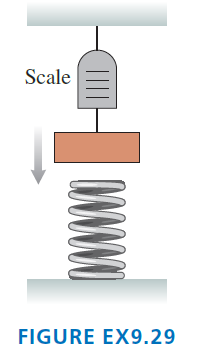
A 5.0 kg mass hanging from a spring scale is slowly lowered onto a vertical spring, as shown in FIGURE EX9.29. The scale reads in newtons.a. What does the spring scale read just before the mass touches the lower spring?b. The scale reads 20 N when the lower spring has been compressed by 2.0 cm.What
A 60 kg student is standing atop a spring in an elevator as it accelerates upward at 3.0 m/s2. The spring constant is 2500 N/m. By how much is the spring compressed?
A 10-cm-long spring is attached to the ceiling. When a 2.0 kg mass is hung from it, the spring stretches to a length of 15 cm.a. What is the spring constant?b. How long is the spring when a 3.0 kg mass is suspended from it?
A 35-cm-long vertical spring has one end fixed on the floor. Placing a 2.2 kg physics textbook on the spring compresses it to a length of 29 cm. What is the spring constant?
A horizontal spring with spring constant 750 N/m is attached to a wall. An athlete presses against the free end of the spring, compressing it 5.0 cm. How hard is the athlete pushing?
A 150 g particle at x = 0 is moving at 2.00 m/s in the +x-direction. As it moves, it experiences a force given by Fx = (0.250 N) sin (x/2.00 m). What is the particle’s speed when it reaches x = 3.14 m?
A particle moving on the x-axis experiences a force given by Fx = qx2, where q is a constant. How much work is done on the particle as it moves from x = 0 to x = d?
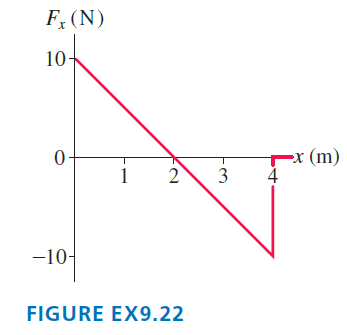
A 2.0 kg particle moving along the x-axis experiences the force shown in FIGURE EX9.22. The particle€™s velocity is 4.0 m/s at x = 0 m. What is its velocity at x = 2 m and x = 4 m? F; (N) 10- -x (m) 4 1 3 -10- FIGURE EX9.22
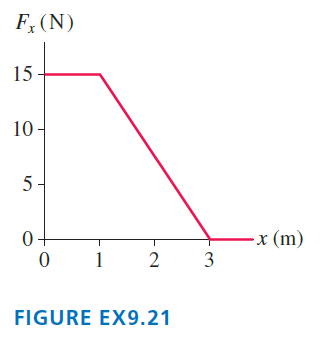
A 500 g particle moving along the x-axis experiences the force shown in FIGURE EX9.21. The particle€™s velocity is 2.0 m/s at x = 0 m. What is its velocity at x = 3 m? F; (N) 15 - 10- 5- -x (m) 0- 1 FIGURE EX9.21 3. 2.
What is the angle θ between vectors A u and Bu in each part of Exercise 12?Exercise 12a. A = 3î + 4ĵ and B = 2î - 6ĵ.b. A = 3î - 2ĵ and B = 6î + 4ĵ.
Evaluate the dot product A · B ifa. A = 3î + 4ĵ and B = 2î - 6ĵ.b. A = 3î - 2ĵ and B = 6î + 4ĵ.
The left end of a spring is attached to a wall. When Bob pulls on the right end with a 200 N force, he stretches the spring by 20 cm.The same spring is then used for a tug-of-war between Bob and Carlos. Each pulls on his end of the spring with a 200 N force.How far does the spring stretch? Explain.
Evaluate the dot product A · B ifa. A = 4î - 2ĵ and B = -2î - 3ĵ.b. A = -4î + 2ĵ and B = 2î + 4ĵ.
You need to raise a heavy block by pulling it with a massless rope.You can either (a) Pull the block straight up height h,(b) Pull it up a long, frictionless plane inclined at a 15° angle until its height has increased by h. Assume you will move the block at constant speed either way. Will
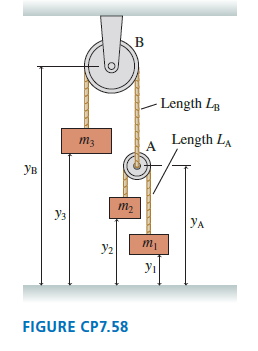
FIGURE CP7.58 shows three hanging masses connected by massless strings over two massless, frictionless pulleys.(a) Find the acceleration constraint for this system. It is a single equation relating a1y, a2y, and a3y.(b) Find an expression for the tension in string A.(c) Suppose: m1= 2.5 kg, m2= 1.5
Showing 3000 - 3100
of 3693
First
23
24
25
26
27
28
29
30
31
32
33
34
35
36
37
Step by Step Answers

 Get 50% OFF
Claim Now
Get 50% OFF
Claim Now