New Semester
Started
Get
50% OFF
Study Help!
--h --m --s
Claim Now
Question Answers
Textbooks
Find textbooks, questions and answers
Oops, something went wrong!
Change your search query and then try again
S
Books
FREE
Study Help
Expert Questions
Accounting
General Management
Mathematics
Finance
Organizational Behaviour
Law
Physics
Operating System
Management Leadership
Sociology
Programming
Marketing
Database
Computer Network
Economics
Textbooks Solutions
Accounting
Managerial Accounting
Management Leadership
Cost Accounting
Statistics
Business Law
Corporate Finance
Finance
Economics
Auditing
Tutors
Online Tutors
Find a Tutor
Hire a Tutor
Become a Tutor
AI Tutor
AI Study Planner
NEW
Sell Books
Search
Search
Sign In
Register
study help
physics
physics scientists and engineers
Physics for Scientists and Engineers A Strategic Approach with Modern Physics 4th edition Randall D. Knight - Solutions
A cylinder of nitrogen gas has a volume of 15,000 cm3 and a pressure of 100 atm.a. What is the thermal energy of this gas at room temperature (20°C)?b. What is the mean free path in the gas?c. The valve is opened and the gas is allowed to expand slowly and isothermally until it reaches a pressure
1.0 mol of a monatomic gas interacts thermally with 1.0 mol of an elemental solid. The gas temperature decreases by 50°C at constant volume. What is the temperature change of the solid?
What is the thermal energy of 100 cm3 of aluminum at 100°C?
The thermal energy of 1.0 mol of a substance is increased by 1.0 J. What is the temperature change if the system is(a) A monatomic gas,(b) A diatomic gas,(c) A solid?
A 6.0 m × 8.0 m × 3.0 m room contains air at 20°C. What is the room’s thermal energy?
The rms speed of the atoms in a 2.0 g sample of helium gas is 700 m/s. What is the thermal energy of the gas?
A 10 g sample of neon gas has 1700 J of thermal energy. Estimate the average speed of a neon atom.
The atmosphere of the sun consists mostly of hydrogen atoms (not molecules) at a temperature of 6000 K. What are(a) The average translational kinetic energy per atom(b) The rms speed of the atoms?
What are(a) The average kinetic energy(b) The rms speed of a proton in the center of the sun, where the temperature is 2.0 × 10⁷ K?
During a physics experiment, helium gas is cooled to a temperature of 10 K at a pressure of 0.10 atm. What are(a) The mean free path in the gas,(b) The rms speed of the atoms,(c) The average energy per atom?
Suppose you double the temperature of a gas at constant volume. Do the following change? If so, by what factor?a. The average translational kinetic energy of a molecule.b. The rms speed of a molecule.c. The mean free path.
At STP, what is the total translational kinetic energy of the molecules in 1.0 mol of(a) Hydrogen,(b) Helium,(c) Oxygen?
Atoms can be “cooled” to incredibly low temperatures by letting them interact with a laser beam. Various novel quantum phenomena appear at these temperatures. What is the rms speed of cesium atoms that have been cooled to a temperature of 100 nK?
By what factor does the rms speed of a molecule change if the temperature is increased from 10°C to 1000°C?
The rms speed of molecules in a gas is 600 m/s. What will be the rms speed if the gas pressure and volume are both halved?
At what temperature (in °C) do hydrogen molecules have the same rms speed as nitrogen molecules at 100°C?
1.5 m/s is a typical walking speed. At what temperature (in °C) would nitrogen molecules have an rms speed of 1.5 m/s?
What are the rms speeds of(a) Argon atoms(b) Hydrogen molecules at 800°C?
A gas consists of a mixture of neon and argon. The rms speed of the neon atoms is 400 m/s. What is the rms speed of the argon atoms?
A cylinder contains gas at a pressure of 2.0 atm and a number density of 4.2 × 1025 m-3. The rms speed of the atoms is 660 m/s. Identify the gas.
At 100°C the rms speed of nitrogen molecules is 576 m/s.Nitrogen at 100°C and a pressure of 2.0 atm is held in a container with a 10 cm × 10 cm square wall. Estimate the rate of molecular collisions (collisions/s) on this wall.
The number density in a container of neon gas is 5.00 × 1025 m-3. The atoms are moving with an rms speed of 660 m/s. What are(a) The temperature(b) The pressure inside the container?
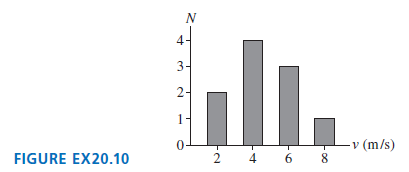
FIGURE EX20.10 is a histogram showing the speeds of the molecules in a very small gas. What are (a) The most probable speed, (b) The average speed, (c) The rms speed? N In. 3- 2- -v (m/s) FIGURE EX20.10 2 4 6 8 4.
Eleven molecules have speeds 15, 16, 17, … , 25 m/s. Calculate(a) vavg(b) vrms.
Suppose you place an ice cube in a beaker of room temperature water, then seal them in a rigid, well-insulated container. No energy can enter or leave the container.a. If you open the container an hour later, will you find a beaker of water slightly cooler than room temperature, or a large ice cube
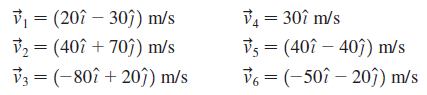
The molecules in a six-particle gas have velocitiesCalculate(a) vavg,(b) vavg,(c) vrms. V1 = (20î – 30) m/s V2 = (40î + 70î) m/s V3 = (-80î + 20ĵ) m/s V = 30î m/s Vs = (40î – 407) m/s 36 = (-50î – 203) m/s %3D %3D
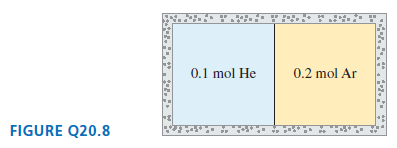
The two containers of gas in FIGURE Q20.8 are in good thermal contact with each other but well insulated from the environment. They have been in contact for a long time and are in thermal equilibrium. a. Is vrms of helium greater than, less than, or equal to vrms of argon? Explain.b. Does the
For a monatomic gas, what is the ratio of the volume per atom (V/N) to the volume of an atom when the mean free path is ten times the atomic diameter?
Suppose you could suddenly increase the speed of every molecule in a gas by a factor of 2.a. Would the temperature of the gas increase by a factor of 21/2, 2, or 22? Explain.b. Would the molar specific heat at constant volume change? If so, by what factor? If not, why not?
A lottery machine uses blowing air to keep 2000 Ping-Pong balls bouncing around inside a 1.0 m × 1.0 m × 1.0 m box. The diameter of a Ping-Pong ball is 3.0 cm. What is the mean free path between collisions? Give your answer in cm.
Suppose you could suddenly increase the speed of every molecule in a gas by a factor of 2.a. Would the rms speed of the molecules increase by a factor of 21/2, 2, or 22? Explain.b. Would the gas pressure increase by a factor of 21/2, 2, or 22? Explain.
The mean free path of a molecule in a gas is 300 nm. What will the mean free path be if the gas temperature is doubled at(a) Constant volume(b) Constant pressure?
If the pressure of a gas is really due to the random collisions of molecules with the walls of the container, why do pressure gauges—even very sensitive ones—give perfectly steady readings? Shouldn’t the gauge be continually jiggling and fluctuating? Explain.
Integrated circuits are manufactured in vacuum chambers in which the air pressure is 1.0 × 10⁻¹⁰ mm of Hg. What are(a) The number density(b) The mean free path of a molecule? Assume T = 20°C.
The mean free path of molecules in a gas is 200 nm.a. What will be the mean free path if the pressure is doubled while the temperature is held constant?b. What will be the mean free path if the absolute temperature is doubled while the pressure is held constant?
The density of air at STP is about 1/1000 the density of water. How does the average distance between air molecules compare to the average distance between water molecules? Explain.
At what pressure will the mean free path in room-temperature (20°C) nitrogen be 1.0 m?
A 1.0 m × 1.0 m × 1.0 m cube of nitrogen gas is at 20°C and 1.0 atm. Estimate the number of molecules in the cube with a speed between 700 m/s and 1000 m/s.
Gases, in contrast with solids and liquids, are very compressible.What can you infer from this observation about the microscopic nature of gases?
The number density of an ideal gas at STP is called the Loschmidt number. Calculate the Loschmidt number.
Solids and liquids resist being compressed. They are not totally incompressible, but it takes large forces to compress them even slightly. If it is true that matter consists of atoms, what can you infer about the microscopic nature of solids and liquids from their incompressibility?
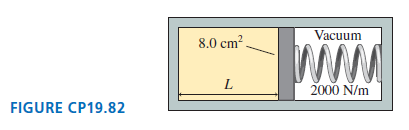
A monatomic gas fills the left end of the cylinder in Figure CP19.82. At 300 K, the gas cylinder length is 10.0 cm and the spring is compressed by 2.0 cm. How much heat energy must be added to the gas to expand the cylinder length to 16.0 cm? 8.0 cm?. Vacuum 2000 N/m FIGURE CP19.82
0.020 mol of a diatomic gas, with initial temperature 20°C, are compressed from 1500 cm3 to 500 cm3 in a process in which pV2 = constant. How much heat energy is added during this process?
One cylinder in the diesel engine of a truck has an initial volume of 600 cm3. Air is admitted to the cylinder at 30°C and a pressure of 1.0 atm. The piston rod then does 400 J of work to rapidly compress the air. What are its final temperature and volume?
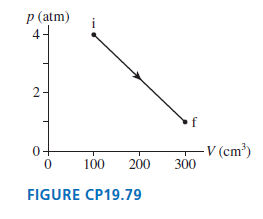
Figure CP19.79 shows a thermodynamic process followed by 0.015 mol of hydrogen. How much heat energy is transferred to the gas? p (atm) 2- -V (cm³) 300 100 200 FIGURE CP19.79
A beaker with a metal bottom is filled with 20 g of water at 20°C. It is brought into good thermal contact with a 4000 cm3 container holding 0.40 mol of a monatomic gas at 10 atm pressure.Both containers are well insulated from their surroundings. What is the gas pressure after a long time has
10 g of aluminum at 200°C and 20 g of copper are dropped into 50 cm3 of ethyl alcohol at 15°C. The temperature quickly comes to 25°C. What was the initial temperature of the copper?
You are given the equation used to solve a problem. For each of these, you are toa. Write a realistic problem for which this is the correct equation.b. Finish the solution of the problem.(10 atm)V21.40 = (1.0 atm)V11.40
You are given the equation used to solve a problem. For each of these, you are toa. Write a realistic problem for which this is the correct equation.b. Finish the solution of the problem.(200 × 10-6 m3)(13,600 kg/m3)× (140 J/kg K)(90°C - 15°C)+ (0.50 kg)(449 J/kg K)(90°C - Ti) = 0
You are given the equation used to solve a problem. For each of these, you are toa. Write a realistic problem for which this is the correct equation.b. Finish the solution of the problem.50 J = -n(8.31 J/mol K)(350 K)ln(1/3)
The sun’s intensity at the distance of the earth is 1370 W/m2.30% of this energy is reflected by water and clouds; 70% is absorbed. What would be the earth’s average temperature (in °C) if the earth had no atmosphere? The emissivity of the surface is very close to 1. (The actual average
A satellite to reflect radar is a 2.0-m-diameter, 2.0-mm-thick spherical copper shell. While orbiting the earth, the satellite absorbs sunlight and is warmed to 50°C. When it passes into the earth’s shadow, the satellite radiates energy to deep space. The temperature of deep space is actually 3
Most stars are main-sequence stars, a group of stars for which size, mass, surface temperature, and radiated power are closely related. The sun, for instance, is a yellow main sequence star with a surface temperature of 5800 K. For a main-sequence star whose mass M is more than twice that of the
A cylindrical copper rod and an iron rod with exactly the same dimensions are welded together end to end. The outside end of the copper rod is held at 100°C, and the outside end of the iron rod is held at 0°C. What is the temperature at the midpoint where the rods are joined together?
A cubical box 20 cm on a side is constructed from 1.2-cm thick concrete panels. A 100 W light bulb is sealed inside the box.What is the air temperature inside the box when the light is on if the surrounding air temperature is 20°C?
You would like to put a solar hot water system on your roof, but you’re not sure it’s feasible. A reference book on solar energy shows that the ground-level solar intensity in your city is 800 W/m2 for at least 5 hours a day throughout most of the year. Assuming that a completely black
When strong winds rapidly carry air down from mountains to a lower elevation, the air has no time to exchange heat with its surroundings. The air is compressed as the pressure rises, and its temperature can increase dramatically. These warm winds are called Chinook winds in the Rocky Mountains and
A cylinder with a movable piston contains n moles of gas at a temperature higher than that of the surrounding environment. An external force on the piston keeps the pressure constant while the gas cools as ΔT = (ΔT)0e-t/τ, where ΔT is the temperature difference between the gas and the
You come into lab one day and find a well-insulated 2000 mL thermos bottle containing 500 mL of boiling liquid nitrogen. The remainder of the thermos has nitrogen gas at a pressure of 1.0 atm. The gas and liquid are in thermal equilibrium. While waiting for lab to start, you notice a piece of iron
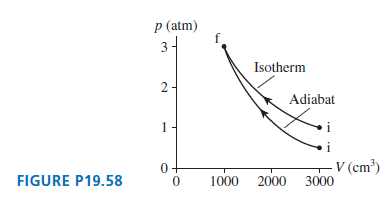
0.10 mol of nitrogen gas follow the two processes shown in Figure P19.58. How much heat is required for each? p (atm) 3 Isotherm 2- Adiabat V (cm³) 3000 FIGURE P19.58 1000 2000
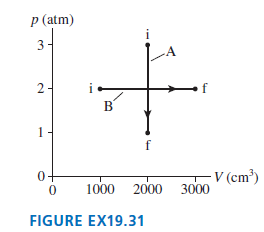
0.10 mol of nitrogen gas follow the two processes shown in Figure EX19.31. How much heat is required for each? p (atm) 3 2 - V (cm³) 0+ 2000 3000 1000 FIGURE EX19.31
A scientist whose scale is broken but who has a working 2.5 kW heating coil and a thermometer decides to improvise to determine the mass of a block of aluminum she has recently acquired. She heats the aluminum for 30 s and finds that its temperature increases from 20°C to 35°C. What is the mass
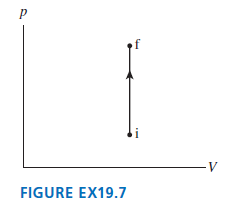
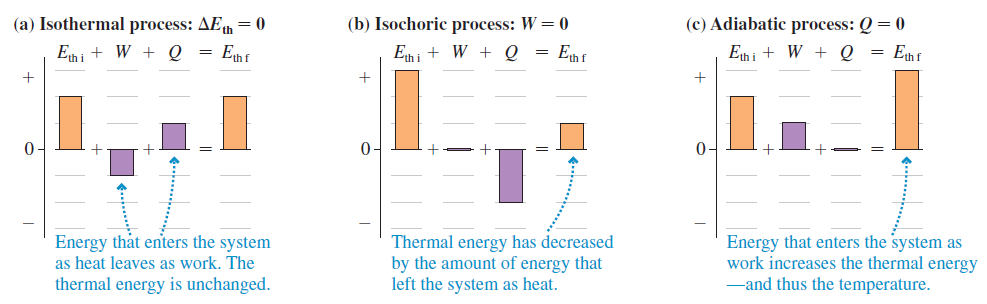
Draw a first-law bar chart (see Figure 19.12) for the gas process in Figure EX19.7.Figure 19.12 -V FIGURE EX19.7 (a) Isothermal process: AEh = 0 (b) Isochoric process: W = 0 (c) Adiabatic process: Q = 0 Eth i + W + Q = Enf En i + W + Q Enf Ehi + W + Q = Enf 0- Energy that enters the system as heat
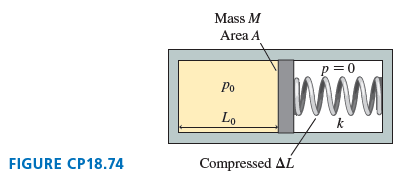
The closed cylinder of FIGURE CP18.74 has a tight-fitting but frictionless piston of mass M. The piston is in equilibrium when the left chamber has pressure p0and length L0while the spring on the right is compressed by ΔL.a. What is ΔL in terms of p0, L0, A, M, and k?b.
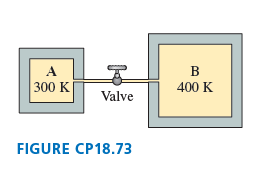
Containers A and B in FIGURE CP18.73 hold the same gas. The volume of B is four times the volume of A. The two containers are connected by a thin tube (negligible volume) and a valve that is closed. The gas in A is at 300 K and pressure of 1.0 × 10⁵Pa.The gas in B is at 400 K and
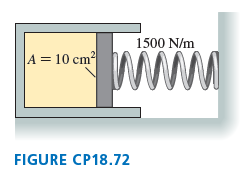
The cylinder in FIGURE CP18.72 has a moveable piston attached to a spring. The cylinder€™s cross-section area is 10 cm2, it contains 0.0040 mol of gas, and the spring constant is 1500 N/m. At 20°C the spring is neither compressed nor stretched. How far is the spring compressed if the
An inflated bicycle inner tube is 2.2 cm in diameter and 200 cm in circumference. A small leak causes the gauge pressure to decrease from 110 psi to 80 psi on a day when the temperature is 20°C. What mass of air is lost? Assume the air is pure nitrogen.
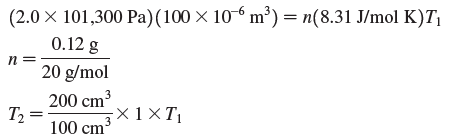
You are given the equation(s) used to solve a problem. For each of these, you are toa. Write a realistic problem for which this is the correct equation(s).b. Draw a pV diagram.c. Finish the solution of the problem. (2.0 × 101,300 Pa)(100 × 10-6 m³) = n(8.31 J/mol K)T| 0.12 g 20 g/mol п 200 cm3
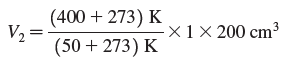
You are given the equation(s) used to solve a problem. For each of these, you are toa. Write a realistic problem for which this is the correct equation(s).b. Draw a pV diagram.c. Finish the solution of the problem. (400 + 273) K V2 = (50 + 273) K ×1 × 200 cm³
You are given the equation(s) used to solve a problem. For each of these, you are toa. Write a realistic problem for which this is the correct equation(s).b. Draw a pV diagram.c. Finish the solution of the problem. 200 kPa |(T, + 273) K = X1 × (400 + 273) K 500 kPa
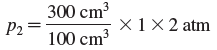
You are given the equation(s) used to solve a problem. For each of these, you are toa. Write a realistic problem for which this is the correct equation(s).b. Draw a pV diagram.c. Finish the solution of the problem. 300 cm3 P2 100 cm3 X1× 2 atm
Five grams of nitrogen gas at an initial pressure of 3.0 atm and at 20°C undergo an isobaric expansion until the volume has tripled.a. What is the gas volume after the expansion?b. What is the gas temperature after the expansion (in °C)? The gas pressure is then decreased at constant volume until
A container of gas at 2.0 atm pressure and 127°C is compressed at constant temperature until the volume is halved. It is then further compressed at constant pressure until the volume is halved again.a. What are the final pressure and temperature of the gas?b. Show this process on a pV diagram.
10 g of dry ice (solid CO2) is placed in a 10,000 cm3 container, then all the air is quickly pumped out and the container sealed. The container is warmed to 0°C, a temperature at which CO2 is a gas.a. What is the gas pressure? Give your answer in atm. The gas then undergoes an isothermal
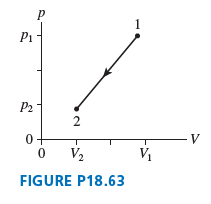
4.0 g of oxygen gas, starting at 820°C, follow the process 1 †’ 2 shown in FIGURE P18.63. What is temperature T2(in °C)? P1 P2 2 0+ V2 V1 FIGURE P18.63
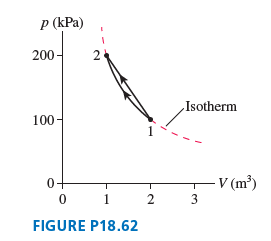
FIGURE P18.62 shows two different processes by which 80 mol of gas move from state 1 to state 2. The dashed line is an isotherm.a. What is the temperature of the isothermal process?b. What maximum temperature is reached along the straight line process? p (kPa) 200- Isotherm 100 - V (m³) 2 3 FIGURE
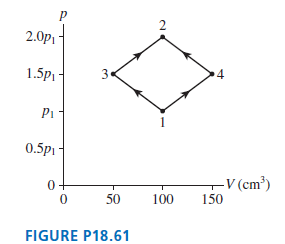
FIGURE P18.61 shows two different processes by which 1.0 g of nitrogen gas moves from state 1 to state 2. The temperature of state 1 is 25?C. What are (a) Pressure p1 (b) Temperatures (in ?C) T2, T3, and T4? 2.0p 1.5p 3. Pi 0.5p1 - V (cm³) 50 100 150 FIGURE P18.61 2.
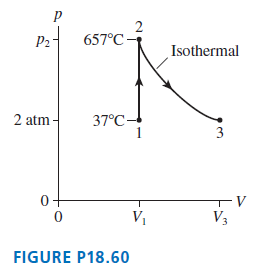
8.0 g of helium gas follows the process 1 ?? 2 ?? 3 shown in FIGURE P18.60. Find the values of V1, V3, p2, and T3. P2- 657°C - Isothermal 2 atm - 37°C- 3 0+ -v V1 V3 FIGURE P18.60
A diver 50 m deep in 10°C fresh water exhales a 1.0-cm diameter bubble. What is the bubble’s diameter just as it reaches the surface of the lake, where the water temperature is 20°C?
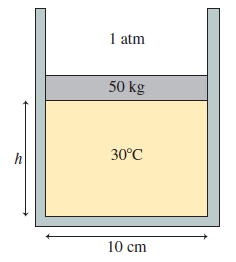
The 50 kg circular piston shown in FIGURE P18.58 floats on 0.12 mol of compressed air.a. What is the piston height h if the temperature is 30?C?b. How far does the piston move if the temperature is increased by 100?C? 1 atm 50 kg 30°C h 10 cm
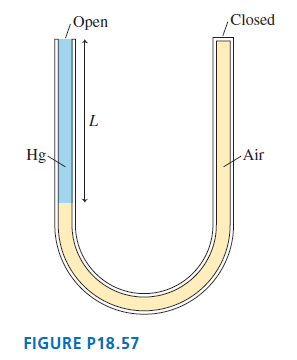
The U-shaped tube in FIGURE P18.57 has a total length of 1.0 m. It is open at one end, closed at the other, and is initially filled with air at 20?C and 1.0 atm pressure. Mercury is poured slowly into the open end without letting any air escape, thus compressing the air.This is continued until the
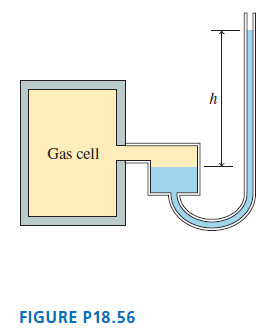
The mercury manometer shown in FIGURE P18.56 is attached to a gas cell. The mercury height h is 120 mm when the cell is placed in an ice-water mixture. The mercury height drops to 30 mm when the device is carried into an industrial freezer.What is the freezer temperature? Gas cell FIGURE P18.56
10,000 cm3 of 200°C steam at a pressure of 20 atm is cooled until it condenses. What is the volume of the liquid water? Give your answer in cm3.
The air temperature and pressure in a laboratory are 20°C and 1.0 atm. A 1.0 L container is open to the air. The container is then sealed and placed in a bath of boiling water. After reaching thermal equilibrium, the container is opened. How many moles of air escape?
On a cool morning, when the temperature is 15°C, you measure the pressure in your car tires to be 30 psi. After driving 20 mi on the freeway, the temperature of your tires is 45°C. What pressure will your tire gauge now show?
An electric generating plant boils water to produce high pressure steam. The steam spins a turbine that is connected to the generator.a. How many liters of water must be boiled to fill a 5.0 m3 boiler with 50 atm of steam at 400°C?b. The steam has dropped to 2.0 atm pressure at 150°C as it exits
A diving bell is a 3.0-m-tall cylinder closed at the upper end but open at the lower end. The temperature of the air in the bell is 20°C. The bell is lowered into the ocean until its lower end is 100 m deep. The temperature at that depth is 10°C.a. How high does the water rise in the bell after
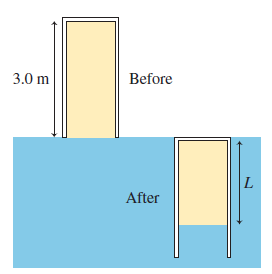
The 3.0-m-long pipe in FIGURE P18.50 is closed at the top end. It is slowly pushed straight down into the water until the top end of the pipe is level with the water€™s surface. What is the length L of the trapped volume of air? Before 3.0 m After
To determine the mass of neon contained in a rigid, 2.0 L cylinder, you vary the cylinder’s temperature while recording the reading of a pressure gauge. Your data are as follows:Temperature (°C) Pressure gauge (atm)100 .....................................................6.52150
On average, each person in the industrialized world is responsible for the emission of 10,000 kg of carbon dioxide (CO2) every year. This includes CO2 that you generate directly, by burning fossil fuels to operate your car or your furnace, as well as CO2 generated on your behalf by electric
A nebula—a region of the galaxy where new stars are for min —contains a very tenuous gas with 100 atoms/cm3. This gas is heated to 7500 K by ultraviolet radiation from nearby stars.What is the gas pressure in atm?
A 6.0-cm-diameter, 10-cm-long cylinder contains 100 mg of oxygen (O2) at a pressure less than 1 atm. The cap on one end of the cylinder is held in place only by the pressure of the air. One day when the atmospheric pressure is 100 kPa, it takes a 184 N force to pull the cap off. What is the
The semiconductor industry manufactures integrated circuits in large vacuum chambers where the pressure is 1.0 × 10⁻¹⁰ mm of Hg.a. What fraction is this of atmospheric pressure?b. At T = 20°C, how many molecules are in a cylindrical chamber 40 cm in diameter and 30 cm tall?
15°C, 2.0-cm-diameter aluminum bar just barely slips between two rigid steel walls 10.0 cm apart. If the bar is warmed to 25°C, how much force does it exert on each wall?
A brass ring with inner diameter 2.00 cm and outer diameter 3.00 cm needs to fit over a 2.00-cm-diameter steel rod, but at 20°C the hole through the brass ring is 50 mm too small in diameter. To what temperature, in °C, must the rod and ring be heated so that the ring just barely slips over the
The molecular mass of water (H2O) is A = 18. How many protons are there in 1.0 L of liquid water?
The atomic mass number of copper is A = 64. Assume that atoms in solid copper form a cubic crystal lattice. To envision this, imagine that you place atoms at the centers of tiny sugar cubes, then stack the little sugar cubes to form a big cube. If you dissolve the sugar, the atoms left behind are
An ideal gas starts with pressure p1 and volume V1. Draw a pV diagram showing the process in which the gas undergoes an isothermal process during which the volume is halved, then an isochoric process during which the pressure is halved, followed by an isobaric process during which the volume is
An ideal gas starts with pressure p1 and volume V1. Draw a pV diagram showing the process in which the gas undergoes an isochoric process that doubles the pressure, then an isobaric process that doubles the volume, followed by an isothermal process that doubles the volume again. Label each of the
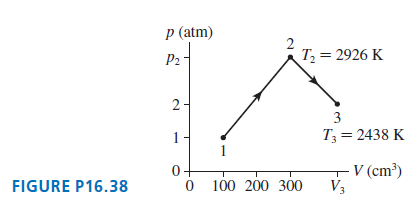
0.0050 mol of gas undergoes the process 1?? 2 ?? 3 shown in Figure P16.38.? What are (a) Temperature T1, (b) Pressure p2, (c) Volume V3? p (atm) P2 - T = 2926 K 3 T3 = 2438 K 1 0+ V (cm³) V3 FIGURE P16.38 100 200 300
Showing 2200 - 2300
of 3693
First
16
17
18
19
20
21
22
23
24
25
26
27
28
29
30
Last
Step by Step Answers

 Get 50% OFF
Claim Now
Get 50% OFF
Claim Now