New Semester
Started
Get
50% OFF
Study Help!
--h --m --s
Claim Now
Question Answers
Textbooks
Find textbooks, questions and answers
Oops, something went wrong!
Change your search query and then try again
S
Books
FREE
Study Help
Expert Questions
Accounting
General Management
Mathematics
Finance
Organizational Behaviour
Law
Physics
Operating System
Management Leadership
Sociology
Programming
Marketing
Database
Computer Network
Economics
Textbooks Solutions
Accounting
Managerial Accounting
Management Leadership
Cost Accounting
Statistics
Business Law
Corporate Finance
Finance
Economics
Auditing
Tutors
Online Tutors
Find a Tutor
Hire a Tutor
Become a Tutor
AI Tutor
AI Study Planner
NEW
Sell Books
Search
Search
Sign In
Register
study help
physics
physics scientists and engineers
Physics for Scientists and Engineers A Strategic Approach with Modern Physics 4th edition Randall D. Knight - Solutions
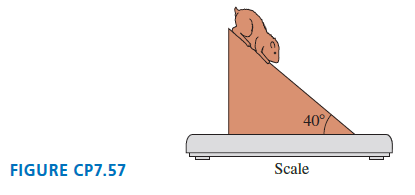
FIGURE CP7.57 shows a 200 g hamster sitting on an 800 g wedge-shaped block. The block, in turn, rests on a spring scale. An extra-fine lubricating oil having μs= μk= 0 is sprayed on the top surface of the block, causing the hamster to slide down. Friction between the
A 40-cm-diameter, 50-cm-tall, 15 kg hollow cylinder is placed on top of a 40-cm-diameter, 30-cm-tall, 100 kg cylinder of solid aluminum, then the two are sent sliding across frictionless ice. The static and kinetic coefficients of friction between the cylinders are 0.45 and 0.25, respectively. Air
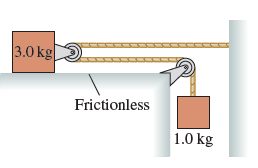
What is the acceleration of the 3.0 kg block in FIGURE CP7.55 across the frictionless table?FIGURE CP7.55 3.0 kg| Frictionless 1.0 kg
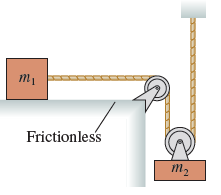
In FIGURE CP7.54, find an expression for the acceleration of m1. The pulleys are massless and frictionless.FIGURE CP7.54 тy Frictionless т,
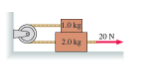
The lower block in FIGURE CP7.53 is pulled on by a rope with a tension force of 20 N. The coefficient of kinetic friction between the lower block and the surface is 0.30. The coefficient of kinetic friction between the lower block and the upper block is also 0.30.What is the acceleration of the 2.0
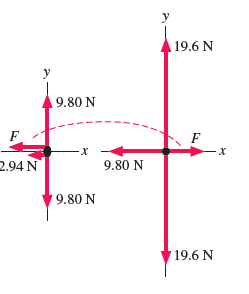
a. Write a realistic problem for which these are the correct freebody diagrams. Be sure that the answer your problem requests is consistent with the diagrams shown.b. Finish the solution of the problem. 19.6 N 9.80 N xX- 2.94 N 9.80 N 9.80 N 19.6 N
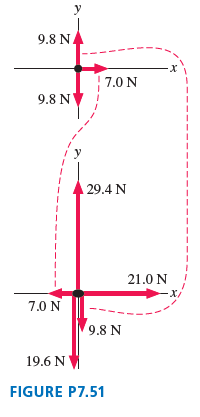
a. Write a realistic problem for which these are the correct freebody diagrams. Be sure that the answer your problem requests is consistent with the diagrams shown.b. Finish the solution of the problem. 9.8 N 7.0 N 9.8 N' 29.4 N 21.0 N 7.0 N 9.8 N 19.6 N FIGURE P7.51
A rocket burns fuel at a rate of 5.0 kg/s, expelling the exhaust gases at a speed of 4.0 km/s relative to the rocket. We would like to find the thrust of the rocket engine.(a) Model the fuel burning as a steady ejection of small pellets, each with the small mass Δm. Suppose it takes a short time
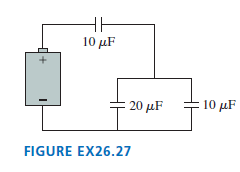
What is the equivalent capacitance of the three capacitors in Figure EX26.27? 10 μF 10 μF 20 μF FIGURE EX26.27
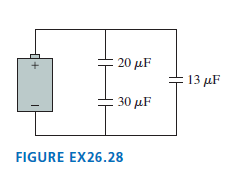
What is the equivalent capacitance of the three capacitors in Figure EX26.28? 20 μF 13 μF 30 μF FIGURE EX26.28
You need a capacitance of 50 μF, but you don’t happen to have a 50 μF capacitor. You do have a 30 μF capacitor. What additional capacitor do you need to produce a total capacitance of 50 μF? Should you join the two capacitors in parallel or in series?
You need a capacitance of 50 μF, but you don’t happen to have a 50 μF capacitor. You do have a 75 μF capacitor. What additional capacitor do you need to produce a total capacitance of 50 μF? Should you join the two capacitors in parallel or in series?
To what potential should you charge a 1.0 μF capacitor to store 1.0 J of energy?
50 pJ of energy is stored in a 2.0 cm × 2.0 cm × 2.0 cm region of uniform electric field. What is the electric field strength?
A 2.0-cm-diameter parallel-plate capacitor with a spacing of 0.50 mm is charged to 200 V. What are(a) The total energy stored in the electric field(b) The energy density?
The 90 μF capacitor in a defibrillator unit supplies an average of 6500 W of power to the chest of the patient during a discharge lasting 5.0 ms. To what voltage is the capacitor charged?
Two 5.0 mm × 5.0 mm electrodes are held 0.10 mm apart and are attached to a 9.0 V battery. Without disconnecting the battery, a 0.10-mm-thick sheet of Mylar is inserted between the electrodes. What are the capacitor’s potential difference, electric field, and charge(a) Before(b) After the Mylar
A typical cell has a layer of negative charge on the inner surface of the cell wall and a layer of positive charge on the outside surface, thus making the cell wall a capacitor. What is the capacitance of a 50-μm-diameter cell with a 7.0-nm-thick cell wall whose dielectric constant is 9.0? Because
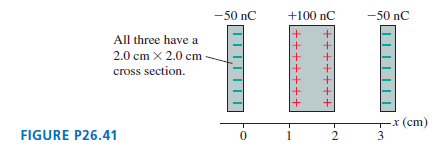
FIGURE P26.41 is an edge view of three charged metal electrodes. Let the left electrode be the zero point of the electric potential. What are V and E at (a) X = 0.5 cm, (b) X = 1.5 cm, (c) X = 2.5 cm? -50 nC +100 nC -50 nC All three have a 2.0 cm x 2.0 cm cross section. -x (cm) T FIGURE P26.41 1 3
Use the on-axis potential of a charged disk from Chapter 25 to find the on-axis electric field of a charged disk.
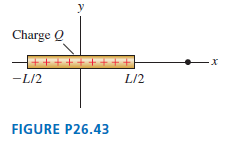
a. Use the methods of Chapter 25 to find the potential at distance x on the axis of the charged rod shown in FIGURE P26.43.b. Use the result of part a to find the electric field at distance x on the axis of a rod. y Charge Q ++++++++ -Xx -L/2 L/2 FIGURE P26.43
It is postulated that the radial electric field of a group of charges falls off as Er = C/rn, where C is a constant, r is the distance from the center of the group, and n is an unknown exponent. To test this hypothesis, you make a field probe consisting of two needle tips spaced 1.00 mm apart. You
Engineers discover that the electric potential between two electrodes can be modeled as V(x) = V0 ln(1 + x/d), where V0 is a constant, x is the distance from the first electrode in the direction of the second, and d is the distance between the electrodes. What is the electric field strength midway
The electric potential in a region of space is V = 200/√x2 + y2, where x and y are in meters. What are the strength and direction of the electric field at (x, y) = (2.0 m, 1.0 m)? Give the direction as an angle cw or ccw (specify which) from the positive x-axis.
Consider a large, thin, electrically neutral conducting plate in the xy-plane at z = 0 and a point charge q on the z-axis at distance zcharge = d. What is the electric field on and above the plate? Although the plate is neutral, electric forces from the point charge polarize the conducting
Metal sphere 1 has a positive charge of 6.0 nC. Metal sphere 2, which is twice the diameter of sphere 1, is initially uncharged. The spheres are then connected together by a long, thin metal wire. What are the final charges on each sphere?
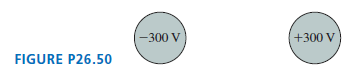
The metal spheres in FIGURE P26.50 are charged to ±300 V. Draw this figure on your paper, then draw a plausible contour map of the potential, showing and labeling the -300 V, -200 V, -100 V, . . . , 300 V equipotential surfaces -300 V +300 V FIGURE P26.50
The potential at the center of a 4.0-cm-diameter copper sphere is 500 V, relative to V = 0 V at infinity. How much excess charge is on the sphere?
The electric potential is 40 V at point A near a uniformly charged sphere. At point B, 2.0 μm farther away from the sphere, the potential has decreased by 0.16 mV. How far is point A from the center of the sphere?
Two 2.0 cm × 2.0 cm metal electrodes are spaced 1.0 mm apart and connected by wires to the terminals of a 9.0 V battery.a. What are the charge on each electrode and the potential difference between them?The wires are disconnected, and insulated handles are used to pull the plates apart to a new
Two 2.0 cm × 2.0 cm metal electrodes are spaced 1.0 mm apart and connected by wires to the terminals of a 9.0 V battery.a. What are the charge on each electrode and the potential difference between them?While the plates are still connected to the battery, insulated handles are used to pull them
Find expressions for the equivalent capacitance of(a) N identical capacitors C in parallel(b) N identical capacitors C in series.
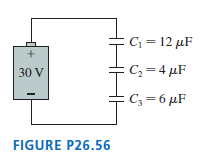
What are the charge on and the potential difference across each capacitor in FIGURE P26.56? C = 12 µF C2= 4 µF 30 V :C;=6 µF FIGURE P26.56
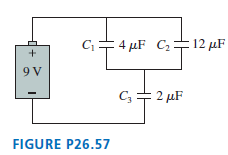
What are the charge on and the potential difference across each capacitor in FIGURE P26.57? 4 μF C C+ +12 μF G+ μF C3 FIGURE P26.57
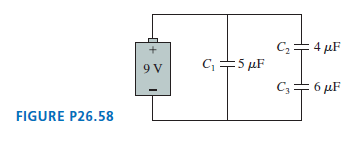
What are the charge on and the potential difference across each capacitor in FIGURE P26.58? C,=4 µF C, =5 µF C;= 6 µF FIGURE P26.58
You have three 12 μF capacitors. Draw diagrams showing how you could arrange all three so that their equivalent capacitance is(a) 4.0 μF,(b) 8.0 μF,(c) 18 μF,(d) 36 μF.
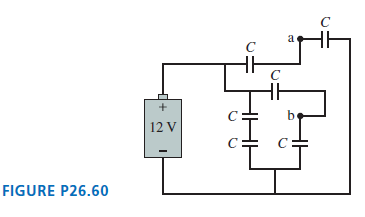
Six identical capacitors with capacitance C are connected as shown in FIGURE P26.60.a. What is the equivalent capacitance of these six capacitors?b. What is the potential difference between points a and b? a be 12 V FIGURE P26.60
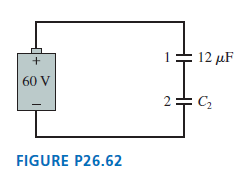
A battery with an emf of 60 V is connected to the two capacitors shown in FIGURE P26.62. Afterward, the charge on capacitor 2 is 450 μC. What is the capacitance of capacitor 2? 12 μF 60 V 2 FIGURE P26.62
Capacitors C1 = 10 μF and C2 = 20 μF are each charged to 10 V, then disconnected from the battery without changing the charge on the capacitor plates. The two capacitors are then connected in parallel, with the positive plate of C1 connected to the negative plate of C2 and vice versa. Afterward,
An isolated 5.0 μF parallel-plate capacitor has 4.0 mC of charge. An external force changes the distance between the electrodes until the capacitance is 2.0 μF. How much work is done by the external force?
An ideal parallel-plate capacitor has a uniform electric field between the plates, zero field outside. By superposition, half the field strength is due to one plate and half due to the other.a. The plates of a parallel-plate capacitor are oppositely charged and attract each other. Find an
The flash unit in a camera uses a 3.0 V battery to charge a capacitor. The capacitor is then discharged through a flashlamp. The discharge takes 10 μs, and the average power dissipated in the flashlamp is 10 W. What is the capacitance of the capacitor?
The label rubbed off one of the capacitors you are using to build a circuit. To find out its capacitance, you place it in series with a 10 μF capacitor and connect them to a 9.0 V battery. Using your voltmeter, you measure 6.0 V across the unknown capacitor.What is the unknown capacitor’s
A capacitor being charged has a current carrying charge to and away from the plates. In the next chapter we will define current to be dQ/dt, the rate of charge flow. What is the current to a 10 μF capacitor whose voltage is increasing at the rate of 2.0 V/s?
The current that charges a capacitor transfers energy that is stored in the capacitor’s electric field. Consider a 2.0 μF capacitor, initially uncharged, that is storing energy at a constant 200 W rate.What is the capacitor voltage 2.0 μs after charging begins?
A typical cell has a membrane potential of -70 mV, meaning that the potential inside the cell is 70 mV less than the potential outside due to a layer of negative charge on the inner surface of the cell wall and a layer of positive charge on the outer surface. This effectively makes the cell wall a
A nerve cell in its resting state has a membrane potential of -70 mV, meaning that the potential inside the cell is 70 mV less than the potential outside due to a layer of negative charge on the inner surface of the cell wall and a layer of positive charge on the outer surface. This effectively
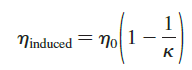
Derive Equation 26.33 for the induced surface charge density on the dielectric in a capacitor.Equation 26.33 nol 1 По Ninduced к
A vacuum-insulated parallel-plate capacitor with plate separation d has capacitance C0. What is the capacitance if an insulator with dielectric constant k and thickness d/2 is slipped between the electrodes without changing the plate separation?
You are given the equation(s) used to solve a problem. For each of these, you are toa. Write a realistic problem for which this is the correct equation(s).b. Finish the solution of the problem.2az V/m = - dV/dz, where a is a constant with units of V/m2V(z = 0) = 10 V
You are given the equation(s) used to solve a problem. For each of these, you are toa. Write a realistic problem for which this is the correct equation(s).b. Finish the solution of the problem.400 nC = (100 V)C (8.85 x 10⁻¹² C/N m²)(0.10 m × 0.10 m) C-
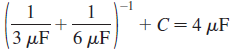
You are given the equation(s) used to solve a problem. For each of these, you are toa. Write a realistic problem for which this is the correct equation(s).b. Finish the solution of the problem. + C=4 μF 3 μF 6μF |
Two 5.0-cm-diameter metal disks separated by a 0.50-mm thick piece of Pyrex glass are charged to a potential difference of 1000 V. What are(a) The surface charge density on the disks(b) The surface charge density on the glass?
An electric dipole at the origin consists of two charges ±q spaced distance s apart along the y-axis.a. Find an expression for the potential V(x, y) at an arbitrary point in the xy-plane. Your answer will be in terms of q, s, x, and y.b. Use the binomial approximation to simplify your result
Charge is uniformly distributed with charge density ρ inside a very long cylinder of radius R. Find the potential difference between the surface and the axis of the cylinder.
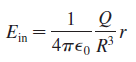
Consider a uniformly charged sphere of radius R and total charge Q. The electric field Eoutoutside the sphere (r ‰¥ R) is simply that of a point charge Q. In Chapter 24, we used Gauss€™s law to find that the electric field Eininside the sphere (r ‰¤ R) is radially
a. Find an expression for the capacitance of a spherical capacitor, consisting of concentric spherical shells of radii R1 (inner shell) and R2 (outer shell).b. A spherical capacitor with a 1.0 mm gap between the shells has a capacitance of 100 pF. What are the diameters of the two spheres?
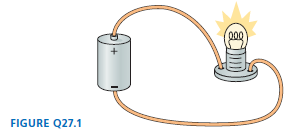
Suppose a time machine has just brought you forward from 1750 (post-Newton but pre-electricity) and you€™ve been shown the lightbulb demonstration of Figure Q27.1. Do observations or simple measurements you might make€”measurements that must make sense to you with your 1700s
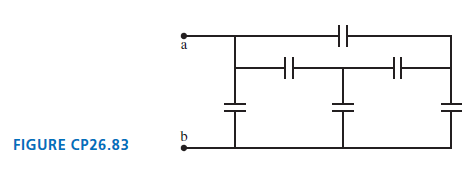
Each capacitor in Figure CP26.83 has capacitance C. What is the equivalent capacitance between points a and b? FIGURE CP26.83
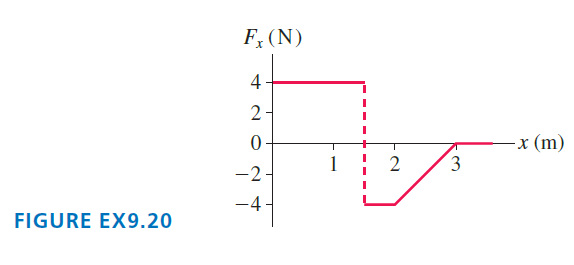
FIGURE EX9.20 is the force-versus-position graph for a particle moving along the x-axis. Determine the work done on the particle during each of the three intervals 0€“1 m, 1€“2 m, and 2€“3 m. F, (N) 4 -x (m) 2 -2 - -4 FIGURE EX9.20
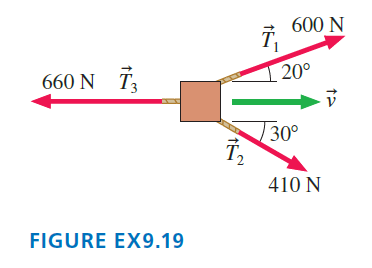
The three ropes shown in the bird€™s-eye view of FIGURE EX9.19 are used to drag a crate 3.0 m across the floor. How much work is done by each of the three forces? 600 N 20° 660 N 30° 410 N FIGURE EX9.19
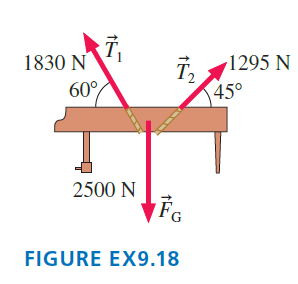
The two ropes seen in FIGURE EX9.18 are used to lower a 255 kg piano 5.00 m from a second-story window to the ground. How much work is done by each of the three forces? 1830 N 60% 1295 N 45° 2500 N FIGURE EX9.18
A 45 g bug is hovering in the air. A gust of wind exerts a force F = (4.0î - 6.0ĵ) × 10-2 N on the bug.a. How much work is done by the wind as the bug undergoes displacement Δr = (2.0î - 2.0ĵ) m?b. What is the bug’s speed at the end of this displacement? Assume that the speed is due
A 25 kg air compressor is dragged up a rough incline from r1 = (1.3î + 1.3ĵ) m to r2 = (8.3î + 2.9ĵ) m, where the y-axis is vertical. How much work does gravity do on the compressor during this displacement?
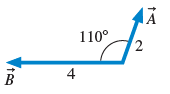
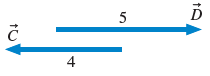
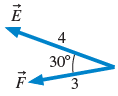
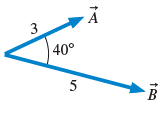
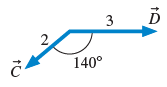
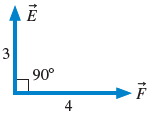
Evaluate the dot product of the three pairs of vectors ina.b.c. 110° 5
Evaluate the dot product of the three pairs of vectors ina.b.c. 3 40° 3 2 140°
A spring has an unstretched length of 10 cm. It exerts a restoring force F when stretched to a length of 11 cm.a. For what length of the spring is its restoring force 3F?b. At what compressed length is the restoring force 2F?
The cable of a crane is lifting a 750 kg girder. The girder increases its speed from 0.25 m/s to 0.75 m/s in a distance of 3.5 m.a. How much work is done by gravity?b. How much work is done by tension?
A sprinter accelerates from rest. Is the work done on the sprinter positive, negative, or zero? Explain.
You throw a 5.5 g coin straight down at 4.0 m/s from a 35-m-high bridge.a. How much work does gravity do as the coin falls to the water below?b. What is the speed of the coin just as it hits the water?
A ball on a string travels once around a circle with a circumference of 2.0 m. The tension in the string is 5.0 N. How much work is done by tension?
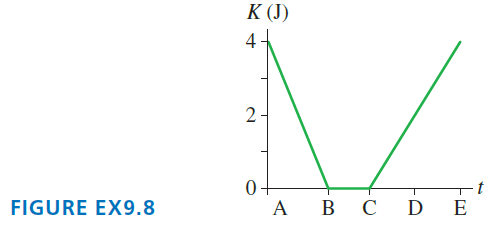
FIGURE EX9.8 is the kinetic-energy graph for a 2.0 kg object moving along the x-axis. Determine the work done on the object during each of the four intervals AB, BC, CD, and DE. K (J) 4- 2 A B C D E FIGURE EX9.8
A 20 g particle is moving to the left at 30 m/s. A force on the particle causes it to move the the right at 30 m/s. How much work is done by the force?
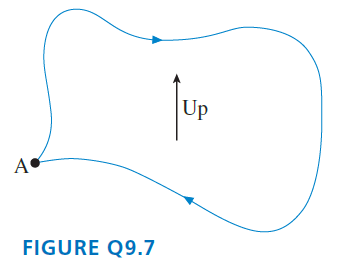
A particle moves in a vertical plane along the closed path seen in FIGURE Q9.7, starting at A and eventually returning to its starting point. Is the work done by gravity positive, negative, or zero? Explain. Up FIGURE Q9.7
A 2.0 kg book is lying on a 0.75-m-high table. You pick it up and place it on a bookshelf 2.25 m above the floor.a. How much work does gravity do on the book?b. How much work does your hand do on the book?
A particle moving to the left is slowed by a force pushing to the right. Is the work done on the particle positive or negative? Or is there not enough information to tell? Explain.
A 25 kg box sliding to the left across a horizontal surface is brought to a halt in a distance of 35 cm by a horizontal rope pulling to the right with 15 N tension. How much work is done by (a) Tension(b) Gravity?
A 0.2 kg plastic cart and a 20 kg lead cart both roll without friction on a horizontal surface. Equal forces are used to push both carts forward a distance of 1 m, starting from rest. After traveling 1 m, is the kinetic energy of the plastic cart greater than, less than, or equal to the kinetic
A horizontal rope with 15 N tension drags a 25 kg box 2.0 m to the left across a horizontal surface. How much work is done by (a) Tension(b) Gravity?
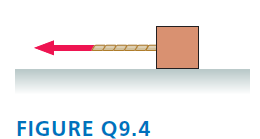
The rope in FIGURE Q9.4 pulls the box to the left across a rough surface. Is the work done by tension positive, negative, or zero? Explain. FIGURE Q9.4
A mother has four times the mass of her young son. Both are running with the same kinetic energy. What is the ratio vson /vmother of their speeds?
An elevator held by a single cable is ascending but slowing down. Is the work done by tension positive, negative, or zero? What about the work done by gravity? Explain.
At what speed does a 1000 kg compact car have the same kinetic energy as a 20,000 kg truck going 25 km/h?
Particle A has half the mass and eight times the kinetic energy of particle B. What is the speed ratio vA/vB?
Which has the larger kinetic energy, a 10 g bullet fired at 500 m/s or a 75 kg student running at 5.5 m/s?
If a particle’s speed increases by a factor of 3, by what factor does its kinetic energy change?
Your laboratory assignment for the week is to measure the specific heat ratio g of carbon dioxide. The gas is contained in a cylinder with a movable piston and a thermometer. When the piston is withdrawn as far as possible, the cylinder’s length is 20 cm. You decide to push the piston in very
An 8.0-cm-diameter, well-insulated vertical cylinder containing nitrogen gas is sealed at the top by a 5.1 kg frictionless piston. The air pressure above the piston is 100 kPa.a. What is the gas pressure inside the cylinder?b. Initially, the piston height above the bottom of the cylinder is 26 cm.
A cube 20 cm on each side contains 3.0 g of helium at 20°C. 1000 J of heat energy are transferred to this gas. What are(a) The final pressure if the process is at constant volume(b) The final volume if the process is at constant pressure?(c) Show and label both processes on a single pV diagram.
A 10-cm-diameter cylinder contains argon gas at 10 atm pressure and a temperature of 50°C. A piston can slide in and out of the cylinder. The cylinder’s initial length is 20 cm. 2500 J of heat are transferred to the gas, causing the gas to expand at constant pressure. What are(a) The final
An ideal-gas process is described by p = cV1/2, where c is a constant.a. Find an expression for the work done on the gas in this process as the volume changes from V1 to V2.b. 0.033 mol of gas at an initial temperature of 150°C is compressed, using this process, from 300 cm3 to 200 cm3. How much
A 560 kg concrete table needs to be supported at the four corners by compressed-air cylinders. Each cylinder is 25 cm in diameter and has a 1.20 m initial length when the pressure inside is 1.0 atm. A hoist lowers the table very slowly, compressing the cylinders while allowing them to stay in
2.0 mol of gas are at 30°C and a pressure of 1.5 atm. How much work must be done on the gas to compress it to one third of its initial volume at(a) Constant temperature(b) Constant pressure?(c) Show both processes on a single pV diagram.
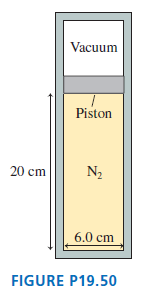
A 6.0-cm-diameter cylinder of nitrogen gas has a 4.0-cm-thick movable copper piston. The cylinder is oriented vertically, as shown in Figure P19.50, and the air above the piston is evacuated. When the gas temperature is 20°C, the piston floats 20 cm above the bottom of the cylinder.a. What is the
A typical nuclear reactor generates 1000 MW (1000 MJ/s) of electrical energy. In doing so, it produces 2000 MW of “waste heat” that must be removed from the reactor to keep it from melting down. Many reactors are sited next to large bodies of water so that they can use the water for cooling.
Your 300 mL cup of coffee is too hot to drink when served at 90°C. What is the mass of an ice cube, taken from a -20°C freezer, that will cool your coffee to a pleasant 60°C?
Suppose you take and hold a deep breath on a chilly day, inhaling 3.0 L of air at 0°C and 1 atm.a. How much heat must your body supply to warm the air to your internal body temperature of 37°C?b. By how much does the air’s volume increase as it warms?
A lava flow is threatening to engulf a small town. A 400-m wide, 35-cm-thick tongue of 1200°C lava is advancing at the rate of 1.0 m per minute. The mayor devises a plan to stop the lava in its tracks by flying in large quantities of 20°C water and dousing it. The lava has density 2500 kg/m3,
The specific heat of most solids is nearly constant over a wide temperature range. Not so for diamond. Between 200 K and 600 K, the specific heat of diamond is reasonably well described by c = 2.8T - 350 J/kg K, where T is in K. For gemstone diamonds, 1 carat = 200 mg. How much heat energy is
A 150 L (≈ 40 gal) electric hot-water tank has a 5.0 kW heater.How many minutes will it take to raise the water temperature from 65°F to 140°F?
Showing 3100 - 3200
of 3693
First
23
24
25
26
27
28
29
30
31
32
33
34
35
36
37
Step by Step Answers

 Get 50% OFF
Claim Now
Get 50% OFF
Claim Now