New Semester
Started
Get
50% OFF
Study Help!
--h --m --s
Claim Now
Question Answers
Textbooks
Find textbooks, questions and answers
Oops, something went wrong!
Change your search query and then try again
S
Books
FREE
Study Help
Expert Questions
Accounting
General Management
Mathematics
Finance
Organizational Behaviour
Law
Physics
Operating System
Management Leadership
Sociology
Programming
Marketing
Database
Computer Network
Economics
Textbooks Solutions
Accounting
Managerial Accounting
Management Leadership
Cost Accounting
Statistics
Business Law
Corporate Finance
Finance
Economics
Auditing
Tutors
Online Tutors
Find a Tutor
Hire a Tutor
Become a Tutor
AI Tutor
AI Study Planner
NEW
Sell Books
Search
Search
Sign In
Register
study help
physics
physics scientists and engineers
Physics for Scientists and Engineers A Strategic Approach with Modern Physics 4th edition Randall D. Knight - Solutions
Two Jupiter-size planets are released from rest 1.0 × 10¹¹ m apart. What are their speeds as they crash together?
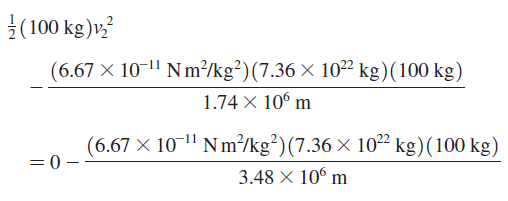
a. Write a realistic problem for which this is the correct equation(s).b. Draw a pictorial representation.c. Finish the solution of the problem. {(100 kg)v? (6.67 × 10⁻¹" Nm²/kg²)(7.36 × 10²² kg)(100 kg) 1.74 × 10° m (6.67 X 10⁻¹" Nm³/kg²)(7.36 × 10²² kg)(100 kg) 3.48 X 10° m =D0
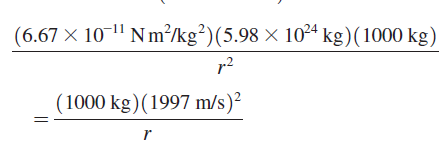
a. Write a realistic problem for which this is the correct equation(s).b. Draw a pictorial representation.c. Finish the solution of the problem.
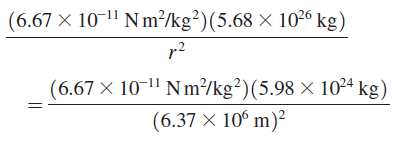
a. Write a realistic problem for which this is the correct equation(s).b. Draw a pictorial representation.c. Finish the solution of the problem.
A 55,000 kg space capsule is in a 28,000-km-diameter circular orbit around the moon. A brief but intense firing of its engine in the forward direction suddenly decreases its speed by 50%. This causes the space capsule to go into an elliptical orbit. What are the space capsule’s (a)
Comets move around the sun in very elliptical orbits. At its closet approach, in 1986, Comet Halley was 8.79 × 10⁷ km from the sun and moving with a speed of 54.6 km/s. What was the comet’s speed when it crossed Neptune’s orbit in 2006?
Three stars, each with the mass of our sun, form an equilateral triangle with sides 1.0 × 10¹² m long. (This triangle would just about fit within the orbit of Jupiter.) The triangle has to rotate, because otherwise the stars would crash together in the center.What is the period of rotation?
The solar system is 25,000 light years from the center of our Milky Way galaxy. One light year is the distance light travels in one year at a speed of 3.0 × 10⁸ m/s. Astronomers have determined that the solar system is orbiting the center of the galaxy at a speed of 230 km/s.a. Assuming the orbit
Large stars can explode as they finish burning their nuclear fuel, causing a supernova. The explosion blows away the outer layers of the star. According to Newton’s third law, the forces that push the outer layers away have reaction forces that are inwardly directed on the core of the star. These
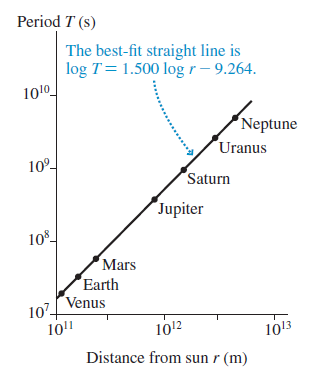
Figure 13.17 showed a graph of log T versus log r for the planetary data given in Table 13.2. Such a graph is called a log-log graph.The scales in Figure 13.17 are logarithmic, not linear, meaning that each division along the axis corresponds to a factor of 10 increase in the value. Strictly
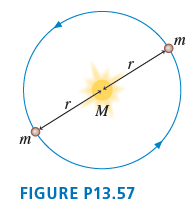
FIGURE P13.57 shows two planets of mass m orbiting a star of mass M. The planets are in the same orbit, with radius r, but are always at opposite ends of a diameter. Find an exact expression for the orbital period T. M m FIGURE P13.57
A satellite orbiting the earth is directly over a point on the equator at 12:00 midnight every two days. It is not over that point at any time in between.What is the radius of the satellite’s orbit?
In 2014, the European Space Agency placed a satellite in orbit around comet 67P/Churyumov-Gerasimenko and then landed a probe on the surface. The actual orbit was elliptical, but we’ll approximate it as a 50-km-diameter circular orbit with a period of 11 days.a. What was the satellite’s orbital
NASA would like to place a satellite in orbit around the moon such that the satellite always remains in the same position over the lunar surface. What is the satellite’s altitude?
How much energy would be required to move the earth into a circular orbit with a radius 1.0 km larger than its current radius?
The 75,000 kg space shuttle used to fly in a 250-km-high circular orbit. It needed to reach a 610-km-high circular orbit to service the Hubble Space Telescope. How much energy was required to boost it to the new orbit?
A 4000 kg lunar lander is in orbit 50 km above the surface of the moon. It needs to move out to a 300-km-high orbit in order to link up with the mother ship that will take the astronauts home.How much work must the thrusters do?
The two stars in a binary star system have masses 2.0 × 1030 kg and 6.0 × 1030 kg. They are separated by 2.0 × 10¹² m. What area. The system’s rotation period, in years?b. The speed of each star?
A starship is circling a distant planet of radius R. The astronauts find that the free-fall acceleration at their altitude is half the value at the planet’s surface. How far above the surface are they orbiting?Your answer will be a multiple of R.
Two spherical asteroids have the same radius R. Asteroid 1 has mass M and asteroid 2 has mass 2M. The two asteroids are released from rest with distance 10R between their centers. What is the speed of each asteroid just before they collide?
A rogue band of colonists on the moon declares war and prepares to use a catapult to launch large boulders at the earth.Assume that the boulders are launched from the point on the moon nearest the earth. For this problem you can ignore the rotation of the two bodies and the orbiting of the moon.a.
Suppose that on earth you can jump straight up a distance of 45 cm. Asteroids are made of material with mass density 2800 kg/m3.What is the maximum diameter of a spherical asteroid from which you could escape by jumping?
An astronaut circling the earth at an altitude of 400 km is horrified to discover that a cloud of space debris is moving in the exact same orbit as his spacecraft, but in the opposite direction. The astronaut detects the debris when it is 25 km away. How much time does he have to fire his rockets
The unexplored planet Alpha Centauri III has a radius of 7.0 × 10⁶ m. A visiting astronaut drops a rock, from rest, into a 100 m deep crevasse. She records that it takes 6.0 s for the rock to reach the bottom. What is the mass of Alpha Centauri III?
A projectile is shot straight up from the earth’s surface at a speed of 10,000 km/h. How high does it go?
An object of mass m is dropped from height h above a planet of mass M and radius R. Find an expression for the object’s speed as it hits the ground.
A rogue black hole with a mass 12 times the mass of the sun drifts into the solar system on a collision course with earth. How far is the black hole from the center of the earth when objects on the earth’s surface begin to lift into the air and “fall” up into the black hole? Give your answer
Two 100 kg lead spheres are suspended from 100-m-long massless cables. The tops of the cables have been carefully anchored exactly 1 m apart. By how much is the distance between the centers of the spheres less than 1 m?
Two spherical objects have a combined mass of 150 kg. The gravitational attraction between them is 8.00 × 10⁻⁶ N when their centers are 20 cm apart. What is the mass of each?
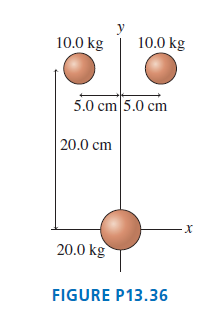
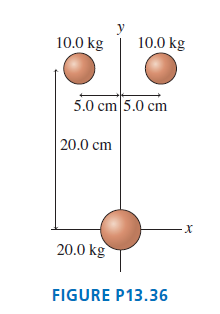
What is the total gravitational potential energy of the three masses in FIGURE P13.36? 10.0 kg y 10.0 kg 5.0 cm 5.0 cm 20.0 cm 20.0 kg FIGURE P13.36
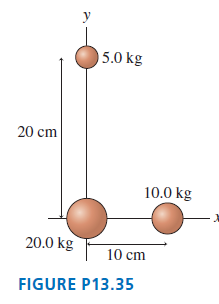
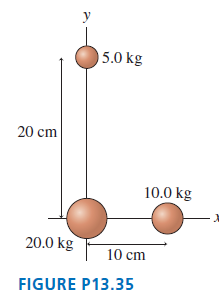
What is the total gravitational potential energy of the three masses in Figure P13.35? 5.0 kg 20 cm 10.0 kg 20.0 kg 10 cm FIGURE P13.35
What are the magnitude and direction of the net gravitational force on the 20.0 kg mass in FIGURE P13.36? y 10.0 kg 10.0 kg 5.0 cm 5.0 cm 20.0 cm 20.0 kg FIGURE P13.36
FIGURE P13.35 shows three masses. What are the magnitude and the direction of the net gravitational force on? (a) The 20.0 kg mass (b) The 5.0 kg mass?? Give the direction as an angle cw or ccw from the y-axis. 5.0 kg 20 cm 10.0 kg 20.0 kg 10 cm FIGURE P13.35
Pluto moves in a fairly elliptical orbit around the sun. Pluto’s speed at its closest approach of 4.43 × 10⁹ km is 6.12 km/s. What is Pluto’s speed at the most distant point in its orbit, where it is 7.30 × 10⁹ km from the sun?
In 2000, NASA placed a satellite in orbit around an asteroid. Consider a spherical asteroid with a mass of 1.0 × 10¹⁶ kg and a radius of 8.8 km.a. What is the speed of a satellite orbiting 5.0 km above the surface?b. What is the escape speed from the asteroid?
a. At what height above the earth is the free-fall acceleration 10% of its value at the surface?b. What is the speed of a satellite orbiting at that height?
What are the speed and altitude of a geosynchronous satellite orbiting Mars? Mars rotates on its axis once every 24.8 hours.
An earth satellite moves in a circular orbit at a speed of 5500 m/s.What is its orbital period?
A small moon orbits its planet in a circular orbit at a speed of 7.5 km/s. It takes 28 hours to complete one full orbit. What is the mass of the planet?
A new planet is discovered orbiting the star Vega in a circular orbit. The planet takes 55 earth years to complete one orbit around the star. Vega’s mass is 2.1 times the sun’s mass. What is the radius of the planet’s orbit? Give your answer as a multiple of the radius of the earth’s orbit.
A satellite orbits the sun with a period of 1.0 day. What is the radius of its orbit?
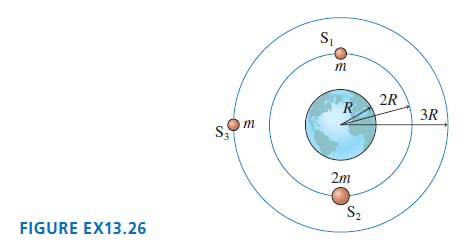
Three satellites orbit a planet of radius R, as shown in FIGURE EX13.26. Satellites S1and S3have mass m. Satellite S2has mass 2m. Satellite S1orbits in 250 minutes and the force on S1is 10,000 N.a. What are the periods of S2and S3?b. What are the forces on S2and S3?c. What is the kinetic-energy
You are the science officer on a visit to a distant solar system. Prior to landing on a planet you measure its diameter to be 1.8 × 10⁷ m and its rotation period to be 22.3 hours. You have previously determined that the planet orbits 2.2 × 10¹¹ m from its star with a period of 402 earth days.
The asteroid belt circles the sun between the orbits of Mars and Jupiter. One asteroid has a period of 5.0 earth years. What are the asteroid’s orbital radius and speed?
A binary star system has two stars, each with the same mass as our sun, separated by 1.0 × 10¹² m. A comet is very far away and essentially at rest. Slowly but surely, gravity pulls the comet toward the stars. Suppose the comet travels along a trajectory that passes through the midpoint between
Two meteoroids are heading for earth. Their speeds as they cross the moon’s orbit are 2.0 km/s.a. The first meteoroid is heading straight for earth. What is its speed of impact?b. The second misses the earth by 5000 km. What is its speed at its closest point?
You have been visiting a distant planet. Your measurements have determined that the planet’s mass is twice that of earth but the free-fall acceleration at the surface is only one-fourth as large.a. What is the planet’s radius?b. To get back to earth, you need to escape the planet. What minimum
Nothing can escape the event horizon of a black hole, not even light. You can think of the event horizon as being the distance from a black hole at which the escape speed is the speed of light, 3.00 × 10⁸ m/s, making all escape impossible. What is the radius of the event horizon for a black hole
A proposed space elevator would consist of a cable stretching from the earth’s surface to a satellite, orbiting far in space, that would keep the cable taut. A motorized climber could slowly carry rockets to the top, where they could be launched away from the earth using much less energy. What
A space station orbits the sun at the same distance as the earth but on the opposite side of the sun. A small probe is fired away from the station. What minimum speed does the probe need to escape the solar system?
A rocket is launched straight up from the earth’s surface at a speed of 15,000 m/s. What is its speed when it is very far away from the earth?
What is the escape speed from Jupiter?
An astronaut on earth can throw a ball straight up to a height of 15 m. How high can he throw the ball on Mars?
Planet Z is 10,000 km in diameter. The free-fall acceleration on Planet Z is 8.0 m/s2.a. What is the mass of Planet Z?b. What is the free-fall acceleration 10,000 km above Planet Z’s north pole?
Suppose we could shrink the earth without changing its mass.At what fraction of its current radius would the free-fall acceleration at the surface be three times its present value?
A newly discovered planet has a radius twice as large as earth’s and a mass five times as large. What is the free-fall acceleration on its surface?
Saturn’s moon Titan has a mass of 1.35 × 10²³ kg and a radius of 2580 km. What is the free-fall acceleration on Titan?
A sensitive gravimeter at a mountain observatory finds that the free-fall acceleration is 0.0075 m/s2 less than that at sea level. What is the observatory’s altitude?
Satellites in near-earth orbit experience a very slight drag due to the extremely thin upper atmosphere. These satellites slowly but surely spiral inward, where they finally burn up as they reach the thicker lower levels of the atmosphere. The radius decreases so slowly that you can consider the
What is the free-fall acceleration at the surface of (a) The moon(b) Jupiter?
The mass of Jupiter is 300 times the mass of the earth. Jupiter orbits the sun with TJupiter = 11.9 yr in an orbit with rJupiter = 5.2rearth. Suppose the earth could be moved to the distance of Jupiter and placed in a circular orbit around the sun.Which of the following describes the earth’s new
a. What is the free-fall acceleration at the surface of the sun?b. What is the free-fall acceleration toward the sun at the distance of the earth?
The escape speed from Planet X is 10,000 m/s. Planet Y has the same radius as Planet X but is twice as dense. What is the escape speed from Planet Y?
A 20 kg sphere is at the origin and a 10 kg sphere is at x = 20 cm.At what position on the x-axis could you place a small mass such that the net gravitational force on it due to the spheres is zero?
Why is the gravitational potential energy of two masses negative?That saying “because that’s what the equation gives” is not an explanation.
Two 65 kg astronauts leave earth in a spacecraft, sitting 1.0 m apart. How far are they from the center of the earth when the gravitational force between them is as strong as the gravitational force of the earth on one of the astronauts?
The free-fall acceleration at the surface of planet 1 is 20 m/s2. The radius and the mass of planet 2 are twice those of planet 1. What is g on planet 2?
The International Space Station orbits 300 km above the surface of the earth. What is the gravitational force on a 1.0 kg sphere inside the International Space Station?
A space station astronaut is working outside the station as it orbits the earth. If he drops a hammer, will it fall to earth? Explain why or why not.
What is the force of attraction between a 50 kg woman and a 70 kg man sitting 1.0 m apart?
How far away from the earth must an orbiting spacecraft be for the astronauts inside to be weightless? Explain.
The centers of a 10 kg lead ball and a 100 g lead ball are separated by 10 cm.a. What gravitational force does each exert on the other?b. What is the ratio of this gravitational force to the gravitational force of the earth on the 100 g ball?
A 1000 kg satellite and a 2000 kg satellite follow exactly the same orbit around the earth.a. What is the ratio F1/F2 of the gravitational force on the first satellite to that on the second satellite?b. What is the ratio a1/a2 of the acceleration of the first satellite to that of the second
What is the ratio of the sun’s gravitational force on the moon to the earth’s gravitational force on the moon?
The gravitational force of a star on orbiting planet 1 is F1. Planet 2, which is twice as massive as planet 1 and orbits at twice the distance from the star, experiences gravitational force F2. What is the ratio F1/F2?
What is the ratio of the sun’s gravitational force on you to the earth’s gravitational force on you?
Is the earth’s gravitational force on the sun larger than, smaller than, or equal to the sun’s gravitational force on the earth? Explain.
A 75 g, 30-cm-long rod hangs vertically on a frictionless, horizontal axle passing through its center. A 10 g ball of clay traveling horizontally at 2.5 m/s hits and sticks to the very bottom tip of the rod. To what maximum angle, measured from vertical, does the rod (with the attached ball of
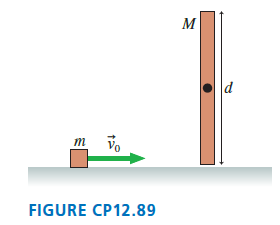
FIGURE CP12.89 shows a cube of mass m sliding without friction at speed v0. It undergoes a perfectly elastic collision with the bottom tip of a rod of length d and mass M = 2m. The rod is pivoted about a frictionless axle through its center, and initially it hangs straight down and is at rest. What
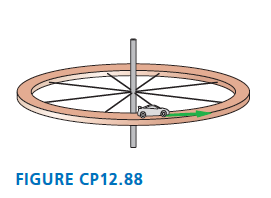
In FIGURE CP12.88, a 200 g toy car is placed on a narrow 60-cm-diameter track with wheel grooves that keep the car going in a circle. The 1.0 kg track is free to turn on a frictionless, vertical axis. The spokes have negligible mass. After the car??s switch is turned on, it soon reaches a steady
A rod of length L and mass M has a nonuniform mass distribution.The linear mass density (mass per length) is λ = cx2, where x is measured from the center of the rod and c is a constant.a. What are the units of c?b. Find an expression for c in terms of L and M.c. Find an expression in terms of L
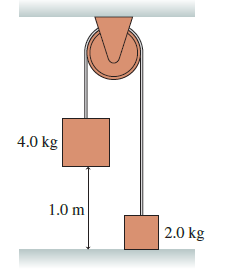
The two blocks in FIGURE CP12.86 are connected by a massless rope that passes over a pulley. The pulley is 12 cm in diameter and has a mass of 2.0 kg. As the pulley turns, friction at the axle exerts a torque of magnitude 0.50 N m. If the blocks are released from rest, how long does it take the 4.0
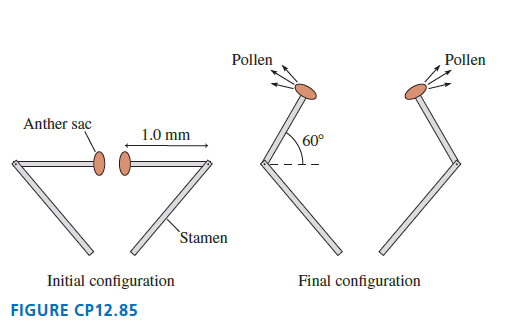
The bunchberry flower has the fastest-moving parts ever observed in a plant. Initially, the stamens are held by the petals in a bent position, storing elastic energy like a coiled spring. When the petals release, the tips of the stamen act like medieval catapults, flipping through a 60? angle in
The earth’s rotation axis, which is tilted 23.5° from the plane of the earth’s orbit, today points to Polaris, the north star. But Polaris has not always been the north star because the earth, like a spinning gyroscope, precesses. That is, a line extending along the earth’s rotation axis
During most of its lifetime, a star maintains an equilibrium size in which the inward force of gravity on each atom is balanced by an outward pressure force due to the heat of the nuclear reactions in the core. But after all the hydrogen “fuel” is consumed by nuclear fusion, the pressure force
A 45 kg figure skater is spinning on the toes of her skates at 1.0 rev/s. Her arms are outstretched as far as they will go. In this orientation, the skater can be modeled as a cylindrical torso (40 kg, 20 cm average diameter, 160 cm tall) plus two rod-like arms (2.5 kg each, 66 cm long) attached to
A merry-go-round is a common piece of playground equipment. A 3.0-m-diameter merry-go-round with a mass of 250 kg is spinning at 20 rpm. John runs tangent to the merry go-round at 5.0 m/s, in the same direction that it is turning, and jumps onto the outer edge. John’s mass is 30 kg. What is the
Luc, who is 1.80 m tall and weighs 950 N, is standing at the center of a playground merry-go-round with his arms extended, holding a 4.0 kg dumbbell in each hand. The merry-go-round can be modeled as a 4.0-m-diameter disk with a weight of 1500 N. Luc’s body can be modeled
A 200 g, 40-cm-diameter turntable rotates on frictionless bearings at 60 rpm. A 20 g block sits at the center of the turntable. A compressed spring shoots the block radially outward along a frictionless groove in the surface of the turntable. What is the turntable’s rotation angular velocity when
A 10 g bullet traveling at 400 m/s strikes a 10 kg, 1.0-m-wide door at the edge opposite the hinge. The bullet embeds itself in the door, causing the door to swing open. What is the angular velocity of the door just after impact?
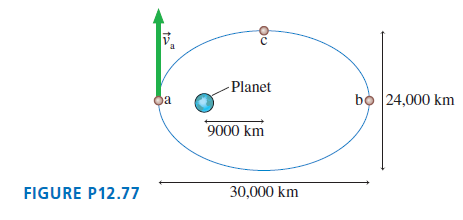
A satellite follows the elliptical orbit shown in FIGURE P12.77. The only force on the satellite is the gravitational attraction of the planet. The satellite€™s speed at point a is 8000 m/s.a. Does the satellite experience any torque about the center of the planet? Explain.b. What is the
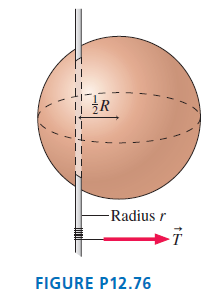
The sphere of mass M and radius R in FIGURE P12.76 is rigidly attached to a thin rod of radius r that passes through the sphere at distance 1/2 R from the center. A string wrapped around the rod pulls with tension T. Find an expression for the sphere??s angular acceleration. The rod??s moment of
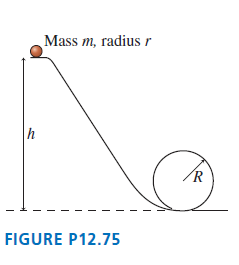
The marble rolls down the track shown in FIGURE P12.75 and around a loop-the-loop of radius R. The marble has mass m and radius r. What minimum height h must the track have for the marble to make it around the loop-the-loop without falling off? Mass m, radius r FIGURE P12.75
A long, thin rod of mass M and length L is standing straight up on a table. Its lower end rotates on a frictionless pivot. A very slight push causes the rod to fall over. As it hits the table, whatare(a) The angular velocity(b) The speed of the tip of the rod?
A thin, uniform rod of length L and mass M is placed vertically on a horizontal table. If tilted ever so slightly, the rod will fall over.a. What is the speed of the center of mass just as the rod hits the table if there’s so much friction that the bottom tip of the rod does not slide?b. What is
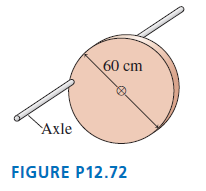
The 5.0 kg, 60-cm-diameter disk in FIGURE P12.72 rotates on an axle passing through one edge. The axle is parallel to the floor. The cylinder is held with the center of mass at the same height as the axle, then released.a. What is the cylinder€™s initial angular acceleration?b. What is
A cylinder of radius R, length L, and mass M is released from rest on a slope inclined at angle θ. It is oriented to roll straight down the slope. If the slope were frictionless, the cylinder would slide down the slope without rotating. What minimum coefficient of static friction is needed for the
A 750 g disk and a 760 g ring, both 15 cm in diameter, are rolling along a horizontal surface at 1.5 m/s when they encounter a 15° slope. How far up the slope does each travel before rolling back down?
A hollow sphere is rolling along a horizontal floor at 5.0 m/s when it comes to a 30 incline. How far up the incline does it roll before reversing direction?
Your engineering team has been assigned the task of measuring the properties of a new jet-engine turbine. You’ve previously determined that the turbine’s moment of inertia is 2.6 kg m2. The next job is to measure the frictional torque of the bearings. Your plan is to run the turbine up to a
Showing 2600 - 2700
of 3693
First
20
21
22
23
24
25
26
27
28
29
30
31
32
33
34
Last
Step by Step Answers

 Get 50% OFF
Claim Now
Get 50% OFF
Claim Now