New Semester
Started
Get
50% OFF
Study Help!
--h --m --s
Claim Now
Question Answers
Textbooks
Find textbooks, questions and answers
Oops, something went wrong!
Change your search query and then try again
S
Books
FREE
Study Help
Expert Questions
Accounting
General Management
Mathematics
Finance
Organizational Behaviour
Law
Physics
Operating System
Management Leadership
Sociology
Programming
Marketing
Database
Computer Network
Economics
Textbooks Solutions
Accounting
Managerial Accounting
Management Leadership
Cost Accounting
Statistics
Business Law
Corporate Finance
Finance
Economics
Auditing
Tutors
Online Tutors
Find a Tutor
Hire a Tutor
Become a Tutor
AI Tutor
AI Study Planner
NEW
Sell Books
Search
Search
Sign In
Register
study help
physics
physics scientists and engineers
Physics for Scientists and Engineers A Strategic Approach with Modern Physics 4th edition Randall D. Knight - Solutions
A 100 g block attached to a spring with spring constant 2.5 N/m oscillates horizontally on a frictionless table. Its velocity is 20 cm/s when x = -5.0 cm.a. What is the amplitude of oscillation?b. What is the block’s maximum acceleration?c. What is the block’s position when the acceleration is
For a particle in simple harmonic motion, show that vmax = (π/2)vavg, where vavg is the average speed during one cycle of the motion.
a. When the displacement of a mass on a spring is 1/2 A, what fraction of the energy is kinetic energy and what fraction is potential energy?b. At what displacement, as a fraction of A, is the energy half kinetic and half potential?
The motion of a particle is given by x(t) = (25 cm)cos(10 t), where t is in s. What is the first time at which the kinetic energy is twice the potential energy?
A 350 g mass on a 45-cm-long string is released at an angle of 4.5° from vertical. It has a damping constant of 0.010 kg/s. After 25 s,(a) How many oscillations has it completed(b) How much energy has been lost?
Vision is blurred if the head is vibrated at 29 Hz because the vibrations are resonant with the natural frequency of the eyeball in its socket. If the mass of the eyeball is 7.5 g, a typical value, what is the effective spring constant of the musculature that holds the eyeball in the socket?
In a science museum, a 110 kg brass pendulum bob swings at the end of a 15.0-m-long wire. The pendulum is started at exactly 8:00 a.m. every morning by pulling it 1.5 m to the side and releasing it. Because of its compact shape and smooth surface, the pendulum’s damping constant is only 0.010
The amplitude of an oscillator decreases to 36.8% of its initial value in 10.0 s. What is the value of the time constant?
A 2.0 g spider is dangling at the end of a silk thread. You can make the spider bounce up and down on the thread by tapping lightly on his feet with a pencil. You soon discover that you can give the spider the largest amplitude on his little bungee cord if you tap exactly once every second. What is
A uniform steel bar swings from a pivot at one end with a period of 1.2 s. How long is the bar?
A 100 g mass on a 1.0-m-long string is pulled 8.0° to one side and released. How long does it take for the pendulum to reach 4.0° on the opposite side?
Astronauts on the first trip to Mars take along a pendulum that has a period on earth of 1.50 s. The period on Mars turns out to be 2.45 s. What is the free-fall acceleration on Mars?
What is the period of a 1.0-m-long pendulum on(a) The earth(b) Venus?
What is the length of a pendulum whose period on the moon matches the period of a 2.0-m-long pendulum on the earth?
A mass on a string of unknown length oscillates as a pendulum with a period of 4.0 s. What is the period ifa. The mass is doubled?b. The string length is doubled?c. The string length is halved?d. The amplitude is doubled?Parts a to d are independent questions, each referring to the initial
A 200 g ball is tied to a string. It is pulled to an angle of 8.0° and released to swing as a pendulum. A student with a stopwatch finds that 10 oscillations take 12 s. How long is the string?
A grandfather clock ticks each time the pendulum passes through the lowest point. If the pendulum is modeled as a simple pendulum, how long must it be for the ticks to occur once a second?
A spring is hung from the ceiling. When a block is attached to its end, it stretches 2.0 cm before reaching its new equilibrium length. The block is then pulled down slightly and released. What is the frequency of oscillation?
A spring with spring constant 15 N/m hangs from the ceiling. A ball is attached to the spring and allowed to come to rest. It is then pulled down 6.0 cm and released. If the ball makes 30 oscillations in 20 s, what are its(a) Mass(b) Maximum speed?
A spring is hanging from the ceiling. Attaching a 500 g physics book to the spring causes it to stretch 20 cm in order to come to equilibrium.a. What is the spring constant?b. From equilibrium, the book is pulled down 10 cm and released.What is the period of oscillation?c. What is the book’s
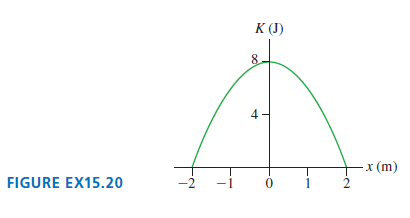
FIGURE EX15.20 is a kinetic-energy graph of a mass oscillating on a very long horizontal spring. What is the spring constant? K (J) 8. 4 x (m) FIGURE EX15.20
A student is bouncing on a trampoline. At her highest point, her feet are 55 cm above the trampoline. When she lands, the trampoline sags 15 cm before propelling her back up. For how long is she in contact with the trampoline?
A 1.0 kg block is attached to a spring with spring constant 16 N/m. While the block is sitting at rest, a student hits it with a hammer and almost instantaneously gives it a speed of 40 cm/s.What area. The amplitude of the subsequent oscillations?b. The block’s speed at the point where x = 1/2 A?
The position of a 50 g oscillating mass is given by x(t) = (2.0 cm) cos(10 t - π/4), where t is in s. Determine:a. The amplitude.b. The period.c. The spring constant.d. The phase constant.e. The initial conditions.f. The maximum speed.g. The total energy.h. The velocity at t = 0.40 s.
200 g mass attached to a horizontal spring oscillates at a frequency of 2.0 Hz. At t = 0 s, the mass is at x = 5.0 cm and has vx = -30 cm/s. Determine:a. The period.b. The angular frequency.c. The amplitude.d. The phase constant.e. The maximum speed.f. The maximum acceleration.g. The total
A 200 g air-track glider is attached to a spring. The glider is pushed in 10 cm and released. A student with a stopwatch finds that 10 oscillations take 12.0 s. What is the spring constant?
A block attached to a spring with unknown spring constant oscillates with a period of 2.0 s. What is the period ifa. The mass is doubled?b. The mass is halved?c. The amplitude is doubled?d. The spring constant is doubled?Parts a to d are independent questions, each referring to the initial
An air-track glider attached to a spring oscillates with a period of 1.5 s. At t = 0 s the glider is 5.00 cm left of the equilibrium position and moving to the right at 36.3 cm/s.a. What is the phase constant?b. What is the phase at t = 0 s, 0.5 s, 1.0 s, and 1.5 s?
What is the difference between the driving frequency and the natural frequency of an oscillator?
An object in simple harmonic motion has amplitude 8.0 cm and frequency 0.50 Hz. At t = 0 s it has its most negative position.Write the function x(t) that describes the object’s position.
a. Describe the difference between τ and T. Don’t just name them; say what is different about the physical concepts they represent.b. Describe the difference between τ and t1/2.
An object in simple harmonic motion has amplitude 4.0 cm and frequency 4.0 Hz, and at t = 0 s it passes through the equilibrium point moving to the right. Write the function x(t) that describes the object’s position.
Suppose the damping constant b of an oscillator increases.a. Is the medium more resistive or less resistive?b. Do the oscillations damp out more quickly or less quickly?c. Is the time constant t increased or decreased?
An object in simple harmonic motion has an amplitude of 8.0 cm, a frequency of 0.25 Hz, and a phase constant of -π/2 rad. Draw a position graph showing two cycles of the motion.
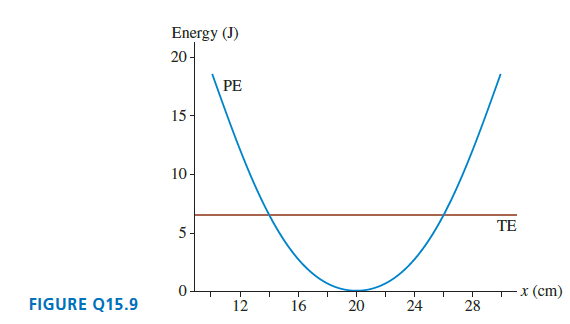
FIGURE Q15.9 shows the potential-energy diagram and the total energy line of a particle oscillating on a spring.a. What is the spring€™s equilibrium length?b. Where are the turning points of the motion? Explain.c. What is the particle€™s maximum kinetic energy?d. What will be
An object in simple harmonic motion has an amplitude of 4.0 cm, a frequency of 2.0 Hz, and a phase constant of 2π/3 rad.Draw a position graph showing two cycles of the motion.
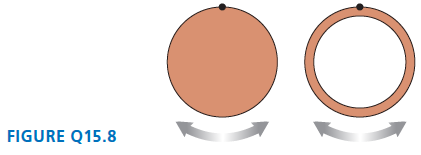
The solid disk and circular hoop in FIGURE Q15.8 have the same radius and the same mass. Each can swing back and forth as a pendulum from a pivot at the top edge. Which, if either, has the larger period of oscillation? FIGURE Q15.8
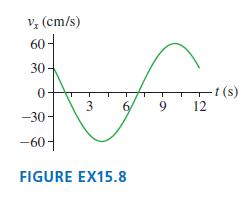
FIGURE EX15.8 is the velocity-versus-time graph of a particle in simple harmonic motion. a. What is the amplitude of the oscillation?b. What is the phase constant?c. What is the position at t = 0 s? V; (cm/s) 60어 30 - - t (s) 12 3 6/ 9 -30- -60- FIGURE EX15.8
A block oscillating on a spring has a maximum speed of 20 cm/s.What will the block’s maximum speed be if the total energy is doubled? Explain.
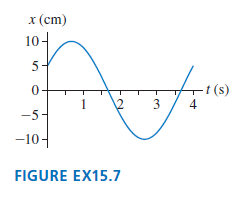
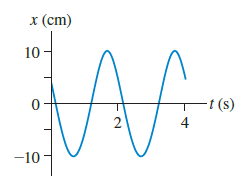
FIGURE EX15.7 is the position-versus-time graph of a particle in simple harmonic motion. a. What is the phase constant?b. What is the velocity at t = 0 s?c. What is vmax? х (ст) 10- 5- 2 (s) 4 1 3 -5- -10- FIGURE EX15.7
A block oscillating on a spring has an amplitude of 20 cm. What will the amplitude be if the total energy is doubled? Explain.
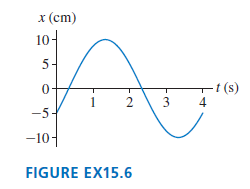
What are the(a) Amplitude,(b) Frequency,(c) Phase constantof the oscillation shown in FIGURE EX15.6? x (ст) 10- - (s) 2 3. -5- -10- FIGURE EX15.6
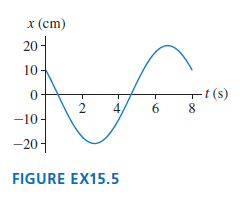
What are the(a) Amplitude,(b) Frequency,(c) Phase constant of the oscillation shown in FIGURE EX15.5? x (cm) 20- 10 -t (s) -10 -20- FIGURE EX15.5 4. 2.
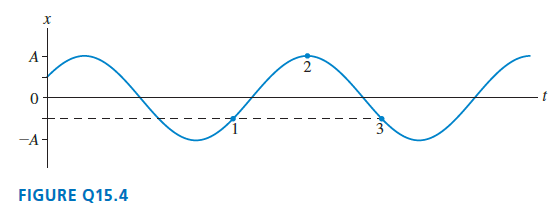
FIGURE Q15.4 shows a position-versus-time graph for a particle in SHM.a. What is the phase constant Ï•0? Explain.b. What is the phase of the particle at each of the three numbered points on the graph? -A FIGURE Q15.4
An object in SHM oscillates with a period of 4.0 s and an amplitude of 10 cm. How long does the object take to move from x = 0.0 cm to x = 6.0 cm?
FIGURE Q15.3 shows a positionversus- time graph for a particle in SHM. What are (a) The amplitude A,(b) The angular frequency v,(c) The phase constant Ï•0? х (ст) 10 -t (s) 4 -10-
When a guitar string plays the note “A,” the string vibrates at 440 Hz. What is the period of the vibration?
A pendulum on Planet X, where the value of g is unknown, oscillates with a period T = 2 s. What is the period of this pendulum if:a. Its mass is doubled? Explain. Note that you do not know the value of m, L, or g, so do not assume any specific values. The required analysis involves thinking about
An air-track glider is attached to a spring. The glider is pulled to the right and released from rest at t = 0 s. It then oscillates with a period of 2.0 s and a maximum speed of 40 cm/s.a. What is the amplitude of the oscillation?b. What is the glider’s position at t = 0.25 s?
A block oscillating on a spring has period T = 2 s. What is the period if:a. The block’s mass is doubled? Explain. Note that you do not know the value of either m or k, so do not assume any particular values for them. The required analysis involves thinking about ratios.b. The value of the spring
An air-track glider attached to a spring oscillates between the 10 cm mark and the 60 cm mark on the track. The glider completes 10 oscillations in 33 s. What are the(a) Period,(b) Frequency,(c) Angular frequency,(d) Amplitude,(e) Maximum speed of the glider?
A 2.0-m-diameter vertical cylinder, open at the top, is filled with ethyl alcohol to the 2.5 m mark. A worker pulls a plug from a hole 55 cm from the bottom, causing the fluid level to begin dropping at a rate of 3.4 mm/min. What is the diameter of the hole?
Water from a vertical pipe emerges as a 10-cm-diameter cylinder and falls straight down 7.5 m into a bucket. The water exits the pipe with a speed of 2.0 m/s. What is the diameter of the column of water as it hits the bucket?
Water flowing out of a 16-mm-diameter faucet fills a 2.0 L bottle in 10 s. At what distance below the faucet has the water stream narrowed to 10 mm diameter?
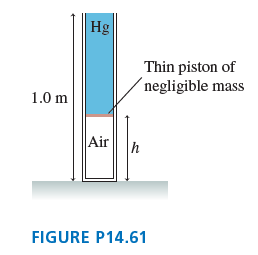
The 1.0-m-tall cylinder in FIGURE P14.61 contains air at a pressure of 1 atm. A very thin, frictionless piston of negligible mass is placed at the top of the cylinder, to prevent any air from escaping, then mercury is slowly poured into the cylinder until no more can be added without the cylinder
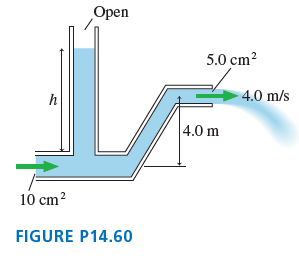
Water flows from the pipe shown in FIGURE P14.60 with a speed of 4.0 m/s.a. What is the water pressure as it exits into the air?b. What is the height h of the standing column of water? Open 5.0 cm? h 4.0 m/s 4.0 m 10 cm? FIGURE P14.60
A tree loses water to the air by the process of transpiration at the rate of 110 g/h. This water is replaced by the upward flow of sap through vessels in the trunk. If the trunk contains 2000 vessels, each 100 μm in diameter, what is the upward speed of the sap in each vessel? The density of tree
a. A liquid of density r flows at speed v0 through a horizontal pipe that expands smoothly from diameter d0 to a larger diameter d1. The pressure in the narrower section is p0. Find an expression for the pressure p1 in the wider section.b. A pressure gauge reads 50 kPa as water flows at 10.0 m/s
A nuclear power plant draws 3.0 × 10⁶ L/min of cooling water from the ocean. If the water is drawn in through two parallel, 3.0-m-diameter pipes, what is the water speed in each pipe?
A 355 mL soda can is 6.2 cm in diameter and has a mass of 20 g. Such a soda can half full of water is floating upright in water.What length of the can is above the water level?
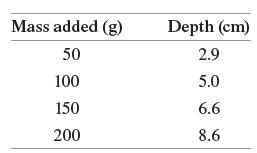
A plastic “boat” with a 25 cm2 square cross section floats in a liquid. One by one, you place 50 g masses inside the boat and measure how far the boat extends below the surface. Your data are as follows: Draw an appropriate graph of the data and, from the slope and intercept of the best-fit
A spring with spring constant 35 N/m is attached to the ceiling, and a 5.0-cm-diameter, 1.0 kg metal cylinder is attached to its lower end. The cylinder is held so that the spring is neither stretched nor compressed, then a tank of water is placed underneath with the surface
One day when you come into physics lab you find several plastic hemispheres floating like boats in a tank of fresh water. Each lab group is challenged to determine the heaviest rock that can be placed in the bottom of a plastic boat without sinking it.You get one try. Sinking the boat gets you no
A 30-cm-tall, 4.0-cm-diameter plastic tube has a sealed bottom. 250 g of lead pellets are poured into the bottom of the tube, whose mass is 30 g, then the tube is lowered into a liquid.The tube floats with 5.0 cm extending above the surface. What is the density of the liquid?
A less-dense liquid of density ρ1 floats on top of a more-dense liquid of density ρ2. A uniform cylinder of length l and density ρ, with ρ1 < ρ < ρ2, floats at the interface with its long axis vertical. What fraction of the length is in the more-dense liquid?
A cylinder with cross-section area A floats with its long axis vertical in a liquid of density ρ.a. Pressing down on the cylinder pushes it deeper into the liquid.Find an expression for the force needed to push the cylinder distance x deeper into the liquid and hold it there.b. A 4.0-cm-diameter
The average density of the body of a fish is 1080 kg/m3. To keep from sinking, a fish increases its volume by inflating an internal air bladder, known as a swim bladder, with air. By what percent must the fish increase its volume to be neutrally buoyant in fresh water? The density of air at 20°C
It’s possible to use the ideal-gas law to show that the density of the earth’s atmosphere decreases exponentially with height. That is, ρ = ρ0 exp(-z/z0), where z is the height above sea level, ρ0 is the density at sea level (you can use the Table 14.1 value), and z0 is called the scale
An aquarium of length L, width (front to back) W, and depth D is filled to the top with liquid of density ρ.a. Find an expression for the force of the liquid on the bottom of the aquarium.b. Find an expression for the force of the liquid on the front window of the aquarium.c. Evaluate the forces
Glycerin is poured into an open U-shaped tube until the height in both sides is 20 cm. Ethyl alcohol is then poured into one arm until the height of the alcohol column is 20 cm. The two liquids do not mix. What is the difference in height between the top surface of the glycerin and the top surface
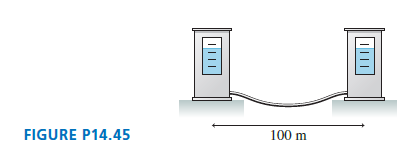
Geologists place tiltmeters on the sides of volcanoes to measure the displacement of the surface as magma moves inside the volcano. Although most tiltmeters today are electronic, the traditional tiltmeter, used for decades, consisted of two or more water-filled metal cans placed some distance apart
A U-shaped tube, open to the air on both ends, contains mercury.Water is poured into the left arm until the water column is 10.0 cm deep. How far upward from its initial position does the mercury in the right arm rise?
A 55 kg cheerleader uses an oil-filled hydraulic lift to hold four 110 kg football players at a height of 1.0 m. If her piston is 16 cm in diameter, what is the diameter of the football players’ piston?
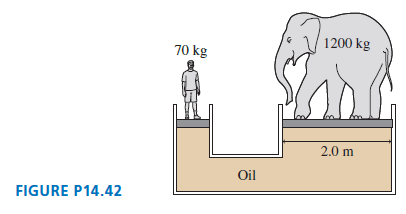
a. The 70 kg student in FIGURE P14.42 balances a 1200 kg elephant on a hydraulic lift. What is the diameter of the piston the student is standing on?b. When a second student joins the first, the piston sinks 35 cm. What is the second student€™s mass? 1200 kg 70 kg 2.0 m Oil FIGURE P14.42
A friend asks you how much pressure is in your car tires. You know that the tire manufacturer recommends 30 psi, but it’s been a while since you’ve checked. You can’t find a tire gauge in the car, but you do find the owner’s manual and a ruler. Fortunately, you’ve just finished taking
Postural hypotension is the occurrence of low systolic blood pressure when a person stands up too quickly from a reclining position. A brain blood pressure lower than 90 mm of Hg can cause fainting or lightheadedness. In a healthy adult, the automatic constriction and expansion of blood vessels
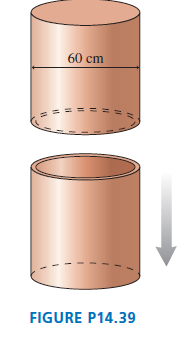
The two 60-cm-diameter cylinders in FIGURE P14.39, closed at one end, open at the other, are joined to form a single cylinder, then the air inside is removed.a. How much force does the atmosphere exert on the flat end of each cylinder?b. Suppose one cylinder is bolted to a sturdy ceiling. How many
A 5.0-m-diameter solid aluminum sphere is launched into space.By how much does its diameter increase? Give your answer in μm.
A large 10,000 L aquarium is supported by four wood posts (Douglas fir) at the corners. Each post has a square 4.0 cm × 4.0 cm cross section and is 80 cm tall. By how much is each post compressed by the weight of the aquarium?
a. What is the pressure at a depth of 5000 m in the ocean?b. What is the fractional volume change ΔV/V of seawater at this pressure?c. What is the density of seawater at this pressure?
A 3.0-m-tall, 50-cm-diameter concrete column supports a 200,000 kg load. By how much is the column compressed?
An 80-cm-long, 1.0-mm-diameter steel guitar string must be tightened to a tension of 2000 N by turning the tuning screws. By how much is the string stretched?
A 70 kg mountain climber dangling in a crevasse stretches a 50-m-long, 1.0-cm-diameter rope by 8.0 cm. What is Young’s modulus for the rope?
A 2.0 mL syringe has an inner diameter of 6.0 mm, a needle inner diameter of 0.25 mm, and a plunger pad diameter (where you place your finger) of 1.2 cm. A nurse uses the syringe to inject medicine into a patient whose blood pressure is 140/100.a. What is the minimum force the nurse needs to apply
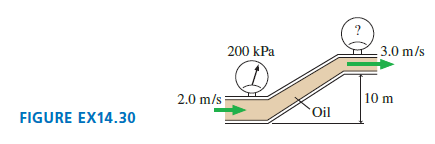
What does the top pressure gauge read in FIGURE EX14.30? 200 kPa 3.0 m/s 10 m Oil 2.0 m/s FIGURE EX14.30
A bucket is filled with water to a height of 23 cm, then a plug is removed from a 4.0-mm-diameter hole in the bottom of the bucket. As the water begins to pour out of the hole, how fast is it moving?
A 1.0-cm-diameter pipe widens to 2.0 cm, then narrows to 5.0 mm. Liquid flows through the first segment at a speed of 4.0 m/s.a. What is the speed in the second and third segments?b. What is the volume flow rate through the pipe?
Water flows through a 2.5-cm-diameter hose at 3.0 m/s.How long, in minutes, will it take to fill a 600 L child’s wading pool?
You and your friends are playing in the swimming pool with a 60-cm-diameter beach ball. How much force would be needed to push the ball completely under water?
Styrofoam has a density of 150 kg/m3. What is the maximum mass that can hang without sinking from a 50-cm-diameter Styrofoam sphere in water? Assume the volume of the mass is negligible compared to that of the sphere.
You need to determine the density of a ceramic statue. If you suspend it from a spring scale, the scale reads 28.4 N.If you then lower the statue into a tub of water, so that it is completely submerged, the scale reads 17.0 N. What is the statue’s density?
A 10-cm-diameter, 20-cm-tall steel cylinder (ρsteel = 7900 kg/m3) floats in mercury. The axis of the cylinder is perpendicular to the surface. What length of steel is above the surface?
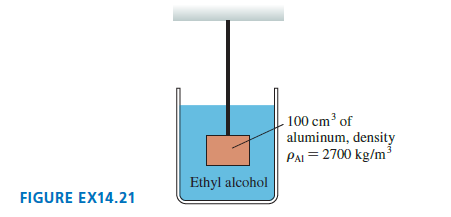
What is the tension of the string in FIGURE EX14.21? 100 cm³ of aluminum, density PAI = 2700 kg/m³ Ethyl alcohol FIGURE EX14.21
A 5.0 kg rock whose density is 4800 kg/m3 is suspended by a string such that half of the rock’s volume is under water. What is the tension in the string?
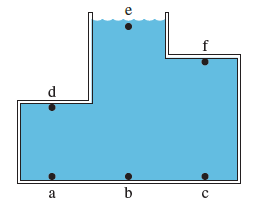
Rank in order, from largest to smallest, the pressures at d, e, and f in FIGURE Q14.2. Explain. f d a b
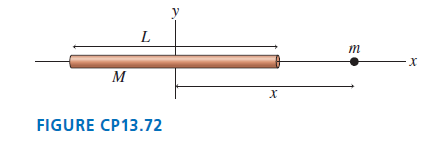
FIGURE CP13.72 shows a particle of mass m at distance x from the center of a very thin cylinder of mass M and length L. The particle is outside the cylinder, so x > L/2.a. Calculate the gravitational potential energy of these two masses.b. Use what you know about the relationship between force
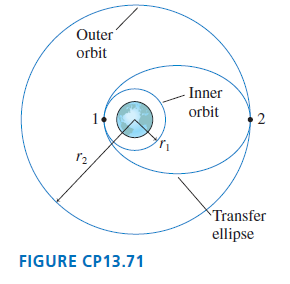
Let€™s look in more detail at how a satellite is moved from one circular orbit to another. FIGURE CP13.71 shows two circular orbits, of radii r1and r2, and an elliptical orbit that connects them. Points 1 and 2 are at the ends of the semi major axis of the ellipse.a. A satellite moving
A moon lander is orbiting the moon at an altitude of 1000 km. By what percentage must it decrease its speed so as to just graze the moon’s surface one-half period later?
While visiting Planet Physics, you toss a rock straight up at 11 m/s and catch it 2.5 s later. While you visit the surface, your cruise ship orbits at an altitude equal to the planet’s radius every 230 min. What are the (a) Mass(b) Radius of Planet Physics?
A satellite in a circular orbit of radius r has period T. A satellite in a nearby orbit with radius r + Δr, where Δr << r, has the very slightly different period T + ΔT.a. Show that ΔT/T = 3/2 Δr/rb. Two earth satellites are in parallel orbits with radii 6700 km and 6701 km. One day they
Showing 2500 - 2600
of 3693
First
19
20
21
22
23
24
25
26
27
28
29
30
31
32
33
Last
Step by Step Answers

 Get 50% OFF
Claim Now
Get 50% OFF
Claim Now