New Semester
Started
Get
50% OFF
Study Help!
--h --m --s
Claim Now
Question Answers
Textbooks
Find textbooks, questions and answers
Oops, something went wrong!
Change your search query and then try again
S
Books
FREE
Study Help
Expert Questions
Accounting
General Management
Mathematics
Finance
Organizational Behaviour
Law
Physics
Operating System
Management Leadership
Sociology
Programming
Marketing
Database
Computer Network
Economics
Textbooks Solutions
Accounting
Managerial Accounting
Management Leadership
Cost Accounting
Statistics
Business Law
Corporate Finance
Finance
Economics
Auditing
Tutors
Online Tutors
Find a Tutor
Hire a Tutor
Become a Tutor
AI Tutor
AI Study Planner
NEW
Sell Books
Search
Search
Sign In
Register
study help
physics
physics scientists and engineers
Physics for Scientists and Engineers A Strategic Approach with Modern Physics 4th edition Randall D. Knight - Solutions
A 30-cm-diameter, 1.2 kg solid turntable rotates on a 1.2-cm diameter, 450 g shaft at a constant 33 rpm. When you hit the stop switch, a brake pad presses against the shaft and brings the turntable to a halt in 15 seconds. How much friction force does the brake pad apply to the shaft?
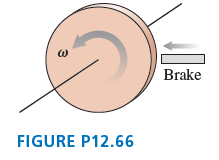
The 2.0 kg, 30-cm-diameter disk in Figure P12.66 is spinning at 300 rpm. How much friction force must the brake apply to the rim to bring the disk to a halt in 3.0 s? Brake FIGURE P12.66
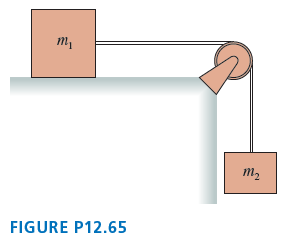
Blocks of mass m1and m2are connected by a massless string that passes over the pulley in Figure P12.65. The pulley turns on frictionless bearings. Mass m1slides on a horizontal, frictionless surface. Mass m2is released while the blocks are at rest.a. Assume the pulley is massless. Find the
Flywheels are large, massive wheels used to store energy. They can be spun up slowly, then the wheel’s energy can be released quickly to accomplish a task that demands high power. An industrial flywheel has a 1.5 m diameter and a mass of 250 kg. Its maximum angular velocity is 1200 rpm.a. A motor
A piece of modern sculpture consists of an 8.0-m-long, 150 kg stainless steel bar passing diametrically through a 50 kg copper sphere. The center of the sphere is 2.0 m from one end of the bar.To be mounted for display, the bar is oriented vertically, with the copper sphere at the lower end, then
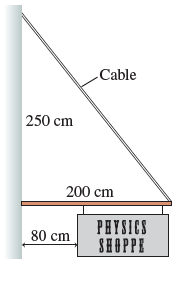
A 120-cm-wide sign hangs from a 5.0 kg, 200-cm-long pole. A cable of negligible mass supports the end of the rod as shown in Figure P12.62. What is the maximum mass of the sign if the maximum tension in the cable without breaking is 300 N? Cable 250 cm 200 cm PHYSICS SHOPPE 80 cm
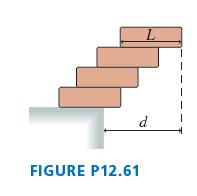
Your task in a science contest is to stack four identical uniform bricks, each of length L, so that the top brick is as far to the right as possible without the stack falling over. Is it possible, as Figure P12.61 shows, to stack the bricks such that no part of the top brick is over the table?
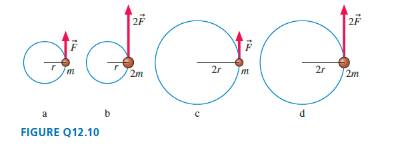
Rank in order, from largest to smallest, the angular accelerations αato αdin FIGURE Q12.10. Explain. 2F 2F 2m 2r 2r 2m b d FIGURE Q12.10
You are given the equation(s) used to solve a problem. For each of these, you are toa. Write a realistic problem for which this is the correct equation(s).b. Finish the solution of the problem, including a pictorial representation.(0.10 kg + 0.20 kg)v1x = (0.10 kg)(3.0 m/s)1/2 (0.30 kg)(0 m/s)2 +
You are given the equation(s) used to solve a problem. For each of these, you are toa. Write a realistic problem for which this is the correct equation(s).b. Finish the solution of the problem, including a pictorial representation.(3000 kg)vfx = (2000 kg)(5.0 m/s) + (1000 kg)(-4.0 m/s)
You are given the equation(s) used to solve a problem. For each of these, you are toa. Write a realistic problem for which this is the correct equation(s).b. Finish the solution of the problem, including a pictorial representation.(600 g)(4.0 m/s) = (400 g)(3.0 m/s) + (200 g)(vix)2
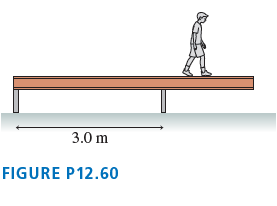
A 40 kg, 5.0-m-long beam is supported by, but not attached to, the two posts in Figure P12.60. A 20 kg boy starts walking along the beam. How close can he get to the right end of the beam without it falling over? 3.0 m FIGURE P12.60
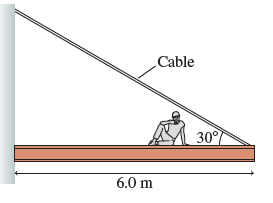
In Figure P12.59, an 80 kg construction worker sits down 2.0 m from the end of a 1450 kg steel beam to eat his lunch.What is the tension in the cable? Cable 30°7 6.0 m
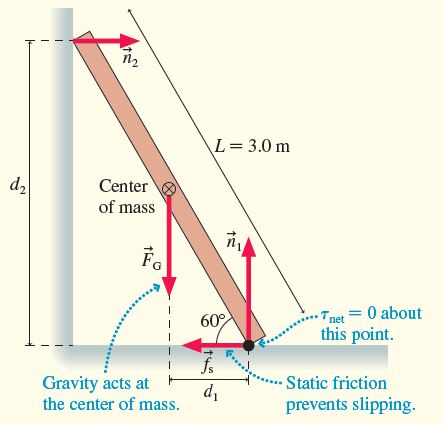
A 3.0-m-long ladder, as shown in Figure 12.35, leans against a frictionless wall. The coefficient of static friction between the ladder and the floor is 0.40. What is the minimum angle the ladder can make with the floor without slipping? L= 3.0 m dz Center of mass Tnet = 0 about this point. 60°
A person’s center of mass is easily found by having the person lie on a reaction board. A horizontal, 2.5-m-long, 6.1 kg reaction board is supported only at the ends, with one end resting on a scale and the other on a pivot. A 60 kg woman lies on the reaction board with her feet over the pivot.
Consider a solid cone of radius R, height H, and mass M. The volume of a cone is 1/3πHR2.a. What is the distance from the apex (the point) to the center of mass?b. What is the moment of inertia for rotation about the axis of the cone?
a. A disk of mass M and radius R has a hole of radius r centered on the axis. Calculate the moment of inertia of the disk.b. Confirm that your answer agrees with Table 12.2 when r = 0 and when r = R.c. A 4.0-cm-diameter disk with a 3.0-cm-diameter hole rolls down a 50-cm-long, 20° ramp. What is
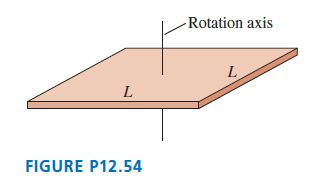
Calculate the moment of inertia of the rectangular plate in FIGURE P12.54 for rotation about a perpendicular axis through the center. Rotation axis L L FIGURE P12.54
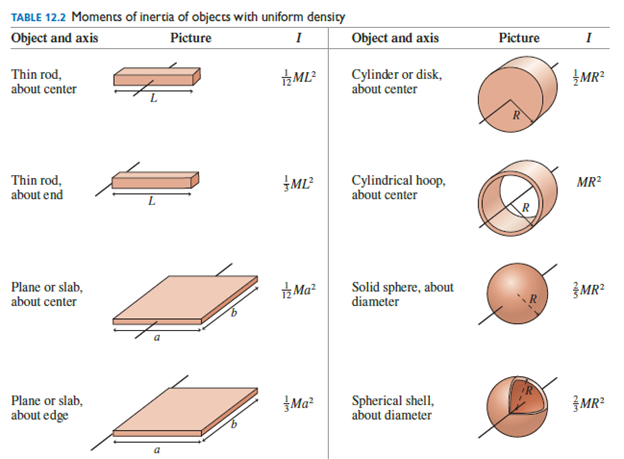
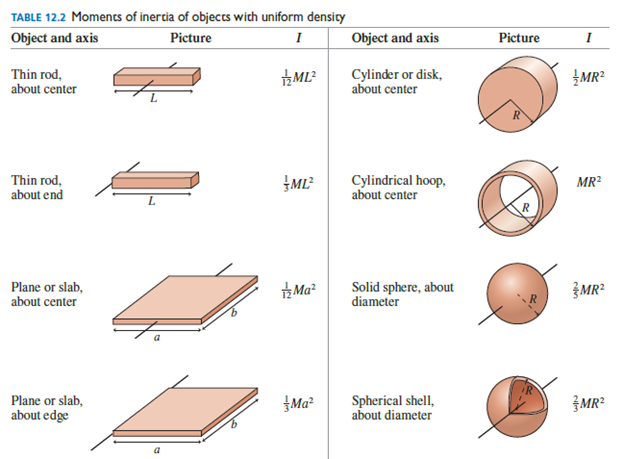
Calculate by direct integration the moment of inertia for a thin rod of mass M and length L about an axis located distance d from one end. Confirm that your answer agrees with Table 12.2 when d = 0 and when d = L /2. TABLE 12.2 Moments of inertia of objects wich uniform density Object and axis
What is the moment of inertia of a 2.0 kg, 20-cm-diameter disk for rotation about an axis(a) Through the center,(b) Through the edge of the disk?
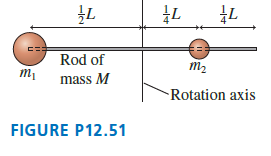
Determine the moment of inertia about the axis of the object shown in FIGURE P12.51. Rod of тp т, mass M Rotation axis FIGURE P12.51
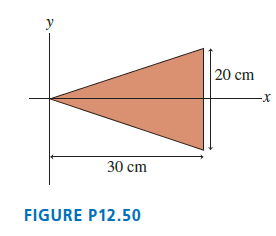
An 800 g steel plate has the shape of the isosceles triangle shown in FIGURE P12.50. What are the x- and y-coordinates of the center of mass? y 20 cm 30 cm FIGURE P12.50
A 300 g ball and a 600 g ball are connected by a 40-cm-long massless, rigid rod. The structure rotates about its center of mass at 100 rpm. What is its rotational kinetic energy?
A toy gyroscope has a ring of mass M and radius R attached to the axle by lightweight spokes. The end of the axle is distance R from the center of the ring. The gyroscope is spun at angular velocity Ω, then the end of the axle is placed on a support that allows the gyroscope to precess.a. Find an
A 75 g, 6.0-cm-diameter solid spherical top is spun at 1200 rpm on an axle that extends 1.0 cm past the edge of the sphere.The tip of the axle is placed on a support. What is the top’s precession frequency in rpm?
A 2.0 kg, 20-cm-diameter turntable rotates at 100 rpm on frictionless bearings. Two 500 g blocks fall from above, hit the turntable simultaneously at opposite ends of a diameter, and stick.What is the turntable’s angular velocity, in rpm, just after this event?
How fast, in rpm, would a 5.0 kg, 22-cm-diameter bowling ball have to spin to have an angular momentum of 0.23 kg m2/s?
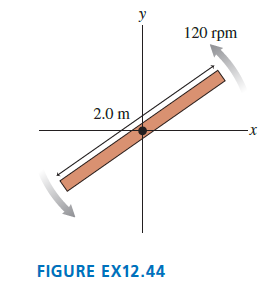
What is the angular momentum vector of the 500 g rotating bar in FIGURE EX12.44? 120 rpm 2.0 m FIGURE EX12.44
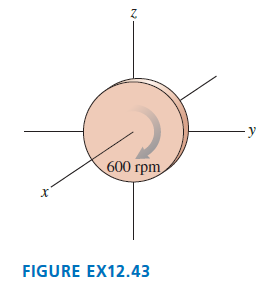
What is the angular momentum vector of the 2.0 kg, 4.0-cm-diameter rotating disk in FIGURE EX12.43? y 600 rpm х FIGURE EX12.43
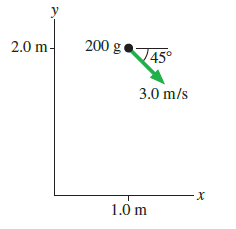
What are the magnitude and direction of the angular momentum relative to the origin of the 200 g particle in FIGURE EX12.42? 200 g 45° 2.0 m- 3.0 m/s -х 1.0 m
A 1.3 kg ball on the end of a lightweight rod is located at (x, y) = (3.0 m, 2.0 m), where the y-axis is vertical. The other end of the rod is attached to a pivot at (x, y) = (0 m, 3.0 m).What is the torque about the pivot? Write your answer using unit vectors.
Force F = -10ĵ N is exerted on a particle at r = (5î + 5ĵ) m.What is the torque on the particle about the origin?
Vector A = 3î + ĵ and vector B = 3î - 2ĵ + 2k̂. What is the cross product A × B?
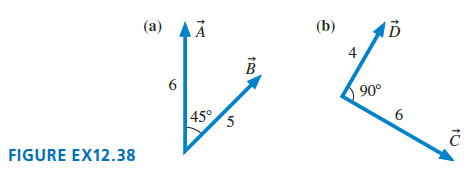
Evaluate the cross products A × B and C × D. (a) AÅ (b) Б 4 90° 45° FIGURE EX12.38
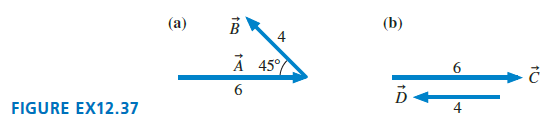
Evaluate the cross products A × B and C × D. (b) (a) A 45°/ FIGURE EX12.37
A solid sphere of radius R is placed at a height of 30 cm on a 15° slope. It is released and rolls, without slipping, to the bottom. From what height should a circular hoop of radius R be released on the same slope in order to equal the sphere’s speed at the bottom?
An 8.0-cm-diameter, 400 g solid sphere is released from rest at the top of a 2.1-m-long, 25° incline. It rolls, without slipping, to the bottom.a. What is the sphere’s angular velocity at the bottom of the incline?b. What fraction of its kinetic energy is rotational?
A 500 g, 8.0-cm-diameter can is filled with uniform, dense food. It rolls across the floor at 1.0 m/s. What is the can’s kinetic energy?
A car tire is 60 cm in diameter. The car is traveling at a speed of 20 m/s.a. What is the tire’s angular velocity, in rpm?b. What is the speed of a point at the top edge of the tire?c. What is the speed of a point at the bottom edge of the tire?
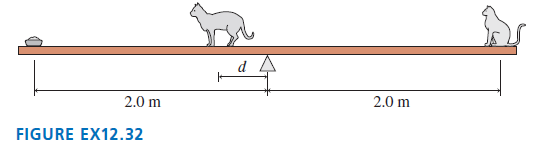
A 5.0 kg cat and a 2.0 kg bowl of tuna fish are at opposite ends of the 4.0-m-long seesaw of Figure EX12.32. How far to the left of the pivot must a 4.0 kg cat stand to keep the seesaw balanced? 2.0 m 2.0 m FIGURE EX12.32
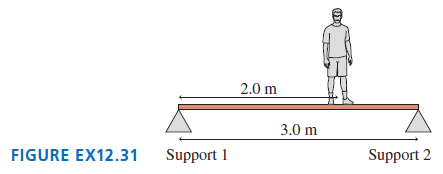
The 3.0-m-long, 100 kg rigid beam of Figure EX12.31 is supported at each end. An 80 kg student stands 2.0 m from support 1. How much upward force does each support exert on the beam? 2.0 m 3.0 m FIGURE EX12.31 Support 2 Support 1
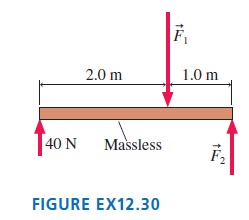
The object shown in Figure EX12.30 is in equilibrium. What are the magnitudes of F1and F2? 2.0 m 1.0 m f40 N Massless FIGURE EX12.30
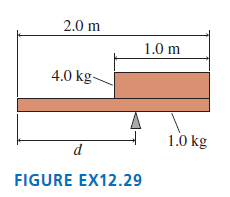
The two objects in Figure EX12.29 are balanced on the pivot.What is distance d? 2.0 m 1.0 m 4.0 kg- 1.0 kg FIGURE EX12.29
A 4.0 kg, 36-cm-diameter metal disk, initially at rest, can rotate on an axle along its axis. A steady 5.0 N tangential force is applied to the edge of the disk. What is the disk’s angular velocity, in rpm, 4.0 s later?
Starting from rest, a 12-cm-diameter compact disk takes 3.0 s to reach its operating angular velocity of 2000 rpm. Assume that the angular acceleration is constant. The disk’s moment of inertia is 2.5 × 10⁻⁵ kg m2.a. How much net torque is applied to the disk?b. How many revolutions does it make
A 1.0 kg ball and a 2.0 kg ball are connected by a 1.0-m-long rigid, massless rod. The rod is rotating cw about its center of mass at 20 rpm. What net torque will bring the balls to a halt in 5.0 s?
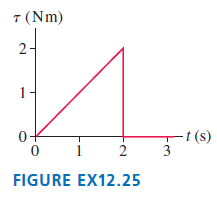
An object whose moment of inertia is 4.0 kg m2experiences the torque shown in Figure EX12.25. What is the object€™s angular velocity at t = 3.0 s? Assume it starts from rest. т (Nm) 0+ -t (s) 3 FIGURE EX12.25
An object’s moment of inertia is 2.0 kg m2. Its angular velocity is increasing at the rate of 4.0 rad/s per second. What is the net torque on the object?
An athlete at the gym holds a 3.0 kg steel ball in his hand. His arm is 70 cm long and has a mass of 3.8 kg, with the center of mass at 40% of the arm length. What is the magnitude of the torque about his shoulder due to the ball and the weight of his arm if he holds his arma. Straight out to his
A 4.0-m-long, 500 kg steel beam extends horizontally from the point where it has been bolted to the framework of a new building under construction. A 70 kg construction worker stands at the far end of the beam. What is the magnitude of the torque about the bolt due to the worker and the weight of
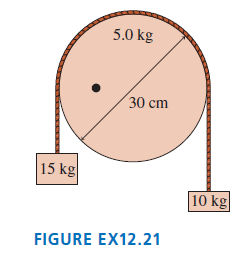
The axle in Figure EX12.21 is half the distance from the center to the rim. What is the net torque about the axle? 5.0 kg 30 cm 15 kg |10 kg FIGURE EX12.21
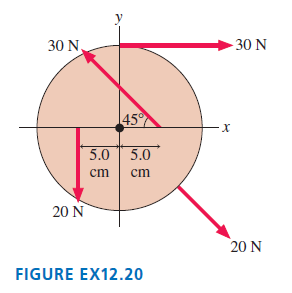
The 20-cm-diameter disk in Figure EX12.20 can rotate on an axle through its center. What is the net torque about the axle? y 30 N, 30 N 45 5.0 5.0 cт cm 20 N 20 N FIGURE EX12.20
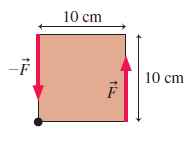
In Figure EX12.19, what magnitude force provides 5.0 N m net torque about the axle? 10 cm 10 cm
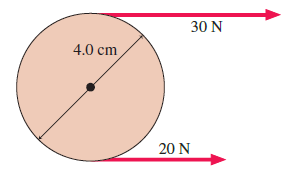
In Figure EX12.18, what is the net torque about the axle? 30 N 4.0 cm 20 N
A 25 kg solid door is 220 cm tall, 91 cm wide. What is the door’s moment of inertia for(a) Rotation on its hinges(b) Rotation about a vertical axis inside the door, 15 cm from one edge?
A 12-cm-diameter CD has a mass of 21 g. What is the CD’s moment of inertia for rotation about a perpendicular axis(a) Through its center(b) Through the edge of the disk?
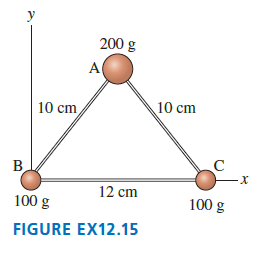
The three masses shown in Figure EX12.15 are connected by massless, rigid rods.a. Find the coordinates of the center of mass.b. Find the moment of inertia about an axis that passes through mass A and is perpendicular to the page.c. Find the moment of inertia about an axis that passes through masses
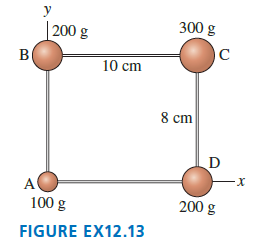
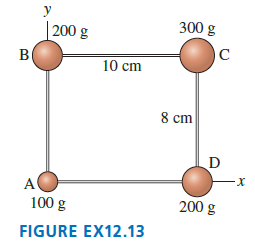
The four masses shown in Figure EX12.13 are connected by massless, rigid rods.a. Find the coordinates of the center of mass.b. Find the moment of inertia about a diagonal axis that passes through masses B and D. y 300 g 200 g BỊ 10 cm 8 cm D 200 g 100 g FIGURE EX12.13
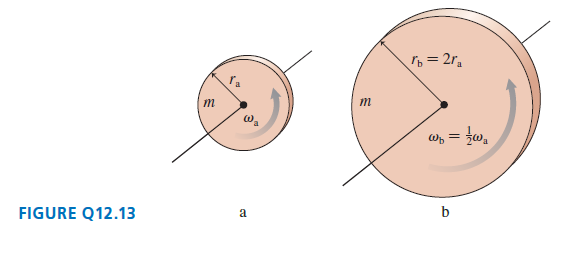
Is the angular momentum of disk a in FIGURE Q12.13 larger than, smaller than, or equal to the angular momentum of disk b? Explain. Ib = 2r, т т wn = 2w, b FIGURE Q12.13
The four masses shown in Figure EX12.13 are connected by massless, rigid rods.a. Find the coordinates of the center of mass.b. Find the moment of inertia about an axis that passes through mass A and is perpendicular to the page. y 300 g 200 g BỊ 10 cm 8 cm D 200 g 100 g FIGURE EX12.13
A diver in the pike position (legs straight, hands on ankles) usually makes only one or one-and-a-half rotations. To make two or three rotations, the diver goes into a tuck position (knees bent, body curled up tight). Why?
A drum major twirls a 96-cm-long, 400 g baton about its center of mass at 100 rpm. What is the baton’s rotational kinetic energy?
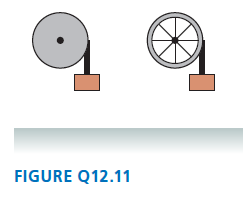
The solid cylinder and cylindrical shell in FIGURE Q12.11 have the same mass, same radius, and turn on frictionless, horizontal axles.(The cylindrical shell has lightweight spokes connecting the shell to the axle.) A rope is wrapped around each cylinder and tied to a block. The blocks have the same
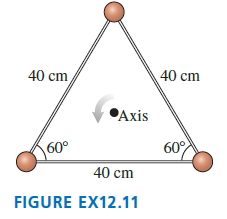
The three 200 g masses in Figure EX12.11 are connected by massless, rigid rods.a. What is the triangle€™s moment of inertia about the axis through the center?b. What is the triangle€™s kinetic energy if it rotates about the axis at 5.0 rev/s? 40 cm 40 cm, •Axis 60° 60 40 cm
What is the rotational kinetic energy of the earth? Assume the earth is a uniform sphere. Data for the earth can be found inside the back cover of the book.
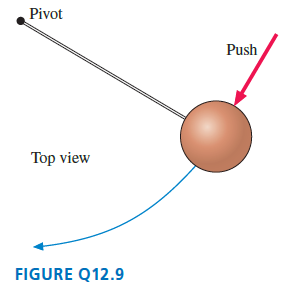
A student gives a quick push to a ball at the end of a massless, rigid rod, as shown in FIGURE Q12.9, causing the ball to rotate clockwise in a horizontal circle. The rod€™s pivot is frictionless.a. As the student is pushing, is the torque about the pivot positive, negative, or zero?b.
A thin, 100 g disk with a diameter of 8.0 cm rotates about an axis through its center with 0.15 J of kinetic energy. What is the speed of a point on the rim?
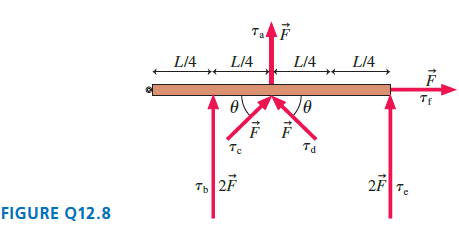
Six forces are applied to the door in FIGURE Q12.8. Rank in order, from largest to smallest, the six torques Ï„ato Ï„fabout the hinge on the left. Explain. таF LI4 L/4 L/4 L/4 т 'ө Td 2F T. Ть 2F FIGURE Q12.8
A 100 g ball and a 200 g ball are connected by a 30-cm-long, massless, rigid rod. The balls rotate about their center of mass at 120 rpm. What is the speed of the 100 g ball?
The professor hands you two spheres. They have the same mass, the same radius, and the same exterior surface. The professor claims that one is a solid sphere and the other is hollow. Can you determine which is which without cutting them open? If so, how? If not, why not?
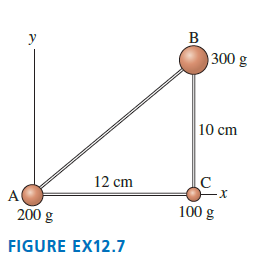
The three masses shown in Figure EX12.7 are connected by massless, rigid rods. What are the coordinates of the center of mass? B 300 g 10 cm 12 cm х 100 g 200 g FIGURE EX12.7
You have two solid steel spheres. Sphere 2 has twice the radius of sphere 1. By what factor does the moment of inertia I2 of sphere 2 exceed the moment of inertia I1 of sphere 1?
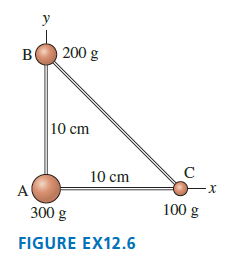
The three masses shown in Figure EX12.6 are connected by massless, rigid rods. What are the coordinates of the center of mass? 200 g B 10 cm 10 cm A 100 g 300 g FIGURE EX12.6
The moment of inertia of a uniform rod about an axis through its center is 1/12 mL2. The moment of inertia about an axis at one end is 1/3 mL2. Explain why the moment of inertia is larger about the end than about the center.
How far from the center of the earth is the center of mass of the earth + moon system? Data for the earth and moon can be found inside the back cover of the book.
Must an object be rotating to have a moment of inertia? Explain.
An 18-cm-long bicycle crank arm, with a pedal at one end, is attached to a 20-cm-diameter sprocket, the toothed disk around which the chain moves. A cyclist riding this bike increases her pedaling rate from 60 rpm to 90 rpm in 10 s.a. What is the tangential acceleration of the pedal?b. What length
A ceiling fan with 80-cm-diameter blades is turning at 60 rpm. Suppose the fan coasts to a stop 25 s after being turned off.a. What is the speed of the tip of a blade 10 s after the fan is turned off?b. Through how many revolutions does the fan turn while stopping?
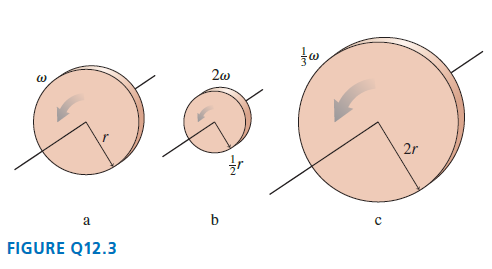
FIGURE Q12.3 shows three rotating disks, all of equal mass. Rank in order, from largest to smallest, their rotational kinetic energies Kato Kc. 2w 2r FIGURE Q12.3 len
A skater holds her arms outstretched as she spins at 180 rpm. What is the speed of her hands if they are 140 cm apart?
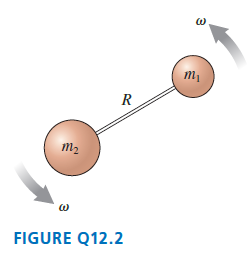
If the angular velocity ω is held constant, by what factor must R change to double the rotational kinetic energy of the dumbbell in FIGURE Q12.2? т, R M2 FIGURE Q12.2
A high-speed drill reaches 2000 rpm in 0.50 s.a. What is the drill’s angular acceleration?b. Through how many revolutions does it turn during this first 0.50 s?
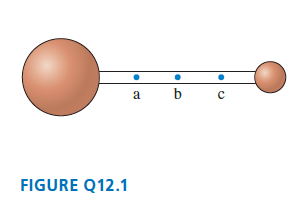
Is the center of mass of the dumbbell in FIGURE Q12.1 at point a, b, or c? Explain. a b FIGURE Q12.1
Section 11.6 found an equation for vmax of a rocket fired in deep space. What is vmax for a rocket fired vertically from the surface of an airless planet with free-fall acceleration g? Referring to Section 11.6, you can write an equation for ΔPy, the change of momentum in the vertical direction,
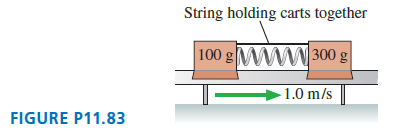
The air-track carts in FIGURE CP11.83 are sliding to the right at 1.0 m/s. The spring between them has a spring constant of 120 N/m and is compressed 4.0 cm. The carts slide past a flame that burns through the string holding them together. Afterward, what are the speed and direction of each cart?
A two-stage rocket is traveling at 1200 m/s with respect to the earth when the first stage runs out of fuel. Explosive bolts release the first stage and push it backward with a speed of 35 m/s relative to the second stage. The first stage is three times as massive as the second stage. What is the
A 20 kg wood ball hangs from a 2.0-m-long wire. The maximum tension the wire can withstand without breaking is 400 N.A 1.0 kg projectile traveling horizontally hits and embeds itself in the wood ball. What is the greatest speed this projectile can have without causing the wire to break?
A spaceship of mass 2.0 × 10⁶ kg is cruising at a speed of 5.0 × 10⁶ m/s when the antimatter reactor fails, blowing the ship into three pieces. One section, having a mass of 5.0 × 10⁵ kg, is blown straight backward with a speed of 2.0 × 10⁶ m/s. A second piece, with mass 8.0 × 10⁵ kg,
A 1000 kg cart is rolling to the right at 5.0 m/s. A 70 kg man is standing on the right end of the cart. What is the speed of the cart if the man suddenly starts running to the left with a speed of 10 m/s relative to the cart?
You are given the equation(s) used to solve a problem. For each of these, you are toa. Write a realistic problem for which this is the correct equation(s).b. Finish the solution of the problem, including a pictorial representation.(0.10 kg)(40 m/s) - (0.10 kg)(-30 m/s) = 1/2 (1400 N) Δt
a. To understand why rockets often have multiple stages, first consider a single-stage rocket with an empty mass of 200 kg, 800 kg of fuel, and a 2000 m/s exhaust speed.If fired in deep space, what is the rocket’s maximum speed?b. Now divide the rocket into two stages, each with an empty mass of
A rocket in deep space has an empty mass of 150 kg and exhausts the hot gases of burned fuel at 2500 m/s. It is loaded with 600 kg of fuel, which it burns in 30 s. What is the rocket’s speed 10 s, 20 s, and 30 s after launch?
A 2100 kg truck is traveling east through an intersection at 2.0 m/s when it is hit simultaneously from the side and the rear. (Some people have all the luck!) One car is a 1200 kg compact traveling north at 5.0 m/s. The other is a 1500 kg midsize traveling east at 10 m/s. The three vehicles become
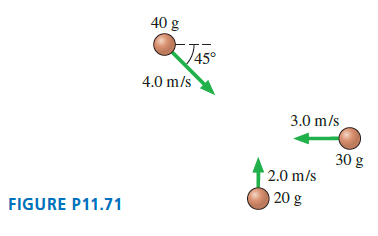
FIGURE P11.71 shows a collision between three balls of clay.The three hit simultaneously and stick together. What are the speed and direction of the resulting blob of clay? 40 g JASO 45° 4.0 m/s 3.0 m/s 30 g 2.0 m/s 20 g FIGURE P11.71
A 20 g ball of clay traveling east at 2.0 m/s collides with a 30 g ball of clay traveling 30° south of west at 1.0 m/s. What are the speed and direction of the resulting 50 g blob of clay?
A neutron is an electrically neutral subatomic particle with a mass just slightly greater than that of a proton. A free neutron is radioactive and decays after a few minutes into other subatomic particles. In one experiment, a neutron at rest was observed to decay into a proton (mass 1.67 × 10⁻²⁷
The nucleus of the polonium isotope 214Po (mass 214 u) is radioactive and decays by emitting an alpha particle (a helium nucleus with mass 4 u). Laboratory experiments measure the speed of the alpha particle to be 1.92 × 10⁷ m/s. Assuming the polonium nucleus was initially at rest, what is the
A proton (mass 1 u) is shot toward an unknown target nucleus at a speed of 2.50 × 10⁶ m/s. The proton rebounds with its speed reduced by 25% while the target nucleus acquires a speed of 3.12 × 10⁵ m/s. What is the mass, in atomic mass units, of the target nucleus?
Old naval ships fired 10 kg cannon balls from a 200 kg cannon. It was very important to stop the recoil of the cannon, since otherwise the heavy cannon would go careening across the deck of the ship. In one design, a large spring with spring constant 20,000 N/m was placed behind the cannon. The
A 100 g ball moving to the right at 4.0 m/s collides head-on with a 200 g ball that is moving to the left at 3.0 m/s.a. If the collision is perfectly elastic, what are the speed and direction of each ball after the collision?b. If the collision is perfectly inelastic, what are the speed and
Showing 2700 - 2800
of 3693
First
21
22
23
24
25
26
27
28
29
30
31
32
33
34
35
Last
Step by Step Answers

 Get 50% OFF
Claim Now
Get 50% OFF
Claim Now