New Semester
Started
Get
50% OFF
Study Help!
--h --m --s
Claim Now
Question Answers
Textbooks
Find textbooks, questions and answers
Oops, something went wrong!
Change your search query and then try again
S
Books
FREE
Study Help
Expert Questions
Accounting
General Management
Mathematics
Finance
Organizational Behaviour
Law
Physics
Operating System
Management Leadership
Sociology
Programming
Marketing
Database
Computer Network
Economics
Textbooks Solutions
Accounting
Managerial Accounting
Management Leadership
Cost Accounting
Statistics
Business Law
Corporate Finance
Finance
Economics
Auditing
Tutors
Online Tutors
Find a Tutor
Hire a Tutor
Become a Tutor
AI Tutor
AI Study Planner
NEW
Sell Books
Search
Search
Sign In
Register
study help
sciences
chemistry a molecular approach
Chemistry A Molecular Approach 5th Edition Nivaldo Tro - Solutions
Design a device that uses an electrochemical cell to determine the amount of Cu2+ in a sample of water. Describe, in detail, the construction and the theory of operation of your device. If you are able to measure voltage with one-millivolt accuracy, what will the uncertainty in your measured
Using a library or the Internet, research a fuel cell that uses methanol for fuel. What is the reaction at the anode? What is the reaction at the cathode? What is the overall reaction? What is the standard cell potential? How many kWh can it generate from 1 L (0.792 kg) of methanol?
What is radioactivity? Who discovered it? How was it discovered?
Explain Marie Curie’s role in the discovery of radioactivity.
Define A, Z, and X in the following notation used to specify a nuclide: AZ X.
Use the notation from Question 3 to write symbols for a proton, a neutron, and an electron.Question 3Define A, Z, and X in the following notation used to specify a nuclide: AZ X.
What is an alpha particle? What happens to the mass number and atomic number of a nuclide that emits an alpha particle?
What is a beta particle? What happens to the mass number and atomic number of a nuclide that emits a beta particle?
What is a positron? What happens to the mass number and atomic number of a nuclide that emits a positron?
Describe the process of electron capture. What happens to the mass number and atomic number of a nuclide that undergoes electron capture?
Rank alpha particles, beta particles, positrons, and gamma rays in terms of: (a) Increasing ionizing power; (b) Increasing penetrating power.
Explain why the ratio of neutrons to protons (N/Z) is important in determining nuclear stability. How can you use the N/Z ratio of a nuclide to predict the kind of radioactive decay that it might undergo?
What are magic numbers? How are they important in determining the stability of a nuclide?
Describe the basic way that each device detects radioactivity:(a) Thermoluminescent dosimeter; (b) Geiger–Müller counter; and (c) Scintillation counter.
Explain the concept of half-life with respect to radioactive nuclides. What rate law is characteristic of radioactivity?
Explain the main concepts behind the technique of radiocarbon dating. How can radiocarbon dating be corrected for changes in atmospheric concentrations of C-14? What range of ages can be reliably determined by C-14 dating?
How is the uranium to lead ratio in a rock used to estimate its age? How does this dating technique provide an estimate for Earth’s age? How old is Earth according to this dating method?
Describe fission. Include the concepts of chain reaction and critical mass in your description. How and by whom was fission discovered?Explain how fission can be used to generate electricity.
What was the Manhattan Project? Briefly describe its development and culmination.
Describe the advantages and disadvantages of using fission to generate electricity.
The products of a nuclear reaction usually have a different mass than the reactants. Why?
Explain the concepts of mass defect and nuclear binding energy. At what mass number does the nuclear binding energy per nucleon peak? What is the significance of this?
What is fusion? Why can fusion and fission both produce energy? Explain.
What are some of the problems associated with using fusion to generate electricity?
Explain transmutation and provide one or two examples.
How does a linear accelerator work? For what purpose is it used?
Explain the basic principles of cyclotron function.
How does radiation affect living organisms?
Explain why different kinds of radiation affect biological tissues differently, even though the amount of radiation exposure may be the same.
Explain the significance of the biological effectiveness factor in measuring radiation exposure. What types of radiation would you expect to have the highest biological effectiveness factor?
Describe some of the medical uses, both in diagnosis and in treatment of disease, of radioactivity.
Write a nuclear equation for the indicated decay of each nuclide.a. Po-210 (alpha)b. Ac-227 (beta)c. Tl-207 (beta)d. O-15 (positron emission)e. Pd-103 (electron capture)
Write a partial decay series for Th-232 undergoing the sequential decays: α, β, β, α.
Write a partial decay series for Rn-220 undergoing the sequential decays: α, α, β, β.
Neon and magnesium each have three stable isotopes while sodium and aluminum each have only one. Explain why this might be so.
Predict a likely mode of decay for each unstable nuclide.a. Mo-109 b. Ru-90c. P-27 d. Sn-100
Predict a likely mode of decay for each unstable nuclide.a. Sb-132b. Te-139c. Fr-202d. Ba-123
Which nuclide in each pair would you expect to have the longer half-life?a. Cs-113 or Cs-125b. Fe-62 or Fe-70
Which nuclide in each pair would you expect to have the longer half-life?a. Cs-149 or Cs-139 b. Fe-45 or Fe-52
One of the nuclides in spent nuclear fuel is U-235, an alpha emitter with a half-life of 703 million years. How long will it take for the amount of U-235 to reach 10.0% of its initial amount?
A patient is given 0.050 mg of technetium-99m, a radioactive isotope with a half-life of about 6.0 hours. How long does it take for the radioactive isotope to decay to 1.0 * 10-3 μg?
A radioactive sample contains 1.55 g of an isotope with a halflife of 3.8 days. What mass of the isotope remains after 5.5 days?
At 8:00 a.m., a patient receives a 1.5-mg dose of I-131 to treat thyroid cancer. If the nuclide has a half-life of eight days, what mass of the nuclide remains in the patient at 5:00 p.m. the next day? (Assume no excretion of the nuclide from the body.)
A sample of F-18 has an initial decay rate of 1.5 * 105/s. How long will it take for the decay rate to fall to 2.5 * 103/s?
A sample of Tl-201 has an initial decay rate of 5.88 * 104/s.How long will it take for the decay rate to fall to 287/s?
A wooden boat discovered just south of the Great Pyramid in Egypt has a carbon-14/carbon-12 ratio that is 72.5% of that found in living organisms. How old is the boat?
A layer of peat beneath the glacial sediments of the last ice age has a carbon-14/carbon-12 ratio that is 22.8% of that found in living organisms. How long ago was this ice age?
An ancient skull has a carbon-14 decay rate of 0.85 disintegration per minute per gram of carbon (0.85 dis/min · g C). How old is the skull? (Assume that living organisms have a carbon-14 decay rate of 15.3 dis/min · g C and that carbon-14 has a half-life of 5715 yr.)
A mammoth skeleton has a carbon-14 decay rate of 0.48 disintegration per minute per gram of carbon (0.48 dis/min · g C). When did the mammoth live? (Assume that living organisms have a carbon-14 decay rate of 15.3 dis/min · g C and that carbon-14 has a half-life of 5715 yr.)
A rock from Australia contains 0.438 g of Pb-206 to every 1.00 g of U-238.Assuming that the rock did not contain any Pb-206 at the time of its formation, how old is the rock?
A meteor has a Pb-206:U-238 mass ratio of 0.855:1.00. What is the age of the meteor? (Assume that the meteor did not contain any Pb-206 at the time of its formation.)
Write the nuclear reaction for the neutron-induced fission of U-235 to form Xe-144 and Sr-90. How many neutrons are produced in the reaction?
Write the nuclear reaction for the neutron-induced fission of U-235 to produce Te-137 and Zr-97. How many neutrons are produced in the reaction?
Write the nuclear equation for the fusion of two H-2 atoms to form He-3 and one neutron.
Write the nuclear equation for the fusion of H-3 with H-1 to form He-4.
A breeder nuclear reactor is a reactor in which nonfissionable (nonfissile) U-238 is converted into fissionable (fissile) Pu-239.The process involves bombardment of U-238 by neutrons to form U-239, which then undergoes two sequential beta decays.Write nuclear equations for this process.
Write the series of nuclear equations to represent the bombardment of Al-27 with a neutron to form a product that subsequently undergoes a beta decay.
Rutherfordium-257 was synthesized by bombarding Cf-249 with C-12. Write the nuclear equation for this reaction.
Element 107, now named bohrium, was synthesized by German researchers by colliding bismuth-209 with chromium-54 to form a bohrium isotope and one neutron. Write the nuclear equation to represent this reaction.
If 1.0 g of matter is converted to energy, how much energy is formed?
A typical home uses approximately 1.0 * 103 kWh of energy per month. If the energy came from a nuclear reaction, what mass would have to be converted to energy per year to meet the energy needs of the home?
Calculate the mass defect and nuclear binding energy per nucleon of each nuclide.a. O-16 (atomic mass = 15.994915 amu)b. Ni-58 (atomic mass = 57.935346 amu)c. Xe-129 (atomic mass = 128.904780 amu)
Calculate the mass defect and nuclear binding energy per nucleon of each nuclide.a. Li-7 (atomic mass = 7.016003 amu)b. Ti-48 (atomic mass = 47.947947 amu)c. Ag-107 (atomic mass = 106.905092 amu)
Calculate the quantity of energy produced per gram of U-235 (atomic mass = 235.043922 amu) for the neutron-induced fission of U-235 to form Xe-144 (atomic mass = 143.9385 amu) and Sr-90 (atomic mass = 89.907738 amu) (discussed in Problem 57).Problem 57Write the nuclear reaction for the
Calculate the quantity of energy produced per gram of reactant for the fusion of two H-2 (atomic mass = 2.014102 amu) atoms to form He-3 (atomic mass = 3.016029 amu) and one neutron (discussed in Problem 59). Problem 59Write the nuclear equation for the fusion of two H-2 atoms to form He-3 and one
Calculate the quantity of energy produced per gram of reactant for the fusion of H-3 (atomic mass = 3.016049 amu) with H-1 (atomic mass = 1.007825 amu) to form He-4 (atomic mass = 4.002603 amu) (discussed in Problem 60).Problem 60Write the nuclear equation for the fusion of H-3 with H-1 to form
A 75-kg human has a dose of 32.8 rad of radiation. How much energy is absorbed by the person’s body? Compare this energy to the amount of energy absorbed by the person’s body if he or she jumped from a chair to the floor (assume that the chair is 0.50 m from the ground and that all of the
If a 55-gram laboratory mouse has a dose of 20.5 rad of radiation, how much energy is absorbed by the mouse’s body?
PET studies require fluorine-18, which is produced in a cyclotron and decays with a half-life of 1.83 hours. Assuming that the F-18 can be transported at 60.0 miles/hour, how close must the hospital be to the cyclotron if 65% of the F-18 produced makes it to the hospital?
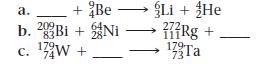
Complete each nuclear equation and calculate the energy change (in J/mol of reactant) associated with each (Be-9 = 9.012182 amu, Bi-209 = 208.980384 amu, He-4 = 4.002603 amu, Li-6 = 6.015122 amu, Ni-64 = 63.927969 amu, Rg-272 = 272.1535 amu, Ta-179 = 178.94593 amu, and W-179 = 178.94707 amu). a. +
Suppose a patient is given 1.55 mg of I-131, a beta emitter with a half-life of 8.0 days. Assuming that none of the I-131 is eliminated from the person’s body in the first 4.0 hours of treatment, what is the exposure (in Ci) during those first four hours?
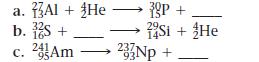
Complete each nuclear equation and calculate the energy change (in J/mol of reactant) associated with each (Al-27 = 26.981538 amu, Am-241 = 241.056822 amu, He-4 = 4.002603 amu, Np-237 = 237.048166 amu, P-30 = 29.981801 amu, S-32 = 31.972071 amu, and Si-29 = 28.976495 amu). a. 13Al + He b.
Write the nuclear equation for the most likely mode of decay for each unstable nuclide.a. Ru-114b. Ra-216c. Zn-58d. Ne-31
Write the nuclear equation for the most likely mode of decay for each unstable nuclide.a. Kr-74 b. Th-221 c. Ar-44 d. Nb-85
Bismuth-210 is a beta emitter with a half-life of 5.0 days.If a sample contains 1.2 g of Bi-210 (atomic mass = 209.984105 amu), how many beta emissions occur in 13.5 days?If a person’s body intercepts 5.5% of those emissions, to what amount of radiation (in Ci) is the person exposed?
Polonium-218 is an alpha emitter with a half-life of 3.0 minutes.If a sample contains 55 mg of Po-218 (atomic mass = 218.008965 amu), how many alpha emissions occur in 25.0 minutes? If the polonium is ingested by a person, to what amount of radiation (in Ci) is the person exposed?
Radium-226 (atomic mass = 226.025402 amu) decays to radon-224 (a radioactive gas) with a half-life of 1.6 * 103 years. What volume of radon gas (at 25.0 °C and 1.0 atm) does 25.0 g of radium produce in 5.0 days? (Report your answer to two significant digits.)
In one of the neutron-induced fission reactions of U-235 (atomic mass = 235.043922 amu), the products are Ba-140 and Kr-93 (a radioactive gas). What volume of Kr-93 (at 25.0 °C and 1.0 atm) is produced when 1.00 g of U-235 undergoes this fission reaction?
A typical nuclear reactor produces about 1.0 MW of power per day. What is the minimum rate of mass loss required to produce this much energy?
Find the binding energy in an atom of 3He, which has a mass of 3.016030 amu.
The overall hydrogen burning reaction in stars can be represented as the conversion of four protons to one a particle. Use the data for the mass of H-1 and He-4 to calculate the energy released by this process.
The nuclide 247Es can be made by bombardment of 238U in a reaction that emits five neutrons. Identify the bombarding particle.
The nuclide 6Li reacts with 2H to form two identical particles. Identify the particles.
The half-life of 238U is 4.5 * 109 yr. A sample of rock of mass 1.6 g produces 29 dis/s. Assuming all the radioactivity is due to 238U, find the percent by mass of 238U in the rock.
The half-life of 232Th is 1.4 * 1010 yr. Find the number of disintegrations per hour emitted by 1.0 mol of 232Th.
A 1.50-L gas sample at 745 mm Hg and 25.0 °C contains 3.55% radon-220 by volume. Radon-220 is an alpha emitter with a half-life of 55.6 s. How many alpha particles are emitted by the gas sample in 5.00 minutes?
A 228-mL sample of an aqueous solution contains 2.35% MgCl2 by mass. Exactly one-half of the magnesium ions are Mg-28, a beta emitter with a half-life of 21 hours. What is the decay rate of Mg-28 in the solution after 4.00 days?
When a positron and an electron collide and annihilate each other, two photons of equal energy are produced. Find the wavelength of these photons.
The half-life of 235U, an alpha emitter, is 7.1 * 108 yr. Calculate the number of alpha particles emitted by 1.0 mg of this nuclide in 1.0 minute.
Given that the energy released in the fusion of two deuterons to a 3He and a neutron is 3.3 MeV, and in the fusion to tritium and a proton it is 4.0 MeV, calculate the energy change for the process 3He + 1n → 3H + 1p. Suggest an explanation for why this process occurs at much lower temperatures
The space shuttle carries about 72,500 kg of solid aluminum fuel, which is oxidized with ammonium perchlorate according to the reaction shown here:The space shuttle also carries about 608,000 kg of oxygen (which reacts with hydrogen to form gaseous water).a. Assuming that aluminum and oxygen are
The nuclide 18F decays by both electron capture and b+ decay.Find the difference in the energy released by these two processes.The atomic masses are 18F = 18.000950 and 18O = 17.9991598.
In addition to the natural radioactive decay series that begins with U-238 and ends with Pb-206, there are natural radioactive decay series that begin with U-235 and Th-232. Both of these series end with nuclides of Pb. Predict the likely end product of each series and the number of α decay steps
The hydride of an unstable nuclide of a Group IIA metal, MH2(s), decays by a-emission. A 0.025-mol sample of the hydride is placed in an evacuated 2.0 L container at 298 K. After 82 minutes, the pressure in the container is 0.55 atm. Find the half-life of the nuclide.
The nuclide 38Cl decays by beta emission with a half-life of 37.2 min. A sample of 0.40 mol of H38Cl is placed in a 6.24-L container. After 74.4 min the pressure is 1650 mmHg. What is the temperature of the container?
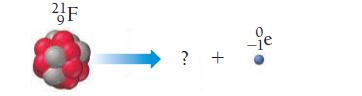
Closely examine the diagram representing the beta decay of fluorine-21 and draw in the missing nucleus. 2JF ? +
When 10BF3 is bombarded with neutrons, the boron-10 undergoes an a decay, but the F is unaffected. A 0.20-mol sample of 10BF3 contained in a 3.0-L container at 298 K is bombarded with neutrons until half of the 10BF3 has reacted. What is the pressure in the container at 298 K?
Approximately how many half-lives must pass for the amount of radioactivity in a substance to decrease to below 1% of its initial level?
A person is exposed for three days to identical amounts of two different nuclides that emit positrons of roughly equal energy.The half-life of nuclide A is 18.5 days, and the half-life of nuclide B is 255 days. Which of the two nuclides poses the greater health risk?
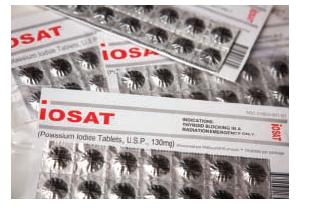
Drugstores in many areas now carry tablets, under such trade names as Iosat and NoRad, designed to be taken in the event of an accident at a nuclear power plant or a terrorist attack that releases radioactive material. These tablets contain potassium iodide (KI). Can you explain the nature of the
Showing 100 - 200
of 4045
1
2
3
4
5
6
7
8
9
10
11
12
13
14
15
Last
Step by Step Answers

 Get 50% OFF
Claim Now
Get 50% OFF
Claim Now