New Semester
Started
Get
50% OFF
Study Help!
--h --m --s
Claim Now
Question Answers
Textbooks
Find textbooks, questions and answers
Oops, something went wrong!
Change your search query and then try again
S
Books
FREE
Study Help
Expert Questions
Accounting
General Management
Mathematics
Finance
Organizational Behaviour
Law
Physics
Operating System
Management Leadership
Sociology
Programming
Marketing
Database
Computer Network
Economics
Textbooks Solutions
Accounting
Managerial Accounting
Management Leadership
Cost Accounting
Statistics
Business Law
Corporate Finance
Finance
Economics
Auditing
Tutors
Online Tutors
Find a Tutor
Hire a Tutor
Become a Tutor
AI Tutor
AI Study Planner
NEW
Sell Books
Search
Search
Sign In
Register
study help
sciences
chemistry a molecular approach
Chemistry A Molecular Approach 5th Edition Nivaldo Tro - Solutions
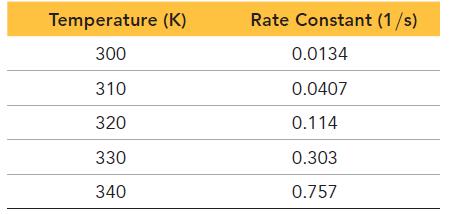
The tabulated data show the rate constant of a reaction measured at several different temperatures. Use an Arrhenius plot to determine the activation barrier and frequency factor for the reaction. Temperature (K) 300 310 320 330 340 Rate Constant (1/s) 0.0134 0.0407 0.114 0.303 0.757
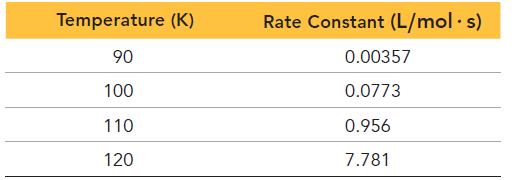
The tabulated data were collected for the second-order reaction:Cl(g) + H2(g) → HCl(g) + H(g)Use an Arrhenius plot to determine the activation barrier and frequency factor for the reaction. Temperature (K) 90 100 110 120 Rate Constant (L/mol. s) 0.00357 0.0773 0.956 7.781
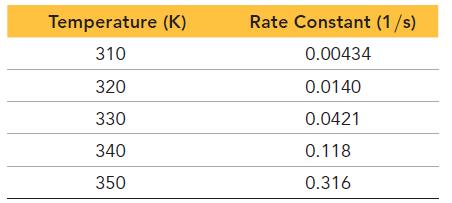
The tabulated data show the rate constant of a reaction measured at several different temperatures. Use an Arrhenius plot to determine the activation barrier and frequency factor for the reaction. Temperature (K) 310 320 330 340 350 Rate Constant (1/s) 0.00434 0.0140 0.0421 0.118 0.316
A reaction has a rate constant of 0.000122/s at 27 °C and 0.228/s at 77 °C.a. Determine the activation barrier for the reaction.b. What is the value of the rate constant at 17 °C?
A reaction has a rate constant of 0.0117/s at 400.0 K and 0.689/s at 450.0 K.a. Determine the activation barrier for the reaction.b. What is the value of the rate constant at 425 K?
If a temperature increase from 10.0 °C to 20.0 °C doubles the rate constant for a reaction, what is the value of the activation barrier for the reaction?
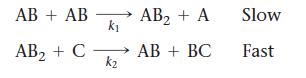
Consider this overall reaction, which is experimentally observed to be second order in AB and zero order in C:Is the following mechanism valid for this reaction? AB + C A + BC
If a temperature increase from 20.0 °C to 35.0 °C triples the rate constant for a reaction, what is the value of the activation barrier for the reaction?
Which of these two reactions would you expect to have the smaller orientation factor? Explain. a. O(g) + N₂(8) NO(g) + N(g) b. NO(g) + Cl₂(g) → NOCI(g) + Cl(g)
Consider these two gas-phase reactions:a. AA(g) + BB(g) → 2 AB( g)b. AB(g) + CD(g) → AC(g) + BD(g)If the reactions have identical activation barriers and are carried out under the same conditions, which one would you expect to have the faster rate?
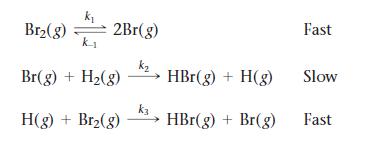
The proposed mechanism for the formation of hydrogen bromide can be written in a simplified form as:What rate law corresponds to this mechanism? Br₂(g) k₁ 2Br(g) Br(g) + H₂(g) H(g) + Br₂(g) k3 HBr(g) + H(g) HBr(g) + Br(g) Fast Slow Fast
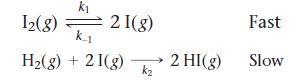
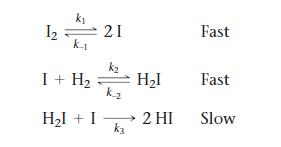
A proposed mechanism for the formation of hydrogen iodide can be written in simplified form asWhat rate law corresponds to this mechanism? 1₂ k₁ I + H₂ H₂1 + I 21 k₂ k_₂ k3 H₂1 2 HI Fast Fast Slow
A certain substance X decomposes. Fifty percent of X remains after 100 minutes. How much X remains after 200 minutes if the reaction order with respect to X is (a) Zero order, (b) First order, (c) Second order?
The half-life for radioactive decay (a first-order process) of plutonium-239 is 24,000 years. How many years does it take for one mole of this radioactive material to decay until just one atom remains?
The energy of activation for the decomposition of 2 mol of HI to H2 and I2 in the gas phase is 185 kJ. The heat of formation of HI(g) from H2( g) and I2( g) is -5.65 kJ/mol. Find the energy of activation for the reaction of 1 mol of H2 and 1 mol of I2 to form 2 mol of HI in the gas phase.
Ethyl chloride vapor decomposes by the first-order reaction:The activation energy is 249 kJ/mol, and the frequency factor is 1.6 * 1014 s-1. Find the value of the rate constant at 710 K.What fraction of the ethyl chloride decomposes in 15 minutes at this temperature? Find the temperature at which
The first-order integrated rate law for the reaction A → products is derived from the rate law using calculus:The equation just given is a first-order, separable differential equation that can be solved by separating the variables and integrating:In the integral just given, [A]0 is the initial
In this chapter, we have seen a number of reactions in which a single reactant forms products. For example, consider the following first-order reaction:CH3NC(g) → CH3CN( g)However, we also learned that gas-phase reactions occur through collisions.a. One possible explanation for how this reaction
The previous exercise shows how the first-order integrated rate law is derived from the first-order differential rate law. Begin with the second-order differential rate law and derive the second-order integrated rate law.Previous ExerciseThe first-order integrated rate law for the reaction A →
The rate constant for the first-order decomposition of N2O5(g) to NO2(g) and O2(g) is 7.48 * 10-3 s-1 at a given temperature.a. Find the length of time required for the total pressure in a system containing N2O5 at an initial pressure of 0.100 atm to rise to 0.145 atm.b. To 0.200 atm.c. Find the
The rate of decomposition of N2O3(g) to NO2(g) and NO(g) is followed by measuring [NO2] at different times. The following data are obtained.The reaction follows a first-order rate law. Calculate the rate constant. Assume that after 50,000 s all N2O3( g) had decomposed. [NO₂](mol/L) 0 0.193 t
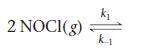
At 473 K, for the elementary reaction2 NO(g) + Cl2(g)A sample of NOCl is placed in a container and heated to 473 K.When the system comes to equilibrium, [NOCl] is found to be 0.12 mol/L. What are the concentrations of NO and Cl2? 2 NOCI(g) k₁ k1
Three different reactions involve a single reactant converting to products. Reaction A has a half-life that is independent of the initial concentration of the reactant, reaction B has a half-life that doubles when the initial concentration of the reactant doubles, and reaction C has a half-life
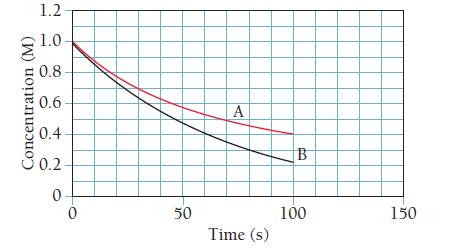
The accompanying graph shows the concentration of a reactant as a function of time for two different reactions. One of the reactions is first order, and the other is second order. Which of the two reactions is first order? Second order? How would you change each plot to make it linear?
A particular reaction, A → products, has a rate that slows down as the reaction proceeds. The half-life of the reaction is found to depend on the initial concentration of A. Determine whether each statement is likely to be true or false for this reaction.a. A doubling of the concentration of A
A certain compound, A, reacts to form products according to the reaction A → P. The amount of A is measured as a function of time under a variety of different conditions, and the tabulated results are shown here:Have one group member make a graph of [A] versus t, one group member make a graph of
Methane (CH4) is a greenhouse gas emitted by industry, agriculture, and waste systems. Methane is the second most prevalent greenhouse gas (after carbon dioxide). Methane plays an important role in climate change because it absorbs infrared radiation more efficiently than carbon dioxide. Methane is
A student says, “The initial concentration of a reactant was doubled, and the rate doubled. Therefore the reaction is second order in that reactant.” Why might the student say that? What is wrong with the statement? What is the actual order with respect to the reactant? Explain your reasoning
Consider the reaction:If a reaction mixture initially contains 0.110 M CO and 0.110 M H2O, what will the equilibrium concentration of each of the reactants and products be? CO(g) + H₂O(g) = CO₂(g) + H₂(g) Ke = 102 at 500 K
Find the pH of a 0.100 M HClO2 solution.
Rank the solutions in order of decreasing [H3O+]: 0.10 M HCl; 0.10 M HF; 0.10 M HClO; 0.10 M HC6H5O.
Without referring to the text, have each member of your group mention a different property of either an acid or a base, such as “Acids turn blue litmus paper red.” Record as many properties as your group can recall without the text.
Calculate the pH of a buffer solution that is 0.100 M in HC2H3O2 and 0.100 M in NaC2H3O2.
A buffer is 0.100 M in NH4Cl and 0.100 M in NH3. When a small amount of hydrobromic acid is added to this buffer, which buffer component neutralizes the added acid? a) NH4+ b) Cl c) NH3 d) None of the above (hydrobromic acid will not be neutralized by this buffer).
Which solution is a buffer?(a) A solution that is 0.100 M in HNO2 and 0.100 M in HCl(b) A solution that is 0.100 M in HNO3 and 0.100 M in NaNO3(c) A solution that is 0.100 M in HNO2 and 0.100 M in NaCl(d) A solution that is 0.100 M in HNO2 and 0.100 M in NaNO2
A buffer contains the weak acid HA and its conjugate base A–. The weak acid has a pKa of 4.82 and the buffer has a pH of 4.25.Which statement is true of the relative concentrations of the weak acid and conjugate base in the buffer? (a) [HA]> [A] (b) [HA]< [A] (c) [HA] = [A]
What is the pH of a buffer that is 0.120 M in formic acid (HCHO2) and 0.080 M in potassium formate (KCHO2)? For formic acid, Ka = 1.8 * 10-4.a) 2.33 b) 3.57 c) 3.74 d) 3.91
A 1.0-L buffer solution contains 0.100 mol HC2H3O2 and 0.100 mol NaC2H3O2. The value of Ka for HC2H3O2 is 1.8 * 10-5. Because the initial amounts of acid and conjugate base are equal, the pH of the buffer is equal to pKa = -log(1.8 * 10-5) = 4.74. Calculate the new pH after adding 0.010 mol of
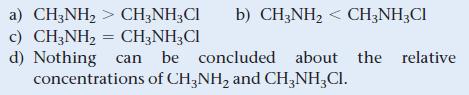
A buffer with a pH of 9.85 contains CH3NH2 and CH3NH3Cl in water. What can you conclude about the relative concentrations of CH3NH2 and CH3NH3Cl in this buffer? For CH3NH2, pKb = 3.36. a) CH3NH₂ > CH3NH3Cl b) CH3NH₂ < CH3NH3Cl c) CH3NH₂ = CH3NH₂Cl d) Nothing can be concluded about the
Use the Henderson–Hasselbalch equation to calculate the pH of a buffer solution that is 0.50 M in NH3 and 0.20 M in NH4Cl. For ammonia, pKb = 4.75.
A buffer contains equal amounts of a weak acid and its conjugate base and has a pH of 5.25. Which would be a reasonable value of buffer pH after the addition of a small amount of acid?(a) 4.15(b) 5.15(c) 5.35(d) 6.35
Which acid would you choose to combine with its sodium salt to make a solution buffered at pH 4.25? For the best choice, calculate the ratio of the conjugate base to the acid required to attain the desired pH. chlorous acid (HClO₂) pK₁ = 1.95 formic acid (HCHO₂) nitrous acid (HNO₂) pKa
A 500.0-mL buffer solution is 0.10 M in benzoic acid and 0.10 M in sodium benzoate and has an initial pH of 4.19. What is the pH of the buffer upon addition of 0.010 mol of NaOH?a) 1.70b) 4.01 c) 4.29 d) 4.37
Consider a buffer composed of the weak acid HA and its conjugate base A–. Which pair of concentrations results in the most effective buffer? a) 0.10 M HA; 0.10 M A c) 0.90 M HA; 0.10 M A b) 0.50 M HA; 0.50 M A d) 0.10 M HA; 0.90 M A
A 1.0-L buffer solution is 0.10 M in HF and 0.050 M in NaF. Which action destroys the buffer?(a) Adding 0.050 mol of HCl(b) Adding 0.050 mol of NaOH(c) Adding 0.050 mol of NaF(d) None of the above
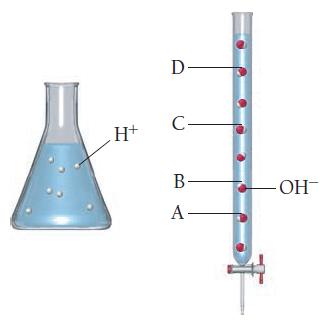
The amount of strong acid in the flask shown here is to be titrated by a strong base. Which mark on the burette next to the flask indicates the amount of base required to reach the equivalence point?(a) A(b) B(c) C(d) D H+ D- C- B- A- -ОН-
A 50.0-mL sample of 0.200 M sodium hydroxide is titrated with 0.200 M nitric acid. Calculate pH:(a) After adding 30.00 mL of HNO3(b) At the equivalence point
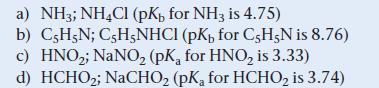
Which combination is the best choice to prepare a buffer with a pH of 9.0? a) NH3; NH4Cl (pK, for NH3 is 4.75) b) C5H5N; C5H5NHCl (pK, for C5H5N is 8.76) c) HNO₂; NaNO₂ (pKa for HNO₂ is 3.33) d) HCHO₂; NaCHO₂ (pK, for HCHO₂ is 3.74)
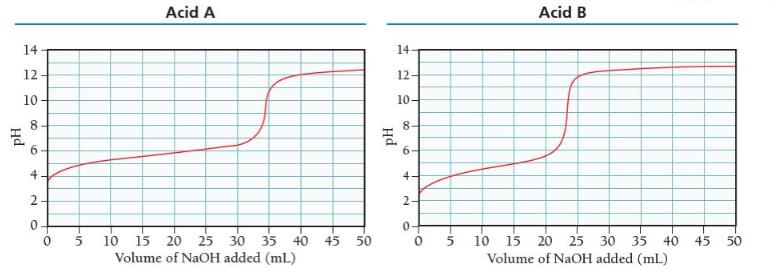
Two 25.0-mL samples of unknown monoprotic weak acids, A and B, are titrated with 0.100 M NaOH solutions.The titration curve for each acid is shown below. Which of the two weak acid solutions is more concentrated? Which of the two weak acids has the larger Ka?(a) Acid B is more concentrated and has
A 40.0-mL sample of 0.100 M HNO2 is titrated with 0.200 M KOH. Calculate:(a) The volume required to reach the equivalence point(b) The pH after adding 5.00 mL of KOH(c) The pH at one-half the equivalence point
A 25.0-mL sample of an unknown HBr solution is titrated with 0.100 M NaOH. The equivalence point is reached upon the addition of 18.88 mL of the base. What is the concentration of the HBr solution?a) 0.0755 M b) 0.0376 Mc) 0.100 M d) 0.00188 M
Calculate the molar solubility of PbCl2 in pure water.
What is the pH at the half-equivalence point in the titration of a weak base with a strong acid? The pKb of the weak base is 8.75.(a) 8.75 (b) 7.0 (c) 5.25 (d) 4.37
A 10.0-mL sample of 0.200 M hydrocyanic acid (HCN) is titrated with 0.0998 M NaOH. What is the pH at the equivalence point? For hydrocyanic acid, pKa = 9.31.a) 7.00 b) 8.76 c) 9.31 d) 11.07
The molar solubility of Ag2SO4 in pure water is 1.4 * 10-2 M. Calculate Ksp.
Consider these three titrations:(i) The titration of 25.0 mL of a 0.100 M monoprotic weak acid with 0.100 M NaOH (ii) The titration of 25.0 mL of a 0.100 M diprotic weak acid with 0.100 M NaOH (iii) The titration of 25.0 mL of a 0.100 M strong acid with 0.100 M NaOH Which statement is most
A 20.0-mL sample of 0.150 M ethylamine is titrated with 0.0981 M HCl. What is the pH after the addition of 5.0 mL of HCl? For ethylamine, pKb = 3.25.a) 10.75 b) 11.04 c) 2.96 d) 11.46
What is the molar solubility of CaF2 in a solution containing 0.100 M NaF?
In which solution is BaSO4 most soluble?(a) A solution that is 0.10 M in BaNO3(b) A solution that is 0.10 M in Na2SO4(c) A solution that is 0.10 M in NaNO3
Three 15.0-mL acid samples—0.10 M HA, 0.10 M HB, and 0.10 M H2C—are all titrated with 0.100 M NaOH. If HA is a weak acid, HB is a strong acid, and H2C is a diprotic acid, which statement is true of all three titrations?a) All three titrations have the same pH at the first equivalence point.b)
A solution contains equal concentrations of Ba2+, Pb2+, and Ca2+ ions. When postassium sulfate is added to this solution, which cation precipitates first? (a) Ba²+ (b) Pb²+ (c) Ca²+
Determine whether each compound is more soluble in an acidic solution than it is in a neutral solution.(a) BaF2 (b) AgI (c) Ca(OH)2
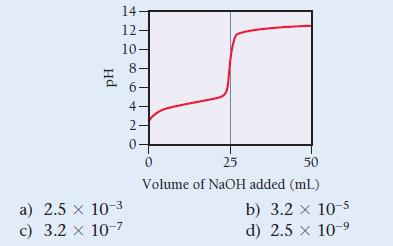
A weak unknown monoprotic acid is titrated with a strong base.The titration curve is shown. Find Ka for the unknown acid. 14. 12. 10 Hd ∞0 60+ NO 8 a) 2.5 x 10⁻³ c) 3.2 x 10⁻⁷ 6- 4- 2- 0+ 0 25 50 Volume of NaOH added (ml) b) 3.2 x 10⁻⁵ d) 2.5 x 10⁻⁹
A solution containing lead(II) nitrate is mixed with one containing sodium bromide to form a solution that is 0.0150 M in Pb(NO3)2 and 0.00350 M in NaBr. Does a precipitate form in the newly mixed solution?
Which compound, when added to water, is most likely to increase the solubility of CuS?(a) NaCl (b) KNO3 (c) NaCN (d) MgBr2
Calculate the molar solubility of lead(II) bromide (PbBr2).For lead(II) bromide, Ksp = 4.67 * 10-6.a) 0.00153 Mb) 0.0105 Mc) 0.0167 Md) 0.0211 M
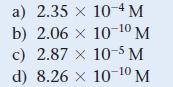
Calculate the molar solubility of magnesium fluoride (MgF2) in a solution that is 0.250 M in NaF. For magnesium fluoride, Ksp = 5.16 * 10-11. a) 2.35 x 10⁻⁴ M b) 2.06 x 10⁻¹⁰ M c) 2.87 x 10⁻⁵ M d) 8.26 x 10⁻¹⁰ M
The magnesium and calcium ions present in seawater ([Mg2+] = 0.059 M and [Ca2+] = 0.011 M) can be separated by selective precipitation with KOH. What minimum [OH-] triggers the precipitation of the Mg2+ ion?
You add potassium hydroxide to the solution in Example 18.13. When the [OH-] reaches 1.9 * 10-6 M (as you just calculated), magnesium hydroxide begins to precipitate out of solution. As you continue to add KOH, the magnesium hydroxide continues to precipitate. However, at some point, the [OH-]
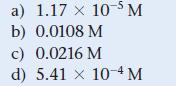
A solution is 0.0250 M in Pb2+. What minimum concentration of Cl– is required to begin to precipitate PbCl2?For PbCl2, Ksp = 1.17 * 10-5. a) 1.17 x 10⁻⁵ M b) 0.0108 M c) 0.0216 M d) 5.41 x 10⁻⁴ M
Which compound is more soluble in an acidic solution than in a neutral solution?a) PbBr2b) CuClc) AgId) BaF2
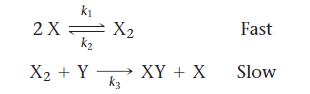
Consider this overall reaction, which is experimentally observed to be second order in X and first order in Y:a. Does the reaction occur in a single step in which X and Y collide?b. Is this two-step mechanism valid? X + Y→→→ XY
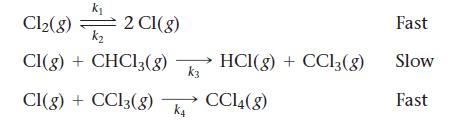
Consider this three-step mechanism for a reaction:a. What is the overall reaction?b. Identify the intermediates in the mechanism.c. What is the predicted rate law? k₁ Cl₂(8) k₂ Cl(g) + CHCl3(8) HC1(g) + CC13 (8) Cl(g) + CC13(g) CC14(8) 2 Cl(g) k3 K4 Fast Slow Fast
Consider this two-step mechanism for a reaction:a. What is the overall reaction?b. Identify the intermediates in the mechanism.c. What is the predicted rate law? NO₂(g) + Cl₂(8) NO₂(g) + Cl(g) K₁ k₂ CINO₂(g) + CI(g) CINO₂(g) Slow Fast
Many heterogeneous catalysts are deposited on high-surfacearea supports. Why?
Suppose that the reaction A¡products is exothermic and has an activation barrier of 75 kJ/mol. Sketch an energy diagram showing the energy of the reaction as a function of the progress of the reaction. Draw a second energy curve showing the effect of a catalyst.
Suppose that a catalyst lowers the activation barrier of a reaction from 125 kJ/mol to 55 kJ/mol. By what factor would you expect the reaction rate to increase at 25 °C?
The tabulated data were collected for this reaction at 500 °C:a. Determine the order of the reaction and the value of the rate constant at this temperature.b. What is the half-life for this reaction (at the initial concentration)?c. How long will it take for 90% of the CH3CN to convert to CH3NC ?
The activation barrier for the hydrolysis of sucrose into glucose and fructose is 108 kJ/mol. If an enzyme increases the rate of the hydrolysis reaction by a factor of 1 million, how much lower must the activation barrier be when sucrose is in the active site of the enzyme?
The tabulated data were collected for this reaction at a certain temperature:a. Determine the order of the reaction and the value of the rate constant at this temperature.b. What is the half-life for this reaction (at the initial concentration)?c. What is the concentration of X after 10.0 hours?
Consider the reaction: A + B + C → DThe rate law for this reaction is:Suppose the rate of the reaction at certain initial concentrations of A, B, and C is 0.0115 M/s. What is the rate of the reaction if the concentrations of A and C are doubled and the concentration of B is tripled?
At 700 K, acetaldehyde decomposes in the gas phase to methane and carbon monoxide. The reaction is: CH3CHO(g)¡CH4(g) + CO(g)A sample of CH3CHO is heated to 700 K, and the pressure is measured as 0.22 atm before any reaction takes place. The kinetics of the reaction are followed by measurements of
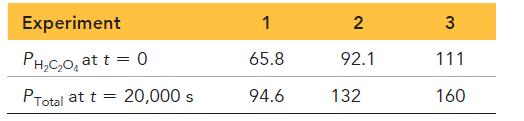
At 400 K, oxalic acid decomposes according to the reaction:H2C2O4(g) → CO2(g) + HCOOH(g)In three separate experiments, the initial pressure of oxalic acid and final total pressure after 20,000 s are measured.Find the rate law of the reaction and its rate constant. Experiment PH₂C₂O₂ at t =
Dinitrogen pentoxide decomposes in the gas phase to form nitrogen dioxide and oxygen gas. The reaction is first order in dinitrogen pentoxide and has a half-life of 2.81 h at 25 °C. If a 1.5-L reaction vessel initially contains 745 torr of N2O5 at 25 °C, what partial pressure of O2 is present in
Cyclopropane (C3H6) reacts to form propene (C3H6) in the gas phase. The reaction is first order in cyclopropane and has a rate constant of 5.87 * 10-4/s at 485 °C. If a 2.5-L reaction vessel initially contains 722 torr of cyclopropane at 485 °C, how long will it take for the partial pressure of
Iodine atoms combine to form I2 in liquid hexane solvent with a rate constant of 1.5 * 1010 L/mol · s. The reaction is second order in I. Since the reaction occurs so quickly, the only way to study the reaction is to create iodine atoms almost instantaneously, usually by photochemical
The hydrolysis of sucrose (C12H22O11) into glucose and fructose in acidic water has a rate constant of 1.8 * 10-4 s-1 at 25 °C.Assuming the reaction is first order in sucrose, determine the mass of sucrose that is hydrolyzed when 2.55 L of a 0.150 M sucrose solution is allowed to react for 195
The reaction AB(aq) → A( g) + B( g) is second order in AB and has a rate constant of 0.0118 M-1 · s-1 at 25.0 °C. A reaction vessel initially contains 250.0 mL of 0.100 M AB that is allowed to react to form the gaseous product. The product is collected over water at 25.0 °C. How much time is
The reaction 2 H2O2(aq) → 2 H2O(l) + O2( g) is first order in H2O2 and under certain conditions has a rate constant of 0.00752 s-1 at 20.0 °C. A reaction vessel initially contains 150.0 mL of 30.0% H2O2 by mass solution (the density of the solution is 1.11 g/mL). The gaseous oxygen is collected
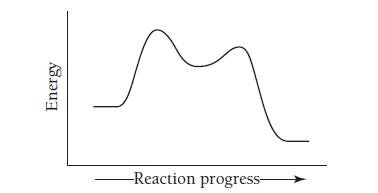
Consider this energy diagram:a. How many elementary steps are involved in this reaction?b. Label the reactants, products, and intermediates.c. Which step is rate limiting?d. Is the overall reaction endothermic or exothermic? Energy -Reaction progress-
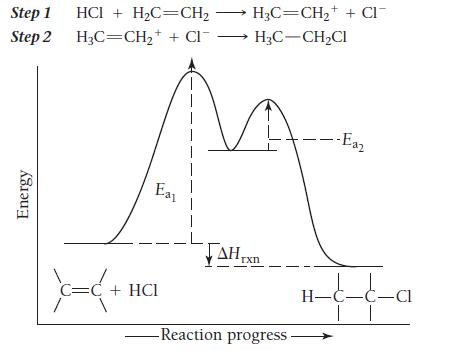
Consider the reaction in which HCl adds across the double bond of ethene:HCl + H2C = CH2→ H3C—CH2Cl The following mechanism, with the accompanying energy diagram, has been suggested for this reaction:a. Based on the energy diagram, determine which step is rate limiting.b. What is the expected
The desorption (leaving of the surface) of a single molecular layer of n-butane from a single crystal of aluminum oxide is found to be first order with a rate constant of 0.128/s at 150 K.a. What is the half-life of the desorption reaction?b. If the surface is initially completely covered with
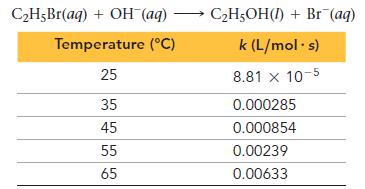
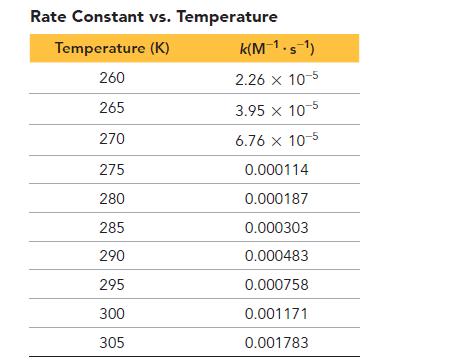
The kinetics of this reaction were studied as a function of temperature.a. Determine the activation energy and frequency factor for the reaction.b. Determine the rate constant at 15 °C.c. If a reaction mixture is 0.155 M in C2H5Br and 0.250 M in OH-, what is the initial rate of the reaction at 75
The evaporation of a 120-nm film of n-pentane from a single crystal of aluminum oxide is zero order with a rate constant of 1.92 * 1013 molecules/cm2 · s at 120 K.a. If the initial surface coverage is 8.9 * 1016 molecules/cm2, how long will it take for one-half of the film to evaporate?b. What
The reaction 2 N2O5 → 2 N2O4 + O2 takes place at around room temperature in solvents such as CCl4. The rate constant at 293 K is found to be 2.35 * 10-4 s-1, and at 303 K the rate constant is found to be 9.15 * 10-4 s-1. Calculate the frequency factor for the reaction.
This reaction has an activation energy of zero in the gas phase:CH3 + CH3 →C2H6a. Would you expect the rate of this reaction to change very much with temperature?b. Why might the activation energy be zero?c. What other types of reactions would you expect to have little or no activation energy?
Consider the two reactions:a. Why is the activation barrier for the first reaction so much higher than that for the second?b. The frequency factors for these two reactions are very close to each other in value. Assuming that they are the same, calculate the ratio of the reaction rate constants for
Anthropologists can estimate the age of a bone or other sample of organic matter by its carbon-14 content. The carbon-14 in a living organism is constant until the organism dies, after which carbon-14 decays with first-order kinetics and a half-life of 5730 years.Suppose a bone from an ancient
Consider the gas-phase reaction:The reaction was experimentally determined to be first order in H2 and first order in I2. Consider the proposed mechanisms.Proposed mechanism I:Proposed mechanism II:a. Show that both of the proposed mechanisms are valid.b. What kind of experimental evidence might
Geologists can estimate the age of rocks by their uranium-238 content. The uranium is incorporated in the rock as it hardens and then decays with first-order kinetics and a half-life of 4.5 billion years. A rock contains 83.2% of the amount of uranium-238 that it contained when it was formed. (The
Showing 1400 - 1500
of 4045
First
8
9
10
11
12
13
14
15
16
17
18
19
20
21
22
Last
Step by Step Answers

 Get 50% OFF
Claim Now
Get 50% OFF
Claim Now





![Rate = k[A] (first-order rate law) d[A] Rate = dt d[A] dt -k[A]](https://dsd5zvtm8ll6.cloudfront.net/images/question_images/1700/2/0/4/13565570e67ab0db1700204132464.jpg)
![d[A] [A] IA]d[A] [A]o [A] -kdt -S kdt](https://dsd5zvtm8ll6.cloudfront.net/images/question_images/1700/2/0/4/15965570e7f50ae81700204156168.jpg)
![[In[A]] = k[t] In[A] In[A]o -kt In[A] = -kt + In[A]o (integrated rate law)](https://dsd5zvtm8ll6.cloudfront.net/images/question_images/1700/2/0/4/18365570e97069641700204178442.jpg)
 0 0.193 t (s) 0 884 0.316 0.427 0.784 1610 2460 50,000](https://dsd5zvtm8ll6.cloudfront.net/images/question_images/1700/2/0/4/35665570f448efea1700204352677.jpg)

![Time (s) 0 10 20 30 40 50 60 25.0 C [A] (M) 1.000 0.779 0.591 0.453 0.338 0.259 0.200 35.0 C [A] (M) 1.000](https://dsd5zvtm8ll6.cloudfront.net/images/question_images/1700/2/0/5/688655714788b8921700205687143.jpg)
![Time (s) 0 0.1 0.2 0.3 0.4 0.5 0.6 25.0 C [A] (M) 1.000 0.724 0.511 0.375 0.275 0.198 0.141 35.0 C [A] (M)](https://dsd5zvtm8ll6.cloudfront.net/images/question_images/1700/2/0/5/7106557148eaedb41700205708921.jpg)

![Initial Rate vs. Initial [CH4] 0.010 0.020 0.020 [03] 0.010 0.010 0.020 Concentrations Initial Rate (M/s)](https://dsd5zvtm8ll6.cloudfront.net/images/question_images/1700/2/0/5/774655714ceb5f7b1700205773653.jpg)


![(a) [HA]> [A] (b) [HA] < [A] (c) [HA] = [A]](https://dsd5zvtm8ll6.cloudfront.net/images/question_images/1700/2/9/9/3706558826ad0a1b1700299365717.jpg)





![CH3CN(g) Time (h) 0.0 5.0 10.0 15.0 20.0 25.0 CH3NC(g) [CH3CN] (M) 1.000 0.794 0.631 0.501 0.398 0.316](https://dsd5zvtm8ll6.cloudfront.net/images/question_images/1700/2/0/1/440655703e06d9341700201438304.jpg)
![XY Time (h) 0.0 1.0 2.0 3.0 4.0 5.0 2X + Y [XY] (M) 0.100 0.0856 0.0748 0.0664 0.0598 0.0543](https://dsd5zvtm8ll6.cloudfront.net/images/question_images/1700/2/0/1/472655704008ff6b1700201470675.jpg)
![[A][C] [B]/2 Rate = k](https://dsd5zvtm8ll6.cloudfront.net/images/question_images/1700/2/0/1/633655704a1e35021700201632477.jpg)