New Semester
Started
Get
50% OFF
Study Help!
--h --m --s
Claim Now
Question Answers
Textbooks
Find textbooks, questions and answers
Oops, something went wrong!
Change your search query and then try again
S
Books
FREE
Study Help
Expert Questions
Accounting
General Management
Mathematics
Finance
Organizational Behaviour
Law
Physics
Operating System
Management Leadership
Sociology
Programming
Marketing
Database
Computer Network
Economics
Textbooks Solutions
Accounting
Managerial Accounting
Management Leadership
Cost Accounting
Statistics
Business Law
Corporate Finance
Finance
Economics
Auditing
Tutors
Online Tutors
Find a Tutor
Hire a Tutor
Become a Tutor
AI Tutor
AI Study Planner
NEW
Sell Books
Search
Search
Sign In
Register
study help
sciences
chemistry a molecular approach
Chemistry A Molecular Approach 5th Edition Nivaldo Tro - Solutions
Have each group member select and study a material from the section on ceramics, cement, and glass. Take turns describing your material to the group, and see if they can identify the type of material based on your description (without consulting the text).
Describe how a common object or toy (e.g., a train, building blocks, or beads on a string) could represent the structure of a polymer. Describe how the following terms would be represented using your model: monomer, dimer, addition polymer, condensation polymer, branching.
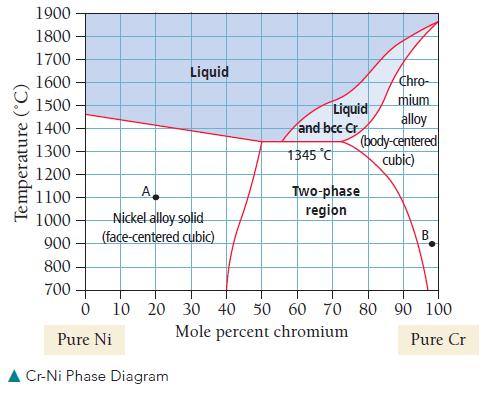
An alloy is a metallic mixture composed of two or more elements. As is the case in all mixtures, the relative amounts of the elements in an alloy can vary. In some cases, the components of an alloy can have different crystal structures. For example, a nickel–chromium alloy consists of nickel,
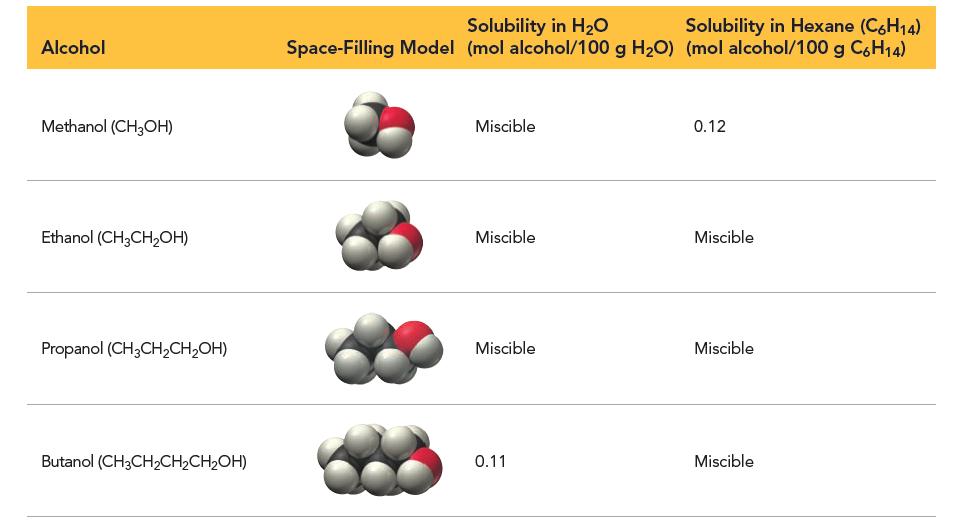
Consider the table listing the solubilities of several alcohols in water and in hexane. Which statement best describes the observed trend in terms of intermolecular forces?(a) As you move down the list, molecules become more polar, less soluble in water, and more soluble in hexane.(b) As you move
Which statement is true?(a) Ideal gases mix because mixing decreases their potential energy.(b) Ideal gases mix because mixing increases their potential energy.(c) Ideal gases mix because mixing decreases their entropy.(d) Ideal gases mix because mixing increases their entropy.
This graph shows the concentration of the reactant A in the reaction A → B. Determine the average rate of the reaction between 0 and 10 seconds.a) 0.07 M/s b) 0.007 M/s c) 0.86 M/s d) 0.014 M/s Concentration (M) 1.2- 1 0.8 0.6- 0.4- 0.2 [A] 0 0 10 20 30 40 50 60 70 80 Time (s)
For the reaction A + 2B → C under a given set of conditions, the initial rate is 0.100 M/s. What is Δ[B]/Δt under the same conditions?(a) -0.0500 M/s(b) -0.100 M/s(c) -0.200 M/s(d) +0.200 M/s
Explain why lizards become sluggish in cold weather. How is this phenomenon related to chemistry?
Consider this balanced chemical equation:In the first 10.0 seconds of the reaction, the concentration of I - drops from 1.000 M to 0.868 M.(a) Calculate the average rate of this reaction in this time interval.(b) Determine the rate of change in the concentration of H+ (that is, Δ[H+]/Δt) during
For a particular reaction in which A → products, a doubling of the concentration of A causes the reaction rate to double. What is the order of the reaction?(a) 0 (b) 1 (c) 2
Dinitrogen monoxide decomposes into nitrogen and oxygen when heated. The initial rate of the reaction is 0.022 M/s.What is the initial rate of change of the concentration of N2O (that is, Δ[N2O]/Δt)?a) -0.022 M/s b) -0.011 M/sc) -0.044 M/s d) +0.022 M/s 2 N₂O(g) → 2 N₂(g) + O₂(g)
Why are reaction rates important (both practically and theoretically)?
Consider the reaction between nitrogen dioxide and carbon monoxide:The initial rate of the reaction is measured at several different concentrations of the reactants, and the tabulated results are shown here.From the data, determine:(a) The rate law for the reaction (b) The rate constant (k) for
The reaction A → B has been experimentally determined to be second order. The initial rate is 0.0100 M/s at an initial concentration of A of 0.100 M. What is the initial rate at [A] = 0.500 M ?(a) 0.00200 M/s (b) 0.0100 M/s (c) 0.0500 M/s (d) 0.250 M/s
Consider the equation for the decomposition of SO2Cl2:The concentration of SO2Cl2 is monitored at a fixed temperature as a function of time during the decomposition reaction, and the following data are tabulated:Show that the reaction is first order, and determine the rate constant for the
What units are typically used to express the rate of a reaction?
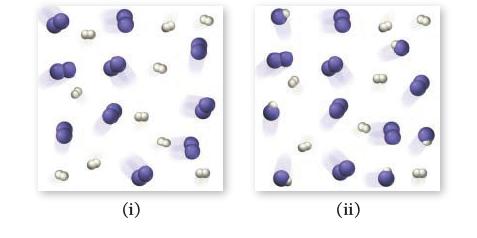
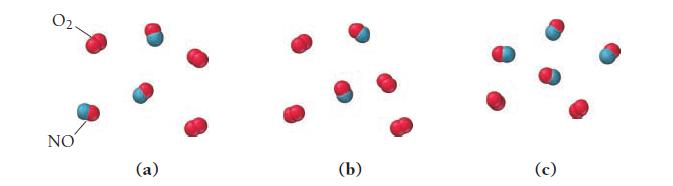
This reaction was experimentally determined to be first order with respect to O2 and second order with respect to NO:The diagrams shown here represent reaction mixtures in which the number of each type of molecule represents its relative initial concentration. Which mixture has the fastest initial
For the reaction 2 A + B → C, the initial rate is measured at several different reactant concentrations. From the resulting tabulated data, determine the rate law for the reaction.a) Rate = k[A][B] b) Rate = k[A]2[B]c) Rate = k[A][B]2 d) Rate = k[A]2[B]2 [A] (M) 0.05 0.10 0.20 [B]
In Example 15.3, you determined that the decomposition of SO2Cl2 (under the given reaction conditions) is first order and has a rate constant of +2.90 * 10-4 s-1. If the reaction is carried out at the same temperature and the initial concentration of SO2Cl2 is 0.0225 M, what is the SO2Cl2
Why is the reaction rate for reactants defined as the negative of the change in reactant concentration with respect to time, whereas for products it is defined as the change in reactant concentration with respect to time (with a positive sign)?
The images shown here depict the first-order reaction A → B at various times during the reaction process. The black circles represent reactant A, and the red circles represent product B. What is the half-life of the reaction?(a) 30 s (b) 60 s (c) 90 s (d) 120 s t = 0 t = 30 s t = 60 s t = 90
What is the rate constant for the reaction in Question 4?Question 4For the reaction 2 A + B → C, the initial rate is measured at several different reactant concentrations. From the resulting tabulated data, determine the rate law for the reaction. a) 2.8 x 10² M². s-¹ c) 1.4 x 10² M-2.s-1 b)
Consider the equation for the decomposition of NO2:The concentration of NO2 is monitored at a fixed temperature as a function of time during the decomposition reaction and the data tabulated in the margin at right.Show by graphical analysis that the reaction is not first order and that it is second
Explain the difference between the average rate of reaction and the instantaneous rate of reaction.
The decomposition of Br2 is followed as a function of time; two different plots of the data are shown. Determine the order and rate constant for the reaction. In [Br₂] -0.5- -1 -1.5 -2- -2.5+ 0 20 40 Time (s) 60 80
Consider a simple reaction in which reactant A forms products:What is the rate law if the reaction is zero order with respect to A? First order? Second order? For each case, explain how a doubling of the concentration of A would affect the rate of reaction. A- products
A decomposition reaction, with a rate that is observed to slow down as the reaction proceeds, has a halflife that depends on the initial concentration of the reactant. Which statement is most likely true for this reaction?(a) A plot of the natural log of the concentration of the reactant as a
The reaction X → products is second order in X and has a rate constant of 0.035 M-1s-1. If a reaction mixture is initially 0.45 M in X, what is the concentration of X after 155 seconds?a) 7.6 Mb) 2.0 * 10-3 Mc) 0.13 Md) 0.00 M
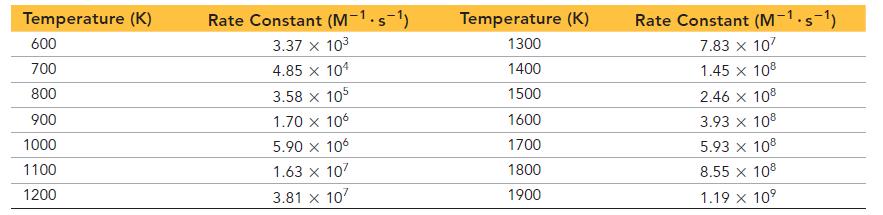
The decomposition of ozone shown here is important to many atmospheric reactions:A study of the kinetics of the reaction results in the following data:Determine the value of the frequency factor and activation energy for the reaction. 03(g) O₂(g) + 0(g)
How is the order of a reaction generally determined?
Which statement best explains why reaction rates generally increase with increasing temperature?(a) Reaction rates increase with increasing temperature because, as temperature increases, a greater fraction of molecules have enough thermal energy to surmount the activation barrier.(b) Reaction rates
A decomposition reaction has a half-life that does not depend on the initial concentration of the reactant. What is the order of the reaction?a) Zero order b) First order c) Second order d) Order cannot be determined without more information.
Consider the reaction between nitrogen dioxide and carbon monoxide:The rate constant at 701 K is measured as 2.57 M-1 · s-1 and that at 895 K is measured as 567 M-1 · s-1. Find the activation energy for the reaction in kJ/mol. NO₂(g) + CO(g) NO(g) + CO₂(g)
For a reaction with multiple reactants, how is the overall order of the reaction defined?
A and reaction B have identical frequency factors. However, reaction B has a higher activation energy than reaction A. Which reaction has a greater rate constant at room temperature?(a) Reaction A (b) Reaction B
The rate constant of a reaction is measured at different temperatures. A plot of the natural log of the rate constant as a function of the inverse of the temperature (in kelvins) yields a straight line with a slope of -8.55 * 103 K-1.What is the activation energy (Ea) for the reaction?a) -71
Ozone naturally decomposes to oxygen by this reaction:The experimentally observed rate law for this reaction is:Show that this proposed mechanism is consistent with the experimentally observed rate law. 203 (8) 3 0₂(8)
Explain the difference between the rate law for a reaction and the integrated rate law for a reaction. What relationship does each kind of rate law express?
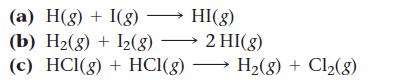
Which reaction do you expect to have the smallest orientation factor? (a) H(g) + I(g) — HI(g) (b) H₂(g) + 12(g) → 2 HI(g) (c) HCl(g) + HCI(g) H₂(g) + Cl₂(8)
The rate constant for a reaction at 25.0 °C is 0.010 s-1, and its activation energy is 35.8 kJ. Find the rate constant at 50.0 °C.a) 0.021 s-1b) 0.010 s-1c) 0.0033 s-1d) 0.031 s-1
Write integrated rate laws for zero-order, first-order, and secondorder reactions of the form A → products.
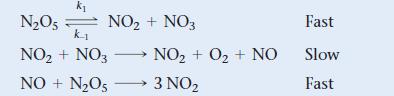
The mechanism shown is proposed for the gas-phase reaction, 2 N2O5 → 4 NO2 + O2. What rate law does the mechanism predict?a) Rate = k[N2O5]b) Rate = k[N2O5]2c) Rate = k[N2O5]0d) Rate = k[NO2][NO3] k₁ N₂O5 k₁ NO₂ + NO3 NO + N₂O5 NO₂ + NO3 NO₂ + O₂ + NO 3 NO₂ Fast Slow Fast
What is the rate law for the elementary step Cl + CO → ClCO ?(a) Rate = k[Cl] (b) Rate = k[CO](c) Rate = k[ClCO](d) Rate = k[Cl][CO]
What does the term half-life mean? Write the expressions for the half-lives of zero-order, first-order, and second-order reactions.
Which statement is true regarding the function of a catalyst in a chemical reaction?a) A catalyst increases the rate of a reaction.b) A catalyst provides an alternate mechanism for the reaction.c) A catalyst is not consumed by the reaction.d) All of the above are true.
How do reaction rates typically depend on temperature? What part of the rate law is temperature dependent?
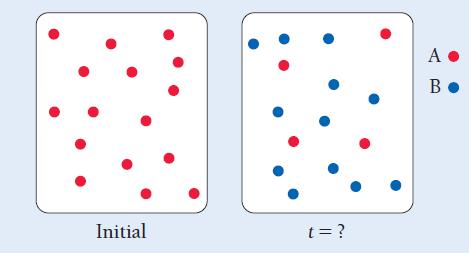
These images represent the first-order reaction A → B initially and at some later time. The rate law for the reaction is Rate = 0.010 s-1 [A]. How much time has passed between the two images?a) 69 s b) 139 s c) 60 s d) 12.5 s Initial t = ? A. B
Explain the meaning of each term within the Arrhenius equation: activation energy, frequency factor, and exponential factor.Use these terms and the Arrhenius equation to explain why small changes in temperature can result in large changes in reaction rates.
Use collision theory to determine which single-step reaction has the smallest orientation factor.a) H + H → H2b) I + HI → I2 + Hc) H2 + H2C = CH2 → H3C—CH3d) All of these reactions have the same orientation factor.
What is an Arrhenius plot? Explain the significance of the slope and intercept of an Arrhenius plot.
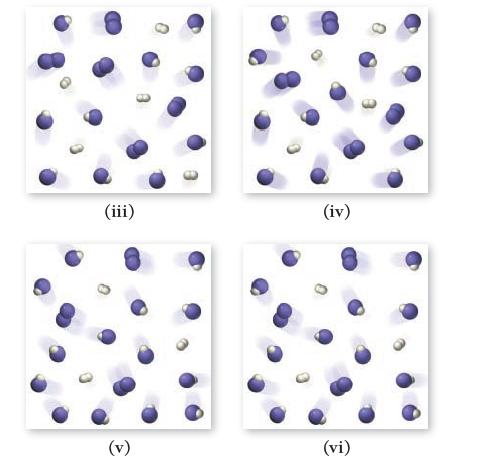
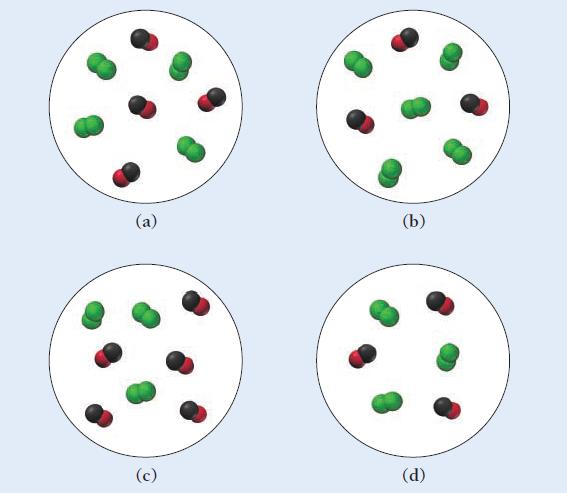
Carbon monoxide and chlorine gas react to form phosgene (COCl2) according to the equation:The rate law for the reaction is Rate = k[Cl2]3/2[CO]. Which representation of a mixture of chlorine gas and carbon monoxide gas has the fastest initial rate? CO(g) + Cl₂(g) - COCI₂(g)
Explain how a chemical reaction occurs according to the collision model. Explain the meaning of the orientation factor in this model.
Explain the difference between a normal chemical equation for a chemical reaction and the mechanism of that reaction.
In a reaction mechanism, what is an elementary step? Write down the three most common elementary steps and the corresponding rate law for each one.
What are the two requirements for a proposed mechanism to be valid for a given reaction?
What is a catalyst? How does a catalyst increase the rate of a chemical reaction?
What is an intermediate within a reaction mechanism?
Explain the difference between homogeneous catalysis and heterogeneous catalysis.
What are the four basic steps involved in heterogeneous catalysis?
What are enzymes? What is the active site of an enzyme? What is a substrate?
What is the general two-step mechanism by which most enzymes work?
Consider the reaction:2 N2O(g) → 2 N2(g) + O2(g)a. Express the rate of the reaction in terms of the change in concentration of each of the reactants and products.b. In the first 15.0 s of the reaction, 0.015 mol of O2 is produced in a reaction vessel with a volume of 0.500 L. What is the average
For the reaction 2 A(g) + B(g) → 3 C( g),a. Determine the expression for the rate of the reaction in terms of the change in concentration of each of the reactants and products.b. When A is decreasing at a rate of 0.100 M/s, how fast is B decreasing? How fast is C increasing?
For the reaction A(g) + 1/2 B(g) → 2 C(g), a. Determine the expression for the rate of the reaction in terms of the change in concentration of each of the reactants and products.b. When C is increasing at a rate of 0.025 M/s, how fast is B decreasing? How fast is A decreasing?
Consider the reaction: Cl2(g) + 3 F2(g) → 2 ClF3(g)Complete the table. A[Cl₂]/At A[F₂]/At -0.012 M/s A[CIF3]/At Rate
Consider the reaction:8 H2S(g) + 4 O2(g) → 8 H2O(g) + S8(g)Complete the table. A[H₂S]/At A[0₂]/At -0.080 M/s A[H₂O]/At A[Ss]/At Rate
Consider the reaction:C4H8(g) → 2 C2H4(g)The tabulated data were collected for the concentration of C4H8 as a function of time:a. What is the average rate of the reaction between 0 and 10 s? Between 40 and 50 s?b. What is the rate of formation of C2H4 between 20 and 30 s? Time
Consider the reaction:NO2(g) → NO(g) + 1/2 O2(g)The tabulated data were collected for the concentration of NO2 as a function of time:a. What is the average rate of the reaction between 10 and 20 s? Between 50 and 60 s?b. What is the rate of formation of O2 between 50 and 60 s? Time
This graph shows a plot of the rate of a reaction versus the concentration of the reactant A for the reaction A → products.a. What is the order of the reaction with respect to A?b. Make a rough sketch of a plot of [A] versus time.c. Write a rate law for the reaction including an estimate for the
Consider the reaction:2 H2O2(aq) → 2 H2O(l) + O2(g)The graph shows the concentration of H2O2 as a function of time.Use the graph to calculate each quantity:a. The average rate of the reaction between 10 and 20 s b. The instantaneous rate of the reaction at 30 s c. The instantaneous rate of
This graph shows a plot of the rate of a reaction versus the concentration of the reactant.a. What is the order of the reaction with respect to A?b. Make a rough sketch of a plot of [A] versus time.c. Write a rate law for the reaction including the value of k. Rate
What are the units of k for each type of reaction?a. First-order reactionb. Second-order reactionc. Zero-order reaction
This reaction is first order in N2O5:The rate constant for the reaction at a certain temperature is 0.053/s.a. Calculate the rate of the reaction when [N2O5] = 0.055 M.b. What would the rate of the reaction be at the concentration indicated in part a if the reaction were second order? Zero order?
Consider the data showing the initial rate of a reaction (A → products) at several different concentrations of A.What is the order of the reaction? Write a rate law for the reaction, including the value of the rate constant, k. [A] (M) 0.100 0.200 0.300 Initial Rate (M/s) 0.053 0.210 0.473
Consider the data showing the initial rate of a reaction (A → products) at several different concentrations of A. What is the order of the reaction? Write a rate law for the reaction, including the value of the rate constant, k. [A] (M) 0.15 0.30 0.60 Initial Rate (M/s) 0.008 0.016 0.032
Consider the tabulated data showing the initial rate of a reaction (A → products) at several different concentrations of A.What is the order of the reaction? Write a rate law for the reaction, including the value of the rate constant, k. [A] (M) 0.12 0.16 0.20 Initial Rate
Consider the tabulated data showing the initial rate of a reaction (A → products) at several different concentrations of A.What is the order of the reaction? Write a rate law for the reaction, including the value of the rate constant, k. [A] (M) 0.12 0.18 0.28 Initial Rate (M/s) 3.89 x 10⁻⁴ 8.75
The tabulated data were collected for this reaction:Write an expression for the reaction rate law and calculate the value of the rate constant, k. What is the overall order of the reaction? 2 NO₂(g) + F₂(g) - 2 NO₂F(g)
The tabulated data were collected for this reaction:Write an expression for the reaction rate law and calculate the value of the rate constant, k. What is the overall order of the reaction? CH3CI(g) [CH3CI] (M) 0.050 0.100 0.100 0.200 + 3 Cl₂(g) [Cl₂] (M) 0.050 0.050 0.100 0.200 CCl4(g) + 3
Indicate the order of reaction consistent with each observation.a. A plot of the concentration of the reactant versus time yields a straight line.b. The reaction has a half-life that is independent of initial concentration.c. A plot of the inverse of the concentration versus time yields a straight
The tabulated data show the concentration of AB versus time for this reaction:Determine the order of the reaction and the value of the rate constant. Predict the concentration of AB at 25 s. AB(g) Time (s) 0 50 100 150 200 250 300 350 400 450 500 A(g) + B(g) [AB]
Indicate the order of reaction consistent with each observation.a. The half-life of the reaction gets shorter as the initial concentration is increased.b. A plot of the natural log of the concentration of the reactant versus time yields a straight line.c. The half-life of the reaction gets longer
The tabulated data show the concentration of N2O5 versus time for this reaction:Determine the order of the reaction and the value of the rate constant. Predict the concentration of N2O5 at 250 s. N₂O5(g) Time (s) 0 25 50 75 100 125 150 175 200 NO3(g) + NO₂(8) [N₂O5]
The tabulated data show the concentration of cyclobutane (C4H8) versus time for this reaction:Determine the order of the reaction and the value of the rate constant. What is the rate of reaction when [C4H8] = 0.25 M? C4H8 Time (s) 0 10 20 30 40 50 60 70 80 90 100 → 2 C₂H4 [C4H8]
The reaction A → products was monitored as a function of time. The results are shown here.Determine the order of the reaction and the value of the rate constant. What is the rate of reaction when [A] = 0.10 M ? Time (s) 0 25 50 75 100 125 150 175 200 [A]
This reaction was monitored as a function of time:A plot of ln[A] versus time yields a straight line with slope -0.0045/s.a. What is the value of the rate constant (k) for this reaction at this temperature?b. Write the rate law for the reaction.c. What is the half-life?d. If the initial
This reaction was monitored as a function of time:A plot of 1/[AB] versus time yields a straight line with a slope of +0.55/M · s.a. What is the value of the rate constant (k) for this reaction at this temperature?b. Write the rate law for the reaction.c. What is the half-life when the initial
The decomposition of SO2Cl2 is first order in SO2Cl2 and has a rate constant of 1.42 * 10-4s-1 at a certain temperature.a. What is the half-life for this reaction?b. How long will it take for the concentration of SO2Cl2 to decrease to 25% of its initial concentration?c. If the initial concentration
The decomposition of XY is second order in XY and has a rate constant of 7.02 * 10-3M-1 · s-1 at a certain temperature.a. What is the half-life for this reaction at an initial concentration of 0.100 M?b. How long will it take for the concentration of XY to decrease to 12.5% of its initial
The half-life for the radioactive decay of U-238 is 4.5 billion years and is independent of initial concentration. How long will it take for 10% of the U-238 atoms in a sample of U-238 to decay? If a sample of U-238 initially contained 1.5 * 1018 atoms when the universe was formed 13.8 billion
The half-life for the radioactive decay of C-14 is 5730 years and is independent of the initial concentration. How long does it take for 25% of the C-14 atoms in a sample of C-14 to decay? If a sample of C-14 initially contains 1.5 mmol of C-14, how many millimoles are left after 2255 years?
A chemical reaction is endothermic and has an activation energy that is twice the value of the enthalpy change of the reaction. Draw a diagram depicting the energy of the reaction as it progresses. Label the position of the reactants and products and indicate the activation energy and enthalpy of
H2 and I2 are combined in a flask and allowed to react according to the reaction:Examine the figures (sequential in time) and answer the questions:a. Which figure represents the point at which equilibrium is reached?b. How would the series of figures change in the presence of a catalyst?c. Would
Calculate the pH of a buffer solution that is 0.050 M in benzoic acid (HC7H5O2) and 0.150 M in sodium benzoate (NaC7H5O2). For benzoic acid, Ka = 6.5 * 10-5.
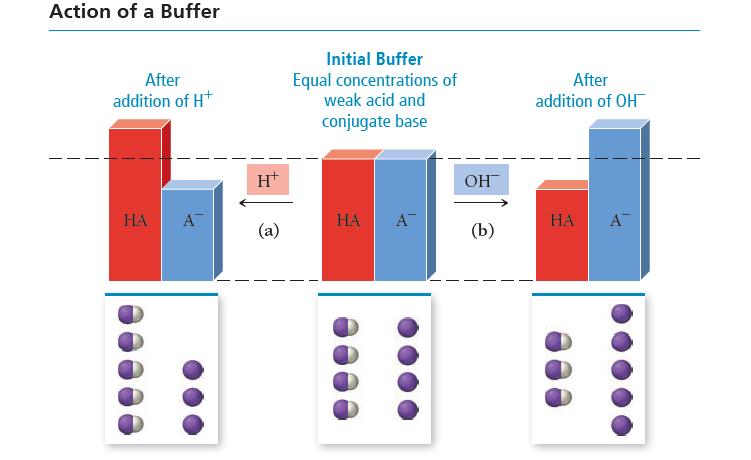
Closely examine Figure 18.3. Which image best represents the amount of OH- added to the buffer in part (b) of the figure? a. b. C.
The activation energy of a reaction is 56.8 kJ/mol, and the frequency factor is 1.5 * 1011/s. Calculate the rate constant of the reaction at 25 °C.
The rate constant of a reaction at 32 °C is 0.055/s. If the frequency factor is 1.2 * 1013/s, what is the activation barrier?
The rate constant (k) for a reaction was measured as a function of temperature. A plot of ln k versus 1/T (in K) is linear and has a slope of -7445 K. Calculate the activation energy for the reaction.
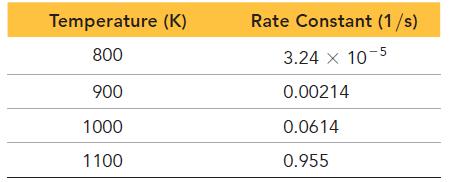
The data shown here were collected for the first-order reaction:Use an Arrhenius plot to determine the activation barrier and frequency factor for the reaction. N₂O(g) N₂(g) + O(g)
The rate constant (k) for a reaction was measured as a function of temperature. A plot of ln k versus 1/T (in K) is linear and has a slope of -1.01 * 104 K. Calculate the activation energy for the reaction.
Showing 1300 - 1400
of 4045
First
7
8
9
10
11
12
13
14
15
16
17
18
19
20
21
Last
Step by Step Answers

 Get 50% OFF
Claim Now
Get 50% OFF
Claim Now



![Concentration (M) 1.2- 1 0.8 0.6- 0.4- 0.2 [A] 0 0 10 20 30 40 50 60 70 80 Time (s)](https://dsd5zvtm8ll6.cloudfront.net/images/question_images/1700/1/9/6/3446556eff8e20da1700196344748.jpg)



![[NO] (M) 0.10 0.20 0.20 0.40 [CO] (M) 0.10 0.10 0.20 0.10 Initial Rate (M/s) 0.0021 0.0082 0.0083 0.033](https://dsd5zvtm8ll6.cloudfront.net/images/question_images/1700/1/3/3/7016555fb45375d81700133699294.jpg)

![Time (s) 0 100 200 300 400 500 600 700 [SOCl] (M) 0.100 0.0971 0.0944 0.0917 0.0890 0.0865 0.0840 0.0816 Time](https://dsd5zvtm8ll6.cloudfront.net/images/question_images/1700/1/3/3/7336555fb659baa91700133731283.jpg)

![[A] (M) 0.05 0.10 0.20 [B] (M) 0.05 0.05 0.10 Initial Rate (M/s) 0.035 0.070 0.56](https://dsd5zvtm8ll6.cloudfront.net/images/question_images/1700/1/9/6/4716556f077a7e0e1700196470489.jpg)




![In [Br] -0.5- -1 -1.5 -2- -2.5+ 0 20 40 Time (s) 60 80](https://dsd5zvtm8ll6.cloudfront.net/images/question_images/1700/1/9/6/5236556f0ab2733a1700196522339.jpg)
![1/[Br] 10. 9. 8- 7 5- 4 3- 2. 1 0 0 20 40 Time (s) 60 80](https://dsd5zvtm8ll6.cloudfront.net/images/question_images/1700/1/9/6/5306556f0b21119e1700196529185.jpg)





![-1 Rate = k[03][0]-](https://dsd5zvtm8ll6.cloudfront.net/images/question_images/1700/1/3/4/0016555fc711e3b21700133998406.jpg)


![A[Cl]/At A[F]/At -0.012 M/s A[CIF3]/At Rate](https://dsd5zvtm8ll6.cloudfront.net/images/question_images/1700/1/9/8/1136556f6e1021ae1700198110998.jpg)
![A[HS]/At A[0]/At -0.080 M/s A[HO]/At A[Ss]/At Rate](https://dsd5zvtm8ll6.cloudfront.net/images/question_images/1700/1/9/8/1526556f70862da91700198149752.jpg)
![Time (s) 0 10 20 30 40 50 [C4H8] (M) 1.000 0.913 0.835 0.763 0.697 0.637](https://dsd5zvtm8ll6.cloudfront.net/images/question_images/1700/1/9/8/4026556f802e126b1700198402474.jpg)
![Time (s) 0 10 20 30 40 50 60 70 80 90 100 [NO] (M) 1.000 0.951 0.904 0.860 0.818 0.778 0.740 0.704 0.670](https://dsd5zvtm8ll6.cloudfront.net/images/question_images/1700/1/9/8/4866556f8566bd361700198484974.jpg)
![Rate (M/s) 0.012 0.010 0.008 0.006- 0.004 0.002 0 0 0.2 0.4 0.6 [A] (M) 0.8 1](https://dsd5zvtm8ll6.cloudfront.net/images/question_images/1700/1/9/8/7786556f97af09731700198777421.jpg)
![Concentration (M) 1.2. $1.0- 0.8 0.6 0.4- 50.2 [HO] 0- 0 10 20 30 40 50 60 70 80 Time (s)](https://dsd5zvtm8ll6.cloudfront.net/images/question_images/1700/1/9/8/5686556f8a897ad41700198566812.jpg)
![Rate (M/s) 0.012 0.010- 0.008 0.006 0.004 0.002 0 0 0.2 0.4 0.6 [A] (M) 0.8 1](https://dsd5zvtm8ll6.cloudfront.net/images/question_images/1700/1/9/8/7976556f98d585a31700198795517.jpg)

![[A] (M) 0.100 0.200 0.300 Initial Rate (M/s) 0.053 0.210 0.473](https://dsd5zvtm8ll6.cloudfront.net/images/question_images/1700/1/9/8/9586556fa2e5edc81700198958131.jpg)
![[A] (M) 0.15 0.30 0.60 Initial Rate (M/s) 0.008 0.016 0.032](https://dsd5zvtm8ll6.cloudfront.net/images/question_images/1700/1/9/9/5236556fc634ddef1700199522037.jpg)
![[A] (M) 0.12 0.16 0.20 Initial Rate (M/s) 0.0078 0.0104 0.0130](https://dsd5zvtm8ll6.cloudfront.net/images/question_images/1700/1/9/9/5396556fc73852831700199538160.jpg)
![[A] (M) 0.12 0.18 0.28 Initial Rate (M/s) 3.89 x 10⁻⁴ 8.75 X 10⁻⁴ 2.12 x 10-3](https://dsd5zvtm8ll6.cloudfront.net/images/question_images/1700/1/9/9/7056556fd19bf2df1700199704049.jpg)

![[NO] 0.100 0.200 0.200 0.400 [F] (M) 0.100 0.100 0.200 0.400 Initial Rate (M/s) 0.026 0.051 0.103 0.411](https://dsd5zvtm8ll6.cloudfront.net/images/question_images/1700/1/9/9/7286556fd309b4941700199727229.jpg)
![CH3CI(g) [CH3CI] (M) 0.050 0.100 0.100 0.200 + 3 Cl(g) [Cl] (M) 0.050 0.050 0.100 0.200 CCl4(g) + 3 HCl(g)](https://dsd5zvtm8ll6.cloudfront.net/images/question_images/1700/1/9/9/7506556fd46e3c351700199748951.jpg)
![AB(g) Time (s) 0 50 100 150 200 250 300 350 400 450 500 A(g) + B(g) [AB] (M) 0.950 0.459 0.302 0.225 0.180](https://dsd5zvtm8ll6.cloudfront.net/images/question_images/1700/1/9/9/7866556fd6ab86171700199784137.jpg)
![NO5 (g) Time (s) 0 25 50 75 100 125 150 175 200 NO3(g) + NO(8) [NO5] (M) 1.000 0.822 0.677 0.557 0.458 0.377](https://dsd5zvtm8ll6.cloudfront.net/images/question_images/1700/1/9/9/8116556fd83eda1f1700199809723.jpg)
![C4H8 Time (s) 0 10 20 30 40 50 60 70 80 90 100 2 CH4 [C4H8] (M) 1.000 0.894 0.799 0.714 0.638 0.571 0.510](https://dsd5zvtm8ll6.cloudfront.net/images/question_images/1700/1/9/9/8986556fdda6b91f1700199896318.jpg)
![Time (s) 0 25 50 75 100 125 150 175 200 [A] (M) 1.000 0.914 0.829 0.744 0.659 0.573 0.488 0.403 0.318](https://dsd5zvtm8ll6.cloudfront.net/images/question_images/1700/1/9/9/9326556fdfccab481700199930382.jpg)