New Semester
Started
Get
50% OFF
Study Help!
--h --m --s
Claim Now
Question Answers
Textbooks
Find textbooks, questions and answers
Oops, something went wrong!
Change your search query and then try again
S
Books
FREE
Study Help
Expert Questions
Accounting
General Management
Mathematics
Finance
Organizational Behaviour
Law
Physics
Operating System
Management Leadership
Sociology
Programming
Marketing
Database
Computer Network
Economics
Textbooks Solutions
Accounting
Managerial Accounting
Management Leadership
Cost Accounting
Statistics
Business Law
Corporate Finance
Finance
Economics
Auditing
Tutors
Online Tutors
Find a Tutor
Hire a Tutor
Become a Tutor
AI Tutor
AI Study Planner
NEW
Sell Books
Search
Search
Sign In
Register
study help
sciences
chemistry a molecular approach
Chemistry A Molecular Approach 5th Edition Nivaldo Tro - Solutions
Blood is buffered by carbonic acid and the bicarbonate ion. Normal blood plasma is 0.024 M in HCO3 - and 0.0012 M H2CO3 (pKa1 for H2CO3 at body temperature is 6.1).a. What is the pH of blood plasma?b. If the volume of blood in a normal adult is 5.0 L, what mass of HCl can be neutralized by the
Which buffer system is the best choice to create a buffer with pH = 7.20? For the best system, calculate the ratio of the masses of the buffer components required to make the buffer. HC₂H302/KC₂H3O2 NH3/NH4Cl HCIO₂/KCIO2 HCIO/KCIO
Which buffer system is the best choice to create a buffer with pH = 9.00? For the best system, calculate the ratio of the masses of the buffer components required to make the buffer. HF/KF NH3/NH4Cl HNO₂/KNO₂ HCIO/KCIO
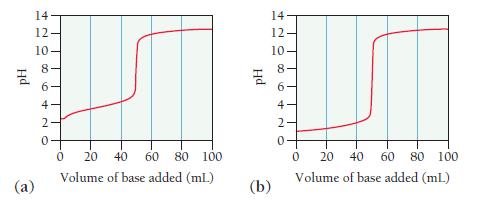
The graphs labeled (a) and (b) show the titration curves for two equal-volume samples of monoprotic acids, one weak and one strong. Both titrations were carried out with the same concentration of strong base.i. What is the approximate pH at the equivalence point of each curve?ii. Which graph
A 500.0-mL buffer solution is 0.100 M in HNO2 and 0.150 M in KNO2. Determine if each addition would exceed the capacity of the buffer to neutralize it.a. 250 mg NaOHb. 350 mg KOHc. 1.25 g HBrd. 1.35 g HI
A 1.0-L buffer solution is 0.125 M in HNO2 and 0.145 M in NaNO2. Determine the concentrations of HNO2 and NaNO2 after the addition of each substance:a. 1.5 g HCl b. 1.5 g NaOH c. 1.5 g HI
Two 25.0-mL samples, one 0.100 M HCl and the other 0.100 M HF, are titrated with 0.200 M KOH.a. What is the volume of added base at the equivalence point for each titration?b. Is the pH at the equivalence point for each titration acidic, basic, or neutral?c. Which titration curve has the lower
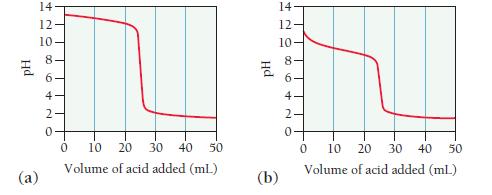
The graphs labeled (a) and (b) show the titration curves for two equal-volume samples of bases, one weak and one strong. Both titrations were carried out with the same concentration of strong acid.i. What is the approximate pH at the equivalence point of each curve?ii. Which graph corresponds to
Two 20.0-mL samples, one 0.200 M KOH and the other 0.200 M CH3NH2, are titrated with 0.100 M HI.a. What is the volume of added acid at the equivalence point for each titration?b. Is the pH at the equivalence point for each titration acidic, basic, or neutral?c. Which titration curve has the lower
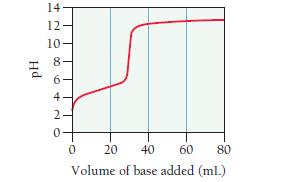
Consider the curve shown here for the titration of a weak monoprotic acid with a strong base and answer each question.a. What is the pH and what is the volume of added base at the equivalence point?b. At what volume of added base is the pH calculated by working an equilibrium problem based on the
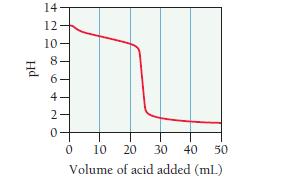
Consider the curve shown here for the titration of a weak base with a strong acid and answer each question.a. What is the pH and what is the volume of added acid at the equivalence point?b. At what volume of added acid is the pH calculated by working an equilibrium problem based on the initial
Consider the titration of a 35.0-mL sample of 0.175 M HBr with 0.200 M KOH. Determine each quantity.a. The initial pH b. The volume of added base required to reach the equivalence point c. The pH at 10.0 mL of added base d. The pH at the equivalence point e. The pH after adding 5.0 mL of base
A 20.0-mL sample of 0.125 M HNO3 is titrated with 0.150 M NaOH. Calculate the pH for at least five different points throughout the titration curve and sketch the curve. Indicate the volume at the equivalence point on your graph.
Consider the titration of a 25.0-mL sample of 0.115 M RbOH with 0.100 M HCl. Determine each quantity.a. The initial pHb. The volume of added acid required to reach the equivalence pointc. The pH at 5.0 mL of added acidd. The pH at the equivalence pointe. The pH after adding 5.0 mL of acid beyond
A 15.0-mL sample of 0.100 M Ba(OH)2 is titrated with 0.125 M HCl. Calculate the pH for at least five different points throughout the titration curve and sketch the curve. Indicate the volume at the equivalence point on your graph.
Consider the titration of a 20.0-mL sample of 0.105 M HC2H3O2 with 0.125 M NaOH. Determine each quantity.a. The initial pHb. The volume of added base required to reach the equivalence pointc. The pH at 5.0 mL of added based. The pH at one-half of the equivalence pointe. The pH at the equivalence
A 30.0-mL sample of 0.165 M propanoic acid is titrated with 0.300 M KOH. Calculate the pH at each volume of added base: 0 mL, 5 mL, 10 mL, equivalence point, one-half equivalence point, 20 mL, 25 mL. Sketch the titration curve.
Consider the titration of a 25.0-mL sample of 0.175 M CH3NH2 with 0.150 M HBr. Determine each quantity.a. The initial pHb. The volume of added acid required to reach the equivalence pointc. The pH at 5.0 mL of added acidd. The pH at one-half of the equivalence pointe. The pH at the equivalence
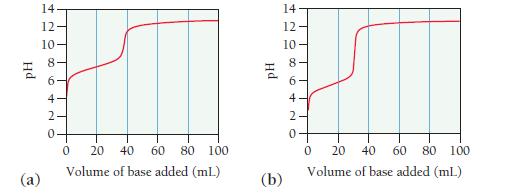
Consider the titration curves (labeled a and b) for two weak acids, both titrated with 0.100 M NaOH.i. Which acid solution is more concentrated?ii. Which acid has the larger Ka? Hd @ 14 12- 10 08 6 4- 420 20 40 60 80 100 Volume of base added (ml.) 0 Hd (b) 14 12 10 0 20 40 60 80 100 Volume of base
A 25.0-mL sample of 0.125 M pyridine is titrated with 0.100 M HCl. Calculate the pH at each volume of added acid: 0 mL, 10 mL, 20 mL, equivalence point, one-half equivalence point, 40 mL, 50 mL. Sketch the titration curve.
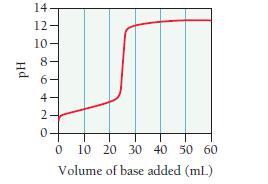
A 0.229-g sample of an unknown monoprotic acid is titrated with 0.112 M NaOH. The resulting titration curve is shown here.Determine the molar mass and pKa of the acid. Hd 14 12- 10 8 6- Na 00 4- 0 0 10 20 30 40 50 60 Volume of base added (ml)
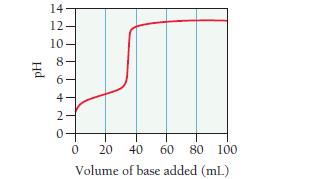
A 0.446-g sample of an unknown monoprotic acid is titrated with 0.105 M KOH. The resulting titration curve is shown here.Determine the molar mass and pKa of the acid. Hd 14 12- 10- ∞06+NO 8- 4- 2 20 40 60 80 100 Volume of base added (mL) 0
A 20.0-mL sample of 0.115 M sulfurous acid (H2SO3) solution is titrated with 0.1014 M KOH. At what added volume of base solution does each equivalence point occur?
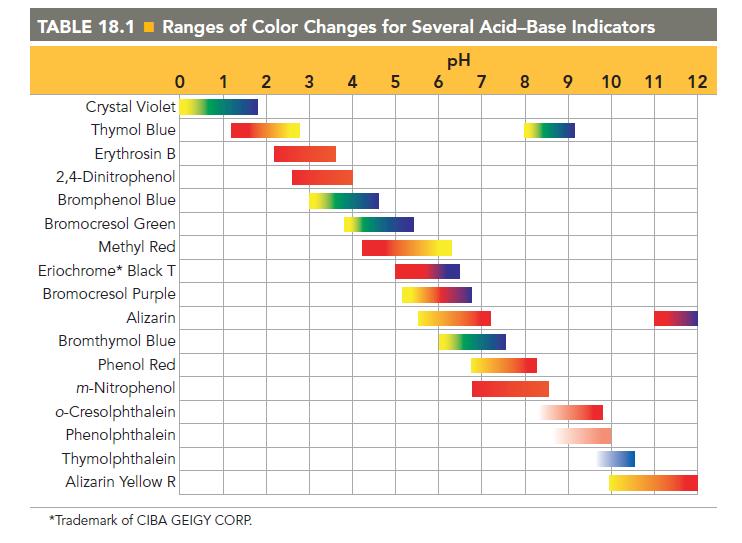
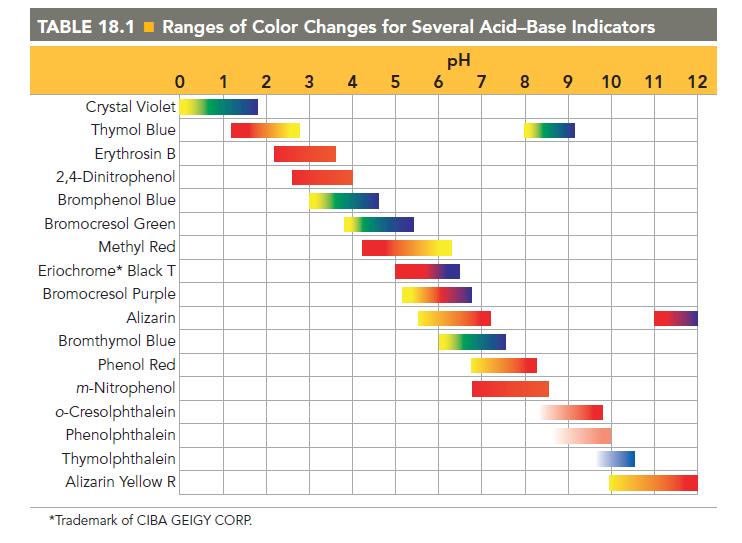
Referring to Table 18.1, pick an indicator for use in the titration of each acid with a strong base.a. HFb. HClc. HCN TABLE 18.1 Ranges of Color Changes for Several Acid-Base Indicators pH 5 6 7 8 9 0 1 2 Crystal Violet Thymol Blue Erythrosin B 2,4-Dinitrophenol Bromphenol Blue Bromocresol
A 20.0-mL sample of a 0.125 M diprotic acid (H2A) solution is titrated with 0.1019 M KOH. The acid ionization constants for the acid are Ka1 = 5.2 * 10-5 and Ka2 = 3.4 * 10-10. At what added volume of base does each equivalence point occur?
Referring to Table 18.1, pick an indicator for use in the titration of each base with a strong acid.a. CH3NH2b. NaOHc. C6H5NH2 TABLE 18.1 Ranges of Color Changes for Several Acid-Base Indicators pH 5 6 7 8 9 0 1 2 Crystal Violet Thymol Blue Erythrosin B 2,4-Dinitrophenol Bromphenol Blue Bromocresol
Methyl red has a pKa of 5.0 and is red in its acid form and yellow in its basic form. If several drops of this indicator are placed in a 25.0-mL sample of 0.100 M HCl, what color will the solution appear? If 0.100 M NaOH is slowly added to the HCl sample, in what pH range will the indicator change
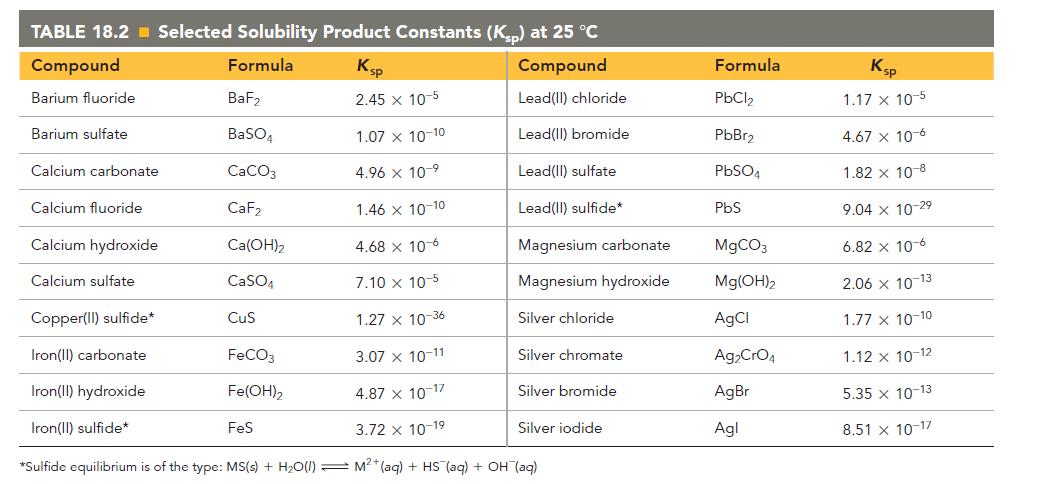
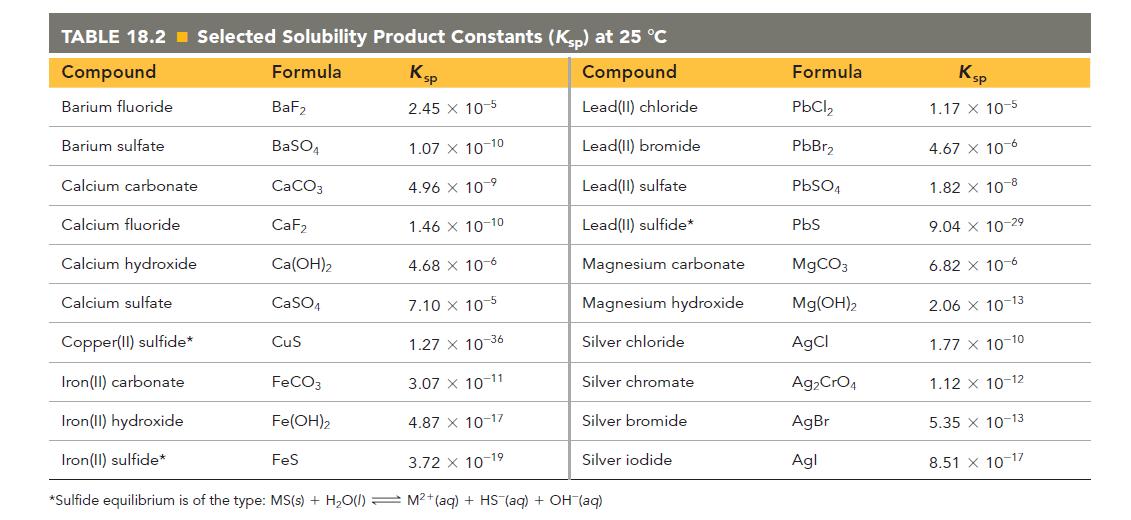
Refer to the Ksp values in Table 18.2 to calculate the molar solubility of each compound in pure water.a. AgBrb. Mg(OH)2c. CaF2 TABLE 18.2 Selected Solubility Product Constants (Ksp) at 25 °C Compound Formula Ksp Compound Barium fluoride 2.45 x 10⁻⁵ Lead(II) chloride Lead(II) bromide Lead(II)
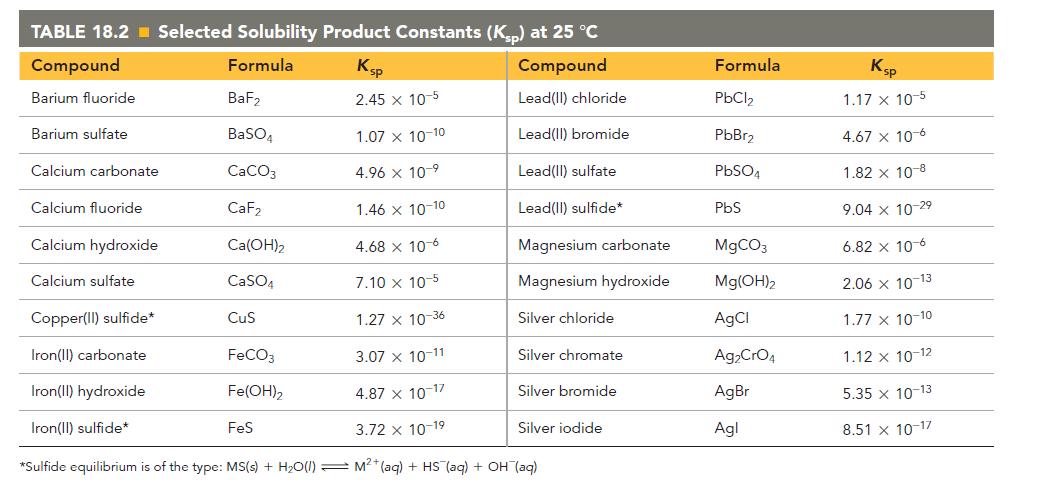
Refer to the Ksp values in Table 18.2 to calculate the molar solubility of each compound in pure water.a. MX (Ksp = 1.27 * 10-36)b. Ag2CrO4c. Ca(OH)2 TABLE 18.2 Selected Solubility Product Constants (Ksp) at 25 °C Compound Formula Ksp Compound Barium fluoride 2.45 x 10⁻⁵ Lead(II) chloride Lead(II)
Write balanced equations and expressions for Ksp for the dissolution of each ionic compound.a. CaCO3b. PbCl2c. AgI
Use the given molar solubilities in pure water to calculate Ksp for each compound.a. MX; molar solubility = 3.27 * 10-11 Mb. PbF2; molar solubility = 5.63 * 10-3 Mc. MgF2; molar solubility = 2.65 * 10-4 M
Refer to the Ksp value from Table 18.2 to calculate the solubility of iron(II) hydroxide in pure water in grams per 100.0 mL of solution. TABLE 18.2 Selected Solubility Product Constants (Ksp) at 25 °C Compound Formula Compound Lead(II) chloride Lead(II) bromide Lead(II) sulfate Lead(II)
Use the given molar solubilities in pure water to calculate Ksp for each compound.a. BaCrO4; molar solubility = 1.08 * 10-5 Mb. Ag2SO3; molar solubility = 1.55 * 10-5 Mc. Pd(SCN)2; molar solubility = 2.22 * 10-8 M
Two compounds with general formulas AX and AX2 have Ksp = 1.5 * 10-5. Which of the two compounds has the higher molar solubility?
Consider the compounds with the generic formulas listed and their corresponding molar solubilities in pure water. Which compound has the smallest value of Ksp?a. AX; molar solubility = 1.35 * 10-4 Mb. AX2; molar solubility = 2.25 * 10-4 Mc. A2X; molar solubility = 1.75 * 10-4 M
The solubility of copper(I) chloride is 3.91 mg per 100.0 mL of solution. Calculate Ksp for CuCl.
Calculate the molar solubility of barium fluoride in each liquid or solution. a. Pure waterb. 0.10 M Ba(NO3)2c. 0.15 M NaF
Calculate the molar solubility of MX (Ksp = 1.27 * 10-36) in each liquid or solution.a. Pure waterb. 0.25 M MCl2c. 0.20 M Na2X
Calculate the molar solubility of calcium hydroxide in a solution buffered at each pH.a. pH = 4b. pH = 7c. pH = 9
Calculate the solubility (in grams per 1.00 * 102 mL of solution) of magnesium hydroxide in a solution buffered at pH = 10. How does this compare to the solubility of Mg(OH)2 in pure water?
Determine if each compound is more soluble in acidic solution than it is in pure water. Explain.a. BaCO3b. CuSc. AgCld. PbI2
Determine if each compound is more soluble in acidic solution than it is in pure water. Explain.a. Hg2Br2b. Mg(OH)2c. CaCO3d. AgI
A solution containing sodium fluoride is mixed with one containing calcium nitrate to form a solution that is 0.015 M in NaF and 0.010 M in Ca(NO3)2. Does a precipitate form in the mixed solution? If so, identify the precipitate.
A solution containing potassium bromide is mixed with one containing lead acetate to form a solution that is 0.013 M in KBr and 0.0035 M in Pb(C2H3O2)2. Does a precipitate form in the mixed solution? If so, identify the precipitate.
Predict whether a precipitate will form if you mix 75.0 mL of a NaOH solution with pOH = 2.58 with 125.0 mL of a 0.018 M MgCl2 solution. Identify the precipitate, if any.
Predict whether a precipitate will form if you mix 175.0 mL of a 0.0055 M KCl solution with 145.0 mL of a 0.0015 M AgNO3 solution.Identify the precipitate, if any.
Potassium hydroxide is used to precipitate each of the cations from their respective solution. Determine the minimum concentration of KOH required for precipitation to begin in each case.a. 0.015 M CaCl2b. 0.0025 M Fe(NO3)2c. 0.0018 M MgBr2
Determine the minimum concentration of the precipitating agent on the right to cause precipitation of the cation from the solution on the left.a. 0.035 M Ba(NO3)2; NaFb. 0.085 M CaI2; K2SO4c. 0.0018 M AgNO3; RbCl
A solution is 0.010 M in Ba2+ and 0.020 M in Ca2+.a. If sodium sulfate is used to selectively precipitate one of the cations while leaving the other cation in solution, which cation will precipitate first? What minimum concentration of Na2SO4 will trigger the precipitation of the cation that
A solution is 0.022 M in Fe2+ and 0.014 M in Mg2+.a. If potassium carbonate is used to selectively precipitate one of the cations while leaving the other cation in solution, which cation will precipitate first? What minimum concentration of K2CO3 will trigger the precipitation of the cation that
Use the appropriate values of Ksp and Kf to find the equilibrium constant for the reaction. Fes(s) + 6 CN (aq) Fe(CN)6+ (aq) + S² (aq)
A solution is 1.1 * 10-3 M in Zn(NO3)2 and 0.150 M in NH3.After the solution reaches equilibrium, what concentration of Zn2+ (aq) remains?
A 120.0-mL sample of a solution that is 2.8 * 10-3 M in AgNO3 is mixed with a 225.0-mL sample of a solution that is 0.10 M in NaCN. After the solution reaches equilibrium, what concentration of Ag+(aq) remains?
Use the appropriate values of Ksp and Kf to find the equilibrium constant for the reaction. PbCl₂(s) + 3 OH(aq) — Pb(OH)₂ (aq) + 2 Cl¯ (aq)
A 150.0-mL solution contains 2.05 g of sodium benzoate and 2.47 g of benzoic acid. Calculate the pH of the solution.
A solution is made by combining 10.0 mL of 17.5 M acetic acid with 5.54 g of sodium acetate and diluting to a total volume of 1.50 L. Calculate the pH of the solution.
A buffer is created by combining 150.0 mL of 0.25 M HCHO2 with 75.0 mL of 0.20 M NaOH. Determine the pH of the buffer.
A buffer is created by combining 3.55 g of NH3 with 4.78 g of HCl and diluting to a total volume of 750.0 mL. Determine the pH of the buffer.
A 1.0-L buffer solution initially contains 0.25 mol of NH3 and 0.25 mol of NH4Cl. In order to adjust the buffer pH to 8.75, should you add NaOH or HCl to the buffer mixture? What mass of the correct reagent should you add?
A 250.0-mL buffer solution initially contains 0.025 mol of HCHO2 and 0.025 mol of NaCHO2. In order to adjust the buffer pH to 4.10, should you add NaOH or HCl to the buffer mixture?What mass of the correct reagent should you add?
In analytical chemistry, bases used for titrations must often be standardized; that is, their concentration must be precisely determined. Standardization of sodium hydroxide solutions can be accomplished by titrating potassium hydrogen phthalate (KHC8H4O4), also known as KHP, with the NaOH solution
A 0.5224-g sample of an unknown monoprotic acid was titrated with 0.0998 M NaOH. The equivalence point of the titration occurred at 23.82 mL. Determine the molar mass of the unknown acid.
A 0.25-mol sample of a weak acid with an unknown pKa was combined with 10.0 mL of 3.00 M KOH, and the resulting solution was diluted to 1.500 L. The measured pH of the solution was 3.85. What is the pKa of the weak acid?
A 5.55-g sample of a weak acid with Ka = 1.3 * 10-4 was combined with 5.00 mL of 6.00 M NaOH, and the resulting solution was diluted to 750.0 mL. The measured pH of the solution was 4.25. What is the molar mass of the weak acid?
How is the change in internal energy of a system related to heat and work?
Suppose you find a penny (minted before 1982, when pennies were almost entirely copper) in the snow.How much heat is absorbed by the penny as it warms from the temperature of the snow, which is -8.0 °C, to the temperature of your body, 37.0 °C ? Assume the penny is pure copper and has a mass of
What is energy? What is work? List some examples of each.
Which sample is most likely to undergo the smallest change in temperature upon the absorption of 100 kJ of heat?a) 15 g water b) 15 g lead c) 50 g water d) 50 g lead
Which heat exchange is best classified as work?(a) An ice cube melts and cools the surrounding beverage.(b) A metal cylinder is rolled up a ramp.(c) Steam condenses on skin, causing a burn.
A potato cannon provides a good example of the heat and work associated with a chemical reaction. In a potato cannon, a potato is stuffed into a long cylinder that is capped on one end and open at the other. Some kind of fuel is introduced under the potato at the capped end—usually through a
What is thermochemistry? Why is it important?
A chemical system produces 155 kJ of heat and does 22 kJ of work. What is ΔE for the surroundings?a) 177 kJ b) -177 kJ c) 133 kJ d) -133 kJ
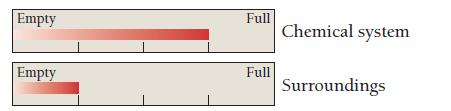
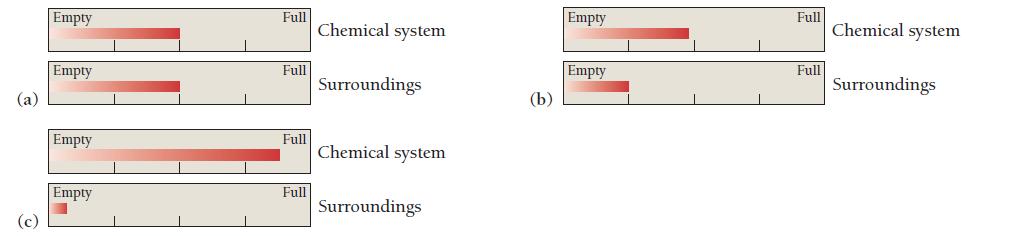
Consider these fictitious internal energy gauges that describe the initial conditions for a chemical system and its surroundings:Which energy gauges correspond to the final conditions following an energy exchange in which ΔEsys is negative? Empty Empty Full Full Chemical system Surroundings
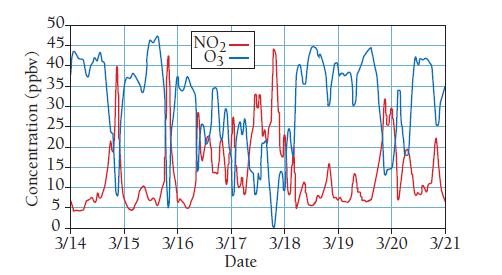
When fuels are burned in air, such as in an automobile engine, some of the nitrogen in the air oxidizes to form nitrogen oxide gases such as NO and NO2 (known collectively as NOx). The U.S. Environmental Protection Agency (EPA) sets standards for air quality of several pollutants including NO2.
A gas mixture contains each of the following gases at the indicated partial pressures: N2, 215 torr; O2, 102 torr; and He, 117 torr. What is the total pressure of the mixture? What mass of each gas is present in a 1.35-L sample of this mixture at 25.0 °C?
A sample of gas has a mass of 0.555 g. Its volume is 117 mL at a temperature of 85 °C and a pressure of 753 mmHg. Find the molar mass of the gas.
A sample of gas has a mass of 38.8 mg. Its volume is 224 mL at a temperature of 55 °C and a pressure of 886 torr. Find the molar mass of the gas.
A 113-mL gas sample has a mass of 0.171 g at a pressure of 721 mmHg and a temperature of 32 °C. What is the molar mass of the gas?
A 248-mL gas sample has a mass of 0.433 g at a pressure of 745 mmHg and a temperature of 28 °C. What is the molar mass of the gas?
A sample of N2O gas has a density of 2.85 g/L at 298 K. What is the pressure of the gas (in mmHg)?
What is the density (in g/L) of hydrogen gas at 20.0 °C and a pressure of 1655 psi?
A syringe containing 1.55 mL of oxygen gas is cooled from 95.3 °C to 0.0 °C. What is the final volume of oxygen gas?
A 48.3-mL sample of gas in a cylinder is warmed from 22 °C to 87 °C. What is its volume at the final temperature?
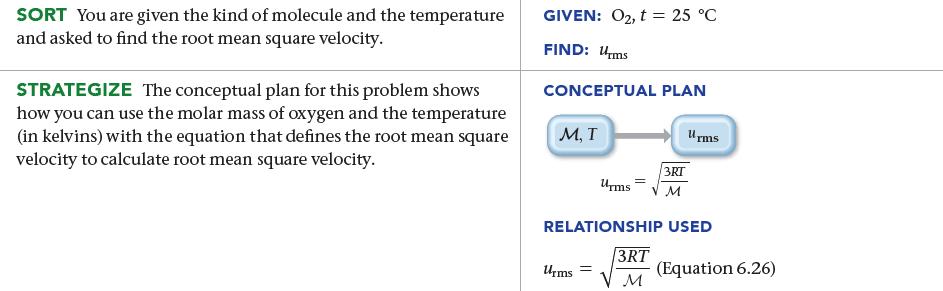
Calculate the root mean square velocity of oxygen molecules at 25 °C. SORT You are given the kind of molecule and the temperature and asked to find the root mean square velocity. STRATEGIZE The conceptual plan for this problem shows how you can use the molar mass of oxygen and the temperature (in
What is the oxidation state of carbon in CO32-?a) +4 b) +3 c) -3 d) -2
What is pressure? What causes pressure?
Arrange the following gases in order of increasing density at STP: Ne, Cl2, F2, and O2.(a) Ne < O2 < F2 < Cl2 (b) F2 < Ne < O2 < Cl2 (c) Cl2 < F2 < O2 < Ne
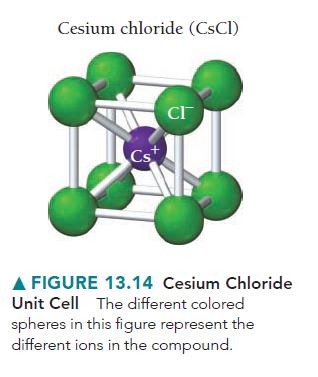
Silver iodide crystallizes in the zinc blende structure. The separation between nearest-neighbor cations and anions is approximately 325 pm, and the melting point is 558 °C. Cesium chloride, by contrast, crystallizes in the structure shown in Figure 13.14.Even though the separation between
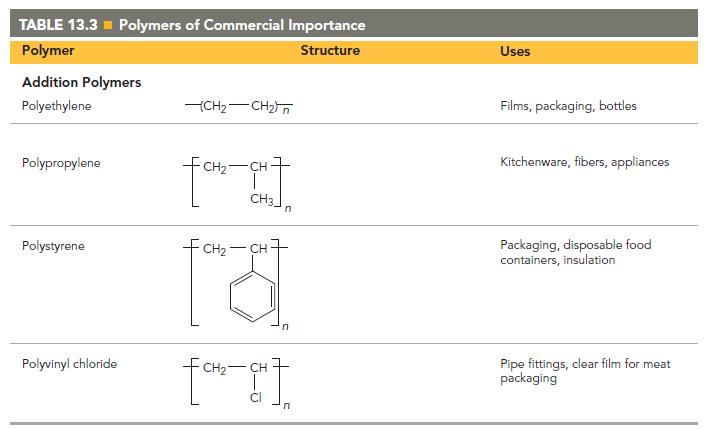
The structure of the addition polymer polypropylene is shown in Table 13.3.a. Draw the structure of the monomer.b. Show how an alternate version of the polypropylene polymer (with a different arrangement) could be formed from the monomer you found in part a. TABLE 13.3 Polymers of Commercial
Perovskite is a compound with a cubic unit cell and has a strontium atom at the center of the cell, titanium atoms at the corners of the unit cell, and oxygen atoms at the centers of each face of the unit cell.a. What is the formula of perovskite?b. What is the coordination number of strontium in
A compound with the formula Rb3C60 has been shown to demonstrate superconductivity below 30.0 K. Given that the C60 molecules have a face-centered cubic arrangement, which of the tetrahedral and octahedral sites are occupied by Rb atoms?
Despite Dalton’s laws, it is now known that many ionic compounds do not always contain atoms in small integer ratios. For example, a sample of iron(II) oxide may, in fact, contain a significant amount of Fe3+ in addition to Fe2+. This is an example of a nonstoichiometric compound. A sample of
During the glass manufacturing process, the liquid must be cooled relatively quickly to form the glass. Why?
Why are X-rays used for crystallography? Why not use some other, more accessible type of electromagnetic radiation such as ultraviolet light?
Compare the crystal structure of diamond (C) and zinc blende (ZnS). What are the key similarities and differences between the two structures?
In X-ray crystallography, a small amount of oil is often used to mount the crystal sample on a glass fiber. Explain why neither the oil nor the glass fiber interferes with the diffraction pattern of the crystal.
Which is not likely to lead to an increase in electrical conductivity?a. Increasing the temperature of a semiconductor b. Choosing a semiconductor with a smaller band gap c. Doping the semiconductor d. All of the above would likely lead to an increase in electrical conductivity.
Have each group member select one of the cubic crystalline lattices. Learn everything you can about your lattice and present it to the group.
Using group members to play the role of atoms or molecules, demonstrate the main structural features of the following categories of crystalline solids: molecular solid, ionic solid, nonbonded solid, metallic solid, network covalent solid. Clearly identify what you represent and how you are
Make a list of questions you would need to ask in order to classify a solid into one of the categories of crystalline solids (molecular solid, ionic solid, nonbonded solid, metallic solid, and network covalent solid). Determine a good order to ask them. (You may need a branching decision tree.)
Showing 1200 - 1300
of 4045
First
6
7
8
9
10
11
12
13
14
15
16
17
18
19
20
Last
Step by Step Answers

 Get 50% OFF
Claim Now
Get 50% OFF
Claim Now