New Semester
Started
Get
50% OFF
Study Help!
--h --m --s
Claim Now
Question Answers
Textbooks
Find textbooks, questions and answers
Oops, something went wrong!
Change your search query and then try again
S
Books
FREE
Study Help
Expert Questions
Accounting
General Management
Mathematics
Finance
Organizational Behaviour
Law
Physics
Operating System
Management Leadership
Sociology
Programming
Marketing
Database
Computer Network
Economics
Textbooks Solutions
Accounting
Managerial Accounting
Management Leadership
Cost Accounting
Statistics
Business Law
Corporate Finance
Finance
Economics
Auditing
Tutors
Online Tutors
Find a Tutor
Hire a Tutor
Become a Tutor
AI Tutor
AI Study Planner
NEW
Sell Books
Search
Search
Sign In
Register
study help
sciences
college physics reasoning
College Physics Reasoning and Relationships 2nd edition Nicholas Giordano - Solutions
A hoop and a disk have the same radius and the same moment of inertia. What is the ratio of their masses?
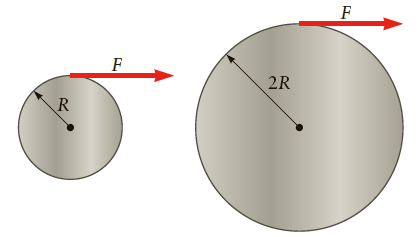
Two disks, each of mass m, have radii R and 2R and are mounted on axles that pass through their centers. (a) Which disk has the larger moment of inertia? (b) If a force of magnitude F is applied at the edge of each disk as shown in Figure Q8.2, which disk will experience the larger torque? (c)
Explain why placing your hands behind your head rather than placing them on your stomach makes sit-ups more difficult.
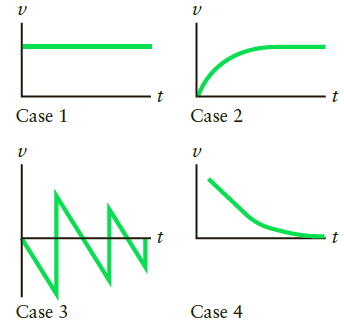
Match each of the examples of motion in Problem 22 to one of the velocity???time graphs shown in Figure P2.23. Figure P2.23 ? t Case 1 Case 2 t Case 3 Case 4
A railroad car (m = 3000 kg) is coasting along a level track with an initial speed of 25 m/s. A load of coal is then dropped into the car as sketched in Figure 7.19.? (a) Treat the railroad car plus coal as a system. Is the momentum of this system along the horizontal (x) or vertical (y)
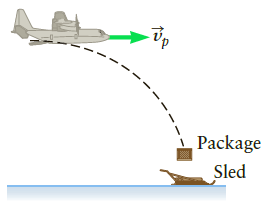
An airplane is sent on a rescue mission to help a stranded explorer near the South Pole. The plane cannot land, but instead drops a supply package of mass m = 60 kg while it is flying horizontally with speed vp= 120 m/s. The supply package drops onto a waiting sled that is initially at rest (Fig.
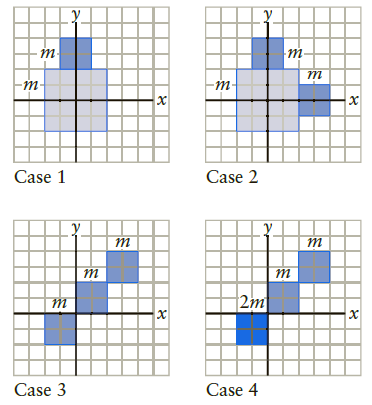
Figure P7.45 shows several arrangements of blocks. In cases 1 through 3, the blocks all have the same mass, but in case 4, one of the blocks has a mass twice that of the other two blocks. Find the approximate center of mass for each arrangement. Assume the grid lines are spaced 1 m apart in both
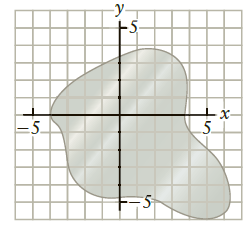
Estimate the location of the center of mass of the thin metal plate in Figure P7.46. Assume the grid lines are spaced 1 cm apart in both the x and y directions. Figure P7.46 ? -y- +5 =5. 5.
Consider the Sun and the Earth as a “system” of two “particles.” The center of mass of this system lies a distance L from the center of the Sun. Find L and compare it to the radius of the Sun.
A block of wood (Mblock = 5.2 kg) rests on a horizontal surface for which the coefficient of kinetic friction is 0.28. A bullet (mbullet = 32 g) is shot along the horizontal direction and quickly becomes stuck in the block. The block plus bullet then slide 87 cm before they come to rest. What was
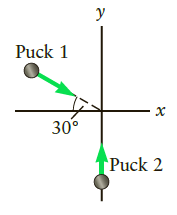
Consider again the collision between two hockey pucks in Figure P7.24, but now they do not stick together. Their speeds before the collision are v1i= 20 m/s and v2i= 15 m/s. It is found that after the collision one of the pucks is moving along x with a speed of 10 m/s. What is the final velocity of
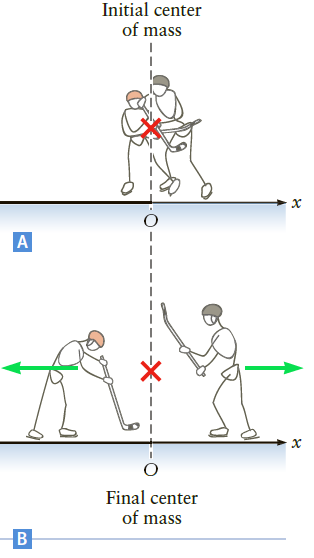
Consider the motion of the two ice skaters in Figure 7.28 and assume they have masses of 60 kg and 100 kg. If the larger skater has moved a distance of 12 m from his initial position, where is the smaller skater? Figure 7.28 ? Initial center of mass A Final center of mass B
A person of mass 90 kg standing on a friction less, horizontal surface fires a bullet of mass 40 g in a horizontal direction. After the bullet has traveled a distance of 50 m, what distance has the person moved?
Consider the motion of an apple and the Earth as the apple falls to the ground. If the apple begins at the top of a tree of height 15 m, how much does the Earth move?
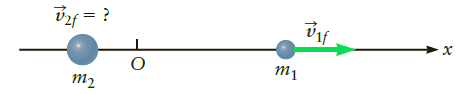
A bomb that is initially at rest at the origin explodes and breaks into two pieces of mass m1= 1500 kg and m2= 2500 kg as shown in Figure P7.50. If piece 1 has a velocity of +35 m/s directed along x, what is the velocity of piece 2 after the explosion? Figure P7.50 vzf = ? m1 m2
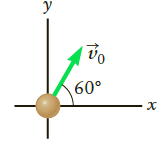
A hand grenade is thrown with speed v0= 30 m/s, as sketched in Figure P7.51, just prior to exploding. It breaks into two pieces of equal mass after the explosion. One piece has a final velocity of 40 m/s along x. Find the velocity of the other piece after the explosion. Figure P7.51 ? y 60°
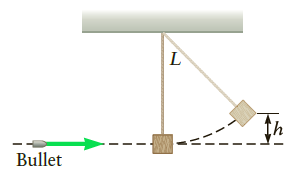
The ballistic pendulum. A bullet of mass m = 30 g is fired into a wooden block of mass M = 5.0 kg as shown in Figure P7.52. The block is attached to a string of length 1.5 m. The bullet is embedded in the block, causing the block to then swing as shown in the figure. If the block reaches a maximum
A rock of mass 30 g strikes a car windshield while the car is traveling on a highway. Estimate the force of the rock on the windshield. You will need to estimate the collision time (i.e., the time that the rock is in contact with the windshield). For comparison, the collision time for a
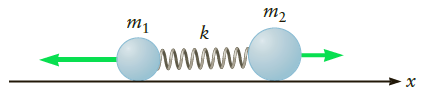
Two particles of mass 2.3 kg and mass 4.3 kg that are free to move on a horizontal track are initially held at rest so that they compress a spring as shown in Figure P7.54. The spring has a spring constant k = 400 N/m and is compressed 0.12 m. Find the final velocity of each particle. Figure
A tennis ball of mass 0.12 kg is dropped vertically onto a hard concrete floor from a height of 1.5 m. The ball then bounces up to some maximum height h. If the ball bounces up to a height h = 1.0 m, what is the approximate average force of the floor on the ball?
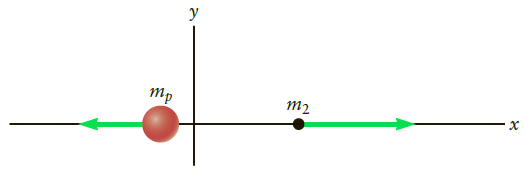
Consider a reaction that involves the creation of two elementary particles as in Figure P7.56. One particle is a proton of mass mp, and the other has mass m2= mp/1800. If the proton leaves the reaction with speed vp, what is the final speed of the other particle? Express your answer in terms of
Finding the barycenter. How far is the center of mass of the Earth-Moon system from the center of the Earth? Is it below the surface of the Earth?
A father (mF = 75 kg) and his daughter (mD = 35 kg) stand on a flat, frozen lake of negligible friction. They hold a 10-m-long rope stretched between them. The father and daughter then pull the rope to bring them together. If the father is initially standing at the origin, how far from the origin
Twin brothers, each of mass 50 kg, sit in a symmetric canoe of mass 40 kg. Each boy sits 1.5 m away from the center of the canoe as they toss a basketball (mass = 0.60 kg) back and forth.(a) How much does the center of the canoe move as the ball moves from one brother to the other? (b) How
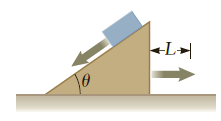
A block of mass 3.5 kg is initially at rest on a wedge of mass 20 kg, height 0.30 m, and incline angle θ = 35° as shown in Figure P7.60. There is no friction between the wedge and the floor. Starting at the top of the incline, the block is released and slides toward the bottom of the wedge. At
Consider three scenarios for a one-dimensional elastic collision in which a “bullet” is fired at a stationary target. For each scenario, determine the final velocities of both the bullet, v1f, and the target, v2f, in terms of the bullet’s initial velocity, v0. Assume both the bullet and
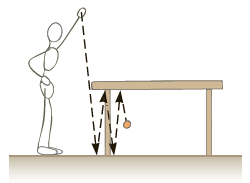
Fun with a Super Ball. A Super Ball has a coefficient of restitution α = 0.90. This means that the y components of the ball???s velocity just before and after hitting the floor are related by vfy= -αvif. It is dropped from a height of 1.8 m such that it goes under a table of height 70 cm. The
Consider again the discussion in Section 7.2 concerning air bags and impulse for a car colliding with a tree. The car’s velocity of 40 mi/h is reduced to zero very quickly, but the head of a passenger is still moving at 40 mi/h (about 18 m/s). Calculate the average force exerted on the
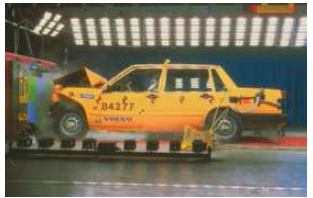
Crumple zones. A life-saving development in automobile manufacture is the invention of crumple zones, areas of the body and frame of a car deliberately made to collapse in a collision (Fig. P7.64) such that the passenger compartment will not. Introduced in 1955 on the Heckflosse made by Mercedes,
A projectile of mass 10 kg is launched at an angle of 55° and an initial speed of 87 m/s. Just as the object reaches the maximum height in its trajectory, a small explosion along the horizontal blows off the projectile???s back portion equal to one-fourth its original mass. The smaller piece lands
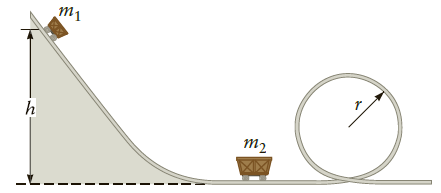
A cart of mass m1= 10 kg slides down a friction less ramp and is made to collide with a second cart of mass m2= 20 kg, which then heads into a vertical loop of radius 0.25 m as shown in Figure P7.66.? (a) Determine the height h from which cart 1 would need to start to make sure that cart 2
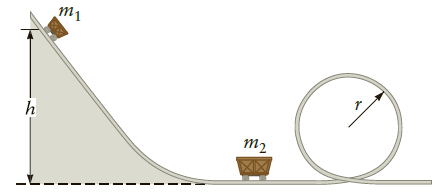
Again consider the track and carts in Figure P7.66 with m1= 10 kg and m2= 20 kg, but this time the carts stick together after the collision.? (a) Find the height h from which cart 1 would need to start to make sure that both carts complete the loop without leaving the track.? (b) Find the height
A firefighter directs a horizontal stream of water toward a fire at an angle of 40° measured from the horizontal. The fire hydrant and hose deliver 95 gallons per minute (1 gal/min = 6.31 × 10⁻⁴ m3/s), and the nozzle projects the water with a speed of 7.5 m/s. How much horizontal force must the
A machine gun directs a flow of bullets at a steel target mounted on a cart with negligible friction and of mass 600 kg. In this case, the gun is an Uzi, which uses 9-mm (8.0-g) bullets and can fire at a rate of 10 rounds/s, and the bullets have an average muzzle velocity of 400 m/s. (a)
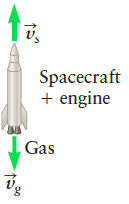
Rocket engines work by expelling gas at a high speed as illustrated in Figure P7.71. We wish to design an engine that expels an amount of gas mg= 50 kg each second, and we want the engine to exert a force F = 20,000 N on a rocket. At what speed vgshould the gas be expelled? Assume the mass of the
Comet Shoemaker-Levy struck Jupiter in 1994. Just before the collision, the comet broke into several pieces. The total mass of all the pieces was estimated to be 3.8 × 10⁸ kg, and they all had a velocity relative to Jupiter of 60 km/s. How much energy was deposited on Jupiter?
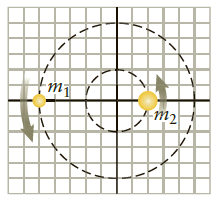
Figure P7.73 shows two stars with masses m1and m2moving in circular orbits (the dashed circles) due to their mutual gravitational attraction. What is the approximate value of the mass ratio m1/m2? Figure P7.73 ? m2
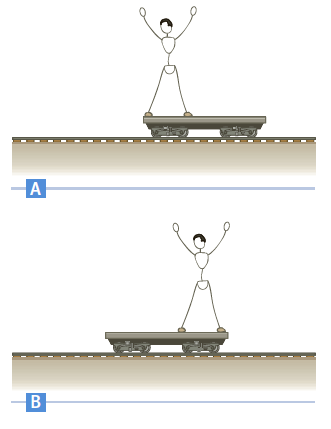
A man (m1= 90 kg) is standing on a railroad flat car that is 9.0 m long and of unknown mass m2. The man and the car are initially at rest on a level track (Fig. P7.74A), and the wheels of the car are friction less. The man then runs to the opposite end of the car and the car moves a distance 1.5 m
What is the magnitude of the momentum of a baseball (m = 0.14 kg) traveling at a speed of 100 mi/h? Express your answer in SI units.
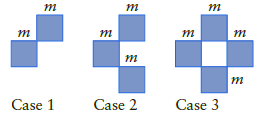
The boxes in Figure Q7.2 all have the same mass and size. What is the approximate location of the center of mass of the two boxes in case 1, the three boxes in case 2, and the four boxes in case 3? Figure Q7.2 ? m m m m m m m Case 1 Case 2 Case 3
Consider two cars, one a compact model (m = 800 kg) and the other an SUV (m = 2500 kg). The SUV is traveling at 10 m/s, while the compact car is traveling at an unknown speed v. If the two cars have the same momentum, what is v?
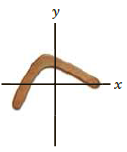
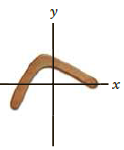
What is the approximate location of the center of mass of the boomerang in Figure Q7.3? Figure Q7.3 ? y — х
Consider two cars that are on course for a head-on collision. If they have masses m1 = 1200 kg and m2 = 1800 kg and are both traveling at 30 m/s, what is the magnitude of the total momentum?
Explain why the center of mass of an object (such as the boomerang in Fig. Q7.3) may not be ???inside??? the object. We discussed how the center of mass can be thought of as the ???balance point??? of an object. How might you use the idea of a balance point to locate the center of mass in cases in
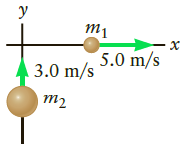
Two particles of mass m1= 1.2 kg and m2= 2.9 kg are traveling as shown in Figure P7.4. What is the total momentum of this system? Be sure to give the magnitude and direction of the momentum. Figure P7.4 ? y m1 5.0 m/s 3.0 m/s |m2
If the magnitude of the momentum of an object is increased by a factor of three, by what factor is the kinetic energy changed? Assume the mass of the object is unchanged.
Slap shot! A hockey player strikes a puck that is initially at rest. The force exerted by the stick on the puck is 1000 N, and the stick is in contact with the puck for 5.0 ms (0.0050 s). (a) Find the impulse imparted by the stick to the puck. (b) What is the speed of the puck (m = 0.12
Two objects of different mass have the same kinetic energy. Which one has the larger momentum?
A constant force of magnitude 25 N acts on an object for 3.0 s. What is the magnitude of the impulse?
A baseball has a certain momentum pball and a certain kinetic energy KEball. One golf ball (ball 1) is given a momentum equal to pball, and a second golf ball (ball 2) is given a kinetic energy equal to KEball. Which golf ball has the higher speed?
A rubber ball (mass 0.25 kg) is dropped from a height of 1.5 m onto the floor. Just after bouncing from the floor, the ball has a speed of 4.0 m/s. (a) What are the magnitude and direction of the impulse imparted by the floor to the ball? (b) If the average force of the floor on the ball
Consider the momentum of an object that is undergoing projectile motion. Is its momentum conserved? If the answer is no, is any component of the momentum conserved? Explain.
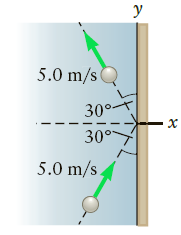
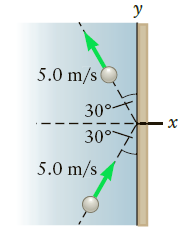
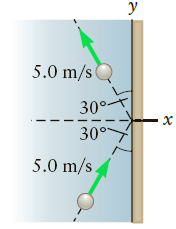
For the cue ball in Figure Q7.12, make a qualitative sketch of how the force exerted by the rail on the ball varies with time. Be sure to plot both the x and y components of the force and indicate when the ball is in contact with the rail. Figure Q7.12 ? y 5.0 m/s 30°- 30° 7 5.0 m/s.
In which case is the momentum change of a baseball largest, (a) A pitch caught by a catcher, (b) A baseball thrown by a pitcher, or (c) A baseball hit by a batter? Explain your answer.
(a) What is the impulse imparted to the ball? Be sure to give the magnitude and direction. (b) What is the change in momentum of the ball? Be sure to give the magnitude and direction. Figure Q7.12 5.0 m/s 30°- 30° 5.0 m/s.
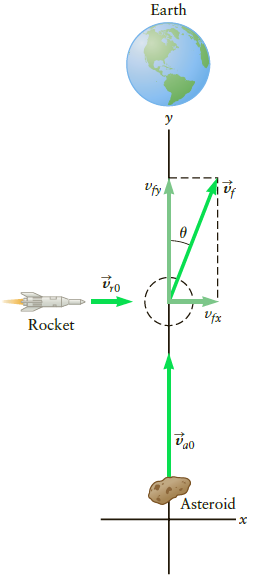
Consider the collision between an asteroid and a rocket as discussed in connection with Figure 7.17. We have already calculated the deflection angle that results from the collision with the rocket (Eq. 7.27), but we need to also determine if this deflection will actually save the Earth. If we
A rubber ball is dropped and bounces vertically from a horizontal concrete floor. If the ball has a speed of 3.0 m/s just before striking the floor and a speed of 2.5 m/s just after bouncing, what is the average force of the floor on the ball? Assume the ball is in contact with the floor for 0.12 s
Finish the analysis of the force in the automobile collision in Example 7.7. Find the average collision force along y and the magnitude of the total collision force.
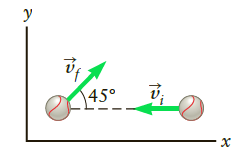
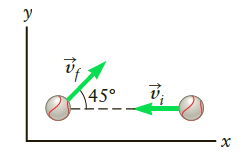
A baseball player hits a baseball (m = 0.14 kg) as shown in Figure P7.11. The ball is initially traveling horizontally with a speed of 40 m/s. The batter hits a fly ball as shown, with speed vf= 55 m/s.? (a) What are the magnitude and direction of the impulse imparted to the ball?? (b) If the ball
A cue ball bounces off the rail of a pool table as shown in Figure Q7.12. The momentum of the ball changes.? (a) What is the source of the impulse?? (b) That is, what is the source of the force?? (c) Explain why the answers to (a) and (b) are closely(!) related. Figure Q7.12 ? y 5.0 m/s 30° 30°
The baseball in Problem 11 is replaced by a very flexible rubber ball of equal mass.? (a) Does the contact time increase or decrease?? (b) If the contact time changes by a factor of 50 but the initial and final velocities are the same, by what factor does the force of the bat on the ball
Two crates are on an icy, friction less, horizontal surface. One of the crates is then given a push and collides with the other. If the crates stick together after the collision, which of the following quantities is conserved in the collision, (a) horizontal momentum, (b) kinetic energy, (c) both,
An egg and a tomato of equal mass are dropped from the roof of a three-story building onto the sidewalk below. The sidewalk imparts an impulse to both as they splatter. (a) Is the impulse imparted to the egg greater than, less than, or equal to the impulse imparted to the tomato? (b) Is
A tennis ball and a ball of soft clay are dropped from the same height onto the floor below. The force from the floor produces an impulse on each ball. If the balls have the same mass, which impulse is larger? Explain.
Consider an archer who fi res an arrow. The arrow has a mass of 0.030 kg and leaves the bow with a horizontal velocity of 80 m/s. (a) What is the impulse imparted to the arrow? Give both the magnitude and direction of the impulse. (b) What is the approximate average force of the bow
When you fire a gun, you experience a recoil force due to the impulse produced by the bullet on the barrel of the gun. Is it possible to design a gun in which the recoil force is zero? If so, explain how you could do it. Why do you think guns are not made in this way?
Consider a tennis player who hits a serve at 140 mi/h (63 m/s). Estimate the average force exerted by the racket on the ball (m = 57 g).You will need to estimate the collision time, that is, the time two objects are in contact during a collision. For comparison, the collision time for a
Two masses m1 and m2 have the same momentum. If the masses are not equal, which statement(s) are correct? (a) The velocities are the same. (b) The velocities are in the same direction. (c) The kinetic energies are the same.
Consider the problem of returning a serve in tennis. A serve is hit at a speed of 63 m/s and is hit back to the server with a speed of 40 m/s. (a) What is the impulse imparted to the ball? (b) What is the approximate average force on the ball (m = 57 g)? For simplicity, assume
In the event of a two-car, head-on collision, would you rather be riding in a heavy car (large mass) or a small car? Justify your answer in terms of the impulse and force on a car during a collision.
A golf ball is hit from the tee and travels a distance of 300 yards. Estimate the magnitude of the impulse imparted to the golf ball. Ignore air drag in your analysis.You will need to estimate the collision time, that is, the time two objects are in contact during a collision. For comparison, the
Explain why a padded dashboard makes a car safer in the event of an accident.
Uppercut! A boxer hits an opponent on the chin and imparts an impulse of 500 N · s. Estimate the magnitude of the average force.You will need to estimate the collision time, that is, the time two objects are in contact during a collision. For comparison, the collision time for a baseball–bat
An astronaut is working in distant space (outside his spaceship and far from any planets or stars) and floating freely when he accidently throws a wrench. (a) Is the astronaut’s momentum conserveda (i.e., is his momentum the same before and after he throws the wrench)? (b) Is the
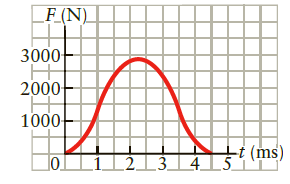
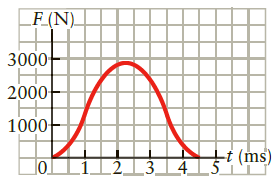
Suppose the force on an object varies with time as shown in Figure P7.19. Estimate the impulse imparted to the object. Assume the motion is one dimensional. Figure P7.19 ? F (N)_ 3000 2000 1000 -t (ms) lolLil2_3_| 4_5. (ms)
As an apple falls from a tree, its speed increases, so the magnitude of its momentum also increases. Explain why this is consistent with the principle of conservation of momentum.
Two objects of mass m and 3m undergo a completely inelastic collision in one dimension. If the two objects are at rest after the collision, what was the ratio of their speeds before the collision?
Two particles of mass m1= 1.5 kg and m2= 3.5 kg undergo a one-dimensional head-on collision as shown in Figure P7.21. Their initial velocities along x are v1i= 12 m/s and v2i= -7.5 m/s. The two particles stick together after the collision (a completely inelastic collision).? (a) Find the velocity
Two skaters are studying collisions on an ice-covered (frictionless) lake. Skater 1 (m1 = 85 kg) is initially traveling with a speed of 5.0 m/s, and skater 2 (m2 = 120 kg) is initially at rest. Skater 1 then “collides” with skater 2, and they lock arms and travel away together. (a)
The particles in Figure P7.21 (m1= 1.5 kg and m2= 3.5 kg) undergo an elastic collision in one dimension. Their velocities before the collision are v1i= 12 m/s and v2i= -7.5 m/s. Find the velocities of the two particles after the collision. Figure P7.21 ? M1 m2
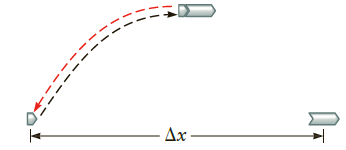
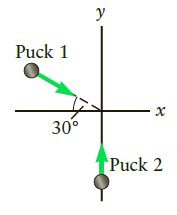
has an initial speed of 20 m/s, and puck 2 has an initial speed of 15 m/s. They collide, and some glue on one of the pucks causes them to stick together.? (a) If the two pucks form a ???system,??? is the momentum of this system along x or y conserved? (b) Find the components along x and y of the
In Example 7.5, we considered an elastic collision in one dimension in which one of the objects is initially at rest. Notice that mass 2 is the one that is initially at rest. Use the results for v1f and v2f to answer the following problems. (a) Assume m1 = 10m2 so that the incoming object
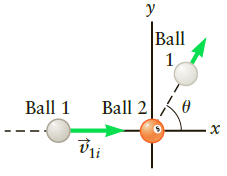
Two billiard balls undergo an elastic collision as shown in Figure P7.27. Ball 1 is initially traveling along x with a speed of 10 m/s, and ball 2 is at rest. After the collision, ball 1 moves away with a speed of 4.7 m/s at an angle θ = 60°.? (a) Find the speed of ball 2 after the
Consider an elastic collision in one dimension that involves objects of mass 2.5 kg and 4.5 kg. The larger mass is initially at rest, and the smaller one has an initial velocity of 12 m/s. Find the velocities of the two objects after the collision.
Two hockey players are traveling at velocities of v1 = 12 m/s and v2 = -18 m/s when they undergo a head-on collision. After the collision, they grab each other and slide away together with a velocity of -4.0 m/s. Hockey player 1 has a mass of 120 kg. What is the mass of the other player?
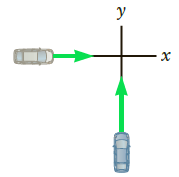
Two cars of equal mass are traveling as shown in Figure P7.30 just before undergoing a collision. Before the collision, one of the cars has a speed of 18 m/s along +x and the other has a speed of 25 m/s along +y. The cars lock bumpers and then slide away together after the collision. What are the
Two cars collide head-on and lock bumpers on an icy (frictionless) road. One car has a mass of 800 kg and an initial speed of 12 m/s and is moving toward the north. The other car has a mass of 1200 kg. If the speed of the cars after the collision is 4.5 m/s and they are moving north, what was the
A baseball pitcher (m = 80 kg) is initially standing at rest on an extremely slippery, icy surface. He then throws a baseball (m = 0.14 kg) with a horizontal velocity of 50 m/s. What is the recoil velocity of the pitcher?
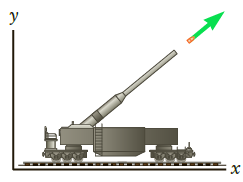
A military gun is mounted on a railroad car (m = 1500 kg) as shown in Figure P7.34. There is no frictional force on the car, the track is horizontal, and the car is initially at rest. The gun then fires a shell of mass 30 kg with a velocity of 300 m/s at an angle of 40° with respect to the
An open railroad car of mass 2500 kg is coasting with an initial speed of 14 m/s on a friction less, horizontal track. It is raining, and water begins to accumulate in the car. After some time, it is found that the speed of the car is only 11 m/s. How much water (in kilograms) has accumulated in
The M79 grenade launcher was first used by the U.S. Army in 1961. It fires a grenade with an approximate mass m ≈ 7.0 kg at a speed of 75 m/s. (a) If a soldier fires the M79 horizontally while standing on a very slippery surface, what is the recoil speed of the soldier? Take the mass of the
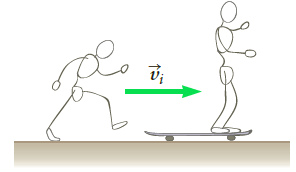
A skateboarder (m = 85 kg) takes a running jump onto a friend???s skateboard that is initially at rest as sketched in Figure P7.37. The friend is standing on the skateboard (mass of friend plus skateboard = 110 kg). After landing on the skateboard, the velocity of the board plus the two
A bullet of mass 15 g is fired with an initial speed of 300 m/s into a wooden block that is initially at rest. The bullet becomes lodged in the block, and the bullet and block then slide together on the floor for a distance of 1.5 m before coming to rest (Fig. P7.38). If the coefficient of friction
A railroad car containing explosive material is initially traveling south at a speed of 5.0 m/s on level ground. The total mass of the car plus explosives is 3.0 × 10⁴ kg. An accidental spark ignites the explosive, and the car breaks into two pieces, which then roll away along the same track. If
Find the center of mass of the two particles in Figure P7.41. Figure P7.41 ? 7.0 kg 3.0 kg т т х (m) -5 5
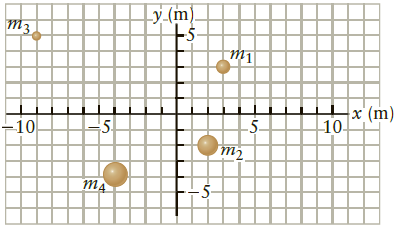
Find the center of mass of the four particles in Figure P7.42. Their masses are m1= 12 kg, m2?= 18 kg, m3= 7.9 kg, and m4= 23 kg. Figure P7.42 ? y (m). -10 -5. х (m) 10- -5. m2
Two objects are moving along the x axis with velocities of 35 m/s (object 1) and -25 m/s (object 2). (a) If the center of mass has a velocity of +10 m/s, which object has the greater mass? (b) What is the ratio of their masses?
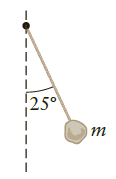
A rock of mass 3.3 kg is tied to a string of length 1.2 m. The rock is held at rest as shown in Figure P6.49 so that the string is initially tight, and then it is released.? (a) Find the speed of the rock when it reaches the lowest point of its trajectory.? (b) What is the maximum tension in the
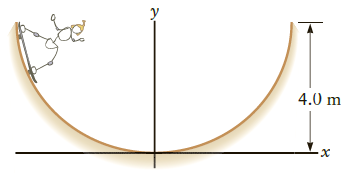
Consider again the skateboarder in Figure P6.39. (a) Assuming she starts at the top of the half-pipe, make qualitative sketches of her kinetic energy and potential energy as a function of x in the half-pipe. Start your plots when she is at the far left in Figure P6.39 and end them when she reaches
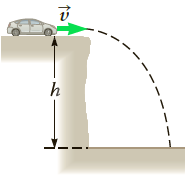
A car of mass m = 1500 kg is pushed off a cliff of height h = 24 m (Fig. P6.28). If the car lands a distance of 10 m from the base of the cliff, what was the kinetic energy of the car the instant after it left the cliff? Figure P6.28 ? h た1
Showing 4200 - 4300
of 4913
First
36
37
38
39
40
41
42
43
44
45
46
47
48
49
50
Step by Step Answers

 Get 50% OFF
Claim Now
Get 50% OFF
Claim Now