New Semester
Started
Get
50% OFF
Study Help!
--h --m --s
Claim Now
Question Answers
Textbooks
Find textbooks, questions and answers
Oops, something went wrong!
Change your search query and then try again
S
Books
FREE
Study Help
Expert Questions
Accounting
General Management
Mathematics
Finance
Organizational Behaviour
Law
Physics
Operating System
Management Leadership
Sociology
Programming
Marketing
Database
Computer Network
Economics
Textbooks Solutions
Accounting
Managerial Accounting
Management Leadership
Cost Accounting
Statistics
Business Law
Corporate Finance
Finance
Economics
Auditing
Tutors
Online Tutors
Find a Tutor
Hire a Tutor
Become a Tutor
AI Tutor
AI Study Planner
NEW
Sell Books
Search
Search
Sign In
Register
study help
sciences
college physics reasoning
College Physics Reasoning and Relationships 2nd edition Nicholas Giordano - Solutions
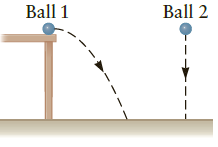
Ball 1 rolls off the edge of a table and falls to the floor below, while ball 2 is dropped from the same height (Fig. Q4.19). Which ball reaches the ground first? Explain why your answer does, or does not, depend on the velocity of ball 1 just before it leaves the table. Figure Q4.19 Ball 1
A soccer ball is kicked with an initial speed of 30 m/s at an angle of 25° with respect to the horizontal. Find (a) The maximum height reached by the ball and (b) The speed of the ball when it is at the highest point on its trajectory. (c) Where does the ball land? That is, what is
Two balls are thrown into the air with the same initial speed, directed at the same initial angle with respect to the horizontal. Ball 1 has a mass five times the mass of ball 2, and the force of air drag is negligible.(a) Which ball has the larger acceleration as it moves through the air?(b) Which
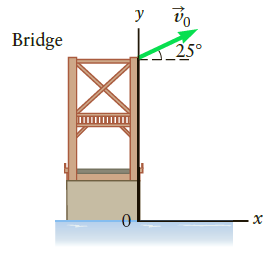
Consider a rock thrown off a bridge of height 75 m at an angle θ = 25° with respect to the horizontal as shown in Figure P4.20. The initial speed of the rock is 15 m/s. Find the following quantities: (a) the maximum height reached by the rock, (b) the time it takes the rock to
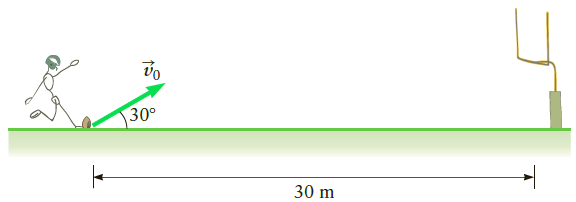
A football player wants to kick a ball through the uprights as shown in Figure P4.21. The ball is kicked from a distance of 30 m (he€™s playing metric football) with a velocity of magnitude 25 m/s at an angle of 30°. Will the ball make it over the crossbar (height 3.1 m)?Figure P4.21
An airplane is flying horizontally with a constant velocity of 200 m/s at an altitude of 5000 m when it releases a package. (a) How long does it take the package to reach the ground? (b) What is the distance between the airplane and the package when the package hits the ground? (c)
A horizontal rifle is fired at a target 50 m away. The bullet falls vertically a distance of 12 cm on the way to the target.(a) What is the speed of the bullet just after it leaves the rifle?(b) What is the speed of the bullet just before it hits the target?
A bullet of mass 0.024 kg is fired horizontally with a speed of 75 m/s from a tall bridge. If the bullet is in the air for 2.3 s, how far from the base of the bridge does it land?
Consider the game of baseball. A pitcher throws a ball to the catcher at a speed of 100 mi/h (45 m/s). If the velocity of the ball is horizontal when it leaves the pitcher’s hand, how far (vertically) will it fall on the way to the catcher? The distance from the pitcher to the catcher is 60.5 ft.
A batted baseball is hit with a speed of 45 m/s starting from an initial height of 1 m. Find how high the ball travels in two cases: (a) A ball hit directly upward and (b) A ball hit at an angle of 70° with respect to the horizontal. Also find how long the ball stays in the air in each
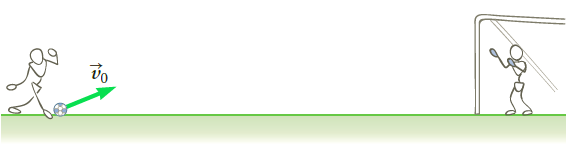
Consider the problem of kicking a soccer ball past a goalkeeper into the goal (Fig. P4.29). You are 25 m away from the goal and kick the ball at an angle of 30° with respect to the horizontal, and the ball just passes over the goalkeeper€™s hands. Find the initial speed of the ball.
A ball is thrown straight up and rises to a maximum height of 24 m. At what height is the speed of the ball equal to half its initial value? Assume the ball starts at a height of 2.0 m above the ground.
Two rocks are thrown off a cliff. One rock (1) is thrown horizontally with a speed of 20 m/s. The other rock (2) is thrown at an angle θ relative to the horizontal with a speed of 30 m/s. While the two rocks are in the air, rock 2 is always directly above 1. Find θ.
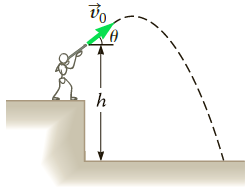
A bullet is fired from a rifle with speed v0at an angle θ with respect to the horizontal axis (Fig. P4.32) from a cliff that is a height h above the ground below. (a) Calculate the speed of the bullet when it strikes the ground. Express your answer in terms of v0, h, g, and
A high jumper can run horizontally with a top speed of 10.0 m/s. (a) If he can “convert” this velocity to the vertical direction when he leaves the ground, what is the theoretical limit on the height of his jump? (b) How does your result to part (a) compare with the current high-jump
A baseball is thrown with an initial velocity of magnitude v0 at an angle of 60° with respect to the horizontal (x) direction. At the same time, a second ball is thrown with the same initial speed at an angle θ with respect to x. If the two balls land at the same spot, what is θ?
A swimmer is able to swim at a speed of 0.90 m/s in still water.(a) How long does it take the swimmer to go a distance of 1500 m in still water? Call this time t1. (b) The swimmer then decides to swim the same distance in a river having a current with a speed of 0.50 m/s. How long does this
Consider a swimmer who wants to swim directly across a river as in Example 4.7. If the speed of the current is 0.30 m/s and the swimmer’s speed relative to the water is 0.60 m/s, how long will it take her to cross a river that is 15 m wide?
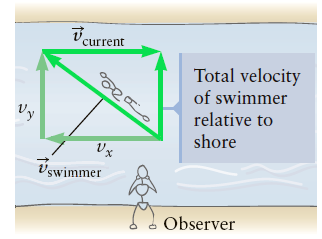
Suppose the swimmer in Figure 4.21 has a swimming speed relative to the water of 0.45 m/s and the current€™s speed is 2.5 m/s. If it takes the swimmer 200 s to cross the river, how wide is the river?Figure 4.21 Vcurrer nt Total velocity of swimmer ం Vy relative to shore Ux Vswimmer
An airplane has a velocity relative to the air of 200 m/s in a westerly direction. If the wind has a speed relative to the ground of 60 m/s directed to the north, what is the speed of the airplane relative to the ground?
Consider again the airplane in Problem 38, but now suppose the wind is directed in an easterly direction. How long does it take the airplane to travel a distance between two cities that are 300 km apart?
An airplane flies from Boston to San Francisco (a distance of 5000 km) in the morning and then immediately returns to Boston. The airplane’s speed relative to the air is 250 m/s. The wind is blowing at 50 m/s from west to east, so it is “in the face” of the airplane on the way to San
Round trip. An airplane flies from Chicago to New Orleans (a distance of 1500 km) in the morning and then immediately returns to Chicago. The airplane’s speed relative to the air is 250 m/s. The wind is blowing at 50 m/s from west to east, so it is perpendicular to the line that connects the two
A 35-m-wide river flows in a straight line (the x direction) with a speed of 0.25 m/s. A boat is rowed such that it travels directly across the river (along y). If the boat takes exactly 4 minutes to cross the river, what is the speed of the boat relative to the water?
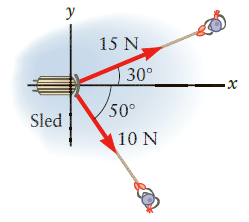
Two children pull a sled of mass 15 kg along a friction less surface as shown in Figure P4.43. (a) Find the magnitude and direction of the sled€™s acceleration. (b) How long does it take the sled to reach a speed of 10 m/s?Figure P4.43 15 N, 30° х 50° Sled 10 N
Consider the crates in Problem 12 (Fig. P4.12). Assume there is no friction between m1and the table. (a) Sketch all the forces on the crates. Include a coordinate system. (b) Determine the components of the forces along the coordinate axes.(c) Write Newton€™s second law for
When a car is traveling at 25 m/s on level ground, the stopping distance is found to be 22 m. This distance is measured by pushing hard on the brakes so that the wheels skid on the pavement. The same car is driving at the same speed down an incline that makes an angle of 8.0° with the horizontal.
A block slides down an inclined plane that makes an angle of 40° with the horizontal. There is friction between the block and the plane. (a) Sketch all the forces on the block. Include a coordinate system. (b) Determine the components of the forces along the coordinate axes. (c)
A sled is pulled with a horizontal force of 20 N along a level trail, and the acceleration is found to be 0.40 m/s2. An extra mass m = 4.5 kg is placed on the sled. If the same force is just barely able to keep the sled moving, what is the coefficient of kinetic friction between the sled and the
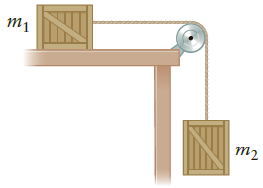
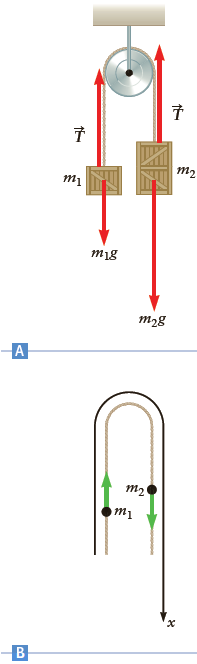
Two crates are connected by a mass less rope that passes over a pulley as shown in Figure 4.26. If the crates have mass 35 kg and 85 kg, what is their acceleration? If the system begins at rest, with the more massive crate a distance 12 m above the floor, how long does it take the more massive
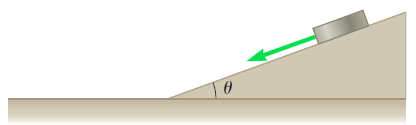
A hockey puck is sliding down an inclined plane with angle θ = 15° as shown in Figure P4.49. If the puck is moving with a constant speed, what is the coefficient of kinetic friction between the puck and the plane?Figure P4.49
Hang time. LeBron James decides to jump high enough to dunk a basketball. What is the approximate force between the floor and his feet while he is jumping from the floor?
Calculate the terminal speed for a bacterium in water. Use the expression for the drag force in Equation 3.23. Assume the bacterium has a mass m = 4 × 10–15 kg, a drag coefficient C = 0.02 N • s/m2 and can be approximated as a sphere of radius r - 1 μm. How long does it take a bacterium to
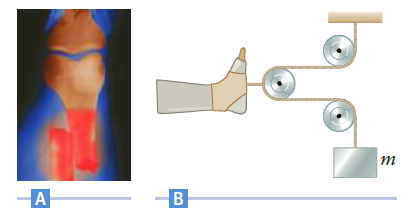
In traction. When a large bone such as the femur is broken, the two pieces are often pulled out of alignment by the complicated combination of tension and compression forces that arise from the muscles and tendons in the leg (see the X-ray image in Fig. P3.64A). To realign the bones and allow
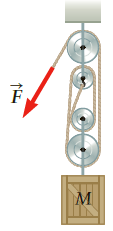
A mass with M = 102 kg is attached to the bottom of a block-and-tackle pulley system as depicted in Figure P3.65. How much tension force is needed to keep the mass at its current position?Figure P3.65 10
What is the approximate speed at which the force of air drag on a car is equal to the weight of the car?
A bullet of mass 10 g leaves the barrel of a rifle at 300 m/s. Assuming the force on the bullet is constant while it is in the barrel, find the magnitude of this force.
When an airplane takes off, it accelerates on the runway starting from rest. What is the magnitude of this runway acceleration for a passenger jet?
Calculate the terminal speed for a pollen grain falling through the air using the drag force Equation 3.20. Assume the pollen grain has a diameter of 1 mm and a density of 0.2 g/cm3. If this grain is released from the top of a tree (height 10 m), estimate the time it will take to fall to the ground.
Consider a skydiver who lands on the ground with a speed of 3 m/s. What is the approximate force on the skydiver’s legs when she lands?
Calculate the terminal speed for a baseball. A baseball’s diameter is approximately d = 0.070 m, and its mass is m = 0.14 kg. Express your answer in meters per second and miles per hour.
Hail forms high in the atmosphere and can be accelerated to a high speed before it reaches the ground. Estimate the terminal speed of a spherical hailstone that has a diameter of 2.0 cm.
Calculate the force of air drag on a hockey puck moving at 30 m/s. A hockey puck is approximately 3.0 cm tall and 8.0 cm in diameter.
The following items are dropped from an airplane. Rank them in order from lowest terminal speed to highest and justify your ranking.(a) Bowling ball(b) Beach ball(c) Spear or javelin (pointing downward)(d) Watermelon(e) Cantaloupe(f) Apple
A Styrofoam ball of radius 28 cm falls with a terminal speed of 5.0 m/s. What is the mass of the ball?
You are a secret agent and find that you have been pushed out of an airplane without a parachute. Fortunately, you are wearing a large overcoat (as secret agents often do). Thinking quickly, you are able to spread out and hold the overcoat so that you increase your overall area by a factor of four.
Calculate the drag force on a bullet that is 5.0 mm in diameter and moving at a speed of 600 m/s. If the mass of the bullet is 10 g, compare this force to the weight of the bullet and to your own weight. Assume the drag force on the bullet is given by Equation 3.20.Equation 3.20ma - ΣF - Fgrav +
The force exerted on a bacterium by its flagellum is 4 × 10-13 N. Find the velocity of the bacterium in water. Assume a size r = 1 mm.
A textbook rests at the edge of a desk of average height. (a) If the book gently tips off the desk, what is its approximate speed when it hits the floor? (b) If the height of the desk were doubled, by what factor would the book’s speed at impact with the floor increase?
The kick experienced when firing a rifle can be explained by Newton’s third law. A .22-caliber rifle has a mass M = 5.2 kg, and a bullet with a mass m = 3.0 g leaves the barrel of the gun at a velocity of 320 m/s. (a) If the bullet starts from rest and leaves the gun barrel after t - 0.010
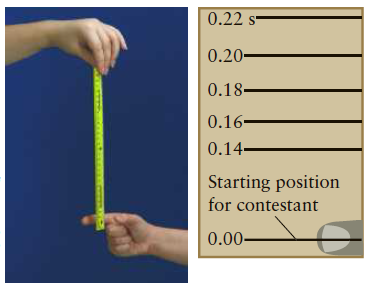
What is your reaction time? The following simple method can be employed to determine reaction time. A partner holds a meter stick by pinching it at the top and letting it hang vertically. To measure your reaction time, place your thumb and fore finger just below the base of the meter stick, ready
Deer in the headlights. There are two important time intervals to consider when coming to an emergency stop while driving. The first is the driver’s reaction time to get a foot on the brake pedal, and the second is the time it takes to slow the car to a stop. Consider a car moving at 30 m/s
A boy pushes a 3.1-kg book against a vertical wall with a horizontal force of 40 N. What is the minimum coefficient of friction that will keep the book in place without sliding?
An impish young lad stands on a bridge 10 m above a lake and drops a water balloon on a boat of unsuspecting tourists. Although the boat is traveling at a speed of 7.5 m/s, the boy manages to land the balloon right on the deck of the boat. How far away from the base of the bridge was the boat when
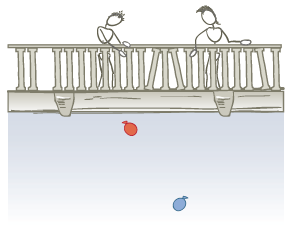
Two mischievous children drop water balloons from a bridge as depicted in Figure P3.87. Each water balloon is approximately 30 cm in diameter, and in this figure the red balloon is about 1.8 m below the railing of the bridge. What is the time interval between when the first balloon was let go and
A subway train is designed with a maximum acceleration of +0.20 m/s2, which allows for both passenger safety and comfort. (a) If subway stations are 1.2 km apart, what is the maximum velocity that can be obtained between stations? (b) How long does it take to travel between two stations?
A spring scale indicates that a helium balloon tied to it produces a tension of 0.20 N in the string. The string is then cut, and the balloon rises until it comes to rest on the ceiling. (a) Draw a free-body diagram of the balloon on the ceiling. (b) What is the normal force exerted by
Slap shot. In professional hockey, a slap shot is a type of shot in which a player literally “slaps” the puck with his stick. The puck may start with a very low speed and can leave the stick with a speed as high as 45 m/s (100 mi/h). Assuming the puck starts from rest, what is the average force
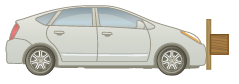
A car is outfitted with a flat piece of plywood mounted vertically on its front bumper. As seen in Figure P3.91, a block of wood is simply placed in front of the car just as the car begins to accelerate. (a) If the coefficient of static friction between the block and the plywood is µS -
Two spheres, one of balsa wood (diameter 40 cm) and one of steel (diameter 10 cm), have the same mass. (a) How many times greater is the terminal speed of the steel sphere than that of the wooden sphere? (b) The balsa wood sphere is now trimmed down so that it has the same diameter as the
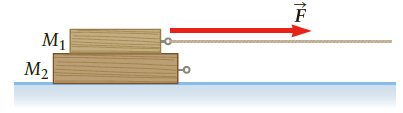
A block of mass M1= 3.0 kg rests on top of a second block of mass M2- 5.0 kg, and the second block sits on a surface that is so slippery that the friction can be assumed to be zero (see Fig. P3.93). (a) If the coefficient of static friction between the blocks is μS - 0.21, how
Launching satellites into space using rockets is expensive, prompting some engineers and scientists to consider firing satellites into space using what is essentially a very powerful gun. In one recent design, the gun would be 1100 m long and the satellite would leave the gun with a speed of 6000
A bullet of mass m = 10 g and velocity 300 m/s is shot into a block of wood that is firmly attached to the ground. The bullet comes to rest in the wood at a depth of 8.1 cm. (a) What was the acceleration of the bullet? (b) How long did it take the bullet to come to rest once it entered
Consider a small sailboat with a triangular sail of height 10 m and width at the base of 5.0 m. (a) Assuming a wind speed of 15 mi/h relative to the boat and a wind direction perpendicular to the sail, estimate the force exerted by the wind on the sail. (b) If the sailboat is moving with
High dive. The cliff-divers of Acapulco are famous for diving from steep cliffs that overlook the ocean into places where the water is very shallow. (a) Suppose a cliff-diver jumps from a cliff that is 25 m above the water. What is the speed of the diver just before he enters the water? Ignore
The pedestrian walkway on the Golden Gate Bridge is about 75 m above the water below. This bridge is (unfortunately) a popular spot for some unhappy people, who attempt to jump off. Ignore air drag and calculate (a) The time it takes an object to fall from the bridge to the water (b) The
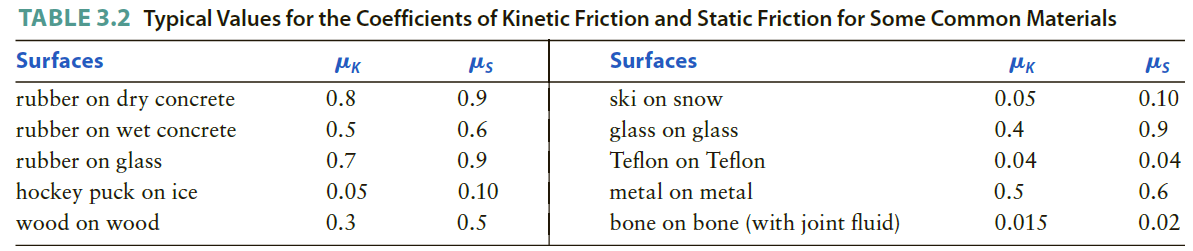
The surfaces where bones meet are lubricated by a fluid like substance, which makes the coefficient of friction between bones very small (see Table 3.2). What is the approximate lateral (i.e., horizontal) force required to make the bones in a typical knee joint slide across each other? For
A driver makes an emergency stop and inadvertently locks up the brakes of the car, which skids to a stop on dry concrete. Consider the effect of rain on this scenario. If the coefficients of kinetic friction for rubber on dry and wet concrete are μK(dry) - 0.80 and μK(wet) = 0.50, how much
You are trying to slide a refrigerator across a horizontal floor. The mass of the refrigerator is 200 kg, and you need to exert a force of 350 N to make it just begin to move. (a) What is the coefficient of static friction between the floor and the refrigerator? (b) After it starts
After struggling to move the refrigerator in Problem 41, you finally apply enough force to get it moving. What is the minimum force required to keep it moving with a constant velocity? Assume μK - 0.20.Data From Problem 41The coefficient of kinetic friction between a refrigerator (mass 100 kg) and
The coefficient of kinetic friction between a refrigerator (mass 100 kg) and the floor is 0.20, and the coefficient of static friction is 0.25. If you apply the minimum force needed to get the refrigerator to move, what will the acceleration then be?
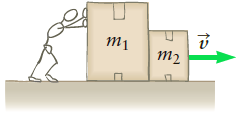
Your moving company runs out of rope and hand trucks, so you are forced to push two crates along the floor as shown in Figure P3.39. The crates are moving at constant velocity, their masses are m1- 45 kg and m2- 22 kg, and the coefficients of kinetic friction between both crates and the floor are
You are given the job of moving a refrigerator of mass 100 kg across a horizontal floor. The coefficient of static friction between the refrigerator and the floor is 0.45. What is the minimum force that is required to just set the refrigerator into motion?
A car is moving with a velocity of 20 m/s when the brakes are applied and the wheels lock (stop spinning). The car then slides to a stop in 40 m. Find the coefficient of kinetic friction between the tires and the road.
A hockey puck slides with an initial speed of 50 m/s on a large frozen lake. If the coefficient of kinetic friction between the puck and the ice is 0.030, what is the speed of the puck after 10 s?
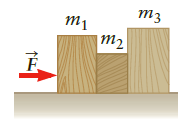
Three blocks rest on a friction less, horizontal table (Fig. P3.36), with m1= 10 kg and m3= 15 kg. A horizontal force F - 110 N is applied to block 1, and the acceleration of all three blocks is found to be 3.3 m/s2. (a) Find m2. (b) What is the magnitude of the normal force between
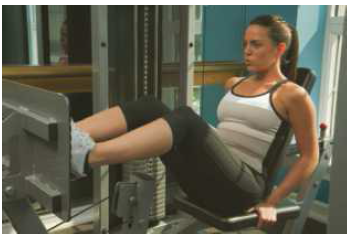
A bodybuilder configures a leg-press apparatus (Fig. P3.35) to a resistance of 1000 N (about 230 lb). She pushes the weight to her full extension and comes to rest. (a) What is the normal force on each of her feet? (b) Assume she is able to move the push-plate of the leg-press machine at
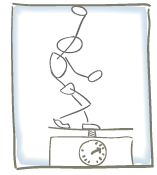
A tall strongman of mass m = 95 kg stands upon a scale while at the same time pushing on the ceiling in a small room. Draw a free-body diagram of the strongman (Fig. P3.34) and indicate all normal forces acting on him. If the scale reads 1100 N (about 240 lb), what is the magnitude of the normal
Your friend’s car has broken down, and you volunteer to push it to the nearest repair shop, which is 2.0 km away. You carefully move your car so that the bumpers of the two cars are in contact and then slowly accelerate to a speed of 2.5 m/s over the course of 1 min. (a) If the mass of your
A grand piano with three legs has a mass of 350 kg and is at rest on a level floor. (a) Draw a free-body diagram for the piano. Show the force of the floor on each leg as a separate force in your diagram. Assume the weight of the piano is distributed equally among the three legs. (b) What
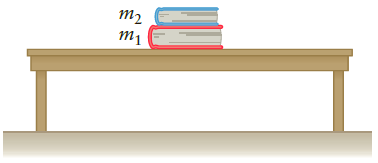
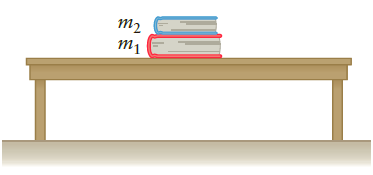
The table in Figure Q3.14 is now sitting in an elevator, with m1- 9.5 kg and m2- 2.5 kg. The normal force between the table and the bottom book is 70 N. Find the magnitude and direction of the elevator€™s acceleration.Figure Q3.14 тp тy
Two books of mass m1= 8.0 kg and m2= 5.5 kg are stacked on a table as shown in Figure Q3.14. Find the normal force acting between the table and the bottom book.Figure Q3.14 тp тy
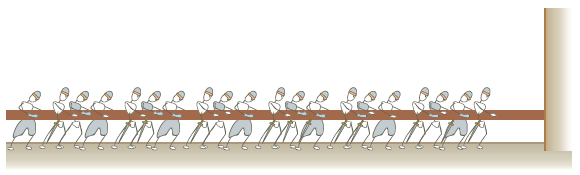
Under siege. Twenty soldiers hold a long beam of heavy wood against a fortified castle door and attempt to push it open (Fig. P3.29). If each soldier is able to supply a forward force on the beam of 80 N, what normal force does the castle door exert on the beam if the door does not open?Figure P3.29
A book of mass 3.0 kg sits at rest on a horizontal table. What is the magnitude of the normal force exerted by the table on the book?
A person has a weight of 500 N. What is her mass?
A motivated mule can accelerate an empty cart of mass m = 180 kg from rest to 5.0 m/s in 10 s. If the cart is loaded with 540 kg of wood, how long will it take the mule to get the cart to 5.0 m/s? Assume a constant acceleration. Also assume the mule exerts the same force as when the cart is empty.
You are a passenger (m = 110 kg) in an airplane that is accelerating on the runway, beginning to take off. The force between your back and your seat is 400 N. Starting from rest, how far does the plane travel as it accelerates to a takeoff speed of 130 m/s?
A rock is dropped from a tree of height 25 m into a lake (depth 5.0 m) below. After entering the water, the rock floats gently down through the water at a constant speed of 1.5 m/s to the bottom of the lake. What is the total elapsed time?
One end of a string is tied to the ceiling of an elevator, and the other end is tied to a rock (Fig. Q3.20). The elevator is moving in such a way that the tension in the string is zero. (a) What is the acceleration of the rock? (b) Explain why you cannot find the velocity of the rock,
An astronaut measures her mass and her weight on Earth and again when she reaches the Moon. Which one of these quantities changes as a result of this trip and which one does not? Explain.
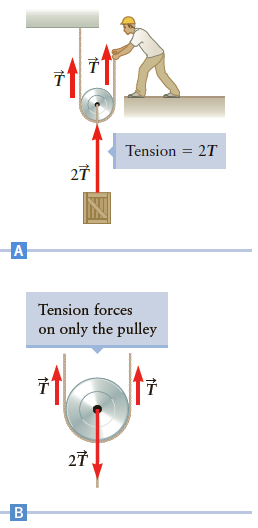
In our discussion of the block and tackle in Figure 3.23, we claimed that when the right end of the string is lifted through a distance L, the body of the pulley is lifted a distance L/2. Give a geometric argument to prove this claim.Figure 3.23 Tension = 2T 27 Tension forces on only the pulley 27
Imagine a skydiver who waits a long time before opening her parachute. For simplicity, assume she moves along a straight line. (a) In what direction is the skydiver moving (what is the direction of her velocity) just before she opens her parachute? (b) Suppose that when she finally opens her
Imagine that you are a passenger on the International Space Station. While on the station, you are “weightless” and so is everything else, including wrenches and furniture. Even though everything appears weightless, explain why mass still matters. Why does it still take longer for a given force
Devise a block-and-tackle arrangement that amplifies the applied force by a factor of three.
Give an example of motion in which the acceleration and the velocity are in opposite directions.
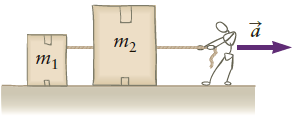
You work for a moving company and are given the job of pulling two large boxes of mass m1= 120 kg and m2= 290 kg using ropes as shown in Figure P3.63. You pull very hard, and the boxes are accelerating with a - 0.22 m/s2. What is the tension in each rope? Assume there is no friction between the
A car of mass 1200 kg is lowered onto a junk pile at the end of the cable of a large crane. If the car is accelerating downward at 0.20 m/s2, what is the tension in the cable?
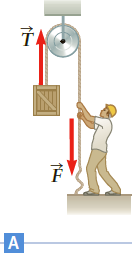
A crate of mass 55 kg is attached to one end of a string, and the other end of the string runs over a pulley and is held by a person as in Figure 3.22A. If the person pulls with a force of 85 N, what is the crate€™s acceleration?Figure 3.22A A
A cable attached to a block of mass 12 kg pulls the block along a horizontal floor at a constant velocity. If the tension in the cable is 5.0 N, what is the coefficient of kinetic friction between the block and the floor?
You are standing across the street from a tall building when the top of the building (h = 80 m) is hit by lightning and a brick is knocked loose. You see the lightning strike and immediately see that the brick will fall to hit a person standing at the base of the building. You then run toward the
Showing 4600 - 4700
of 4913
First
36
37
38
39
40
41
42
43
44
45
46
47
48
49
50
Step by Step Answers

 Get 50% OFF
Claim Now
Get 50% OFF
Claim Now