New Semester
Started
Get
50% OFF
Study Help!
--h --m --s
Claim Now
Question Answers
Textbooks
Find textbooks, questions and answers
Oops, something went wrong!
Change your search query and then try again
S
Books
FREE
Study Help
Expert Questions
Accounting
General Management
Mathematics
Finance
Organizational Behaviour
Law
Physics
Operating System
Management Leadership
Sociology
Programming
Marketing
Database
Computer Network
Economics
Textbooks Solutions
Accounting
Managerial Accounting
Management Leadership
Cost Accounting
Statistics
Business Law
Corporate Finance
Finance
Economics
Auditing
Tutors
Online Tutors
Find a Tutor
Hire a Tutor
Become a Tutor
AI Tutor
AI Study Planner
NEW
Sell Books
Search
Search
Sign In
Register
study help
sciences
college physics reasoning
College Physics Reasoning and Relationships 2nd edition Nicholas Giordano - Solutions
An electron is traveling through a region of space in which the electric field is along the +x direction and has a magnitude of 2000 N/C. What is the acceleration of the electron? Give both the magnitude and direction of a(vector).
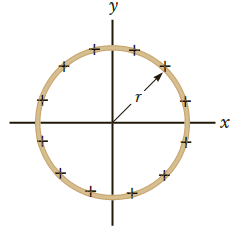
A circular ring of radius 25 cm and total charge 500 µC is centered at the origin as shown in Figure P17.40. If the charge is distributed uniformly around the ring, what is the electric field at the origin?Figure P17.40 -x-
A point charge with q1 = +2.5 C is located at x = -3.0 m, y = 0, and a second point charge with q2 = +4.0 C is at x = +1.0 m, y = +2.0 m. What are the components of the electric field at x = +1.0 m, y = 0?
A point particle with charge q = 4.5 µC is placed on the x axis at x = -10 cm and a second particle of charge Q = 6.7 µC is placed on the x axis at x = +25 cm. (a) Determine the x and y components of the electric field due to this arrangement of charges at the point (x, y) = (10, 10) (the
A point particle with charge q = 4.5 µC is placed on the x axis at x = -10 cm. A second particle of charge Q is now placed on the x axis at x = +25 cm, and it is found that the electric field at the origin is zero. Find Q.
Find the electric field a distance of 1.0 nm from an electron. Is this field directed toward or away from the electron?
What is the magnitude of the electric field at a distance of 1.5 m from a point charge with Q = 3.5 C?
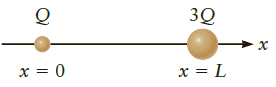
Objects of charge q1 = Q and q2 = 3Q are located on the x axis as shown in Figure P17.34.? (a) Suppose a third object of unknown charge q3 is now placed someplace on the x axis. Where should the third object be placed so that the net electric force on that object is zero? Assume q3 is placed
Two point charges are a distance L apart, and the electric force exerted by one charge on the other is FE. The charges are then moved farther apart, and the electric force between them decreases to FE/9. What is the new separation between the charges?
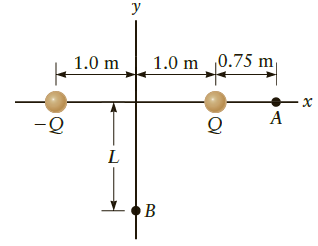
Consider again the dipole in Figure P17.31 with Q = 3.3 ?C. A point particle of charge 6.9 ?C is placed at location B, and the magnitude of the electric force on this particle is found to be 0.035 N. Find L. Figure P17.31 ? y 1.0 m 1.0 m 0.75 m A -2 L B
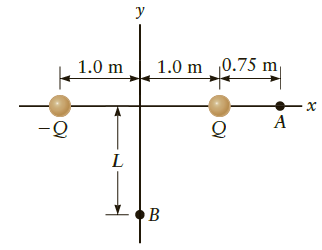
An electric dipole is situated as shown in Figure P17.31, and the dipole charges are ±Q, with Q = 3.3 µC. A point particle with charge q is now placed at location A as shown in the figure. If the force on the particle is 2.5 N and is directed toward the origin, find q.Figure P17.31 y
A helium nucleus contains two protons. What is the approximate magnitude of the electric force between these two protons? Is this force attractive or repulsive? The radius of this nucleus is about 1.0 × 10⁻¹⁵ m. Assume the protons are point particles.
The mass of a typical car is m = 1000 kg, so its weight on the Earth’s surface is mg = 9800 N. Suppose you have two containers, one with N electrons and another with N protons. These two containers are placed a distance 10 m apart, and the electric force between them is equal to the weight of the
You are on vacation in an alternate universe where nearly all the laws of physics are the same as in your home universe, but you notice that the charge on an electron in the alternate universe is -0.9999e and the charge on a proton is +e. Consider now two spheres of copper, each with mass 1.0
Consider an electron and a proton separated by a distance of 1.0 nm. (a) What is the magnitude of the gravitational force between them? (b) What is the magnitude of the electric force between them? (c) How would the ratio of these gravitational and electric forces change if the
A point charge q1 = -1.5 C is at the origin, and a second point charge q2 = +5.0 C is at the point x = 1.2 m, y = 2.5 m. (a) Find the x and y coordinates of the position at which an electron would be in equilibrium. (b) Find the x and y coordinates of the position at which a proton would
Particles of charge Q and 3Q are placed on the x axis at x = -L and x = +L, respectively. A third particle of charge q is placed on the x axis, and it is found that the total electric force on this particle is zero. Where is the particle?
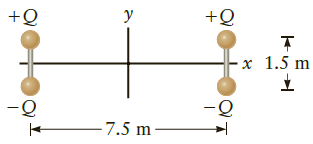
Two electric dipoles with charges +Q, where Q = 5.0 C, are arranged as shown in Figure P17.24. The charges??Q on the left are attached to each other by a rigid rod, and the two charges on the right are also rigidly attached to each other. Find the electric force between the two dipoles. Figure
You are given two boxes containing electrons, with 1.0 g of electrons in each box. If these boxes are separated by 1.0 m, estimate the gravitational force between them. Compare this force with the electric force found on page 547 using Equation 17.3. Assume the boxes are both very small so that you
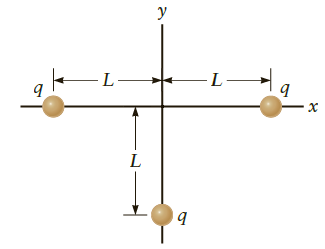
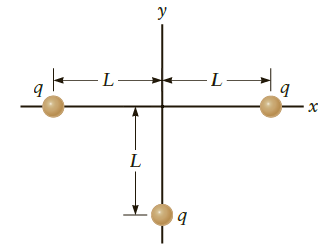
Three charges each with positive charge q are located as in Figure P17.21. What are the magnitude and direction of the force on an electron (charge -e) at the origin? Figure P17.21 ? y -L- -L- L
Three charges with q = +7.5 ?C are located as shown in Figure P17.21, with L = 25 cm.? (a) What are the magnitude and direction of the total electric force on the charge at the bottom?? (b) What are the magnitude and direction of the total electric force on the charge at the right? Figure P17.21 ?
The particles in Problem 19 are conducting and are brought together so that they touch. Charge then moves between the two particles so as to make the excess charge on the two particles equal. If the particles are then separated by a distance of 5.3 mm, what is the magnitude of the electric force
Two small particles have charges Q1 = +3.0 µC and Q2 = -5.0 µC. If the magnitude of the electric force between the particles is 120 N, what is the distance between the particles?
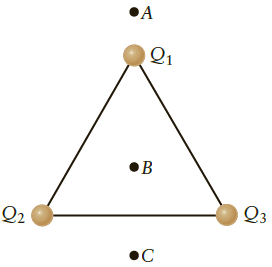
Three point charges Q1, Q2, and Q3 are arranged to form an equilateral triangle as shown in Figure P17.18. The signs of these charges are unknown. (a) A test charge Qtest is now placed at point A. If the net force on the test charge is zero, what might be the signs of Q1, Q2, and Q3? Pick the
Two point charges are separated by a distance r. If the separation is reduced by a factor of 1.5, by what factor does the electric force between them change?
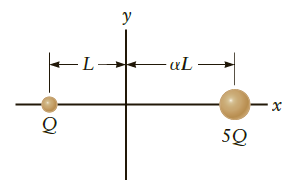
Two particles of charge Q and 5Q are located as shown in Figure P17.16. When a third charge is placed at the origin, it is found that the force on it is zero. Find a. Figure P17.16 ? y - L· -«L – x. 5Q
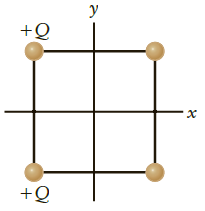
Four point particles are located at the corners of a square (Fig. P17.15). The two particles on the left each carry a charge +Q. If the electric field at the center of the square is directed to the right (along the +x axis), what might the charges on the particles on the right be?Figure
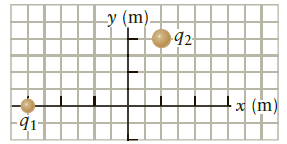
A point charge with q1 = +2.5 C is located at x = -3.0 m, y = 0, and a second point charge with q2 = +4.0 C is at x = +1.0 m, y = +2.0 m (Fig. P17.14).? (a) What is the force exerted by q1 on q2?? (b) What is the force exerted by q2 on q1? Figure P17.14 ? -у (m). 42 ·지 (m) -41-
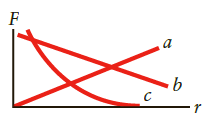
Which graph in Figure P17.13, a, b, or c, best describes how the electric force between two point charges varies with their separation, r?Figure P17.13 F a
Two particles with electric charges Q and -3Q are separated by a distance of 1.2 m. (a) If Q = 4.5 C, what is the electric force between the two particles? (b) If Q = -4.5 C, how does the answer change?
What is the magnitude of the electric force between an electron and a proton in a hydrogen atom? Assume they are point charges separated by 0.050 nm.
What is the magnitude of the electric force between two electrons separated by a distance of 0.10 nm (approximately the diameter of an atom)?
What is the net charge on a Ca+2 ion?
The charge per unit length on a glass rod is λ = -7.5 μC/m. If the rod is 2.5 m long, how many excess electrons are on the rod?
The excess charge per unit area on a surface is σ = -5.0 × 10⁻³ C/m2. How many excess electrons are there on a 1.0-mm2 piece of the surface?
Approximately how many electrons are in a penny? Assume the penny is made of pure copper.
What is the net charge on an object that has an excess of 45 electrons?
Approximately how many electrons are in your body? What is the total charge of these electrons?
A piece of amber is charged by rubbing with a piece of fur. If the net excess charge on the fur is +8.5 nC (+8.5 × 10⁻⁹ C), how many electrons were added to the amber?
You are given a container with 5.0 g of hydrogen atoms. What is the total charge on the electrons in the container? What is the total charge on the protons?
What is the total charge of 1 mole of electrons?
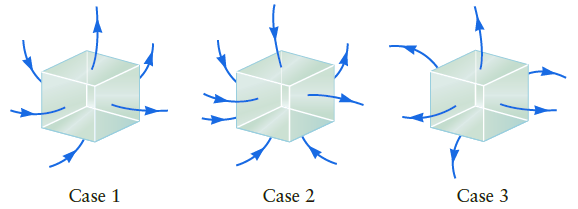
Figure Q17.20 shows the electric field lines outside several Gaussian surfaces, but does not show the electric charges inside. In which cases is the net charge inside positive, negative, or perhaps zero? How do you know?Figure Q17.20 Case 1 Case 2 Case 3
An ion is released from rest in a region in which the electric field is nonzero. If the ion moves in a direction anti parallel (opposite) to the direction of the electric field, is the ion positively charged or negatively charged?
The electron was not discovered until well after the laws of electricity were determined. Protons were discovered even later, so scientists such as Coulomb and Gauss did not know that electric charge is quantized. How do you think that affected their way of thinking about electric phenomena?
A charge is placed inside a partially inflated balloon. If the balloon is then further inflated to a larger volume and the associated surface area increases, does the electric flux though the balloon’s surface change? Why or why not?
Explain why it is desirable that a test charge used to measure a field be small in comparison with the field’s source charge.
Describe at least three ways in which Coulomb’s law is similar to Newton’s law of gravitation. Discuss at least two ways in which the two laws are different.
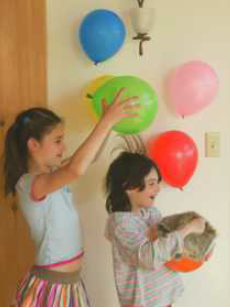
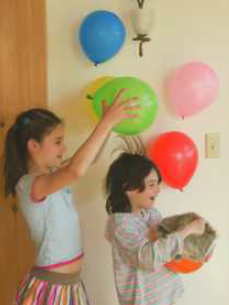
Explain why the child’s hair in Figure Q17.8 is “standing on end.”Figure Q17.8
In Example 17.1, we mentioned that there are approximately 4 × 10¹⁴ atoms in a dust particle of mass 1 ng. Estimate this number for yourself.
When two objects (such as a glass rod and a silk cloth) are rubbed together, electrons can be transferred from one to the other. Can protons also be transferred? Explain why or why not.
Under normal atmospheric conditions, the surface of the Earth is negatively charged. What is the direction of the electric field near the Earth’s surface?
Two point particles, each of charge Q1, are located on the x axis at x = ± L. Another particle having charge Q2 is now placed at the origin. (a) Show that the total force on charge Q2 is zero. (b) Suppose Q2 is now moved a very small distance away from the origin, along the x axis. What
The end of a charged rubber rod will attract small pellets of Styrofoam that, having made contact with the rod, will move violently away from it. Describe why that happens.
The children in Figure Q17.8 are rubbing balloons on their hair and then placing the balloons on the wall and ceiling. If the rubbing process puts excess electrons on the balloon, how does the balloon then stay attached to the ceiling or wall?Figure Q17.8
If a charged point particle is repelled from a glass rod that has been charged by rubbing with silk, what is the sign of the charge on the particle?
Explain how two objects can be attracted due to an electric force, even when both objects have zero net charge.
Explain how two objects can be attracted due to an electric force, even when one object has zero net charge.
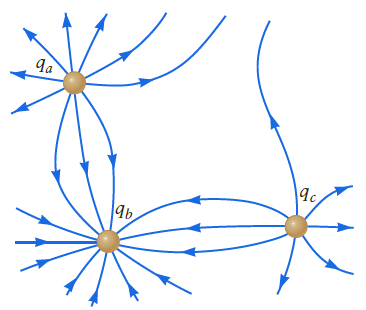
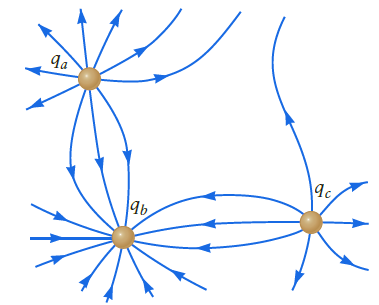
Consider the charges qa, qb, and qc in Figure Q17.3. In terms of magnitude, which charge is the greatest? Which is the smallest? How do you know?Figure Q17.3 Яa 9c Яь.
Determine the sign of each charge qa, qb, and qc in Figure Q17.3. Яa 9b
Suppose (hypothetically) that two electric field lines crossed. What would that mean for a test charge placed at the crossing point? Use your result to explain why two electric field lines cannot cross.
When a glass rod is rubbed with silk, the rod becomes positively charged, but when a rubber rod is rubbed with fur, the rubber becomes negatively charged. Suppose you have a charged object but don’t know whether its charge is positive or negative. Explain how you could use a glass rod and piece
Consider a steel rod of diameter 1.0 cm and length 1.0 m. If the temperature of this rod is increased by 25°C, its length will change by a certain amount ΔL. The length can also be changed by applying a tensile force. How much force must be applied to change the length of the rod by the same
A carpenter constructs a house of length 15 m out of wood. If the temperature changes by 5.0°C, how much does the length of the house change?
The author’s gold wedding ring is stuck on his finger, and he must remove it. The ring has an inside diameter of 2.00 cm, but the knuckle of the finger in question has a diameter of 2.05 cm. The author decides to get the ring off by heating it. How much must the temperature of the ring be
When the metal cap on a glass jar is stuck (i.e., when the cap is too tight to open), it sometimes helps to hold the jar and cap under hot water. Explain why.
The pressure amplitude associated with a very faint sound is about 2 × 10⁻⁵ Pa. (a) If this is the difference in pressure between the two sides of your eardrum, what is the approximate force on your eardrum? (b) How does this force compare to the weight of a mosquito (approximate mass
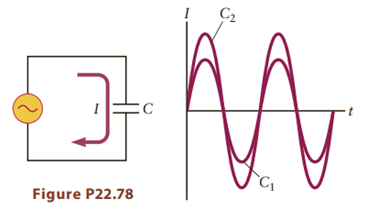
Figure P22.78 (left) shows an AC voltage source connected to a capacitor. The graphs on the right show the current as a function of time for two values of the capacitance C1 and C2. What is the approximate ratio C2/C1. C2 Figure P22.78
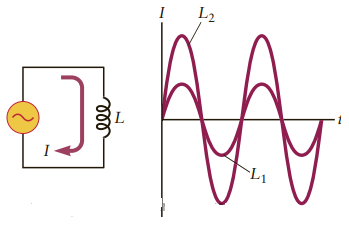
Figure P22.79 (left) shows an AC voltage source connected to an inductor. The graphs on the right show the current as a function of time for two values of the inductance L1 and L2. What is the approximate ratio L2/L1?Figure P22.79 L2 `L1
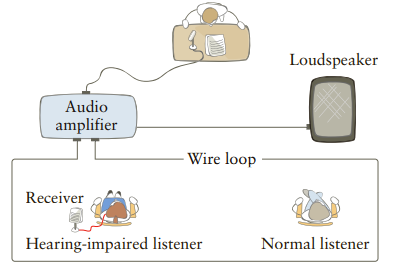
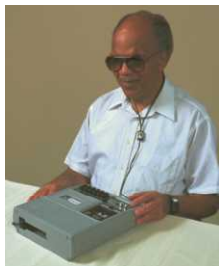
Magnetic induction is used to provide real-time amplifi cation to hearing-impaired audience members. The system taps into the amplifi cation system already in place in the room and routes the amplifi ed electric waveforms from the speaker’s microphone into two wire loops around the perimeter of
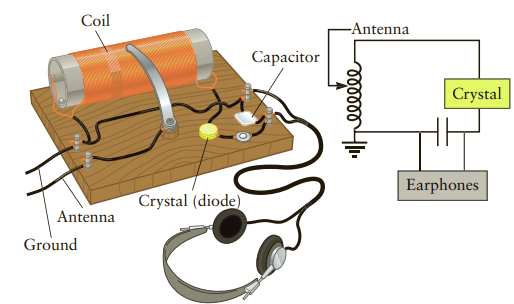
The phenomenon of resonance makes it possible to listen to AM broadcasts with a very simple circuit and never need a battery. When a system is driven at its resonant frequency, even if by minute oscillations of current in the antenna, the resulting amplitude can be many times greater than the
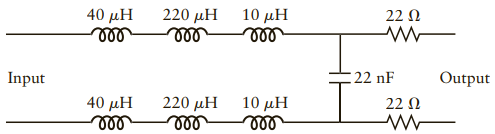
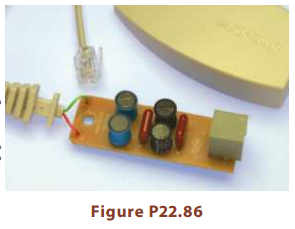
Copper telephone wires were originally designed to carry “commercial speech” using a band of frequencies from 300 Hz to 3400 Hz through a system called the PSTN (Public Switched Telephone Network). The ADSL (Asymmetric Digital Subscriber Line) uses frequencies very much higher than this speech
The power brick for the author’s laptop computer (Fig. 22.30) has the following power specifications: AC 100 V/1.6 A; DC 16.5 V/3.6 A. Here, the numbers following “AC” describe the input to the power brick (from the AC power line) and the numbers following “DC” describe the DC output to
On a hot summer day, an electric fan can make a difference in comfort. The fan does not cool the air, however. In fact, it slightly raises the temperature of the air that it circulates. How is it that a fan can make you cooler?
Consider Joule’s experiment described in Insight 14.1. Assume the mass m = 2.0 kg and the fluid is water with a volume of 1.0 L. What is the increase in the temperature of the water when the mass moves vertically a distance z = 1.0 m?
Metal cookware made from steel or aluminum often has a copper bottom. Why?
Why does a lake freeze first at its surface?
You are a high-precision carpenter and use a high-precision steel ruler. If you want the dimensions of your work to be accurate to 1.0 mm over distances of 15 m, you will have to keep the temperature of your ruler constant to within an uncertainty of ΔT. Find ΔT.
There are many different types of glass; all are composed mainly of SiO2, but the addition of other elements can change the color and other properties substantially. One type of glass, called Pyrex, incorporates small amounts of the element boron, which gives it a very small coeffifificient of
A cup of coffee is initially at a temperature of 70°C and then cools to room temperature. (a) Estimate how much heat flows out of the cup during this time. (b) If this energy were converted to the kinetic energy of a baseball, what would be the speed of the ball?
A potato will bake faster if a nail is stuck through it. Why? Which would make the potato cook faster, an aluminum nail or a steel nail?
You are a blacksmith and have been working with 12 kg of steel. When you are finished shaping it, the steel is at a temperature of 400°C. To cool it off, you drop it into a bucket containing 5.0 kg of water at 50°C. How much of this water is converted to steam? Assume the steel, the water, and
You are a blacksmith and have been working with 12 kg of steel. When you are finished shaping it, the steel is at a temperature of 400°C. To cool it off, you drop it into a bucket containing 5.0 kg of water at 50°C. How much of this water is converted to steam? Assume the steel, the water, and
(a) How much energy is required to evaporate all the water in a swimming pool of area 100 m2 and depth 2.0 m on a typical summer day?(b) The intensity of sunlight is about 1000 W/m2. If all this energy is absorbed by the water in the pool, how long will it take the water to evaporate?
One section of a steel railroad track is 25 m long. If its temperature increases by 25 K during the day, how much does the track expand?
One section of a steel railroad track is 25 m long. If its temperature increases by 25 K during the day, how much does the track expand?
A material of unknown composition with an initial length of 2.0 m is found to expand by 0.33 mm when it is heated by 15 K. What is the coefficient of thermal expansion of this material?
A new cement bridge will be 50 m long. The bridge contains expansion joints, so it will not crack when the temperature changes. Suppose you are the designer of this bridge, and your job is to design the expansion joints. Estimate how much change in length the joints will have to accommodate.
A new cement bridge will be 50 m long. The bridge contains expansion joints, so it will not crack when the temperature changes. Suppose you are the designer of this bridge, and your job is to design the expansion joints. Estimate how much change in length the joints will have to accommodate.
A material of unknown composition with an initial length of 2.0 m is found to expand by 0.33 mm when it is heated by 15 K. What is the coefficient of thermal expansion of this material?
Your swimming pool is square and 5.0 m on a side. It is 3.0 m deep in the morning. If the temperature changes by 20°C during the afternoon, how much does the depth of the water increase?
The Golden Gate Bridge is a famous suspension bridge in San Francisco. The main segment is approximately 1400 m long and is composed of steel. Estimate how much the length of the bridge increases as time passes from morning to afternoon on a typical day.
The Golden Gate Bridge is a famous suspension bridge in San Francisco. The main segment is approximately 1400 m long and is composed of steel. Estimate how much the length of the bridge increases as time passes from morning to afternoon on a typical day.
Your swimming pool is square and 5.0 m on a side. It is 3.0 m deep in the morning. If the temperature changes by 20°C during the afternoon, how much does the depth of the water increase?
A steel building is 120 m tall when the outside temperature is 0°C. How tall is the building on a hot summer day (30°C)? The change in height is small, so express your answer with five significant figures.
A steel building is 120 m tall when the outside temperature is 0°C. How tall is the building on a hot summer day (30°C)? The change in height is small, so express your answer with five significant figures.
You are given the job of designing a bridge that is to be made of concrete slabs that rest on a steel support frame. The total length of the bridge is 300 m, and you want to be sure that the expansion joints are sufficiently large. If the temperature increases by 25°C, what is the difference in
You are given the job of designing a bridge that is to be made of concrete slabs that rest on a steel support frame. The total length of the bridge is 300 m, and you want to be sure that the expansion joints are sufficiently large. If the temperature increases by 25°C, what is the difference in
A blood flow meter uses the Doppler effect to measure the speed of blood. Suppose a sound wave at 80,000 Hz is emitted into a vein where the speed of sound is about 1500 m/s. The wave is Doppler-shifted as it is absorbed by the red blood cells moving toward a stationary receiver. The wave is then
Two adjacent notes in the musical scale used in Western music have fundamental frequencies whose ratio is approximately 1.059. For example, the fundamental frequencies of the notes C-sharp and C have this ratio. The frequency of a note produced by a flute, or any other woodwind instrument, depends
A trumpet at room temperature (25°C) is tuned to play the note middle C, which has a fundamental frequency of 262 Hz. The trumpet is then taken outside, and after a few minutes, it is found that the same note has a frequency of 245 Hz. What is the outside temperature?
Showing 3500 - 3600
of 4913
First
29
30
31
32
33
34
35
36
37
38
39
40
41
42
43
Last
Step by Step Answers

 Get 50% OFF
Claim Now
Get 50% OFF
Claim Now